Call Us
+86 136 6007 9809
Call Us
+86 136 6007 9809

Jul. 17, 2024
Stainless Steel Castle Nuts and Cotter Pins: Slotted Nut Joint Design for OEM Equipment
Stainless steel castle nuts, castellated nuts and slotted hex nuts are mechanical fastening components used in assemblies that require a positive means of restricting nut rotation.
Unlike prevailing-torque lock nuts, which generate rotational resistance through thread interference, castle nut fastening systems use a separate mechanical locking element.
A typical assembly includes a slotted or castellated nut, a compatible cross-drilled bolt or pin, and a cotter pin—also known as a split pin in many international markets.
When installed correctly, the cotter pin passes through the drilled hole and engages the nut slots, creating a physical obstruction to further nut rotation.
This design may be considered for selected industrial machinery, agricultural equipment, mechanical linkages, marine equipment and customer-approved vehicle components.
However, reliable performance depends on more than simply installing a pin through a nut.
The thread specification, nut geometry, drilled-hole position, tightening procedure, cotter pin dimensions and joint loading must be evaluated together.
For mechanical and design engineers, the primary questions involve positive locking, joint loading and dimensional compatibility.
For manufacturing engineers and production managers, the focus is correct slot alignment, pin installation, inspection accessibility and consistent assembly.
For procurement and supplier development teams, the challenge is sourcing a complete set of compatible components rather than treating the nut and cotter pin as independent catalog items.
This guide explains how to specify and evaluate stainless steel castle nut fastening systems for industrial OEM applications.
Juxin Fasteners supplies industrial fastening components and welcomes drawing-based inquiries for stainless steel slotted nuts, castellated nuts and related threaded parts.
What Are Stainless Steel Castle Nuts?
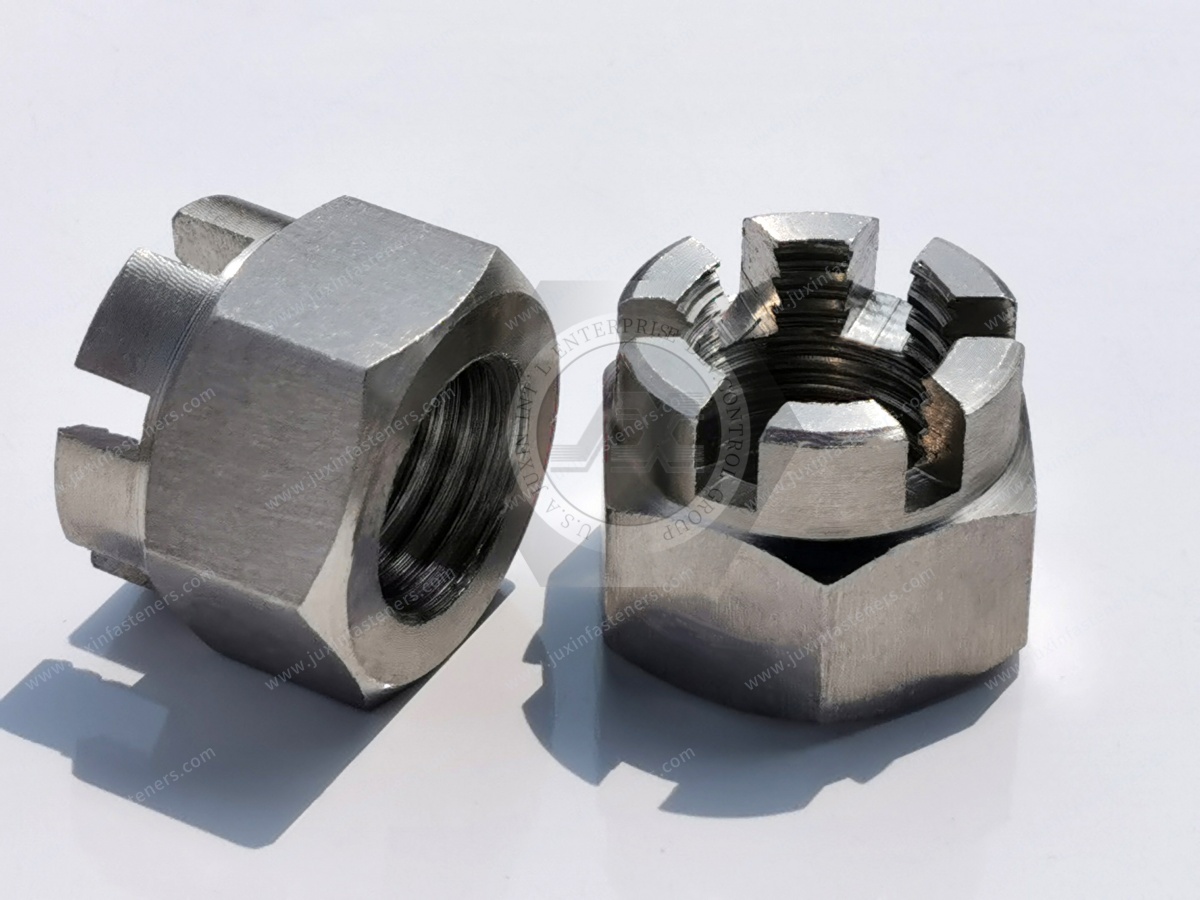
A castle nut is a threaded nut with raised sections and slots that allow a cotter pin to engage the nut.
The castellated geometry provides a mechanical interface for positive locking.
A slotted hex nut has slots formed in the nut body and may have a different external profile.
Both designs can be used with a compatible cross-drilled threaded member and cotter pin.
Common International Terminology
Stainless steel castle nut
Stainless steel castellated nut
Stainless steel slotted hex nut
Slotted locknut
Cotter pin locking nut
Split pin locking nut
Positive locking nut
Terminology Note
The terms castle nut, castellated nut and slotted nut are sometimes used loosely in commercial listings.
However, the actual geometry and dimensional standard should be confirmed before ordering.
How Does a Castle Nut and Cotter Pin Assembly Work?
A typical assembly includes three essential components.
Slotted or Castellated Nut
The nut provides the threaded connection and slots for engagement with the pin.
Cross-Drilled Bolt or Pin
The mating threaded member contains a transverse hole positioned to align with the nut slots at the approved installation condition.
Cotter Pin / Split Pin
The pin passes through the transverse hole and is retained by bending or securing its legs according to the approved procedure.
Mechanical Locking Principle
Once correctly installed, the pin physically obstructs substantial rotation of the nut relative to the drilled member.
This is different from a friction-based prevailing-torque locking mechanism.
Important Limitation
The pin does not automatically preserve the original clamp load.
If the joint settles, relaxes or loses preload, the nut may remain mechanically retained while the joint becomes less tightly clamped.
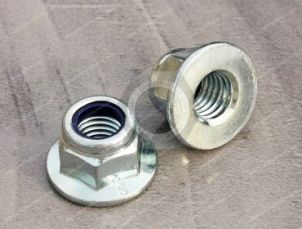
Castle Nuts vs. Prevailing-Torque Lock Nuts
These products use fundamentally different locking mechanisms.
| Selection factor | Castle or slotted nut with cotter pin | Prevailing-torque lock nut |
|---|---|---|
| Locking principle | Physical obstruction through a separate pin | Rotational resistance from a locking feature |
| Mating component | Requires an appropriately drilled threaded member | Usually uses a compatible threaded fastener without a cross-hole |
| Assembly operation | Tighten, align slots, insert and secure pin | Tighten according to approved procedure |
| Additional component | Cotter pin or specified retaining pin | Usually integrated locking feature |
| Service procedure | Pin removal and replacement requirements | Reuse depends on locking design and specification |
| Main design concern | Hole position, slot alignment and pin retention | Prevailing torque, thread interference and locking performance |
Engineering Insight
Neither design is universally superior.
The correct choice depends on the joint function, required preload, available installation space, maintenance requirements and approved engineering specification.
Positive Locking Does Not Mean Constant Preload
A common misunderstanding is that a castle nut automatically maintains joint clamping force because the cotter pin prevents rotation.
These are separate functions.
Positive Mechanical Locking
The pin restricts relative nut rotation.
Preload
Preload is the tensile force introduced into a fastener during tightening.
Clamp Load
Clamp load is the compressive force developed between the joined components.
Potential Joint Changes
Even with the nut mechanically retained, the assembly may experience:
Surface embedding
Material relaxation
Wear
Thermal expansion and contraction
Joint settlement
Component deformation
Engineering Recommendation
For preloaded joints, evaluate the required clamp load independently of the locking mechanism.
For joints designed to retain a pin or permit controlled articulation, the tightening and clearance requirements may be different.
Important Distinction
A castle nut used on a pivot or retained pin may not be intended to clamp the connected parts rigidly.
The intended joint function must be established before defining the tightening procedure.
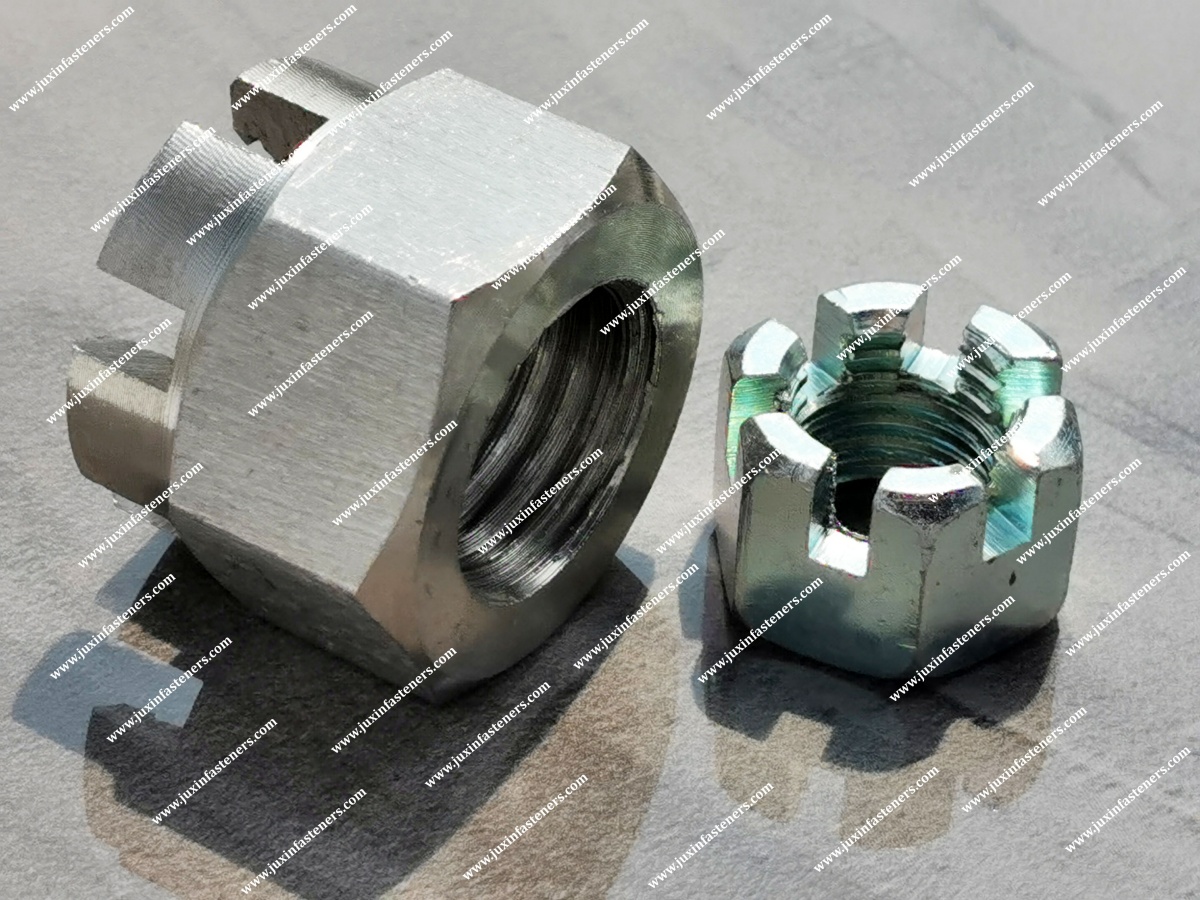
Castellated Nuts vs. Slotted Hex Nuts
Castellated and slotted nuts have related functions but different geometries.
Castellated Nuts
These nuts have raised castellations with slots between them.
Slotted Hex Nuts
These nuts have slots cut into the hexagonal nut body.
Selection Considerations
Nut height
Slot depth
Slot width
Across-flats dimension
Thread designation
Bearing surface
Available installation space
Drilled-hole position
Engineering Recommendation
Use the specified product standard or customer drawing rather than substituting one geometry for another based on the commercial name.
Cross-Drilled Bolt and Nut Compatibility
The mating bolt or pin is a critical part of the assembly.
A standard undrilled bolt cannot provide the intended cotter pin locking function.
Thread Compatibility
Confirm:
Thread system
Nominal diameter
Pitch
Tolerance
Thread engagement
Cross-Hole Geometry
Confirm:
Hole diameter
Hole position
Hole orientation where specified
Edge distances and remaining section
Burr control
Surface condition
Hole Position
The drilled hole must align with the nut slots at an approved installation condition.
Mechanical Considerations
Cross-drilling removes material from the threaded member.
The hole location may influence the member's mechanical capacity and fatigue behavior.
Engineering Recommendation
Do not add a transverse hole to an existing high-strength or safety-critical bolt without engineering approval.
Metric and Inch Thread Systems
Castle nuts may be specified in metric or inch-series thread systems.
Metric
ISO metric threads use metric nominal dimensions and pitch designations.
UNC and UNF
Unified coarse and fine threads are separate inch-series systems.
BSW and BSF
Whitworth and British Standard Fine threads are distinct legacy systems.
Critical Compatibility Rule
Metric, UNC, UNF, BSW and BSF threads are not directly interchangeable.
Approximate diameter conversions are references only and do not establish fit.
Castle Nut Slot Alignment and Tightening Procedure
Slot alignment is one of the most important assembly considerations.
The nut must reach an approved installation condition while providing a usable path for the cotter pin.
Typical Assembly Sequence
Verify the nut, drilled bolt and cotter pin specifications.
Inspect the threads, cross-hole and nut slots.
Assemble the joint according to the approved procedure.
Establish the required tightening condition.
Align a suitable nut slot with the transverse hole within the permitted installation limits.
Insert the specified cotter pin.
Secure the pin legs according to the approved installation method.
Inspect the final assembly.
Important Tightening Rule
Do not loosen or over-tighten the nut merely to align a slot unless the approved procedure explicitly permits that action.
Some applications may specify tightening to a defined condition and advancing to the next available slot within an allowed range.
Others may use different installation methods.
Engineering Recommendation
The approved drawing or service procedure must govern the tightening and slot-alignment method.
Why Slot Alignment Matters
A castle nut can be dimensionally correct yet difficult to install if the drilled-hole position and nut geometry are not coordinated.
Potential Problems
Hole obscured by the nut
Slot not aligned at the required tightening condition
Insufficient thread engagement
Cotter pin interference
Incorrect pin bending clearance
Information Gain: Design for Assembly
Engineers should evaluate slot alignment during the initial design stage rather than relying on production operators to compensate for dimensional mismatches.
Cotter Pin Size and Installation Requirements
The cotter pin must be compatible with both the transverse hole and the nut slots.
Important Dimensions
Nominal pin diameter
Pin length
Hole diameter
Slot width
Available bending clearance
Material Selection
The pin material should be compatible with the operating environment and assembly requirements.
Installation Condition
The pin must be inserted and secured according to the approved procedure.
Important Limitation
A cotter pin that fits through the hole is not automatically the correct pin.
An undersized pin may provide excessive movement, while an oversized pin may be difficult to install or may damage the mating components.
Engineering Recommendation
Specify the cotter pin together with the nut and drilled member.
Cotter Pin Retention and Inspection
Correct pin installation is essential to the positive locking function.
Inspection Considerations
Correct pin size
Full insertion
Correct engagement through the cross-hole
Proper leg retention
No prohibited interference
No visible installation damage
Production Manager's Perspective
A missing, incorrectly installed or damaged cotter pin can defeat the intended locking function even when the nut itself is dimensionally acceptable.
Practical Manufacturing Recommendation
For repetitive production, establish a clear visual or functional inspection criterion for the installed pin.
Material Selection for Stainless Steel Castle Nuts
Material selection should reflect the actual environment and mechanical requirements.
304 Stainless Steel
304 may be considered for general industrial equipment and selected outdoor applications where its corrosion resistance is appropriate.
316 Stainless Steel
316 generally offers improved resistance to certain localized corrosion mechanisms compared with 304.
It may be considered for more demanding moisture or chloride exposure.
18-8 Stainless Steel
18-8 is a broad commercial designation associated with certain chromium-nickel stainless steels.
It should not automatically be treated as a complete material specification equivalent to every 304 product.
Mechanical Properties
The nut material must satisfy the approved mechanical requirements.
Important Limitation
Stainless steel grade alone does not establish nut strength, joint capacity or suitability for safety-critical service.
Corrosion Considerations for Nut, Bolt and Pin Assemblies
A castle nut fastening system contains several interacting components.
Corrosion performance should therefore be evaluated at the assembly level.
Potential Exposure Conditions
Rainwater
Humidity
Road salt
Coastal environments
Industrial chemicals
Cleaning agents
Crevice Corrosion
Moisture trapped between the nut, bolt and pin may create localized corrosion conditions.
Galvanic Compatibility
Mixed-metal combinations may require galvanic-corrosion evaluation.
Surface Finishing
Passivation or other appropriate surface treatments may be considered where specified.
Important Limitation
Surface finishing does not eliminate the need for suitable material selection and joint design.
Stainless Steel Thread Galling
Stainless steel threaded assemblies may experience galling under certain installation conditions.
Galling involves adhesive surface damage during relative sliding.
Potential Contributing Factors
Material pairing
Thread surface condition
Installation speed
High contact pressure
Misalignment
Inappropriate lubrication
Engineering Recommendation
Where galling is a concern, evaluate the actual nut-and-bolt combination under representative assembly conditions.
Any lubricant or coating must be reviewed for its effect on friction and tightening behavior.
Industrial Machinery Applications
Castle nuts and cotter pins may be considered for selected industrial mechanical assemblies.
Potential applications include:
Mechanical linkages
Retained pivot assemblies
Adjustable mechanical connections
Agricultural machinery components
Selected equipment accessories
Engineering Priorities
Joint function
Mechanical loading
Thread engagement
Pin retention
Inspection access
Maintenance requirements
Important Limitation
Rotating machinery and highly loaded mechanical joints may require specific engineering qualification.
A castle nut should not be selected solely because it provides positive locking.
Agricultural and Off-Road Equipment
Agricultural and off-road equipment may contain joints exposed to vibration, moisture and dirt.
Potential applications include:
Selected mechanical linkages
Auxiliary pivot assemblies
Equipment accessories
Customer-approved retention mechanisms
Engineering Priorities
Environmental exposure
Mechanical loading
Maintenance accessibility
Cotter pin retention
Service procedures
Important Limitation
Steering, braking and other safety-related equipment connections require approved specifications and qualification.
Automotive Mechanical Linkages
Certain vehicle designs use castellated or slotted nuts in conjunction with cotter pins.
However, the suitability of a particular stainless steel material or nut design depends on the approved vehicle specification.
Potential Application Areas
Customer-approved mechanical linkages
Specified pivot retention assemblies
Approved serviceable mechanical connections
Important Safety Limitation
Suspension, steering, wheel retention, braking and primary chassis connections require application-specific engineering approval.
A generic stainless steel castle nut must not be substituted into these assemblies based solely on thread size or corrosion resistance.
Marine and Coastal Equipment
Selected marine equipment may use mechanically retained threaded connections.
Potential applications include:
Auxiliary mechanical linkages
Marine instrumentation
Equipment accessories
Customer-approved retention assemblies
Material Considerations
316 may offer improved resistance to certain localized corrosion conditions compared with 304.
However, crevice conditions, seawater exposure and joint geometry must be evaluated.
Important Limitation
316 stainless steel is not universally suitable for every seawater or offshore application.
Construction and Outdoor Equipment
Potential applications include:
Outdoor mechanical equipment
Serviceable retention mechanisms
Instrumentation hardware
Nonstructural mechanical accessories
Important Structural Limitation
Bridges, primary structural steel connections, curtain wall retention and other safety-critical building systems require appropriate engineering codes and approvals.
A standard castle nut should not be substituted without qualification.
Food-Processing and Laboratory Equipment
Selected non-product-contact mechanical equipment may require corrosion-resistant fasteners.
Potential applications include:
Equipment accessories
Mechanical linkages
Serviceable retention assemblies
Engineering Priorities
Cleaning compatibility
Corrosion resistance
Inspection access
Pin retention
Contamination control
Important Limitation
A cotter pin's exposed legs and retention geometry may create cleaning or contamination concerns.
Stainless steel material alone does not establish hygienic design or medical-device compliance.
Aerospace and Other High-Reliability Applications
Certain aerospace assemblies use positive mechanical locking methods.
However, aerospace fastening systems are governed by specific approved materials, part numbers, manufacturing controls and qualification requirements.
Important Limitation
General industrial stainless steel castle nuts are not automatically suitable for aircraft structures, flight controls or landing gear.
Such applications require the exact approved aerospace specification and supplier qualification.
International Standards for Castle Nuts and Cotter Pins
Relevant standards depend on the exact nut geometry, thread system and pin configuration.
DIN 935
DIN 935 is associated with castellated hexagon nuts.
The applicable edition and dimensions should be confirmed.
DIN 937
DIN 937 is associated with slotted thin hexagon nuts.
The exact product geometry should be checked before substitution.
ISO 7035
ISO 7035 specifies dimensions for certain slotted hexagon nuts.
Its scope should be checked against the required product.
ISO 1234
ISO 1234 specifies requirements for split pins.
ISO 3506-2
ISO 3506-2 covers specified mechanical properties of corrosion-resistant stainless steel nuts.
Important Standards Principle
A dimensional standard does not automatically establish material suitability, mechanical strength or application approval.
OEM Drawings
Customer drawings may additionally define:
Nut height
Slot geometry
Thread tolerance
Material
Mechanical properties
Surface condition
Drilled-hole position
Cotter pin dimensions
Inspection criteria
Custom Stainless Steel Castle Nuts and Slotted Nuts
Some industrial OEM applications require dimensions or configurations that differ from standard products.
Potential custom requirements include:
Special nut height
Nonstandard slot geometry
Custom thread designation
Specific bearing surface
Defined material
Surface treatment
Critical tolerances
Engineering Review
Custom projects should consider:
Mating bolt geometry
Drilled-hole position
Cotter pin compatibility
Joint loading
Mechanical requirements
Manufacturing feasibility
Inspection requirements
Commercial Review
Sample requirements, MOQ, tooling considerations and delivery schedules should be confirmed during quotation.
Important Limitation
Custom manufacturing does not automatically establish suitability for regulated or safety-critical applications.
Any required testing and customer approval must be completed separately.
Production Assembly and Quality Control
For repetitive OEM assembly, the castle nut system should be evaluated for manufacturing consistency.
Potential Production Risks
Incorrect nut selection
Thread mismatch
Poor slot alignment
Missing cotter pin
Incorrect pin size
Improper pin bending
Cross-hole burrs
Thread damage
Galling
Recommended Process Controls
Depending on the application:
Component identification
Incoming dimensional inspection
Approved tightening procedure
Slot alignment verification
Pin insertion verification
Final visual inspection
Production Manager's Perspective
A fastening system that requires manual slot alignment and pin bending may have different assembly-time requirements from an integrated prevailing-torque locking nut.
The choice should consider both functional reliability and production efficiency.
Information Gain: Total Assembly Cost
When comparing locking methods, consider more than the nut unit price.
Relevant costs may include:
Nut manufacturing
Cross-drilling
Cotter pin procurement
Installation labor
Tooling
Inspection
Rework
Maintenance
Supplier Qualification for Stainless Steel Castle Nuts
Supplier development teams should evaluate the complete fastening system.
Product Definition
Confirm the correct nut geometry and approved drawing.
Material
Specify the required stainless steel grade and mechanical properties.
Thread Compatibility
Confirm the mating bolt thread system and tolerance.
Pin Compatibility
Define the required cotter pin and drilled-hole dimensions.
Functional Requirements
Identify the joint function, loading and locking requirements.
Inspection
Define critical dimensions and final acceptance criteria.
Change Control
Review changes to nut geometry, material, hole position or pin specification against customer approval requirements.
Commercial Evaluation
Review:
Sample quantity
MOQ
Production volume
Packaging
Delivery schedule
Supply continuity
Total assembly cost
Supplier Development Insight
A replacement castle nut may match the nominal thread size yet fail to align with the existing drilled bolt at the approved tightening condition.
This is why complete assembly compatibility must be evaluated before supplier approval.
Preparing a Stainless Steel Castle Nut RFQ
A complete RFQ should identify all relevant components.
Nut Information
Approved drawing or standard
Castellated or slotted geometry
Thread designation
Dimensions
Material and mechanical requirements
Mating Bolt or Pin
Drawing or standard
Thread specification
Cross-hole diameter
Cross-hole position
Material and mechanical requirements
Cotter Pin
Drawing or standard
Nominal diameter
Length
Material
Installation requirements
Joint Information
Joint function
Mechanical loading
Tightening procedure
Operating environment
Maintenance requirements
Quality and Commercial Information
Inspection criteria
Sample quantity
Annual demand
Production quantity
Packaging
Target delivery schedule
Practical Procurement Recommendation
For replacement projects, provide the existing approved nut, bolt and cotter pin specifications.
This helps identify slot alignment and compatibility risks before a proposed alternative is evaluated.
Frequently Asked Questions
What is the difference between a castle nut and a slotted nut?
Both can provide a slot interface for a cotter pin, but their external geometries and applicable standards may differ.
Do castle nuts require drilled bolts?
A conventional cotter pin locking arrangement requires a compatible cross-hole in the mating threaded member.
Can a castle nut prevent all loosening?
No. The pin restricts rotation but does not prevent every form of clamp-load loss.
Are stainless steel castle nuts suitable for automotive applications?
They may be suitable where specifically approved, but safety-critical connections require application-specific qualification.
Can 316 stainless steel castle nuts be used in marine equipment?
Potentially, depending on chloride exposure, crevice conditions, mechanical requirements and the approved design.
Can castle nuts be reused?
Reuse of the nut depends on its condition and the approved specification.
Cotter pins are generally treated as replacement items during disassembly unless an approved procedure states otherwise.
Can a castle nut replace a nylon insert lock nut?
Not automatically. The locking mechanisms, mating components and installation requirements differ.
Can a metric castle nut replace a UNC or UNF castle nut?
No. The thread systems are not directly interchangeable.
What should an OEM buyer provide when sourcing castle nuts?
The approved nut drawing, mating bolt or pin specification, drilled-hole dimensions, cotter pin specification, material, joint requirements and purchasing quantities.
Juxin Fasteners: Stainless Steel Castle Nuts and OEM Fastening Components
Juxin Fasteners supplies industrial fastening components and welcomes drawing-based inquiries for stainless steel castle nuts, slotted nuts and related fastening systems.
Relevant product categories include:
Stainless steel castellated nuts
Stainless steel slotted hex nuts
Stainless steel hex nuts
Stainless steel bolts
Stainless steel threaded components
Custom OEM fasteners
Specific materials, dimensions, cotter pin configurations, samples, MOQ, inspection requirements and delivery schedules are subject to technical and commercial confirmation.
Request a Stainless Steel Castle Nut and Cotter Pin RFQ
Are you sourcing stainless steel castle nuts, slotted nuts or cotter pin locking components for industrial machinery,
agricultural equipment, marine accessories or customer-approved mechanical assemblies?
Do you need to qualify a replacement supplier or evaluate a custom nut configuration for an existing drilled bolt?
Juxin Fasteners welcomes inquiries from design engineers, mechanical engineers, structural engineers, manufacturing engineers,
production managers, purchasing specialists, procurement managers, supplier development teams and supply chain managers.
For technical review and quotation, please provide:
Nut drawing or standard + thread designation + nut dimensions and slot geometry + material and mechanical-property requirements
+ mating bolt or pin drawing + cross-hole dimensions and location + cotter pin specification + joint loading
+ tightening procedure + operating environment + inspection criteria + sample quantity + annual demand + production quantity + packaging requirements + target delivery schedule.
For replacement projects, identify the existing approved parts and any proposed changes.
Company: Juxin Fasteners
Website: https://www.juxinfasteners.com/
Email: info@juxinfasteners.com
Send your stainless steel castle nut drawings and OEM RFQ to Juxin Fasteners for technical review and quotation.
Contact Us
Tel.:
+86 020 8621 0320
+86 020 3121 6067
E-mail:
Technical Support:
Navigation
SEND INQUIREY