
Call Us
+86 136 6007 9809
Call Us
+86 136 6007 9809

Oct. 23, 2023
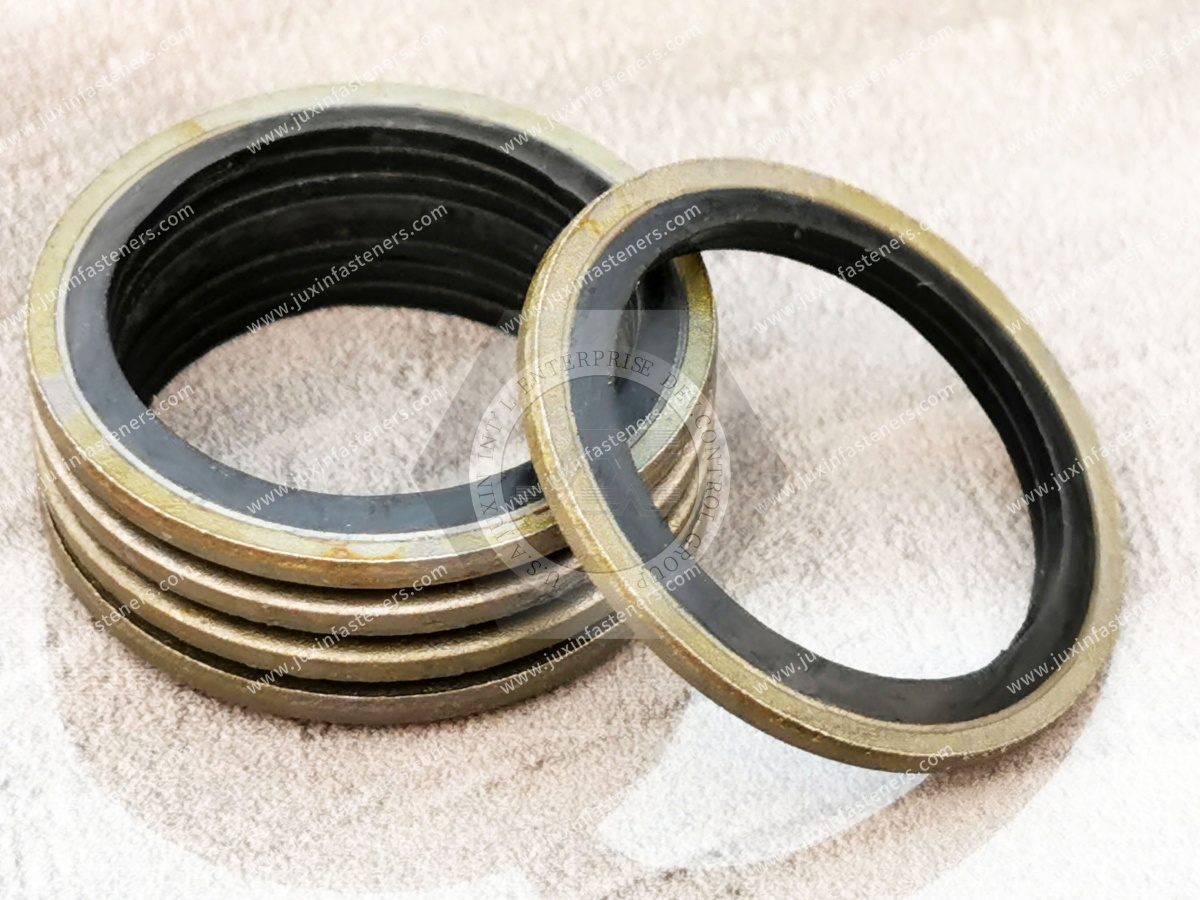
Bonded sealing washers—commonly called bonded seals, metal-bonded sealing washers, hydraulic sealing washers,
and in some markets Dowty-type seals—combine a rigid metal washer with a bonded elastomer sealing element.
They are commonly used around bolts, plugs, hydraulic fittings, threaded ports and other connections where the assembly must provide both mechanical support and fluid sealing.
Unlike a conventional flat washer, a bonded sealing washer is selected as part of the sealing system.
Its performance depends on the metal carrier, elastomer compound, mating surfaces, fluid compatibility, temperature, pressure, connection geometry and installation conditions.
For engineers and sourcing teams, this distinction is important: selecting a bonded seal by thread size alone may not be sufficient.
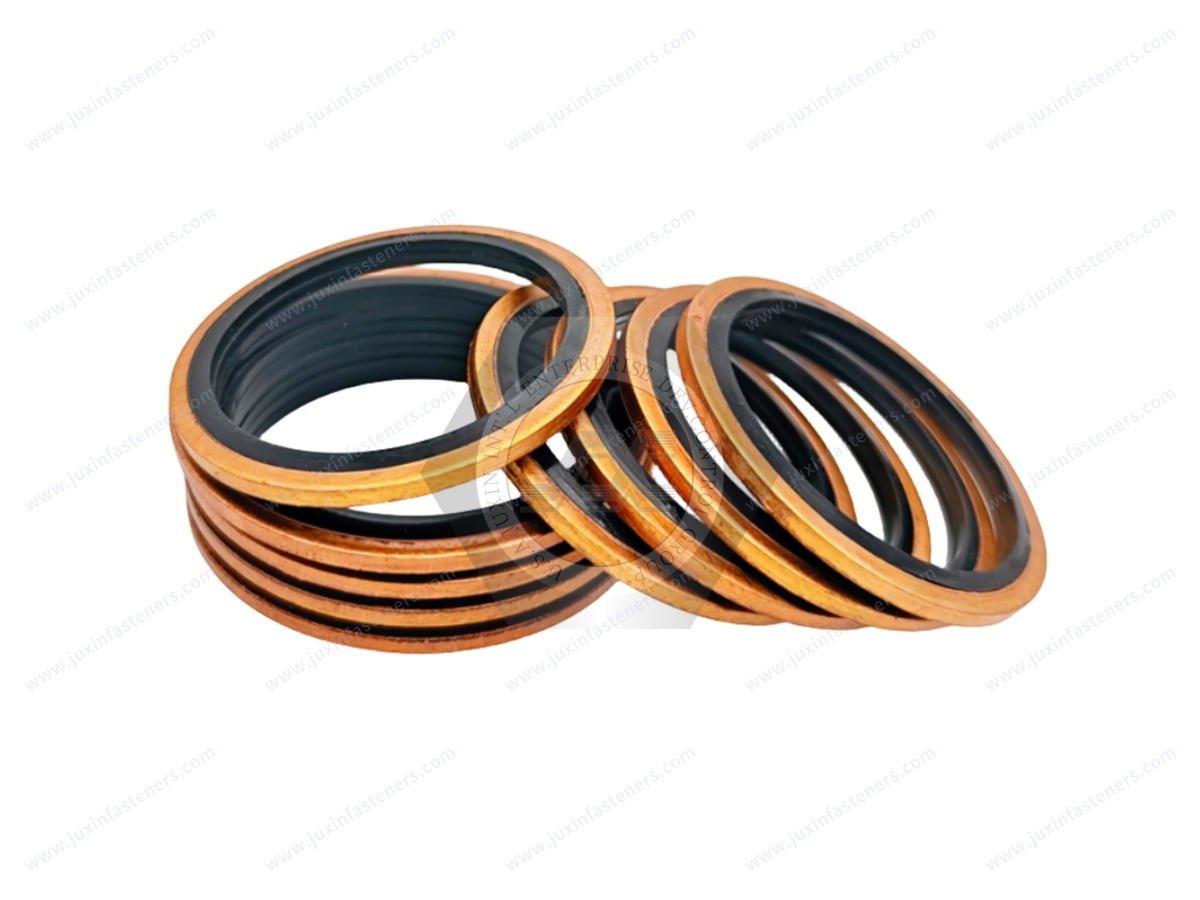
A typical bonded seal consists of two functional elements:
Metal outer ring — provides structural support and limits excessive deformation of the sealing element.
Elastomer inner sealing ring — compresses between the fastener or fitting and mating surface to create the seal.
During tightening, the elastomer deforms within the designed sealing area while the metal portion supports the assembly.
The objective is not simply to apply maximum compression. The objective is to achieve controlled elastomer compression within the actual joint geometry.
This makes bonded sealing washers useful for hydraulic and industrial fluid connections where a separate machined O-ring groove may not be practical.
These components should not be treated as interchangeable.
A standard flat washer is primarily intended to:
distribute load;
protect the mating surface;
provide bearing area;
support the bolted joint.
A conventional metal flat washer should not automatically be considered a pressure seal.
A bonded sealing washer combines:
a structural metal carrier;
an elastomer sealing element;
localized sealing around the fastener or port.
It is often selected where sealing is required directly beneath a bolt head, plug, fitting or similar interface.
An O-ring normally works within a specifically designed groove or gland. Its performance depends heavily on gland geometry, squeeze, stretch, material and operating conditions.
Engineering decision: Do not replace an O-ring with a bonded seal—or a bonded seal with a flat washer—without reviewing the joint and sealing geometry.
Metal selection should be based on mechanical requirements, corrosion environment, mating materials and customer specifications.
Common options may include:
Suitable for many general industrial and hydraulic applications when combined with an appropriate protective finish.
Selection should consider:
corrosion exposure;
coating compatibility;
storage conditions;
operating environment.
Stainless steel bonded sealing washers may be specified where improved corrosion resistance is required.
The exact stainless grade should be defined by the drawing, environmental requirements or customer specification rather than assumed from the product name alone.
The elastomer is one of the most important specification variables in a bonded sealing washer.
NBR is widely considered for applications involving many petroleum-based oils and hydraulic fluids.
However, suitability depends on the actual:
fluid formulation;
operating temperature;
exposure duration;
pressure cycle;
elastomer grade.
FKM may be considered where higher temperature capability or different chemical resistance is required.
It should not automatically be described as the “better” material. The correct choice depends on the media and operating conditions.
Depending on the project, an OEM may specify:
elastomer family;
hardness range;
temperature requirements;
chemical compatibility;
color;
regulatory requirements;
specific material documentation.
For critical sealing applications, fluid compatibility should be confirmed rather than inferred from a generic material name.
Bonded seals are commonly associated with:
hydraulic fittings;
threaded ports;
hydraulic plugs;
valve assemblies;
manifolds;
pumps;
cylinders;
mobile hydraulic equipment.
These applications often require compact sealing around a threaded connection without introducing a separate gasket arrangement.
Potential applications include selected:
fluid connections;
lubrication systems;
hydraulic assemblies;
transmission-related equipment;
pumps and valve interfaces.
Automotive use should always be evaluated against the specific OEM drawing, fluid, temperature, pressure and validation requirements.
Bonded sealing washers may be used in:
machine tools;
industrial pumps;
compressors;
lubrication systems;
hydraulic power units;
manufacturing equipment.
Mobile equipment frequently combines vibration, hydraulic pressure, outdoor exposure and repeated operating cycles.
This makes material selection and sealing-interface control especially important.
Depending on the fluid and operating conditions, bonded sealing washers can also be considered for selected connections in:
power equipment;
process machinery;
valves;
pumps;
fluid distribution equipment.
The seal compound must be evaluated against the actual media rather than selected solely by industry.
One of the most useful questions during bonded-seal selection is not:
“What thread size do you need?”
It is:
“Where is the sealing interface in the assembled joint?”
A thread designation describes the threaded connection, but it does not completely define the sealing interface.
Engineers should review:
fastener or fitting geometry;
washer inside and outside diameters;
available bearing surface;
mating-surface condition;
elastomer contact area;
operating pressure;
fluid media;
temperature;
installation method.
Two connections using the same nominal thread can have different sealing requirements.
A bonded seal cannot compensate for every surface defect.
Potential leakage paths may be created by:
deep scratches;
burrs;
damaged spotfaces;
excessive surface irregularity;
contamination;
corrosion;
misalignment.
For this reason, sealing performance should be evaluated as a system interaction between the bonded washer and the mating components, not as an isolated property of the washer.
A common sourcing mistake is to request a “high-pressure bonded washer” without defining the rest of the operating conditions.
Pressure capability can depend on:
seal geometry;
metal-ring dimensions;
elastomer compound;
hardness;
temperature;
fluid;
surface finish;
joint design;
installation compression;
pressure cycling.
JUXIN FASTENERS therefore does not recommend treating a universal pressure rating as applicable to every bonded-seal configuration.
For OEM applications, the required operating conditions should be reviewed together with the drawing or mating-component information.
The washer must seat correctly against the intended sealing surface. Special-profile bonded seals may have orientation requirements.
Before assembly, check for:
burrs;
scratches;
contamination;
corrosion;
deformation.
Sharp edges, incorrect handling or unsuitable installation geometry can cut or displace the sealing element.
Excessive tightening should not be assumed to improve sealing.
The correct tightening condition depends on the complete joint design, including:
fastener;
thread;
mating material;
bearing surface;
seal geometry;
lubrication condition;
OEM specification.
Reuse should never be assumed automatically.
After disassembly, the elastomer may have experienced:
compression set;
cutting;
extrusion;
chemical degradation;
thermal aging;
permanent deformation.
For applications where leakage has significant safety or maintenance consequences,
replacement requirements should follow the equipment manufacturer's validation and maintenance procedure.
For design engineers and sourcing teams, a practical selection sequence is:
Identify whether the seal is used beneath a:
bolt head;
threaded plug;
hydraulic fitting;
adapter;
port connection;
custom component.
Specify the actual operating medium rather than simply stating “oil” or “chemical.”
Provide:
normal operating temperature;
temperature extremes;
working pressure;
pressure cycling;
external corrosion exposure.
Evaluate NBR, FKM or another specified compound against the actual media and temperature conditions.
Choose carbon steel, stainless steel or another specified material based on structural and environmental requirements.
Review:
nominal thread or fastener size;
inside diameter;
outside diameter;
thickness;
sealing-lip profile;
available seating area.
For critical OEM applications, validation should be performed in the actual joint configuration and operating environment.
This approach is more reliable than purchasing a bonded seal solely from a nominal metric size.
Standard metric bonded seals are suitable for many common hydraulic and industrial connections.
A custom solution may be appropriate when the project requires:
non-standard dimensions;
special metal thickness;
special elastomer compound;
different hardness requirements;
unusual operating media;
stainless steel construction;
customer-specific geometry;
drawing-controlled manufacturing.
For OEM programs, a drawing or existing sample can significantly reduce ambiguity during supplier evaluation.
A technically complete RFQ helps prevent repeated clarification and incorrect quotations.
Where available, provide:
drawing or dimensional specification;
nominal thread or fastener size;
washer ID, OD and thickness;
metal material;
metal finish;
elastomer material;
elastomer hardness requirement;
operating fluid;
operating temperature range;
working pressure or system requirements;
annual usage;
order quantity;
sample requirements;
inspection or documentation requirements.
If the existing part is being replaced, provide the current sample, drawing or mating-component information where possible.
For procurement engineers and supplier-development teams, unit price should not be the only sourcing criterion.
Important supplier-evaluation factors include:
dimensional consistency;
metal and elastomer material control;
bonding quality;
sealing-profile consistency;
surface-finish control;
lot traceability when required;
drawing revision control;
inspection capability;
sample validation support;
repeat production consistency.
A bonded sealing washer is inexpensive compared with many hydraulic assemblies, but a leakage failure can create substantially higher maintenance, warranty and downtime costs.
Engineers evaluating bonded sealing washers may also need related components such as:
custom washers and stamped components for non-standard bearing and sealing geometries;
stainless steel washers for corrosion-resistant assemblies;
industrial fasteners for machinery and equipment;
custom fasteners manufactured to customer drawings;
OEM fastening solutions for application-specific assemblies.
These components should be selected as part of the complete joint rather than as unrelated individual hardware.
JUXIN FASTENERS supports global OEM, industrial and equipment-manufacturing customers with standard and custom fastening components.
For bonded sealing washer projects, we can review customer requirements based on:
drawings;
dimensions;
metal material;
elastomer specification;
operating environment;
application requirements;
sample requirements;
production quantities.
Our objective is not simply to supply a washer by nominal size. For engineering-driven projects,
the goal is to help customers define the correct component specification before production and purchasing decisions are finalized.
For a faster technical and commercial review, send your drawing, specification, sample information or required dimensions together with the application conditions.
Email: info@juxinfasteners.com
Website: www.juxinfasteners.com
JUXIN FASTENERS provides bonded sealing washers, custom washers and fastening solutions for OEM and industrial applications.
Previous: Sealing Washers: Types & Selection
 MORE NEWS
Sep. 27, 2026
Sep. 27, 2026
Sep. 27, 2026
Contact Us
Tel.:
+86 020 8621 0320
+86 020 3121 6067
E-mail:
Technical Support:
Navigation
SEND INQUIREY