
Call Us
+86 136 6007 9809
Call Us
+86 136 6007 9809

Oct. 22, 2023
Pipe clamps are mechanical fastening components used to support, locate, secure, guide or restrain pipes and tubes within equipment and piping assemblies.
Depending on the application, a pipe fastening system may include pipe clamps, pipe straps, U-bolts, mounting brackets, bolts, nuts, washers, lock nuts, threaded rods and custom stamped metal components.
However, the term "pipe clamp" covers many different products. A clamp designed to attach tubing to a machine frame performs a very different function from a mechanical pipe coupling designed to join two pipe sections.
For engineers and procurement teams, the first step is therefore not simply to search for a "pipe clamp." It is to define what the clamp must do in the assembly.
JUXIN FASTENERS supplies standard and custom fastening components for industrial pipe and tube support applications, including U-bolts, bolts, nuts,
washers, stamped metal clamps, mounting hardware and made-to-drawing fasteners for OEM equipment manufacturers.
A pipe clamp is a fastening or support component that interfaces with a pipe or tube to control its position relative to equipment, a bracket, a frame or another structural element.
Depending on the design, a pipe clamp may be intended to:
support the weight of a pipe or tube;
attach tubing to equipment;
control lateral movement;
maintain routing and spacing;
reduce unwanted movement;
provide a defined restraint point;
separate the pipe from the supporting structure;
support vibration-management requirements.
Some specialized clamp-type products are also used for pipe joining or repair, but these should not be confused with ordinary pipe support clamps and mounting fasteners.
Terminology is important when sourcing internationally.
Pipe clamp is the broadest and most commercially useful term. It can refer to many types of components used to support, secure or restrain pipe and tubing.
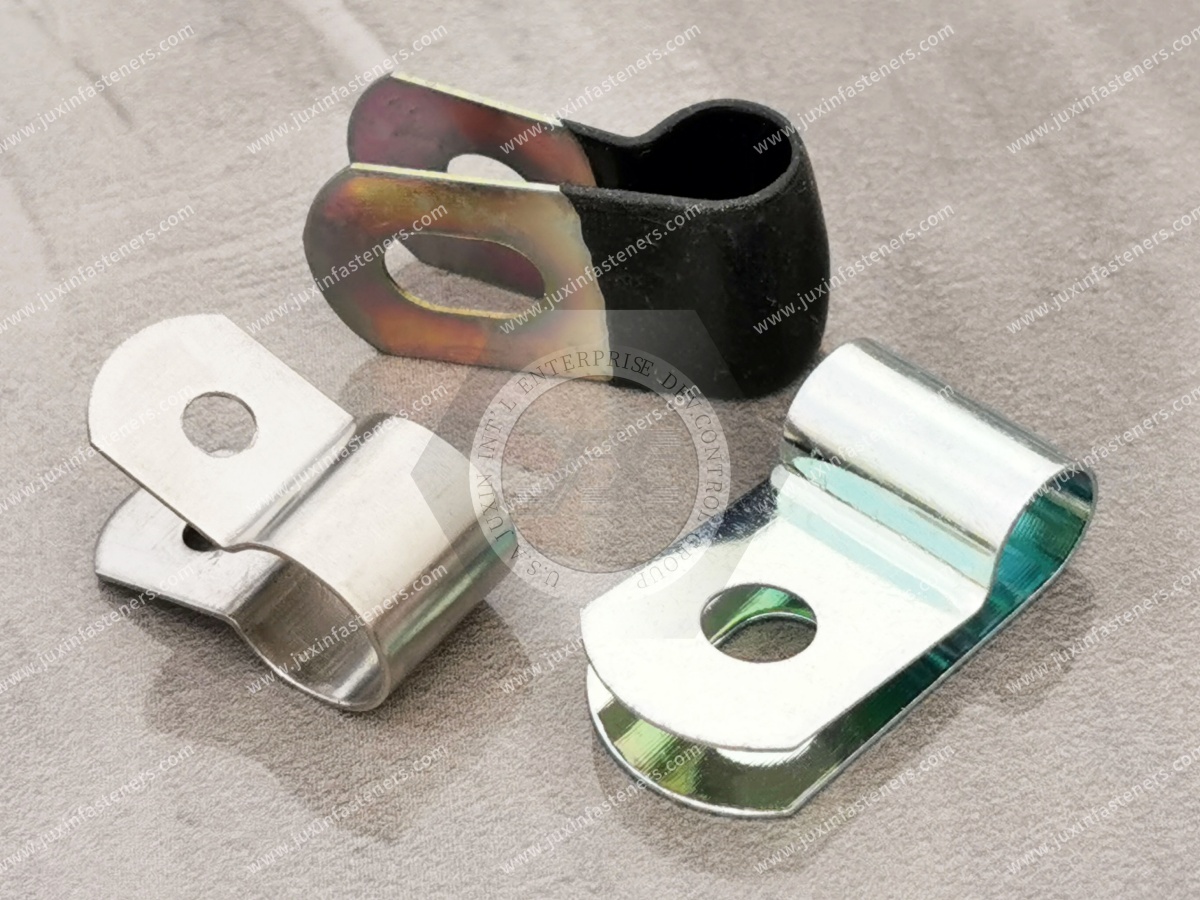
A pipe strap is typically a formed metal component that partially or fully surrounds a pipe and attaches it to a wall, panel, frame or supporting surface.
Common configurations include one-hole and two-hole mounting designs.
"Pipe hoop" may be understood in some markets, but it is not always the preferred engineering or procurement term for industrial pipe support hardware.
Depending on the actual geometry, buyers may instead search for:
pipe clamp;
pipe support clamp;
pipe strap;
tube clamp;
U-bolt clamp;
mounting clamp;
pipe hanger;
pipe bracket.
For RFQs, a drawing or photograph is often more reliable than terminology alone.
This distinction prevents a common specification error.
A pipe support clamp primarily controls the mechanical position of a pipe.
A pipe coupling is primarily intended to connect pipe sections.
These are different engineering functions.
A support clamp should therefore not automatically be described as creating a leak-tight pipe connection.
Where pressure containment or fluid sealing is required, the complete piping joint, coupling, seal and applicable system requirements must be specified separately.
There is no single universal pipe clamp design. The correct geometry depends on the pipe, support structure, loads and operating environment.
U-bolts are among the most recognizable pipe support fasteners.
A typical system consists of:
a U-shaped threaded fastener;
nuts;
washers where specified;
a support bracket, plate or structural member.
U-bolts can be used to position or restrain pipe and tubing against a supporting structure.
Important selection variables include:
inside width;
rod diameter;
leg length;
thread specification;
pipe outside diameter;
material;
surface finish;
mounting geometry.
The nominal pipe designation alone may not provide enough information to manufacture the correct U-bolt.
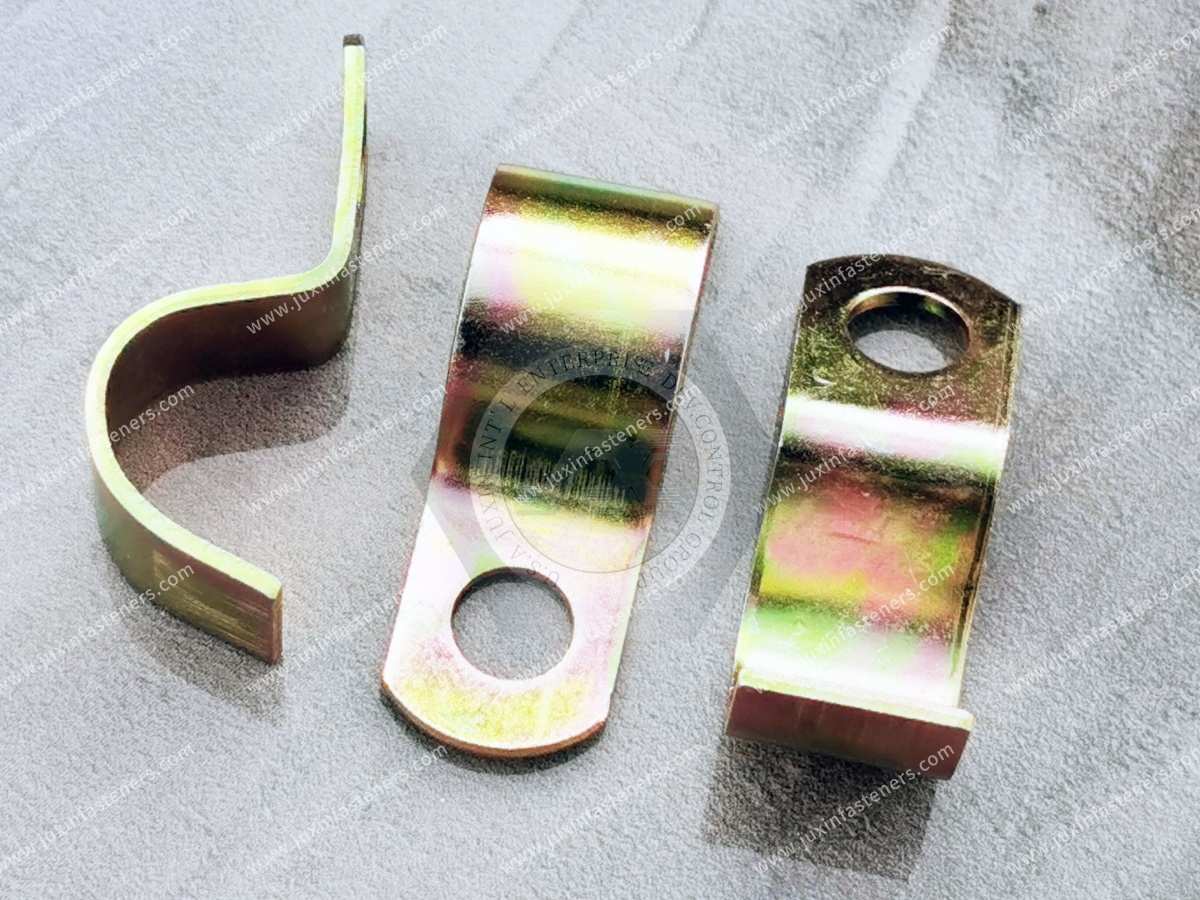
Two-hole pipe straps typically wrap partially around the pipe or tube and are secured through mounting holes on both sides.
They can be useful for:
equipment panels;
enclosures;
machinery;
HVAC assemblies;
electrical equipment;
light industrial tube routing.
The mounting fasteners and substrate must be selected together with the strap.
One-hole straps provide a compact attachment method where installation space is limited or the application does not require a two-point mounting arrangement.
Engineering evaluation should still consider:
expected load direction;
pipe movement;
mounting substrate;
vibration;
installation orientation.
A one-hole strap should not automatically be substituted for a two-hole design simply because both fit the same pipe diameter.
Split clamps use two or more clamp sections around the pipe or tube.
This architecture can be useful when:
installation around an existing line is required;
complete circumferential support is desirable;
the assembly needs to be removable;
the clamp geometry must integrate with a mounting bracket.
Fasteners used to close the clamp become part of the clamp's load path and should be specified accordingly.
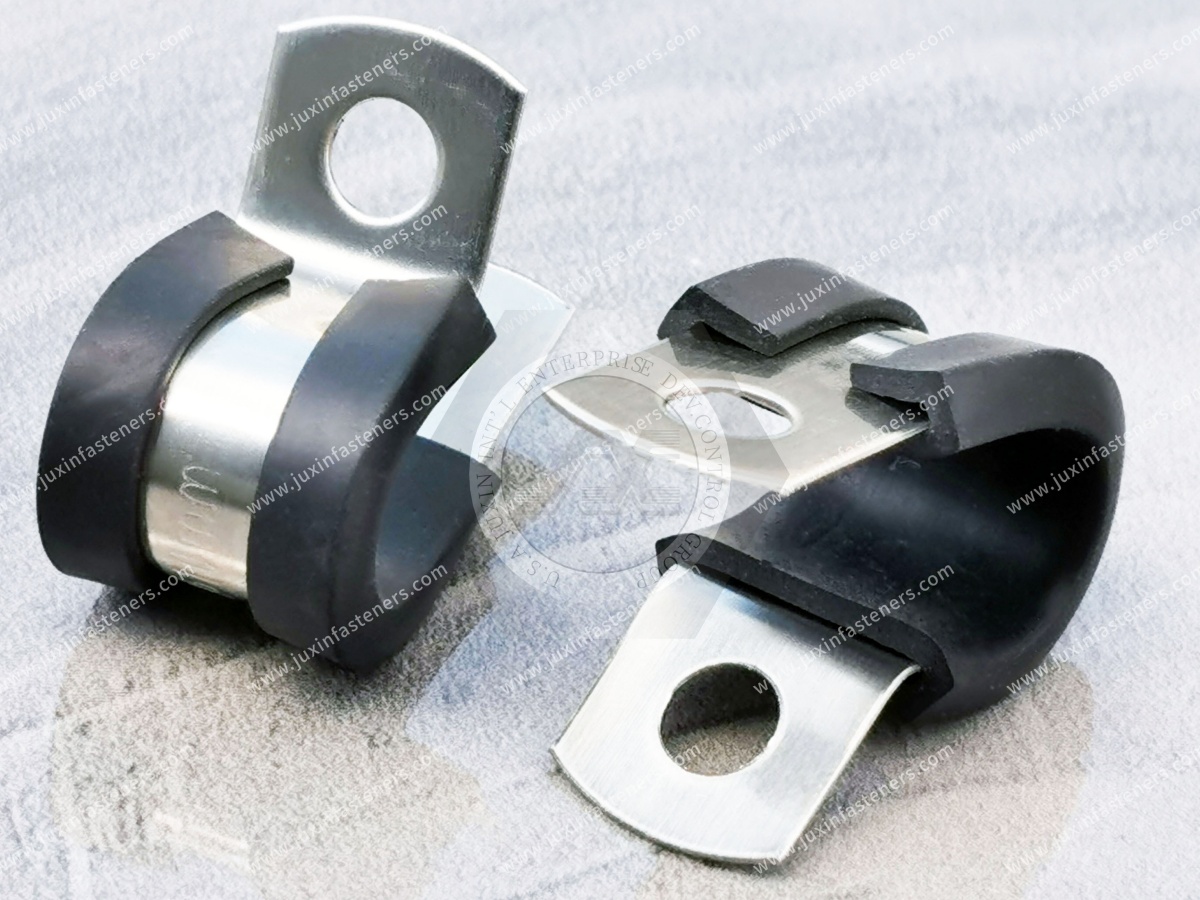
Some clamps incorporate a polymer, elastomeric or other nonmetallic interface between the metal clamp and the pipe.
Depending on the validated design, this interface may help with objectives such as:
separating metal surfaces;
reducing direct metal-to-metal contact;
accommodating certain vibration conditions;
protecting tube surfaces;
managing noise transmission.
The cushion material must be selected for the actual operating environment.
Temperature, fluids, oils, chemicals, UV exposure and long-term material behavior may all matter.
A cushioned clamp should therefore not automatically be assumed to provide universal vibration isolation.
Standard catalog clamps do not fit every OEM assembly.
Custom pipe clamps can be produced from sheet material using processes such as:
blanking;
punching;
bending;
forming;
stamping.
Drawing-based designs may incorporate:
custom hole patterns;
mounting tabs;
asymmetric geometry;
formed ribs;
special radii;
locating features;
application-specific interfaces.
For OEM applications, the clamp should be designed as part of the surrounding equipment rather than as an isolated commodity.
Before selecting a clamp, determine what the pipe support point is supposed to accomplish.
Ask:
Is the pipe being supported, located, guided or restrained?
These functions are not identical.
A support point intended primarily to carry weight may require a different design from a restraint intended to control movement.
The required function affects:
clamp geometry;
fastener selection;
bracket design;
material;
installation method;
allowable movement.
A common procurement mistake is specifying only a nominal pipe size.
For clamp manufacturing, engineers may need to provide the actual outside diameter of the pipe or tube.
Why?
Because the clamp interfaces with the outside surface.
Different piping and tubing systems may use different dimensional conventions, and a nominal designation does not always communicate the physical OD required by the clamp manufacturer.
For a custom clamp RFQ, provide:
actual pipe/tube outside diameter;
clamp width;
material thickness;
mounting-hole dimensions;
hole spacing;
required clearances;
relevant tolerances.
A pipe clamp is only one component in the fastening system.
A typical load path may be:
pipe → clamp → bolt/U-bolt → bracket → equipment frame or structure
This means selecting a stronger clamp alone does not necessarily create a stronger support system.
Engineers should evaluate:
clamp body;
bolts;
nuts;
washers;
bracket;
mounting surface;
surrounding structure.
The weakest part of the load path may determine the practical performance of the assembly.
Pipe supports can experience more than simple static weight.
Depending on the equipment, relevant loads may arise from:
vibration;
acceleration;
start/stop cycles;
pressure-related movement;
thermal movement;
equipment motion;
installation loads;
external mechanical forces.
A clamp that appears adequate under static conditions may behave differently when exposed to repeated dynamic loading.
For vibration-sensitive applications, the entire joint should be evaluated rather than relying on a generic claim that a clamp is "vibration proof."
Pipe and tube assemblies may change length as temperature changes.
If every clamp rigidly restrains movement, thermal expansion can introduce unwanted loads into:
clamps;
brackets;
equipment;
pipe connections.
Depending on the system, engineers may intentionally use different support functions at different locations, such as fixed points and locations that permit controlled movement.
The correct arrangement is an engineering system decision and should not be determined by clamp size alone.
Common pipe-clamp materials can include carbon steel and stainless steel.
The correct material depends on more than mechanical strength.
Consider:
indoor or outdoor service;
moisture;
condensation;
salt exposure;
cleaning chemicals;
industrial atmosphere;
operating temperature;
contact with dissimilar metals;
required service life.
Carbon steel can be appropriate for many industrial applications and can be combined with an application-specific surface finish where required.
Stainless steel may be selected where increased corrosion resistance is required.
The stainless grade should be specified according to the actual service environment rather than assuming all stainless steels provide identical corrosion performance.
A clamp and pipe can be manufactured from different materials.
Where dissimilar metals are combined in the presence of an electrolyte, galvanic interaction may become an engineering consideration.
Designers may need to evaluate:
clamp material;
pipe material;
coatings;
environmental moisture;
electrical contact;
insulating interfaces.
Simply specifying "stainless steel clamp" does not automatically solve every corrosion problem.
Surface finish should be selected according to:
base material;
corrosion environment;
appearance requirements;
assembly conditions;
customer specification.
Depending on the component and application, possible specifications may involve plated or coated carbon steel, stainless steel or other engineered finishes.
Surface treatment should not be selected independently of the clamp's dimensions and function because coating thickness and process conditions can affect fit and assembly.
A clamp must retain the pipe appropriately without creating unwanted damage.
Excessive tightening can potentially:
deform thin-wall tubing;
damage coatings;
crush nonmetallic components;
damage cushion material;
distort the clamp;
overstress mounting hardware.
Insufficient tightening may allow unwanted movement.
There is therefore no universal tightening torque for all pipe clamps.
Torque requirements depend on the complete assembly, including:
fastener size;
fastener material;
thread condition;
lubrication;
clamp geometry;
pipe material;
substrate;
required preload.
Use validated engineering or manufacturer requirements for the actual assembly.
HVAC equipment contains extensive networks of pipes, tubes, hoses and conduits.
Potential applications include:
air-handling equipment;
chillers;
heat-exchange equipment;
cooling systems;
ventilation equipment;
thermal-management modules.
Pipe support fasteners may be used to maintain routing, prevent unwanted movement and integrate piping with sheet-metal or structural equipment frames.
For OEM manufacturers, custom clamp geometry can also help reduce assembly complexity.
Industrial machinery may contain:
hydraulic lines;
pneumatic lines;
cooling pipes;
lubrication lines;
process tubing;
electrical conduits.
These systems can experience equipment vibration and repeated operating cycles.
Clamp selection should therefore consider both the pipe and the machine environment.
Electrical and power equipment can require mechanical support for:
conduit;
cooling lines;
cable-protection tubing;
auxiliary piping;
equipment-mounted tube systems.
Space constraints, corrosion conditions and service access may influence the fastening architecture.
This creates demand not only for clamps but also for the associated:
bolts;
nuts;
washers;
lock nuts;
threaded components;
mounting brackets.
Modern data center infrastructure increasingly incorporates thermal-management equipment, including liquid-cooling systems and associated piping or tubing.
Fastening components in these assemblies may be required to provide:
controlled routing;
mechanical support;
equipment integration;
service access;
vibration management.
The clamp itself should not be treated as the sealing component of the fluid system unless it is specifically designed and validated for that function.
For OEM thermal-management equipment, drawing-based pipe and tube support hardware can be developed around the equipment architecture.
Vehicles and transportation equipment can contain tubing and lines for multiple functions.
Depending on the application, pipe or tube clamps may be used for:
routing;
positioning;
separation;
attachment to brackets;
control of unwanted movement.
Automotive and transportation applications may introduce additional requirements for:
vibration;
temperature cycling;
corrosion resistance;
assembly speed;
weight;
dimensional consistency.
Application-specific drawings and specifications should control the final component design.
A standard clamp is usually the logical starting point when:
the pipe OD matches an available size;
mounting geometry is conventional;
environmental requirements are straightforward;
no special packaging or assembly requirement exists.
A custom pipe clamp may make more sense when:
installation space is restricted;
mounting-hole locations are fixed;
the pipe follows unusual routing;
multiple components must be integrated;
special material is required;
standard clamps create assembly interference;
OEM production requires a dedicated geometry.
For volume OEM production, a custom stamped component can sometimes simplify the overall assembly even when the individual clamp is more specialized.
A practical engineering sequence is:
What must the clamp do?
↓
What is the actual pipe or tube OD?
↓
What loads and movement must be controlled?
↓
Is the support fixed, guided or intended to permit movement?
↓
What mounting structure is available?
↓
What environmental and corrosion conditions apply?
↓
Is cushioning or surface protection required?
↓
What bolts, nuts and washers complete the joint?
↓
Can a standard clamp meet the requirements?
↓
If not, what drawing-based custom geometry is required?
This sequence is more reliable than selecting a clamp only by nominal pipe diameter.
A U-bolt can provide a simple and robust fastening architecture for many pipe-support applications.
A formed or stamped pipe clamp may be preferred when the design requires:
lower profile;
compact packaging;
integrated mounting holes;
specific surface contact;
custom geometry;
equipment-specific assembly.
Neither is universally better.
The choice depends on the mechanical architecture and production requirements.
The actual pipe OD may be necessary to manufacture the correct clamp.
Support clamps and pipe couplings perform different functions.
Rigid restraint at inappropriate locations can introduce additional loads.
Corrosion, temperature and dissimilar-metal interaction can also control material selection.
Bolts, nuts, washers, brackets and mounting structures form part of the complete load path.
Torque depends on the actual joint and cannot be assigned reliably from the term "pipe clamp" alone.
Cushioning behavior depends on material, geometry, frequency, load and installation conditions.
Different buyers search for the same product in very different ways.
how to select pipe clamps;
pipe clamp vs pipe strap;
U-bolt pipe clamp design;
pipe support clamp material selection;
stainless steel pipe clamps;
tube clamp vibration isolation;
pipe clamp for thermal expansion;
custom clamp design.
Their question is:
"Will this fastening system work in my assembly?"
pipe clamp manufacturer;
custom pipe clamp supplier;
stainless steel pipe clamp supplier;
U-bolt manufacturer;
custom metal clamp manufacturer;
OEM pipe support fastener supplier;
stamped pipe clamp supplier;
made-to-drawing fastener manufacturer.
Their question is:
"Can this supplier manufacture and supply the required component consistently?"
A successful B2B sourcing program must answer both questions.
For a standard component, provide the recognized standard or exact product specification where available.
For custom pipe clamps, U-bolts or support hardware, provide:
2D drawing;
3D model where available;
actual pipe or tube OD;
clamp geometry;
material;
material thickness;
bolt or thread specification;
mounting-hole dimensions;
tolerances;
surface finish;
application;
operating environment;
expected load or functional requirement where applicable;
prototype quantity;
production quantity;
estimated annual usage;
inspection requirements;
packaging requirements.
For replacement components, an unused physical sample can also assist dimensional and manufacturing evaluation.
A pipe clamp is a mechanical component used to support, locate, secure, guide or restrain a pipe or tube relative to another structure.
No. A support clamp primarily controls pipe position, while a pipe coupling primarily joins pipe sections. Some specialized products may combine functions,
but the terms should not automatically be treated as interchangeable.
"Pipe hoop" can describe a ring or band around a pipe, but terms such as pipe clamp, pipe strap, U-bolt clamp or pipe support clamp are often more useful for technical sourcing.
An ordinary pipe support clamp should not be assumed to provide a pressure seal. Leak prevention depends on the design of the piping joint and sealing system.
The most useful starting information includes a drawing, actual pipe OD, material, clamp dimensions, mounting geometry, surface finish, operating environment and required quantity.
Yes. Drawing-based stainless steel clamps and associated fastening components can be evaluated for suitable OEM applications.
JUXIN FASTENERS can evaluate standard and custom U-bolts together with nuts, washers and related fastening components according to the required specification or drawing.
Yes. Custom stamped and formed fastening components can be evaluated from 2D drawings, 3D models, samples and application requirements.
Selecting a pipe clamp is not simply a matter of matching a clamp to a pipe diameter.
The complete engineering decision involves:
pipe OD + support function + load path + movement + clamp geometry + material + environment + mounting hardware
JUXIN FASTENERS supplies fastening components for industrial pipe and tube support assemblies, including:
U-bolts;
bolts and screws;
nuts and lock nuts;
flat and locking washers;
stainless steel fasteners;
stamped metal clamps;
mounting fasteners;
custom made-to-drawing components.
For standard components, send the required specification, dimensions, material and quantity.
For custom pipe clamps or mounting hardware, send your 2D drawing or 3D model together with the application requirements.
For an existing component that requires replacement or localization, an unused physical sample can also support engineering evaluation.
Our team can support drawing review, manufacturing feasibility, sample development, qualification and volume production for global OEM and industrial customers.
Email: info@juxinfasteners.com
Website: www.juxinfasteners.com
Previous: Bonded Sealing Washers
 MORE NEWS
Sep. 27, 2026
Sep. 27, 2026
Sep. 27, 2026
Contact Us
Tel.:
+86 020 8621 0320
+86 020 3121 6067
E-mail:
Technical Support:
Navigation
SEND INQUIREY