
Call Us
+86 136 6007 9809
Call Us
+86 136 6007 9809

Apr. 14, 2026
Aluminum and Titanium Nylon Insert Lock Nuts: Lightweight Fastening Solutions for Industrial OEM Applications
Aluminum and titanium nylon insert lock nuts are specialized fastening components for mechanical assemblies where reduced weight,
controlled rotational resistance and material compatibility are important design considerations.
These products combine a lightweight metallic nut body with a nonmetallic prevailing-torque insert.
The locking element creates frictional resistance against the mating bolt thread, while the metallic body transfers the mechanical loads associated with the threaded connection.
Unlike conventional carbon steel nylon insert lock nuts, aluminum and titanium versions introduce additional considerations involving thread strength,
elastic stiffness, surface friction, material pairing and manufacturing cost.
Their applications extend beyond motorsport to selected automotive components,
industrial machinery, robotics, electrical equipment, agricultural machinery and other engineered assemblies.
Juxin Fasteners supplies aluminum and titanium nylon insert lock nuts alongside conventional steel and stainless steel locking fasteners for applicable industrial and OEM requirements.
Product Construction and Functional Characteristics
A nylon insert lock nut contains two principal functional elements:
A metallic internally threaded hexagon nut body.
A polymer insert that produces prevailing torque through interference with the mating external thread.
The metal body provides the structural thread engagement and wrenching surfaces.
The insert provides additional resistance to nut rotation.
These functions are complementary but mechanically distinct.
The metallic nut body influences load capacity, stiffness, corrosion behavior and component mass.
The polymer insert influences prevailing torque, installation behavior, temperature limitations and reuse characteristics.
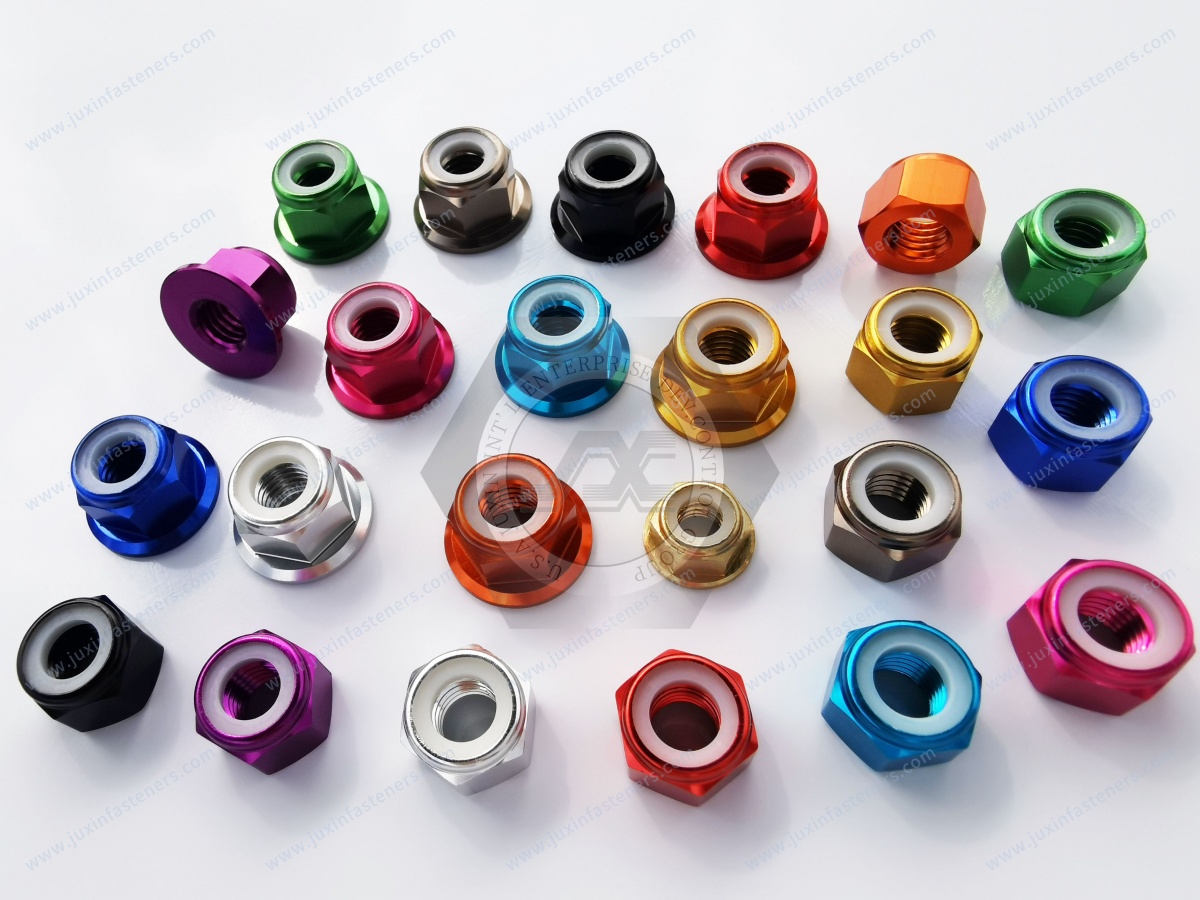
Low-Profile DIN 985-Style Configurations
Low-profile nylon insert lock nuts are commonly associated with the legacy DIN 985 designation.
The reduced-height configuration can provide a compact fastening arrangement where axial installation space is limited.
However, nut height also influences available metal thread engagement.
A thin aluminum or titanium nut may have different load-carrying capability from a conventional full-height steel nut of the same nominal thread diameter.
For lightweight material versions, the required geometry and mechanical performance are established by the product drawing and applicable engineering specification.
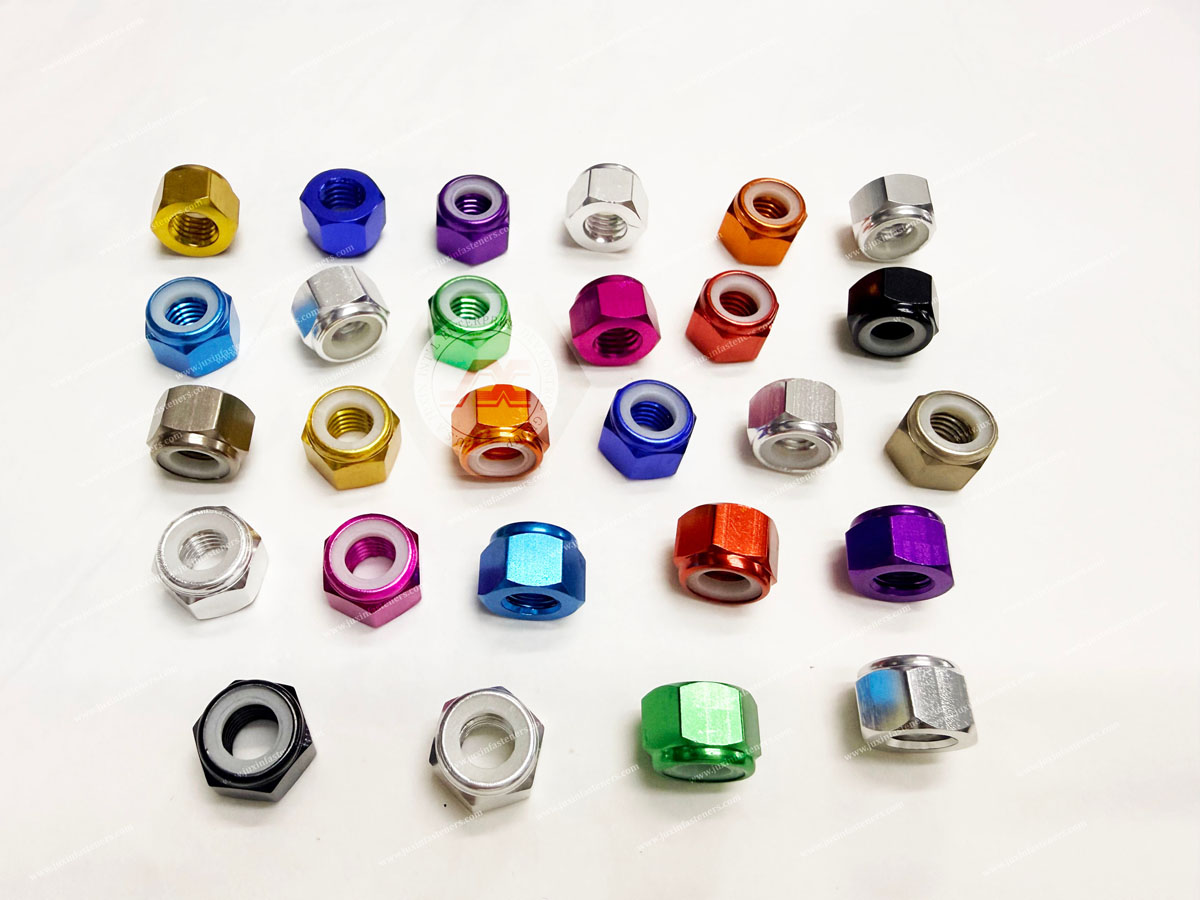
Aluminum Nylon Insert Lock Nuts: Low-Mass Fastening Components
Aluminum nylon insert lock nuts are relevant to assemblies where low component weight is a primary design consideration and the mechanical loads remain compatible with the selected alloy.
Aluminum alloys have substantially lower density than conventional steels.
This creates opportunities for mass reduction in fastening arrangements containing multiple attachment points.
The actual weight advantage depends on the finished nut geometry, not material density alone.
Aluminum Alloy and Mechanical Performance
Aluminum alloys differ significantly in yield strength, tensile strength, hardness and corrosion behavior.
The alloy designation and temper are therefore important parts of the product specification.
A general description such as aluminum nylon lock nut does not establish a particular mechanical strength.
Internal Thread Load Capacity
The internal thread may be a critical feature in an aluminum nut.
Thread stripping resistance depends on:
Alloy strength
Effective thread engagement
Nut height
Thread geometry
Mating bolt properties
Applied preload
This is particularly important when aluminum nuts are assembled with higher-strength steel or titanium bolts.
A stronger bolt does not compensate automatically for limited nut thread strength.
Surface Finish
Depending on the alloy and application, aluminum nuts may use specified surface treatments.
These treatments can influence corrosion resistance, appearance and friction behavior.
Thread fit and locking performance must remain compatible with the finished surface condition.
Titanium Nylon Insert Lock Nuts: Specific Strength and Material Performance
Titanium nylon insert lock nuts offer a different combination of mechanical properties and density.
Titanium alloys are lighter than conventional steels but heavier than aluminum alloys.
Certain titanium alloys provide useful strength-to-weight characteristics for specialized mechanical applications.
However, the performance of a finished titanium nut depends on its alloy, manufacturing condition and geometry.
Titanium Thread Behavior
Titanium threaded connections can experience galling under particular assembly conditions.
Galling is an adhesive wear mechanism that may damage contacting thread surfaces and increase resistance during installation.
Its likelihood depends on the material pairing, contact pressure, surface finish, lubrication and assembly conditions.
Elastic Stiffness
Titanium has a lower elastic modulus than conventional steel.
This difference can influence deformation and contact behavior in threaded assemblies.
The significance depends on the complete joint configuration.
Corrosion Characteristics
Titanium offers favorable corrosion resistance in many environments.
Nevertheless, its use with aluminum or other dissimilar metals can introduce galvanic corrosion considerations when moisture or another electrolyte is present.
Aluminum vs. Titanium: Product Engineering Comparison
| Engineering factor | Aluminum nylon insert lock nut | Titanium nylon insert lock nut |
|---|---|---|
| Density | Lower | Higher than aluminum, lower than steel |
| Weight-saving potential | Particularly attractive | Attractive relative to steel |
| Material strength | Depends on alloy and temper | Depends on alloy and condition |
| Thread engagement | Important because of alloy strength and nut height | Important because of geometry and material |
| Surface damage | Depends on mating materials and finish | Galling can be significant |
| Corrosion | Alloy, finish and environment dependent | Favorable in many environments |
| Material cost | Generally lower | Generally higher |
| Polymer insert limitations | Apply | Apply |
The Important Difference Between Weight Reduction and Joint Performance
A lower-density nut may reduce the mass of a fastening assembly without providing equivalent mechanical performance.
For a fixed thread size, changing the nut material can alter thread stripping resistance, contact deformation and tightening behavior.
The engineering comparison therefore involves both the mass of the component and its required load-bearing capability.

Prevailing Torque Is Not the Same as Bolt Preload
The nylon insert creates prevailing torque through interference with the mating bolt thread.
This resistance exists even before the nut reaches the clamped components.
Bolt preload, by contrast, is generated through tightening and elastic deformation of the bolted joint.
The two functions must be distinguished.
Prevailing Torque
The torque required to overcome the resistance created by the locking feature.
Assembly Torque
The total applied torque during tightening, including prevailing torque and frictional effects associated with joint loading.
Bolt Preload
The tensile force generated in the bolt as the joint is tightened.
These quantities are related, but they are not interchangeable.
Engineering Implication for Lightweight Nuts
A steel, aluminum and titanium lock nut may produce different tightening behavior even when the nominal thread size is identical.
The differences may arise from material strength, surface condition, friction and locking insert characteristics.
A tightening torque specified for one material configuration does not automatically establish an equivalent preload in another.
Vibration Resistance and Joint Reliability
Nylon insert lock nuts are used to provide resistance to unintended rotation in vibration-exposed assemblies.
The polymer insert contributes rotational resistance through thread interference.
However, the complete joint's response to vibration depends on:
Initial preload
Joint stiffness
Transverse loading
Interface friction
Clamped material properties
Thread engagement
Service conditions
Under severe transverse movement, a prevailing-torque nut may still rotate and lose part of its preload.
The locking feature can reduce the tendency toward complete disengagement under certain conditions, but it does not guarantee constant clamp load.
Rotational Loosening and Joint Relaxation
Rotational loosening involves relative rotation between the nut and bolt.
Joint relaxation may occur without substantial rotation.
Examples include:
Settlement of contact surfaces
Creep in polymer components
Local deformation
Thermal relaxation
These mechanisms are particularly relevant in assemblies combining metallic fasteners with lightweight panels, polymers or composite components.
Temperature and Nylon Insert Performance
The polymer insert introduces temperature limitations that are separate from the metallic nut body's properties.
Temperature exposure can affect polymer stiffness, creep, deformation and retained prevailing torque.
The allowable operating conditions depend on the insert material, exposure duration and applicable product specification.
A titanium nut body does not remove the temperature limitations of its nylon insert.
Similarly, the thermal properties of an aluminum nut body do not establish the permissible temperature range of the complete locking fastener.
All-Metal Locking Alternatives
For certain elevated-temperature applications, an all-metal prevailing-torque nut may be a more appropriate design.
The suitability of the alternative depends on its material, thread configuration, locking performance and the joint's requirements.
Repeated Installation and Maintenance
Nylon insert lock nuts may experience changes in prevailing torque during repeated installation and removal.
Potential contributing mechanisms include:
Insert wear
Permanent deformation
Changes in thread interference
Thermal exposure
Contamination
Damage to the mating thread
The acceptable reuse condition depends on the applicable specification and the requirements of the assembly.
Visual appearance alone does not establish retained locking performance.
Motorsport and Racing Motorcycle Applications
Lightweight nylon insert lock nuts may be relevant to selected racing motorcycle and motorsport assemblies.
These applications combine vibration exposure, restricted packaging space and maintenance requirements.
Motorcycle Fairings and Bodywork
Suitable bodywork attachment points may use lightweight locking hardware to limit fastener mass while providing rotational resistance.
Relevant joint characteristics include panel material, bracket geometry, service frequency and thread engagement.
Accessory and Instrument Mounting
Selected accessory brackets, instrument supports and auxiliary mounting assemblies may incorporate lightweight lock nuts.
The required mechanical capacity depends on the attachment geometry and service loads.
Motorsport Support Equipment
Lightweight locking fasteners may also be considered for specialized fixtures, removable covers and equipment assemblies.
Critical Connection Limitations
Brake, steering, suspension and wheel-retention connections are governed by application-specific engineering and safety requirements.
Neither aluminum nor titanium nylon insert lock nuts should be assumed suitable for these connections solely because of their weight or prevailing-torque mechanism.
Automotive and Performance Vehicle Applications
Automotive applications include a wide range of mechanical fastening conditions.
Selected noncritical applications may involve:
Lightweight body panels
Accessory mounting brackets
Instrumentation hardware
Equipment covers
Auxiliary component supports
Removable interior assemblies
The fastening configuration depends on joint loading, temperature, vibration and the mating components.
Lightweight Body Structures
A body panel attachment may prioritize low mass, limited installation height and service access.
However, the clamped materials and connection geometry can affect preload retention.
Performance Vehicle Accessories
Specialized vehicle equipment may require compact locking fasteners for selected mounting arrangements.
The use of aluminum or titanium depends on the material and mechanical requirements rather than the vehicle category alone.
Robotics and Automation Equipment
Robotics and automated machinery may include weight-sensitive moving assemblies.
Suitable applications for lightweight lock nuts can include:
Sensor brackets
Auxiliary mounting hardware
Equipment covers
Noncritical support structures
Serviceable mechanical attachments
Mass Reduction in Moving Assemblies
The effect of component weight depends on its position within the moving system.
Mass reduction may be more valuable in some moving components than in stationary structures.
Assembly Repeatability
For automated equipment production, thread conformity and prevailing-torque consistency can influence installation behavior.
Variations in the polymer insert or internal thread may affect tightening resistance and assembly efficiency.
Industrial Machinery and Mechanical Equipment
Industrial machinery may experience vibration from motors, pumps, fans and moving mechanisms.
Nylon insert lock nuts may be relevant to selected equipment assemblies where their load and temperature limitations are compatible with the design.
Potential applications include:
Machine covers
Auxiliary mounting brackets
Equipment panels
Instrument supports
Serviceable mechanical attachments
The use of aluminum or titanium versions depends on whether reduced weight or material compatibility provides a meaningful engineering advantage.
Conventional steel or stainless steel lock nuts may remain more appropriate for many general-purpose connections.
Electrical Equipment and Enclosure Assemblies
Selected electrical equipment assemblies may use nylon insert lock nuts for mechanical attachment.
Potential applications include:
Control cabinet brackets
Internal equipment supports
Instrument mounting
Lightweight enclosure hardware
Auxiliary panel attachments
The polymer insert provides a mechanical locking function.
It does not automatically provide a specified electrical insulation or grounding function for the complete joint.
Agricultural and Outdoor Equipment
Agricultural machinery and outdoor equipment may experience vibration, moisture and environmental contamination.
Nylon insert lock nuts can be relevant to suitable mechanical attachments.
For aluminum and titanium versions, the commercial and engineering justification depends on the value of reduced weight or the required material characteristics.
Corrosion behavior, thread strength and environmental exposure remain important.
HVAC, Ventilation and Industrial Fan Equipment
HVAC equipment, ventilation systems and industrial fans may include vibration-exposed mechanical attachments.
Suitable nylon insert lock nuts may be considered for selected covers, brackets and auxiliary mounting components.
For many such applications, conventional steel or stainless steel versions may offer a more appropriate balance of strength and cost.
Lightweight aluminum or titanium versions become relevant where the design provides a specific reason for their use.
Engineering Information Gain: Lightweight Materials Are Not Automatically the Best Choice
The engineering value of aluminum and titanium lock nuts depends on the application.
A stationary industrial cabinet may gain little practical benefit from replacing steel nuts with titanium.
A weight-sensitive moving assembly may justify a more expensive lightweight material.
The most appropriate product therefore depends on the relationship between component mass, mechanical performance, manufacturing requirements and total cost.
Thread Systems and Dimensional Compatibility
Nylon insert lock nuts may be specified with metric or inch-series threads, depending on the actual product configuration.
Metric Threads
Metric configurations are commonly associated with DIN and ISO product references.
UNC and UNF Threads
Unified inch-series threads are used in many North American industrial applications.
The specified diameter, thread pitch and tolerance determine compatibility with the mating bolt.
BSW and BSF Threads
British Whitworth thread systems are separate from metric and Unified threads.
Different thread systems are not directly interchangeable.
An approximate nominal diameter match does not establish a compatible threaded connection.
Relevant International Standards
DIN 985
DIN 985 is a legacy product designation associated with low-profile nylon-insert prevailing-torque hexagon nuts.
ISO 10511:2025
ISO 10511:2025 covers specified thin prevailing-torque hexagon nuts with nonmetallic inserts in steel and stainless steel.
The standard identifies reduced loadability for thin nut configurations.
Aluminum and titanium products with similar geometry require separately defined material and mechanical requirements.
ISO 2320:2015
ISO 2320 specifies functional properties and testing for covered steel prevailing-torque nuts.
Its functional requirements cannot automatically be applied as a conformity claim for aluminum or titanium nuts.
ASME B18.16.6
ASME B18.16.6 addresses specified inch-series prevailing-torque lock nuts, including particular carbon steel nylon-insert designs.
An aluminum or titanium inch-series nut does not automatically conform to those material-specific requirements.
Drawing-Defined Lightweight Configurations
For aluminum and titanium nylon insert lock nuts, the applicable product drawing and purchase specification establish
the required combination of dimensions, material, thread and locking performance.
Manufacturing and Functional Consistency
The manufacturing quality of a nylon insert lock nut involves both the metallic nut body and the polymer locking element.
Relevant characteristics include:
Nut geometry
Internal thread dimensions
Material specification
Insert dimensions
Insert retention
Surface condition
Prevailing-torque performance
Thread Quality
Thread conformity affects assembly fit and the interaction between the nut and mating bolt.
Insert Geometry
Variation in polymer insert geometry can influence prevailing torque.
Surface Finish
Surface treatments and lubrication conditions may affect installation friction.
Functional Testing
Prevailing-torque evaluation depends on the specified mating thread, test conditions and acceptance criteria.
Visual inspection alone does not establish functional locking performance.
OEM Supply and Procurement Considerations
For international OEM programs, aluminum and titanium nylon insert lock nuts may be sourced for prototype development,
new equipment programs or established production assemblies.
Technical and commercial requirements can include:
| Specification area | Relevant information |
|---|---|
| Product design | Low-profile or other specified nut geometry |
| Material | Aluminum or titanium alloy |
| Thread | Metric, UNC or UNF |
| Dimensions | Nut height, width across flats and tolerances |
| Locking insert | Polymer specification |
| Functional performance | Prevailing-torque requirements |
| Mechanical performance | Thread load capacity and joint requirements |
| Surface finish | Coating and corrosion requirements |
| Inspection | Dimensional and functional characteristics |
| Documentation | Material and inspection records |
| Packaging | Component protection and lot identification |
| Volume | Prototype demand and annual forecast |
| Commercial terms | MOQ, lead time and delivery schedule |
Cost and Supply Considerations
The cost of lightweight lock nuts depends on material, geometry, manufacturing process, surface treatment and inspection requirements.
Titanium generally involves higher material and processing costs than aluminum.
Custom low-volume components may also have different manufacturing economics from established standard configurations.
For OEM purchasing, the relevant comparison is the delivered value of the specified fastener within the finished assembly.
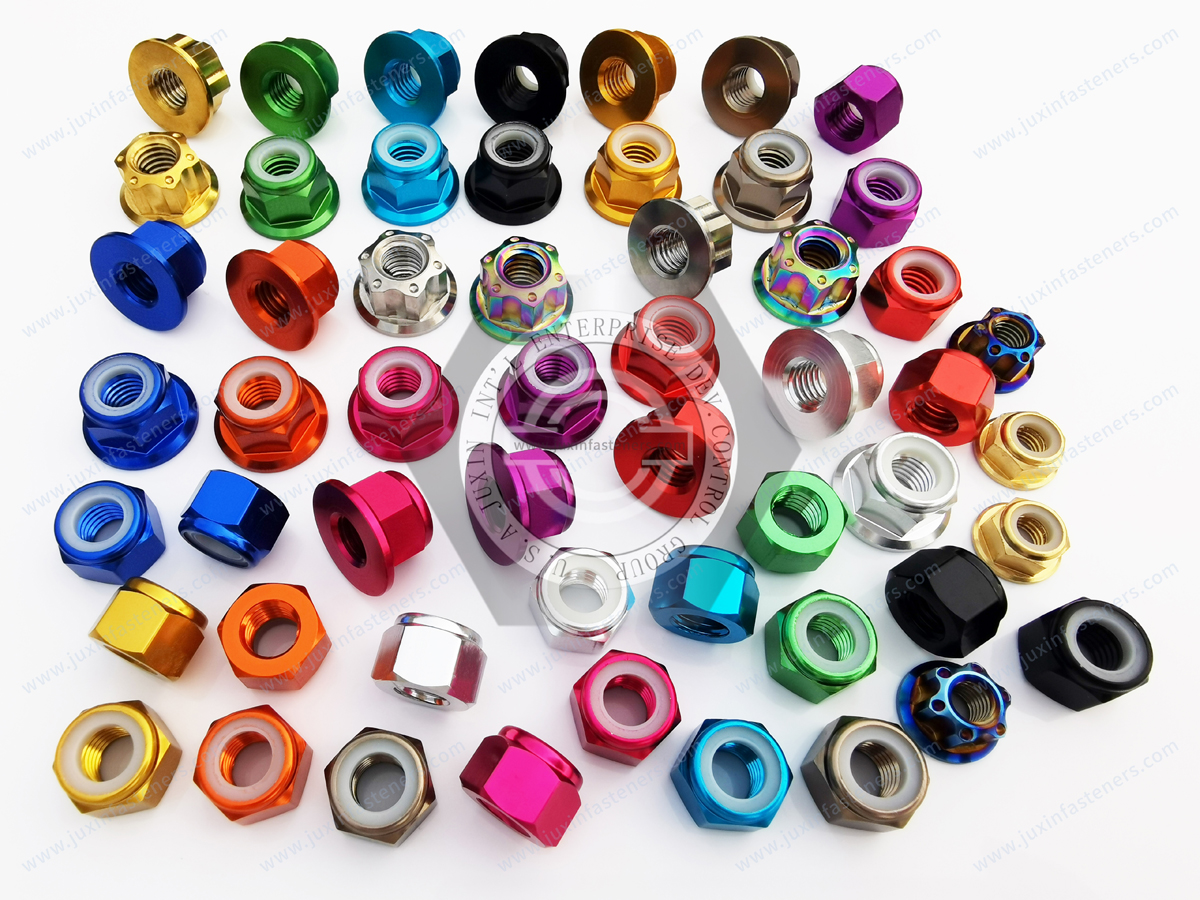
Aluminum and Titanium Nylon Insert Lock Nuts from Juxin Fasteners
Juxin Fasteners supplies industrial locking fasteners for international OEM manufacturers, equipment producers and industrial procurement programs.
Our related fastening products include:
Aluminum nylon insert lock nuts
Titanium nylon insert lock nuts
Carbon steel nylon insert lock nuts
Stainless steel nylon insert lock nuts
DIN 985-style low-profile lock nuts
All-metal prevailing-torque lock nuts
Nylon-insert flange lock nuts
Drawing-based custom fastening components
Specific product configurations are reviewed according to material, thread, dimensions, locking requirements and intended application.
Manufacturing feasibility, material availability, inspection arrangements, MOQ and delivery terms are confirmed for each project.
OEM RFQ — Aluminum and Titanium Nylon Insert Lock Nuts
Juxin Fasteners welcomes inquiries for aluminum and titanium nylon insert lock nuts used in motorsport equipment, automotive assemblies,
industrial machinery, robotics, electrical equipment and other suitable industrial applications.
Relevant technical and commercial information includes:
2D/3D drawings and revision
Applicable DIN, ISO, ASME or customer specification
Required aluminum or titanium alloy
Metric or inch thread specification
Nut dimensions and tolerances
Mating bolt material and strength
Required mechanical performance
Prevailing-torque requirements
Assembly and service temperature
Vibration and loading conditions
Surface treatment
Inspection and documentation requirements
Prototype quantity
Estimated annual demand
Packaging and delivery schedule
Company: Juxin Fasteners
Website: https://www.juxinfasteners.com/
Email: info@juxinfasteners.com
For aluminum and titanium nylon insert lock nuts, lightweight locking fasteners and drawing-based OEM fastening projects,
contact Juxin Fasteners with your technical specifications for feasibility review and quotation.
Contact Us
Tel.:
+86 020 8621 0320
+86 020 3121 6067
E-mail:
Technical Support:
Navigation
SEND INQUIREY



