
Call Us
+86 136 6007 9809
Call Us
+86 136 6007 9809

Aug. 30, 2023
Nylon blind rivet nuts are specialized threaded fastening components designed for applications where conventional metal fasteners may create excessive surface pressure,
scratching, vibration transmission, galvanic interaction, or installation complexity.
They are particularly relevant when engineers need to create a reusable threaded attachment point in:
Thin panels
Painted sheet
Coated panels
Fiberglass
Rigid plastics
Composite panels
Laminated boards
Equipment housings
Automotive interior components
Electrical enclosures
HVAC panels
Lightweight industrial structures
Unlike conventional metal blind rivet nuts that are normally installed with a dedicated setting tool,
the hybrid nylon-sleeve design described in this solution uses an expanding sleeve mechanism activated by the mating screw.
The product architecture combines a threaded metal core with an elastic nylon sleeve.
The sleeve expands behind or within the panel as the screw is tightened, creating a mechanical retention point without requiring a conventional rivet-nut setting tool.
JUXIN FASTENERS' existing product information describes this type of nylon blind rivet nut as an aluminum-alloy threaded core combined with a diagonally backed nylon sleeve,
with manual installation and expansion through the mating screw.
This makes the product particularly interesting for applications where engineers need:
Tool-free or low-complexity installation
Blind-side fastening
Surface protection
Lightweight fastening
Reduced direct metal-to-metal contact
Vibration and shock isolation characteristics
Removable service access
Threaded attachment points in difficult-to-access panels
However, these fasteners should not be treated as a universal replacement for conventional metal blind rivet nuts.
Their engineering behavior is different because the nylon sleeve becomes part of the load path.
That difference is the key to selecting them correctly.
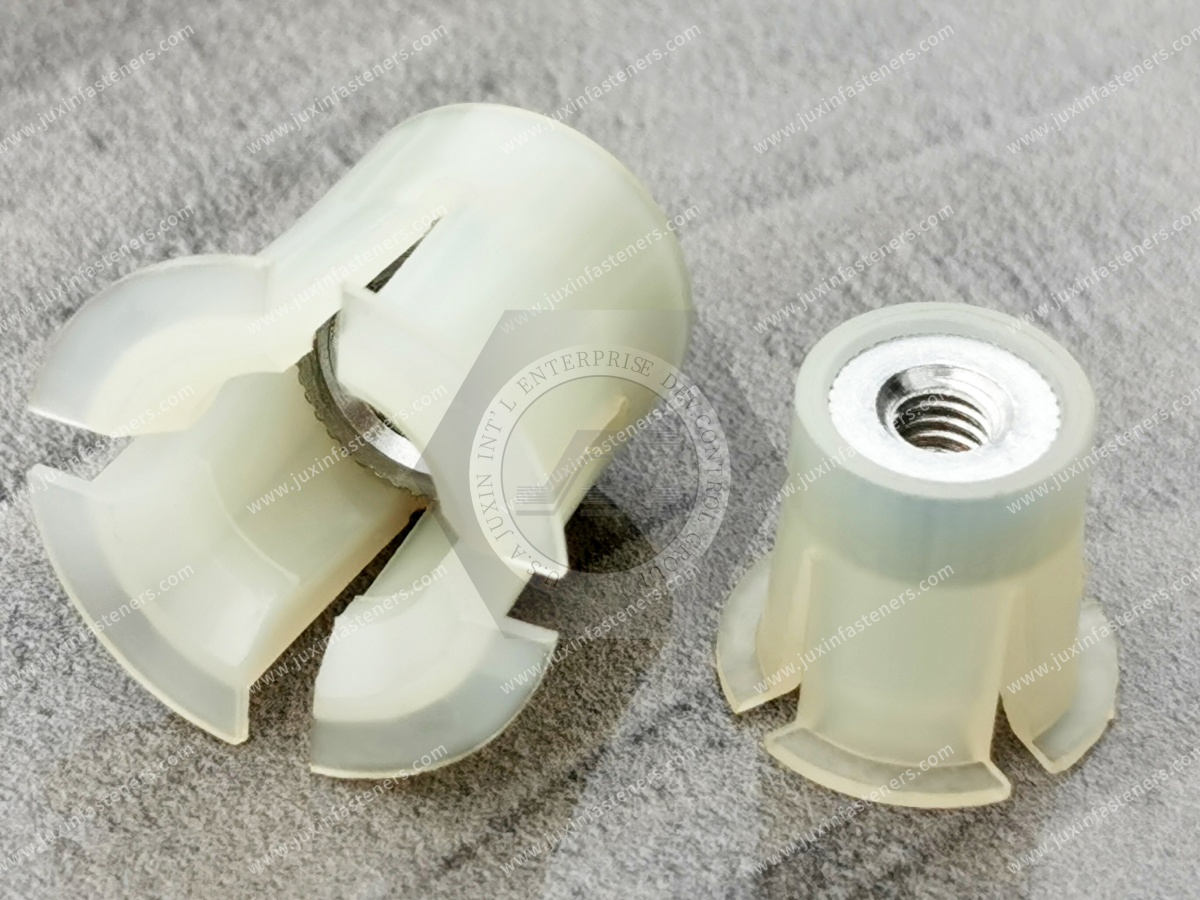
Nylon blind rivet nuts are hybrid threaded inserts consisting of a threaded core and a resilient polymer sleeve.
Depending on the product design, the threaded core may be aluminum alloy or another specified metal, while the outer sleeve is an engineering polymer such as nylon.
The product is inserted into a prepared hole from one side.
A compatible screw is then installed into the threaded core.
As the screw advances, the threaded core moves relative to the sleeve, causing the sleeve to expand and create a mechanical retention feature inside the panel.
This allows a threaded connection to be created where access to the rear side of the panel is limited or unavailable.
The term “rivet nut” is commonly used for several different fastening architectures.
A conventional metal blind rivet nut generally uses permanent deformation of the fastener body during installation.
A nylon-sleeve expanding insert works differently.
The polymer sleeve participates directly in the expansion and retention mechanism.
For engineering and procurement purposes, it is therefore useful to describe the product by its actual architecture:
threaded metal core + expanding nylon sleeve + blind-hole installation + screw-activated expansion.
This description is more useful than relying on a generic product name alone.
The primary attraction of this design is the installation mechanism.
The fastener is placed into the prepared hole.
The mating screw is inserted through the component being attached.
As the screw engages the threaded core, the core moves relative to the sleeve.
The sleeve expands against the inside surface of the panel.
The resulting expanded section prevents the insert from pulling back through the prepared hole under normal design conditions.
The actual retention capability depends on:
Sleeve material
Core geometry
Hole diameter
Panel thickness
Panel material
Thread size
Screw geometry
Installation condition
The sleeve is designed to deform in a controlled manner when the threaded core is drawn into the appropriate position.
This produces radial expansion.
The expanded polymer contacts the panel.
The panel therefore becomes mechanically captured between the external flange or front portion and the expanded sleeve.
The exact deformation geometry depends on the product design.
It should not be assumed that every nylon insert develops the same expansion shape.
The threaded core provides the internal machine thread.
This creates the reusable connection for the mating screw.
The core material can be important because it influences:
Thread strength
Corrosion compatibility
Weight
Machinability
Screw interaction
Installation behavior
Where aluminum alloy is used, the core provides a lightweight metallic thread while the nylon sleeve provides the panel interface.
The sleeve is not simply an outer cosmetic component.
It is a functional mechanical component.
The sleeve can influence:
Retention
Panel contact
Vibration behavior
Surface protection
Electrical separation
Moisture exposure
Reusability
Temperature response
For that reason, the nylon material should be specified according to the actual application.
“Nylon” is a broad material family.
Different polyamide formulations can have different:
Moisture absorption
Stiffness
Strength
Toughness
Temperature behavior
Chemical resistance
Dimensional stability
Therefore, the engineering specification should identify the required nylon type or material designation where the application requires it.
ASTM D4066 provides a classification system for nylon injection and extrusion materials, but it is a material classification system rather than a finished nylon fastener standard.
ASTM itself notes that material selection should consider design, environment, processing and required performance.
One of the most important differences between nylon and metal is environmental sensitivity.
Nylon can absorb moisture.
That can affect:
Dimensions
Stiffness
Mechanical behavior
Friction
Long-term retention
Installation characteristics
Therefore, a nylon threaded insert designed for a dry indoor environment should not automatically be assumed suitable for a continuously wet application.
A hybrid aluminum-and-nylon design combines two materials with different characteristics.
The aluminum core provides:
Internal thread
Metal screw interface
Lightweight metallic structure
The nylon sleeve provides:
Panel contact
Expansion
Mechanical cushioning
Electrical separation characteristics
Surface protection
The result is a fastening system rather than a simple metal nut.
The hybrid structure can be valuable when a conventional all-metal fastener creates problems.
Potential drivers include:
Panel damage
Galvanic concerns
Excessive vibration transmission
Weight
Tool requirements
Repeated service access
The design should still be validated against the specific application.
A major Information Gain point for procurement teams is that “tool-free installation” describes the installation mechanism.
It does not mean that engineering specifications are unnecessary.
The application still requires control of:
Hole diameter
Panel thickness
Grip range
Thread size
Screw length
Installation condition
Material
Environment
Tool-free installation reduces equipment requirements.
It does not eliminate joint-design requirements.
A major benefit is access from one side of the panel.
This can be valuable when the back side is:
Enclosed
Inaccessible
Difficult to reach
Already assembled
Hidden inside a structure
The insert can be installed from the accessible side before the final component is attached.
Thin panels often create difficulties for conventional threaded holes.
There may not be sufficient material thickness to create adequate thread engagement.
A nylon blind threaded insert can provide a separate threaded interface without requiring the panel itself to contain the complete machine thread.
Pre-painted panels create another challenge.
Traditional metal expansion or clamping mechanisms can damage:
Paint
Powder coating
Decorative finishes
Protective coatings
A polymer sleeve provides a softer interface.
However, “surface protection” should not be interpreted as an absolute guarantee against every type of coating damage.
Installation force, hole quality and panel condition still matter.
Even a soft nylon sleeve cannot compensate for:
Oversized holes
Burrs
Sharp edges
Cracked coatings
Incorrect installation
Excessive tightening
Damaged sleeves
Therefore, the hole preparation process is part of the surface-protection strategy.
Fiberglass and composite panels can be sensitive to:
Local crushing
Edge damage
Delamination
Point loading
Over-tightening
A polymer sleeve can distribute contact more gently than a rigid metal expansion component.
However, the composite layup and panel structure must still be considered.
Plastic panels introduce additional considerations:
Creep
Stress relaxation
Temperature
Moisture
Chemical exposure
Thread stripping
Local deformation
A nylon threaded insert may be useful when a reusable machine-thread connection is required.
But the insert must be evaluated with the plastic substrate.
Composite sandwich panels may contain:
Fiberglass skins
Polymer cores
Honeycomb structures
Laminated skins
Foam structures
A fastening solution must be compatible with the actual panel architecture.
The nominal panel thickness alone may not be enough information.
Laminated boards and rigid fiber-based panels can require threaded attachment points for:
Equipment covers
Furniture systems
Displays
Modular assemblies
Service panels
The insert should be selected according to board density, thickness and hole condition.
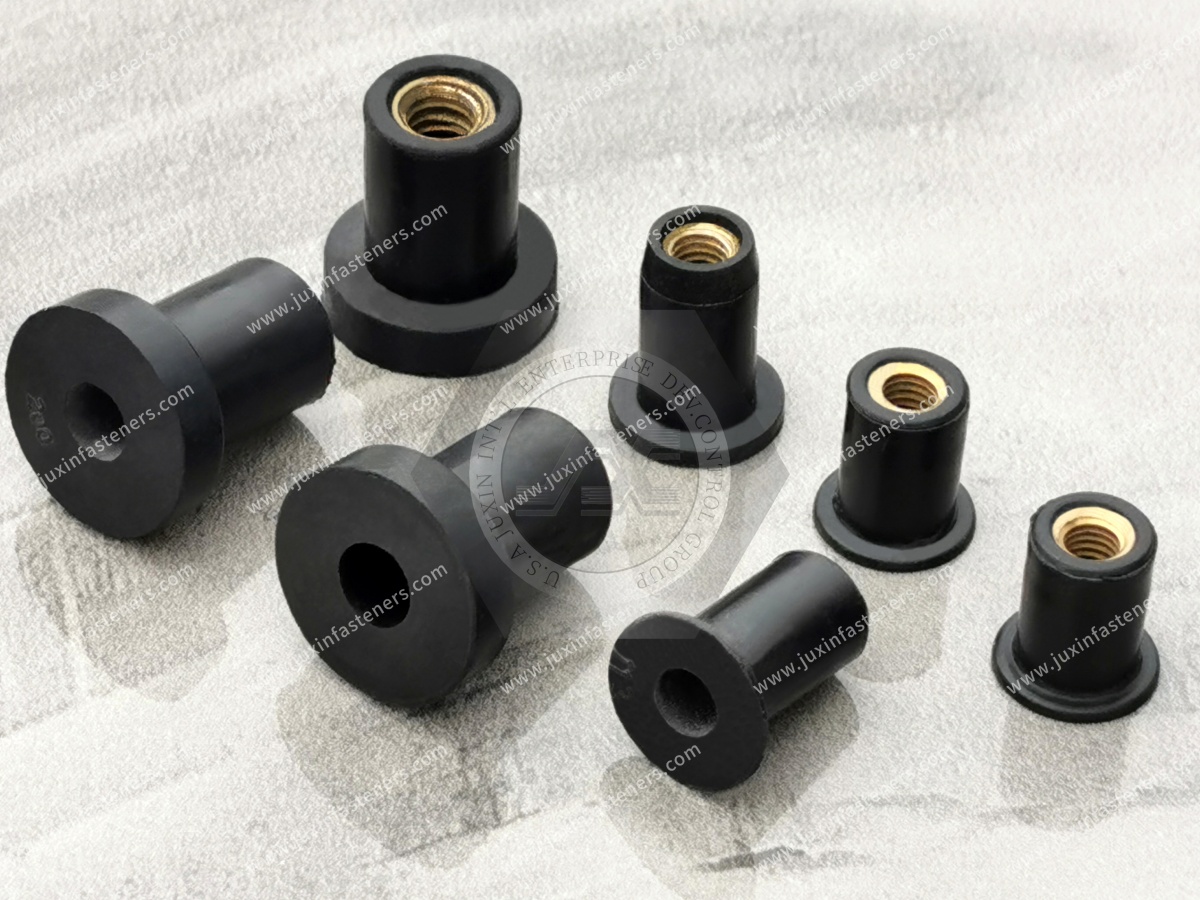
Automotive interiors can contain:
Plastic panels
Composite trim
Decorative surfaces
Fiberboard structures
Lightweight covers
A polymer-sleeved threaded insert may be considered where surface protection and low installation complexity are important.
It can be particularly relevant to removable interior components.
Interior trim may require repeated removal for:
Maintenance
Electrical service
Component replacement
Inspection
Product upgrades
A reusable threaded connection can be advantageous compared with a permanent push-type attachment in selected designs.
Electronics enclosures often combine:
Painted metal
Aluminum
Plastic
Composite panels
A polymer sleeve can help reduce direct contact between the threaded metal core and the panel.
This can be useful where electrical isolation or material compatibility is part of the design requirement.
HVAC equipment frequently includes thin sheet-metal panels and removable covers.
Tool-free threaded inserts can simplify:
Panel installation
Service access
Modular assembly
Field maintenance
The application should still consider temperature, condensation and chemical exposure.
Marine equipment can contain:
Fiberglass panels
Composite structures
Instrument panels
Lightweight covers
The material selection should account for moisture and salt exposure.
Nylon should not automatically be considered equivalent to every marine-grade polymer.
Industrial equipment often requires removable access panels.
A reusable threaded insert can support:
Maintenance
Inspection
Replacement
Adjustment
The insert can be installed before the enclosure is fully assembled.
One potential benefit of a nylon sleeve is reduced direct metal-to-metal contact between the threaded core and the panel.
This can be useful in mixed-material assemblies.
However, electrical isolation must be evaluated at the complete assembly level.
A nylon sleeve does not automatically establish a certified electrical insulation system.
This distinction is important.
A polymer-sleeved fastener may reduce direct electrical contact.
That does not mean the fastener automatically provides:
EMI shielding
RFI shielding
Grounding
Controlled electrical resistance
EMC compliance
Those functions must be designed and validated separately.
Galvanic corrosion can occur when dissimilar conductive materials are electrically connected in a suitable electrolyte environment.
A polymer sleeve can reduce direct metal-to-panel contact.
This can be beneficial.
However, the complete assembly may still contain other conductive paths.
Therefore, the correct engineering question is:
Does the complete joint adequately control galvanic interaction under the actual environmental conditions?
The polymer sleeve can introduce a more compliant interface than an all-metal fastener.
Potential benefits may include:
Reduced direct metal contact
Vibration isolation
Noise reduction
Shock absorption characteristics
However, “vibration dampening” should not be interpreted as a guaranteed vibration qualification.
The complete joint still needs validation when vibration is critical.
A fastener cannot be evaluated independently from:
Panel stiffness
Screw preload
Component mass
Excitation frequency
Joint geometry
Sleeve material
Assembly condition
The same insert may behave differently in two different panels.
For shock-sensitive equipment, the polymer sleeve may provide some compliance.
However, shock performance should be evaluated against the actual load case.
Do not assume a nylon sleeve automatically qualifies the joint for a specific shock standard.
A polymer interface can reduce direct hard-surface contact.
This may help reduce:
Rattling
Contact noise
Panel vibration transmission
But acoustic performance depends on the complete assembly.
One of the strongest commercial applications is service access.
If the threaded core and sleeve remain intact, the mating screw can be removed and reinstalled.
Potential applications include:
Electronic enclosures
Instrument panels
Automotive trim
Equipment covers
Modular displays
Service panels
A reusable insert should not automatically be described as capable of unlimited installation cycles.
Repeated assembly can affect:
Threads
Sleeve deformation
Panel hole condition
Screw condition
Retention
The required number of service cycles should be validated for the application.
The mating screw is part of the fastening system.
Important variables include:
Thread size
Thread pitch
Thread length
Screw material
Head style
Drive
Surface finish
A screw that fits the thread may still be unsuitable if its length or head geometry is incorrect.
Screw length must provide sufficient thread engagement without causing:
Bottoming
Excessive penetration
Internal interference
Contact with hidden components
The required length should be established from the stack-up.
Thread engagement must be sufficient for the required joint function.
The correct value depends on:
Core material
Thread diameter
Screw material
Load
Application
Product geometry
It should not be replaced by a universal rule.
The screw should be tightened according to the product and application requirements.
Excessive torque may:
Deform the sleeve
Damage the panel
Distort the insert
Strip the thread
Reduce service life
Therefore, torque should be controlled where the application requires it.
For an expanding insert, there can be two distinct process questions:
How much tightening is required to establish the insert?
and
How much tightening is required for the final component joint?
These should not automatically be treated as the same value.
The installation procedure should be validated for the specific product.
Hole diameter is one of the most important dimensions.
If the hole is too small:
Installation may be difficult
Sleeve damage may occur
Panel deformation may increase
If the hole is too large:
Retention may decrease
Sleeve expansion may not work as intended
Insert movement may occur
The hole should be evaluated for:
Burrs
Sharp edges
Cracks
Coating damage
Deformation
Surface contamination
This is especially important for fiberglass and brittle composite panels.
Grip range describes the panel thickness or material stack that the insert is designed to accommodate.
The engineer should identify:
Minimum panel thickness
Maximum panel thickness
Number of layers
Coating thickness
Washers or intermediate components
Grip range should be confirmed from the actual product drawing.
Two inserts can have the same M6 internal thread but completely different:
Hole diameter
Grip range
Flange diameter
Overall length
Sleeve geometry
Retention behavior
Therefore, procurement should never specify only:
“M6 nylon blind rivet nut.”
The complete dimensional configuration is required.
The flange provides the front-side seating surface.
Important dimensions include:
Flange diameter
Flange thickness
Body diameter
Body length
These dimensions affect panel contact and component clearance.
Different applications may require different front-side geometries.
Possible requirements include:
Flush seating
Low-profile flange
Wide flange
Standard flange
Custom flange
The choice depends on the surrounding component.
When several layers are involved, engineers should calculate the total stack-up.
For example:
Panel + coating + gasket + bracket = effective grip thickness.
The insert should be selected based on the actual assembled thickness rather than the bare panel alone.
Paint and powder coating can change the effective hole and grip condition.
The engineering drawing should clarify whether dimensions are measured:
Before coating
After coating
Over finished surfaces
This can prevent installation variation.
For painted panels, the fastener interacts with the finished surface.
The specification should therefore consider:
Coating thickness
Coating hardness
Hole quality
Surface protection
Installation force
Fastener selection and coating process cannot always be separated.
Nylon can absorb moisture from its environment.
This can change material behavior.
Potential effects include:
Dimensional change
Reduced stiffness
Changed mechanical response
Changed friction
Changed long-term behavior
Therefore, moisture conditioning may be relevant for demanding applications.
Polymer behavior changes with temperature.
Engineers should consider:
Minimum service temperature
Maximum service temperature
Short-term temperature exposure
Long-term exposure
Thermal cycling
The exact limits must come from the selected material and product specification.
Nylon can interact differently with:
Oils
Fuels
Solvents
Cleaning chemicals
Detergents
Coolants
Acids
Alkalis
Chemical compatibility should therefore be checked against the actual environment.
Automotive applications may involve:
Cleaning agents
Interior chemicals
Lubricants
Coolants
Fuel-related exposure
Adhesives
The nylon formulation should be evaluated against the actual chemicals.
HVAC applications can involve:
Condensation
Cleaning chemicals
Refrigeration-related environments
Oils
Outdoor contaminants
Material selection should be based on actual exposure rather than assuming all nylon formulations behave identically.
The word “nylon” is not enough to define performance.
The RFQ should identify, where relevant:
PA family
Reinforcement
Color
Stabilization
Environmental requirements
Temperature requirements
Chemical exposure
Material selection should be tied to the application.
Creep is a long-term deformation mechanism that can occur under sustained load.
For a nylon sleeve, creep may influence:
Retention
Compression
Dimensional stability
Long-term joint behavior
This is particularly important for permanently loaded applications.
Polymer materials can also experience stress relaxation.
This means that a material held under deformation can experience a reduction in internal stress over time.
For an expanding sleeve, this is relevant when long-term retention is critical.
An insert may install successfully during assembly.
That does not automatically prove long-term performance.
Long-term evaluation may need to consider:
Temperature
Moisture
Load
Vibration
Chemical exposure
Time
Repeated service cycles
This is especially important when nylon is part of the structural load path.
Conventional metal blind rivet nuts and nylon-sleeved expanding inserts solve related but different engineering problems.
Metal blind rivet nuts are often selected for:
Higher structural loading
Sheet-metal assemblies
Permanent installation
Strong threaded joints
Industrial production
Nylon-sleeve inserts can be attractive where:
Surface protection
Vibration isolation
Electrical separation
Lightweight construction
Manual installation
Fragile panels
are important.
The correct selection depends on the application.
A polymer-based insert can be technically attractive, but it is not automatically a lower-cost replacement for a metal blind rivet nut.
The correct comparison should include:
Fastener cost
Installation tooling
Assembly time
Panel damage
Serviceability
Validation requirements
Supply volume
Total installed cost can be more meaningful than piece price.
One potential advantage is reduced dependence on dedicated riveting equipment.
For:
Low-volume production
Service operations
Field assembly
Prototype builds
Modular products
this may simplify the installation process.
In higher-volume production, however, engineers should still evaluate:
Cycle time
Screwdriver compatibility
Feed method
Operator ergonomics
Torque control
Part presentation
“Tool-free” does not automatically mean “best for automated production.”
Field service is a strong application area because the insert can potentially be installed using basic screw-driving equipment.
This can be useful for:
Replacement panels
Equipment covers
Service brackets
Electronics housings
Display systems
Modular equipment often needs components to be removed and reinstalled.
A threaded insert can provide a reusable attachment point without requiring access to the rear side.
If a panel is expected to be removed several times during the product life, the engineer should specify:
Expected service cycles
Screw type
Thread engagement
Panel material
Insert retention
Replacement procedure
This allows the fastener to be selected around the service requirement rather than around initial assembly alone.
The polymer sleeve provides a non-metallic interface around the panel hole.
This can reduce direct hard-metal contact.
Potential benefits include:
Reduced scratching
Reduced edge damage
Reduced contact pressure
Improved compatibility with coated panels
The result still depends on correct hole preparation.
Painted aluminum panels are particularly relevant because aluminum is relatively soft compared with many steel fasteners.
A polymer interface can reduce direct mechanical contact between the panel and metallic expansion components.
Fiberglass panels may be damaged by concentrated mechanical loads.
The sleeve can distribute the contact over a larger area.
The panel manufacturer’s design limits should still be respected.
Carbon-fiber composites introduce additional concerns around:
Electrical conductivity
Galvanic interaction
Local damage
Delamination
Fiber direction
A polymer sleeve can help separate the threaded core from the composite surface.
But the complete joint should be evaluated.
For composite structures, “3 mm panel” may not fully describe the fastening environment.
The RFQ may need:
Skin material
Core material
Laminate structure
Hole diameter
Edge distance
Local reinforcement
Surface coating
This allows the insert supplier to understand the actual fastening condition.
Nylon-sleeved threaded inserts can be considered for:
Control boxes
Instrument enclosures
Electronics housings
Display systems
Communication equipment
The application should specify whether electrical isolation is merely preferred or is a validated functional requirement.
Telecommunications equipment often combines:
Thin sheet metal
Aluminum
Plastic
Painted surfaces
Electronic modules
For broader telecommunications self-clinching and fastener requirements, see:
/solutions/telecommunications-equipment-fasteners-self-clinching-nuts
HVAC panels often require frequent access.
A reusable threaded insert can support:
Cover removal
Filter access
Service access
Modular panel construction
The polymer material should be compatible with the equipment environment.
Automotive interiors require attention to:
Appearance
Noise
Vibration
Weight
Serviceability
Temperature
Chemical exposure
A polymer-sleeved insert can address several of these considerations simultaneously, subject to application validation.
Fiberglass instrument panels are another potential application.
The design should consider:
Moisture
Salt exposure
Panel thickness
Composite construction
Electrical requirements
Appliance assemblies may use thin painted or coated panels.
Potential benefits include:
Reduced surface damage
Simple installation
Serviceability
Lightweight fastening
Display systems can require hidden or semi-hidden threaded attachment points.
A manually installed insert can simplify assembly in low-volume or modular equipment.
“Automotive,” “HVAC,” or “electronics” does not by itself determine whether a nylon insert is appropriate.
The more useful classification is:
Panel material + thickness + environment + load + service requirement + installation method.
This is the information engineers should provide when selecting the product.
Depending on the actual design, product variations may include:
Standard flange
Large flange
Different sleeve lengths
Different thread sizes
Different hole diameters
Different grip ranges
Different core materials
Different polymer materials
The exact available configuration should be confirmed from the current product drawing.
Standard configurations are appropriate when:
Hole dimensions are conventional
Thread size is standard
Grip range matches
Material requirements are established
Custom designs may be necessary when:
Hole diameter is unusual
Panel thickness is unusual
Flange geometry is restricted
Thread length is unusual
Special material is required
OEM customers may require:
Custom flange diameter
Custom sleeve length
Special core geometry
Special thread
Modified grip range
Special material
Custom color
Customer drawing control
A drawing is the best starting point for evaluation.
Instead of asking only:
“Can you make this custom size?”
engineers can provide the reason for customization:
Panel cracking
Hole enlargement
Limited clearance
Excessive vibration
Corrosion concern
Service-cycle requirement
Tool limitation
Understanding the failure mode helps the supplier evaluate the correct design direction.
Potential inspection items can include:
Overall dimensions
Flange dimensions
Sleeve dimensions
Thread size
Thread condition
Core retention
Material identification
Visual condition
The exact inspection plan should be defined by the drawing and customer requirements.
The internal thread should be compatible with the specified mating screw.
Inspection may include appropriate thread gauges or dimensional inspection depending on the product specification.
The applicable gauge and acceptance criteria should be agreed for production parts.
The sleeve can be inspected for:
Dimensions
Surface condition
Defects
Material consistency
Assembly fit
For critical applications, the inspection method should be defined before production.
Where material control is important, the supplier should identify the specified material for:
Threaded core
Nylon sleeve
These are two different material requirements and should not be combined into one generic “material” field.
Depending on the customer requirement, procurement documentation may include:
Drawing
Material specification
Inspection report
Certificate of conformity
Batch identification
Packaging specification
The exact documentation package should be agreed during sourcing.
Not every nylon insert requires the same documentation level.
For a simple equipment cover, basic dimensional and material documentation may be sufficient.
For a safety-critical or highly controlled OEM application, more detailed validation may be required.
The documentation level should therefore match the application risk.
Procurement teams should define:
Part number
Drawing revision
Material
Thread
Hole diameter
Grip range
Quantity
Packaging
Documentation
Delivery requirement
This avoids suppliers quoting technically different products under the same generic description.
When evaluating a supplier, procurement teams should ask:
Can the supplier understand the product mechanism?
Can the supplier control both polymer and metal components?
Can the supplier produce the required geometry?
Can samples be evaluated?
Can the supplier support drawing-based production?
Can material requirements be documented?
Can changes be controlled?
Engineers may search for:
Nylon blind rivet nut
Nylon threaded insert
Tool-free threaded insert
Fiberglass panel fastener
Plastic panel insert
Vibration isolation fastener
Reusable threaded insert
Procurement teams may search for:
Nylon fastener supplier
Custom nylon threaded insert manufacturer
OEM threaded insert supplier
Nylon rivet nut manufacturer
Bulk nylon fasteners
Drawing-based fastener quotation
A strong B2B page should address both.
A request such as:
“Please quote M6 nylon rivet nuts.”
is incomplete.
A better RFQ includes:
Panel material
Panel thickness
Hole diameter
Required thread
Grip range
Environmental exposure
Screw type
Service-cycle requirement
Annual quantity
This gives the supplier the information needed to assess whether the insert is appropriate.
For a nylon blind rivet nut project, provide:
2D drawing
3D model if available
Thread size
Thread pitch
Panel material
Panel thickness
Hole diameter
Grip range
Flange diameter
Insert overall length
Core material
Nylon material
Color if relevant
Surface condition
Screw material
Screw length
Installation method
Expected service cycles
Temperature exposure
Moisture exposure
Chemical exposure
Vibration requirements
Inspection requirements
Documentation requirements
Annual volume
Initial order quantity
Packaging requirements
Delivery location
A practical selection sequence is:
Panel → Hole → Thickness → Grip → Thread → Core → Sleeve → Environment → Installation → Service Requirement → Validation → RFQ
This is more useful than starting with the thread size.
Determine whether the substrate is:
Sheet metal
Aluminum
Fiberglass
Plastic
Composite
Laminated board
Record:
Minimum thickness
Maximum thickness
Coating thickness
Multi-layer stack-up
Specify:
Hole diameter
Hole tolerance
Hole shape
Burr condition
Edge condition
Specify:
Metric or inch thread
Nominal diameter
Pitch
Thread length
Screw type
Consider:
Moisture
Temperature
Chemicals
Outdoor exposure
Vibration
Shock
Electrical requirements
Ask:
Is the joint permanent?
Will the screw be removed?
How often?
Is field service required?
Is replacement expected?
Clarify whether installation will be:
Manual
Semi-automated
Automated
Field-installed
If the product is selected specifically because no dedicated rivet-nut setting tool is desired, state that as a design requirement.
Validation may consider:
Installation fit
Panel damage
Retention
Thread engagement
Screw installation
Repeated assembly
Environmental exposure
The appropriate tests depend on the application.
A common misunderstanding is:
“If the insert is tool-free, operators can simply tighten until it feels right.”
That approach may be acceptable for some low-risk applications but is unsuitable as a universal production-control method.
Where joint consistency matters, installation procedure should define:
Screw type
Driver
Installation method
Tightening condition
Inspection criteria
The threaded core allows the panel to receive a conventional screw.
This can be useful when the product requires:
Repeated service
Component replacement
Modular assembly
Adjustable access
Repeated removal does not only affect the insert.
It can also affect:
Panel hole
Coating
Composite structure
Screw
Threaded core
Therefore, the complete joint should be evaluated over the expected service life.
Hybrid aluminum-and-nylon construction can reduce mass compared with some all-metal fastening arrangements.
Weight reduction can be relevant to:
Automotive interiors
Electronics
Displays
Portable equipment
Lightweight enclosures
Actual weight should be confirmed from the specific part drawing.
For global B2B procurement, packaging should protect:
Nylon sleeves
Threads
Flanges
Surface condition
Packaging should also prevent:
Crushing
Contamination
Mixed part numbers
Lot confusion
Procurement should control:
Part number
Drawing revision
Material
Lot identification
Quantity
Packaging label
This becomes particularly important when similar inserts have different grip ranges.
A part can be dimensionally correct and still fail to perform if it is used outside its intended grip range.
For example, an insert selected for a thin panel may not behave correctly in a much thicker stack.
Therefore, a supplier quality issue should not be assumed until the application stack-up has been checked.
JUXIN FASTENERS has a product focus covering plastic fasteners and threaded fastening components for industrial applications.
Its existing nylon blind rivet nut product information describes a hybrid design using an aluminum-alloy threaded core and nylon sleeve, with manual installation through screw-driven expansion.
Potential application areas include:
Automotive interiors
Electrical enclosures
Electronics
HVAC equipment
Fiberglass panels
Composite panels
Industrial equipment
Modular covers
Lightweight structures
The final product configuration should be selected from the actual customer drawing and application conditions.
For broader plastic and nylon fastening requirements, JUXIN FASTENERS provides a wider plastic fastening solution covering applications involving:
Plastic screws
Plastic nuts
Plastic washers
Plastic spacers
Plastic clips
Plastic cable clamps
Nylon fastening components
Related solution:
/solutions/automotive-plastic-fasteners-guide
Where the application requires conventional metal blind rivet nuts rather than polymer-sleeved expanding inserts, JUXIN FASTENERS also works with blind rivet nut applications.
Related engineering solutions include:
/solutions/blind-rivet-nuts-engineering-principles-applications
and
/solutions/blind-rivet-nuts-comprehensive-engineering-guide
The choice between the two technologies should be based on load, substrate, installation method and environmental requirements.
A metal blind rivet nut may be preferable where the design requires:
Higher mechanical loading
More rigid retention
Structural sheet-metal fastening
Established production riveting
Higher resistance to deformation
A nylon-sleeve insert may be preferable where:
Surface protection
Electrical separation
Lightweight construction
Vibration isolation
Manual installation
are more important.
An M6 conventional blind rivet nut and an M6 nylon expanding insert may have completely different:
Installation mechanisms
Load paths
Retention mechanisms
Environmental behavior
Panel requirements
Therefore, “same M6 thread” does not mean “equivalent fastener.”
| Application Requirement | Nylon-Sleeve Expanding Insert | Conventional Metal Blind Rivet Nut |
|---|---|---|
| Blind installation | Suitable for appropriate designs | Suitable |
| Tool-free installation | Potential advantage | Usually requires setting process |
| Fragile panel | Potential advantage | Depends on design |
| Painted surface | Potential advantage | Depends on installation |
| Vibration isolation | Potential advantage | Primarily rigid metal joint |
| Electrical separation | Potential advantage | Requires additional isolation |
| High structural load | Must be validated | Often more suitable |
| Repeated service | Potential advantage | Depends on product |
| Plastic/composite panel | Often attractive | Depends on substrate |
| Sheet-metal production | Application dependent | Widely used |
This is an engineering comparison, not a universal product ranking.
Avoid:
Specifying only the thread size
Ignoring panel thickness
Ignoring hole diameter
Ignoring grip range
Assuming all nylon is equivalent
Assuming tool-free means uncontrolled installation
Assuming nylon automatically solves galvanic corrosion
Assuming vibration damping equals vibration qualification
Assuming reusable means unlimited cycles
Assuming ASTM D4066 is a finished fastener standard
Treating the product as interchangeable with a conventional blind rivet nut
For this type of product, the hole is not simply an opening.
It controls:
Insert fit
Sleeve expansion
Retention
Panel stress
Surface condition
This means hole design should be considered together with fastener design.
A product selected without knowing the actual panel thickness is not fully specified.
For a multi-layer assembly, use:
Total fastening stack = panel + coating + bracket + gasket + intermediate layers
Then select the appropriate grip range.
The insert cannot be evaluated independently from the screw.
The screw determines:
Thread engagement
Installation force
Core interaction
Final joint geometry
Therefore, screw specification should be included in the engineering review.
The recommended sourcing path is:
Application
→
Panel Material
→
Panel Thickness
→
Hole Diameter
→
Grip Range
→
Thread Size
→
Core Material
→
Nylon Material
→
Environmental Conditions
→
Assembly Method
→
Service Requirement
→
Drawing Review
→
Sample Validation
→
Production RFQ
This approach gives engineering and procurement teams a common specification.
Instead of sending:
“Please quote M6 nylon rivet nuts.”
send:
“Please quote the attached nylon-sleeved threaded insert drawing. The application is a painted aluminum panel. Please review the specified hole diameter, panel thickness, grip range, M6 thread, core material, nylon material, installation method and annual quantity.”
This provides substantially more useful information to the supplier.
Procurement and supplier-development teams can ask:
What is the threaded core material?
What is the sleeve material?
What is the approved hole diameter?
What is the supported grip range?
What screw specification is recommended?
What installation procedure is required?
What environmental limitations apply?
What inspection documents are available?
Can samples be supplied against a drawing?
Can the supplier support custom dimensions?
Design engineers should ask:
Does the insert fit the panel?
Does the sleeve expand correctly?
Is the panel damaged?
Is the thread accessible?
Is the screw length correct?
Does the joint meet the required load?
Is repeated removal required?
Does the material tolerate the environment?
Procurement teams should ask:
Is the part standard or custom?
What is the MOQ?
What annual quantity is expected?
What packaging is required?
What documentation is required?
What drawing revision controls the product?
What sample quantity is required?
What delivery location applies?
JUXIN FASTENERS can evaluate nylon blind rivet nut and threaded insert requirements from customer drawings and application information.
For custom requirements, the most useful starting information includes:
Drawing
Thread
Panel material
Panel thickness
Hole diameter
Grip range
Material
Environment
Quantity
This allows the product configuration to be evaluated against the real application rather than a generic catalog description.
A drawing defines the product more accurately than a commercial product name.
It can establish:
Geometry
Dimensions
Tolerances
Thread
Material
Grip range
Special features
This reduces supplier interpretation and procurement risk.
For a new application, samples can be used to verify:
Hole fit
Panel compatibility
Installation
Thread engagement
Surface protection
Retention
Serviceability
Customer validation requirements should determine the final approval process.
After approval, production should be controlled through:
Approved drawing
Material specification
Approved sample
Inspection criteria
Packaging specification
Revision control
This provides a stable basis for repeat purchasing.
One common sourcing problem is that engineering uses a drawing while purchasing uses a shortened product description.
This can create supplier confusion.
The better approach is:
Engineering drawing = procurement purchasing definition.
Both teams should use the same:
Part number
Revision
Material
Dimensions
Thread
Grip range
Inspection requirement
Nylon blind rivet nuts and expanding threaded inserts can provide a useful alternative to conventional all-metal fastening in applications involving:
Fragile panels
Painted surfaces
Plastics
Fiberglass
Composite materials
Lightweight structures
Serviceable enclosures
Vibration-sensitive assemblies
Their value comes from the combination of:
Threaded metal core
Expanding polymer sleeve
Blind installation
Surface protection
Potential vibration isolation
Reusable threaded attachment
The key is to select the complete fastening system rather than the thread size alone.
For OEM, industrial or engineering applications, send JUXIN FASTENERS your drawing and application information.
Please include:
2D drawing
3D model if available
Panel material
Panel thickness
Hole diameter
Required grip range
Thread size
Thread pitch
Core material
Nylon material
Environmental conditions
Installation method
Screw specification
Service-cycle requirement
Inspection requirements
Documentation requirements
Annual volume
Initial order quantity
Delivery destination
JUXIN FASTENERS can then evaluate the product configuration and sourcing route based on the actual application.
Email: info@juxinfasteners.com
Website: www.juxinfasteners.com
For nylon blind rivet nuts, tool-free threaded inserts, plastic fasteners and custom OEM fastening components, contact JUXIN FASTENERS with your drawing or technical specification.
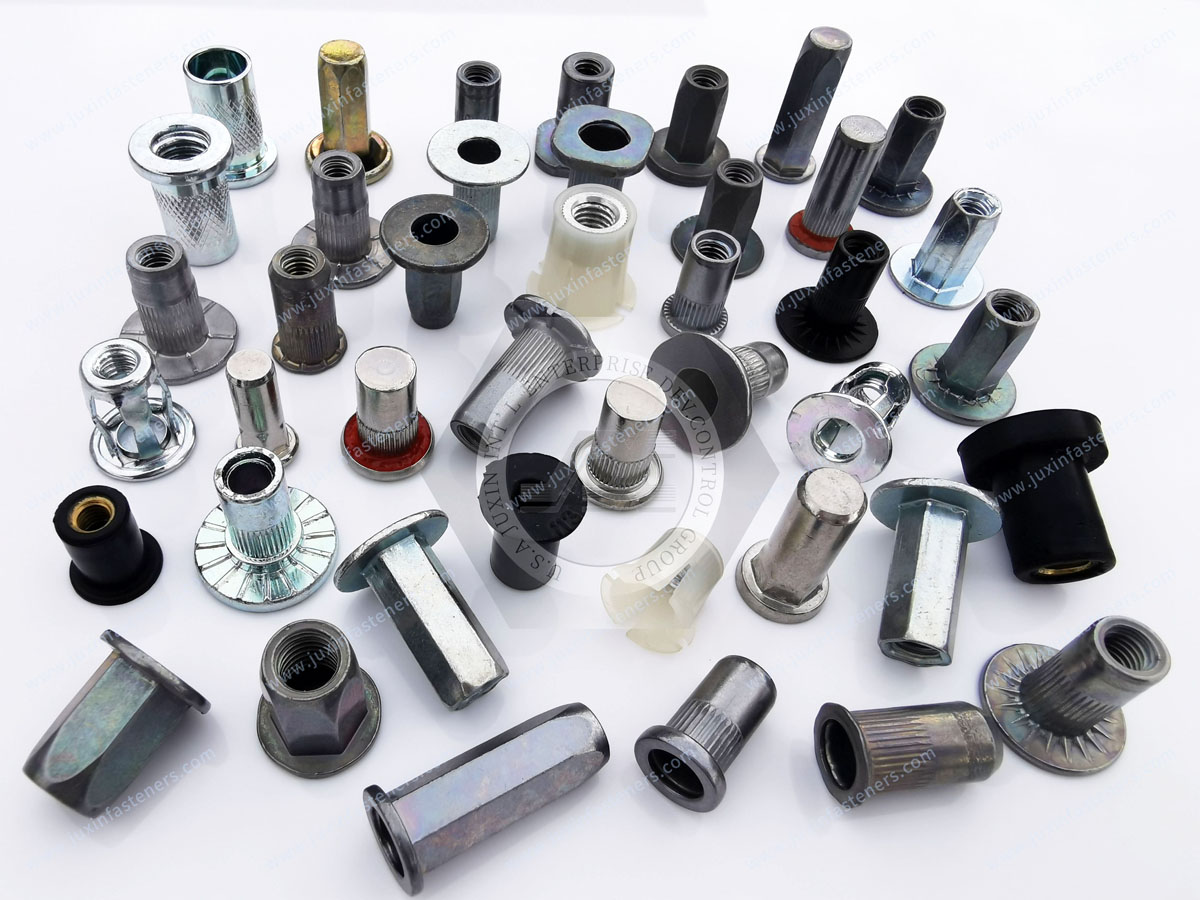
 MORE NEWS
Sep. 25, 2026
Sep. 25, 2026
Sep. 25, 2026
Contact Us
Tel.:
+86 020 8621 0320
+86 020 3121 6067
E-mail:
Technical Support:
Navigation
SEND INQUIREY