
Call Us
+86 136 6007 9809
Call Us
+86 136 6007 9809

Sep. 27, 2026
Nylon hex nuts and plastic threaded nuts are used in industrial assemblies where designers need a non-metallic threaded fastening option for applications involving electrical separation,
low component mass, corrosion-sensitive environments, delicate mating surfaces, or specialized equipment architectures.
Typical applications can be found in electrical equipment, electronics, switchgear, power distribution systems, instrumentation, semiconductor equipment,
telecommunications hardware, medical equipment, industrial automation, renewable energy equipment, lighting, appliances, automotive electronics, AI servers, and other OEM assemblies.
However, a plastic threaded joint should not be designed as though it were simply a metal nut manufactured from another material.
Engineering polymers behave differently from carbon steel, stainless steel, brass, or aluminum under tightening load.
Their performance can be influenced by:
thread geometry
thread pitch
nut height
thread engagement
mating screw material
tightening torque
bearing area
temperature
moisture
chemical exposure
polymer grade
sustained preload
creep and stress relaxation
vibration
assembly method
For this reason, selecting a nylon hex nut requires more than matching the nominal thread size.
A more reliable engineering sequence is:
Thread System → Mating Fastener → Joint Function → Required Clamp Load → Bearing Interface → Polymer Material → Environment → Installation Method → Validation
Juxin Fasteners supplies standard and custom nylon nuts, plastic hex nuts, wing nuts, threaded polymer components, nylon machine screws,
plastic washers, spacers, standoffs, and drawing-based plastic fastening components for industrial OEM applications.
Engineering and procurement teams can submit an existing part number, physical sample, 2D drawing, 3D CAD model, thread specification,
material requirement, mating hardware information, or application details for evaluation.
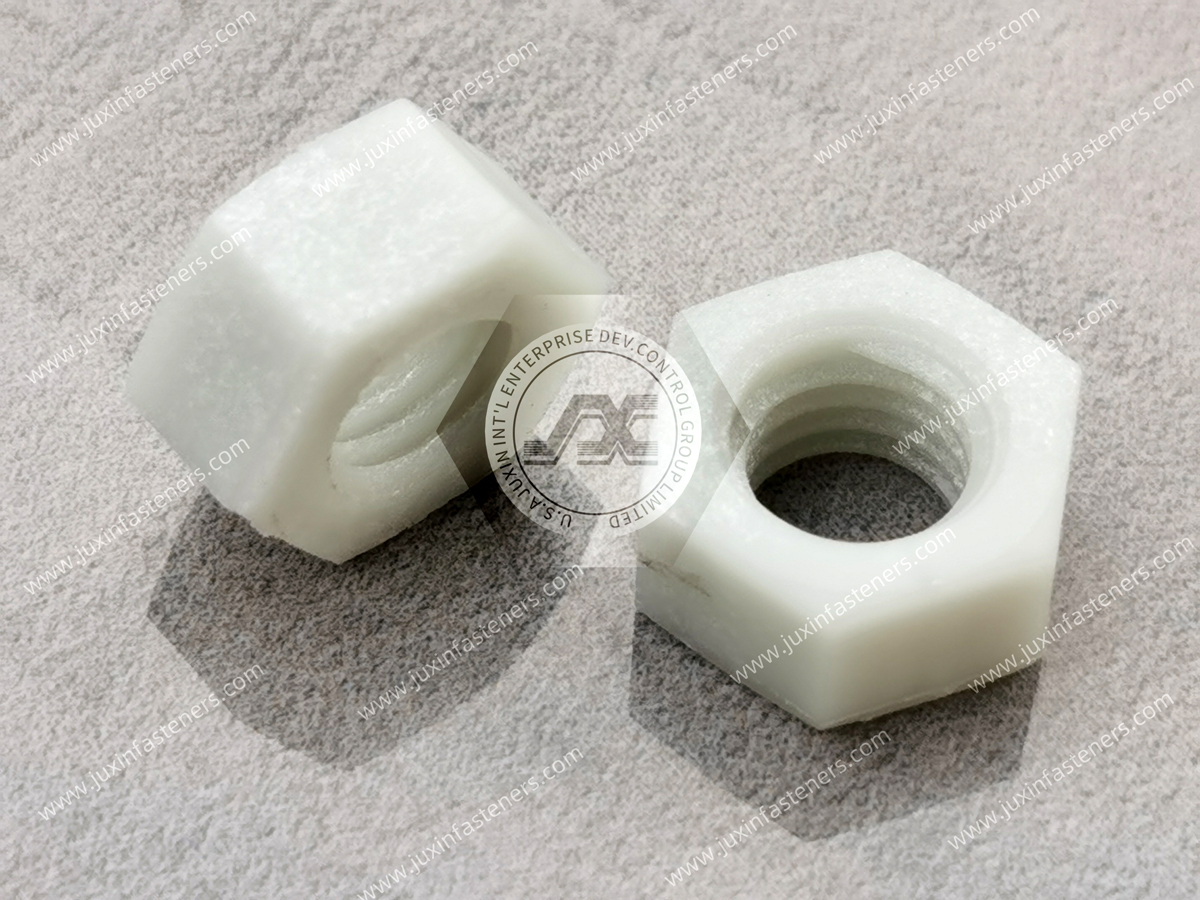
Plastic threaded nuts can provide useful engineering characteristics where metallic hardware is not the preferred solution.
Depending on the selected polymer and application, potential reasons for using a plastic nut include:
non-metallic fastening
electrical separation
reduced component mass
resistance to selected corrosive environments
reduced risk of scratching sensitive mating surfaces
reduced thermal conduction compared with many metals
compatibility with other plastic hardware
equipment-specific material requirements
tool-free adjustment in wing-nut or thumb-nut configurations
These benefits are application dependent.
A plastic nut should not automatically be considered an electrical safety device, universal corrosion solution, vibration-locking fastener, or direct mechanical substitute for a metal nut.
The complete joint must be evaluated.
Metal fasteners are often designed around relatively high stiffness and controlled elastic preload.
Polymer threaded fasteners are viscoelastic.
That means their mechanical response can change with:
load
time
temperature
moisture
material conditioning
A nylon nut may initially develop acceptable clamp load during installation and then experience some preload reduction as the polymer relaxes under sustained stress.
This creates an important design distinction:
Initial Tightening Condition ≠ Long-Term Joint Condition
The amount of change depends on the material, geometry, temperature, moisture, initial stress, mating hardware, and application.
Plastic threaded nuts are available in several functional architectures.
The correct configuration depends on how the joint is assembled, loaded, accessed, and serviced.
Nylon hex nuts use an external hex profile for wrench or socket engagement.
They may be used in:
electrical assemblies
electronics
instrumentation
equipment panels
PCB-related assemblies
light-duty mechanical assemblies
non-metallic fastening systems
Available thread systems depend on the product family and specification.
Metric and Unified thread configurations should be identified explicitly rather than assumed from nominal diameter alone.
Nylon wing nuts incorporate molded wings for manual tightening.
They can be useful in assemblies requiring:
tool-free adjustment
frequent access
removable covers
laboratory equipment
test fixtures
instrumentation
modular equipment
Wing geometry affects the amount of manual torque a user can apply.
The design should therefore balance:
Grip Accessibility → Manual Tightening → Required Retention → Risk of Over-Tightening
A wing nut should not automatically be assumed suitable for a vibration-critical joint merely because it can be tightened by hand.
Thumb nuts or knurled plastic nuts provide another tool-free fastening option.
They may be useful where wing clearance is restricted or where a compact manual adjustment interface is required.
Selection considerations include:
outside diameter
grip texture
thread size
available hand clearance
required tightening effort
frequency of adjustment
service requirements
A molded flange increases the bearing area under the nut.
This can help distribute load over a larger surface.
Flanged plastic nuts may be useful when mating against:
polymer housings
sheet materials
softer substrates
components where local bearing stress should be reduced
However, a flange does not automatically prevent loosening.
Load Distribution and Anti-Loosening Are Different Functions.
Some polymer nut designs may incorporate prevailing-torque or other locking geometry.
These should be evaluated according to their actual design and validation requirements.
The term “lock nut” should not be applied generically to a standard nylon hex nut.
Likewise, a plastic nut should not be assumed vibration resistant simply because the polymer provides friction.
Correct thread identification is fundamental.
Common projects may use metric or Unified thread systems.
Depending on the application, engineering information can include:
nominal thread diameter
thread pitch or threads per inch
internal thread form
mating external thread
thread engagement
nut height
tolerance requirements
Examples may include metric thread designations such as M3, M4, M5, M6 or other sizes, and Unified thread designations used in North American equipment.
The actual product specification should always be confirmed.
Two nuts can share a similar nominal diameter while using different thread pitches.
Incorrect pitch matching can result in:
inability to assemble
cross-threading
damaged polymer threads
poor engagement
reduced load capacity
An RFQ should therefore specify the complete thread designation whenever possible.
A plastic nut may be paired with:
a nylon machine screw
another polymer screw
stainless steel screw
steel screw
threaded stud
application-specific threaded component
Each combination creates a different joint.
For example:
Plastic Nut + Plastic Screw
and
Plastic Nut + Metal Screw
should not automatically be assigned the same installation torque or expected failure mode.
The relative stiffness and strength of the mating threads matter.
When a metal screw is used with a polymer nut, the metal external thread may be substantially stronger and stiffer than the molded internal thread.
In such a joint, one possible limiting failure mode is damage to the polymer female thread.
Potential issues include:
thread stripping
local deformation
excessive bearing stress
over-tightening
long-term preload relaxation
Torque should therefore be limited by the plastic joint rather than by the capability of the metal screw.
When both threaded components are polymer, additional variables can include:
deformation of both thread sets
friction behavior
material conditioning
thread damage
head or drive failure
tensile failure of the screw
nut thread stripping
The complete fastener pair should be evaluated together.
Thread engagement is important because load is transferred through the engaged threads.
However, there is no universal rule that every plastic nut requires thread engagement equal to 1.5D, 2D, or another fixed multiple of nominal diameter.
Required engagement depends on:
nut material
screw material
thread size
thread pitch
thread geometry
nut height
required clamp load
temperature
moisture
expected service life
failure mode
Therefore:
Thread Engagement Requirement ≠ Universal Diameter Multiple
For critical applications, the appropriate engagement should be established through engineering analysis and assembly validation.
The assembly should provide sufficient usable engagement for the intended joint.
However, simply maximizing screw protrusion beyond the nut does not automatically increase joint performance once the functional thread engagement has been achieved.
Design teams should consider:
available nut thread length
mating screw length
surrounding clearance
assembly sequence
service access
One of the most common questions is:
“What torque should I use for an M4 or M6 nylon nut?”
There is no responsible universal answer based only on nominal thread size.
Torque depends on:
polymer grade
nut geometry
screw material
thread condition
pitch
lubrication or contamination
washer configuration
bearing surface
temperature
moisture condition
required clamp load
installation speed
assembly tool
Therefore, Juxin Fasteners should not publish one universal torque table for all nylon nuts.
The installation condition should be established for the actual fastener and joint.
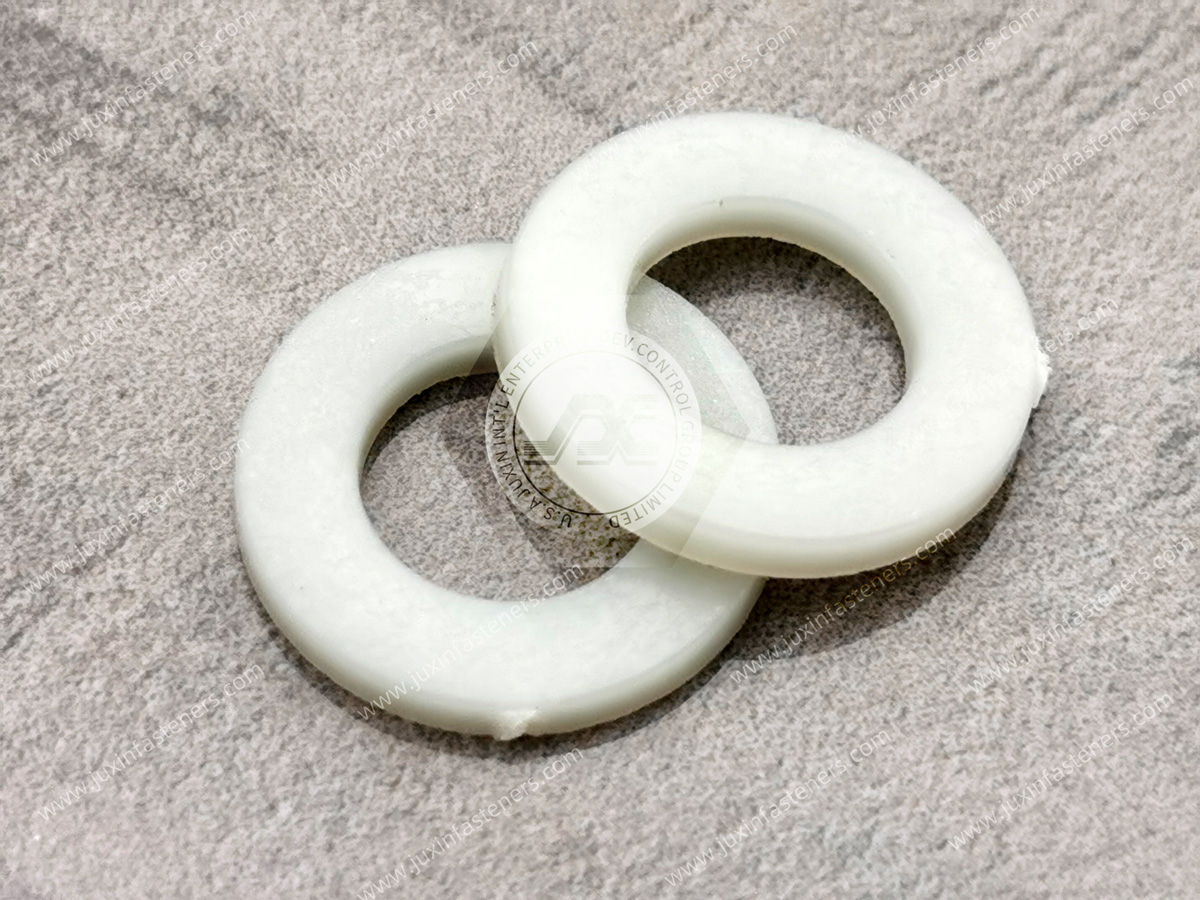
Tightening torque is only an indirect method of generating preload.
A simplified relationship is:
Applied Torque → Thread Friction + Bearing Friction + Fastener Deformation → Clamp Load
A large portion of applied torque can be consumed by friction.
This means two apparently identical assemblies can generate different clamp loads if friction conditions change.
Polymer surface behavior adds further variability.
For critical applications, engineers should focus on the required joint condition rather than torque alone.
Excessive tightening can cause:
female thread stripping
permanent thread deformation
flange deformation
bearing-surface damage
screw failure
nut cracking depending on material and geometry
Damage may not always be obvious immediately after assembly.
A component can remain assembled while its retention capability has already been reduced.
Controlled assembly is therefore important.
Where nylon nuts are installed using powered drivers, the assembly process should account for:
tool repeatability
tightening speed
torque setting
seating detection
cross-thread prevention
part orientation
thread starting
failure detection
A torque setting developed for a metal nut should not automatically be transferred to a plastic nut.
The joint interface under the nut is another critical design area.
A small bearing area can concentrate compressive stress.
This is particularly relevant when the nut seats against:
plastic housings
PCB materials
thin panels
coatings
soft insulation
composite materials
Possible strategies include:
larger nut bearing area
flange nut
suitable flat washer
larger support surface
The appropriate solution depends on the joint.
Nylon flat washers can be used with plastic nuts where a larger bearing area, non-metallic interface, spacing function, or surface protection is required.
However, adding a plastic washer also introduces another viscoelastic element into the joint.
The washer may affect:
compression
settlement
preload
creep
bearing behavior
A washer should therefore be selected as part of the complete joint architecture.
A conventional split lock washer should not be presented as a generic solution for stress relaxation in a nylon threaded joint.
Polymer creep is a time-dependent material behavior.
The appropriate response may instead involve:
reducing initial stress
increasing bearing area
changing geometry
selecting a different material
changing joint architecture
using a validated locking feature
establishing an application-specific maintenance strategy where appropriate
The solution depends on the actual failure mode.
Engineering polymers can exhibit creep under sustained load.
In a threaded joint, a simplified progression may be:
Initial Tightening → Polymer Stress → Time + Temperature → Molecular Rearrangement → Reduced Preload
This does not mean a nylon nut will automatically become loose.
It means that long-term joint behavior must be considered differently from a metal-only joint.
Higher temperatures can increase creep and stress relaxation in many polymers.
A joint operating near:
power electronics
transformers
heat sinks
lighting systems
server power supplies
industrial equipment heat sources
may behave differently from the same joint at room temperature.
Material selection and joint validation should therefore use the real operating environment.
PA66 and PA6 are commonly used engineering polyamides for plastic fasteners.
Depending on grade and application, they can provide useful combinations of:
mechanical strength
toughness
wear resistance
fatigue behavior
moldability
electrical properties
However, neither polymer family should be treated as universally suitable for every application.
The actual resin grade matters.
PA66 is widely used in industrial plastic fasteners, but product material should be confirmed.
The selection can depend on:
mechanical requirement
temperature
moisture
chemical exposure
electrical requirements
flame-performance requirements
dimensional stability
manufacturing requirements
Product descriptions should identify actual material where known rather than assuming PA66 across an entire category.
Polyamides are hygroscopic.
They absorb moisture from the surrounding environment.
Moisture conditioning can influence:
dimensions
stiffness
toughness
strength
thread fit
installation torque
creep
stress relaxation
This matters particularly where thread tolerances or joint behavior are sensitive.
Mechanical data measured in a dry-as-molded state should not automatically be assumed to represent long-term field behavior.
Conditioned nylon may behave differently.
For precision threaded assemblies, engineering teams should consider whether the expected service environment materially changes:
nut dimensions
thread fit
tightening behavior
long-term preload
The significance depends on the resin, geometry, humidity, temperature, and application.
Threaded components contain multiple interacting surfaces.
Dimensional changes can influence:
pitch-diameter relationship
running fit
friction
assembly torque
removal torque
For tightly controlled applications, environmental conditioning may therefore be relevant during validation.
Glass reinforcement can increase stiffness and modify other mechanical properties.
However, glass-filled nylon should not automatically be described as an upgrade over unfilled nylon.
Potential trade-offs can include:
reduced flexibility
altered impact behavior
different shrinkage
anisotropy
different surface characteristics
increased brittleness in some geometries
changed thread behavior
A rigid reinforced resin may be beneficial for one nut design and undesirable for another.
Material and geometry should be evaluated together.
POM may be considered for selected threaded plastic components where properties such as dimensional stability, low moisture absorption, low friction, or wear behavior are relevant.
However, material selection must still consider:
temperature
chemical exposure
flame requirements
joint load
application environment
No single polymer is universally superior.
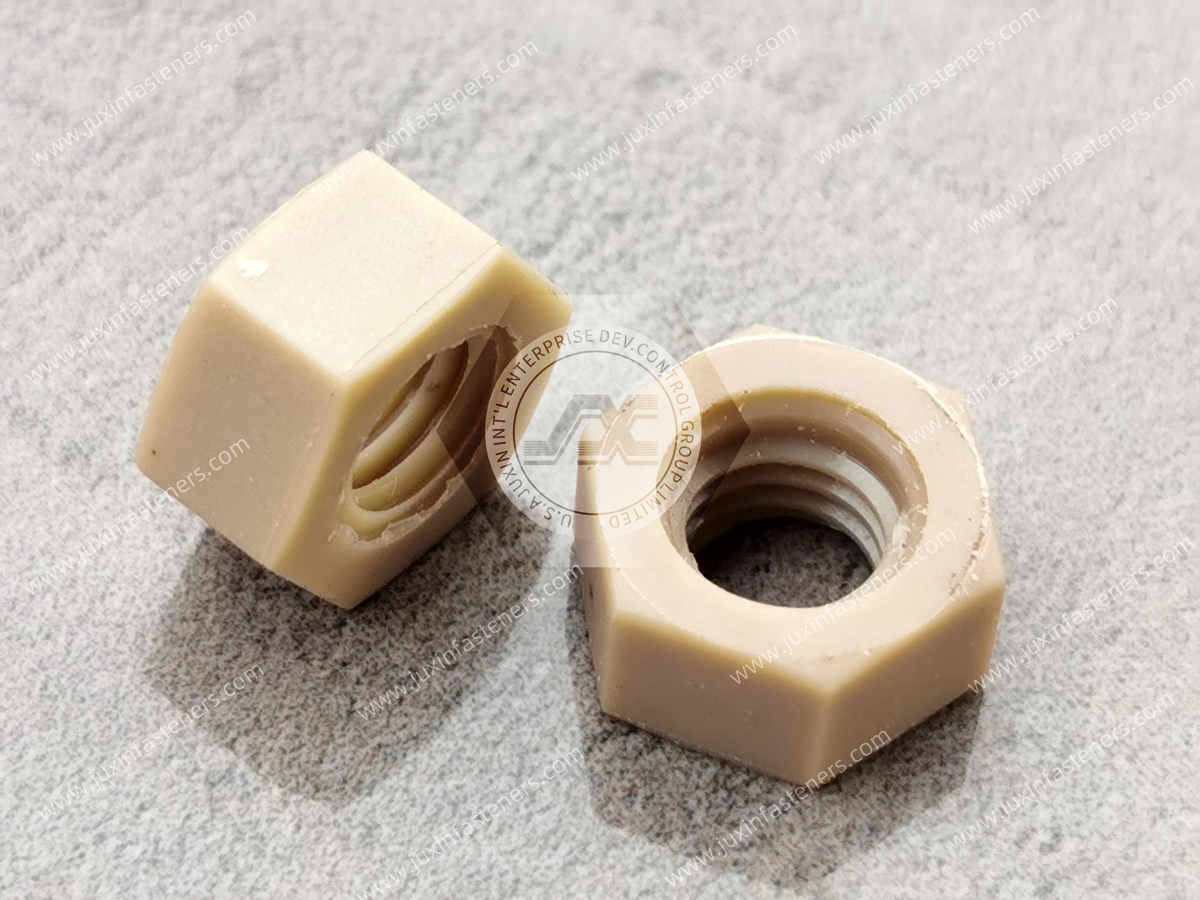
PEEK can be considered for specialized applications requiring a demanding combination of material properties.
Potential use cases may involve elevated temperature, chemical exposure, or specialized industrial environments.
However, PEEK carries different:
material costs
processing requirements
sourcing considerations
qualification requirements
It should be selected only when the application justifies its properties.
PVDF may be relevant to selected chemically demanding or specialized applications.
Its suitability depends on the actual:
chemical
temperature
mechanical
dimensional
electrical
requirements.
A generic “chemical resistant” label is not sufficient for engineering selection.
Plastic nuts can be exposed to:
oils
greases
cleaning agents
coolants
solvents
process chemicals
humidity
salt-containing environments
Compatibility should be checked against:
Specific Polymer Grade + Specific Chemical + Concentration + Temperature + Exposure Time + Mechanical Stress
This is more reliable than describing a polymer as universally chemical resistant.
Non-metallic threaded hardware can be useful where designers want to reduce direct metallic conduction paths or separate certain components mechanically.
Potential applications include:
electronics
switchgear
instrumentation
PCB assemblies
power equipment
semiconductor equipment
However:
Plastic Nut ≠ Certified Electrical Insulation System
A nylon nut does not automatically:
prevent all short circuits
establish creepage distance
establish clearance distance
provide a specified dielectric rating
certify equipment electrical safety
These depend on the material grade, geometry, voltage, environment, equipment architecture, and applicable standards.
Replacing a direct metal-to-metal interface with a polymer component can alter the electrical path between dissimilar metals.
However, it is too broad to state that a nylon nut universally “eliminates galvanic corrosion.”
Galvanic corrosion depends on:
materials
electrical contact
electrolyte
geometry
environment
Plastic hardware can contribute to isolation in a properly designed system, but the complete assembly must be evaluated.
Polymers generally have lower thermal conductivity than common structural metals.
This can be useful in some assemblies where reduced heat conduction through the fastener is desired.
However, a nylon nut should not automatically be described as a certified thermal barrier.
Thermal performance depends on:
material
geometry
joint architecture
temperature
surrounding structure
Vibration can create:
transverse joint movement
rotational movement
fluctuating load
local fretting
changes in clamp load
A standard nylon nut should not automatically be labeled vibration resistant.
The correct anti-loosening strategy depends on the joint.
Possible design approaches may involve:
appropriate preload
prevailing-torque features
flange geometry
locking architecture
joint redesign
validated assembly controls
The chosen method should be validated for the actual vibration environment.
Instead of asking only “Which nylon nut fits this screw?”, engineers can ask:
What is the likely limiting failure mode of this joint?
Possible failure modes include:
Internal polymer threads shear or deform.
The nut changes shape under tightening or sustained load.
The surface beneath the nut compresses.
Clamp load decreases over time.
The mating screw fails before the nut.
The assembly loses required retention under dynamic loading.
Temperature, moisture, chemicals, or UV alter material behavior.
The dominant failure mode determines what should be optimized.
| Design Condition | Engineering Question | Potential Selection Direction |
|---|---|---|
| Electrical equipment | Is a non-metallic fastening interface required? | Evaluate nylon or other suitable polymer nut |
| Tool-free service | Must users adjust the joint manually? | Evaluate wing or thumb nut |
| Soft mating surface | Is bearing stress a concern? | Evaluate flange or washer-supported joint |
| Elevated temperature | Will long-term polymer behavior change? | Review actual resin grade and creep behavior |
| High humidity | Can nylon conditioning affect fit or preload? | Evaluate moisture-conditioned behavior |
| Metal screw + plastic nut | Is polymer thread stripping the limiting mode? | Control installation and validate joint |
| Vibration | Is loosening a system-level risk? | Use validated locking architecture |
| Chemical exposure | Which media contact the nut? | Perform grade-specific compatibility review |
| Tight dimensional fit | Can moisture or molding variation affect threads? | Review resin, tolerances and conditioning |
This matrix is a starting point rather than a universal specification.
Nylon hex nuts and plastic threaded fasteners can be used in selected:
control panels
electronic enclosures
PCB assemblies
power supplies
instrumentation
terminal-related structures
Selection should consider electrical architecture, temperature, required clamp load, and serviceability.
Potential applications may involve:
insulating structures
control hardware
low-load auxiliary components
electronics mounting
selected enclosure assemblies
Plastic fasteners should not replace load-bearing metallic hardware unless the joint has been specifically engineered and validated for the requirement.
Semiconductor manufacturing and test equipment can require specialized polymer components.
Selection may depend on:
chemical environment
temperature
dimensional stability
cleanliness
electrical requirements
customer material specifications
The actual equipment specification should control material selection.
Potential applications include:
electronic modules
housings
instrumentation
lightweight internal assemblies
Material, cleaning environment, regulatory requirements, and mechanical loads should be defined by the equipment manufacturer.
Nylon and other polymer nuts may be considered in selected:
electronics
control equipment
sensor assemblies
low-load auxiliary hardware
Outdoor or energy-storage applications may introduce additional requirements involving temperature, UV, moisture, and flame performance.
Plastic threaded hardware may be useful in selected server and data center assemblies involving:
PCB hardware
lightweight electronics
cable-management structures
airflow hardware
serviceable modules
Temperature, material flammability requirements, thread behavior, and service access should be evaluated for the actual equipment architecture.
Applications may include:
network hardware
electronics
rack accessories
control assemblies
instrumentation
Tool-free plastic nuts may also be useful in selected serviceable interfaces.
Potential uses include:
sensors
controls
electronics
cable-management assemblies
lightweight protective components
Vibration, oils, temperature, and maintenance requirements should be considered.
Before specifying a nylon or plastic threaded nut, define:
thread system
nominal diameter
pitch or threads per inch
mating screw material
mating screw specification
required thread engagement
required clamp function
bearing surface
nut geometry
material
operating temperature
humidity
chemical exposure
vibration
electrical requirements
installation method
service/removal requirements
This information provides a more reliable selection basis than thread size alone.
Procurement teams frequently search for nylon hex nuts because they need to:
replace an existing supplier
qualify a second source
source a discontinued part
consolidate suppliers
reduce supply-chain risk
source a custom polymer nut
support a new OEM project
A technically responsible cross-reference process should compare more than the thread designation.
Useful information includes:
current manufacturer
current part number
thread designation
nut dimensions
material
color
physical sample
application
mating screw
required documentation
A candidate with the same nominal thread is not automatically a drop-in replacement.
Depending on the product, compare:
thread diameter
pitch
thread fit
nut height
width across flats
flange dimensions where applicable
material
color
molded geometry
mating screw
assembly torque
functional performance
The customer's actual mating hardware should be used where possible.
Physical samples can be useful for:
thread fit
assembly
wrench engagement
wing accessibility
seating
bearing contact
installation behavior
removal behavior
For second-source projects, testing should reproduce the actual joint rather than evaluating the nut in isolation.
Standard nylon hex nuts do not satisfy every OEM requirement.
Custom development may be considered where a project requires:
non-standard nut height
unusual hex dimensions
integrated flange
wing geometry
thumb grip
captive features
anti-rotation geometry
non-standard thread
special polymer
unique mating interface
integrated spacer or locating feature
Juxin Fasteners can review custom molded plastic threaded components from:
2D drawings
3D CAD models
physical samples
existing part numbers
mating-component information
Custom development should include DFM, material, thread, tolerance, tooling, and assembly review.
Depending on the project, procurement teams may request:
material identification
resin information
dimensional inspection
lot identification
traceability
RoHS documentation
REACH documentation
flammability information where applicable
customer-specific documentation
Documentation requirements should be specified during the RFQ.
They should not be assumed from a generic product category.
For efficient engineering and commercial evaluation, provide as much of the following as available:
existing manufacturer
existing part number
OEM internal part number
drawing
physical sample
thread system
nominal thread size
thread pitch / TPI
nut height
width across flats
flange dimensions where applicable
wing dimensions where applicable
mating screw material
mating screw specification
required material
color
operating temperature
humidity / moisture exposure
chemical exposure
electrical requirements
vibration conditions
required clamp function
installation method
expected tightening control
removal / service requirements
required compliance documentation
sample quantity
order quantity
estimated annual volume
packaging requirements
For a new design:
Joint Requirement → Thread System → Mating Screw → Load & Bearing Review → Material Selection
→ Environmental Review → Nut Geometry → Sample → Assembly Validation → Production RFQ
For a second-source project:
Existing Part → Thread & Dimensional Review → Material Review → Mating Hardware Review
→ Candidate Cross-Reference → Physical Sample → Assembly Validation → Supplier Qualification → Production RFQ
For a custom nylon nut:
2D/3D Drawing + Application Requirements → Engineering / DFM Review → Material & Thread Review
→ Tooling → Sample → Joint Validation → Qualification → Production
Nylon nuts should normally be evaluated as part of the complete fastening system.
Related Juxin Fasteners product pathways include:
Nylon Machine Screws for non-metallic threaded fastening assemblies
Nylon Flat Washers for bearing-area distribution, spacing, and selected isolation interfaces
Plastic Spacers and Standoffs for controlled component spacing
Snap-Fit PCB Supports for tool-efficient circuit board mounting
Custom Molded Plastic Fasteners for non-standard nut geometry and integrated polymer components
AI Server Plastic Hardware for high-density electronics and data center equipment
EV Battery Pack Plastic Fasteners for selected electrical, cable-routing, and auxiliary EV hardware applications
These pages should be cross-linked according to the actual assembly problem rather than simply by product category.
Juxin Fasteners supplies standard and custom nylon nuts, plastic hex nuts, nylon wing nuts, plastic threaded components,
nylon machine screws, washers, spacers, standoffs, and other plastic fastening hardware for industrial OEM applications.
Engineering and procurement teams can submit:
an existing manufacturer part number
OEM internal part number
physical sample
2D drawing
3D CAD model
thread specification
mating screw information
material requirement
application environment
expected annual volume
for technical and commercial evaluation.
For new applications, the correct question is not simply:
“What torque can this nylon nut take?”
A more useful engineering question is:
“What threaded joint must this nut create, with which mating screw, at what temperature and moisture condition,
under what sustained load, and what failure mode must be prevented?”
For second-source projects, the objective is not merely to locate another plastic nut with the same nominal thread.
The objective is to verify the combination of:
Thread Compatibility + Geometry + Material + Mating Hardware + Installation + Environment + Long-Term Joint Behavior
before production qualification.
This creates a more reliable pathway from engineering selection to sample evaluation, supplier qualification, and production sourcing.
Email: info@juxinfasteners.com
Website: www.juxinfasteners.com
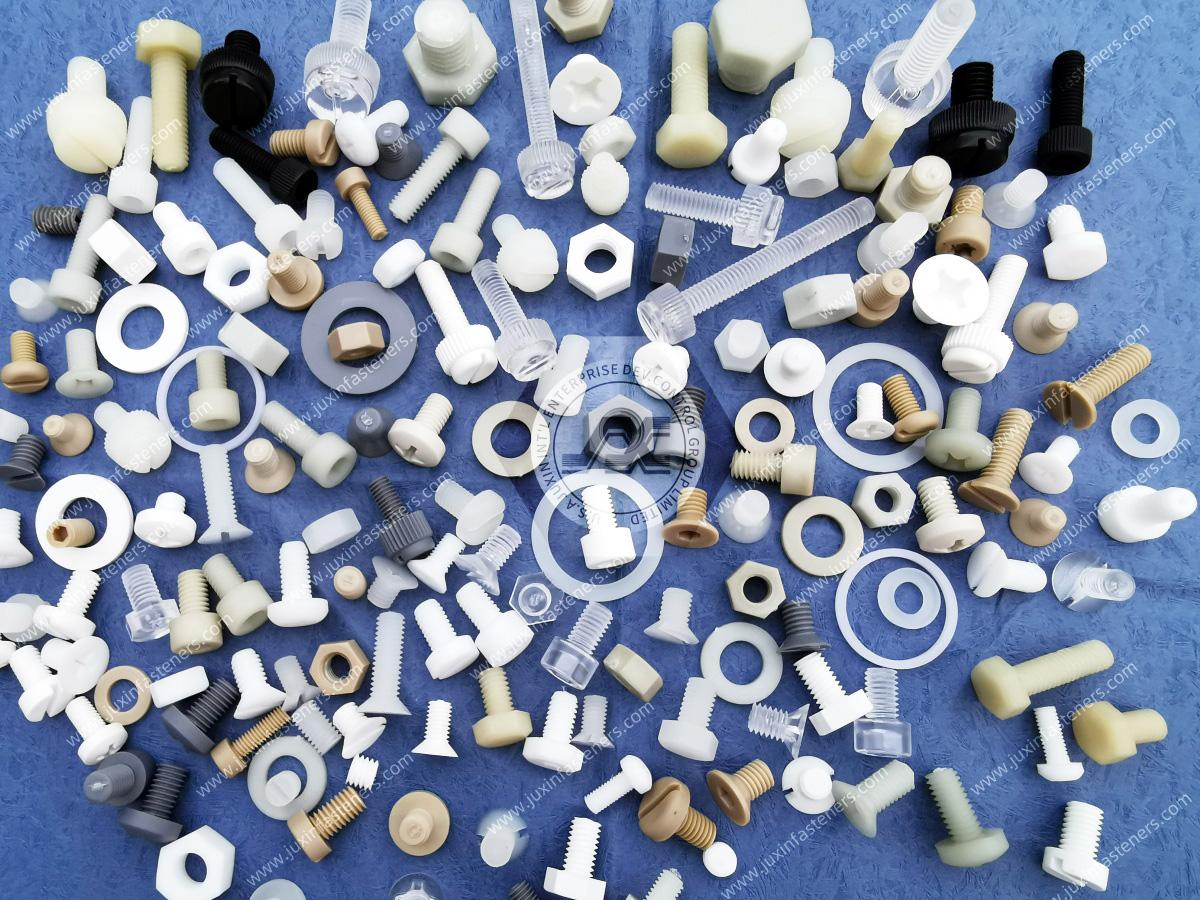
Previous: Nylon Screws, Nuts & Washers
 MORE NEWS
Sep. 27, 2026
Sep. 27, 2026
Sep. 27, 2026
Contact Us
Tel.:
+86 020 8621 0320
+86 020 3121 6067
E-mail:
Technical Support:
Navigation
SEND INQUIREY