
Call Us
+86 136 6007 9809
Call Us
+86 136 6007 9809

Sep. 27, 2026
Nylon machine screws and plastic threaded fasteners provide engineers with fastening options for assemblies requiring electrical insulation,
low weight, corrosion resistance, non-magnetic behavior, controlled contact with sensitive components, or compatibility with environments where conventional metallic hardware may be undesirable.
They are widely used in electronics, electrical equipment, switchgear, semiconductor equipment, telecommunications infrastructure,
data-center hardware, medical equipment, laboratory instruments, industrial automation, robotics, lighting, automotive electronics, energy-storage equipment, renewable-energy systems, appliances, and instrumentation.
Unlike steel or stainless steel screws, however, polymer threaded fasteners cannot be selected simply by replacing a metal screw with an identically sized plastic component.
The mechanical behavior is fundamentally different.
A successful polymer threaded joint depends on the interaction between:
polymer material + screw geometry + thread size and pitch + mating thread + tightening method + required clamp load + temperature + moisture + chemical environment + sustained loading + service life
Juxin Fasteners supplies standard and custom nylon machine screws and other engineered polymer fasteners for industrial OEM applications.
Engineering and procurement teams can submit existing part numbers, physical samples, 2D drawings, 3D models, thread specifications, material requirements,
and application conditions for cross-reference evaluation, sample development, second-source qualification, or custom manufacturing review.
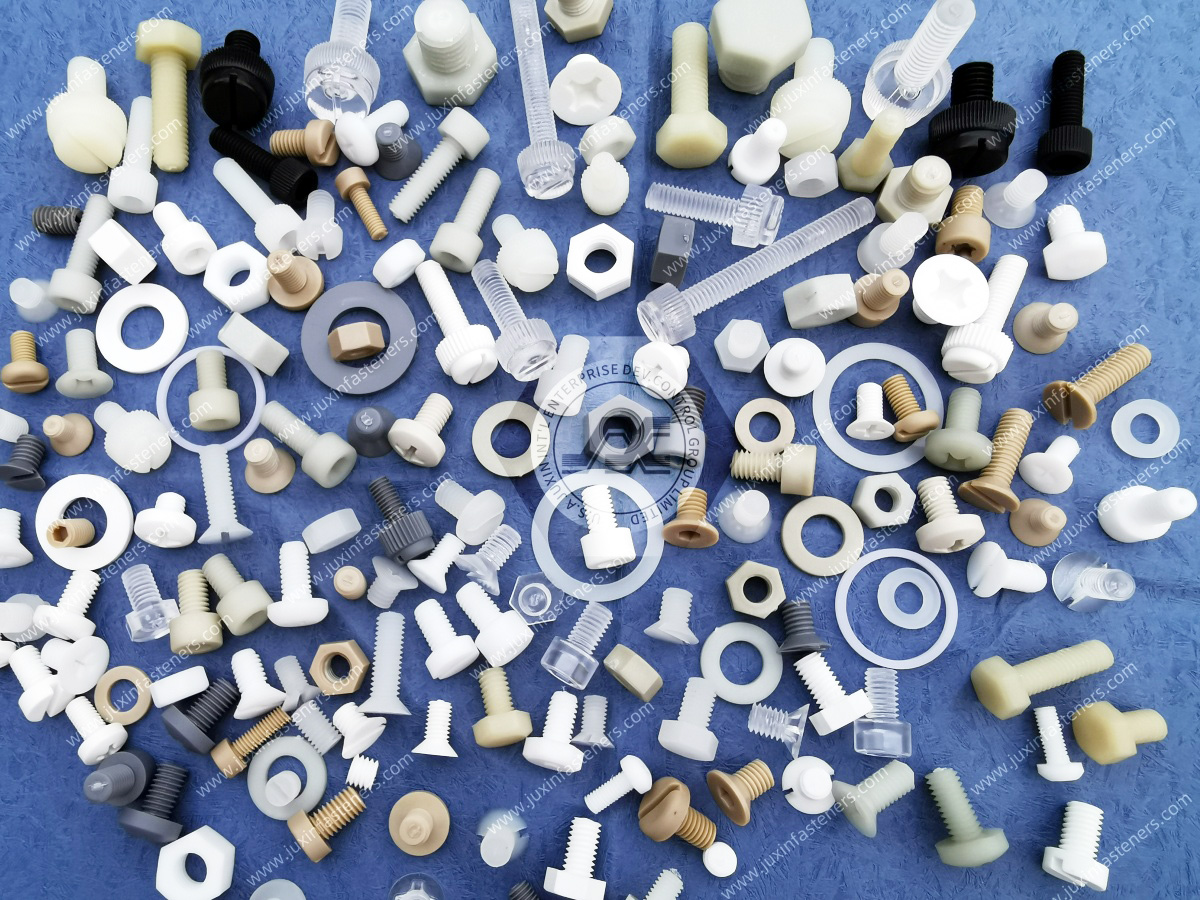
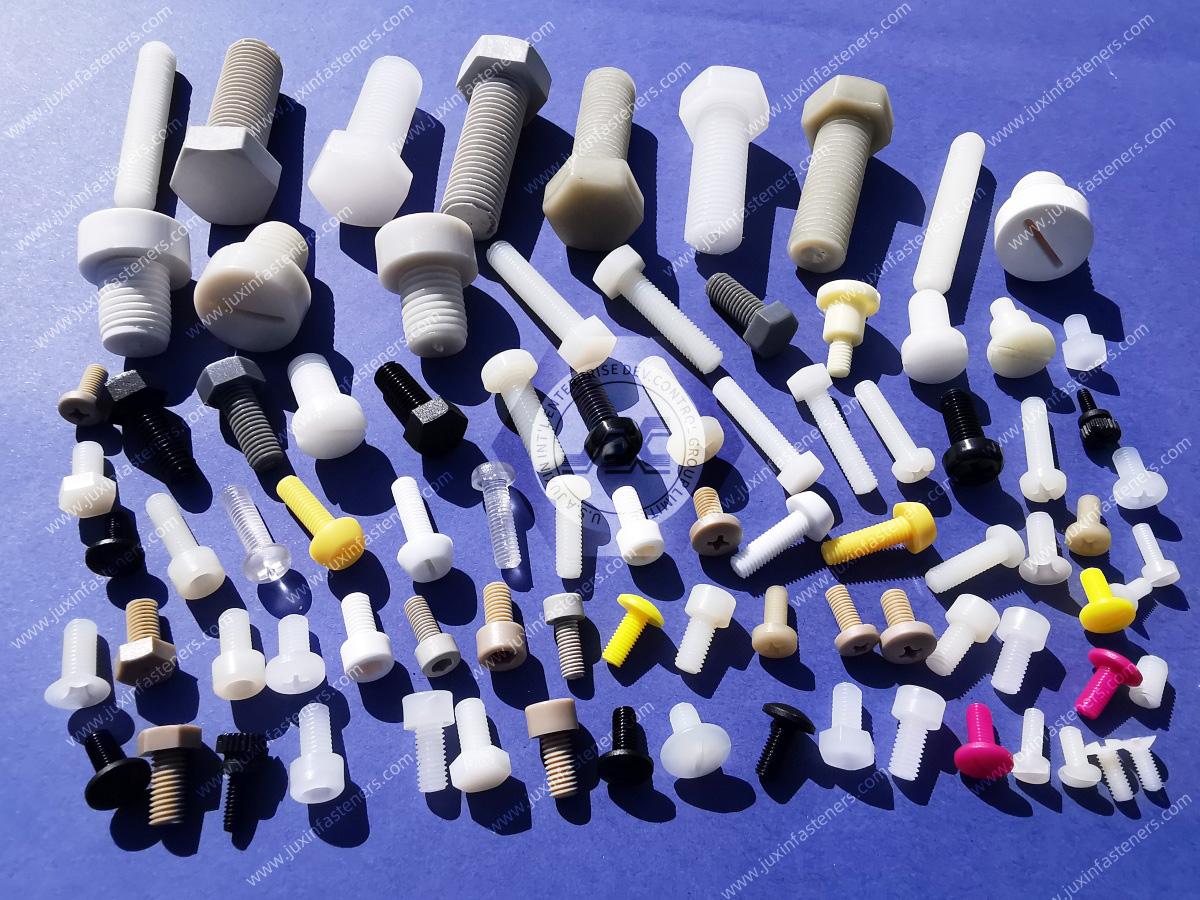
A nylon machine screw is a threaded fastener manufactured from nylon or another specified polymer and designed to engage with a compatible internal thread, nut, threaded insert, or other mating feature.
Common configurations include:
Pan head screws
Hex head screws
Slotted screws
Phillips drive screws
Socket-style designs where applicable
Countersunk or flat head screws
Round head screws
Thumb screws
Knurled-head screws
Studs and threaded rods
Customer-specific molded or machined threaded fasteners
Metric and inch-series threads may be available depending on the product family and application.
The term "plastic screw" should not be treated as one material specification. Nylon, PEEK, PVDF, and other engineering polymers have significantly different mechanical, thermal, moisture, chemical, and dimensional characteristics.
Material selection must therefore be treated as part of the joint design.
Plastic threaded fasteners are generally selected because they provide one or more functional advantages that a conventional metallic fastener may not provide as easily.
Potential reasons include:
Electrical insulation
Galvanic isolation
Corrosion resistance
Low weight
Non-magnetic behavior
Reduced risk of scratching sensitive surfaces
Chemical compatibility for selected environments
Reduced thermal conduction
Compatibility with lightweight polymer assemblies
Tool-free access with specialized head designs
These benefits do not mean plastic screws are universal replacements for metal fasteners.
Applications requiring high structural preload, high tensile capacity, severe impact resistance,
or high-temperature mechanical performance may require metallic hardware or a higher-performance engineered polymer specifically validated for the application.
Pan head screws combine a relatively broad bearing surface with a compact head profile.
They are commonly used in:
Electronics
Electrical enclosures
Instrumentation
PCB-related equipment
Control systems
Lightweight equipment housings
The larger bearing surface can help distribute contact load, but allowable tightening load still depends on the screw material, mating component, and joint design.
Hex head plastic screws can be installed with conventional wrench or socket tooling.
They are useful where:
External wrench access is convenient
Drive recess damage is undesirable
Assembly tools are standardized around hex heads
Larger head bearing surfaces are useful
A hex head does not mean the polymer screw can safely accept metallic-bolt torque levels. The allowable installation torque remains limited by the polymer,
thread geometry, screw diameter, head-to-shank transition, and mating joint.
Slotted and cross-recess drive configurations are widely used in electrical, electronics, appliance, and instrumentation assemblies.
They provide familiar installation interfaces for manual and automated production.
Drive selection should consider:
Required installation torque
Driver alignment
Risk of recess damage
Automated assembly
Service access
Cosmetic requirements
Thumb screws provide manual adjustment or removal without conventional tools.
Applications can include:
Test equipment
Laboratory instruments
Electronic enclosures
Server and telecommunications equipment
Inspection covers
Adjustable components
Where repeated service cycles are expected, both the external thread and mating internal thread should be evaluated for wear and long-term durability.
Polyamide 66, commonly known as PA66 or nylon 66, is widely used for molded industrial fasteners.
Depending on grade and application, PA66 can provide a useful balance of:
Mechanical strength
Toughness
Fatigue resistance
Wear resistance
Electrical insulation
Moldability
Low component weight
PA66 is therefore frequently used for general-purpose nylon screws, nuts, washers, spacers, standoffs, and related fastening components.
However, PA66 is not one single engineering condition.
Different formulations can include:
Unfilled nylon
Heat-stabilized grades
Impact-modified grades
Flame-retardant grades
UV-stabilized grades
Reinforced formulations
Other application-specific compounds
The exact resin grade should be selected according to the application rather than assuming that all PA66 fasteners provide identical performance.
Glass reinforcement can substantially alter nylon's stiffness, strength, dimensional behavior, and thermal response.
This can be useful in selected applications.
However, increasing stiffness also changes the way a threaded fastener behaves during tightening and service.
Potential engineering considerations include:
Reduced elongation
Changed torsional behavior
Increased brittleness in some conditions
Different thread-forming and molding behavior
Different surface interaction
Increased abrasiveness toward mating components
Direction-dependent properties related to fiber orientation
A glass-filled nylon screw should therefore not automatically be substituted for an unfilled nylon screw merely because the reinforced material has higher published tensile properties.
The finished fastener and complete joint must be evaluated.
PEEK is a high-performance engineering thermoplastic used where standard nylon may not provide sufficient thermal, chemical, dimensional, or mechanical performance.
Potential applications include:
Semiconductor equipment
Electronics manufacturing equipment
Laboratory systems
Chemical-processing equipment
Medical and analytical equipment
High-temperature electrical assemblies
PEEK fasteners can provide valuable performance in demanding environments, but the exact grade and finished-component design remain important.
PEEK should not be presented simply as "stronger nylon." It is a different engineering polymer with a different performance and cost profile.
PVDF can be considered where chemical resistance, corrosion resistance, and electrical characteristics are important.
Potential applications can include:
Chemical equipment
Semiconductor processing
Fluid-handling equipment
Laboratory equipment
Selected electrical systems
Its mechanical behavior differs from both nylon and PEEK.
Material selection should therefore begin with the application's actual chemical, thermal, mechanical, and electrical requirements rather than a generic material hierarchy.
A useful material-selection sequence is:
Application environment → mechanical requirement → electrical requirement → chemical exposure
→ temperature → moisture → dimensional requirement → candidate polymer → fastener geometry → joint validation
This is more reliable than selecting a familiar nylon screw first and attempting to make the material fit the application afterward.
PA66 is hygroscopic and absorbs moisture from the surrounding environment.
Moisture can influence:
Dimensions
Stiffness
Strength
Toughness
Thread fit
Tightening behavior
Creep
Stress relaxation
Electrical properties
Conditioned nylon generally behaves differently from dry-as-molded material.
For a threaded fastener, this can affect more than simple dimensional fit.
Changes in stiffness and dimensions can alter:
Torque response
Clamp-load development
Thread engagement
Head seating
Long-term preload retention
Where dimensional stability or joint performance is critical, engineers should consider the environmental condition in which the fastener will actually operate.
ISO 62 may be relevant when characterizing water absorption behavior of plastic materials. Material mechanical properties may also be evaluated using applicable ISO or ASTM polymer test methods.
Material-level test data, however, should not be confused with finished-joint performance.
Temperature can influence a polymer fastener's:
Modulus
Strength
Creep rate
Stress-relaxation rate
Dimensions
Thread behavior
Clamp-load retention
A nylon screw that performs satisfactorily during room-temperature assembly may behave differently after prolonged operation at elevated temperature.
Likewise, low-temperature conditions can change toughness and installation behavior.
For this reason, a generic "maximum temperature" should not be used as the sole selection criterion for a threaded polymer joint.
The design should consider:
Continuous operating temperature
Short-duration temperature peaks
Thermal cycling
Applied mechanical load
Material grade
Required service life
One of the most important differences between metallic and polymer threaded fasteners is the relationship between applied torque and useful joint preload.
Installation torque is consumed by several mechanisms, including:
Thread friction
Head-bearing friction
Torsional deformation of the screw
Elastic deformation
Local deformation of mating components
The torque value alone therefore does not directly describe the clamp load generated by a nylon screw.
Changes in:
Lubrication
Surface finish
Moisture condition
Mating material
Washer material
Thread tolerance
Assembly speed
can alter the torque-preload relationship.
For critical assemblies, tightening limits should be established through testing of the actual screw and mating joint rather than copied from a generic torque table.
A metal screw and a nylon screw of the same nominal thread size do not have equivalent torsional, tensile, or preload capability.
Applying a metallic fastener torque specification to a nylon screw can result in:
Thread stripping
Twisted shank
Head failure
Neck fracture
Mating-thread damage
Excessive joint compression
Permanent deformation
Installation specifications should therefore be based on the actual polymer fastener, thread size, geometry, material condition, mating component, and application.
A nylon screw can fail before the intended clamp load is achieved if the applied installation torque exceeds its torsional capability.
Possible failure locations include:
Drive recess
Head
Head-to-shank transition
Threaded shank
First engaged thread
Failure location can provide useful information during root-cause analysis.
For example, repeated drive damage may indicate a tooling or recess problem, while shank twisting can indicate excessive tightening torque or an unsuitable fastener material for the required preload.
Thread stripping can occur in:
The plastic screw
A plastic nut
A tapped polymer component
Another relatively soft mating thread
The failure mode depends on:
External thread material
Internal thread material
Thread geometry
Thread engagement
Diameter
Pitch
Tolerance
Temperature
Moisture
Applied load
This means that a screw cannot be evaluated independently from its mating thread.
A common engineering shortcut is to specify one universal thread-engagement length as a multiple of nominal screw diameter.
That approach can be misleading for polymer joints.
Required engagement depends on the relative strength and geometry of both mating components.
For example:
nylon screw into metal nut
behaves differently from:
nylon screw into nylon nut
which behaves differently again from:
nylon screw into a tapped molded-plastic boss
or:
polymer screw into a threaded insert
Thread engagement should therefore be established using:
Material properties
Thread geometry
Internal-thread strength
External-thread strength
Required axial load
Temperature
Long-term loading
Application validation
There is no single engagement ratio that should be presented as correct for all plastic threaded assemblies.
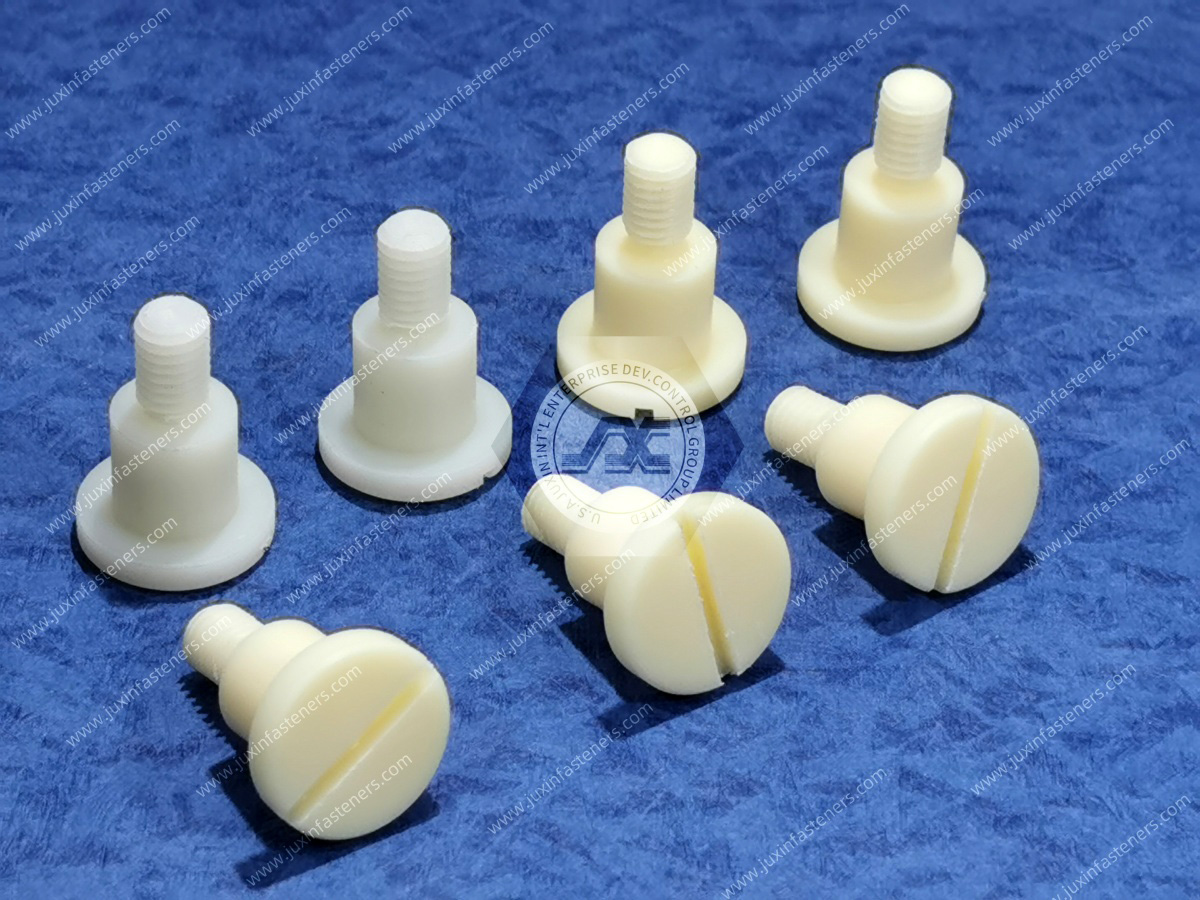
If the receiving component is plastic, engineers must decide whether the joint should use:
Molded internal thread
Machined or tapped thread
Thread-forming fastener
Heat-installed insert
Ultrasonically installed insert
Press-in insert
Molded-in insert
Captive nut
Separate polymer nut
The correct solution depends on:
Assembly load
Required service cycles
Host polymer
Wall thickness
Boss geometry
Production process
Temperature
Required durability
Repeated assembly and disassembly may favor an insert rather than repeatedly loading a relatively soft plastic internal thread.
Polymers are viscoelastic materials.
Under sustained stress, time-dependent deformation can occur.
This means that the initial clamp load generated during installation may decrease over time because of:
Screw creep
Stress relaxation
Compression of plastic joint members
Creep of the mating thread
Gasket relaxation
Temperature exposure
Moisture conditioning
The complete joint stack must therefore be considered.
A polymer screw installed into a metal nut can still lose joint preload if the clamped components themselves are polymeric and relax under compression.
A lock washer may provide useful functionality in some assemblies, but it should not be treated as a universal solution to clamp-load loss caused by polymer creep.
Likewise, routine retightening is not always practical or appropriate for OEM products.
More robust design strategies may include:
Reducing required sustained preload
Selecting a more dimensionally stable polymer
Using a compliant joint element where appropriate
Increasing bearing area
Redesigning the joint geometry
Using a metallic insert or compression limiter
Selecting a different fastening architecture
The appropriate approach depends on why clamp load is required in the first place.
Polymer screws and polymer joint members can deform under concentrated bearing pressure.
Head geometry and washer selection can therefore influence joint performance.
A larger bearing area can help distribute load over:
Plastic housings
PCB-related components
Insulating sheets
Composite materials
Lightweight panels
However, increasing head or washer area does not eliminate the need to control tightening force.
Plastic washers can provide:
Electrical isolation
Surface protection
Load distribution
Separation between dissimilar materials
Reduced direct metal contact
For assemblies requiring electrical insulation, a nylon screw combined with a plastic washer may provide additional isolation at the bearing interface.
The complete current path must still be evaluated at system level.
One of the strongest reasons to specify nylon machine screws is their electrically insulating nature relative to metallic hardware.
Potential applications include:
Circuit assemblies
Switchgear
Power distribution equipment
Sensors
Instrumentation
Telecommunications equipment
Semiconductor equipment
Battery-related electronics
Control systems
However, using an insulating screw alone does not automatically establish the required creepage distance, clearance, dielectric performance, or equipment-level electrical safety.
Those requirements must be evaluated within the complete electrical design.
Metallic fasteners can create conductive contact between dissimilar metals.
A polymer fastener can help interrupt direct metallic contact in appropriate designs.
This can be useful where components include combinations such as:
Aluminum
Copper
Stainless steel
Coated sheet metal
Other conductive materials
However, galvanic corrosion is a system-level electrochemical issue involving materials, electrolytes, geometry, coatings, and conductive paths.
A plastic screw should therefore be considered one possible isolation component rather than a universal corrosion solution.
Polymers generally conduct substantially less heat than common metallic fastener materials.
Plastic threaded fasteners can therefore be useful where minimizing conductive heat transfer through the fastener is desirable.
Potential applications include:
Electronics
Sensors
Instrumentation
Thermal-control assemblies
Laboratory equipment
The contribution of the fastener to overall thermal performance should still be evaluated within the complete assembly.
Polymer fasteners can offer excellent corrosion resistance because they do not rust like carbon steel.
Chemical resistance, however, is material-specific.
PA66, PEEK, PVDF, and other polymers respond differently to:
Acids
Alkalis
Solvents
Oils
Fuels
Cleaning chemicals
Process fluids
Compatibility also depends on:
Concentration
Temperature
Exposure duration
Applied stress
For chemically demanding applications, the exact resin should be reviewed against the actual exposure environment.
Nylon machine screws can be used in:
Electrical enclosures
Terminal assemblies
Insulating panels
Sensors
Control modules
Lightweight covers
Instrument housings
Selected PCB-related assemblies
Their combination of low weight and electrical insulation can be valuable where high structural preload is not required.
Potential uses include:
Insulating barriers
Lightweight internal components
Control assemblies
Non-load-bearing covers
Instrumentation
Material flammability, temperature, electrical properties, and equipment-specific requirements should be confirmed for the exact application.
Semiconductor equipment can require fasteners offering:
Electrical isolation
Chemical resistance
Low magnetic interference
Corrosion resistance
High-temperature capability
Dimensional stability
Depending on the environment, PA66 may be suitable for some applications, while PEEK, PVDF, or another engineered polymer may be evaluated for more demanding conditions.
Material cleanliness and customer-specific requirements should be specified during sourcing.

Plastic threaded fasteners may be used in:
Diagnostic equipment
Laboratory instruments
Analytical devices
Electronic housings
Non-magnetic equipment
Fluid-handling systems
The term "medical equipment" covers very different risk and regulatory environments.
Material biocompatibility, sterilization compatibility, cleanliness, or regulatory requirements should never be assumed merely because a polymer fastener is used in medical equipment.
These requirements must be specified by the customer where applicable.
Nylon machine screws can support:
Network equipment
Communication enclosures
Rack-mounted electronics
Cable-management assemblies
Airflow components
Sensor assemblies
Insulating components
Material selection should consider operating temperature, electrical requirements, flammability requirements, service access, and expected mechanical loading.
Potential applications include:
Sensors
Electronic modules
Control housings
Insulating mounts
Lightweight guards
Instrumentation
Cable-management systems
Where fasteners are located on moving machinery, vibration, acceleration, repeated service cycles, and cable loads should be included in the design review.
Polymer threaded fasteners can be relevant to:
Electronic control units
Sensors
Interior electronic assemblies
Low-load insulating components
Selected battery-system auxiliary components
Cable-management assemblies
Application-specific thermal, electrical, chemical, vibration, and flammability requirements should be defined before selecting the polymer.
Potential applications include:
Inverters
Control equipment
Monitoring systems
Battery electronics
Electrical enclosures
Sensor assemblies
Insulating structures
Electrical isolation can be valuable, but mechanical and thermal requirements must still be evaluated for each joint.
An efficient engineering decision path is:
Is the primary requirement:
Electrical insulation?
Corrosion resistance?
Low weight?
Chemical resistance?
Thermal isolation?
Non-magnetic behavior?
Surface protection?
Determine:
Axial load
Required clamp load
Shear load
Vibration
Shock
Expected service life
Number of assembly cycles
Identify:
Metal nut
Nylon nut
Molded plastic thread
Machined plastic thread
Metal threaded insert
Captive nut
Other mating feature
Specify:
Temperature
Moisture
Chemical exposure
UV exposure
Electrical requirements
Evaluate PA66, PEEK, PVDF, or another appropriate material based on the actual requirement.
Confirm:
Metric or inch thread
Diameter
Pitch
Length
Threaded length
Head style
Drive
Bearing area
Define the installation method and validate an appropriate torque or other installation-control strategy for the actual assembly.
Test representative components under relevant mechanical and environmental conditions.
Investigate:
Excessive torque
Incorrect driver
Thread interference
Material condition
Head-to-shank geometry
Assembly speed
Investigate:
Insufficient engagement
Weak mating material
Incorrect thread
Excessive torque
Temperature
Moisture condition
Investigate:
Creep
Stress relaxation
Thermal cycling
Moisture
Joint-member compression
Vibration
Inadequate preload strategy
Investigate:
Moisture absorption
Dimensional change
Thread tolerance
Mating-material dimensional behavior
Investigate:
Excessive bearing pressure
Insufficient head area
Excessive tightening
Need for an appropriate washer
Weak or thin joint material
This diagnostic approach is more useful than simply replacing one plastic screw with another of the same nominal thread size.
For existing production assemblies, procurement teams often require a second source for an established nylon screw.
Useful information includes:
Existing manufacturer
Existing part number
Thread designation
Length
Head style
Drive
Material
Color
Drawing
Physical sample
A proper cross-reference should compare:
Major geometry
Thread
Head dimensions
Drive dimensions
Material grade
Dimensional tolerances
Installation behavior
Environmental requirements
Documentation requirements
A visually similar plastic screw should not automatically be considered a functional equivalent.
Standard screws are appropriate where existing dimensions and materials satisfy the application.
Custom development may be required for:
Non-standard length
Partial thread
Special head diameter
Reduced head
Shoulder geometry
Custom drive
Special thread
Application-specific polymer
Special color
Integrated features
Customer-specific tolerances
Depending on geometry, material, quantity, and manufacturing route, custom plastic threaded fasteners may be molded or machined.
Physical samples can be used to verify:
Thread fit
Head clearance
Drive engagement
Assembly process
Tightening behavior
Joint seating
Removal
Reinstallation
Dimensional compatibility
For performance-critical applications, qualification may also include:
Tensile testing
Torsional testing
Thread stripping evaluation
Clamp-load evaluation
Creep or stress-relaxation evaluation
Temperature conditioning
Humidity conditioning
Chemical exposure
Vibration testing
The customer should define acceptance criteria according to the actual application.
For efficient evaluation, provide as much of the following information as possible:
Existing part number
2D drawing
3D model
Physical sample
Thread system
Nominal diameter
Thread pitch
Overall length
Threaded length
Head style
Drive style
Required polymer
Material grade, if controlled
Color
Mating thread material
Required clamp load, if specified
Installation torque requirement, if established
Service temperature
Humidity or water exposure
Chemical exposure
Electrical requirements
Flammability requirements, where applicable
UV exposure
Repeated assembly requirements
Required compliance documentation
Required inspection documentation
Lot traceability requirements
Order quantity
Estimated annual volume
Packaging requirements
If the exact polymer grade is unknown, provide the application environment and existing sample or part reference rather than guessing the material requirement.
Depending on customer and application requirements, sourcing documentation may include:
Product drawing
Dimensional inspection
Material information
Material datasheet
RoHS declaration
REACH declaration
Lot traceability
Sample approval records
Customer-specific quality documentation
Specific documentation requirements should be identified during RFQ and qualification.
For an existing component:
Existing Part Number or Sample → Thread and Geometry Review → Material Review → Candidate Cross-Reference
→ Sample Evaluation → Assembly Validation → Second-Source Qualification → Production RFQ
For a new application:
Joint Requirement → Electrical / Mechanical / Environmental Analysis → Polymer Selection → Thread and Head Selection
→ Prototype Samples → Tightening Validation → Environmental Validation → Production Approval → RFQ
For a custom component:
2D/3D Requirement → Material and Manufacturability Review → Prototype or Sample Development → Joint Testing → Qualification → Production Sourcing
This process reduces the risk of treating a plastic machine screw as a simple low-strength copy of a metal screw.
The engineering objective is instead to select a polymer fastener because its material and mechanical behavior are appropriate for the complete assembly.
Juxin Fasteners supports engineering, procurement, supplier-development, and supply-chain teams sourcing standard and custom polymer fastening components, including:
Nylon machine screws
Plastic machine screws
Nylon pan head screws
Nylon hex head screws
Plastic thumb screws
Nylon nuts
Plastic washers
Plastic spacers
Plastic standoffs
PCB hardware
PEEK fasteners
PVDF fasteners
Custom molded plastic fasteners
Custom machined polymer components
For standard sourcing, provide the required thread, length, head style, material, quantity, and application.
For second-source projects, send the existing manufacturer part number, drawing, CAD model, or physical sample.
For new or custom applications, provide the joint requirements, mating material, operating environment, electrical requirements, expected loading, and available engineering drawings.
Juxin Fasteners can review the requirement and support dimensional evaluation, material selection, sample confirmation, second-source qualification, and production RFQ development.
Email: info@juxinfasteners.com
Website: www.juxinfasteners.com
Previous: PCB Hardware & Insulating Supports
 MORE NEWS
Sep. 27, 2026
Sep. 27, 2026
Sep. 27, 2026
Contact Us
Tel.:
+86 020 8621 0320
+86 020 3121 6067
E-mail:
Technical Support:
Navigation
SEND INQUIREY