
Call Us
+86 136 6007 9809
Call Us
+86 136 6007 9809

Aug. 16, 2023
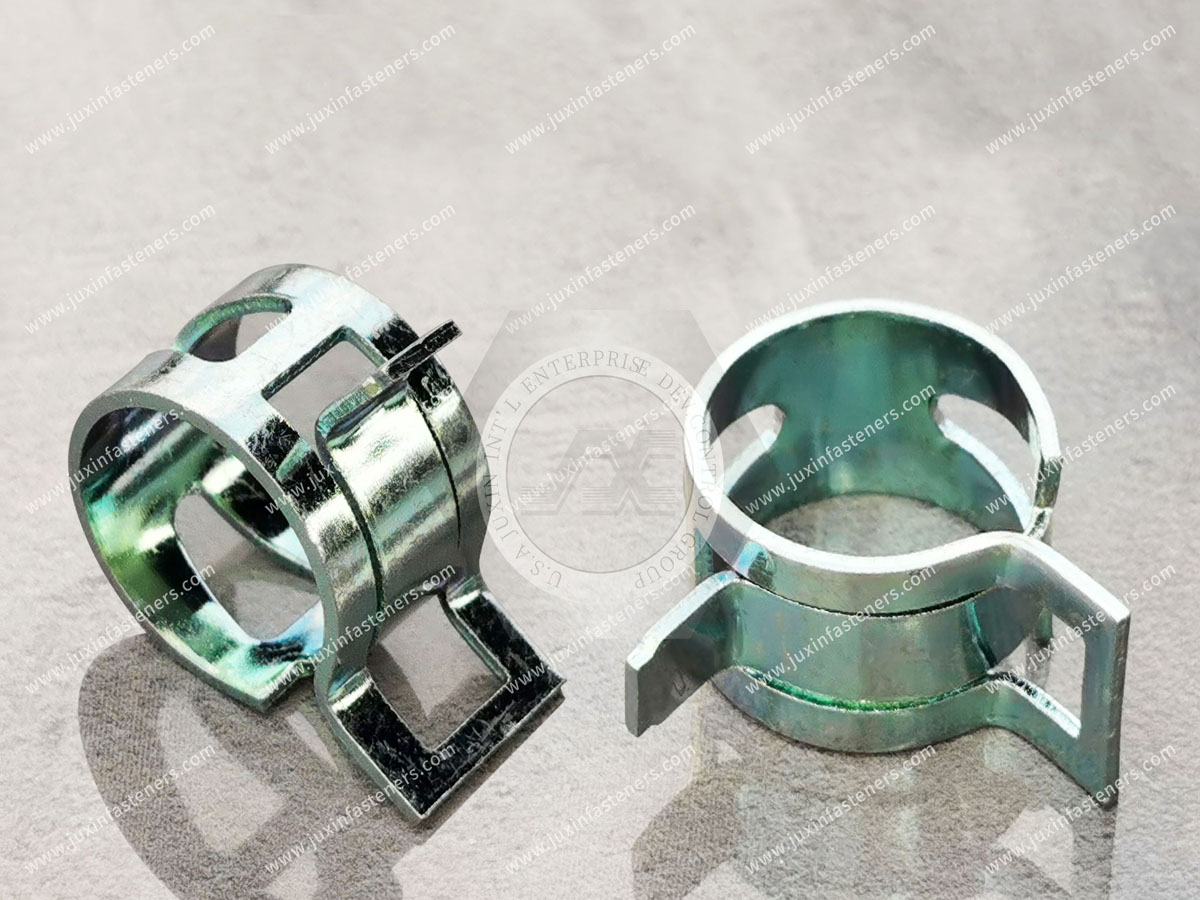
Stainless steel stepless pinch clamps, also called stepless ear clamps, are one-piece radial clamping components used to secure tubing, hoses, and other flexible or semi-rigid fluid lines around compatible fittings.
They are commonly considered for plumbing systems, PEX tubing, automotive fluid circuits, coolant lines, pneumatic systems, industrial equipment, beverage equipment, appliances, and other applications where a compact circumferential clamp is required.
Compared with conventional screw-type hose clamps, a stepless ear clamp uses a continuous band around the joint rather than a worm-drive screw mechanism. When the ear is compressed with the appropriate installation tool, the clamp diameter is reduced and radial force is applied around the tubing.
The actual sealing performance, however, depends on the complete joint rather than the clamp alone.
Important design variables include:
Tubing outside diameter
Tube wall thickness
Fitting geometry
Installed joint diameter
Clamp diameter
Band width
Band thickness
Material
Operating pressure
Temperature
Pressure pulsation
Vibration
Installation method
Required service life
JUXIN FASTENERS supports OEM and industrial sourcing requirements for stainless steel clamps and custom fastening components, with 20+ years of fastener experience.
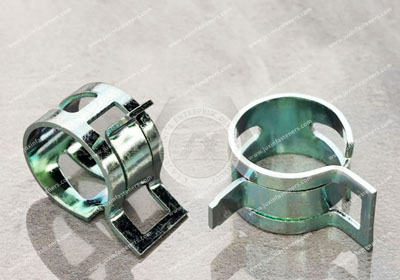 | 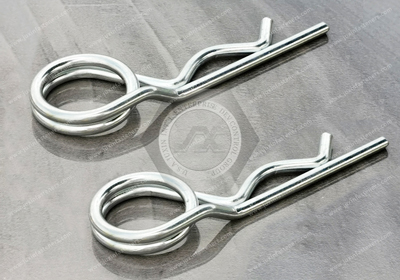 | 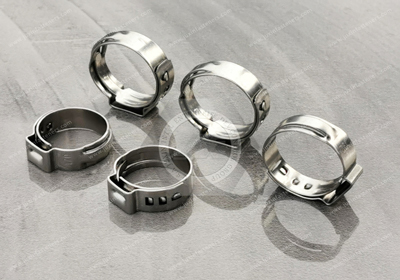 |
A stepless pinch clamp works by converting deformation of the clamp ear into circumferential clamping force.
During installation:
The clamp is positioned over the tubing and fitting.
The band surrounds the joint.
The installation tool compresses the ear.
The band diameter decreases.
Radial pressure is transferred to the tubing.
The tubing is compressed against the fitting surface.
The resulting joint must maintain sufficient contact pressure without excessively damaging the tubing.
This balance is especially important when the mating tube is made from polymer materials.
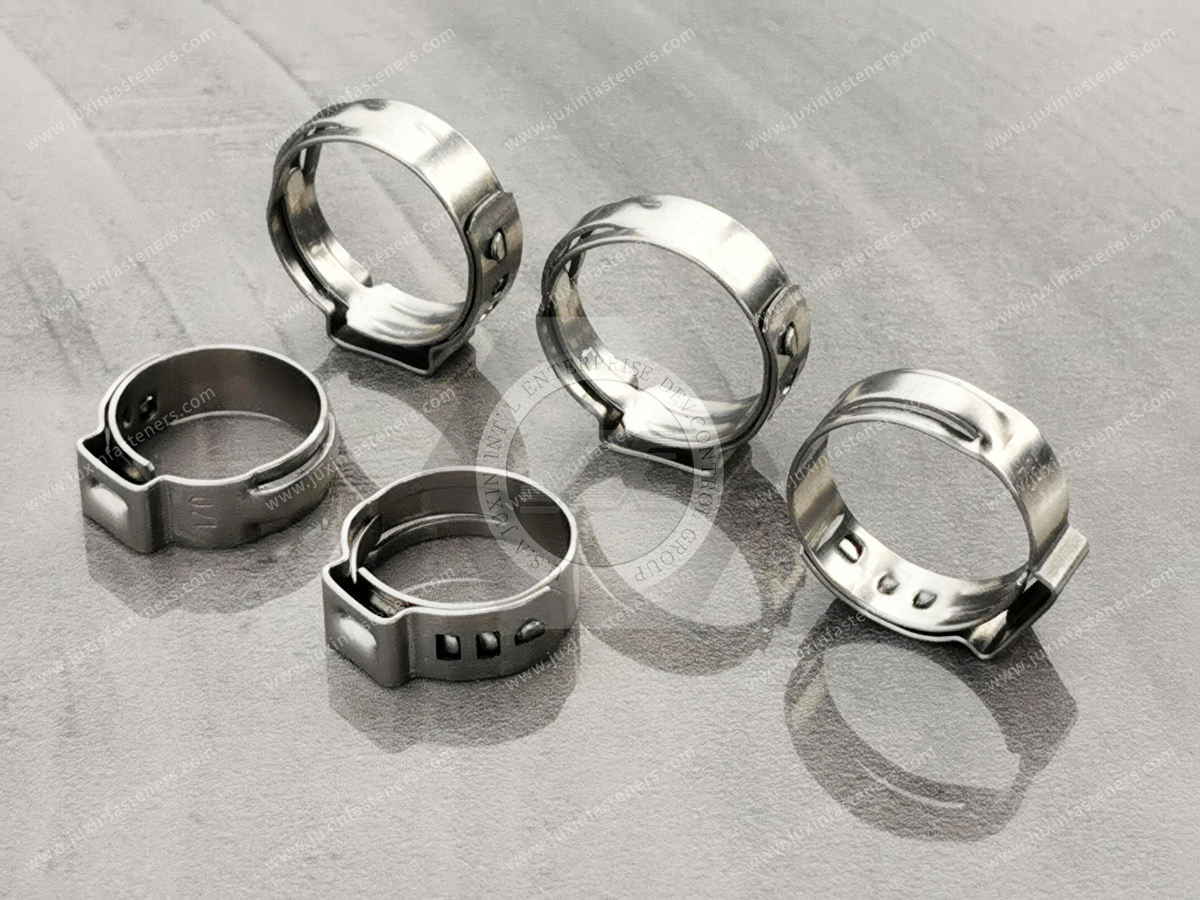
A key characteristic of a stepless ear clamp is its continuous inner circumference.
Unlike clamp designs that introduce a substantial internal step, screw housing, or discontinuity into the band, a stepless design is intended to provide a more continuous circumferential interface.
This can help distribute compression more evenly around the tubing.
However, “360-degree stepless” should not be interpreted as a guarantee of uniform pressure at every point. Actual pressure distribution depends on:
Band geometry
Ear deformation
Tube stiffness
Fitting geometry
Installed diameter
Installation force
Material properties
The complete assembly must therefore be evaluated when sealing performance is critical.
A common product-description mistake is to assume:
Stepless clamp = leak-free joint
The clamp is only one component of the sealing system.
A fluid joint can leak because of:
Incorrect clamp diameter
Insufficient compression
Excessive compression
Tube damage
Incorrect fitting geometry
Tube ovality
Fitting barb geometry
Thermal expansion
Pressure pulsation
Material relaxation
Misalignment
Contamination
Therefore, the correct engineering objective is not simply to maximize clamp force.
The objective is to maintain an appropriate sealing interface throughout the expected operating conditions.
The ear is the primary deformation feature during installation.
When the installation tool compresses the ear, the clamp circumference is reduced.
The final ear position can provide useful evidence that the clamp has been installed within the intended deformation range, depending on the clamp design and installation specification.
For production applications, the following should be controlled where specified:
Tool type
Tool jaw geometry
Ear compression
Installation orientation
Clamp positioning
Maximum permissible ear deformation
The correct installation procedure should follow the clamp manufacturer's requirements and the customer's validated assembly process.
One of the most important sizing considerations is the actual diameter of the assembled joint.
The nominal tubing size alone may not be sufficient because the final joint includes the fitting underneath the tube.
For example:
Tube OD + fitting geometry + tube wall deformation = installed joint diameter
The clamp should therefore be selected based on the applicable manufacturer's sizing range and the actual assembled condition.
For OEM development, measuring the installed outside diameter after the fitting is fully inserted can provide more useful information than relying only on nominal tube size.
A tube may have one nominal OD before assembly and a different effective joint diameter after it is installed over a fitting.
Consider:
Tube OD
Fitting outside diameter
Barb height
Tube wall thickness
Tube material
Insertion depth
Tube elasticity
Final joint compression
The correct clamp must accommodate the assembled interface rather than simply the free tube.
This distinction is particularly important for hard plastic tubing and PEX systems.
PEX tubing is used extensively in:
Residential plumbing
Commercial plumbing
Potable-water systems
Radiant-floor heating
Hydronic systems
Industrial fluid applications
Where an ear clamp is selected for PEX, the designer should verify compatibility with the specific PEX tubing and fitting system.
PEX has different deformation and recovery behavior from many elastomeric hoses.
Therefore, clamp selection should account for:
Tube material
Tube dimensions
Fitting type
Operating temperature
Pressure
Installation method
Manufacturer requirements
Hard or semi-rigid polymer tubing may be used in:
Automotive fluid circuits
Pneumatic equipment
Instrumentation
Appliance systems
Industrial machinery
Cooling circuits
Fluid dispensing equipment
Polymer tubing can respond differently to compression than rubber hose.
Potential considerations include:
Creep
Stress relaxation
Temperature-dependent stiffness
Wall deformation
Chemical compatibility
Long-term dimensional stability
For this reason, the clamp should be selected as part of the tube-and-fitting system.
Band width influences how the clamp transfers radial force to the tubing.
A wider band can distribute the applied force over a larger axial area, while a narrower band can concentrate the clamping interface over a smaller region.
The correct choice depends on:
Tube wall thickness
Tube material
Fitting geometry
Available installation space
Required compression
Application environment
A wider clamp is not automatically stronger or better.
Increasing clamp force may appear attractive when the objective is to prevent leakage.
However, excessive compression can damage polymer tubing or create local stress concentrations.
Potential consequences include:
Permanent deformation
Surface damage
Local cracking
Reduced tube life
Fitting deformation
Restricted flow area
The engineering objective is therefore:
Sufficient retention and sealing pressure without unacceptable tube deformation.
This is particularly important for thin-wall or relatively rigid polymer tubing.
Tube wall thickness is an important input when selecting a clamp.
Two tubes with the same outside diameter can behave differently if their wall thicknesses differ.
The design review should consider:
Tube OD
Tube ID
Wall thickness
Polymer grade
Hardness or stiffness
Temperature
Pressure
Where the customer provides tubing specifications, these should be included with the clamp RFQ.
The fitting underneath the tube contributes significantly to joint retention.
Potential fitting characteristics include:
Barb height
Barb angle
Barb spacing
Fitting diameter
Groove geometry
Surface finish
Material
A clamp cannot compensate indefinitely for an unsuitable fitting design.
The tubing, fitting, and clamp should be evaluated together.
Stainless steel is widely used for ear clamps because corrosion resistance can be important in fluid-system environments.
Common stainless grades considered for industrial clamps include:
304 stainless steel
316 stainless steel
The appropriate grade depends on the operating environment.
304 stainless steel is widely used for general corrosion-resistant applications.
316 stainless steel may be considered where greater resistance to chloride-containing environments is required.
Material selection should be based on actual exposure rather than using “316 is always better” as a universal rule.
ASTM A240 covers chromium and chromium-nickel stainless steel plate, sheet, and strip for pressure vessels and general applications.
Where stainless steel strip is specified for clamp manufacturing, the material designation, grade, thickness, and applicable material standard should be clearly defined in the purchasing specification.
The relevant material standard should not be presented as proof that the finished clamp itself automatically complies with every performance requirement.
Clamps may encounter:
Water
Condensation
Road salt
Cleaning chemicals
Coolants
Oils
Industrial fluids
Humidity
Outdoor exposure
The clamp material should be evaluated together with the fluid, tubing, fitting, and surrounding components.
For aggressive environments, 316 stainless steel may be considered where appropriate, but the complete material system still requires evaluation.
A stainless steel clamp does not automatically make the entire fluid joint corrosion-proof.
Potential corrosion sources include:
Fitting material
Tube material
Clamp material
Galvanic couples
Chloride exposure
Chemical contamination
Surface damage
Crevices
Water retention
This is especially important when stainless steel clamps are installed over aluminum fittings or other dissimilar metals.
Automotive systems may use tubing clamps in:
Coolant circuits
Fuel-related systems where the clamp and tube are approved for the application
Washer-fluid systems
HVAC-related fluid routing
Air and pneumatic systems
Thermal-management assemblies
Automotive applications can involve:
Engine vibration
Pressure pulsation
Temperature cycling
Chemical exposure
Limited installation space
The clamp should therefore be selected based on the actual vehicle-system requirement.
A generic ear clamp should not be assumed to be suitable for every automotive fluid line.
Electric vehicles use multiple thermal-management circuits for components such as:
Battery systems
Power electronics
Motors
Inverters
Charging systems
These systems can use polymer tubing and fluid fittings depending on the vehicle architecture.
Clamp selection should consider:
Coolant compatibility
Temperature range
Pressure
Pulsation
Vibration
Tube material
Fitting material
Service requirements
For battery-related applications, the clamp should be evaluated as part of the complete thermal-management assembly rather than described as a battery component by default.
Industrial equipment can use pinch clamps in:
Cooling loops
Water circuits
Process equipment
Dispensing systems
Pneumatic equipment
Machinery fluid routing
The operating environment can vary substantially between applications.
An RFQ should therefore identify the actual fluid, temperature, pressure, tubing material, and fitting type.
PEX tubing is widely used in residential and commercial plumbing and hydronic heating systems.
Potential applications include:
Water distribution
Radiant-floor heating
Hydronic loops
Equipment connections
The clamp and fitting system should be selected according to the applicable plumbing-system requirements and the tubing manufacturer's installation instructions.
The use of a stainless steel clamp alone does not establish code compliance for an entire plumbing installation.
Fluid equipment used in beverage and food-related environments may require:
Corrosion-resistant materials
Cleanable surfaces
Appropriate fluid compatibility
Controlled assembly
Defined material requirements
The clamp material and surface condition should be evaluated against the actual sanitation and chemical exposure requirements.
Where regulatory or food-contact requirements apply, the complete assembly and material documentation should be reviewed against the customer's applicable requirements.
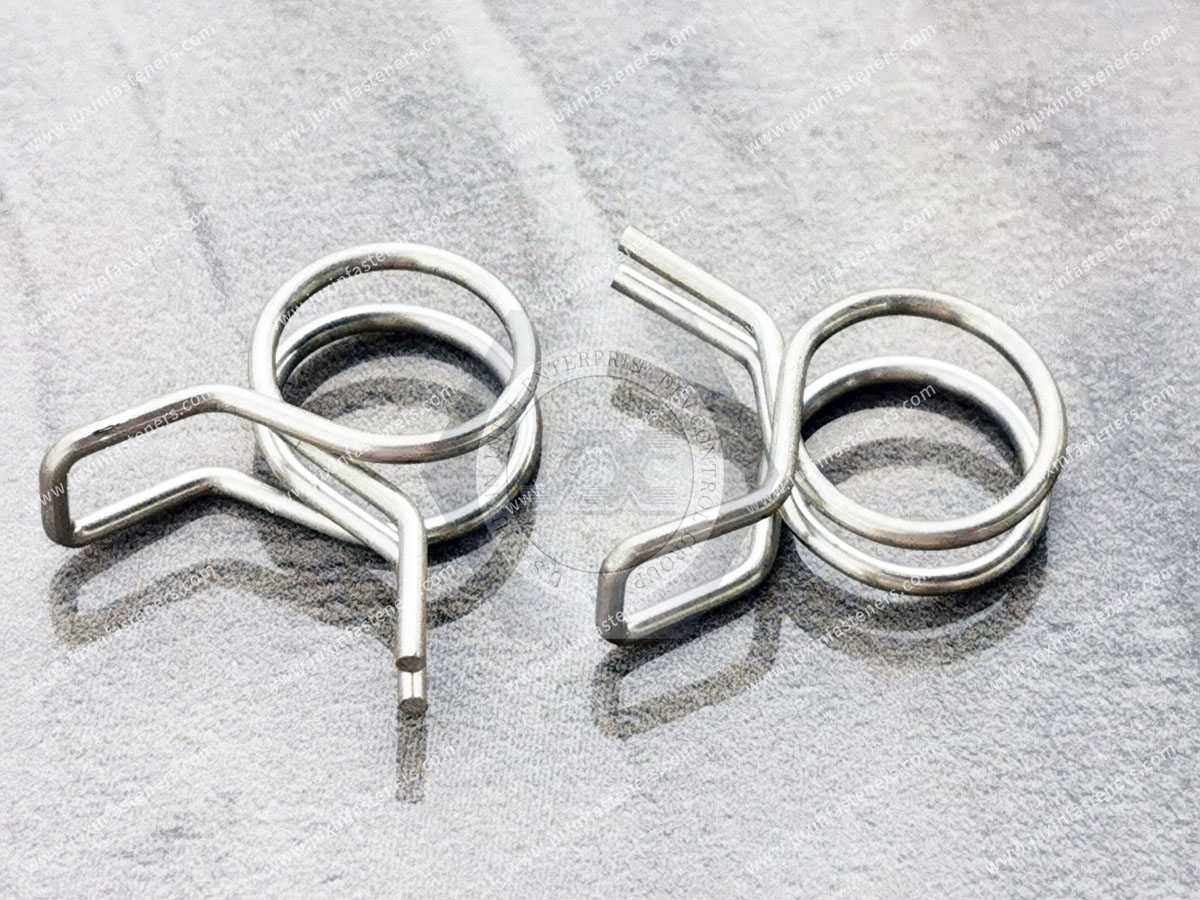
Small-diameter plastic tubing is common in pneumatic and instrumentation equipment.
Applications can include:
Air lines
Control systems
Instrument connections
Automation equipment
Sensors and actuators
For these systems, compact clamp geometry may be useful where installation space is restricted.
The clamp must still be matched to the tube and fitting system.
A clamp should not be assigned a pressure rating independently of the tubing and fitting.
Joint pressure capability can depend on:
Tube material
Tube wall thickness
Fitting geometry
Clamp compression
Temperature
Fluid
Pressure pulsation
Tube aging
Installation quality
Therefore, claims such as “high-pressure clamp” should be supported by a defined assembly test method and configuration.
For OEM development, the customer should specify the required pressure conditions and acceptance criteria.
Plastic tubing can change mechanical behavior with temperature.
During thermal cycling:
The tubing expands or contracts.
The fitting and clamp may respond differently.
Polymer stiffness can change.
Stress may relax over time.
Contact pressure can change.
This means that a joint that appears secure during initial assembly may behave differently after repeated temperature cycles.
For critical applications, validation should reproduce the expected temperature and pressure conditions.
Some fluid systems operate under fluctuating rather than constant pressure.
Examples include:
Pump-driven circuits
Automotive coolant systems
Pneumatic systems
Pulsating process equipment
Pressure changes can create repeated mechanical loading at the tube-fitting interface.
The design should therefore consider:
Static pressure + pressure amplitude + cycle count + temperature + tube material
rather than evaluating only the maximum static pressure.
Vibration can influence:
Tube movement
Fitting movement
Clamp position
Contact wear
Fretting
Material fatigue
Long-term sealing stability
This is particularly relevant to automotive, mobile equipment, industrial machinery, and transportation applications.
The clamp should be positioned correctly on the fitting and should not be used to compensate for excessive tube movement.
A stainless steel band can create a local contact interface with the polymer tube.
The condition of the band edges can therefore matter.
Manufacturing controls may include:
Deburring
Edge conditioning
Surface inspection
Control of sharp edges
Dimensional inspection
The exact edge-treatment process should be specified according to the product design and customer requirement rather than assumed for every clamp.
A damaged tube does not necessarily leak immediately.
Local compression or cutting at the clamp interface may create a weakened region that becomes more important after:
Thermal cycling
Pressure cycling
Vibration
Chemical exposure
Long-term aging
For this reason, visual leak inspection alone may not identify every long-term joint risk.
When developing a new OEM assembly, the tubing condition after installation should be evaluated as part of validation.
Stepless ear clamps are normally installed with a dedicated crimping tool appropriate to the clamp design.
Tool selection should consider:
Clamp size
Ear geometry
Access space
Required installation force
Manual or powered operation
Production volume
Operator ergonomics
Using an unsuitable tool can produce inconsistent ear deformation and therefore inconsistent assembly results.
Low-volume maintenance applications may use hand-operated tools.
High-volume OEM assembly may require:
Repeatable tool positioning
Defined installation sequence
Controlled operator technique
Work instructions
Tool maintenance
Process verification
The clamp specification and installation process should be developed together.
A useful product selection matrix can include:
| Parameter | Engineering Question |
|---|---|
| Tube OD | What is the actual tubing outside diameter? |
| Fitting OD | What is the effective joint diameter after assembly? |
| Wall thickness | How much compression can the tube tolerate? |
| Clamp range | Does the assembled diameter fall within the intended range? |
| Band width | Is the required axial compression area available? |
| Band thickness | Is the clamp stiffness suitable for the application? |
| Material | What corrosion and mechanical requirements apply? |
| Temperature | Will polymer relaxation or thermal expansion matter? |
| Pressure | What are the static and dynamic pressure conditions? |
| Installation | What tool and ear deformation are required? |
This matrix provides a better engineering starting point than selecting a clamp solely by nominal tubing size.
Standard stainless steel stepless ear clamps can be considered for applications such as:
General industrial fluid equipment
Pneumatic lines
Appliance tubing
Small fluid circuits
Equipment assemblies
Available dimensions should always be confirmed against the actual product specification.
Rather than presenting one universal size range, OEM procurement should match the required diameter, band dimensions, material, and application.
Larger or reinforced clamp configurations may be considered for applications requiring greater band stiffness or a larger clamping interface.
Potential applications include:
Larger tubing
Composite tubing
Industrial cooling circuits
Machinery fluid connections
However, “reinforced” should be defined by actual band dimensions and material properties.
A larger band does not automatically provide a higher pressure rating.
PEX clamp applications require careful attention to:
PEX tubing dimensions
Fitting design
Clamp diameter
Installation method
Applicable plumbing requirements
For OEM or project procurement, the tubing and fitting specification should be supplied together with the clamp RFQ.
This reduces the risk of selecting a clamp that is dimensionally similar but functionally unsuitable.
Custom clamp requirements may include:
Non-standard diameter
Special band width
Special band thickness
Custom ear geometry
Material grade
Surface finish
Packaging
Identification
Customer-specific inspection
Custom requirements should be controlled through a drawing or detailed product specification.
JUXIN FASTENERS can review customer drawings, samples, or technical specifications for custom fastening requirements.
An OEM drawing or specification may define:
Clamp Geometry
Nominal diameter
Minimum and maximum installed diameter
Band width
Band thickness
Ear dimensions
Edge condition
Material
Stainless steel grade
Material standard
Surface requirements
Assembly
Tube material
Fitting type
Installation tool
Ear compression requirement
Operating Conditions
Pressure
Temperature
Fluid
Vibration
Pressure cycling
Quality
Dimensional inspection
Material documentation
Surface inspection
Functional validation where required
Procurement teams should avoid vague RFQs such as:
“Please quote stainless steel ear clamps for plastic tubing.”
A more useful RFQ identifies:
Clamp type
Drawing or sample
Required diameter
Band width
Band thickness
Stainless grade
Tubing material
Tubing OD
Fitting OD
Application
Operating temperature
Pressure
Quantity
Packaging
Inspection
Documentation
Delivery requirement
This allows suppliers to quote against the same technical basis.
Engineers commonly search for:
Stepless ear clamp mechanics
Clamp sizing
PEX clamp dimensions
Stainless steel grade
Tube compression
Fitting compatibility
Thermal cycling
Pressure performance
Vibration resistance
Installation tooling
Procurement teams commonly search for:
Stainless steel pinch clamp suppliers
PEX clamp manufacturer
OEM ear clamp supplier
Custom tubing clamps
Stainless steel clamp pricing
Production quantities
Quality documentation
Packaging
Supplier qualification
A strong industrial product solution should address both search paths without turning the page into a keyword list.
Depending on the product drawing, inspection may include:
Clamp diameter
Band width
Band thickness
Ear dimensions
Ring or band geometry
Edge condition
Surface condition
Material verification
Possible inspection methods include:
Calipers
Micrometers
Gauges
Optical measurement
Material documentation review
The inspection plan should be based on the customer's drawing and agreed quality requirements.
OEM customers may require documentation such as:
Certificate of Conformance
Material certificate
Dimensional inspection report
Surface-treatment documentation where applicable
Lot identification
If EN 10204 documentation is required, the customer should specify the required inspection-document type in the purchasing specification.
Not every clamp order requires the same documentation package.
A standard industrial clamp and a high-volume OEM component may have very different documentation requirements.
For example:
Standard maintenance component
→ Product specification + CoC may be sufficient.
Controlled OEM component
→ Drawing revision + lot traceability + dimensional inspection + material documentation may be required.
Special application
→ Additional validation records may be specified by the customer.
This risk-based approach helps procurement teams avoid both insufficient documentation and unnecessary administrative cost.
For products entering regulated supply chains, customers may require material and substance declarations related to:
RoHS
REACH
Restricted substances
Customer-specific environmental requirements
The exact requirements should be confirmed against the destination market and customer's purchasing specification.
Compliance documentation should apply to the actual material, finish, and product supplied.
Supplier qualification may include:
Drawing review
Material verification
Sample approval
Process review
Dimensional inspection
Packaging review
Traceability
Change control
Production capacity
Quality communication
Automotive customers may have additional customer-specific quality-system and production requirements.
These should be agreed before production rather than assumed from the product category.
Testing a clamp by itself does not reproduce the final joint.
For meaningful validation, the test configuration should represent the actual:
Clamp + tube + fitting + fluid + pressure + temperature + installation method
This is particularly important for plastic and PEX systems because polymer behavior can change with temperature, time, and compression.
A test result from one tube and fitting combination should not automatically be transferred to another system.
A clamp may meet its dimensional specification and still produce an inconsistent field joint if installation is uncontrolled.
Important process variables can include:
Clamp positioning
Tool selection
Ear compression
Tool alignment
Operator technique
Tube insertion depth
Fitting cleanliness
For high-volume production, the installation method should therefore be included in the assembly specification.
Fluid-line clamps are often only one part of a larger industrial assembly.
Equipment may also require:
Bolts
Nuts
Self-clinching fasteners
Plastic hardware
CNC-machined components
Custom screws
Retaining components
JUXIN FASTENERS supports broader automotive plastic fasteners for vehicle interiors, body systems, electrical assemblies, and other non-metallic fastening applications.
For higher-load threaded joints, customers can also review high-strength bolts and nuts.
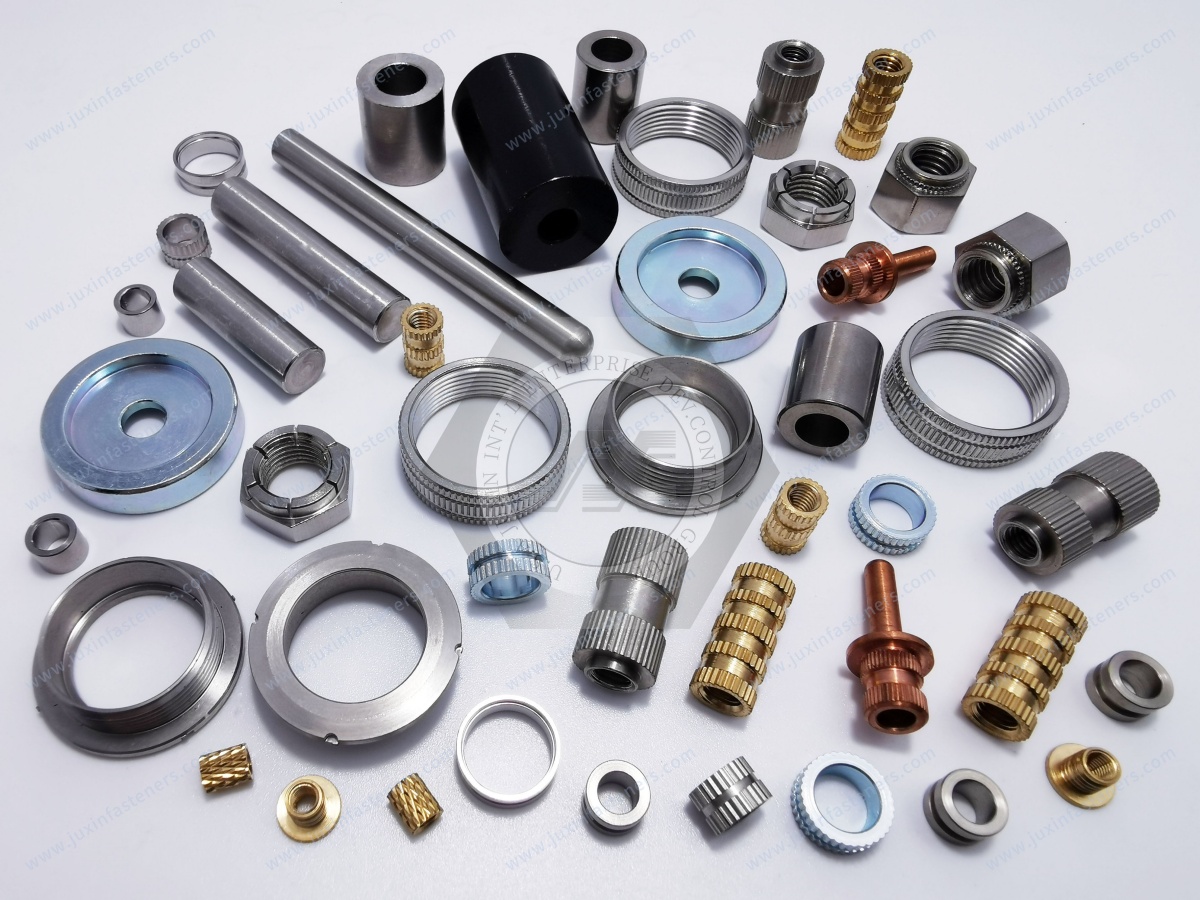
Some fluid-system assemblies require custom machined fittings, brackets, spacers, shafts, or other mechanical components in addition to clamps.
For these requirements, JUXIN FASTENERS also supports stainless steel CNC machining parts.
This allows procurement teams to evaluate related mechanical components together where the project requires multiple custom fastening or machined parts.
A reliable selection sequence is:
Tubing Material
→ Tube OD / Wall Thickness
→ Fitting Geometry
→ Installed Joint OD
→ Operating Pressure
→ Temperature
→ Pulsation / Vibration
→ Required Clamp Range
→ Band Width / Thickness
→ Stainless Grade
→ Installation Tool
→ Inspection Requirement
This sequence is more robust than searching only for:
“12 mm stainless steel hose clamp.”
The objective is to match the clamp to the mechanical and fluid-system interface.
For OEM procurement, the commercial path can be structured as:
Fluid Application
→ plumbing, automotive, EV thermal management, pneumatic or industrial fluid equipment
Tube Material
→ PEX, hard plastic, polymer tubing or other specified material
Fitting Type
→ barb, connector or custom fitting
Installed OD
→ actual assembled diameter
Wall Thickness
→ tube compression behavior
Operating Conditions
→ pressure, temperature and fluid
Dynamic Conditions
→ vibration, pulsation and thermal cycling
Clamp Design
→ stepless ear clamp / pinch clamp
Material
→ 304, 316 or customer-specified stainless steel
Geometry
→ diameter, band width, band thickness and ear configuration
Installation
→ specified crimping tool and process
Quality
→ dimensional and material requirements
Documentation
→ CoC, inspection and material records where required
Supplier Qualification
RFQ
This structure gives engineering and purchasing teams a common technical basis.
A strong RFQ should include as many of the following as possible:
Clamp type
Customer drawing or sample
Required clamp diameter
Tube OD
Tube wall thickness
Tube material
Fitting OD
Fitting material
Fluid type
Operating pressure
Operating temperature
Pressure pulsation
Vibration conditions
Required stainless steel grade
Band width
Band thickness
Installation tool
Annual quantity
Packaging requirements
Inspection requirements
Documentation requirements
Delivery schedule
Providing the application context can significantly reduce quotation ambiguity.
JUXIN FASTENERS supports OEM and industrial customers seeking stainless steel fastening components and custom production solutions.
For stepless pinch clamps and related tubing hardware, the sourcing process can be based on:
Customer drawings
Product samples
Required dimensions
Material specifications
Application requirements
Tubing and fitting information
Production quantities
Inspection requirements
Packaging specifications
The goal is to match the purchased component to the actual assembly rather than supply a nominally similar clamp without understanding the application.
A practical sourcing process can follow:
Application Review
→ Drawing / Sample Review
→ Clamp and Material Specification
→ Sample Evaluation
→ Assembly Validation
→ Production Approval
→ Repeat Manufacturing
→ Quality Documentation
→ Ongoing Supply
For repeat OEM production, the approved drawing revision and agreed material specification should remain the controlling documents.
Any change to material, dimensions, tooling, or manufacturing process should follow the customer's required change-control procedure.
Compare two RFQs:
RFQ A:
“Please quote stainless steel 20 mm ear clamps.”
RFQ B:
“Please quote stainless steel stepless ear clamps for PEX tubing, 20 mm installed joint OD, indoor hydronic system, defined temperature and pressure range, annual volume 100,000 pieces.”
The second RFQ gives the supplier substantially more information for evaluating the correct product configuration.
For OEM sourcing, technical context is often as important as the nominal part size.
If you are developing a PEX plumbing system, automotive fluid line, EV thermal-management assembly, pneumatic system, appliance, beverage machine, or industrial fluid circuit,
send JUXIN FASTENERS the available technical information.
Useful RFQ materials include:
2D drawing
3D model
Existing sample
Tubing specification
Fitting specification
Installed OD
Wall thickness
Material requirement
Clamp dimensions
Operating pressure
Temperature range
Fluid information
Quantity
Inspection requirements
Documentation requirements
JUXIN FASTENERS can review standard or custom stainless steel pinch clamp requirements and support OEM sourcing for stepless ear clamps,
PEX clamps, tubing fasteners, and related industrial fastening components.
JUXIN FASTENERS
20+ Years of Fastener Experience
Stainless Steel Pinch Clamps, Stepless Ear Clamps, PEX Clamps and Custom OEM Fastening Components
Website: www.juxinfasteners.com
Email: info@juxinfasteners.com
 MORE NEWS
Sep. 25, 2026
Sep. 25, 2026
Sep. 25, 2026
Contact Us
Tel.:
+86 020 8621 0320
+86 020 3121 6067
E-mail:
Technical Support:
Navigation
SEND INQUIREY