
Call Us
+86 136 6007 9809
Call Us
+86 136 6007 9809

Sep. 27, 2026
Plastic push rivets and nylon panel fasteners provide a fast, lightweight, and electrically non-conductive method for retaining plastic panels,
sheet-metal components, trim parts, covers, insulation layers, electronic assemblies, and other lightweight structures.
Unlike conventional threaded fasteners, many push-in fasteners can be installed without torque-controlled tightening, nuts,
or rear-side assembly tools, making them particularly useful for high-volume production and applications where assembly access is limited.
They are widely used across automotive interiors and trim systems, commercial vehicles, electrical equipment, electronics, industrial enclosures, appliances,
HVAC equipment, telecommunications infrastructure, industrial automation, vending equipment, and other OEM assemblies.
However, selecting a plastic push rivet is not simply a matter of matching a nominal diameter. Reliable performance depends on the interaction between fastener geometry,
mounting-hole diameter and tolerance, total panel thickness, grip range, substrate stiffness, polymer condition, temperature, moisture exposure, vibration, required retention force, installation method, and expected service life.
Juxin Fasteners supplies standard and custom plastic push rivets, nylon push rivets, panel retainers, snap-fit fasteners, and related plastic fastening components for industrial OEM applications.
Engineering and procurement teams can submit an existing part number, physical sample, 2D drawing, 3D model, or application dimensions for dimensional review,
cross-reference evaluation, sample development, and second-source qualification.
A plastic push rivet is a non-threaded mechanical fastener designed to retain one or more components through a prepared mounting hole.
Depending on the design, installation may expand flexible legs, engage barbs with the hole wall, create a snap-fit behind the panel, or lock a pin into a molded rivet body.
The term is often used broadly, but several related fastener architectures operate differently.
This distinction matters because installation force, pull-out resistance, serviceability, panel-thickness capability, and mounting-hole requirements can vary substantially between designs.
Typical product families include:
Two-piece push-pin rivets
One-piece snap rivets
Nylon push rivets
Push-in panel fasteners
Plastic panel retainers
Barbed push fasteners
Expansion rivets
Removable push rivets
Plastic trim clips
Snap-fit panel fasteners
For OEM engineers, the correct question is therefore not only "What diameter push rivet do I need?" but also "Which retention mechanism is appropriate for the panel stack,
hole geometry, installation process, service environment, and required removal behavior?"
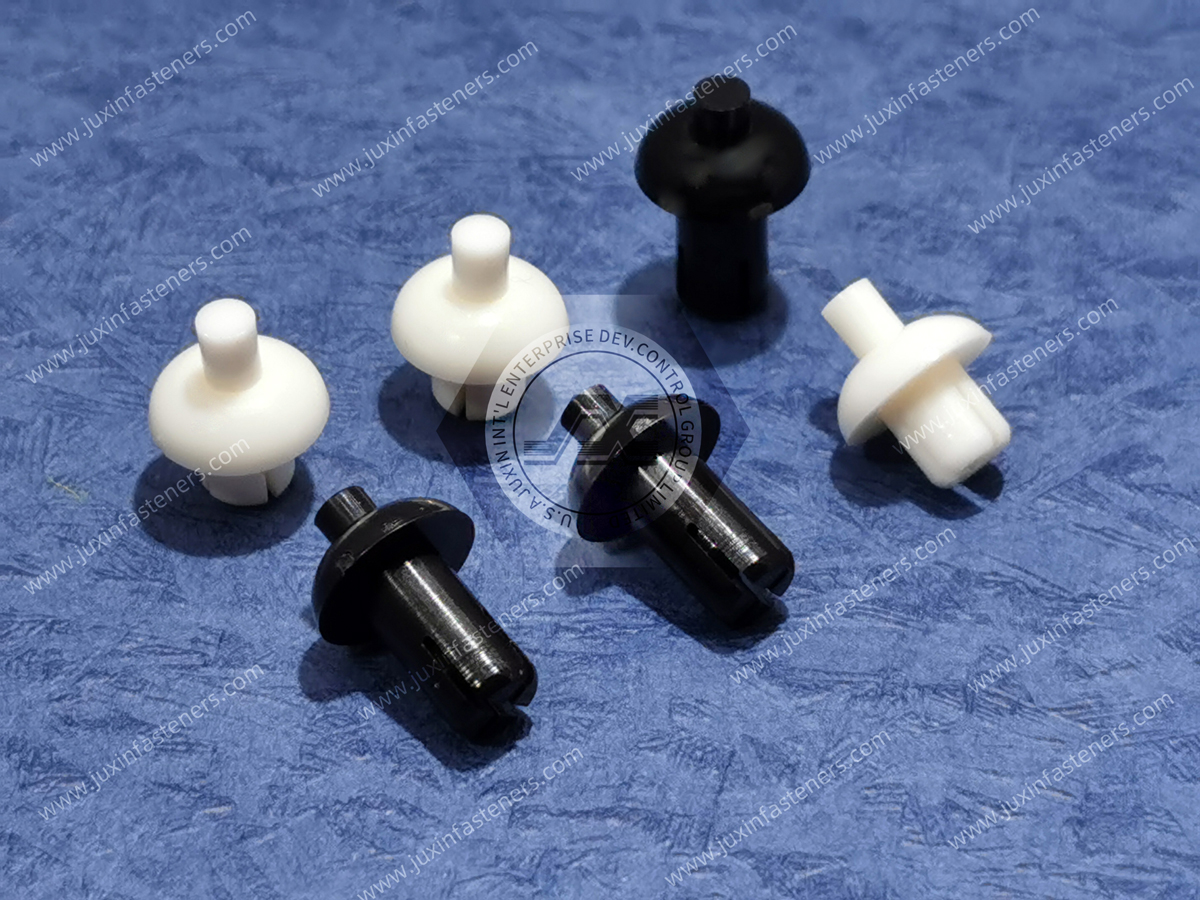
Two-piece push rivets typically consist of a molded body and a separate or captive center pin. The body is inserted through the aligned mounting holes, after which the center pin is pushed into position.
Movement of the pin expands or locks the body legs, creating mechanical retention behind the panel or against the mounting-hole wall.
This architecture can provide:
Controlled expansion after insertion
Fast manual or automated assembly
Good retention in thin panels
Low risk of damage to decorative surfaces
Potential serviceability in designs specifically intended for removal
Not every two-piece rivet is reusable. Removal method and reuse capability must be verified for the individual geometry rather than assumed from the presence of a center pin.
One-piece snap rivets use flexible molded legs, shoulders, or barbed features that deform during insertion and recover after passing through the mounting interface.
They are useful where assembly speed and low part count are priorities.
Typical applications include:
Appliance housings
Electronic enclosures
Lightweight covers
Interior trim
Equipment panels
Insulation assemblies
Low-load industrial structures
Because retention depends strongly on elastic deformation and geometric engagement, hole diameter, panel thickness, polymer stiffness, and temperature can significantly affect installation and pull-out behavior.
Barbed push fasteners use multiple flexible ribs or fins along the shank to engage the mounting hole.
These components can accommodate certain variations in panel thickness or hole conditions depending on the specific geometry.
They are commonly used for trim, insulation, covers, wire-routing components, and other applications where rapid push-in assembly is required.
A barbed fastener should not automatically be considered equivalent to an expanding push rivet. Their retention mechanisms and response to hole tolerance can be different.
Some plastic panel fasteners are engineered for service access. A removable center pin, accessible head, or release feature allows the retainer to be disengaged with an appropriate tool.
These are useful for:
Service panels
Automotive trim
Electrical covers
HVAC access panels
Equipment requiring periodic maintenance
If repeated removal is expected, engineers should evaluate the number of anticipated service cycles and inspect whether the fastener, panel hole, or both experience permanent deformation during removal.
Fastener geometry alone does not determine performance. Polymer selection influences insertion behavior, impact resistance, stiffness, fatigue response, creep,
dimensional stability, chemical resistance, moisture sensitivity, and temperature capability.
Polyamide 66, commonly referred to as PA66 or nylon 66, is widely used for molded industrial fasteners because it can provide a useful combination of strength,
stiffness, toughness, wear resistance, moldability, and repeated elastic deformation.
PA66 push rivets are frequently considered for:
Automotive trim and interior assemblies
Electrical equipment
Electronic housings
Appliances
Industrial enclosures
Cable and wire management
HVAC assemblies
Machinery covers
Material grade must still be selected according to the application. Unfilled, impact-modified, heat-stabilized, flame-retardant, UV-stabilized, or other engineered formulations can behave differently.
A generic description such as "nylon rivet" is therefore not sufficient for a safety-, environment-, or performance-critical application.
Where a component experiences repeated shock, impact, low-temperature handling, or dynamic loading, an impact-modified polymer may be evaluated.
The design trade-off must be considered carefully. Increasing toughness can alter stiffness and dimensional behavior, which may change both insertion force and retention characteristics.
Elevated-temperature applications may require heat-stabilized grades or alternative engineering polymers.
Potential applications include:
Automotive thermal zones
Appliance interiors
Electrical equipment
Power electronics
Industrial machinery
HVAC equipment
Temperature suitability should be evaluated against the actual duty cycle, mechanical load, exposure duration, and material manufacturer's data rather than a generic temperature value assigned to all nylon fasteners.
Electrical and electronic applications may require specific flammability performance, while outdoor assemblies may require UV stabilization and chemically exposed equipment may require enhanced chemical resistance.
A polymer family name alone does not establish a specific flammability rating, regulatory compliance level, UV life, or chemical compatibility.
These characteristics depend on the exact resin formulation and should be specified and documented when required by the application.
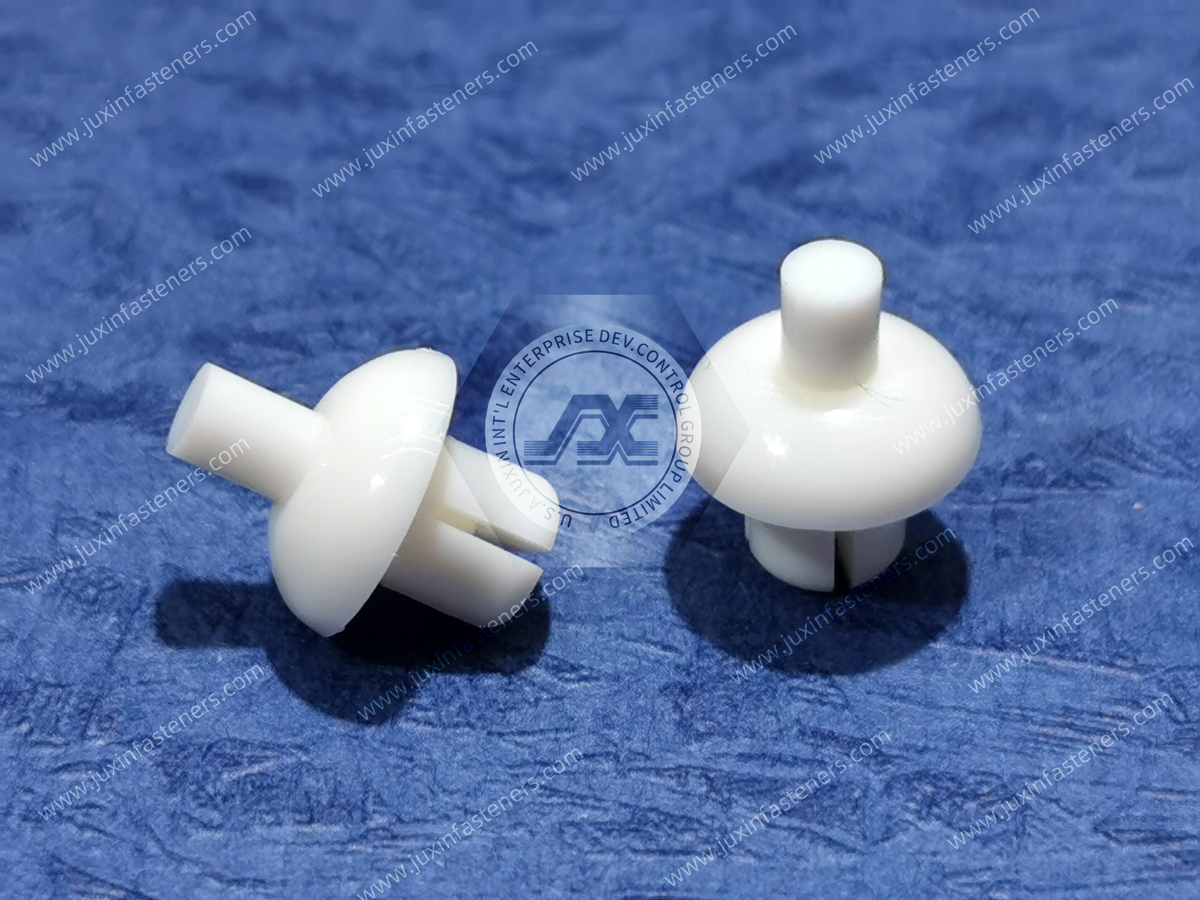
Polyamides are hygroscopic, meaning they absorb moisture from the surrounding environment.
This is important for nylon push rivets because moisture can alter both mechanical and dimensional behavior. Compared with a dry-as-molded condition,
conditioned nylon may exhibit increased toughness and elongation together with reduced stiffness.
For a push-in fastener, those changes can influence:
Insertion force
Leg flexibility
Snap engagement
Pull-out resistance
Dimensional fit
Vibration behavior
Long-term retention
An application validated only with very dry molded components may therefore behave differently after environmental conditioning.
Where moisture sensitivity matters, engineering validation should consider the actual service environment rather than treating published resin properties as fixed values under all conditions.
ISO 62 may be relevant when characterizing water absorption behavior of plastic materials, while material mechanical properties may be evaluated using appropriate polymer test standards such as ISO 527 where applicable.
The important engineering principle is that material data and finished-fastener performance are related but are not interchangeable. Final retention should be validated using the actual fastener geometry, panel configuration, and environmental condition.
Plastic fasteners behave differently from metallic threaded joints.
When a polymer remains under sustained deformation or load, time-dependent creep and stress relaxation can change the force maintained by the fastening feature.
Temperature, moisture, polymer grade, geometry, and loading level all influence this behavior.
For push rivets, long-term design should therefore consider whether retention depends on:
Continuous radial pressure against a mounting hole
Elastic bending of retaining legs
Mechanical engagement behind a panel
Barbs embedded against the hole edge
A combination of elastic preload and geometric locking
A design relying primarily on geometric undercut or positive mechanical engagement may respond differently to long-term polymer relaxation than a design relying heavily on continuous elastic interference.
This distinction is particularly important in automotive, electrical, HVAC, appliance, and industrial equipment applications expected to remain assembled for years.
One of the most common specification errors in plastic push fasteners is treating hole diameter and grip range as though they describe the same interface.
They do not.
The mounting-hole diameter determines how the shank, ribs, or expansion body interacts with the host panel.
If the hole is too large, possible consequences include:
Reduced radial interference
Lower retention
Panel movement
Rattle
Inconsistent engagement
If the hole is too small, possible consequences include:
Excessive insertion force
Damaged ribs or retaining legs
Fastener deformation
Panel damage
Difficult automated assembly
Hole tolerance is therefore just as important as nominal hole diameter.
Grip range refers to the panel thickness or combined material stack that the fastener is designed to retain.
If the stack is too thick, the retaining feature may not fully engage.
If the stack is too thin, the assembly may have excessive clearance or insufficient clamping and anti-rattle performance.
For multi-layer assemblies, engineers should evaluate the complete stack-up rather than only the thickness of the primary panel.
A production assembly rarely remains at one exact nominal thickness.
The actual stack can vary because of:
Sheet-metal thickness tolerance
Molded plastic wall variation
Paint or coating thickness
Foam or insulation compression
Adhesive layers
Gaskets
Multiple overlapping panels
A robust fastener selection therefore considers minimum, nominal, and maximum assembly stack conditions.
A push rivet can be dimensionally correct and still perform inconsistently if the production hole is poorly controlled.
Important interface characteristics include:
Hole diameter
Hole tolerance
Hole roundness
Burr direction and burr height
Panel thickness
Edge condition
Coating buildup
Molded-hole draft
Local panel stiffness
Distance from the hole to the panel edge
Sharp burrs can damage flexible plastic legs during insertion. Excessive coating buildup can reduce effective hole size. A thin or flexible panel may deform before the fastener fully engages.
For this reason, push-rivet qualification should evaluate the actual production panel whenever possible, not only a nominal CAD hole.
Low insertion force can improve assembly-line ergonomics and reduce equipment load, but it does not automatically mean the joint will provide sufficient retention.
Likewise, maximizing interference can increase retention while creating excessive installation force or damaging the fastener.
A successful design balances:
Installation requirement → controlled insertion → complete engagement → required retention → acceptable service removal behavior
Engineering teams should therefore evaluate both insertion and extraction behavior rather than selecting a fastener solely from nominal dimensions.
For automated production, consistency can be as important as the average force. Large force variation can indicate unstable hole dimensions,
polymer conditioning differences, molding variation, or an unsuitable fastener-to-panel interface.
Plastic panel fasteners are often selected for assemblies exposed to vibration because polymer components can provide resilient contact while avoiding metal-to-metal contact.
Applications include:
Vehicle interiors
Commercial vehicle trim
Electrical cabinets
HVAC equipment
Appliances
Industrial machinery
Vending machines
Rail equipment
However, "vibration resistant" should not be treated as a universal property of every plastic push rivet.
Dynamic performance depends on:
Fastener geometry
Panel stiffness
Hole fit
Grip condition
Material properties
Temperature
Vibration amplitude and frequency
Direction of loading
Service duration
If vibration performance is critical, testing should reproduce the actual assembly rather than relying only on the fastener's material description.
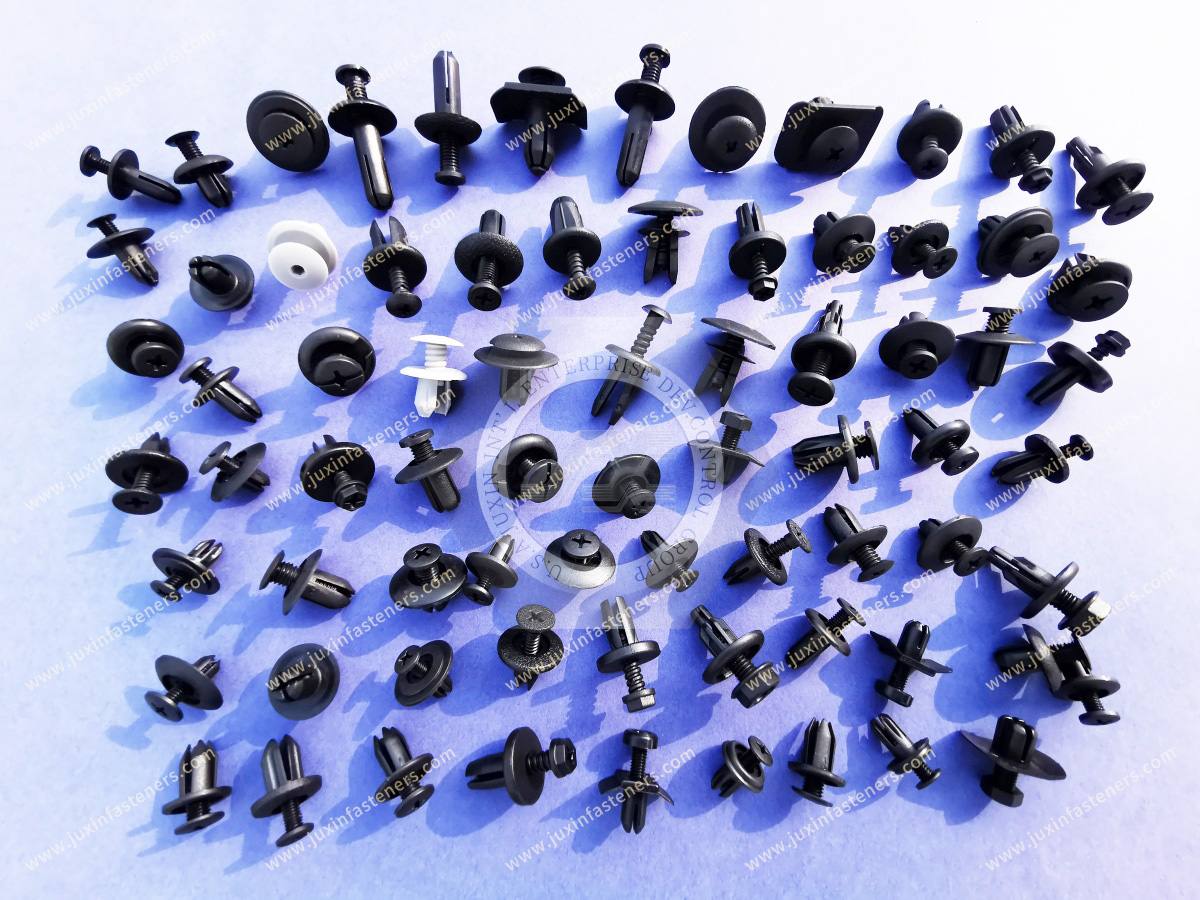
Polymer fasteners can provide electrical isolation between components and can avoid direct metal-to-metal contact.
This can be useful in:
Electrical enclosures
Power distribution equipment
Electronics
PCB-related assemblies
Telecommunications equipment
Battery and energy-storage equipment
Industrial control systems
Plastic fasteners can also help avoid surface scratching on painted, plated, anodized, or decorative panels.
However, the use of a polymer fastener alone should not be assumed to solve every electrical isolation or galvanic-corrosion problem.
The complete assembly—including washers, brackets, conductive debris, coatings, moisture paths, and other hardware—must be considered.
Some push-in fasteners are particularly useful when the installer can access only one side of the assembly.
Unlike a bolt-and-nut connection, the operator may not need to hold a nut or tool behind the panel.
This can simplify assembly in:
Closed sections
Interior trim
Equipment housings
Electrical cabinets
Appliance structures
Vehicle body panels
However, one-sided installation does not mean that every push rivet is suitable for a blind hole. Some designs require open clearance behind the panel so the retaining legs can expand.
Engineers should verify the required rear clearance and retention mechanism before specifying a push fastener for a blind cavity.
Serviceability is another area where product descriptions can be misleading.
Some plastic push rivets are intentionally removable. Others can technically be extracted but may suffer permanent deformation during removal. Some are designed primarily for one installation cycle.
Before specifying a reusable fastener, determine:
How the fastener is released
Whether a special tool is required
Whether the center pin remains captive
Whether the retaining legs recover after removal
Whether the mounting hole is damaged
How many service cycles are expected
For maintenance-intensive products, service-cycle validation should be included in the qualification program.
Understanding failure mode is often more useful than simply measuring whether a fastener "passed" or "failed."
Possible causes include an oversized hole, insufficient geometric engagement, incorrect grip range, or an unsuitable fastener design.
Possible causes include an undersized hole, sharp burrs, excessive insertion force, material condition, low-temperature brittleness, or geometry incompatible with the panel.
Possible causes include excessive grip clearance, panel-stack variation, insufficient head contact, oversized holes, or local panel flexibility.
Potential factors include polymer grade, chemical exposure, temperature, impact, sustained stress, environmental aging, or installation damage.
Possible contributors include creep, stress relaxation, thermal cycling, moisture conditioning, panel deformation, or repeated vibration.
Failure analysis should therefore examine the complete fastener-panel system rather than automatically attributing a problem to the nominal rivet size.
Plastic push rivets and nylon panel fasteners are widely used in:
Interior trim
Door panels
Trunk liners
Wheel-arch liners
Underbody covers
Instrument-panel components
Bumper and trim assemblies
Insulation and acoustic panels
Cable and harness routing components
Automotive engineers should evaluate temperature range, vibration, chemical exposure, serviceability, panel-stack variation, and installation force for the specific vehicle location.
Plastic push-in fasteners can retain:
Insulating panels
Lightweight covers
Internal partitions
Cable-management components
Protective shields
Identification or trim panels
Non-conductive materials can be useful where electrical isolation is part of the assembly design.
Potential applications include:
Equipment housings
Internal covers
Cable-routing structures
Fan and airflow components
Lightweight panel assemblies
Telecommunications hardware
Rack-related plastic components
Material flammability, temperature, dimensional stability, and compliance requirements should be specified according to the actual equipment application.
Push rivets can reduce assembly time in housings, internal covers, insulation systems, control compartments, and decorative panels.
Material selection should consider heat, cleaning chemicals, humidity, and service access where applicable.
Typical uses include:
Covers
Duct-related components
Insulation retention
Control housings
Fan assemblies
Lightweight access panels
Temperature cycling and vibration should be considered during selection.
Plastic push fasteners may be used for guards, covers, cable routing, electronic modules, identification panels,
and lightweight enclosure components where rapid assembly and electrical isolation are beneficial.
Battery systems, power-conversion equipment, UPS systems, and energy-storage enclosures may use polymer fasteners for selected covers,
cable-management systems, electrical isolation components, and low-load internal structures.
Material selection should be based on the actual electrical, thermal, mechanical, and regulatory requirements of the application rather than assuming a standard nylon grade is suitable for every location.
Instead of selecting by catalog appearance alone, engineering teams can use the following decision path.
Identify:
Materials being joined
Number of layers
Minimum and maximum total panel thickness
Hole geometry
Rear-side access
Available clearance
Required head diameter
Cosmetic requirements
Determine:
Required retention
Expected vibration
Shock loading
Direction of service load
Desired insertion force
Whether anti-rattle behavior is required
Specify:
Minimum and maximum service temperature
Humidity
Water exposure
UV exposure
Oils and fuels
Cleaning chemicals
Other relevant chemical exposure
Determine whether the fastener should be:
Permanent
Service-removable
Reusable for a defined number of cycles
Consider:
Manual installation
Automated installation
Target assembly rate
Installation-force limits
Error-proofing requirements
Visual confirmation of engagement
Where joint performance matters, test the selected fastener in representative production panels and environmental conditions before final approval.
A dimensional match is an important starting point, but production qualification should reflect the application's actual risk level.
Depending on the project, validation may include:
Dimensional inspection
Insertion-force testing
Pull-out or retention testing
Push-through testing
Vibration evaluation
Thermal cycling
Humidity conditioning
Chemical exposure
Repeated removal and installation
Visual inspection after installation
Assembly-line trials
Testing methods and acceptance criteria should be defined by the customer according to the application, fastener geometry, material, and required product performance.
Material-level ISO, ASTM, SAE, EN, DIN, or other recognized test methods may support qualification where applicable, but a material certificate alone does not establish finished-joint performance.
OEM procurement teams often approach plastic fastener sourcing with an existing component already in production.
A replacement should not be approved solely because the new part looks similar.
For effective cross-reference evaluation, compare:
Head diameter and profile
Shank diameter
Mounting-hole requirement
Grip range
Overall length
Retaining-leg geometry
Pin geometry
Polymer specification
Color
Installation method
Insertion behavior
Retention behavior
Removal method
Environmental requirements
Small geometric differences can produce significant changes in installation force and retention.
Juxin Fasteners can review existing part numbers, samples, drawings, and application dimensions to support replacement-part evaluation and second-source development.
A standard component is usually the preferred starting point when its geometry and performance fit the application because it can simplify qualification and sourcing.
Custom development may be appropriate when an OEM requires:
Non-standard grip range
Special head geometry
Restricted installation envelope
Unique mounting-hole interface
Application-specific retaining features
Special color
Alternative polymer
Modified removal feature
Customer-specific dimensional tolerances
Integration with another molded feature
For custom plastic fasteners, manufacturability should be reviewed together with the functional requirements before tooling or production release.
Providing complete technical information reduces unnecessary quotation cycles and helps engineering teams evaluate the correct part.
For a plastic push rivet RFQ, provide as many of the following as possible:
Existing part number or reference part
2D drawing or 3D CAD model
Physical sample
Fastener type
Required material or polymer family
Color
Mounting-hole diameter and tolerance
Panel material
Individual panel thicknesses
Minimum and maximum total grip thickness
Head-diameter limitation
Rear-side clearance
Installation method
Required insertion-force range, if controlled
Required retention or pull-out performance, if specified
Service temperature
Moisture or outdoor exposure
Chemical exposure
Vibration requirements
Reusability or service-removal requirements
Required compliance documentation
Required material documentation
Lot traceability requirements
Annual usage
Order quantity
Packaging requirements
If no formal drawing is available, an existing sample together with panel-hole and thickness information can provide a practical starting point for technical review.
Procurement requirements vary significantly between industries and customers.
Where specified by the project, documentation may include:
Dimensional inspection reports
Material information
Material datasheets
RoHS declarations
REACH declarations
Lot traceability
Sample approval documentation
Customer-specific inspection requirements
Required documentation should be identified during RFQ and qualification rather than assumed for every component.
For engineering and procurement teams, sourcing a plastic push rivet should move through a controlled technical path:
Application definition → dimensional review → material selection → candidate fastener → sample evaluation
→ assembly validation → documentation review → second-source approval → production sourcing
This approach reduces the risk of qualifying a component based only on appearance or nominal diameter.
For existing applications, Juxin Fasteners can begin with an existing part number, drawing, CAD model, or physical sample.
For new designs, engineering teams can provide panel materials, hole dimensions, total grip range, environmental conditions,
installation method, and retention requirements so that suitable standard or custom options can be evaluated.
Juxin Fasteners supports engineering, procurement, supplier-development, and supply-chain teams sourcing plastic push rivets,
nylon panel fasteners, plastic machine screws, plastic nuts and washers, panel retaining clips, cable-management hardware,
PCB hardware, and other standard or custom plastic fastening components.
Our role is not limited to matching a product name. For OEM sourcing programs, the objective is to identify a fastening solution compatible with the real assembly interface,
manufacturing process, operating environment, documentation requirements, and supply-chain qualification process.
Whether your project involves a new assembly, an existing component cross-reference, a cost-reduction program,
supply-chain diversification, or development of a custom molded plastic fastener, send us your technical requirements for review.
For faster evaluation, include your 2D drawing, 3D model, existing part number, sample information, panel-hole dimensions, grip range, material requirement, application environment, and expected annual volume.
Email: info@juxinfasteners.com
Website: www.juxinfasteners.com
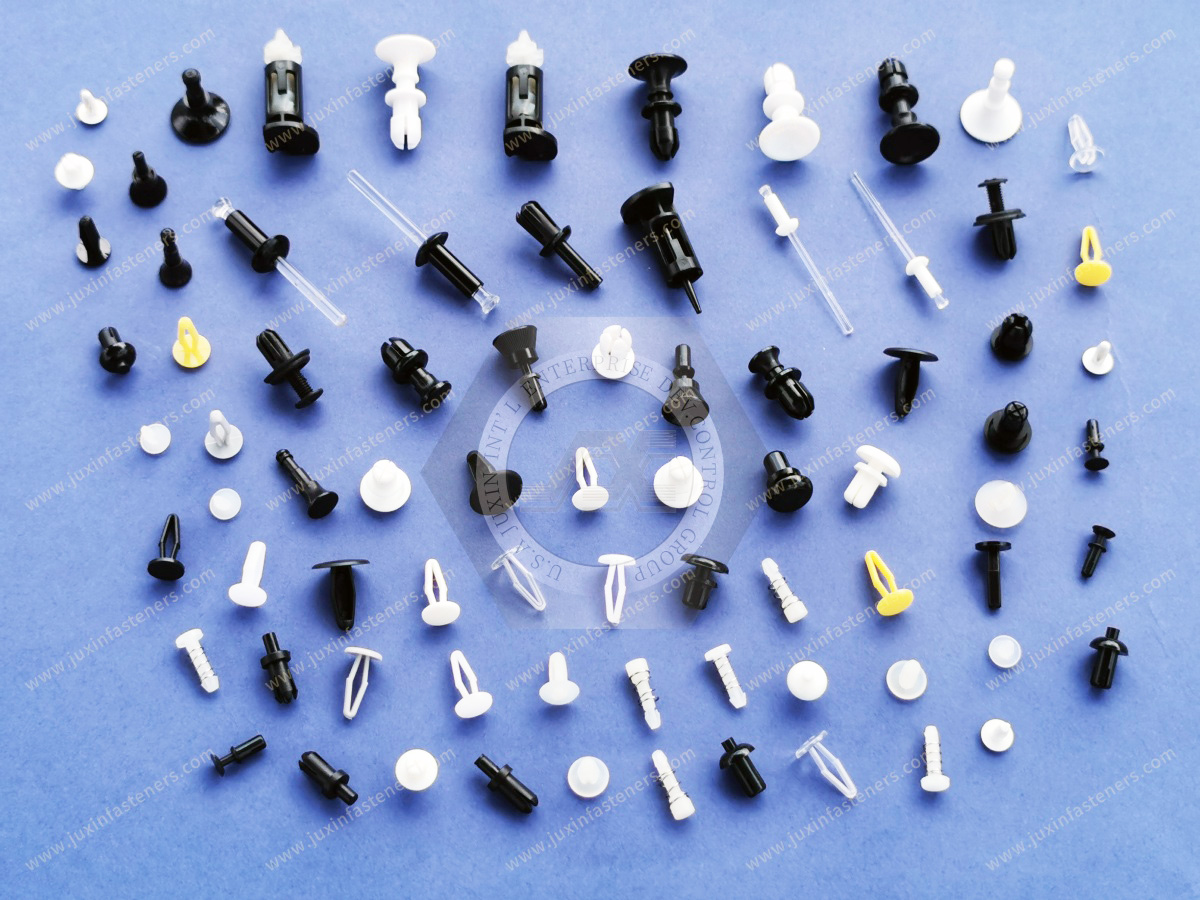
 MORE NEWS
Sep. 27, 2026
Sep. 27, 2026
Sep. 27, 2026
Contact Us
Tel.:
+86 020 8621 0320
+86 020 3121 6067
E-mail:
Technical Support:
Navigation
SEND INQUIREY