
Call Us
+86 136 6007 9809
Call Us
+86 136 6007 9809

Oct. 21, 2023
Push-on nuts are compact retaining fasteners designed to create axial retention on compatible shafts, studs or pins without requiring a conventional mating thread.
Depending on product geometry and regional terminology, these components may also be described as:
push nuts;
push-on retainers;
push-on fasteners;
shaft retainers;
stud retainers;
press-on retainers;
push-on locking fasteners.
Their primary engineering advantage is simple:
they can create a retaining point on a compatible unthreaded or specially designed shaft without installing and tightening a conventional threaded nut.
This can reduce component count and assembly operations in suitable high-volume products.
However, a push-on nut should not be treated as a universal replacement for a threaded nut, retaining ring or circlip.
Its performance depends strongly on the relationship between:
retainer geometry + shaft diameter + shaft material + shaft hardness + interference + installation + required axial retention.
JUXIN FASTENERS supplies standard and custom retaining fasteners, stamped components,
washers, nuts and application-specific fastening components for OEM and industrial applications.
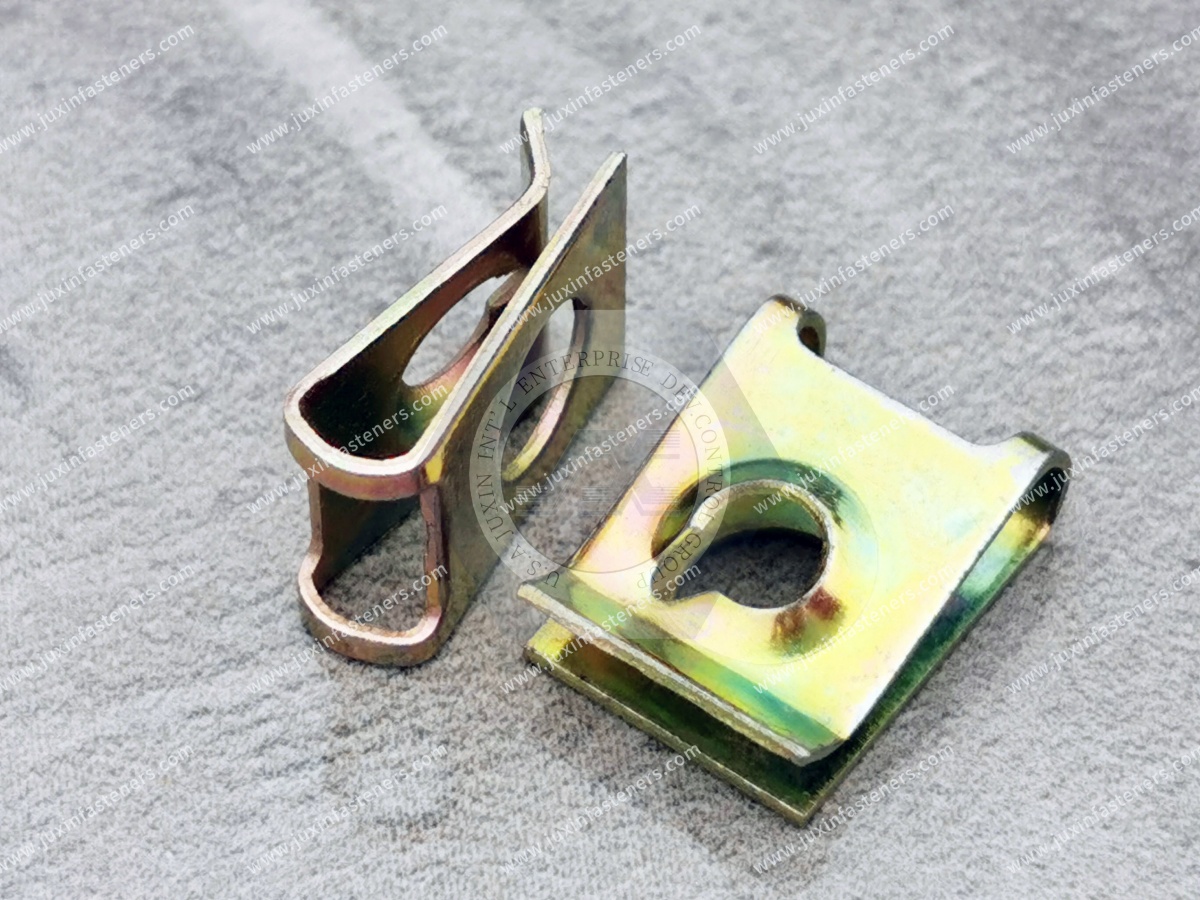
A push-on nut is a retaining component that is pressed axially onto a compatible shaft, stud or pin.
Instead of using mating threads, the retainer uses resilient gripping features around its internal opening.
As the fastener is pushed over the shaft, these features deflect.
After installation, they resist movement in the opposite direction and help retain the assembled component axially.
The concept is particularly useful where an assembly requires:
rapid installation;
no conventional mating nut;
limited axial installation space;
reduced component count;
economical high-volume assembly.
The commercial name can be slightly misleading.
A conventional nut transfers load through mating internal and external threads.
A push-on nut normally does not rely on conventional threaded engagement.
Its retention mechanism is based on interference and gripping features acting against the shaft or stud.
For engineering drawings and sourcing, terms such as push-on retainer or shaft retainer can sometimes describe the function more clearly.
However, "push nut" and "push-on nut" remain useful commercial search terms.
These are completely different fastening technologies.
A strut channel spring nut contains a threaded nut body and is installed inside a compatible mounting channel.
A push-on nut is pressed directly onto a shaft, pin or stud and normally does not require a mating thread.
Therefore:
strut spring nut ≠ push-on nut.
This distinction is important when searching catalogs, requesting quotations or building product databases.
A push-on retainer works through controlled elastic deformation and interference.
During installation:
the fastener is aligned with the shaft or stud;
axial installation force pushes the retainer onto the mating component;
internal gripping features deflect as they pass over the shaft;
the retainer reaches its installed position;
the gripping features resist movement in the reverse direction.
The resulting retention depends on the complete interface rather than the retainer alone.
The internal opening is the most important functional area of many push-on retainers.
Depending on design, the gripping features may use:
inward-facing teeth;
fingers;
tabs;
radial spring elements;
other formed gripping geometry.
These features must deform enough to allow installation while retaining sufficient elastic and mechanical engagement afterward.
If the interference is insufficient, retention can be poor.
If interference is excessive, installation force can become too high or the mating shaft and retainer can be damaged.
Push-on fasteners depend on the dimensional relationship between the retainer and the mating shaft.
Therefore, specifying only the approximate nominal shaft size may not be enough for a critical OEM application.
Engineers should consider:
actual shaft diameter;
shaft tolerance;
retainer opening geometry;
retainer tolerance;
surface finish;
material;
hardness.
A small change in this interface can affect both installation force and removal resistance.
In an interference-based retaining system, dimensional variation directly influences assembly behavior.
A shaft near the upper end of its tolerance may require greater installation force.
A shaft near the lower end may provide less interference.
Therefore, production capability should be evaluated across the expected tolerance range rather than only with one nominal sample.
For OEM development, testing parts representing tolerance extremes can provide useful information.
The mating shaft is part of the fastening system.
Possible shaft materials can include suitable:
carbon steel;
stainless steel;
aluminum;
engineering polymers;
other application-specific materials.
The same push-on retainer can behave differently on different shaft materials.
The shaft surface may experience localized contact from the gripping features, so material strength and surface condition should be considered.
Hardness affects how the retainer teeth or gripping features interact with the shaft.
Depending on the combination, the gripping features may:
elastically engage the surface;
create localized indentation;
mark the shaft;
produce other controlled interference effects.
If shaft cosmetic appearance or dimensional integrity is critical, this interaction should be evaluated during design validation.
A smooth polished shaft, coated stud, plated steel pin and molded polymer post do not necessarily behave identically.
Surface condition can influence:
installation force;
friction;
gripping behavior;
surface damage;
corrosion behavior.
If the shaft has a coating, engineers should also consider whether installation may locally disturb that coating.
These are different engineering parameters.
Installation force is the force required to push the retainer into its assembled position.
Retention force or removal resistance describes the axial force required to displace or remove the installed retainer under defined conditions.
A useful design balances both.
If installation force is too high, assembly can become difficult or damage components.
If retention is too low, the retainer may not adequately secure the component.
There is no universal ratio that applies to every push-on fastener.
It would be misleading to state that a particular nominal push nut always provides a specific retention force without defining the complete assembly.
Performance can depend on:
retainer design;
material;
thickness;
heat treatment;
shaft diameter;
shaft tolerance;
shaft hardness;
shaft material;
surface condition;
installation depth;
loading direction.
For engineered OEM applications, retention should be validated using representative production components.
Push-on retainers can provide effective axial retention in suitable assemblies, but they should not automatically be described as universal vibration-proof fasteners.
Service performance can depend on:
vibration amplitude;
load direction;
shaft interface;
cyclic movement;
temperature;
installation condition;
retainer design.
Where vibration is critical, representative assembly testing may be appropriate.
Reuse should not be assumed.
During installation and removal, the internal gripping features may deform or alter the mating shaft surface.
Depending on the design, removing the retainer may permanently change its geometry.
Therefore, many push-on retaining applications should be evaluated as installation-specific rather than automatically reusable.
If repeated service or disassembly is required, another retention method may be more appropriate.
Push-on nuts and retaining rings can both provide axial retention, but they use different interfaces.
Usually pressed directly onto a compatible shaft or stud.
A machined retaining groove may not be required for some designs.
Typically installs into a defined groove on a shaft or in a bore, depending on the retaining-ring type.
If the shaft is already designed with a retaining-ring groove, a circlip or retaining ring may provide a more defined location.
If the design intentionally avoids groove machining, a push-on retainer may offer manufacturing advantages.
An E-clip typically engages a machined groove on a shaft.
A push-on retainer may be installed axially onto a compatible shaft without that conventional retaining groove.
The choice can affect:
shaft manufacturing;
assembly method;
serviceability;
removal;
cost;
axial positioning.
Neither technology is universally better.
The correct choice depends on the product architecture.
A conventional threaded nut requires a threaded mating component.
A push-on nut can eliminate the need for that thread in suitable applications.
This can reduce machining or forming operations on the shaft.
However, threaded nuts can offer advantages where the assembly requires:
controlled preload;
high structural load;
repeated disassembly;
adjustable clamping;
defined tightening torque.
A push-on retainer should therefore not be substituted for a threaded nut simply to reduce assembly time without reviewing the joint requirements.
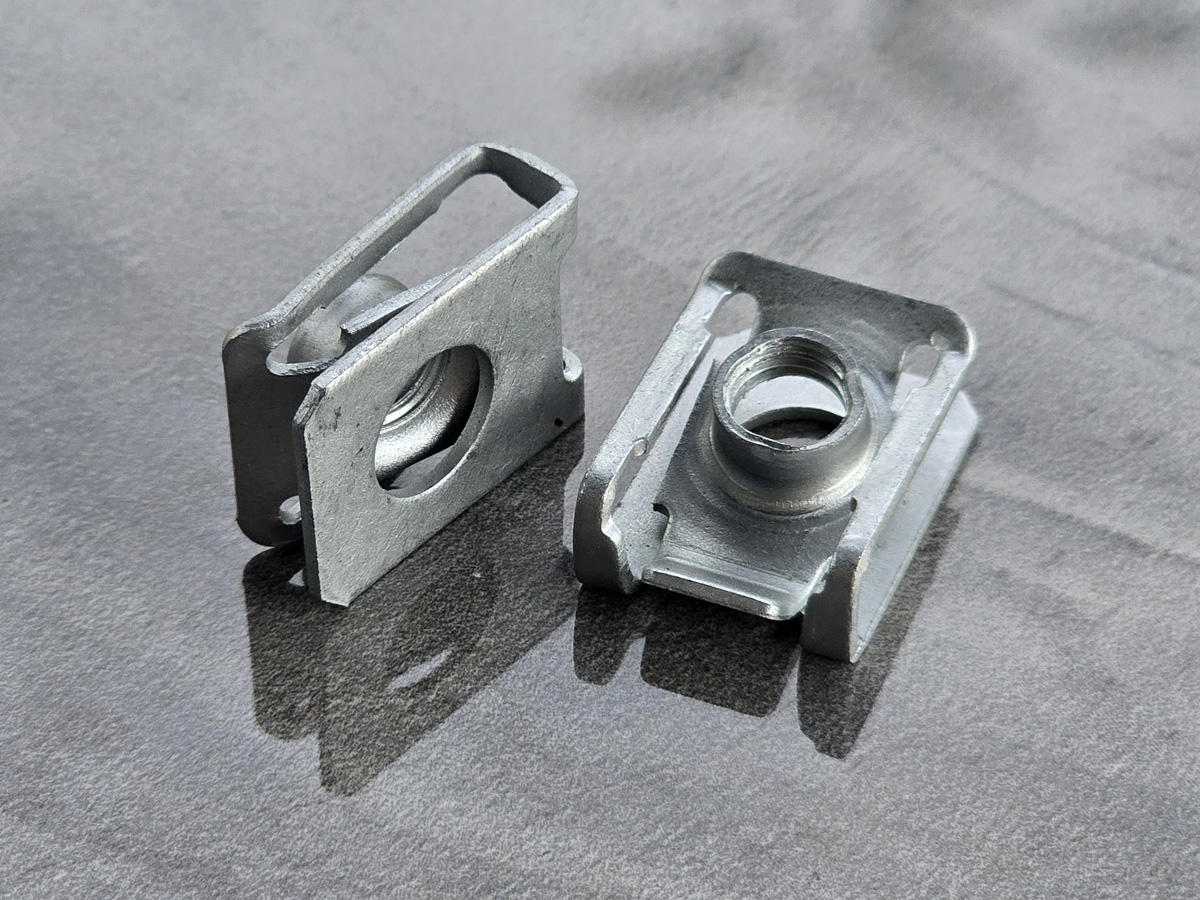
A cotter-pin retention system typically requires a cross-hole or compatible castellated assembly.
A push-on retainer can avoid the cross-hole in suitable applications.
This can simplify shaft manufacturing, but the two systems have different load paths and service characteristics.
A shaft collar clamps around a shaft and can provide adjustable axial positioning in suitable mechanical systems.
Push-on retainers are generally more compact and can be suited to economical high-volume retention.
A shaft collar may be more appropriate when adjustability, removal or higher mechanical control is required.
Push-on retainers require materials capable of providing the necessary formed geometry and elastic behavior.
Depending on design and environment, materials can include suitable spring steels, stainless steels or other engineered metallic materials.
The correct material depends on:
required elastic behavior;
mechanical properties;
corrosion exposure;
forming requirements;
temperature;
application environment.
Stainless steel should not automatically be specified for every push-on nut.
Suitable carbon or spring steel can provide useful combinations of:
formability;
elastic behavior;
strength;
production efficiency.
Surface treatment may be applied where corrosion protection is required.
The exact material condition and treatment should be matched to the product design.
Stainless steel may be selected where corrosion resistance or environmental compatibility is important.
Potential applications can include suitable:
outdoor equipment;
industrial equipment;
appliances;
HVAC equipment;
electrical equipment.
However, simply using stainless steel does not automatically make a component food-grade, hygienic or pharmaceutical compliant.
Those requirements depend on the complete equipment design, material specification, surface condition, cleaning process and applicable industry requirements.
A stainless steel push-on retainer may be used in some food-processing equipment, but stainless steel material alone does not establish compliance with every food-contact or hygienic-design requirement.
Engineers should determine:
whether the fastener contacts food;
cleaning chemicals;
washdown exposure;
corrosion environment;
material specification;
equipment hygiene requirements.
The same principle applies to pharmaceutical equipment.
Compliance must be based on the actual application and applicable specification.
Push-on fasteners can be useful in suitable automotive and transportation assemblies where rapid retention on a stud, shaft or pin is required.
Potential non-universal applications can include:
trim-related assemblies;
shields;
covers;
brackets;
linkages;
other application-specific retained components.
Safety-critical automotive applications should follow the approved engineering drawing and validation requirements.
A general-purpose push nut should not be substituted solely by nominal diameter.
High-volume appliance manufacturing can benefit from fastening methods that reduce assembly operations.
Push-on retainers can be considered for suitable:
shafts;
pins;
rollers;
brackets;
internal mechanisms;
equipment panels or subassemblies.
Their suitability depends on load, temperature, material and service requirements.
Electrical and electromechanical equipment can use push-on retainers for suitable mechanical retention tasks.
Applications can include:
mounting hardware;
shafts;
pins;
brackets;
actuating mechanisms;
equipment subassemblies.
Where electrical conductivity or insulation matters, material and surface finish should be reviewed as part of the complete design.
Rollers, guides and other material-handling mechanisms can require economical axial retention.
A push-on fastener may be useful where:
the retained load is appropriate;
shaft geometry is compatible;
permanent or limited-service assembly is acceptable.
For rotating components, designers should distinguish between simply retaining a component axially and locating or supporting a precision bearing.
Those are different engineering functions.
The old assumption that a push-on nut is automatically suitable for bearing retention should be treated carefully.
Bearing systems can require precise:
axial location;
preload;
shoulder geometry;
runout control;
serviceability.
A general push-on retainer may be suitable in certain light-duty or application-specific assemblies, but it should not automatically replace a properly engineered bearing-retention system.
Lawn and garden equipment, outdoor machinery and other mass-produced products can use push-on retaining fasteners in suitable mechanical assemblies.
Environmental considerations can include:
moisture;
dirt;
corrosion;
temperature cycling;
vibration.
Material and coating selection should reflect the actual service environment.
The commercial advantage of push-on retainers often comes from assembly simplification.
Potential benefits can include:
no mating thread;
no nut-running operation;
reduced part count;
rapid axial installation;
compatibility with automated or semi-automated assembly;
compact packaging space.
For high-volume OEM production, even a small reduction in assembly operations can be commercially important.
However, those benefits matter only when the retention performance meets the application requirements.
Push-on retainers can be installed using suitable manual or automated methods depending on production volume and product design.
An installation tool can help apply force to the appropriate area of the retainer.
The tooling should avoid:
distorting functional gripping features;
tilting the retainer;
damaging the shaft;
applying force to inappropriate areas.
For high-volume programs, assembly-tool design can be considered during fastener development.
Installation position can affect the final assembly.
The retainer may need to seat:
against the retained component;
against a shoulder;
at a defined axial position.
Excessive installation force after seating can deform the retainer or connected component.
The required installed position should therefore be defined by the assembly design.
They can mark or locally interact with the shaft surface because gripping is part of their operating principle.
Whether that matters depends on the application.
If the shaft surface is:
cosmetic;
sealing;
precision bearing;
fatigue-critical;
coated for corrosion protection,
the effect of the retaining teeth should be evaluated.
This is another reason a push-on retainer should not be selected only because it is fast to install.
Removing a push-on retainer can be more difficult than installing it.
Depending on design, removal may:
deform the retainer;
mark the shaft;
require a dedicated tool;
make the component unsuitable for reuse.
If frequent service is expected, engineers should consider this during fastener selection.
Potential issues include:
Possible causes:
shaft below intended diameter;
oversized retainer opening;
insufficient tooth engagement;
incorrect part selection.
Possible causes:
shaft too large;
excessive interference;
unsuitable shaft surface;
incorrect retainer size.
Possible causes:
misaligned tooling;
uneven installation force;
incorrect starting position.
Possible causes:
excessive interference;
unsuitable hardness combination;
aggressive gripping geometry;
repeated removal and installation.
Possible causes can include insufficient engagement, dimensional mismatch, service loading or inappropriate product selection.
These problems should be investigated at the interface level rather than solved by simply changing material.
A practical push-on retainer selection process can follow these steps.
What component must be retained, and in which direction?
Specify:
diameter;
tolerance;
material;
hardness where relevant;
surface finish;
coating.
Consider expected axial load and dynamic conditions.
Determine:
manual or automated installation;
available access;
maximum acceptable installation force.
Will the retainer need to be removed?
Will the assembly be serviced repeatedly?
Choose retainer material according to mechanical and environmental requirements.
Consider the complete assembly and service environment.
For function-critical applications, test representative retainers on production-representative shafts.
Before selecting a push-on nut, ask:
Is the shaft threaded or unthreaded?
Is a retaining groove available?
What axial force must be resisted?
Is removal required?
Can the shaft tolerate local gripping marks?
Is the assembly safety-critical?
What environmental exposure exists?
Is installation automated?
What shaft tolerances are expected?
What happens at dimensional tolerance extremes?
These questions can quickly determine whether a push-on retainer is the correct technology.
A useful RFQ should include:
product drawing or physical sample;
shaft diameter;
shaft tolerance;
shaft material;
shaft hardness where relevant;
shaft surface condition;
retainer dimensions;
retainer material;
finish/coating;
required axial retention where specified;
installation-force requirement where specified;
operating environment;
application;
order quantity;
estimated annual demand;
packaging requirement.
For replacement sourcing, photographs of the installed component can also help clarify its function.
Standard push nuts can meet many applications.
Custom designs may be appropriate when an OEM requires:
non-standard shaft diameter;
unusual outside geometry;
specific tooth configuration;
controlled installation force;
application-specific retention behavior;
special material;
special finish;
proprietary assembly interface.
Custom development should include the mating shaft or representative dimensional information.
The retainer cannot be optimized independently from the component it grips.
Many push-on retainers are well suited to stamping and forming processes.
Manufacturing considerations can include:
strip material;
material thickness;
blank geometry;
forming sequence;
tooth formation;
heat treatment where required;
surface treatment;
dimensional control.
For high-volume production, tooling and material utilization can significantly influence piece cost.
For custom OEM programs, validation can include representative evaluation of:
installation force;
installed position;
axial retention;
shaft marking;
dimensional variation;
environmental exposure;
vibration or cyclic loading where relevant.
The test method should reflect the actual application rather than relying on a generic universal number.
Legacy equipment may use a push-on fastener whose original supplier or part number is no longer available.
Development can begin from:
physical samples;
photographs;
shaft dimensions;
assembly drawings;
application information.
A used retainer should be evaluated carefully because its gripping features may have changed during installation or removal.
Where possible, an unused sample is preferable.
A push-on nut is a retaining fastener pressed onto a compatible shaft, stud or pin to provide axial retention without a conventional mating thread.
Many push-on retainers are specifically designed for unthreaded or otherwise compatible shafts and studs.
Internal spring-like teeth or gripping features deflect during installation and resist reverse axial movement after installation.
Not necessarily. A strut-channel spring nut is a threaded component installed inside a mounting channel. A push-on nut is a retaining fastener pressed onto a shaft or stud.
Reuse should not be assumed. Installation and removal can permanently affect the gripping features or mating shaft.
Some push-on retainer designs can provide retention without the conventional machined groove required by many retaining rings or E-clips.
It may be suitable for certain application-specific axial-retention tasks, but rotating and bearing systems should be evaluated according to their actual load, positioning and service requirements.
No. Material selection depends on mechanical requirements, forming behavior, corrosion environment and application specifications.
No. Stainless steel material alone does not establish food-contact, hygienic or pharmaceutical compliance.
Retention depends on the retainer design, material, shaft diameter, tolerance, hardness, surface condition and installation.
Yes. JUXIN FASTENERS supports drawing-based and sample-based development of custom fastening and retaining components for OEM applications.
Push-on nuts provide a simple way to retain components on compatible shafts, studs and pins without relying on a conventional threaded nut.
Their apparent simplicity should not hide the key engineering relationship:
the retainer and shaft function as a system.
Shaft diameter, tolerance, material, hardness, surface condition and retainer geometry all influence installation and retention.
For design engineers, understanding that interface helps determine whether a push-on retainer, retaining ring, E-clip, threaded nut or another technology is most appropriate.
For procurement and supplier-development teams, supplying shaft information together with the retainer specification significantly improves sourcing accuracy.
JUXIN FASTENERS supports global OEM, ODM, engineering, procurement, sourcing and supplier-development teams with standard and custom retaining fasteners, stamped components and application-specific fastening solutions.
If you have a drawing, send the drawing.
If the original drawing is unavailable, send the existing fastener together with the shaft dimensions or mating sample.
If you are developing a new assembly, send the shaft diameter, tolerance, material, required retention behavior and estimated annual quantity.
We can support technical review, sample review, manufacturing feasibility evaluation, custom development, quotation and production sourcing.
Email: info@juxinfasteners.com
Website: www.juxinfasteners.com
Previous: Starlock Washers & Retainers
 MORE NEWS
Sep. 27, 2026
Sep. 27, 2026
Sep. 27, 2026
Contact Us
Tel.:
+86 020 8621 0320
+86 020 3121 6067
E-mail:
Technical Support:
Navigation
SEND INQUIREY