Call Us
+86 136 6007 9809
Call Us
+86 136 6007 9809

Mar. 29, 2026
EV Battery Pack Rivet Nuts: Sealed Blind Fasteners for Aluminum Enclosures and OEM Assembly
Electric vehicle battery pack enclosures must combine structural integrity, environmental protection, electrical safety, manufacturability and serviceability.
Many battery-related housings and auxiliary structures use aluminum sheet, steel panels, extrusions or other lightweight materials.
These components may require threaded attachment points where backside access is restricted or conventional nut installation is impractical.
Blind rivet nuts for EV battery pack enclosures provide one-sided installation and reusable internal machine threads in suitable thin-wall components.
Also called rivnuts, nutserts or blind threaded inserts, these fasteners are installed through a prepared hole and mechanically deformed to create retention behind the parent material.
Potential applications include:
Battery enclosure covers
Auxiliary mounting brackets
Battery management electronics housings
Cooling-system support brackets
Electrical equipment mounting points
Selected serviceable enclosure interfaces
Lightweight aluminum battery-related structures
However, a blind rivet nut is not automatically suitable for every battery pack connection.
High-voltage battery systems may impose requirements involving vibration, thermal cycling, crash performance,
sealing, corrosion, electrical isolation and long-term mechanical reliability.
The correct fastening solution must therefore be selected and validated as part of the complete enclosure design.
This guide explains how automotive engineers, manufacturing teams and OEM procurement specialists can evaluate rivet nuts for
EV battery-related applications without confusing fastener-level properties with system-level performance.
Juxin Fasteners welcomes drawing-based inquiries for standard and customized blind rivet nuts, including carbon steel,
stainless steel, aluminum and sealed configurations subject to technical confirmation.
Why Blind Rivet Nuts Are Considered for EV Battery Enclosures
EV battery-related components may contain thin sheet metal, closed profiles and restricted installation spaces.
Conventional nuts may require access to both sides of the workpiece.
Directly tapping thin sheet metal may provide insufficient thread engagement.
Weld nuts may introduce welding heat, coating damage or additional process requirements.
Blind rivet nuts can offer an alternative where the design permits one-sided installation.
One-Side Installation
A rivet nut can be inserted and set from the accessible side of the panel.
This can be useful for:
Closed sections
Aluminum enclosure walls
Sheet metal covers
Auxiliary brackets
Equipment housings
Reusable Internal Machine Threads
The installed rivet nut provides a metal internal thread for a mating screw.
This can support removable covers and serviceable components when the complete joint is designed for repeated assembly.
Avoiding a Welding Operation
Blind rivet nuts do not normally require welding during installation.
This may be useful for selected coated or aluminum components where a welding process is undesirable or impractical.
Potential Production Benefits
Depending on the design and equipment, blind rivet nuts may support:
Manual installation
Pneumatic installation
Electric setting systems
Automated installation processes
Important Engineering Limitation
Blind rivet nuts should not be assumed to replace structural welds, crash-critical fasteners or other safety-related joints without application-specific validation and approval.
How a Blind Rivet Nut Works in an Aluminum Battery Housing
A typical blind rivet nut is inserted into a prepared hole and installed using a tool that deforms part of its body behind the panel.
Installation Sequence
Prepare the specified hole.
Position the rivet nut in the parent material.
Engage the installation mandrel.
Apply the qualified setting force or stroke.
Form the backside retaining bulge.
Release the tool.
Inspect seating and thread condition.
The resulting assembly provides a threaded attachment point.
Load Path
The mechanical load is transferred through:
Mating screw → Rivet nut internal thread → Rivet nut body → Backside retaining feature and flange → Aluminum or steel parent material
This load path explains why the parent material is often as important as the rivet nut itself.
A stronger rivet nut does not automatically increase joint strength if the aluminum sheet deforms or tears first.
Selecting the Correct Grip Range for Battery Enclosure Materials
Grip range is the qualified parent material thickness range for a particular rivet nut design.
It must be compatible with the actual thickness of the enclosure panel or material stack.
Why Grip Range Matters
If the sheet thickness falls outside the intended range, the rivet nut may not deform correctly.
Potential problems include:
Incomplete backside formation
Reduced clamping
Insert rotation
Reduced pull-out resistance
Excessive sheet deformation
Inconsistent installation
Engineering Recommendation
Determine the minimum and maximum expected production thickness, including relevant manufacturing variation.
Then select a rivet nut whose specified grip range covers that range.
Do not assume that all rivet nuts with the same internal thread size have the same grip range.
Hole Diameter and Hole Geometry
The installation hole must match the selected rivet nut body.
Oversized Holes
May cause:
Reduced engagement
Insert spinning
Poor alignment
Inconsistent installation
Undersized Holes
May cause:
Difficult insertion
Sheet deformation
Coating damage
Rivet nut body damage
Round vs Hexagonal Holes
Round-body rivet nuts are used with compatible round holes.
Hex-body rivet nuts require suitable nonround holes and may provide additional anti-rotation engagement.
Engineering Limitation
A hex-body rivet nut is not directly interchangeable with a round-body design unless the hole and complete joint are reviewed.
Aluminum Panel Deformation
Aluminum sheet may deform locally during setting.
This can be influenced by:
Alloy
Temper
Sheet thickness
Hole geometry
Rivet nut body style
Setting parameters
Local panel support
Engineering Recommendation
Validate the rivet nut in the actual aluminum alloy, temper and thickness used in the production enclosure.
Vibration Resistance: Insert Retention vs Screw Loosening
Electric vehicles experience mechanical vibration from road conditions, vehicle dynamics and auxiliary equipment.
Blind rivet nuts must resist movement within the parent material.
However, two different failure mechanisms must be distinguished.
Insert Spin-Out
The rivet nut rotates within the parent material.
Mating Screw Loosening
The screw loses preload or rotates relative to the internal thread.
A rivet nut with high spin-out resistance does not inherently prevent the mating screw from loosening.
Engineering Recommendation
Where vibration is important, validate:
Insert retention
Joint preload
Mating screw engagement
Tightening process
Joint stiffness
Locking method where required
Important Limitation
A rivet nut should not be described as vibration-proof without defined joint-level testing.
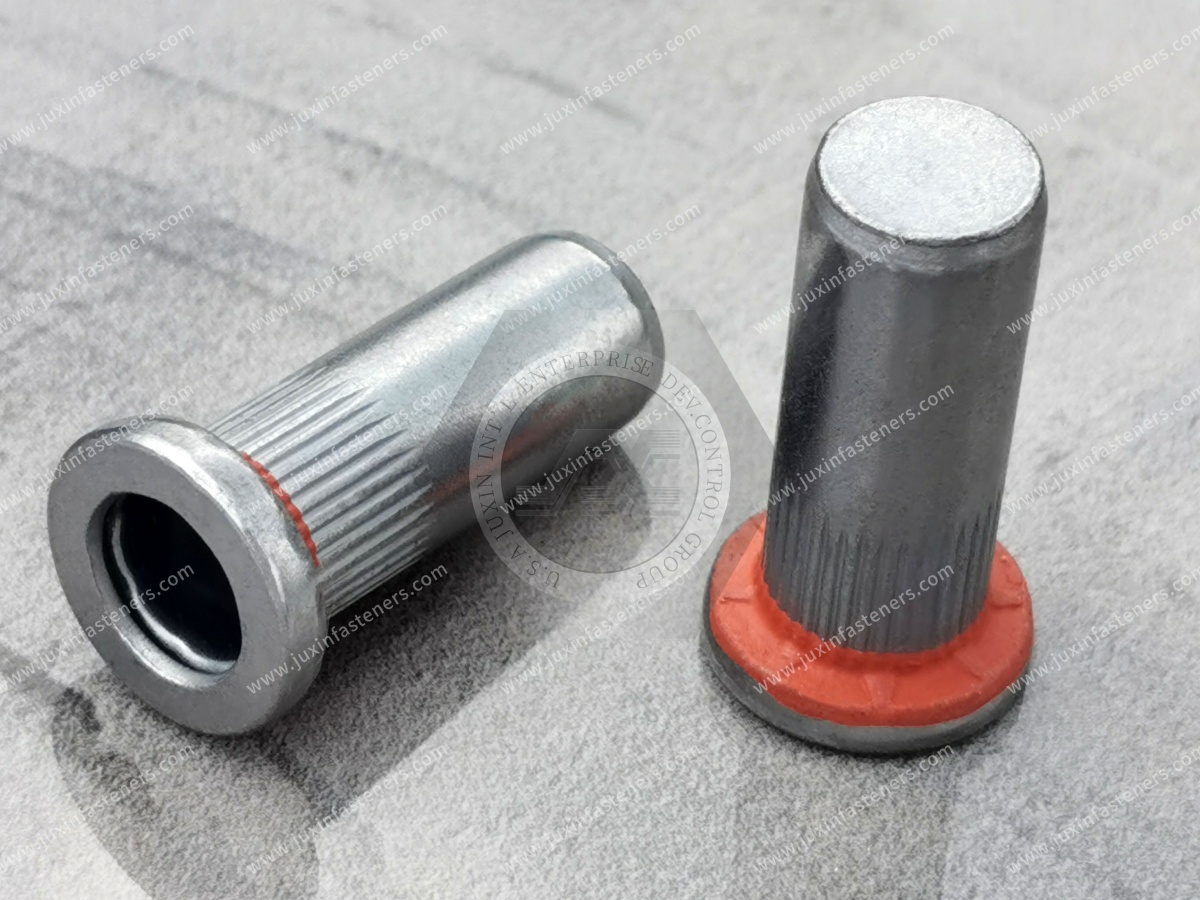
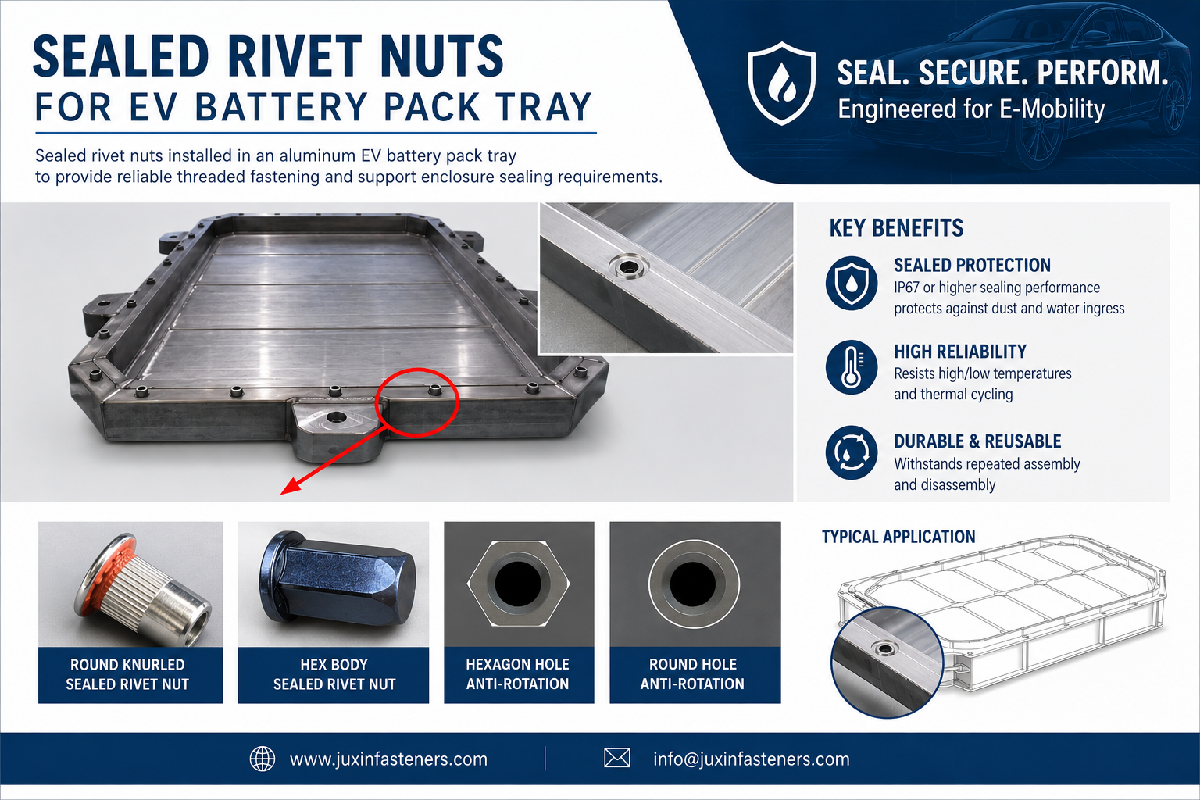
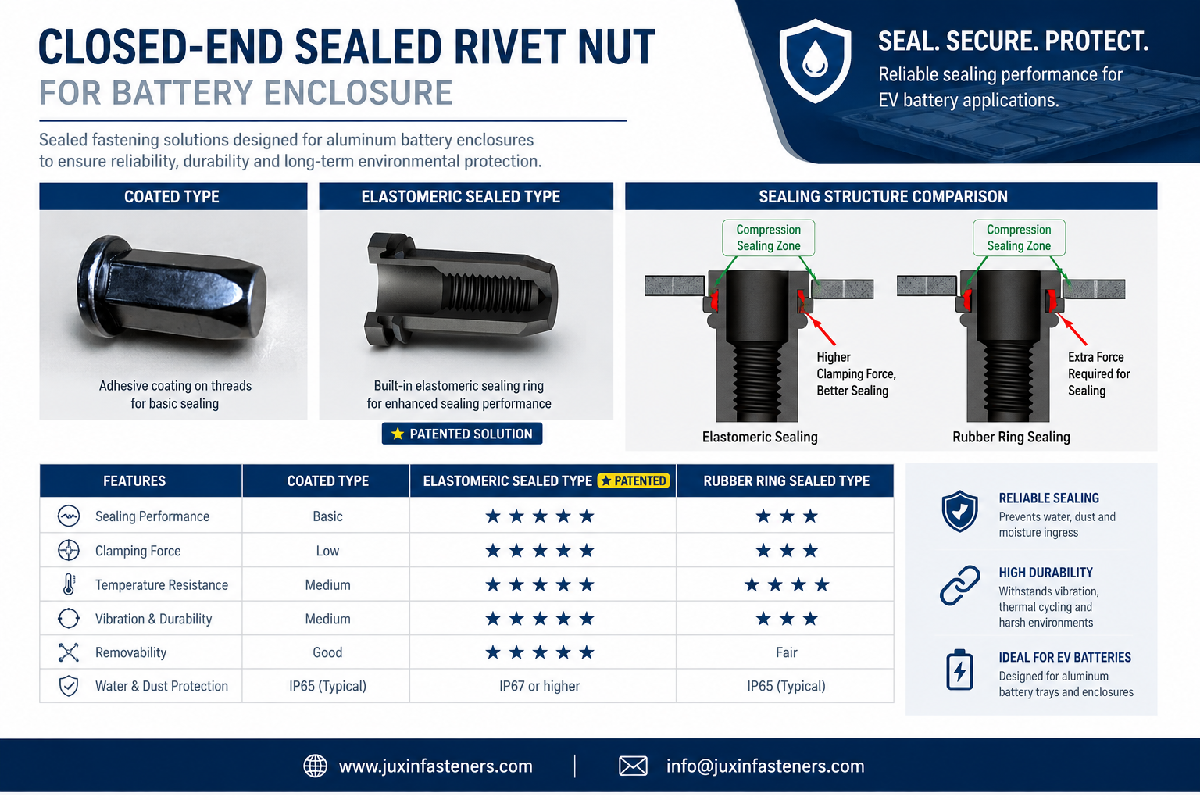
Sealed Blind Rivet Nuts for EV Battery Pack Enclosures
Environmental sealing is a critical consideration for many EV battery enclosures.
However, a sealed rivet nut is only one component of the complete sealing system.
Closed-End Rivet Nuts
A closed-end rivet nut can reduce a potential leakage path through the fastener body.
This may be useful where the internal thread opening would otherwise provide a direct path for moisture or contamination.
Flange Sealing
Water may enter through the interface between the rivet nut flange and the parent material.
Depending on the design, additional sealing may be required.
Possible approaches include:
Specified sealing washers
Compatible gaskets
Qualified sealants
Controlled flange seating
Approved integrated sealing features
Why a Closed-End Rivet Nut Is Not Automatically Waterproof
Potential leakage paths may remain around:
The rivet nut flange
The installation hole
The mating screw
Adjacent enclosure joints
Damaged surface coatings
IP67 and IP68: What They Actually Mean
IP67 and IP68 are ingress-protection classifications defined under IEC 60529.
These classifications concern the tested enclosure under specified conditions.
A sealed rivet nut does not independently guarantee that an EV battery pack meets IP67 or IP68 requirements.
Engineering Recommendation
For battery enclosure sealing, define:
Required enclosure protection level
Fastener sealing configuration
Gasket or sealant requirements
Installation process
Leak-test method
Acceptance criteria
The complete enclosure must be qualified against its actual environmental requirements.
Information Gain: Sealing Performance Depends on Installation Deformation
A rivet nut may include a sealing feature, but installation can change the contact conditions at the flange.
If the flange does not seat properly or the sheet distorts, the sealing interface may be compromised.
Engineering Lesson
Mechanical installation quality and leak-tightness must be validated together.
Material Selection for EV Battery Pack Rivet Nuts
The choice between carbon steel, stainless steel and aluminum should consider mechanical requirements,
installation behavior, corrosion, weight and compatibility with the enclosure.
Carbon Steel Blind Rivet Nuts
Carbon steel rivet nuts may provide useful strength and commercial practicality.
Potential Applications
Selected steel brackets
Auxiliary mounting points
Sheet metal equipment structures
Suitable enclosure interfaces
Engineering Considerations
Steel grade
Coating system
Setting force
Corrosion exposure
Galvanic compatibility
Parent material strength
Coating Options
Depending on the drawing, options may include:
Zinc plating
Zinc-nickel coatings
Other specified corrosion-protection systems
Coating suitability must be evaluated for the actual operating environment.
Stainless Steel Blind Rivet Nuts
Stainless steel rivet nuts may be selected for corrosion-sensitive applications.
Common Candidate Grades
304-type stainless steel
316-type stainless steel
Potential Applications
Moisture-exposed equipment
Selected cooling-related brackets
Outdoor electrical enclosures
Corrosion-sensitive auxiliary components
Engineering Considerations
Stainless steel grade
Chloride exposure
Tool setting capability
Mating screw compatibility
Thread galling
Galvanic corrosion with aluminum
Important Limitation
Stainless steel is not immune to corrosion and may create galvanic compatibility concerns when used with aluminum in conductive environments.
Aluminum Blind Rivet Nuts
Aluminum rivet nuts may be useful for lightweight assemblies.
Potential Applications
Aluminum enclosure panels
Lightweight auxiliary brackets
Selected equipment covers
Engineering Considerations
Aluminum alloy and temper
Thread strength
Setting behavior
Parent material thickness
Corrosion exposure
Mating screw material
Important Limitation
Aluminum rivet nuts are not automatically the best choice for every aluminum enclosure.
The complete joint's strength, installation and corrosion behavior must be evaluated.
Material Comparison
| Selection factor | Carbon steel | Stainless steel | Aluminum |
|---|---|---|---|
| Weight | Relatively high | Relatively high | Low |
| Mechanical performance | Grade-dependent | Grade-dependent | Alloy-dependent |
| Corrosion behavior | Often coating-dependent | Grade-dependent | Alloy/environment-dependent |
| Installation force | Product-dependent | Product-dependent | Product-dependent |
| Galvanic compatibility | Must be evaluated | Must be evaluated | Must be evaluated |
| Typical selection driver | Strength and cost | Corrosion resistance | Weight and compatibility |
Galvanic Corrosion in Aluminum Battery Enclosures
EV battery enclosures may combine aluminum panels with steel or stainless steel fasteners.
When dissimilar metals are electrically connected in the presence of a conductive electrolyte, galvanic corrosion can occur.
Potential Risk Locations
Rivet nut flange
Installation hole
Damaged coating
Mating screw interface
Moisture-trapping joints
Possible Design Measures
Depending on the application:
Compatible coatings
Electrical isolation where appropriate
Sealing of exposed interfaces
Material selection
Drainage and moisture management
Environmental validation
Engineering Recommendation
Evaluate the rivet nut, parent material, mating screw and coating system together.
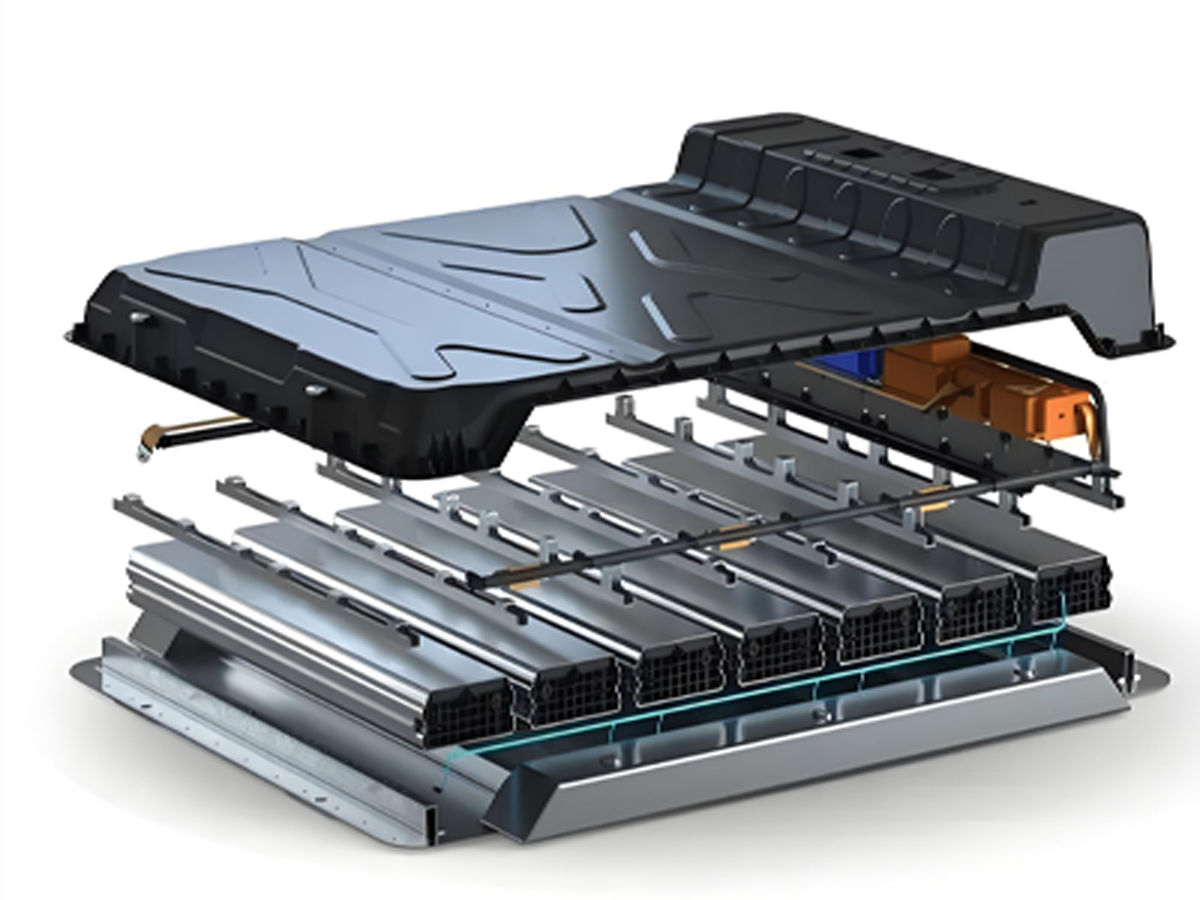
EV Battery Pack Applications
Battery Enclosure Covers
Blind rivet nuts may be considered for removable covers where one-sided installation is required.
Engineering Priorities
Screw access
Grip range
Sealing
Repeated maintenance
Assembly torque
Enclosure stiffness
Battery Module Mounting Systems
Some module-related auxiliary interfaces may use threaded inserts or rivet nuts.
However, load-bearing and safety-critical module retention requires specific engineering qualification.
Engineering Priorities
Mechanical load path
Fatigue
Vibration
Parent material strength
Customer approval
Cooling-System Brackets
Rivet nuts may be considered for mounting suitable cooling-related support components.
Engineering Priorities
Vibration
Thermal cycling
Corrosion
Fluid exposure
Installation accessibility
Electrical Component Mounting
Potential applications include:
Control modules
Sensor brackets
Auxiliary electrical housings
Cable support structures
Engineering Priorities
Electrical clearance
Conductive paths
Mounting stability
Environmental exposure
Maintenance access
High-Voltage Battery Protection Housings
Selected noncritical mounting points may use rivet nuts where permitted by the enclosure design.
Important Safety Limitation
Rivet nuts must not be assumed suitable for high-voltage isolation barriers,
crash-critical retention or other safety-related interfaces without customer-specific qualification.
Battery Energy Storage Systems
Similar one-sided fastening requirements may arise in stationary energy storage equipment.
Potential Applications
Battery cabinet covers
Auxiliary equipment brackets
Electrical enclosure mounting
Serviceable panels
Engineering Priorities
Corrosion
Serviceability
Sealing
Installation repeatability
Applicable safety requirements
EV Battery Rivet Nut Installation Engineering
Installation quality directly affects mechanical retention and, where relevant, sealing.
Hole Preparation
Verify:
Hole diameter
Hole geometry
Burr condition
Panel flatness
Coating condition
Tool Selection
Depending on production volume and component design:
Manual tools
Pneumatic setting tools
Electric setting tools
Automated installation equipment
Setting Force and Setting Stroke
These are installation-process variables used to deform the rivet nut body.
They must not be confused with the tightening torque applied later to the mating screw.
Under-Setting
May cause:
Incomplete backside deformation
Reduced clamping
Insert spinning
Reduced pull-out resistance
Over-Setting
May cause:
Thread distortion
Excessive sheet deformation
Fastener damage
Reduced installation consistency
Installation Process Recommendation
Establish a qualified setting window for the selected rivet nut and actual enclosure material.
Production-Line Quality Control
For manufacturing engineers and production managers, important variables include:
Tool alignment
Setting force or stroke
Mandrel condition
Head seating
Installation cycle time
Process monitoring
Scrap and rework
Operator training
Inspection frequency
Information Gain: A Strong Rivet Nut May Still Be a Poor Production Choice
A rivet nut may meet pull-out requirements in a controlled laboratory test but be difficult to install consistently on a high-volume assembly line.
If the setting process is highly sensitive to sheet thickness variation or tool wear, production defects may increase.
Engineering Lesson
Production process capability should be evaluated alongside mechanical performance.
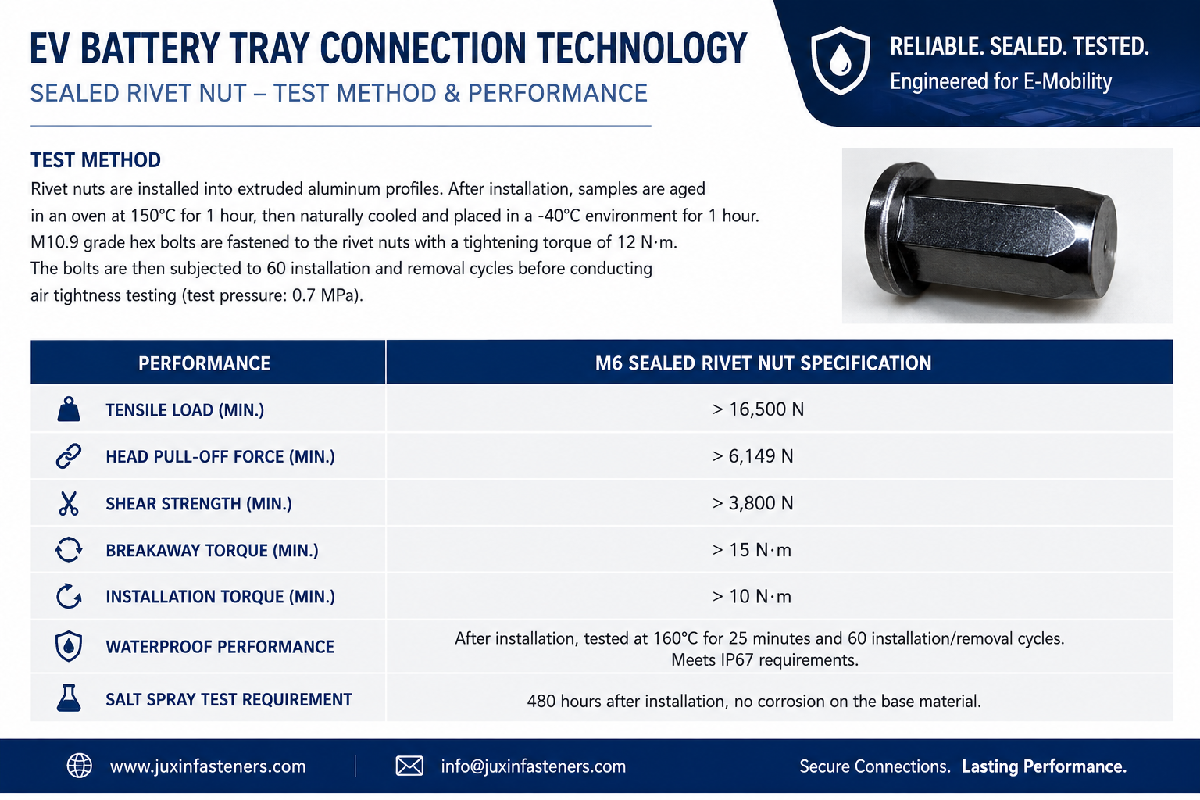
Testing and Validation for EV Battery Enclosure Rivet Nuts
The required test program depends on the function of the joint.
Pull-Out Testing
Evaluates resistance to axial extraction from the installed parent material.
Spin-Out Testing
Evaluates resistance to rotation within the parent material.
Thread and Assembly Testing
May evaluate:
Internal thread condition
Mating screw engagement
Assembly torque
Repeated servicing
Joint preload behavior
Vibration and Fatigue Testing
May be required where the joint experiences dynamic loading.
Thermal Cycling
May be used to evaluate the effects of differential thermal expansion and material changes.
Corrosion Testing
May be required for exposed or dissimilar-metal assemblies.
Leak Testing
May be required for sealed battery enclosures.
Important Testing Principle
Test results are meaningful only when the parent material, sheet thickness, hole geometry, installation process and acceptance criteria are defined.
A generic fastener test result should not be assumed to represent the complete EV battery pack assembly.
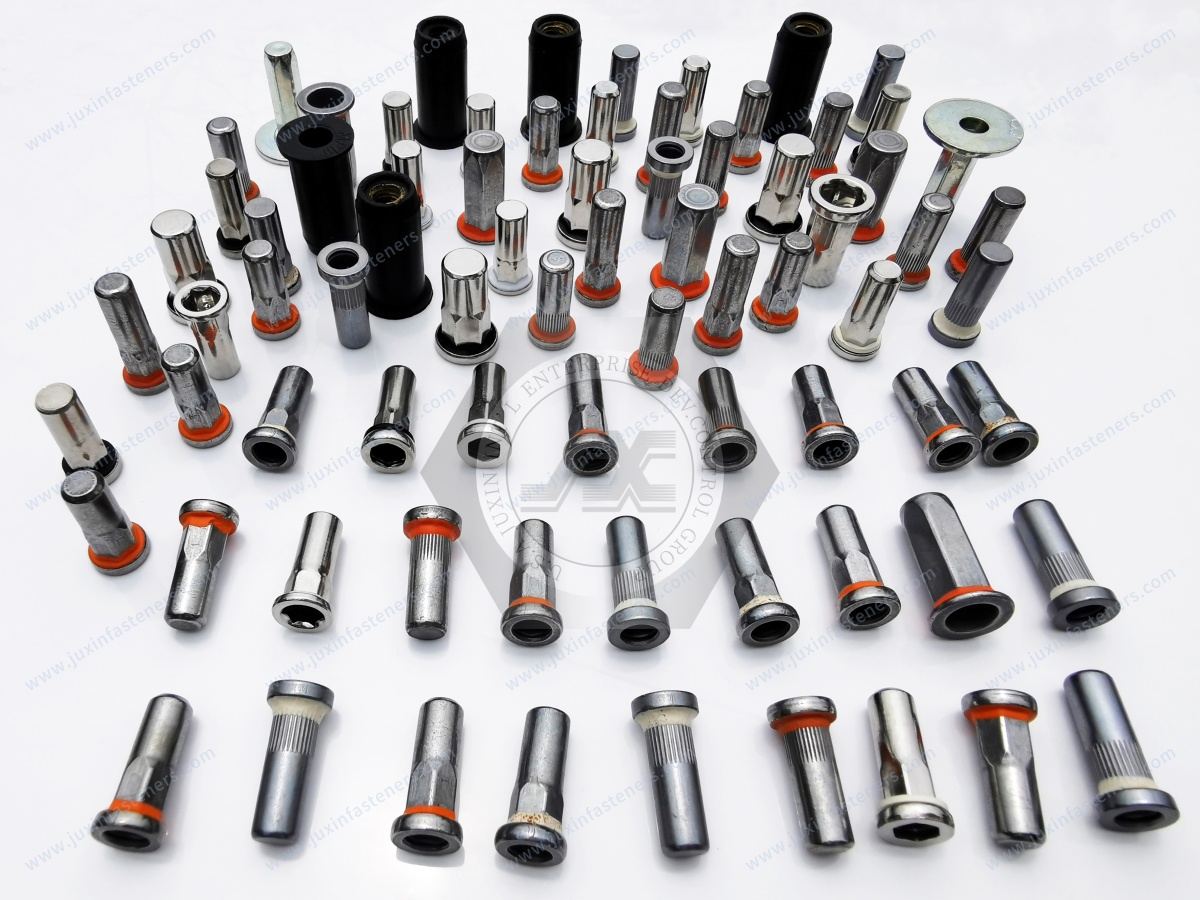
OEM Quality Requirements and Supplier Qualification
EV battery programs may require structured quality planning and documentation.
The applicable requirements depend on the customer and the function of the component.
Potential Product Documentation
Approved drawings
Material specifications
Coating requirements
Dimensional inspection records
Thread inspection
Traceability requirements
Potential Process Documentation
Installation process parameters
Control plans
Process capability evidence
Change-control requirements
PPAP documentation where required
Potential Assembly Validation
Pull-out resistance
Spin-out resistance
Vibration performance
Corrosion evaluation
Thermal cycling
Leak testing
These requirements must be agreed for the specific program.
They should not be assumed automatically available for every standard rivet nut.
Relevant International Standards
Depending on the drawing and application:
ISO 261: General-purpose metric screw thread plan
ISO 965 series: Metric screw thread tolerances
ASME B1.1: Unified inch screw threads
IEC 60529: Ingress protection classifications for enclosures
ISO 9227: Salt spray testing where specified
ISO 2859-1: Sampling procedures for inspection by attributes, where specified
These standards do not establish universal rivet nut retention strength or guarantee suitability for EV battery applications.
Metric and Inch Thread Selection
EV battery enclosure rivet nuts may be specified with metric or unified inch internal threads.
For dimensional reference only:
M5 nominal diameter ≈ 0.197 inch
M6 nominal diameter ≈ 0.236 inch
M8 nominal diameter ≈ 0.315 inch
These are nominal diameter conversions, not interchangeable thread specifications.
Metric, UNC, UNF, BSW and BSF threads are not directly interchangeable.
OEM RFQ Checklist for EV Battery Pack Rivet Nuts
| RFQ item | Information to provide |
|---|---|
| Rivet nut drawing | Part number and revision |
| Thread designation | Metric or unified inch |
| Body style | Round, knurled, hex or other |
| Head style | Flat, reduced or countersunk |
| Material | Carbon steel, stainless steel or aluminum |
| Coating | Required corrosion protection |
| Parent material | Alloy, grade and temper |
| Sheet thickness | Nominal and tolerance range |
| Grip range | Required qualified range |
| Hole geometry | Diameter or hex dimensions |
| Installation access | Tool and backside clearance |
| Setting method | Force, stroke or qualified process |
| Mechanical requirements | Pull-out and spin-out |
| Mating screw | Thread, length and tightening conditions |
| Sealing requirements | Closed-end, gasket or sealant |
| Environmental requirements | Temperature, corrosion and vibration |
| Leak testing | Method and acceptance criteria |
| Quality documentation | Customer-specific requirements |
| Prototype quantity | Sample demand |
| Annual volume | Forecast quantity |
| MOQ | Commercial confirmation |
| Lead time | Required delivery schedule |
| Packaging | Bulk or protected packaging |
Frequently Asked Questions
Are blind rivet nuts suitable for EV battery pack enclosures?
They may be suitable for selected enclosure covers, auxiliary brackets and mounting interfaces where one-sided installation is useful.
Safety-critical applications require specific qualification.
Can rivet nuts be installed in aluminum battery housings?
Yes, provided the rivet nut design, grip range, hole geometry and installation process are compatible with the aluminum material.
Are sealed rivet nuts waterproof?
Some designs can reduce specific leakage paths, but the complete enclosure must be tested to establish sealing performance.
Do sealed rivet nuts guarantee IP67 or IP68?
No. These are enclosure-level ingress-protection classifications and require appropriate assembly validation.
Which rivet nut material is best for aluminum EV enclosures?
The selection depends on mechanical loading, corrosion exposure, installation requirements, mating materials and cost.
Can rivet nuts resist EV vibration?
They can provide mechanical retention, but screw-joint vibration performance must be validated separately.
What is the difference between setting force and screw tightening torque?
Setting force is used to deform and install the rivet nut. Tightening torque is applied later to the mating screw during assembly.
Can blind rivet nuts replace welded nuts in EV battery systems?
Sometimes, but the substitution requires evaluation of load capacity, hole geometry, installation, corrosion, sealing and production cost.
What should an OEM buyer provide for an EV rivet nut quotation?
Provide the drawing, parent material, thickness, grip range, hole geometry, installation method, mechanical requirements,
sealing requirements, quality documentation and forecast demand.
Juxin Fasteners: EV Battery Enclosure Rivet Nut Solutions
Juxin Fasteners welcomes inquiries for standard and custom blind rivet nuts used in suitable EV battery-related and industrial enclosure assemblies.
Relevant product categories include:
Carbon steel blind rivet nuts
Stainless steel blind rivet nuts
Aluminum blind rivet nuts
Round-body rivet nuts
Knurled rivet nuts
Hex-body rivet nuts
Closed-end rivet nuts
Sealed rivet nut designs
Custom OEM threaded fastening components
Specific product configurations, materials, coatings, manufacturing feasibility, inspection documentation,
MOQ and delivery schedules require confirmation against the customer's drawings and program requirements.
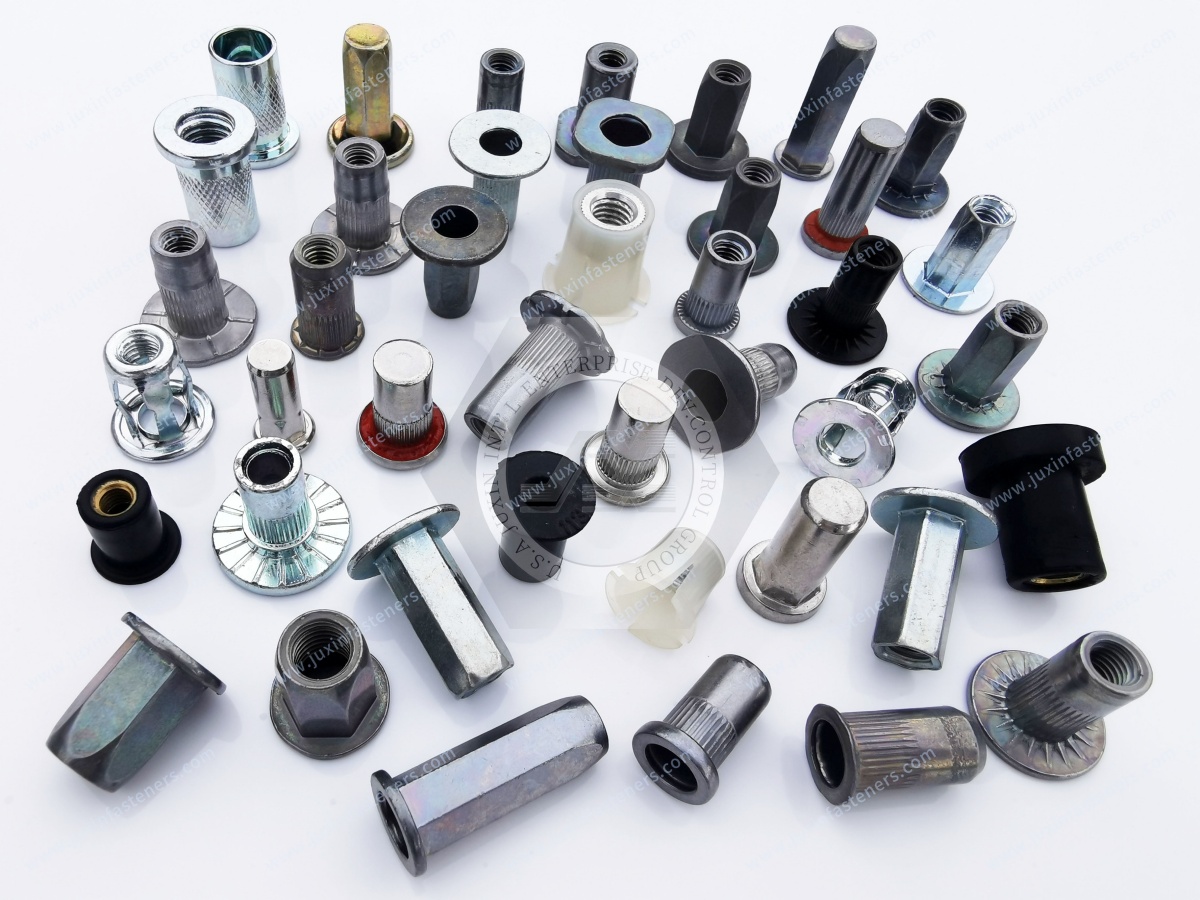
Request an OEM EV Battery Rivet Nut Quotation
Are you developing an aluminum EV battery enclosure, selecting rivet nuts for a sealed service cover,
sourcing threaded mounting points for battery electronics or evaluating an alternative supplier for an automotive program?
Juxin Fasteners welcomes drawing-based inquiries from automotive design engineers, structural engineers, manufacturing engineers, production managers,
purchasing specialists, procurement managers, supplier development teams and supply chain managers.
Please provide:
Rivet nut drawing + thread designation + material and coating + parent material alloy and thickness + hole geometry + grip range
+ installation process + pull-out and spin-out requirements + sealing requirements + environmental conditions
+ quality documentation + prototype quantity + annual volume + packaging + delivery schedule.
Our team can review the supplied information and confirm product options, technical feasibility and quotation conditions.
Company: Juxin Fasteners
Website: https://www.juxinfasteners.com/
Email: info@juxinfasteners.com
Send your drawings and EV battery enclosure rivet nut RFQ to Juxin Fasteners for technical confirmation and quotation.
Contact Us
Tel.:
+86 020 8621 0320
+86 020 3121 6067
E-mail:
Technical Support:
Navigation
SEND INQUIREY