
Call Us
+86 136 6007 9809
Call Us
+86 136 6007 9809

Feb. 23, 2023
Creating reliable threaded connections in thin sheet metal can be difficult when the available material is too thin for conventional tapping.
Directly tapped holes may provide limited thread engagement, while welded nuts introduce heat into the sheet metal manufacturing process and can require additional welding,
cleaning, or finishing operations. Loose nuts can also increase component count and complicate automated assembly.
Self-clinching nuts provide a mechanical alternative by creating a permanent threaded connection directly in the sheet metal.
During installation, a self-clinching nut is pressed into a properly prepared mounting hole using controlled axial force.
The surrounding sheet material flows into the engineered clinching feature of the fastener, mechanically retaining the nut in the panel.
This makes self-clinching fasteners particularly useful for thin sheet metal assemblies where engineers need reliable threads, repeatable installation, and efficient production.
JUXIN FASTENERS supplies self-clinching nuts and related sheet metal fastening solutions for OEM and industrial applications including automotive,
EV, electronics, telecom, industrial automation, HVAC, medical equipment, and electrical enclosures.
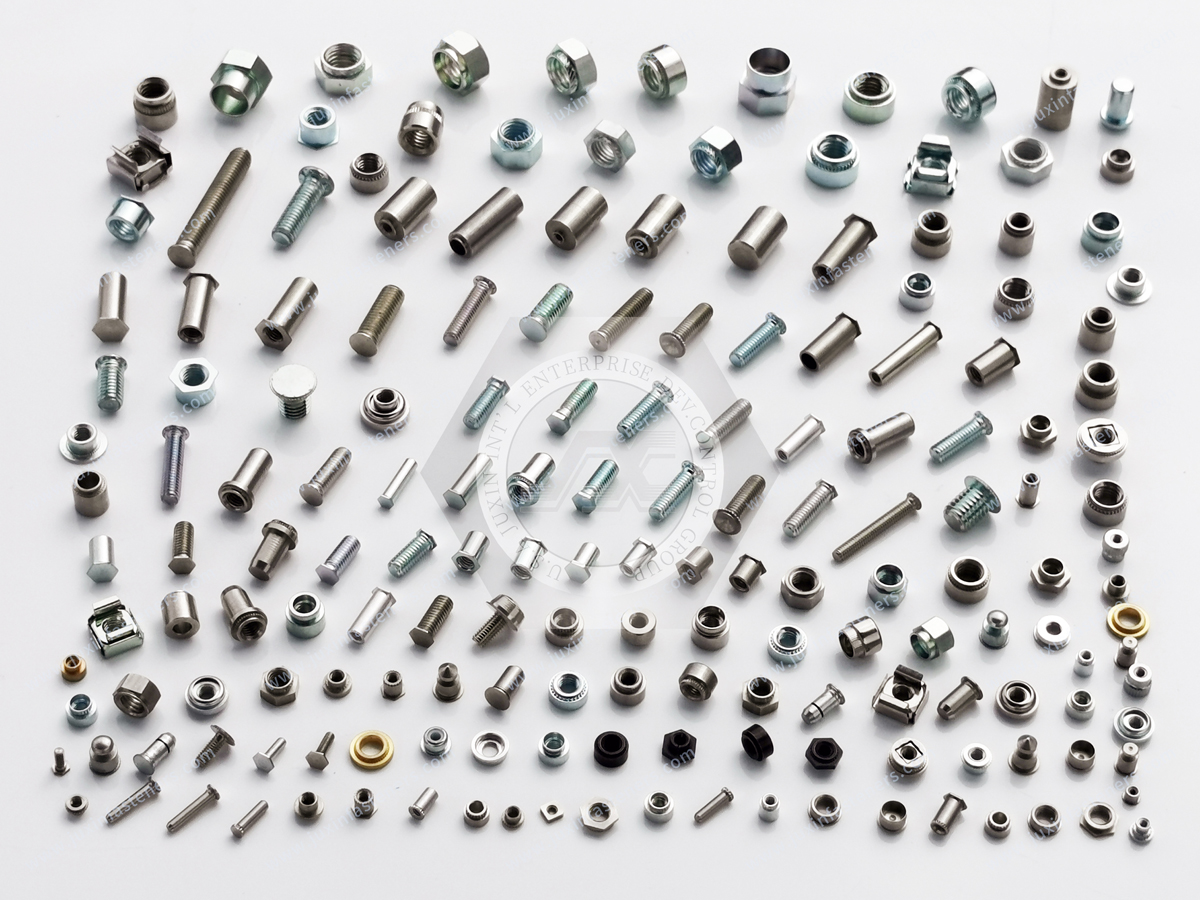
A self-clinching nut is a threaded fastener designed to be permanently installed into sheet metal.
Unlike a conventional nut, the fastener does not remain loose behind the panel. Once properly installed, the sheet material mechanically engages with the clinching section of the fastener.
A typical self-clinching installation involves:
Preparing a mounting hole to the specified diameter and tolerance.
Positioning the self-clinching nut in the hole.
Applying controlled parallel pressing force.
Allowing the sheet material to displace into the fastener's clinching feature.
Verifying installation quality through dimensional and functional inspection.
The result is an integrated threaded mounting point that can be used for screws, bolts, PCB mounting hardware, brackets, covers, and other components.
For thin sheet metal, this approach can eliminate the need for conventional tapping while providing a stronger and more repeatable threaded attachment point than a simple thin-wall tapped hole.
Self-clinching nuts are particularly useful when sheet thickness limits the amount of material available for internal threads.
Key advantages include:
Permanent installation into the sheet
No welding heat or weld splatter
No conventional tapping operation
Reduced need for loose nuts
Consistent threaded mounting points
Compatibility with automated sheet metal production
Efficient installation using controlled pressing equipment
Suitable for many steel, stainless steel, and aluminum sheet applications
The technology is especially valuable when a sheet metal component must be repeatedly assembled and serviced.
Typical applications include:
Electrical enclosures
Control cabinets
Telecom equipment
Server and network racks
Automotive electronic housings
EV components
Industrial automation equipment
Medical equipment
HVAC systems
Sheet metal machinery
Electronic assemblies
Material compatibility is one of the most important engineering considerations when selecting a self-clinching nut.
The host sheet must generally be sufficiently softer and ductile enough for the material to flow around the clinching feature during installation.
However, there is no single hardness value that applies to every self-clinching fastener.
Actual compatibility depends on:
Fastener material
Fastener hardness
Sheet material
Sheet hardness
Sheet thickness
Hole diameter
Fastener geometry
Installation force
Required retention performance
| JUXIN FASTENERS Series | Typical Fastener Material | Potential Host Sheet Materials | Typical Application |
|---|---|---|---|
| Type JX-CLA | Aluminum | Aluminum and other suitable softer sheet materials | Lightweight enclosures, electronics, weight-sensitive assemblies |
| Type JX-CLS | Stainless Steel | Suitable steel and aluminum sheet applications | Telecom cabinets, outdoor equipment, corrosion-sensitive assemblies |
| Type S / SS | Carbon Steel, plated | Steel and aluminum sheet metal | Automotive components, electrical cabinets, industrial machinery |
| Type J-X-SP | Hardened stainless steel | Suitable stainless steel and demanding sheet metal applications | Stainless steel enclosures, EV-related equipment, marine and industrial applications |
The values in a manufacturer's product specification should be used for final material and hardness approval.
For production programs, engineers should validate the combination of fastener, sheet material, thickness, hole size, and installation process rather than relying on fastener material alone.

Stainless steel sheet presents additional challenges because many stainless steels have relatively high hardness and can work-harden during forming.
When selecting stainless steel self-clinching nuts, engineers should consider:
304 or 316 stainless steel sheet
Actual sheet hardness
Sheet thickness
Hole preparation
Fastener hardness
Clinching geometry
Required installation force
Torque-out resistance
Pushout resistance
Corrosion requirements
For harder stainless steel panels, a hardened stainless steel self-clinching nut may provide better compatibility than a conventional stainless steel fastener.
The correct choice should be confirmed against the actual panel specification and the fastener manufacturer's installation requirements.
This is particularly important in stainless steel enclosures used for industrial equipment, medical equipment, food-processing machinery, marine equipment, and outdoor electrical systems.
Engineers often compare several fastening methods when designing thin sheet metal assemblies.
| Evaluation Criteria | Self-Clinching Nuts | Direct Tapped Holes | Weld Nuts | Rivet Nuts |
|---|---|---|---|---|
| Thin Sheet Applications | Excellent for suitable materials | Limited by available thread engagement | Suitable for many sheet applications | Excellent for many thin panels |
| Heat Input | None | None | Yes | None |
| Thread Integration | Permanent | Integral to sheet | Permanent | Permanent |
| Secondary Process | Press installation | Tapping required | Welding required | Riveting installation |
| Loose Hardware | Reduced | Reduced | Reduced | Reduced |
| Installation Access | Normally requires access for press installation | Generally one side | Generally one side | One-side installation |
| Exterior Appearance | Depends on fastener style | Flush | Depends on weld design | Depends on installation |
| Best Use Case | Press-installed threaded attachment | Thicker sheet with adequate thread engagement | Welded sheet metal assemblies | Blind or one-side access applications |
Best suited to sheet metal components where the fastener can be installed during fabrication and a permanent threaded connection is required.
Rivet nuts, also called blind rivet nuts or threaded inserts, are particularly useful where only one side of the panel is accessible.
Weld nuts remain useful for many fabricated sheet metal structures, but welding introduces heat and an additional manufacturing operation.
Tapping can be effective when sufficient material thickness is available. In very thin sheet metal, however, thread engagement can become a limiting design factor.
The best fastening technology should therefore be selected according to the complete manufacturing process rather than by unit fastener price alone.
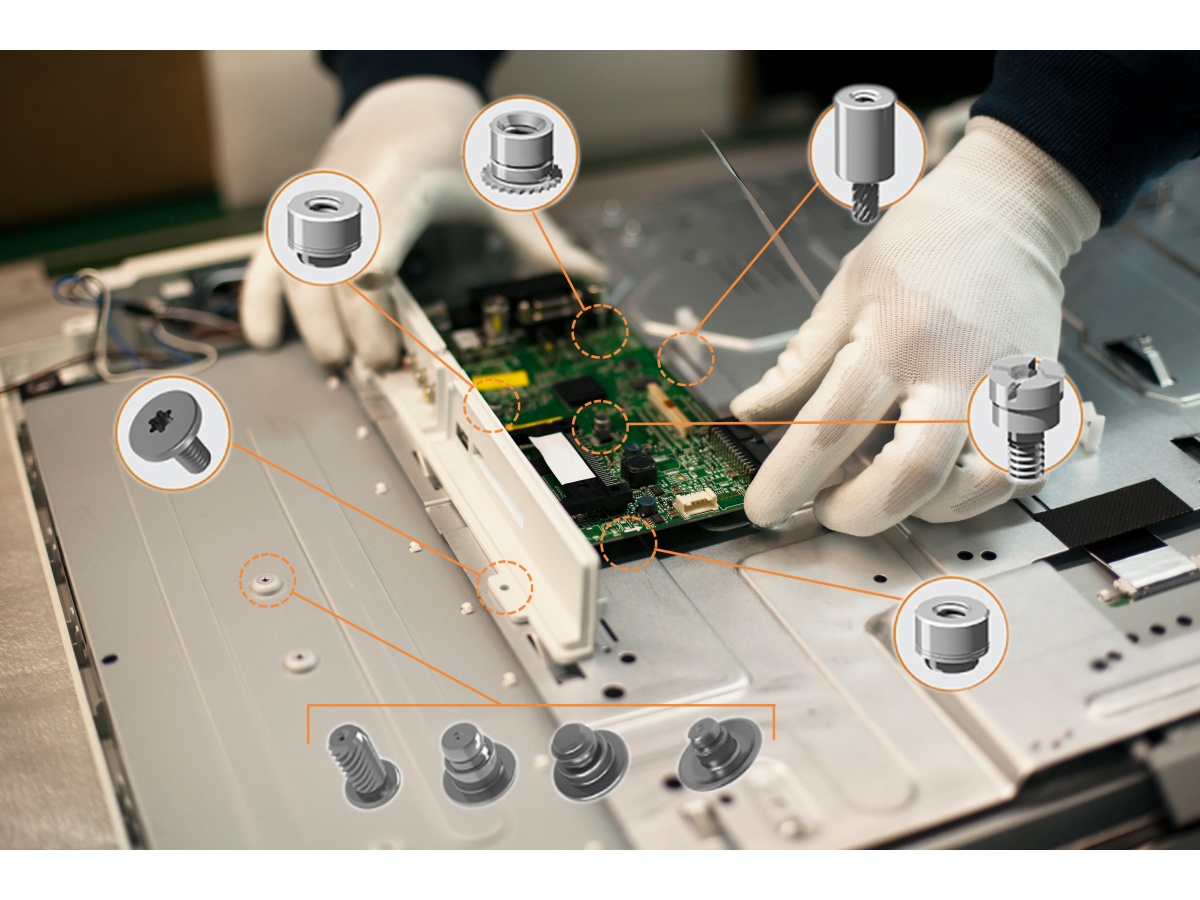
Correct Design for Manufacturing (DFM) is critical to self-clinching fastener performance.
The mounting hole should follow the fastener manufacturer's specified diameter and tolerance.
An oversized hole may reduce retention, while an undersized hole may increase installation force or damage the fastener and sheet.
Hole quality should therefore be controlled during stamping, punching, laser cutting, or drilling.
Self-clinching fasteners generally rely on controlled material displacement around the mounting hole.
Unless otherwise specified, engineers should avoid unnecessary countersinking or modifications to the mounting-hole geometry.
The exact hole preparation should always follow the applicable fastener drawing.
Sheet thickness must fall within the specified range for the selected self-clinching nut.
Using a fastener outside its intended sheet-thickness range can affect installation and retention performance.
Fastener placement should provide sufficient distance from the panel edge to prevent local deformation during installation.
Rather than applying a universal edge-distance formula to every design, engineers should follow the manufacturer's recommended minimum edge distance for the specific fastener series and sheet thickness.
Self-clinching nuts should be installed using controlled parallel force.
Hydraulic, pneumatic, or mechanical presses can be used when properly configured.
Impact installation should generally be avoided because uncontrolled impact can damage the clinching feature, deform the panel, or create inconsistent installation results.
Two important performance characteristics of self-clinching nuts are torque-out resistance and pushout resistance.
Torque-out resistance describes the ability of an installed self-clinching nut to resist rotation when torque is applied to the threaded connection.
This is particularly important in:
Automotive assemblies
Industrial machinery
Electronic enclosures
Equipment subject to vibration
Components requiring repeated maintenance
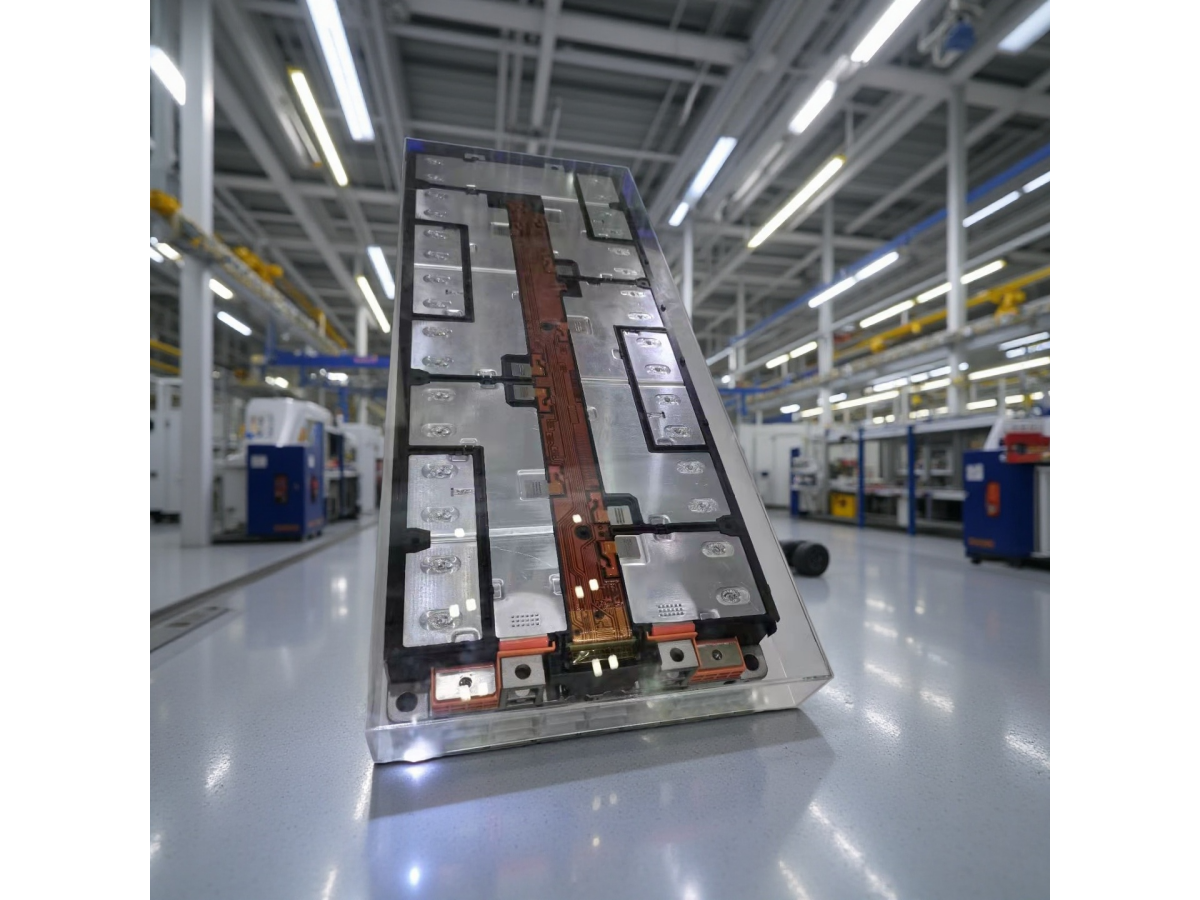
Pushout resistance measures the axial force required to push an installed fastener out of the sheet.
This characteristic becomes important when the connection experiences axial loading or when the fastener supports a mounted component.
Both properties are influenced by:
Sheet hardness
Sheet thickness
Hole diameter
Fastener geometry
Installation force
Fastener material
Thread size
For safety-critical or highly loaded applications, application-specific testing should be performed before production approval.
Electric vehicle systems increasingly use lightweight metal structures, electronic housings, battery-related enclosures, and control modules.
These assemblies may require compact threaded attachment points while maintaining controlled weight and efficient manufacturing.
Self-clinching nuts can be considered for:
Battery enclosure components
Battery management system housings
ECU housings
Electronic control modules
Sensor brackets
Charging equipment
Electrical enclosures
Internal mounting structures
For EV applications, engineers should consider vibration, corrosion, thermal environment, sheet material, electrical requirements, and assembly process when selecting the fastener material and surface treatment.
Where stainless steel sheet is used, hardened stainless steel self-clinching fasteners may be appropriate depending on the panel hardness and installation requirements.
Automotive electronic systems frequently use stamped or formed sheet metal components that require multiple threaded mounting points.
Self-clinching nuts can be installed during the sheet metal manufacturing process before final assembly.
Potential applications include:
ECU housings
Sensor brackets
Control modules
Electronic covers
Automotive electrical enclosures
Mounting brackets
Because the nut is retained in the panel before final assembly, the production process can reduce the handling of separate loose nuts.
This can be particularly useful in automated or high-volume assembly environments where repeatability and component control are important.
Telecom cabinets, server equipment, network hardware, and electronic enclosures often combine thin metal panels with compact internal components.
Self-clinching nuts provide permanent threaded mounting points, while self-clinching standoffs can establish a controlled spacing distance between the enclosure and electronic components.
Common applications include:
5G equipment
Telecom cabinets
Server racks
Network equipment
PCB assemblies
Electronic control boxes
Power electronics enclosures
For PCB mounting, self-clinching standoffs can eliminate separate spacer and nut assemblies while providing a defined mounting height.
Industrial automation equipment often requires frequent maintenance and component replacement.
PLC cabinets, robotic equipment, motion-control systems, machine covers, and control panels can benefit from permanent threaded mounting points.
Self-clinching nuts can support:
Control panel assembly
PLC mounting
Machine covers
Internal brackets
Electrical components
Sensor mounting
Automation enclosures
Where repeated servicing is required, engineers should select the appropriate fastener material and thread specification and verify the required torque-out performance.
Medical equipment, HVAC systems, electrical cabinets, and industrial enclosures frequently use formed sheet metal structures.
The fastening requirements may include:
Corrosion resistance
Clean appearance
Repeatable assembly
Compact internal mounting
Reliable thread engagement
Compatibility with thin sheet metal
Stainless steel self-clinching nuts may be considered where corrosion resistance is important, while plated carbon steel self-clinching nuts can provide a cost-effective solution for suitable general industrial applications.
The fastener material and surface treatment should always be selected according to the actual operating environment.
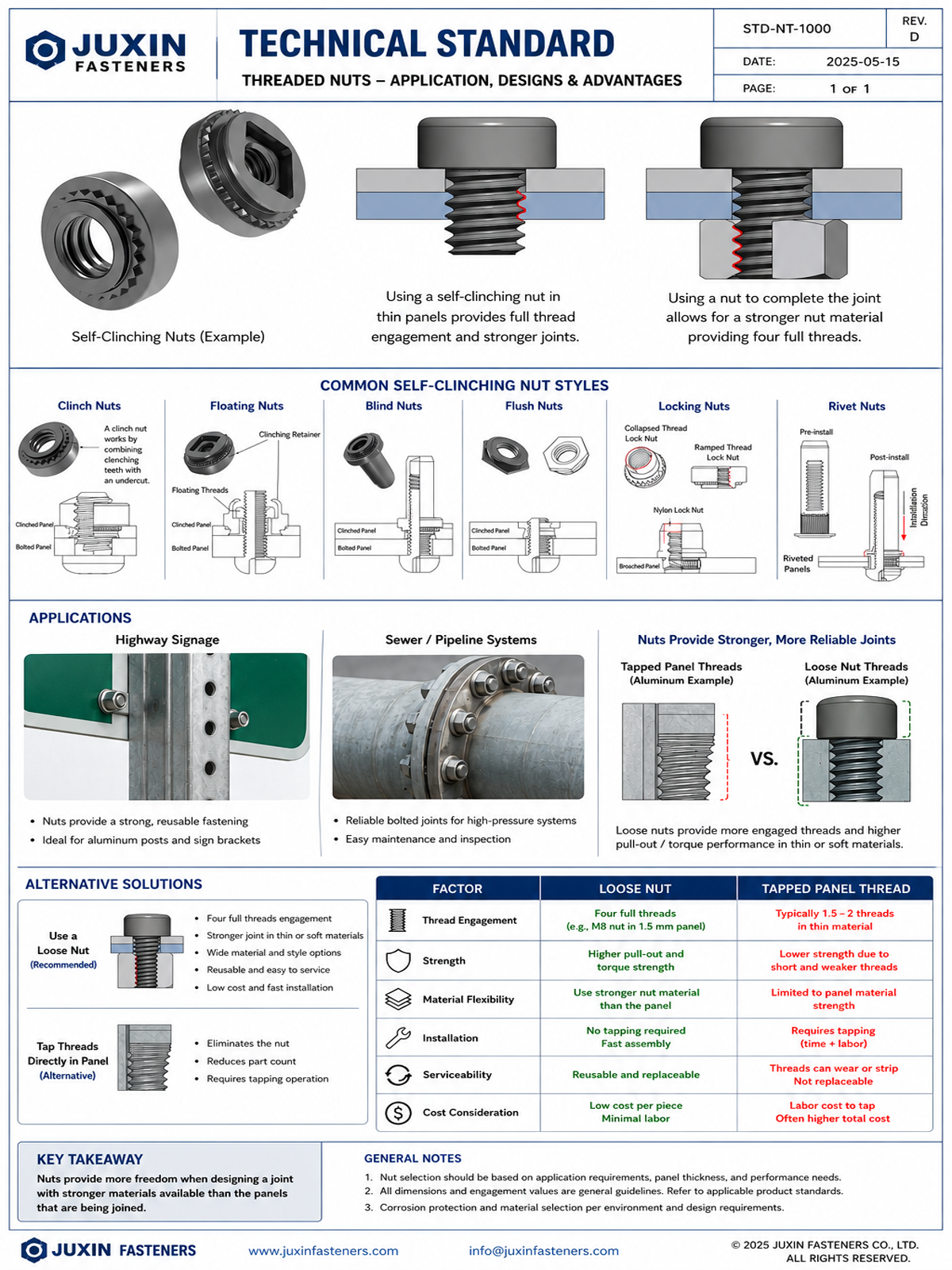
Procurement teams should evaluate self-clinching fasteners according to total assembly cost rather than unit price alone.
Depending on the manufacturing process, self-clinching nuts may reduce or eliminate certain operations such as:
Secondary tapping
Weld nut installation
Welding cleanup
Loose nut handling
Separate spacer installation
Additional hardware assembly
The potential cost benefit depends on production volume, labor rates, equipment, sheet metal process, fastener quantity, and assembly sequence.
For this reason, the correct comparison is often:
Fastener Cost + Installation Cost + Secondary Processing + Labor + Quality Control + Assembly Time
rather than simply comparing the purchase price of one fastener.
This total-cost approach is particularly important for OEM and high-volume sheet metal programs.
Procurement teams may need to source alternatives to existing self-clinching fasteners from established suppliers such as PEM, Southco, Bossard, and other industrial fastening brands.
A cross-reference should not be based only on the product name.
Before approving an alternative supplier, verify:
Thread specification
Thread size
Material
Hardness
Surface treatment
Panel thickness
Mounting-hole diameter
Head dimensions
Shank dimensions
Overall length
Installation method
Torque-out requirement
Pushout requirement
Applicable quality standards
JUXIN FASTENERS can support dimensional cross-reference and application evaluation for self-clinching nuts and related sheet metal fasteners.
For OEM projects, customers can provide an existing part number, drawing, sample, or dimensional specification for evaluation.
For industrial OEM supply, fastener quality involves more than dimensional conformity.
Procurement and quality teams may require:
Material documentation
Dimensional inspection
Thread inspection
Surface treatment information
Batch traceability
RoHS documentation
REACH documentation
Salt spray testing where applicable
PPAP documentation according to project requirements
Production inspection records
JUXIN FASTENERS supports OEM sourcing requirements with quality and technical documentation according to the product and customer specification.
Specific inspection plans and documentation packages can be established according to project requirements.
A practical selection process should start with the sheet rather than the thread.
Determine whether the panel is:
Carbon steel
Stainless steel
Aluminum
Other suitable sheet metal
Record the actual panel thickness and, where relevant, hardness.
This determines whether the selected self-clinching fastener can be properly installed.
Specify:
Metric or Unified thread
Thread diameter
Thread pitch
Required thread length
Consider:
Indoor or outdoor use
Humidity
Salt exposure
Chemical exposure
Temperature
Corrosion requirements
Determine the required:
Torque-out resistance
Pushout resistance
Repeated assembly performance
Electrical or grounding requirements where applicable
Verify:
Hole preparation
Installation equipment
Installation force
Assembly sequence
Inspection requirements
Before mass production, validate the complete fastener and sheet combination through installation and functional testing.
This approach reduces the risk of selecting a fastener that appears dimensionally correct but is unsuitable for the actual manufacturing process.
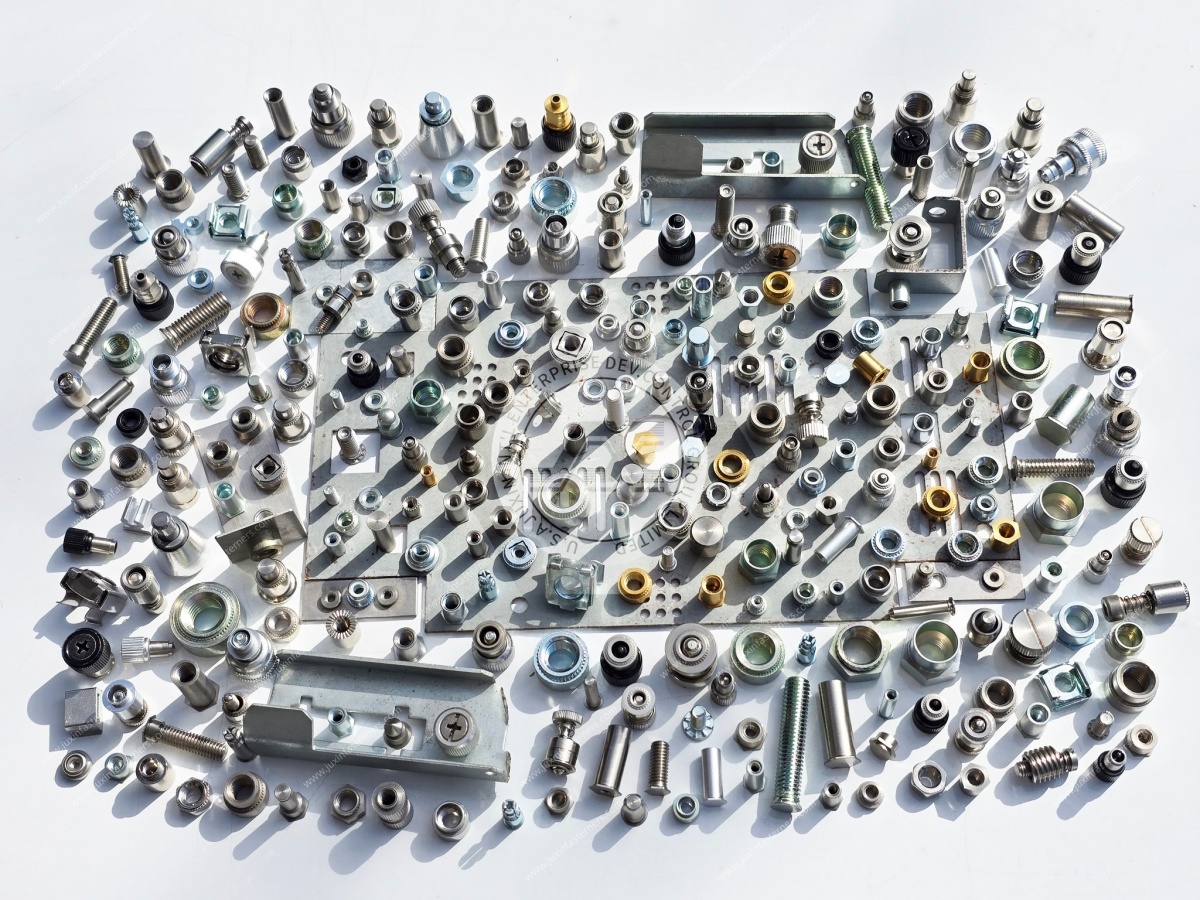
For OEM buyers, selecting a self-clinching nut supplier is not only about finding the lowest unit price.
A capable self-clinching fastener manufacturer should be able to support:
Product selection
Material selection
Dimensional verification
Drawing review
Prototype samples
Custom configurations
Surface treatment
Quality documentation
Production traceability
International OEM supply
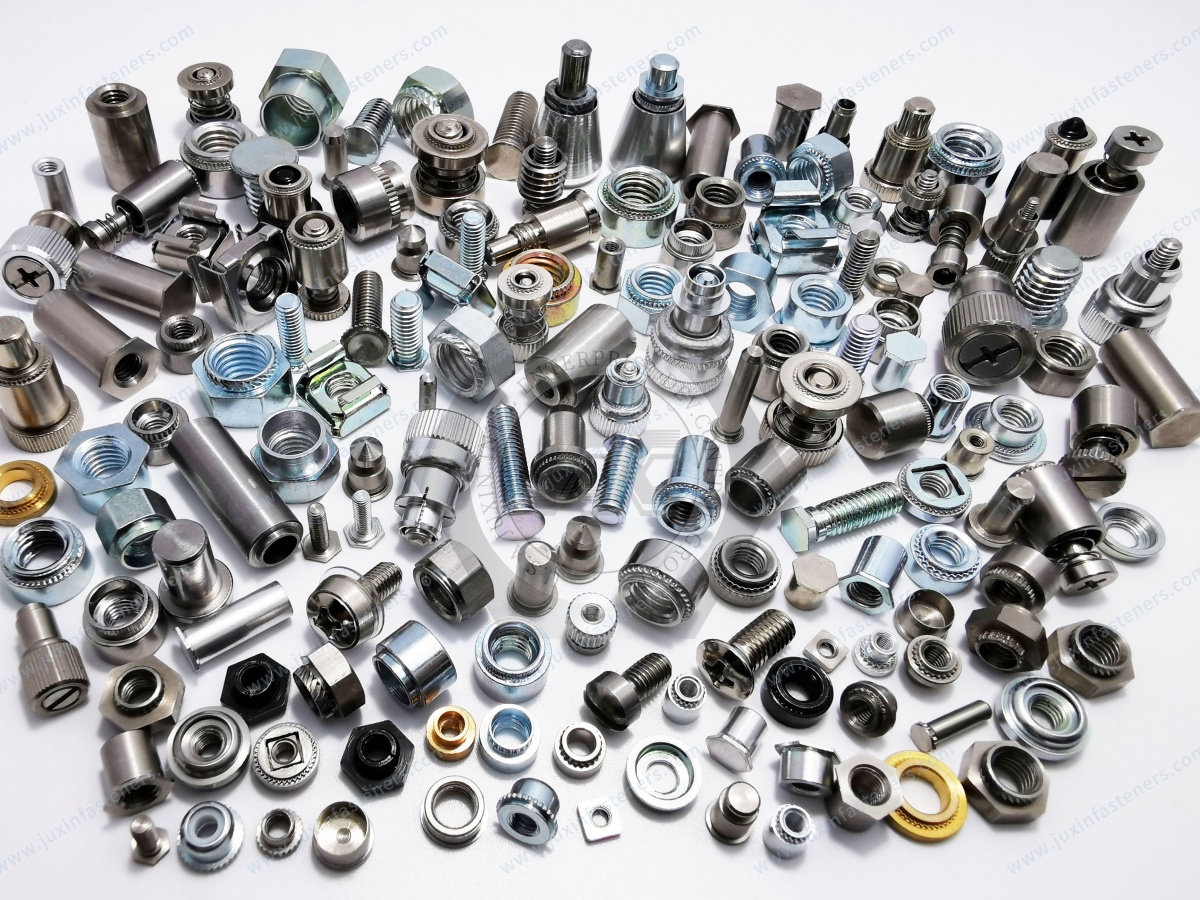
JUXIN FASTENERS supplies self-clinching nuts, self-clinching standoffs, rivet nuts, weld fasteners, and other industrial sheet metal fasteners for global customers.
Our team can work with engineering and procurement departments to evaluate standard and customized fastening requirements from prototype through production sourcing.
If you are sourcing self-clinching nuts for thin sheet metal, providing the application information below can help accelerate product selection:
Sheet material
Sheet thickness
Sheet hardness
Mounting-hole diameter
Thread specification
Required fastener length
Surface treatment
Operating environment
Annual or project quantity
Existing supplier part number
Engineering drawing or sample
JUXIN FASTENERS can support OEM and industrial customers with self-clinching nuts, self-clinching standoffs, and related sheet metal fastening solutions.
For technical drawings, CAD files, samples, cross-reference requests, or OEM quotations:
Email: info@juxinfasteners.com
Website: www.juxinfasteners.com
JUXIN FASTENERS — Self-Clinching Nuts, Self-Clinching Standoffs and Industrial Sheet Metal Fastening Solutions for Global OEMs.
 MORE NEWS
Sep. 25, 2026
Sep. 25, 2026
Sep. 25, 2026
Contact Us
Tel.:
+86 020 8621 0320
+86 020 3121 6067
E-mail:
Technical Support:
Navigation
SEND INQUIREY