
Call Us
+86 136 6007 9809
Call Us
+86 136 6007 9809

Aug. 21, 2026
Press-In Nuts & Self-Clinching Nuts for Industrial Applications
Reliable Threaded Fastening Solutions for Automotive, EV, Battery Pack, Rail, Aerospace, Electrical Cabinets and Industrial Equipment
A press-in nut, also known as a self-clinching nut, clinch nut, or press-fit nut, is a permanent threaded fastening component designed to create a strong internal thread
in sheet metal, panels, brackets, PCB assemblies, and other base materials.
Instead of using a separate loose nut, a self-clinching nut is installed directly into a prepared hole by applying controlled pressing force.
The specially designed shank or clinching feature locks into the parent material, providing a reliable threaded connection with resistance to rotation and pull-out.
This makes press-in nuts and self-clinching fasteners an efficient fastening solution for applications where assembly speed, space efficiency, repeatability,
and mechanical reliability are important.
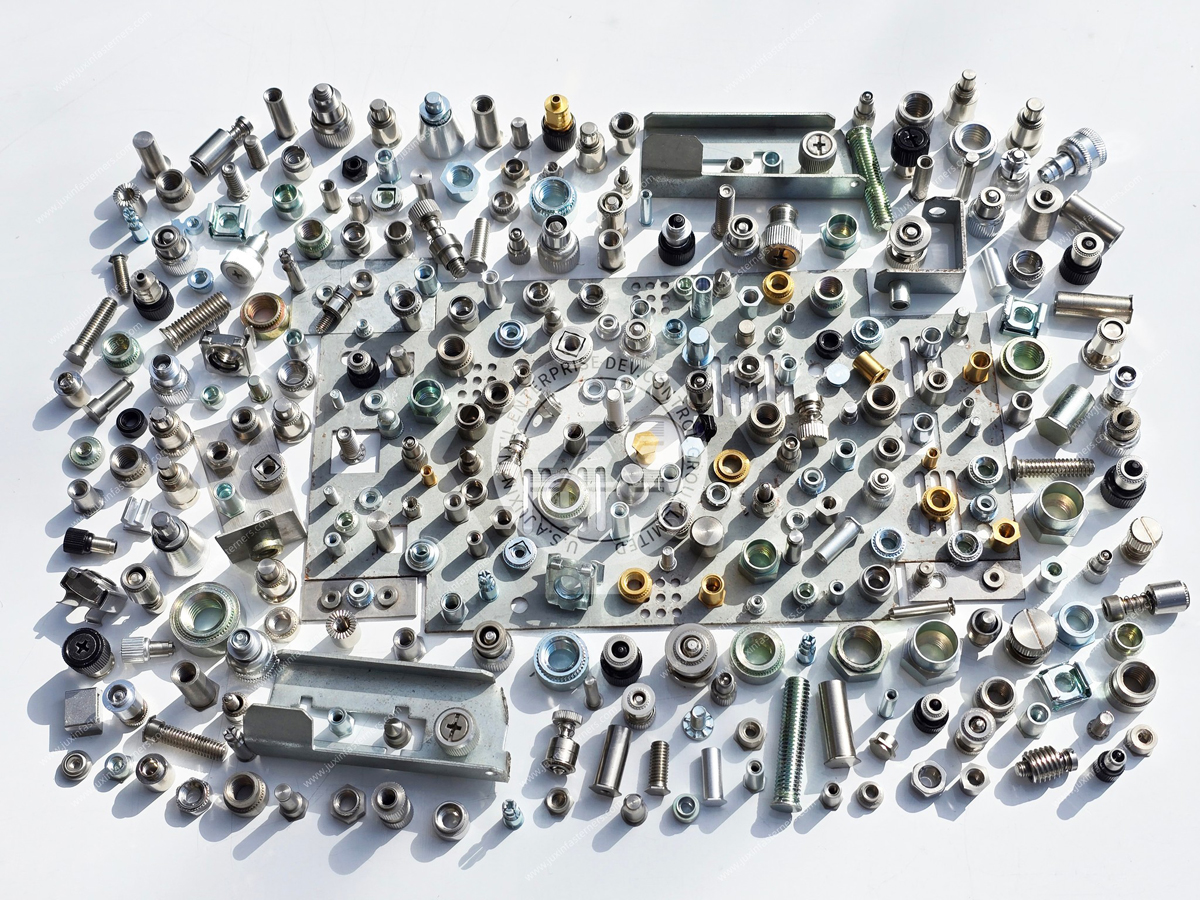
Juxin Fasteners manufactures custom press-in nuts, self-clinching nuts, threaded inserts, and precision fastening components for OEM and industrial
customers across automotive, EV, battery, rail, aerospace, electrical, HVAC, medical, machinery, robotics, and sheet-metal applications.
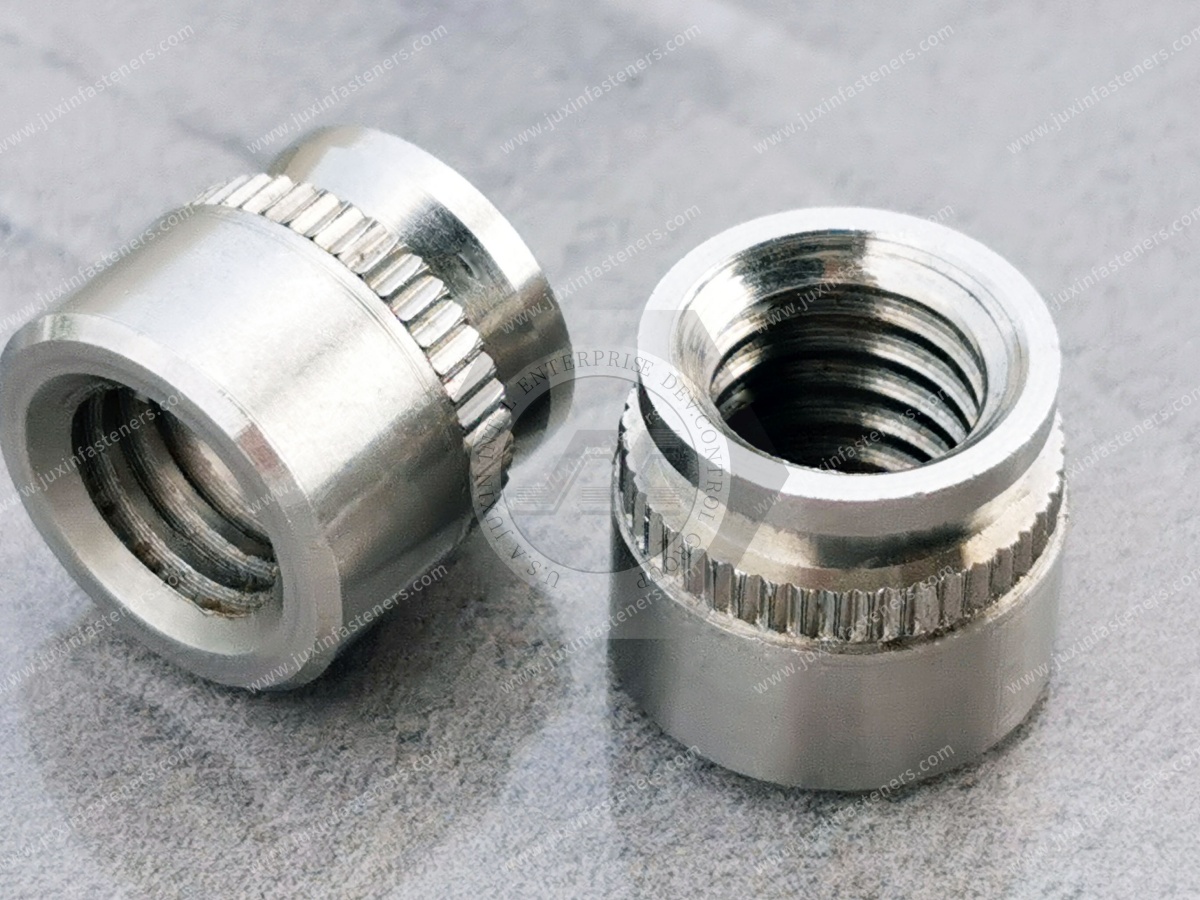
What Is a Press-In Nut?
A press-in nut is a threaded fastener installed into a pre-punched or drilled hole in a base material.
During installation, the fastener is positioned in the prepared hole and compressed using suitable tooling.
The nut's clinching section displaces or deforms the surrounding material, creating a mechanical interlock.
Once properly installed, the nut provides a permanent threaded fastening point.
This design eliminates the need to hold a separate nut during assembly and can improve production efficiency in applications where access to the rear side of the panel is limited.
Common names used in industry include:
Press-in nut
Press-fit nut
Clinch nut
Self-clinching nut
Self-clinching fastener
Press-in threaded insert
Self-clinching threaded insert
Sheet metal clinch nut
PCB press-in nut
For engineering and procurement teams, the exact terminology may vary by industry, manufacturer, and regional market.
The fundamental purpose remains the same: to provide a reliable permanent internal thread in a suitable base material.
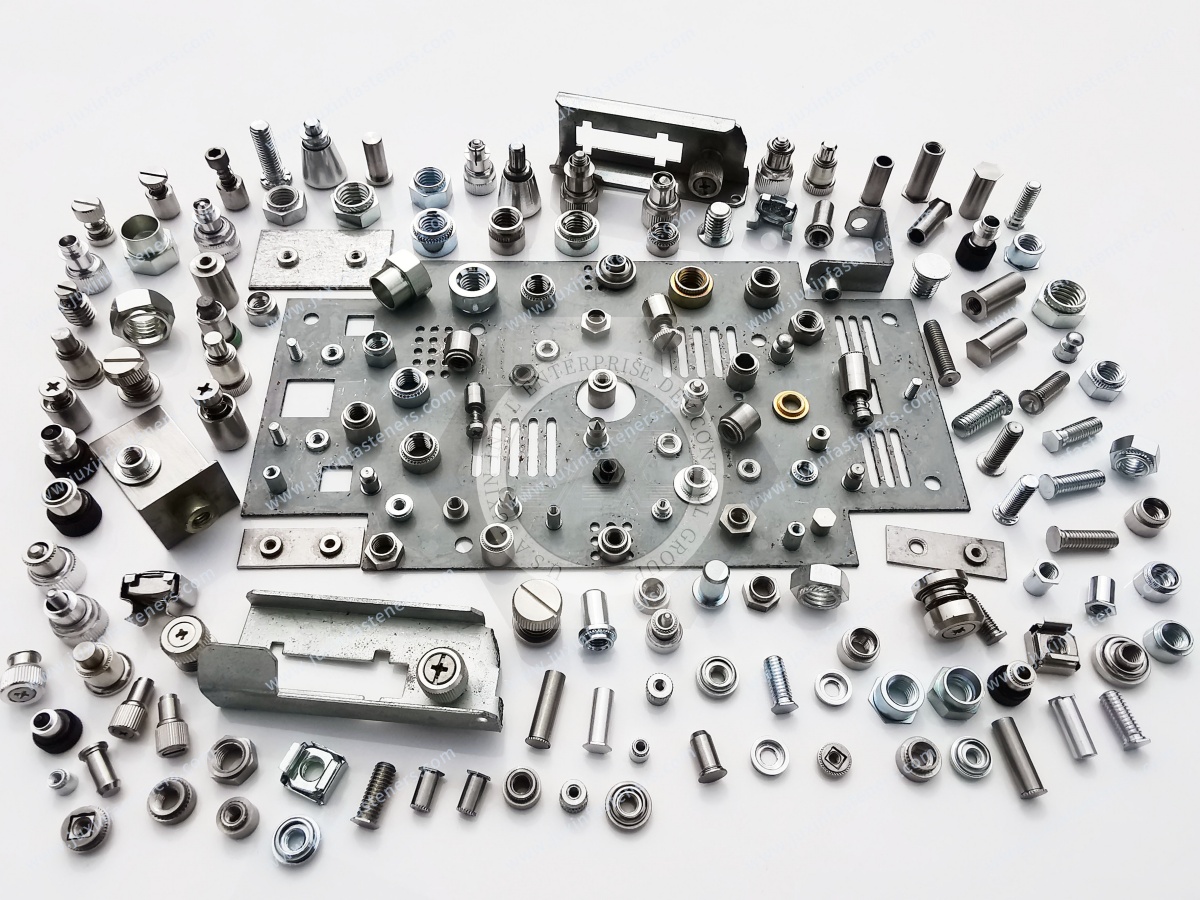
Why Use Self-Clinching Nuts?
Compared with conventional loose nuts and bolts, self-clinching nuts can simplify assembly by integrating the threaded component directly into the panel.
Key advantages include:
Permanent Threaded Connection
Once correctly installed, the nut remains fixed in the base material and provides a repeatable threaded connection for subsequent assembly.
Fast Installation
Press installation can be integrated into production lines and automated assembly processes, reducing manual handling of separate nuts.
Space Efficiency
Self-clinching nuts are particularly useful where available space is limited, and a conventional nut cannot be easily positioned behind the panel.
Resistance to Rotation
The clinching feature mechanically locks the fastener into the parent material, helping prevent rotation during screw tightening and removal.
Consistent Assembly
When you control the correct hole size, material thickness, tooling, and installation force, press-in nuts can provide consistent fastening performance in high-volume production.
Suitable for Sheet Metal and Precision Panels
Self-clinching nuts are widely used in sheet-metal fabrication, electronic enclosures, brackets, chassis components, and other fabricated structures.
Press-In Nuts for PCB and Electronic Equipment
Beyond industrial sheet-metal applications, PCB press-in nuts are used in precision electronic assemblies.
They can provide permanent threaded mounting points for:
PCB mounting
Electronic brackets
Internal support structures
Control modules
Communication equipment
Electronic enclosures
Power electronics
Industrial control systems
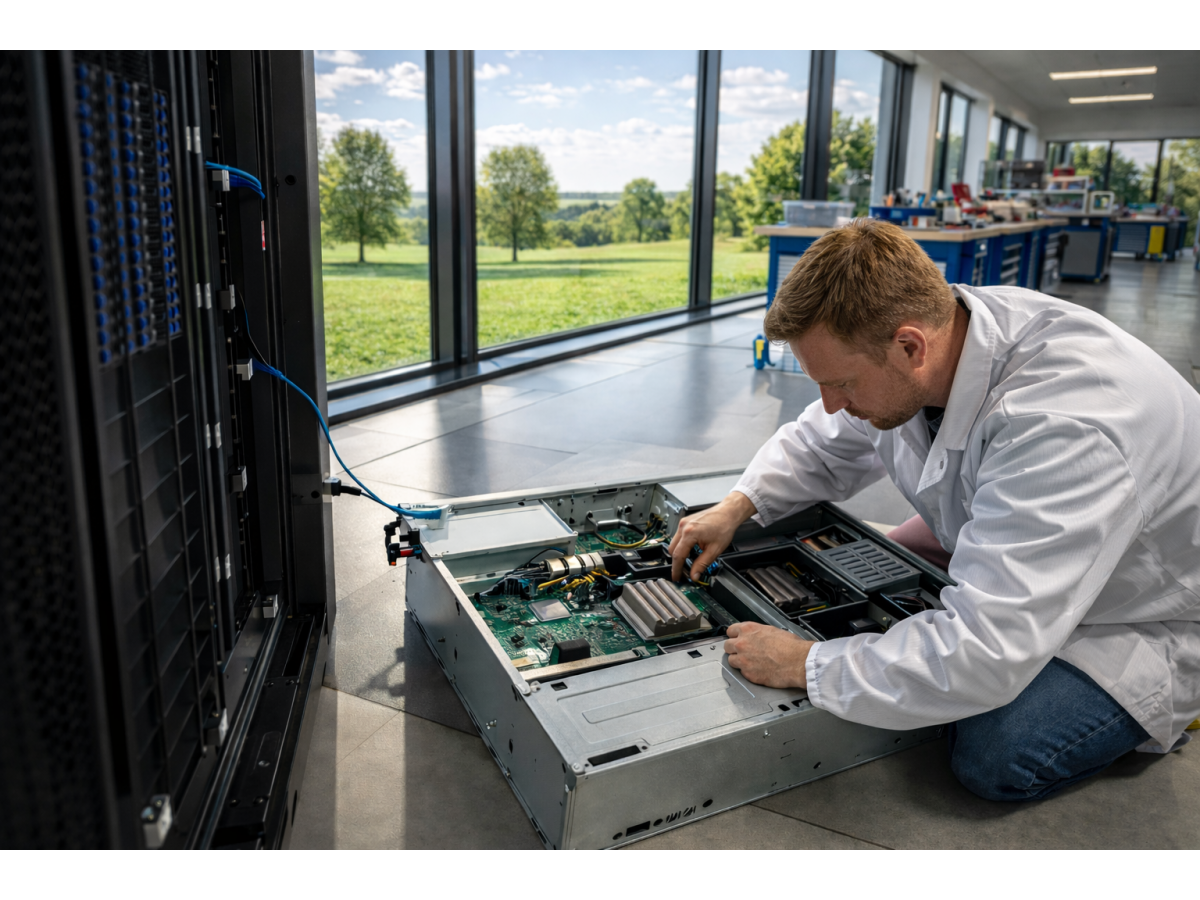
For PCB applications, we can develop different protrusion heights to accommodate spaced or stacked PCB assemblies.
Juxin's press-in threaded components can be engineered for applications requiring precise positioning and reliable mechanical retention.
Depending on the product design and application conditions,
our PCB fastening solutions can achieve positioning accuracy of approximately ±50 μm and pull-out performance exceeding 100 N.
For selected electronic applications, the design can also be evaluated against three-cycle reflow soldering requirements.
Through-Hole and Blind-Hole Designs
Press-in nuts can be configured according to the required assembly structure.
Through-Hole Press-In Nuts
Through-hole designs provide a continuous threaded passage through the fastener.
They are commonly used where:
Full thread access is required
The rear side of the assembly is accessible
Standard screw engagement is preferred
The fastening point is part of a structural assembly
Blind-Hole Press-In Nuts
Blind-hole designs incorporate a closed-end threaded structure.
They can be useful where the rear side of the assembly should remain protected or where a closed threaded fastening point is preferred.
The appropriate design depends on the required thread engagement, panel thickness, installation environment, and assembly configuration.
Materials for Press-In and Self-Clinching Nuts
Material selection directly affects fastening performance, corrosion resistance, hardness, and compatibility with the parent material.
Juxin Fasteners primarily supplies press-in nuts in carbon steel and stainless steel, with additional surface treatment options available according to application requirements.
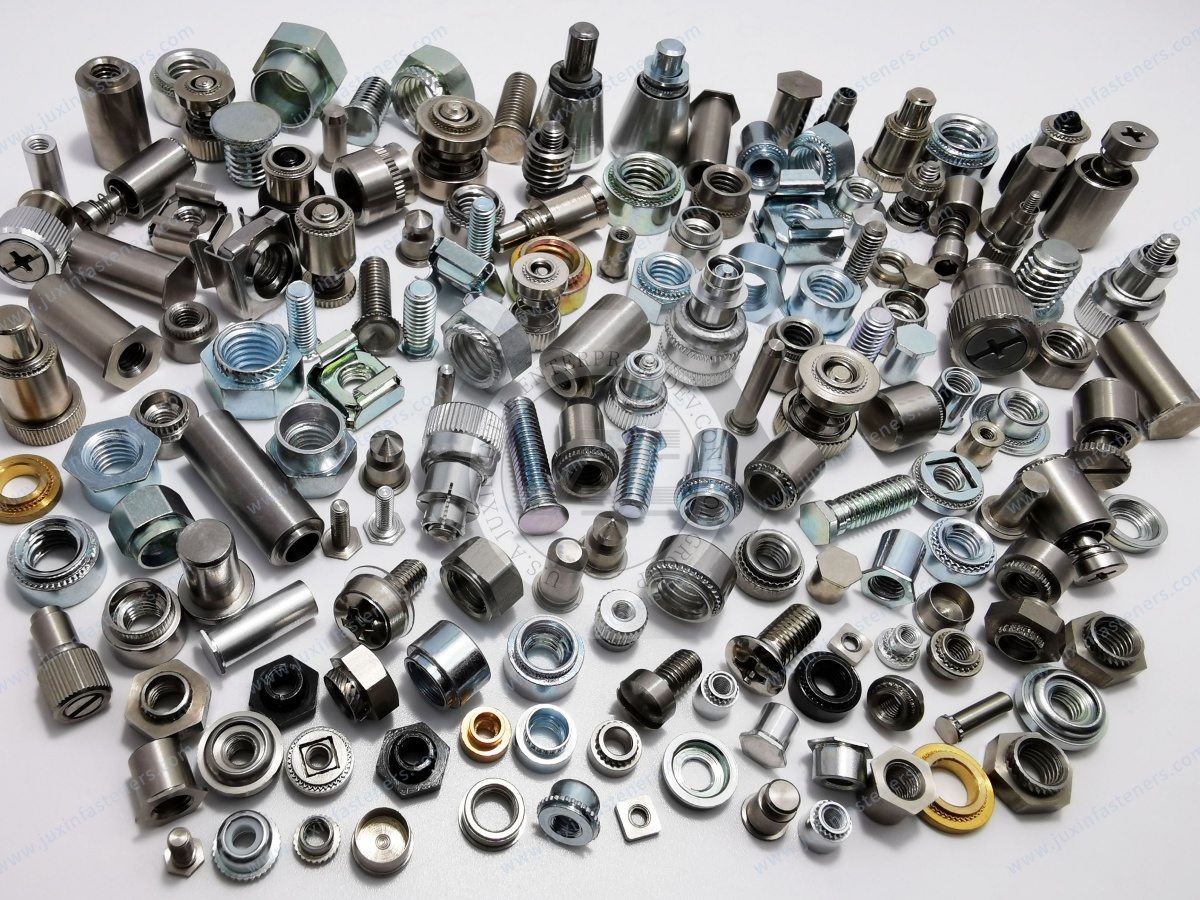
Carbon Steel Press-In Nuts
Carbon steel provides a combination of strength, machinability, and cost efficiency.
For selected designs, carburizing treatment can be applied after manufacturing to increase surface hardness and improve wear resistance.
Zinc plating can then provide additional corrosion protection for suitable industrial environments.
Carbon steel self-clinching nuts are widely considered for:
Automotive components
Machinery
Electrical cabinets
HVAC equipment
Sheet-metal assemblies
Industrial equipment
Stainless Steel Press-In Nuts
Stainless steel provides enhanced corrosion resistance and is suitable for applications exposed to moisture, humidity, or corrosive environments.
However, stainless steel press-in fasteners require careful consideration of the hardness relationship between the fastener and the parent material.
As a general engineering principle, a stainless steel press-in nut should be installed into a stainless steel sheet or
plate with equivalent or lower hardness to allow the clinching feature to form correctly.
Therefore, confirm material compatibility before production.
Press-In Nut Standards and Engineering Specifications
For industrial fastening applications, standards help establish consistent requirements for dimensions, threads, materials, manufacturing processes, installation, and inspection.
Depending on the customer's market and application, press-in and self-clinching fastening components may be specified according to internationally
recognized or regional engineering standards, including ISO, DIN, and ANSI/ASME-related requirements.
Always determine the exact applicable standard based on the product type, thread configuration, parent material, application, and customer drawing.
Important engineering parameters normally include:
Dimensions and Thread Parameters
Specifications can define:
Thread size
Thread pitch
Overall length
Shank dimensions
Head dimensions
Panel thickness
Recommended hole diameter
Protrusion height
Thread engagement
Correct dimensional matching ensures that the fastener fits the base material and provides sufficient thread engagement.
Material and Mechanical Performance
Engineering specifications may define requirements for:
Material grade
Hardness
Tensile strength
Surface hardness
Wear resistance
Corrosion resistance
Mechanical retention
Material selection should consider both the fastener and the parent material.
Manufacturing and Heat Treatment
Production requirements may include controlled machining, cold forming, heat treatment, carburizing, plating, and other surface treatment processes.
Process control is particularly important for high-volume OEM components where dimensional consistency must be maintained from batch to batch.
Installation Requirements
Installation specifications should define the appropriate:
Hole diameter
Panel thickness
Pressing direction
Installation tooling
Pressing force
Tool alignment
Installation depth
Incorrect installation can significantly reduce the designed pull-out and rotational resistance.
Inspection and Evaluation
Quality control may include dimensional, thread, appearance, material verification, hardness, coating, and mechanical performance testing, depending on the applicable product specification.
How to Install a Self-Clinching Nut
Correct installation is essential to achieving reliable fastening performance.
Step 1 — Prepare the Hole
Punch or drill the correct installation hole according to the approved product drawing.
The hole must be within the specified dimensional range.
An oversized hole may reduce the fastener's mechanical retention, while an undersized hole may prevent proper installation or damage the component.
Step 2 — Position the Nut
Place the shank of the press-in nut into the prepared hole.
Align the nut and panel correctly before applying force.
Step 3 — Apply Parallel Pressing Force
Use suitable upper and lower tooling and maintain parallel alignment during pressing.
Apply the required pressing force until the fastener's clinching section is fully embedded in the parent material.
Control the installation process according to the fastener design, panel material, panel thickness, and the manufacturer's recommended parameters.
Engineering Factors to Consider Before Selecting a Press-In Nut
For procurement and engineering teams, start by considering the application rather than just the thread size.
Important considerations include:
1. Parent Material
Identify whether the base material is carbon steel, stainless steel, aluminum, or another suitable sheet or panel material.
2. Material Hardness
The parent material must normally be suitable for the clinching mechanism to form a secure mechanical interlock.
3. Panel Thickness
The thickness of the panel determines whether the selected fastener can be installed correctly.
4. Hole Diameter
Hole diameter is one of the most critical installation parameters.
5. Thread Specification
Select the required metric or inch thread based on the final assembly.
6. Required Thread Engagement
Determine the required screw engagement according to the applied load and application.
7. Protrusion Height
For PCB and electronic assemblies, protrusion height may determine the spacing between boards or internal components.
8. Corrosion Environment
Select carbon steel with an appropriate coating or stainless steel according to environmental requirements.
9. Installation Equipment
Confirm compatibility with the customer's press, tooling, and production process.
10. Mechanical Requirements
Pull-out resistance, push-out resistance, and rotational resistance should be evaluated according to the application requirements.
Applications Across Multiple Industrial Sectors
The versatility of self-clinching technology makes press-in nuts suitable for a wide range of industrial applications.
Automotive
Self-clinching nuts are used for brackets, body structures, interior components, electrical assemblies, control modules, and sheet-metal components.
They provide permanent threaded mounting points while supporting efficient vehicle assembly.
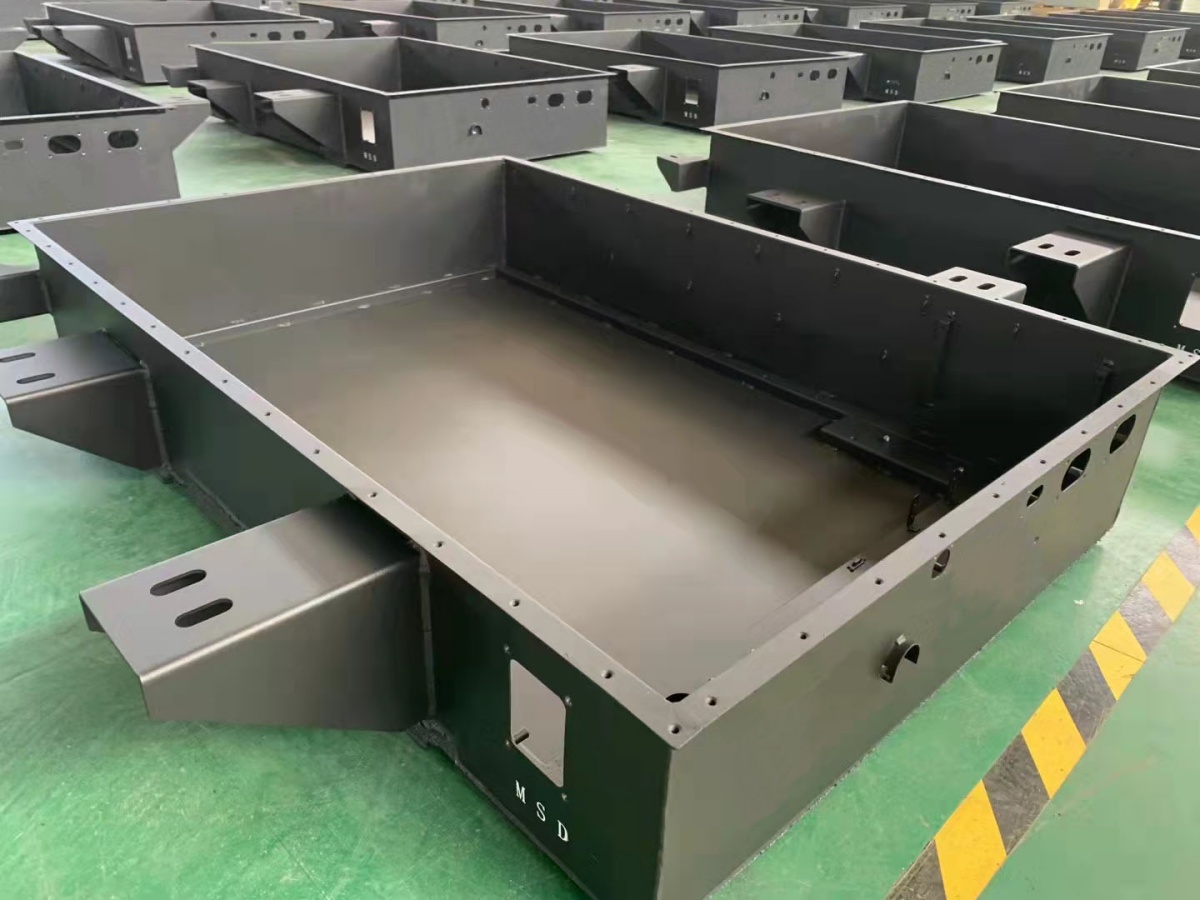
EV and Battery Pack
The electrification industry increasingly requires compact and reliable fastening solutions for:
Battery pack structures
Battery trays
Battery enclosures
Electrical modules
Cooling system components
High-voltage electrical assemblies
EV electronic control systems
For EV applications, material compatibility, corrosion resistance, vibration resistance, and dimensional consistency are particularly important.
Rail Transit
Press-in and self-clinching fasteners can be used in rail vehicle interiors, electrical cabinets, control systems, brackets, equipment enclosures, and sheet-metal assemblies.
Aerospace
Aerospace applications require close attention to material selection, weight, dimensional accuracy, mechanical performance, and traceability.
Self-clinching threaded fasteners can be considered for suitable aircraft interior, equipment, panel, and structural component applications where the fastener and parent material are properly qualified.
Electrical Cabinets
Self-clinching nuts are widely suited to electrical cabinets and control enclosures because they provide permanent threaded mounting points in fabricated sheet-metal panels.
Applications include:
Electrical control cabinets
Switchgear enclosures
Distribution equipment
Control panels
Industrial electrical equipment
HVAC
HVAC systems frequently use sheet-metal housings, brackets, access panels, fan assemblies, and equipment enclosures.
Press-in nuts can simplify the installation of threaded components into fabricated sheet-metal structures.
Medical Equipment
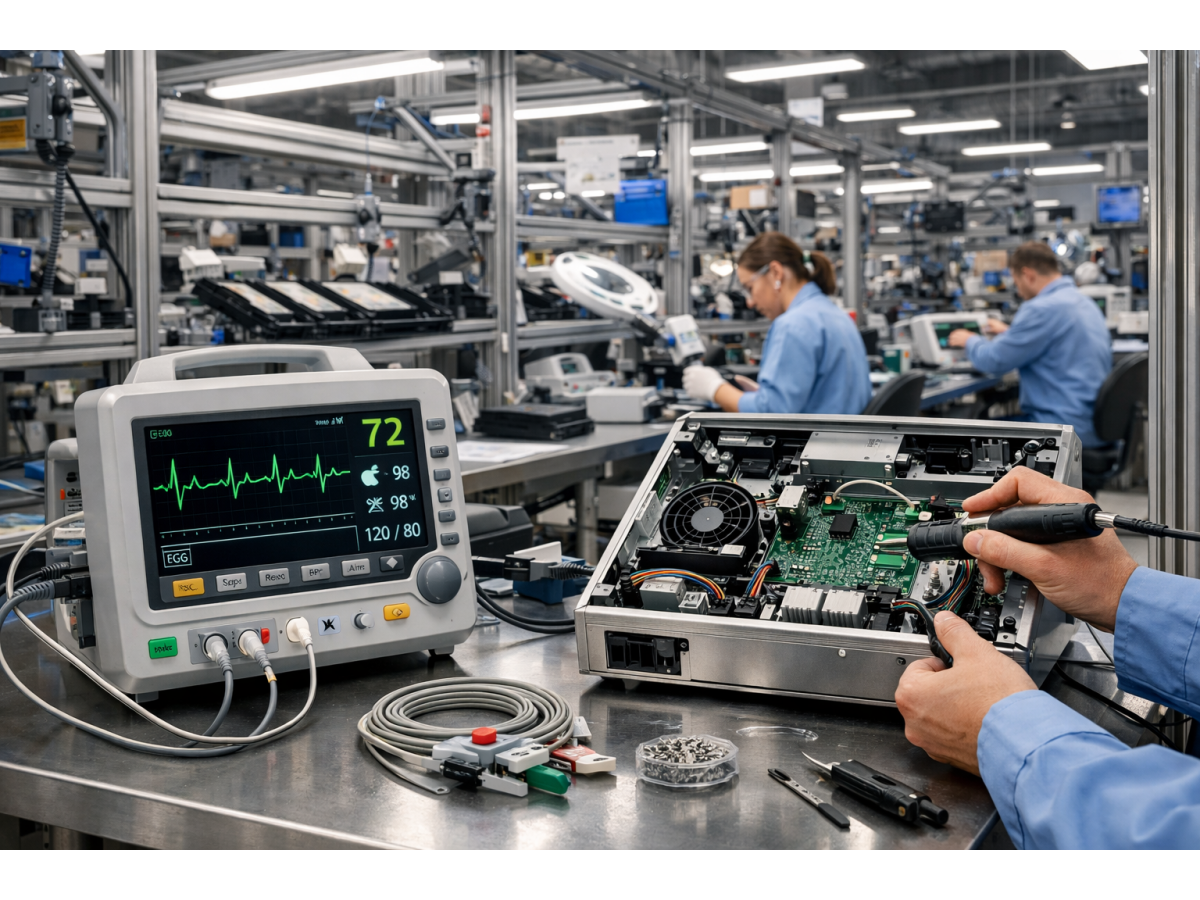
Medical equipment often requires compact internal fastening systems with consistent dimensions and suitable corrosion resistance.
Self-clinching threaded fasteners can be used in equipment frames, sheet-metal housings, brackets, panels, and internal mounting structures where the application requirements are compatible.
Construction Equipment
Press-in nuts can provide permanent threaded mounting points in equipment panels, brackets, enclosures, and fabricated structures.
Machinery
Industrial machinery is one of the major application areas for self-clinching fasteners.
Typical applications include:
Machine frames
Protective covers
Equipment panels
Mounting brackets
Control cabinets
Mechanical assemblies
Robotics
Robotic equipment requires compact fastening solutions for:
Robot housings
Control panels
Sensor brackets
Electrical modules
Sheet-metal covers
Internal support structures
Self-clinching nuts can help simplify assembly while providing repeatable threaded mounting points.
Sheet Metal Fabrication
Sheet metal fabrication is a key application for press-in and self-clinching nuts.
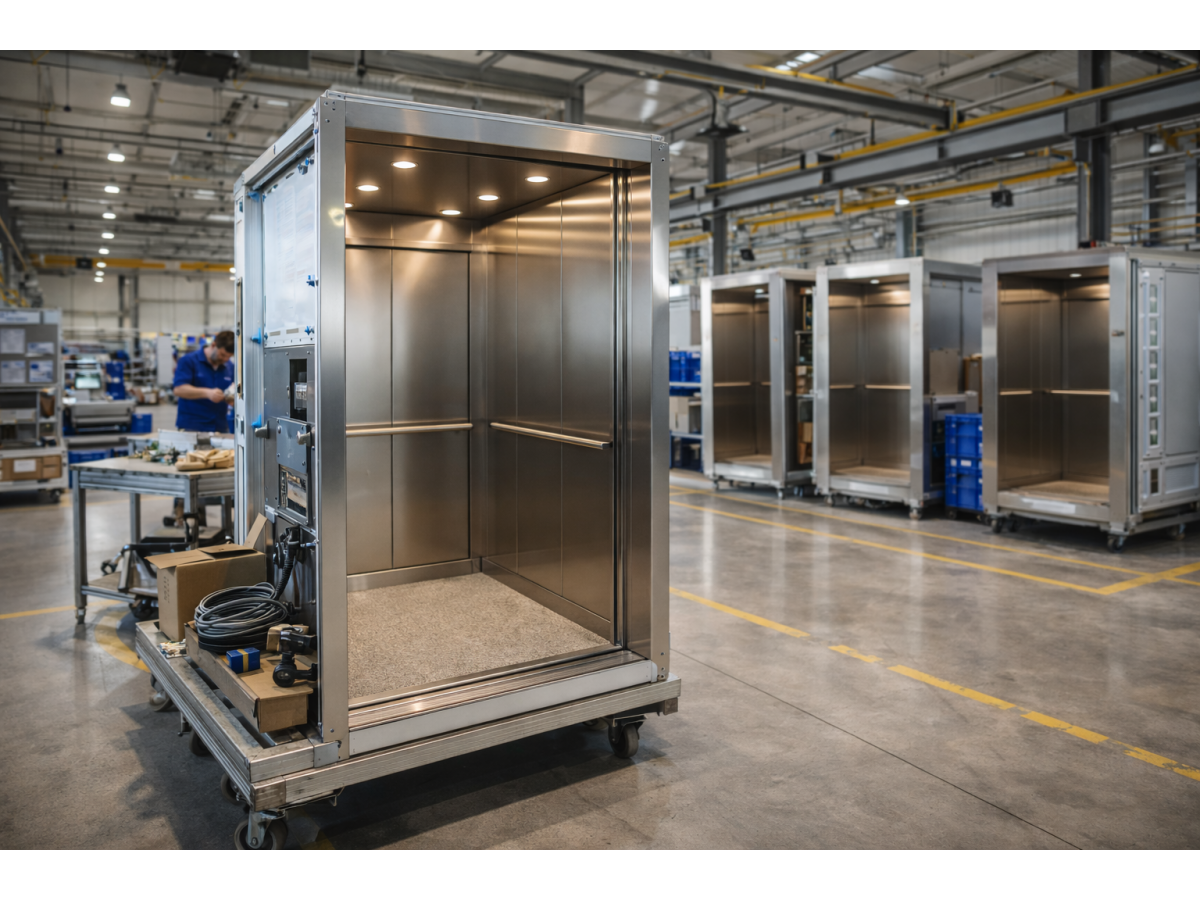
They allow manufacturers to add permanent threaded fastening points to fabricated panels without welding or using separate loose nuts.
This can reduce assembly steps and improve manufacturing efficiency.
Manufacturing and Automatic Inspection
For OEM customers, consistent production quality is as important as the initial product design.
Juxin Fasteners combines precision manufacturing processes with automated sorting and inspection to control the dimensional and appearance quality of high-volume fastening components.
Our production process can include controlled forming, machining, heat treatment, surface treatment, and automated inspection according to the product specification.
The automatic sorting process helps identify defective or dimensionally non-conforming parts before shipment.
This is particularly important for self-clinching nuts, press-in nuts, PCB threaded fasteners, and other precision fastening components used in automated OEM assembly.
Our manufacturing video demonstrates the production process and automatic inspection capability, giving engineering and procurement teams a direct view of how we control product consistency.
Custom Press-In Nut Manufacturing for OEM Applications
Different industries require different combinations of thread size, dimensions, material, hardness, coating, and installation characteristics.
Juxin Fasteners supports OEM customers with customized press-in nuts and self-clinching fasteners based on drawings, samples, specifications, or application requirements.
Our engineering review can consider:
Product drawing
Thread specification
Parent material
Panel thickness
Installation hole
Protrusion height
Material
Heat treatment
Surface treatment
Mechanical requirements
Inspection requirements
Packaging requirements
This allows the fastening component to be evaluated as part of the complete assembly rather than as an isolated standard component.
A Reliable Fastening Partner for Global OEMs
Selecting the right press-in nut or self-clinching fastener is critical when a threaded connection must remain reliable throughout assembly, service, maintenance,
vibration, and repeated screw installation.
Juxin Fasteners provides engineered fastening solutions for global OEM customers across Automotive, EV, Battery Pack, Rail Transit, Aerospace, Electrical Cabinets,
HVAC, Medical Equipment, Construction, Machinery, Robotics, and Sheet Metal Fabrication.
From material selection and product engineering to production and automated inspection, our goal is to provide consistent fastening components that meet the requirements
of demanding industrial applications.
If you are developing a new product or looking for an alternative source for press-in nuts, clinch nuts, self-clinching nuts, PCB threaded fasteners, or custom threaded inserts,
send us your drawing, sample, or application requirements.
Email: info@juxinfasteners.com
 MORE NEWS

Oct. 13, 2026
Contact Us
Tel.:
+86 020 8621 0320
+86 020 3121 6067
E-mail:
Technical Support:
Navigation
SEND INQUIREY