
Call Us
+86 136 6007 9809
Call Us
+86 136 6007 9809

Aug. 21, 2026
Press-In Nuts for PCB Assembly: Precision Threaded Fastening for Electronic Equipment
In modern electronic equipment, PCB assemblies often require reliable threaded fastening points for mounting circuit boards, brackets, shields, covers, connectors,
and other internal components. When space is limited and conventional nuts or threaded inserts are impractical, press-in nuts and PCB threaded fasteners offer a compact, reliable solution.
Juxin Fasteners manufactures press-in nuts, self-clinching nuts, PCB standoffs, and threaded PCB fasteners designed for precision electronic assemblies.
Our manufacturing process combines controlled forming, pressing, and automated inspection to achieve consistent dimensions and reliable installation
performance for demanding electronic and industrial applications.
From PCB mounting and electronic enclosures to communication equipment and precision control systems,
our PCB fastening solutions provide a permanent internal thread without adding a separate loose nut during assembly.
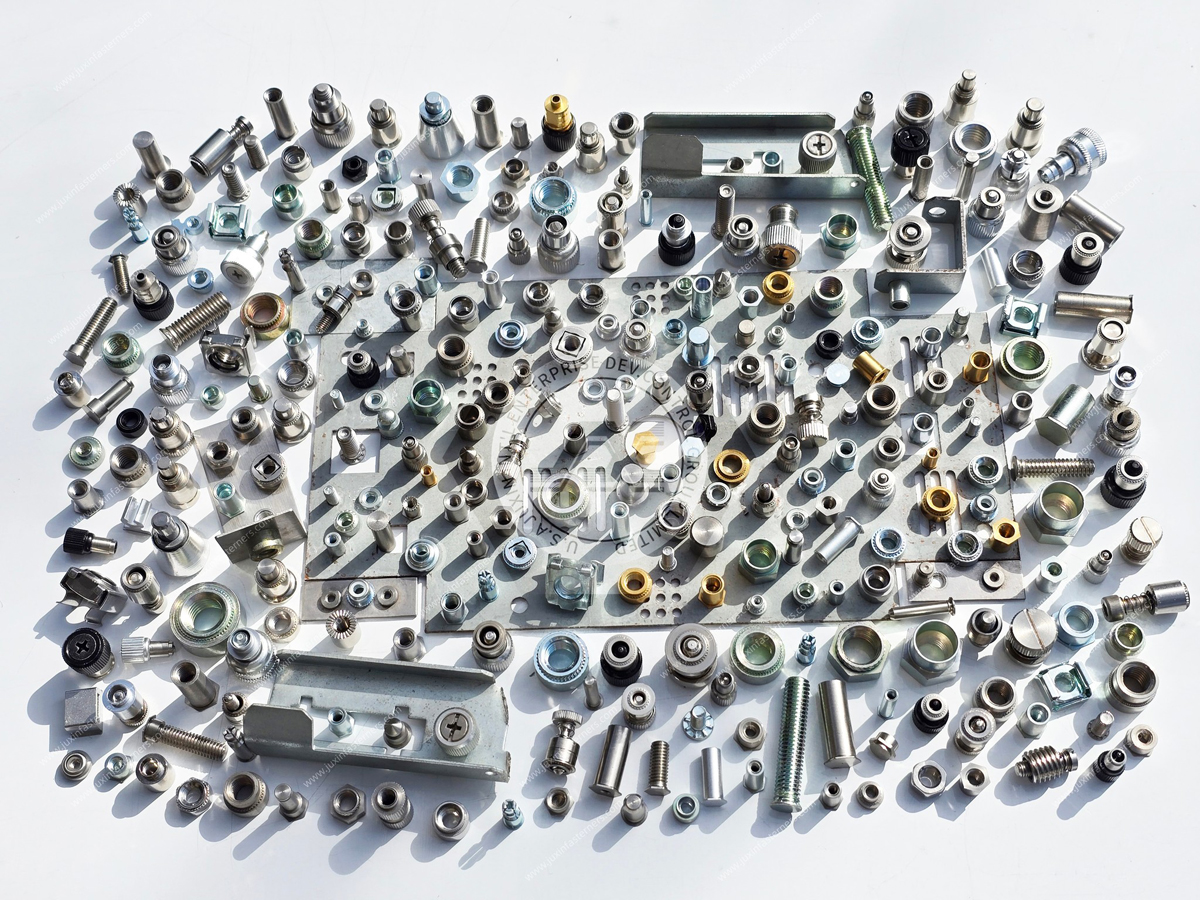
What Are Press-In Nuts for PCB Assembly?
A press-in nut is a threaded fastening component installed into a pre-punched or drilled hole in a panel or PCB-related structural component. During installation,
controlled pressing force causes the fastening section to expand or deform within the panel, creating mechanical resistance against rotation and pull-out.
For PCB applications, press-in nuts provide a fixed internal thread for subsequent component installation while maintaining a clean, compact assembly.
Depending on the application, Juxin Fasteners can supply through-hole and blind-hole press-in nuts, as well as different protrusion heights to accommodate:
Single-layer PCB assemblies
Spaced PCB assemblies
Stacked PCB assemblies
Electronic control modules
PCB mounting brackets
Internal electronic equipment structures
Enclosures and sheet-metal components
The protruding height can be customized according to the required board spacing and assembly configuration.
Precision PCB Fastening for Electronic Equipment
Electronic equipment increasingly requires fastening components that combine mechanical reliability with tight dimensional control.
Our PCB press-in nuts are designed for applications where installation accuracy, thread consistency, pull-out resistance, and long-term assembly reliability are important.
With appropriate tooling and process control, the installation process can achieve positioning accuracy down to approximately ±50 μm,
with pull-out resistance exceeding 100 N depending on the specific product design, material, panel construction, and installation conditions.
For applications involving repeated thermal exposure, the fastening solution can also be evaluated against three-cycle reflow soldering requirements,
making the design suitable for demanding electronic manufacturing environments.
These characteristics make press-in nuts particularly suitable for electronic assemblies where conventional fastening methods may create unnecessary space requirements or assembly complexity.
Press-In Nuts vs. Conventional PCB Fastening Methods
Traditional PCB mounting methods may rely on separate nuts, screws, threaded spacers, or manually installed hardware. These approaches can increase component count and assembly steps.
A properly designed self-clinching PCB fastener becomes mechanically integrated into the panel after installation.
This can provide several advantages:
Permanent internal threads
Reduced risk of loose nuts during assembly
Compact fastening structure
Faster component installation
Improved repeatability in automated production
Suitable for high-volume electronic assembly
Flexible PCB spacing through different protrusion heights
Reduced assembly complexity
For engineering teams, the objective is not simply to select a threaded fastener, but to select a fastening system that works reliably with the PCB material, panel thickness,
installation tooling, thread specification, and assembly process.
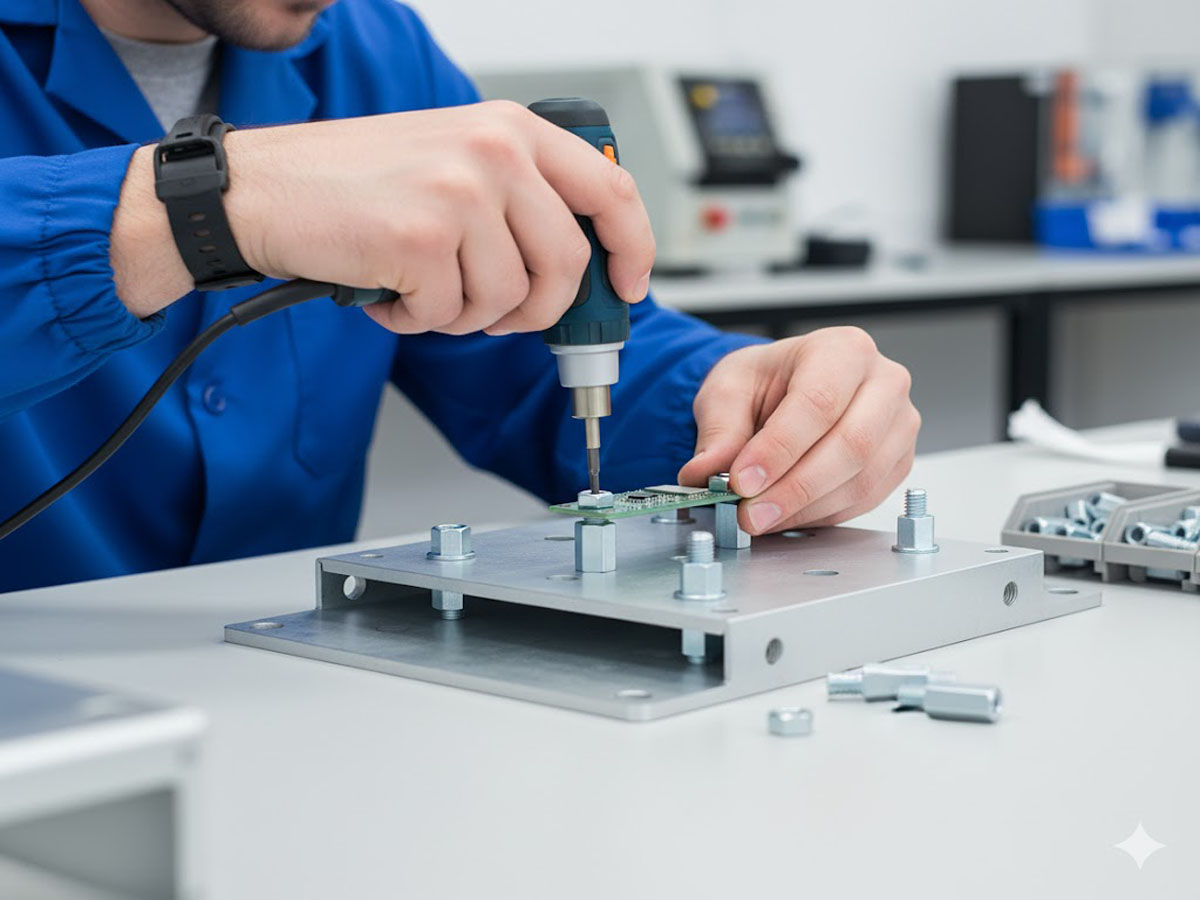
Through-Hole and Blind-Hole Press-In Nuts
Juxin Fasteners supplies both through-hole press-in nuts and blind-hole press-in nuts for different PCB and electronic equipment configurations.
Through-Hole Press-In Nuts
Through-hole designs allow the threaded hole to pass through the fastener body. They are suitable where the back side of the fastening point is accessible or where through-thread engagement is preferred.
Typical applications include:
PCB mounting
Electronic control panels
Sheet-metal enclosures
Communication equipment
Industrial control equipment
Electrical assemblies
Blind-Hole Press-In Nuts
Blind-hole designs provide a closed-end threaded structure. They can be advantageous where protection of the internal assembly from exposed threads or foreign material is required.
They can also provide a cleaner fastening structure for selected electronic enclosure and PCB mounting applications.
The appropriate design should be selected according to the required thread engagement, panel thickness, available installation space, and environmental conditions.
Materials for PCB Press-In Fasteners
Material selection is an important consideration when specifying PCB fasteners and self-clinching threaded inserts.
Juxin Fasteners primarily supplies press-in nuts in:
Carbon Steel with Zinc Plating
Carbon steel provides good mechanical strength and suits many industrial fastening applications.
After manufacturing, specific carbon steel press-in fasteners can undergo carburizing treatment to improve surface hardness and wear resistance.
Zinc plating can then provide additional corrosion protection for suitable applications.
Stainless Steel
Stainless steel press-in nuts provide excellent corrosion resistance and suit applications where environmental resistance is a priority.
However, stainless steel press-in fasteners require careful material compatibility consideration during installation.
Generally, install a stainless steel press-in nut into a stainless steel sheet or plate with equivalent or lower hardness. Therefore, confirm panel hardness and material condition during engineering selection.
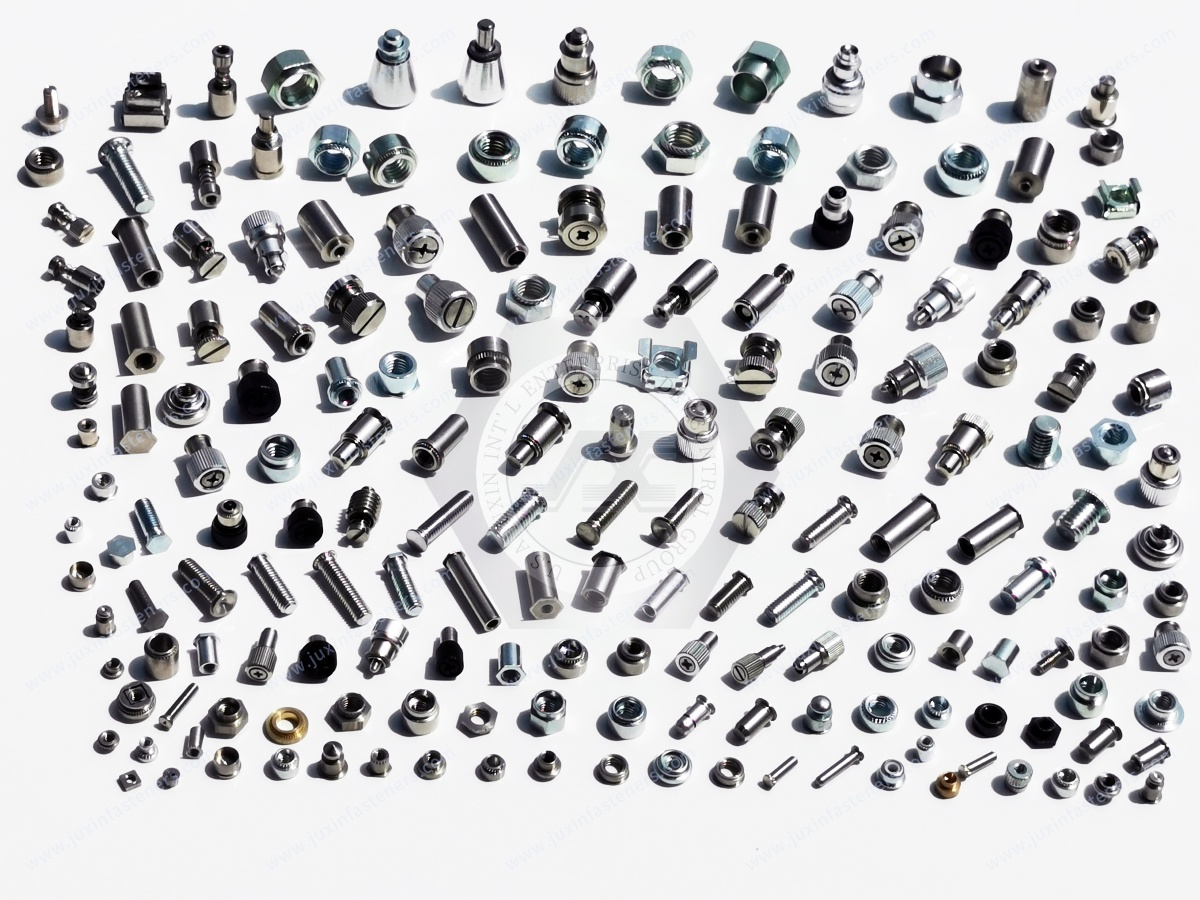
How to Install a Press-In Nut
Correct installation is essential to achieving the designed pull-out and rotational resistance.
The basic installation process consists of three stages.
1. Prepare the Installation Hole
Punch or drill an appropriately sized hole in the PCB, sheet, or mounting panel according to the specified fastener dimensions.
The hole diameter and panel thickness must meet the product drawing requirements.
An oversized or improperly prepared hole can reduce the mechanical retention of the fastener.
2. Position the Fastener
Place the shank of the press-in nut into the prepared installation hole.
The fastener should be positioned vertically and correctly aligned with the panel.
3. Apply Controlled Pressing Force
Use suitable upper and lower tooling to apply pressing force while keeping the two dies parallel.
Continue pressing until the fastening shank is completely embedded into the panel material and the designed locking structure has been fully formed.
Proper tooling alignment and controlled installation force are important for achieving consistent fastening performance.
Engineering Considerations for PCB Press-In Nuts
When selecting a PCB threaded fastener, engineers should consider more than thread size alone.
Important design parameters include:
Panel Material
The fastener must be compatible with the hardness and mechanical properties of the installation panel.
Panel Thickness
The panel thickness determines whether a specific press-in design can develop sufficient mechanical retention.
Hole Diameter
The installation hole must be controlled within the recommended dimensional range.
Thread Specification
Common metric thread configurations can be customized according to the assembly requirements.
Protrusion Height
Different protrusion heights can be developed for single-board, spaced-board, and stacked-PCB configurations.
Installation Force
The required pressing force depends on the fastener design, material, panel hardness, and hole condition.
Pull-Out Resistance
The required retention force should be evaluated according to the application load.
Environmental Requirements
Material and surface treatment should be selected according to humidity, corrosion exposure, temperature, and service conditions.
Assembly Process
For high-volume electronic manufacturing, the fastener should be compatible with the customer's pressing equipment and production process.

Quality Control and Automated Inspection
For precision electronic fastening components, dimensional consistency is critical.
Small variations in thread dimensions, shank geometry, protrusion height, or forming features can affect installation performance.
Juxin Fasteners therefore combines controlled manufacturing processes with automatic sorting and inspection technology.
Our automated inspection process can be used to identify dimensional deviations and appearance defects at production scale, helping maintain consistency across high-volume orders.
This is particularly important for PCB fasteners, press-in nuts, self-clinching fasteners, and precision threaded components used in automated assembly environments.
Our production video demonstrates the manufacturing process together with automatic sorting and inspection, showing how production quality is controlled from forming through final inspection.
Applications of PCB Press-In Nuts
Press-in nuts and PCB threaded fasteners can be used across a wide range of electronic and industrial applications.
Electronic Equipment
Suitable for internal mounting structures, PCB supports, brackets, covers, and component mounting systems.
Communication Equipment
Used in communication modules, network equipment, telecom enclosures, and internal structural assemblies.
Industrial Control Systems
Suitable for control cabinets, industrial controllers, electrical control modules, and automation equipment.
Power Electronics
Can be used in power supplies, converters, control modules, and other equipment requiring compact internal threaded connections.
Automotive Electronics
Suitable for selected electronic control units, sensor assemblies, battery-related electronic modules, and internal automotive electronic structures where the material and installation conditions are compatible.
Electrical and Electronic Enclosures
Press-in threaded fasteners provide a practical solution for creating permanent mounting points in sheet-metal and electronic enclosure structures.
Why Choose Juxin Fasteners for PCB Threaded Fasteners?
Juxin Fasteners combines fastener manufacturing, precision forming, surface treatment, inspection, and customized engineering support to provide fastening solutions for OEM and industrial customers.
Our capabilities support customers looking for:
Custom press-in nuts
PCB threaded fasteners
Self-clinching nuts
PCB standoffs
Press-fit threaded inserts
Custom threaded components
High-volume production
Automated inspection
Material and coating customization
OEM and engineering development
For customers with drawings or specific assembly requirements, we can evaluate the panel material, thickness, hole size, thread specification, protrusion height,
installation method, and required mechanical performance before recommending the appropriate fastening design.
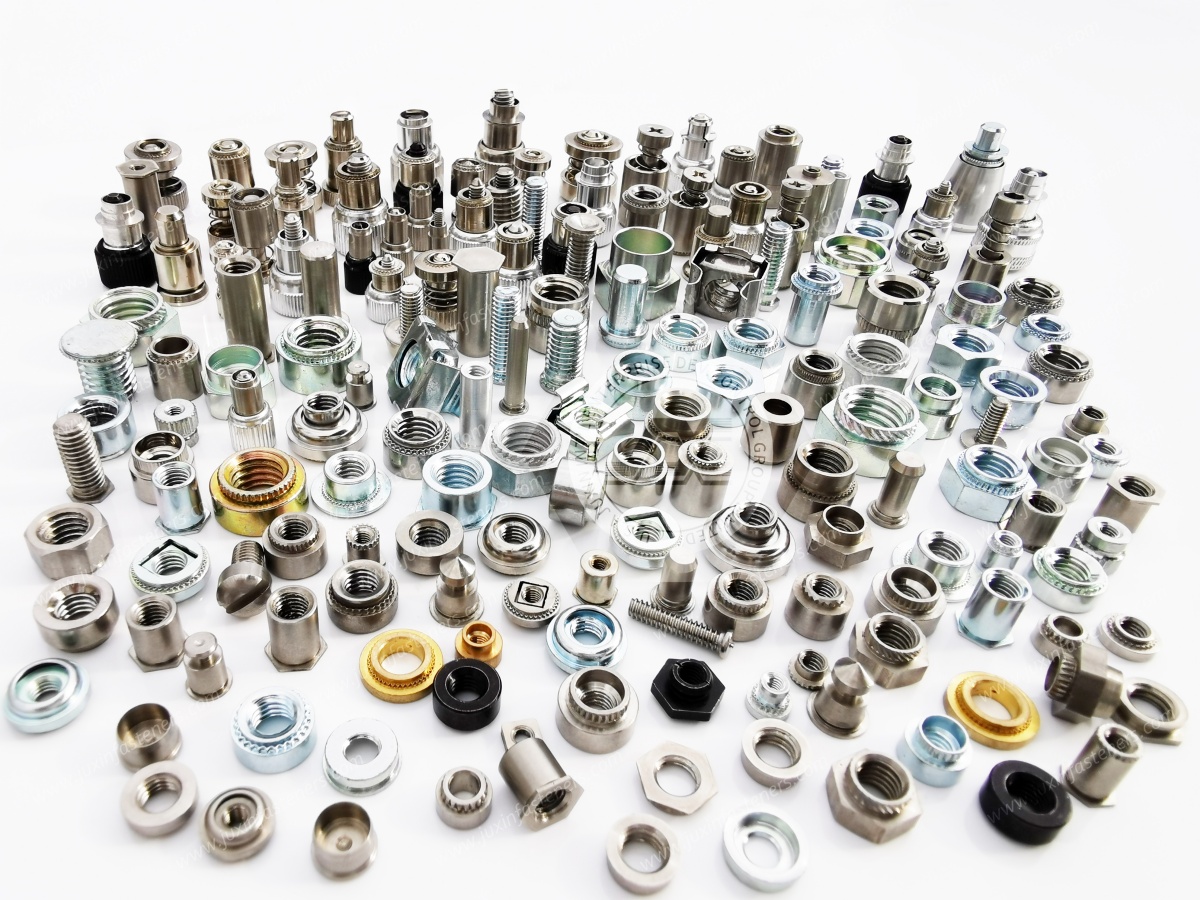
Build a More Reliable PCB Fastening System
A reliable electronic assembly starts with a reliable mechanical connection.
Whether you are designing a PCB mounting system, electronic enclosure, communication module, industrial control unit, or other precision electronic equipment,
the right press-in nut or PCB threaded fastener can simplify assembly while providing a durable and repeatable threaded connection.
Juxin Fasteners supports OEM and engineering teams with customized PCB fastening solutions, from component design and material selection to production and automated inspection.
If you have a PCB fastening requirement, technical drawing, sample, or application specification, contact our engineering team to discuss the appropriate press-in nut,
self-clinching fastener, or threaded PCB fastening solution for your assembly.
Email: info@juxinfasteners.com
 MORE NEWS

Oct. 13, 2026
Contact Us
Tel.:
+86 020 8621 0320
+86 020 3121 6067
E-mail:
Technical Support:
Navigation
SEND INQUIREY