
Call Us
+86 136 6007 9809
Call Us
+86 136 6007 9809

Oct. 10, 2024
Self-Clinching Fasteners for Sheet Metal: OEM Production, Installation and Assembly Solutions
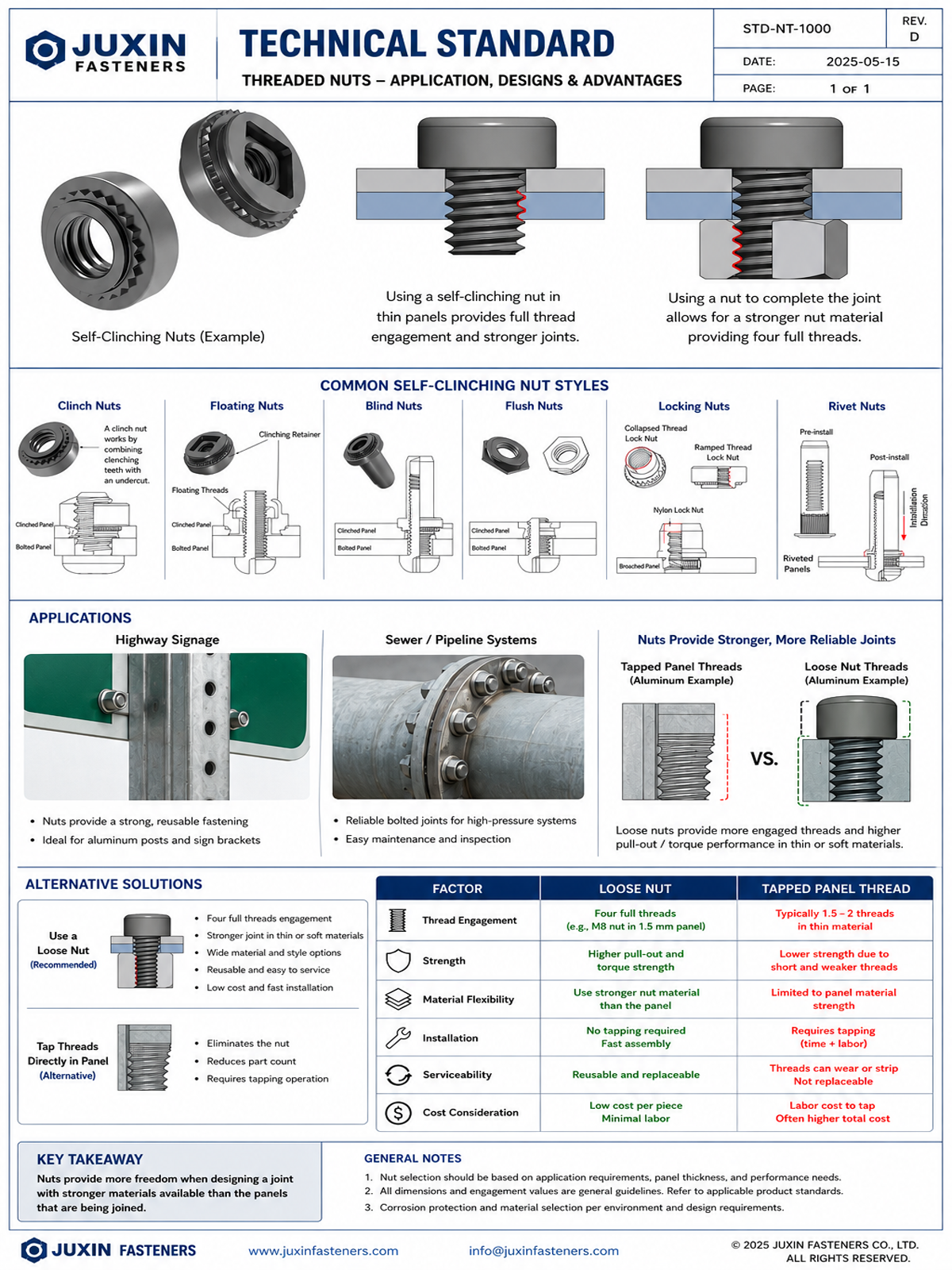
Self-clinching fasteners provide a practical way to introduce captive threaded connections into suitable sheet metal components.
They are widely considered for applications where manufacturers need repeatable mounting points, compact assembly geometry and efficient production processes.
Unlike loose nuts that must be held during assembly, a properly installed self-clinching nut remains mechanically retained in its host panel.
Self-clinching studs and standoffs provide other captive fastening features that can simplify downstream assembly.
For OEM manufacturers, the main value is not simply replacing one fastener with another.
It is selecting a fastening method that fits the sheet material, production sequence, installation equipment and long-term service requirements.
Juxin Fasteners supplies industrial sheet metal fastening components, including self-clinching nuts, press-in nuts, self-clinching studs, standoffs and drawing-specific OEM fasteners.
This guide examines the engineering principles, installation requirements, manufacturing tradeoffs and sourcing considerations involved in using self-clinching fasteners for industrial production.
What Are Self-Clinching Fasteners?
Self-clinching fasteners are mechanically retained components designed to be installed into suitable sheet metal through controlled pressing.
A typical self-clinching fastener includes engineered features such as an undercut, groove, displacer or anti-rotation geometry.
During installation, the fastener displaces material around a correctly prepared mounting hole. The panel material flows into or around the retaining features, producing a mechanical attachment.
The resulting connection provides a captive nut, stud or standoff for subsequent assembly.
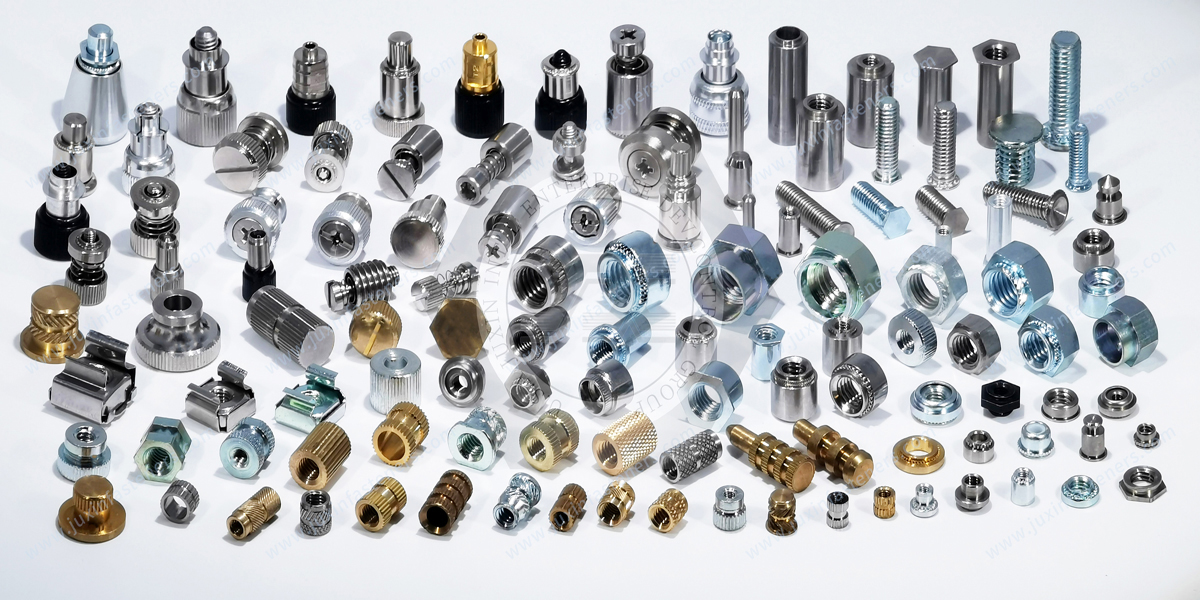
Common product families include:
Self-clinching nuts
Press-in nuts
Clinch nuts
Self-clinching studs
Self-clinching standoffs
Selected specialty clinching components
The exact installation mechanism varies with the fastener design.
How Self-Clinching Installation Works
A successful installation requires compatibility between the fastener, panel and tooling.
The general process involves preparing the mounting hole, positioning the fastener and applying controlled force through suitable installation tooling.
Panel Material Displacement
As the fastener is pressed into the sheet, panel material is displaced into the retaining features.
The geometry and material behavior determine the quality of the mechanical attachment.
Anti-Rotation Features
Certain designs use serrations, knurls, ribs or other geometric features to resist rotation.
These features are intended to help the installed fastener withstand tightening and service loads.
Axial Retention
The clinched geometry helps resist the fastener being pushed or pulled out of the panel.
Retention performance depends on the fastener design, panel material, thickness, hole geometry and installation conditions.
Important Engineering Distinction
A self-clinching fastener is mechanically retained in the panel, but this does not automatically make the final threaded joint resistant to vibration-induced loosening.
The mating screw, joint preload and any additional locking requirements must be evaluated separately.
Self-Clinching Nuts, Studs and Standoffs: Which Product Fits the Assembly?
Different self-clinching fasteners perform different functions.
| Fastener type | Primary function | Typical engineering consideration |
|---|---|---|
| Self-clinching nut | Provides a captive internal thread | Panel thickness, thread size and torque-out resistance |
| Self-clinching stud | Provides a captive external threaded projection | Stud length, clearance and axial retention |
| Self-clinching standoff | Provides a threaded spacing or mounting feature | Standoff height, alignment and panel support |
| Specialty clinching fastener | Provides a defined mechanical or mounting function | Drawing-specific geometry and installation requirements |
Self-Clinching Nuts
Self-clinching nuts are useful where a sheet metal component needs a reusable internal thread.
Potential applications include electrical cabinets, control panels, machinery covers and equipment housings.
The designer should confirm whether the selected nut provides the required thread engagement and panel retention.
Self-Clinching Studs
Self-clinching studs create a fixed external threaded mounting point.
They can simplify assembly where a nut must be installed on a projecting stud or where component positioning is important.
Stud length, projection direction and access to the opposite side must be considered.
Self-Clinching Standoffs
Standoffs provide controlled spacing between components.
They are commonly considered for electronic assemblies, circuit board supports and equipment enclosures.
Important dimensions include overall height, thread geometry, mounting-hole compatibility and installed alignment.
Designing Sheet Metal for Self-Clinching Fasteners
Self-clinching fastener performance depends strongly on the host panel.
A suitable design must address more than the nominal thread size.
Panel Material and Hardness
The panel material must be capable of flowing into the fastener's retaining features during installation.
In general, the host sheet must be sufficiently softer than the clinching features of the fastener.
However, there is no universal hardness difference that applies to every product.
Compatibility must be checked against the selected fastener design and the supplier's installation requirements.
Panel Thickness
Every self-clinching fastener has a specified minimum or permitted panel thickness range.
A fastener designed for a thicker panel may not retain properly in a thinner sheet.
Mounting-Hole Diameter
Hole size is critical.
An oversized hole may reduce material engagement and retention.
An undersized hole may cause excessive deformation or installation problems.
Edge Distance
The distance between the mounting hole and the panel edge must be sufficient for the fastener and material.
Insufficient edge distance may cause panel distortion, edge bulging or loss of retention.
Hole Preparation
Hole geometry, burrs and surface condition can influence installation.
Depending on the product, a punched or drilled hole may be acceptable, but preparation must follow the selected fastener's requirements.
Engineering Recommendation
Do not finalize the panel drawing using thread size alone. Confirm the specific fastener's mounting-hole diameter,
minimum sheet thickness, edge distance and installation direction before releasing the design.
Can Self-Clinching Fasteners Be Used in Aluminum and Stainless Steel Panels?
Yes, selected self-clinching fasteners can be used with suitable aluminum or stainless steel sheet materials, but compatibility is product-specific.
Aluminum Panels
Aluminum is often used in lightweight equipment and EV-related enclosures.
The designer must consider alloy, temper, thickness and local deformation.
A fastener that performs well in one aluminum alloy may not produce equivalent retention in another.
Carbon Steel Panels
Steel sheet can provide a suitable host material for many clinching applications.
The specific sheet grade, hardness and thickness still require verification.
Stainless Steel Panels
Stainless steel sheets may be harder than some conventional sheet metal materials.
They can require specially designed self-clinching fasteners and appropriate installation conditions.
A standard clinch nut intended for softer sheet metal should not automatically be substituted into stainless steel.
Material Pairing and Corrosion
Dissimilar metals may introduce galvanic-corrosion concerns in the presence of a conductive electrolyte.
Fastener material and coating selection should therefore consider the complete assembly environment.
Flush Installation and Surface Clearance
Some self-clinching fasteners are designed to provide a flush or nearly flush surface on a specified side of the panel.
Others create projections or require clearance for the installed geometry.
It is incorrect to assume that every self-clinching nut, stud or standoff leaves the back surface completely flat.
Engineering Recommendation
Review the installed fastener profile in the assembly drawing, including both sides of the panel and any tooling-access requirements.
Installation Equipment and Production-Line Integration
Self-clinching fasteners are generally installed using controlled pressing equipment and suitable tooling.
The exact process depends on the fastener type and panel.
Potential installation systems include:
Manual or assisted presses
Pneumatic or hydraulic press systems
Servo-controlled installation equipment
Automated feeding and positioning systems
Controlled Force and Tool Alignment
The installation force must be appropriate for the selected fastener.
Insufficient force may prevent full material engagement.
Excessive force may deform the panel or damage the fastener.
Misalignment can produce tilted installation or inconsistent retention.
Why Impact Installation Can Be Problematic
Self-clinching fasteners are typically designed for controlled pressing rather than uncontrolled hammering or impact.
Using an unsuitable installation method may damage the fastener or host sheet.
Assembly Sequence
Self-clinching fasteners are often installed before final assembly, allowing captive mounting points to be incorporated into fabricated sheet metal parts.
However, the sequence must consider forming, coating, access and inspection requirements.
Production Manager's Perspective
Evaluate the entire production operation:
Part feeding and orientation
Press cycle time
Installation force control
Tooling changeover
Operator access
Inspection and rework
Scrap risk
Downstream assembly
The fastest installation method is not necessarily the lowest-cost method if it creates excessive setup, inspection or rework.
Push-Out and Torque-Out Performance
Two important performance characteristics for many self-clinching nuts are axial retention and resistance to rotation.
Push-Out Resistance
Push-out testing evaluates the installed fastener's resistance to axial displacement under defined conditions.
The result depends on the fastener and panel combination.
Torque-Out Resistance
Torque-out testing evaluates resistance to rotation of the installed fastener in the panel.
This is particularly important when tightening a mating screw.
Why Catalog Values Need Context
Published retention values, where available, may be based on specific test panels, thicknesses and installation conditions.
They should not automatically be applied to different sheet materials or geometries.
Engineering Recommendation
For critical applications, evaluate installed performance using representative production panels and the approved installation process.
Self-Clinching Fasteners Versus Weld Nuts
Weld nuts and self-clinching nuts can both provide captive threads in sheet metal, but their installation processes and design requirements differ.
| Comparison | Self-clinching nuts | Weld nuts |
|---|---|---|
| Attachment method | Mechanical pressing | Welding |
| Heat input | No welding heat required for clinching | Local welding heat |
| Host material | Must support the clinching mechanism | Must be suitable for the welding process |
| Installation equipment | Press and appropriate tooling | Welding equipment and fixtures |
| Access requirements | Depends on fastener and tooling | Depends on welding method and fixture |
| Verification | Installed retention and dimensional checks | Weld integrity and dimensional checks |
| Typical tradeoff | Panel hardness and thickness sensitivity | Weld process control and heat effects |
When Self-Clinching May Be Preferable
Self-clinching may be attractive when avoiding welding heat, simplifying downstream assembly or incorporating captive threads into suitable fabricated panels.
When Welding May Be Preferable
Weld nuts may be suitable where the panel material, structural requirements or existing production process favors welding.
Important Limitation
Self-clinching is not universally stronger, cheaper or faster than welding.
The correct choice depends on the assembly and production system.
Self-Clinching Nuts Versus Rivet Nuts
Rivet nuts, also called blind rivet nuts or threaded rivet inserts, are another common way to add threads to sheet metal.
The main difference is the installation mechanism.
Self-Clinching Nuts
Typically require suitable pressing access and rely on panel material displacement into retaining features.
Blind Rivet Nuts
Generally deform their own body during installation to form a mechanical attachment.
They are often useful where access is available from only one side of the workpiece.
| Selection factor | Self-clinching nut | Blind rivet nut |
|---|---|---|
| Installation principle | Panel material displacement | Insert body deformation |
| Access | Usually requires opposing tooling access | Often suitable for one-sided access |
| Panel compatibility | Depends on clinching material flow | Depends on grip range and insert design |
| Installed profile | Product-specific | Product-specific |
| Retention | Must be verified for the panel | Must be verified for the panel |
Engineering Recommendation
For closed sections or assemblies with limited rear access, evaluate whether a blind rivet nut offers a more practical installation route.
For accessible sheet metal production, self-clinching may provide a suitable alternative.
Applications in Automotive and EV Manufacturing
Automotive Body and Interior Components
Self-clinching nuts and studs may be used in suitable brackets, interior structures and equipment mounting components.
The required retention and joint strength depend on the approved design.
EV Battery-Related Enclosures
Potential applications include:
Battery management system housings
Electrical protection covers
Power electronics enclosures
Auxiliary equipment brackets
For aluminum enclosures, material compatibility and corrosion behavior require particular attention.
Safety-critical battery structures require dedicated engineering validation and OEM approval.
Electrical Cabinets, Switchgear and Server Racks
Self-clinching nuts and standoffs can provide mounting features for:
Control panels
Electrical enclosures
Server chassis
Telecom cabinets
Electronic modules
The designer should verify electrical clearances, grounding requirements and installed fastener geometry where relevant.

HVAC, Machinery and Industrial Automation
Self-clinching fasteners may be useful in:
Air conditioning housings
Ventilation equipment
Machinery covers
Robot control cabinets
Automated production equipment
Precision sheet metal structures
For production teams, captive threaded features may simplify component handling and reduce the need to position loose nuts during assembly.
Rail, Aerospace-Related and Medical Equipment
Selected sheet metal fastening components may be relevant to rail equipment enclosures, aerospace-related ground equipment or medical equipment housings.
However, these industries may impose additional material, qualification, cleanliness or regulatory requirements.
General industrial self-clinching fasteners should not be represented as approved for safety-critical or regulated applications without specific evidence.
Common Self-Clinching Installation Problems
Fastener Spins During Screw Tightening
Possible causes include insufficient material engagement, an unsuitable panel, incorrect hole dimensions or inadequate installation.
Fastener Pushes Out of the Panel
Possible causes include insufficient retention, incorrect installation or loading beyond the validated design.
Panel Distortion
Possible causes include excessive installation force, inadequate edge distance or insufficient panel support.
Fastener Installs at an Angle
Possible causes include tooling misalignment, incorrect positioning or unsuitable fixturing.
Thread Damage During Assembly
Possible causes include thread contamination, misalignment, incorrect mating screws or excessive installation loads.
Corrective Approach
Investigate the actual cause using the fastener drawing, panel specification, installation process and inspection evidence.
Replacing the fastener with a stronger material is not necessarily the correct solution.
Quality Control for Self-Clinching Fastener Production
Quality assurance should cover both the supplied fastener and the installed assembly.
Fastener Inspection
Relevant checks may include:
Material identification
Thread dimensions
Head and shank geometry
Clinching feature dimensions
Surface condition
Coating requirements
Installed Assembly Inspection
Depending on the application, verification may include:
Installation height
Alignment
Panel deformation
Push-out resistance
Torque-out resistance
Functional thread engagement
Process Consistency
Production controls should address tooling condition, installation parameters and material variation.
Important Distinction
A fastener can pass incoming inspection but still fail after installation if the panel or press process is unsuitable.
OEM Procurement and Supplier Development
For procurement teams, selecting a self-clinching fastener supplier requires both product and application information.
A drawing-based RFQ should include:
Fastener type
Thread designation
Material
Surface treatment
Fastener dimensions
Panel material
Panel thickness
Mounting-hole diameter
Edge distance
Installation direction
Required retention performance
Expected annual volume
Packaging requirements
Manufacturing Feasibility
The supplier should evaluate whether the selected geometry and material can meet the drawing requirements.
Commercial Considerations
MOQ, tooling, batch size, lead time and repeat-order demand should be discussed before production release.
Alternative Product Qualification
When replacing an existing clinch nut or stud, confirm the complete installed performance rather than comparing only the nominal thread size.
Metric and Inch-Series Specifications
Self-clinching fasteners may be designed with metric or inch-series threads.
Metric, UNC and UNF threads are not directly interchangeable.
BSW and BSF are also distinct thread systems and should not be treated as equivalent to metric or Unified threads.
Approximate inch conversions are reference values only.
For replacement projects, confirm the exact thread designation, geometry, panel requirements and installation performance.
Frequently Asked Questions
What is the difference between a self-clinching nut and a rivet nut?
A self-clinching nut generally relies on displacement of the host panel material into retaining features.
A blind rivet nut generally deforms its own body during installation and is often useful for one-sided access.
Can self-clinching fasteners be installed in stainless steel sheet?
Selected designs can be suitable, but panel hardness and the specific fastener design must be verified.
Do self-clinching nuts require a special installation press?
They require suitable controlled pressing equipment and tooling. The exact equipment depends on the fastener and production requirements.
Do self-clinching nuts prevent screws from loosening?
Not automatically. Panel retention and joint resistance to vibration-induced loosening are different engineering functions.
What is the minimum sheet thickness for a self-clinching nut?
There is no universal value. Minimum thickness depends on the selected fastener design and panel material.
Can self-clinching fasteners replace weld nuts?
In suitable designs, yes, but installation access, panel material, retention performance and production cost must be evaluated.
Are self-clinching fasteners suitable for automated assembly?
They can be integrated into suitable automated or assisted production systems, subject to tooling and process validation.
What information should be included in a self-clinching fastener RFQ?
Provide the fastener drawing, panel material and thickness, mounting-hole dimensions, installation conditions, retention requirements and production volume.
Juxin Fasteners: Self-Clinching Nuts, Studs and OEM Sheet Metal Fasteners
Juxin Fasteners supplies industrial fastening components for sheet metal manufacturing and OEM assembly.
Relevant products include:
Self-clinching nuts
Press-in nuts
Clinch nuts
Self-clinching studs
Self-clinching standoffs
Rivet nuts
Threaded inserts
Drawing-specific custom fasteners
Specific thread systems, materials, coatings, installation requirements, inspection documentation, MOQ and lead times are subject to technical and commercial confirmation.
Request a Self-Clinching Fastener Review and OEM RFQ
Are you designing a sheet metal enclosure, evaluating self-clinching nuts against weld nuts or sourcing captive threaded components for production?
Juxin Fasteners welcomes inquiries from OEM manufacturers, sheet metal fabricators, design engineers,
manufacturing engineers, production managers, purchasing specialists and supplier development teams.
To support product selection and quotation, please provide:
Fastener drawing and revision + thread designation + material and coating + panel material + panel thickness + mounting-hole dimensions
+ edge distance + installation direction + required push-out or torque-out performance + prototype quantity + annual demand + batch size + packaging + target delivery schedule.
Company: Juxin Fasteners
Website: https://www.juxinfasteners.com/
Email: info@juxinfasteners.com
Send your drawings and self-clinching fastener RFQ to Juxin Fasteners for technical confirmation, manufacturing feasibility review and quotation.
Contact Us
Tel.:
+86 020 8621 0320
+86 020 3121 6067
E-mail:
Technical Support:
Navigation
SEND INQUIREY



