
Call Us
+86 136 6007 9809
Call Us
+86 136 6007 9809

Oct. 15, 2024
Self-Clinching Fastener Design and Installation: Undercuts, Knurls and Sheet Metal Retention
Self-clinching fasteners create captive threaded connections in suitable sheet metal components without requiring the panel itself to contain a full-depth tapped thread.
Their performance depends on a carefully engineered interaction between the fastener geometry, host material and installation process.
Two important functions are material retention and resistance to rotation.
In many self-clinching designs, an undercut or retaining groove captures displaced panel material,
while serrations, knurls or other anti-rotation features help prevent the fastener from turning during assembly.
However, these features do not operate independently of the panel.
Incorrect hole dimensions, unsuitable material hardness,
insufficient sheet thickness or poor installation alignment can prevent an otherwise correctly manufactured fastener from performing as intended.
For OEM engineers, production managers and supplier development teams,
understanding these relationships is essential when specifying self-clinching nuts, studs, standoffs and custom sheet metal fastening components.
Juxin Fasteners supplies industrial fastening products for sheet metal manufacturing, including self-clinching nuts, press-in nuts,
self-clinching studs, standoffs and drawing-specific OEM fasteners.
This guide focuses on the engineering details that determine installation quality, retention performance and repeatable assembly.
What Makes a Self-Clinching Fastener Stay in Sheet Metal?
A self-clinching fastener is installed into a prepared hole using controlled pressing.
During installation, material from the host sheet is displaced into or around the fastener's retaining geometry.
This creates a mechanical interlock between the fastener and panel.
For many conventional self-clinching nut designs, two functional features are especially important:
An undercut or retaining groove that captures displaced sheet material
An anti-rotation feature that resists turning after installation
The exact geometry differs between product families.
Not every self-clinching fastener uses the same knurl arrangement or retention mechanism.
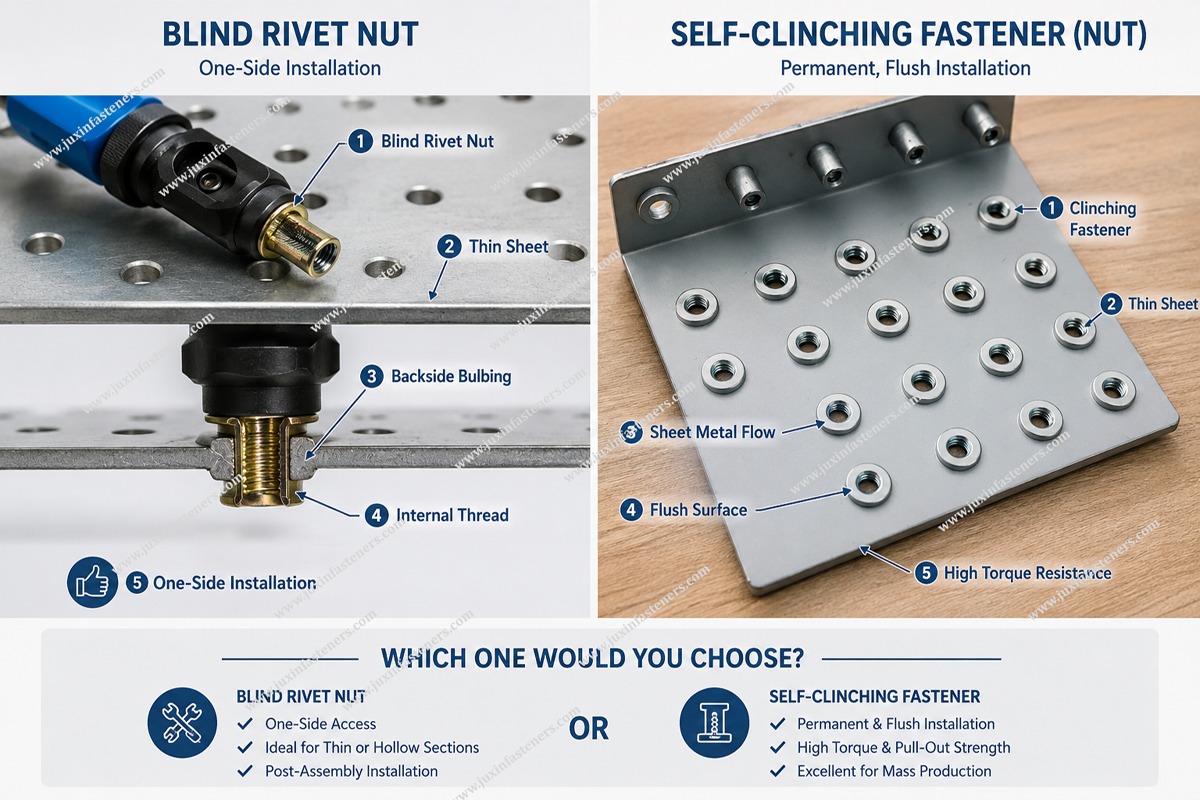
The Undercut: How Axial Retention Is Created
The undercut is a recessed feature designed to receive displaced panel material during installation.
As the fastener is pressed into the sheet, the surrounding material moves into the retaining area.
After installation, this material helps prevent axial displacement of the fastener.
Why Undercut Geometry Matters
The retaining feature must be compatible with the host sheet's thickness, hardness and ability to deform.
If insufficient material enters the undercut, the installed fastener may have inadequate retention.
If the installation process excessively deforms the panel, the surrounding material may be weakened or distorted.
Engineering Recommendation
Do not evaluate the undercut in isolation. The complete fastener and panel combination determines installed retention performance.
Knurls and Anti-Rotation Features
Many self-clinching fasteners use knurls, serrations, ribs or other noncircular features to resist rotation.
During installation, these features displace or engage the surrounding sheet material.
Their purpose is to help the fastener resist turning when a mating screw or nut is tightened.
Why Anti-Rotation Resistance Matters
A self-clinching nut that rotates in the panel can prevent proper tightening and may damage the assembly.
This is especially problematic in automated production, where an installation tool may continue applying torque after the fastener begins to spin.
Does a Knurl Guarantee High Torque Resistance?
No.
Installed torque-out resistance depends on:
Fastener geometry
Panel material
Panel thickness
Hole dimensions
Installation force
Tool alignment
Surrounding panel support
Important Distinction
Torque-out resistance describes the fastener's resistance to rotation within the panel.
It is not the same as the resistance of the completed threaded joint to vibration-induced loosening.
Material Flow: The Critical Interaction Between Fastener and Panel
The ability of sheet metal to flow into the fastener's retaining features is fundamental to self-clinching installation.
A panel that is too hard for the selected fastener may not deform as required.
A panel that is too thin may not provide sufficient material for proper engagement.
A panel that is too soft or poorly supported may deform excessively.
Panel Hardness
The host material must be compatible with the selected fastener design.
Although the panel generally needs to be sufficiently softer than the clinching features, there is no universal hardness limit suitable for every self-clinching product.
Sheet Thickness
Minimum sheet thickness is a product-specific requirement.
A nominal thread size alone does not determine the required panel thickness.
Material Temper and Condition
For aluminum sheet, alloy and temper can significantly affect installation behavior.
For stainless steel sheet, material hardness may require specially designed clinching products.
Engineering Recommendation
Specify the actual sheet material grade, temper or condition, and thickness when requesting a self-clinching fastener recommendation.
Mounting-Hole Design: Why Small Dimensional Errors Matter
The mounting hole is part of the fastening system.
Incorrect hole geometry can prevent the panel material from flowing into the retaining features as intended.
Oversized Holes
An oversized hole may reduce the amount of material available for engagement.
This can contribute to reduced torque-out or axial retention performance.
Undersized Holes
An undersized hole may interfere with insertion, increase installation force or produce undesirable panel deformation.
Burrs and Hole Quality
Burrs, irregular hole edges and poor hole perpendicularity can affect seating and alignment.
The acceptable hole preparation method depends on the selected fastener.
Hole Position
Mounting-hole location must allow sufficient surrounding material and suitable installation-tool access.
Engineering Recommendation
Use the mounting-hole dimensions specified for the exact fastener model.
Do not assume that different suppliers' products with the same thread size use identical installation holes.
Minimum Edge Distance and Panel Deformation
Edge distance is the distance between the mounting-hole center and the nearest relevant panel edge or feature.
Insufficient edge distance can cause:
Edge bulging
Panel distortion
Reduced retention
Cracking or local damage in susceptible materials
Interference with adjacent components
The required distance depends on the fastener and host material.
Engineering Recommendation
Check the minimum edge distance before finalizing the sheet metal drawing, especially for compact enclosures and closely spaced mounting points.
Installation Force and Press Tooling
Self-clinching fasteners are typically installed using controlled pressing equipment and appropriate tooling.
The installation process must produce the intended material displacement without damaging the panel.
Insufficient Installation Force
Possible results include:
Incomplete seating
Insufficient material engagement
Reduced retention
Incorrect installed height
Excessive Installation Force
Possible results include:
Panel distortion
Damaged fastener geometry
Surface marking
Unacceptable installed dimensions
Tool Misalignment
Misaligned tooling may produce tilted installation, uneven deformation or inconsistent retention.
Panel Support
The panel must be adequately supported during installation.
Unsupported sheet regions may bend rather than provide the required material flow.
Production Recommendation
Establish an installation process using the selected fastener's requirements and representative production panels.
Do not assume that the same press settings are suitable for every panel material or fastener size.
Installation Sequence: Before or After Surface Treatment?
The order of forming, clinching and coating can affect the final assembly.
Potential considerations include:
Hole dimensional changes
Coating buildup
Fastener surface damage
Panel corrosion protection
Electrical contact requirements
Cosmetic appearance
Downstream assembly
Example: Coated Sheet Metal
A coating may change local hole dimensions or surface behavior.
If installation damages the coating, corrosion protection may need further evaluation.
Example: Stainless Steel Fastener in Aluminum Sheet
Dissimilar-metal contact may create galvanic-corrosion concerns in suitable environmental conditions.
Engineering Recommendation
Review the complete production sequence rather than selecting the clinching operation independently of panel finishing.
Push-Out, Pull-Out and Torque-Out: Understanding Retention Tests
Installed self-clinching fastener performance is commonly evaluated using mechanical retention tests.
The appropriate test depends on the fastener design and application.
Push-Out Resistance
Push-out testing evaluates resistance to axial displacement in a defined direction under specified conditions.
Pull-Out Resistance
Pull-out testing evaluates resistance to axial extraction under specified conditions.
Push-out and pull-out values should not automatically be treated as identical because loading direction and installation geometry may differ.
Torque-Out Resistance
Torque-out testing evaluates the torque required to rotate the installed fastener relative to the panel under defined conditions.
Why Test Conditions Matter
Results can change with:
Panel material
Panel thickness
Hole preparation
Installation parameters
Fastener design
Test fixture
Loading direction
Engineering Recommendation
When comparing alternative products, use equivalent test conditions and representative host panels.
Catalog retention values should not be assumed to apply to every sheet metal assembly.
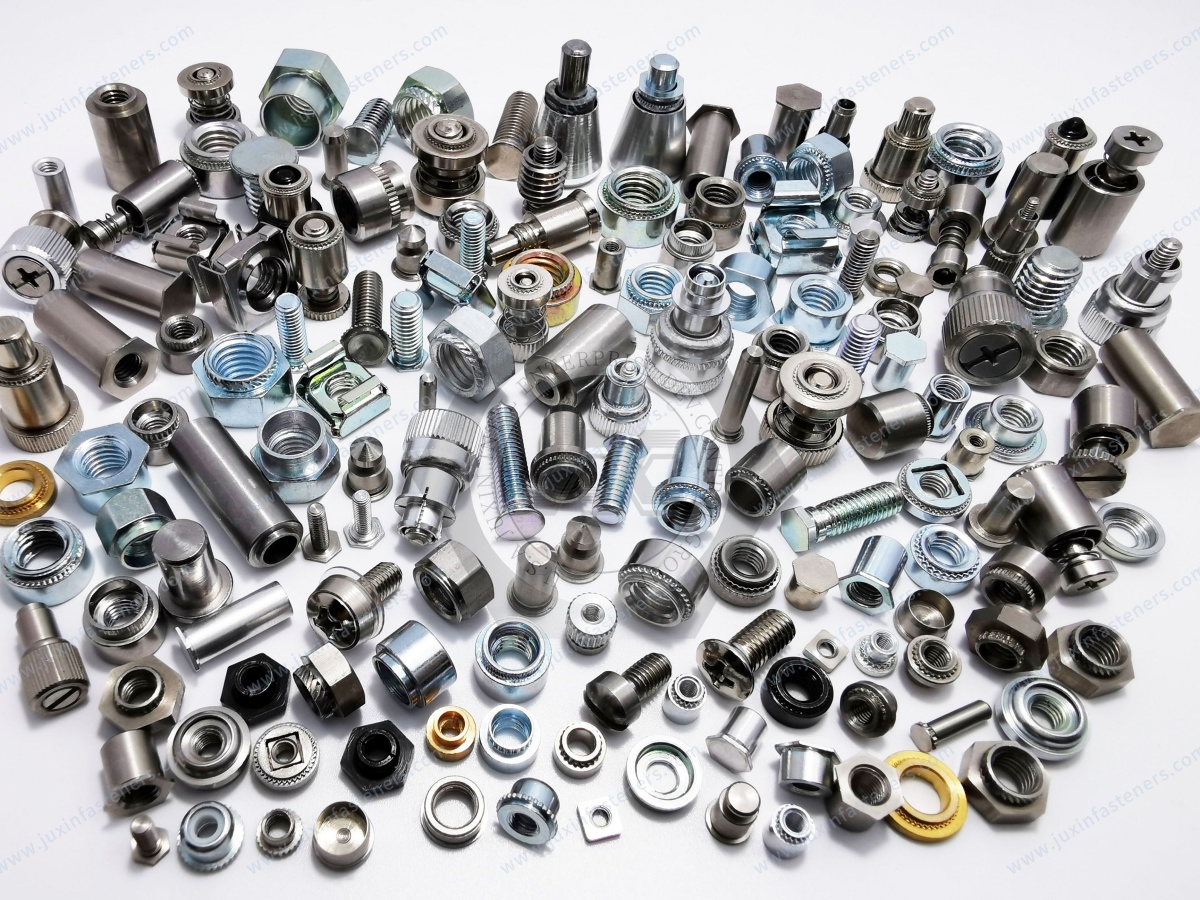
Common Self-Clinching Fastener Failures and Root Causes
A useful troubleshooting process begins by separating the observed failure from its underlying cause.
| Observed problem | Possible cause | What to check |
|---|---|---|
| Nut spins in the panel | Insufficient anti-rotation engagement | Hole size, panel hardness, knurl geometry, installation |
| Fastener pushes out | Inadequate axial retention | Undercut engagement, panel thickness, applied load |
| Panel bulges | Excessive force or inadequate edge distance | Press settings, tooling support, hole position |
| Fastener sits at an angle | Tooling or positioning error | Press alignment, fixture, hole condition |
| Thread is damaged | Misalignment or unsuitable mating screw | Thread specification, installation procedure |
| Panel cracks | Material or geometry incompatibility | Sheet grade, hardness, edge distance, deformation |
Why Replacing the Fastener with a Harder Material May Not Help
A harder fastener may still fail if the panel cannot flow into its retaining features.
Similarly, a larger knurl does not automatically correct an oversized hole or inadequate panel thickness.
The root cause must be identified from the complete fastener-panel-installation system.
Thread Reliability After Installation
The internal or external thread must remain functional after clinching.
Possible problems include:
Thread distortion
Cross-threading
Incorrect mating thread
Coating buildup
Contamination
Installation damage
Engineering Recommendation
Inspect both the installed fastener's retention and its thread functionality.
Passing a thread gauge before installation does not prove that the completed assembly meets every requirement.
Self-Clinching Nuts, Studs and Standoffs: Different Design Priorities
Self-Clinching Nuts
Primary considerations include internal thread integrity, torque-out resistance and axial retention.
Self-Clinching Studs
Primary considerations include stud projection, alignment, external thread integrity and retention under the intended loading direction.
Self-Clinching Standoffs
Primary considerations include height, alignment, thread geometry and support of the mounted component.
Design Recommendation
Choose the product family according to the required mechanical function, not merely the availability of a matching thread size.
Self-Clinching Fasteners for Automotive and EV Applications
Self-clinching components may be suitable for selected automotive and EV-related sheet metal assemblies.
Potential applications include:
Electronic control unit housings
Interior equipment brackets
Battery management system enclosures
Power electronics cabinets
Auxiliary mounting panels
For aluminum enclosures, verify material compatibility, corrosion behavior and installed retention.
Safety-critical automotive and EV battery structures require application-specific qualification and approval.
Electrical Cabinets, Telecom and Server Equipment
Self-clinching nuts and standoffs may provide captive mounting features in:
Electrical control cabinets
Switchgear enclosures
Telecom equipment
Server chassis
Electronic housings
Important design considerations include installed profile, electrical clearance, grounding requirements and access for installation tooling.
HVAC and Industrial Equipment
Self-clinching fasteners may be used in suitable:
Air conditioning housings
Ventilation systems
Machinery covers
Control panels
Fabricated sheet metal assemblies
The production process should account for panel deformation and downstream assembly access.
Robotics, Automation and Precision Equipment
Precision equipment may require consistent fastener positioning and repeatable installation geometry.
Potential applications include:
Robot control cabinets
Automation equipment housings
Positioning fixtures
Precision sheet metal structures
For production managers, inconsistent installed height or alignment can affect downstream assembly and increase rework.
Rail, Aerospace-Related and Medical Equipment
Selected self-clinching fasteners may be relevant to rail equipment enclosures, aerospace-related ground equipment or medical equipment housings.
However, these industries may require additional qualification, documentation, cleanliness or regulatory controls.
General industrial fasteners should not be presented as approved for flight-critical or regulated applications without supporting evidence.
Quality Assurance for Self-Clinching Fasteners
Quality assurance should verify both the supplied fastener and the installed assembly.
Incoming Fastener Inspection
Potential checks include:
Material identification
Thread dimensions
Undercut geometry
Knurl or anti-rotation feature dimensions
Surface condition
Coating requirements
Installed Assembly Verification
Potential checks include:
Seating condition
Installed height
Panel distortion
Alignment
Push-out or pull-out performance
Torque-out performance
Thread functionality
Process Control
Installation tooling, force settings, panel material and hole preparation should be controlled according to the approved process.
Important Distinction
A correctly manufactured self-clinching nut can still fail in service if it is installed into an unsuitable panel.
OEM Supplier Development and Drawing-Based Sourcing
Procurement teams evaluating self-clinching fastener suppliers should provide the complete application requirements.
A useful RFQ includes:
Fastener type and drawing
Thread designation
Material
Surface treatment
Panel material and thickness
Hole diameter and tolerance
Edge distance
Installation direction
Required retention performance
Expected production quantity
Packaging requirements
Target delivery schedule
Alternative Product Qualification
When replacing an existing self-clinching fastener, confirm:
Installation-hole compatibility
Panel thickness range
Material compatibility
Installed profile
Retention performance
Thread specification
Production-tooling compatibility
A nominally equivalent thread size does not establish complete interchangeability.
Commercial Evaluation
MOQ, tooling, prototype quantities, batch sizes, lead time and repeat-order consistency should be discussed before supplier approval.
Metric and Inch-Series Threads
Self-clinching fasteners may use metric or inch-series threads.
Metric, UNC, UNF, BSW and BSF systems are distinct and must not be treated as directly interchangeable.
Approximate inch conversions are reference values only.
The complete thread designation and mating-component requirements must be verified before substitution.
Frequently Asked Questions
What are the two main retaining features of a self-clinching fastener?
Many conventional designs use an undercut or groove for axial retention and knurls, serrations or other features for anti-rotation. The exact design varies by product.
Why does a self-clinching nut spin after installation?
Possible causes include incorrect hole dimensions, insufficient material engagement, unsuitable panel hardness or inadequate installation.
What causes low push-out strength?
Potential causes include insufficient panel material engagement, incorrect sheet thickness, unsuitable installation or loading beyond the validated design.
Can self-clinching nuts be installed in stainless steel sheet?
Selected products can be suitable, but material hardness and fastener compatibility must be confirmed.
Does a self-clinching nut prevent screw loosening under vibration?
No. Retention of the nut in the panel and resistance of the completed threaded joint to loosening are separate functions.
How much installation force is required?
There is no universal value. Force depends on the selected fastener, panel material, thickness and installation tooling.
Are self-clinching fasteners interchangeable between suppliers?
Not automatically. Installation-hole requirements, geometry and retention performance must be verified.
What should be inspected after installation?
Depending on the application, checks may include seating, alignment, installed height, panel condition, thread functionality and retention performance.
Juxin Fasteners: Self-Clinching Nuts, Studs and Custom Sheet Metal Fasteners
Juxin Fasteners supplies industrial fastening components for sheet metal manufacturing and OEM assembly.
Relevant products include:
Self-clinching nuts
Press-in nuts
Clinch nuts
Self-clinching studs
Self-clinching standoffs
Rivet nuts
Threaded inserts
Drawing-specific custom fasteners
Specific material grades, thread systems, coatings, inspection documentation, testing, MOQ and lead times are subject to technical and commercial confirmation.
Request a Self-Clinching Fastener Design Review or OEM RFQ
Are you troubleshooting a spinning clinch nut, specifying a self-clinching stud or evaluating a new supplier for precision sheet metal fasteners?
Juxin Fasteners welcomes drawing-based inquiries from OEM manufacturers, sheet metal fabricators, design engineers, mechanical engineers,
manufacturing engineers, production managers and procurement teams.
For technical review and quotation, please provide:
Fastener drawing and revision + thread designation + material and coating + panel material and thickness + mounting-hole dimensions
+ edge distance + installation direction + required torque-out or axial retention performance + prototype quantity + annual demand + batch size + packaging + target delivery schedule.
Company: Juxin Fasteners
Website: https://www.juxinfasteners.com/
Email: info@juxinfasteners.com
Send your drawings and self-clinching fastener RFQ to Juxin Fasteners for technical confirmation, product selection and quotation.
Contact Us
Tel.:
+86 020 8621 0320
+86 020 3121 6067
E-mail:
Technical Support:
Navigation
SEND INQUIREY



