Call Us
+86 136 6007 9809
Call Us
+86 136 6007 9809

Jan. 22, 2024
Standard ISO, DIN, ASME and other internationally recognized nuts solve a large percentage of industrial fastening requirements.
But not every assembly can be designed around a catalog nut.
Automotive systems, industrial machinery, electrical equipment, rail vehicles, power electronics, automation equipment
and specialized OEM products frequently require a threaded component with a combination of:
nonstandard dimensions;
special flange geometry;
restricted installation space;
anti-rotation features;
locking functions;
weld projections;
special materials;
application-specific coatings;
unusual thread engagement;
captive features;
customer-specific identification;
controlled mechanical properties.
These components are commonly searched as custom nuts, special nuts, non-standard nuts, OEM nuts, nuts made to drawing, custom threaded components, or special fasteners.
JUXIN FASTENERS supports suitable drawing-based and sample-based custom nut projects for OEM manufacturers,
Tier suppliers, engineering companies, procurement teams and supplier-development programs.
Our relevant product capabilities include:
custom cold-formed nuts;
custom machined nuts;
custom lock nuts;
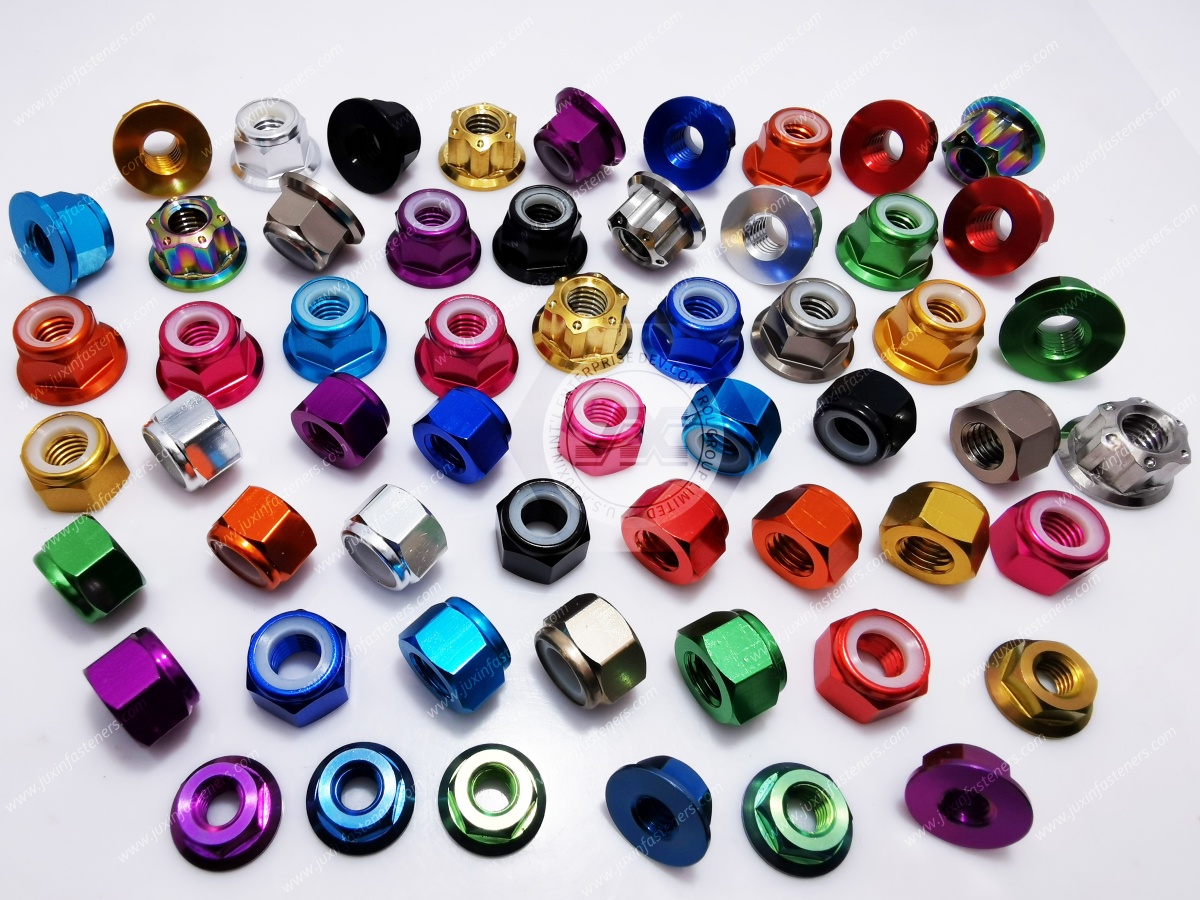
nylon insert locking nuts;
all-metal locking nuts;
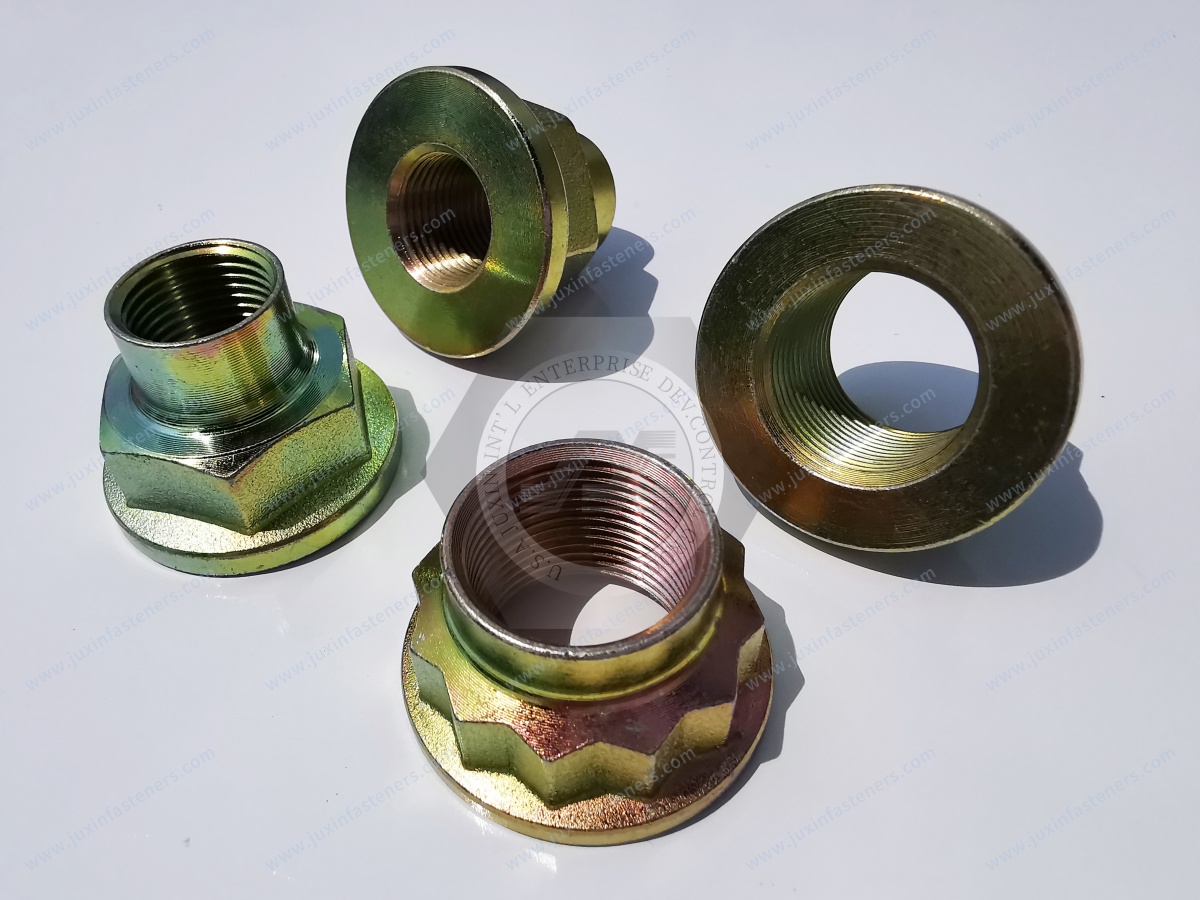
custom flange nuts;
special weld nuts;
square and rectangular nuts;
wing nuts;
cap nuts;
stainless steel nuts;
drawing-based threaded components;
CNC machined special fasteners.
The correct custom nut development process should begin with the functional requirements of the joint, not merely with the external shape of the existing part.
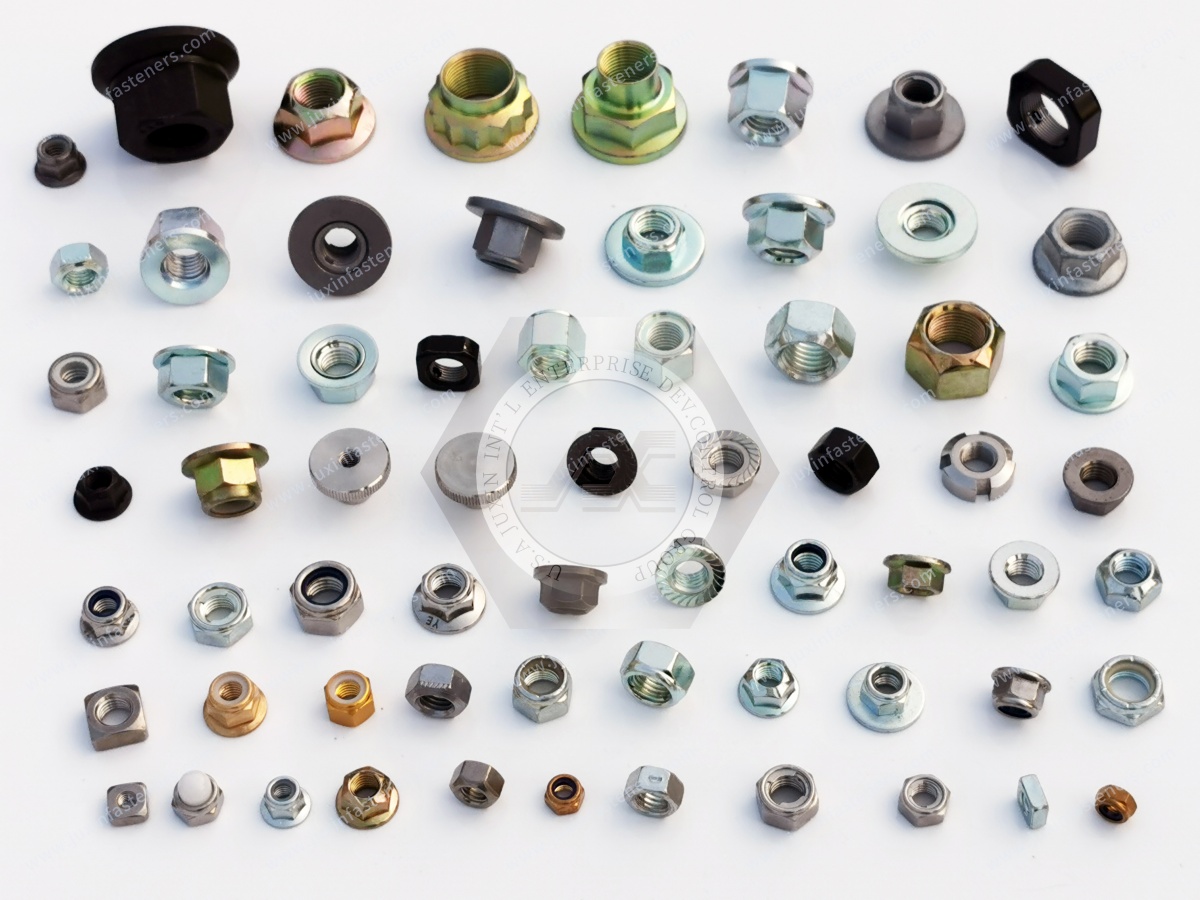
A custom nut is an internally threaded fastening component whose geometry, material, mechanical properties, locking function, surface treatment or other requirements differ from a readily available standard nut.
A component may be considered custom because of only one feature.
For example:
standard M6 internal thread + nonstandard flange;
standard 1/4-20 UNC thread + special wing geometry;
standard metric thread + customer-specific weld projections;
standard nut body + special nylon locking element;
standard hex geometry + unusual height;
standard thread + drawing-specific coating and identification.
Therefore, “custom” does not necessarily mean that every feature of the part is unique.
In many OEM projects, the most efficient solution is to retain standard thread and manufacturing features wherever possible while customizing only the features required by the assembly.
A custom nut may be justified when a standard nut cannot meet one or more of the following requirements:
installation envelope;
wrench access;
bearing area;
anti-rotation;
captive installation;
weldability;
prevailing torque;
manual operation;
electrical function;
weight target;
corrosion requirement;
appearance;
mating-component geometry;
automated assembly;
customer-specific mechanical performance.
The engineering question should be:
Which features actually need customization?
Unnecessary customization increases:
tooling cost;
qualification effort;
inventory complexity;
supplier dependency;
lead time.
Where a standard ISO/DIN/ASME nut can meet the functional requirement, using the standard component may provide better interchangeability.
Where it cannot, controlled customization becomes appropriate.
A practical development sequence is:
Application → Joint Function → Mating Bolt → Thread → Required Load → Locking Requirement
→ Geometry → Material → Manufacturing Process → Coating → Inspection → Prototype → Validation → Production
This sequence prevents a common sourcing problem: copying an existing nut geometrically without understanding why each feature exists.
| Requirement | Standard Nut | Custom Nut |
|---|---|---|
| Standard dimensions | Excellent fit | Possible |
| Immediate interchangeability | Usually higher | Drawing-dependent |
| Special geometry | Limited | High flexibility |
| Custom flange | Limited | Yes |
| Custom locking feature | Limited | Yes |
| Special weld projections | Limited | Yes |
| Special material | Limited by standard availability | Project-dependent |
| Customer-specific coating | Possible | Possible |
| Tooling investment | Usually low | May be required |
| Engineering validation | Standard/application dependent | Usually more extensive |
| Best suited for | Common assemblies | Application-specific OEM assemblies |
Custom does not automatically mean better.
It means the component is engineered around requirements that standard hardware cannot adequately satisfy.
For OEM projects, the preferred technical basis is normally a controlled 2D engineering drawing.
Depending on the component, the drawing can define:
thread;
critical dimensions;
tolerances;
flange diameter;
nut height;
wrenching geometry;
material;
hardness;
mechanical properties;
locking feature;
weld projections;
surface finish;
coating;
marking;
inspection requirements.
A 3D CAD model can provide additional geometry information, particularly for complex special nuts.
However:
A 3D model alone is usually not a complete manufacturing specification.
It may not define:
dimensional tolerances;
thread tolerance;
material condition;
mechanical requirements;
coating;
surface requirements;
critical characteristics.
For sourcing, the controlled 2D drawing should therefore remain an important technical document.
For suitable projects, a physical sample can support reverse engineering and second-source development.
A sample can provide information about:
external geometry;
thread;
flange;
locking structure;
manufacturing features;
surface appearance.
But a sample alone cannot reliably reveal every controlled requirement.
It may not establish:
original material specification;
heat treatment;
mechanical property class;
coating specification;
coating thickness;
friction requirement;
corrosion requirement;
dimensional tolerances;
original design intent.
Therefore, sample-based development should combine physical measurement with available application and specification information.
For critical OEM projects, a controlled drawing remains preferable whenever available.
The appropriate manufacturing route depends on:
geometry;
material;
size;
tolerance;
annual volume;
mechanical requirements;
tooling economics.
Typical manufacturing routes include:
cold forming / cold heading;
machining;
stamping and forming;
secondary threading;
welding or assembly;
combinations of multiple processes.
Cold forming can be suitable for medium- to high-volume custom nut production when geometry and material permit.
Potential advantages include:
high production efficiency;
repeatability;
favorable material utilization;
suitability for large production quantities.
Typical candidates include:
flange nuts;
hex nuts;
special locking nut bodies;
automotive nuts;
high-volume OEM threaded components.
However, custom cold forming may require dedicated tooling.
Tooling economics should therefore be evaluated against:
annual demand;
program life;
geometry;
prototype quantity;
expected production volume.
CNC machining can be useful where:
production quantity is relatively low;
geometry is complex;
tolerances are demanding;
material is difficult to form;
tooling investment is not economical;
prototypes are required.
Potential custom machined components include:
precision nuts;
special threaded sleeves;
adjustment nuts;
titanium threaded components;
stainless steel special nuts;
aluminum threaded parts;
custom spacers with internal threads.
Machining can also provide an efficient route for prototype validation before investing in production tooling, depending on the final manufacturing process and geometry.
This distinction matters.
A prototype produced by CNC machining may confirm:
envelope;
thread;
assembly fit;
functional geometry.
But if the production component will ultimately be cold formed or stamped, the production process can introduce different:
corner radii;
grain flow;
dimensional capability;
surface condition;
mechanical behavior.
Therefore:
prototype approval does not automatically qualify the final production process.
Production-intent samples should be validated before mass production where the application requires it.
Custom nuts can use internationally recognized thread systems such as:
ISO metric coarse threads;
ISO metric fine threads;
UNC;
UNF;
other customer-specified Unified threads.
Special projects may also require drawing-defined thread features.
A complete thread specification should identify:
nominal diameter;
pitch or threads per inch;
thread series;
tolerance class;
mating external thread;
coating condition where relevant.
“Custom nut” should not be used as a reason to leave thread requirements undefined.
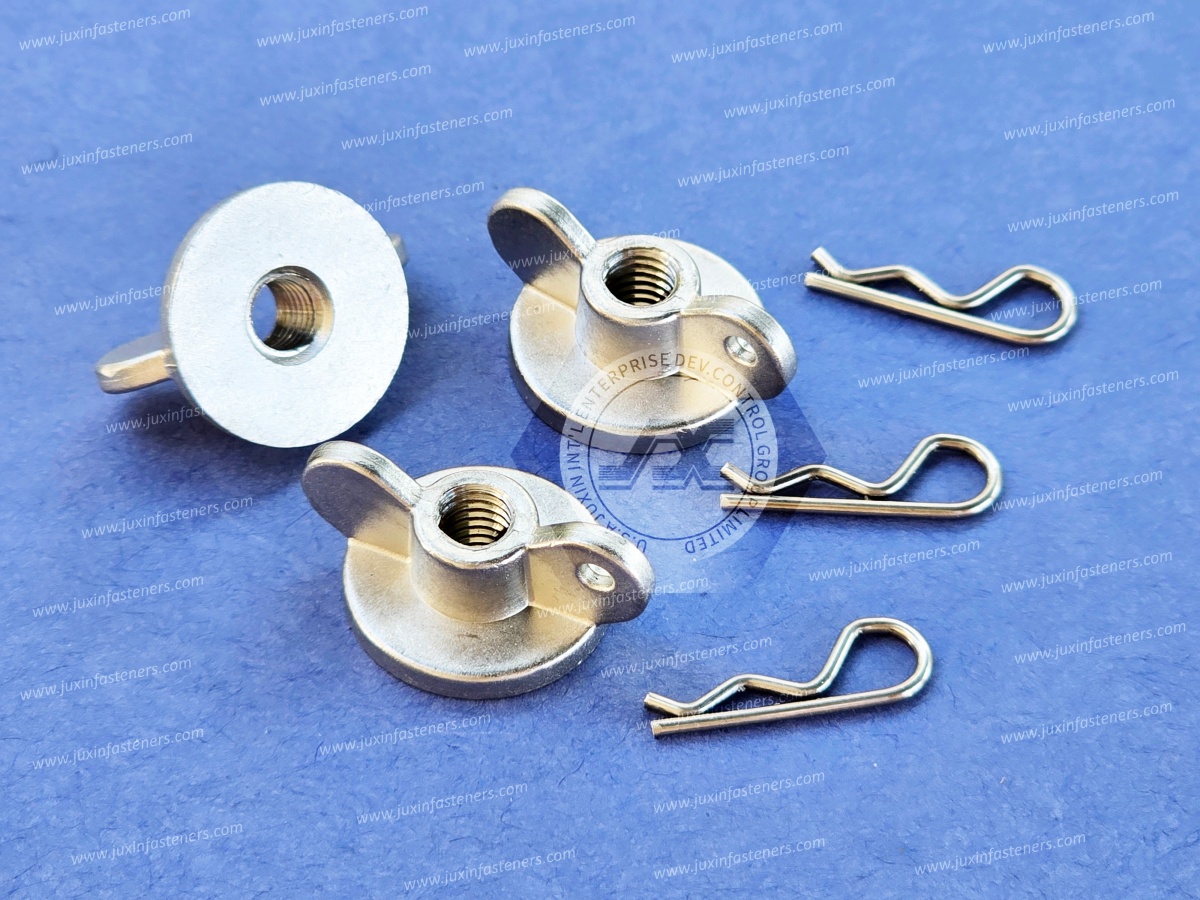
A standard flange nut may not provide the required:
flange diameter;
flange thickness;
bearing area;
wrench clearance;
anti-rotation feature.
A custom flange nut can be designed around the assembly interface.
Applications can include:
automotive structures;
brackets;
machinery;
electrical equipment;
fabricated assemblies.
Engineering review should consider the relationship between:
Flange Diameter → Bearing Area → Joint Surface → Local Bearing Stress → Assembly Access
Increasing flange diameter can improve bearing area but may interfere with surrounding geometry.
A custom locking nut may be required when the application combines:
unusual body geometry;
prevailing-torque requirement;
special material;
customer-specific installation envelope;
manual operation;
specialized mating hardware.
Potential locking technologies include:
nylon insert;
all-metal prevailing-torque geometry;
other drawing-defined mechanical locking features.
JUXIN FASTENERS supports suitable custom lock nut projects based on application requirements and controlled drawings.
A standard DIN 985-style nylon insert lock nut does not fit every assembly.
A customer may require:
special height;
unusual external geometry;
flange;
custom material;
specific nylon color;
special locking element;
application-specific coating.
The polymer locking element should be treated as a functional component.
Relevant factors include:
operating temperature;
chemical exposure;
prevailing-torque requirement;
mating bolt;
reuse requirements.
Related Product: DIN 985 Nylon Insert Lock Nuts
Where a polymer locking element is unsuitable, a drawing-based all-metal locking design may be evaluated.
Applications can include:
elevated-temperature equipment;
automotive systems;
rail equipment;
industrial machinery;
heavy equipment.
The locking geometry should be controlled because small dimensional changes can influence prevailing torque.
For second-source qualification, matching external dimensions alone is insufficient.
Wing nuts are often considered simple components, but OEM designs can require highly specialized configurations.
Variables can include:
wing shape;
wing span;
body material;
thread;
locking feature;
hand torque requirement;
corrosion protection;
appearance.
JUXIN FASTENERS supports suitable metal wing nut and locking wing nut projects.
A specialized design may combine a metal or zinc-alloy wing body with a PA66 locking element to provide both manual adjustment and prevailing-torque functionality.
Related Product: Nylon Locking Wing Nuts
Automotive, rail and fabricated assemblies frequently require weld nuts that differ from general catalog products.
Customization can involve:
projection geometry;
flange shape;
pilot geometry;
nut height;
thread;
material;
weld interface;
anti-rotation features.
For projection welding applications, the weld projections are functional features—not merely cosmetic geometry.
Changes in:
projection height;
projection position;
projection volume;
base material;
can affect welding behavior.
Related Product: DIN 929 Hex Weld Nuts
Related Product: DIN 928 Square Weld Nuts
Related Solution: Automotive Projection Weld Nuts
Two weld nuts may look almost identical but perform differently during resistance welding.
Potential differences include:
projection geometry;
material condition;
coating;
dimensional tolerance;
thread position;
flange flatness.
For second-source development, qualification should include the actual welding and assembly process where required.
Square, rectangular and other non-round nut geometries can be useful where the assembly itself prevents rotation.
Potential applications include:
channels;
cages;
brackets;
furniture systems;
industrial frames;
fabricated structures.
Anti-rotation can also be created through:
flats;
tabs;
knurls;
serrations;
external geometry;
mating pocket design.
The anti-rotation feature should be evaluated against the expected installation torque.
Custom cap nuts may be required where the assembly needs:
protected exposed threads;
controlled appearance;
special dome height;
unusual internal depth;
nonstandard material;
custom coating.
A critical design dimension is the available internal depth.
The nut must achieve the required thread engagement and clamping condition without the mating bolt bottoming inside the closed end.
Stainless steel custom nuts can be manufactured for suitable corrosion-resistant applications.
Common options include:
304 / A2-type stainless steel;
316 / A4-type stainless steel;
other specified stainless grades.
Applications can include:
food equipment;
electrical equipment;
marine-related equipment;
outdoor machinery;
medical equipment;
industrial processing equipment.
However, material selection should follow the actual environment.
“Stainless steel” is not a complete corrosion specification.
Custom stainless nut designs should also consider thread galling.
Risk can increase with combinations of:
similar stainless mating materials;
high assembly speed;
high contact pressure;
damaged threads;
unsuitable lubrication conditions.
For stainless threaded assemblies, the nut and mating bolt should be reviewed as a pair.
Related Engineering Guide: Stainless Steel Thread Galling Prevention
Aluminum nuts may be evaluated where low mass is important.
Potential applications include:
lightweight equipment;
electronics;
specialized machinery;
transportation equipment.
Engineering considerations include:
thread strength;
wear;
mating bolt material;
galvanic corrosion;
required preload;
repeated assembly.
Aluminum should not be selected solely because it is lightweight.
The thread and joint must still support the required mechanical load.
Titanium can be appropriate for specialized projects requiring a combination of:
low density;
corrosion resistance;
specific mechanical properties.
Potential applications can include:
aerospace-related equipment;
specialized machinery;
high-performance equipment.
Relevant considerations include:
titanium alloy;
mating material;
galling;
thread finish;
mechanical requirements;
documentation.
A titanium component should not be described as “aerospace grade” without the applicable material and qualification requirements.
Copper and copper-alloy nuts may be used in electrical assemblies where conductivity is important.
Applications can include:
electrical terminals;
busbar systems;
power distribution;
grounding equipment;
high-current assemblies.
The design should consider:
conductivity;
contact pressure;
oxidation;
surface finish;
thermal cycling;
joint preload.
For electrical connections, the complete contact interface is more important than simply specifying a conductive nut material.
Potential surface treatments can include:
zinc plating;
zinc-nickel coating;
nickel plating where specified;
inorganic coating systems;
customer-defined automotive or industrial finishes.
Surface treatment should be selected according to:
corrosion environment;
appearance;
friction requirement;
temperature;
mating materials;
electrical function;
customer specification.
A coating does more than change color.
It can affect:
corrosion protection;
thread fit;
coefficient of friction;
assembly torque;
electrical contact;
weldability;
dimensional condition.
For threaded components, coating thickness must be considered in relation to thread tolerance.
For torque-controlled joints, a coating change can alter the torque-preload relationship.
Therefore, coating substitutions should be reviewed as engineering changes where joint performance is controlled.
Two black fasteners may appear similar while using completely different coating systems.
Their differences can include:
corrosion performance;
coating thickness;
friction;
appearance stability;
process control.
For OEM sourcing, “black” should never be the complete coating specification.
The drawing or purchasing specification should define the required coating system and performance.
Automotive OEM and Tier suppliers may require custom nuts for:
body structures;
seat-related systems;
interior assemblies;
exterior assemblies;
chassis equipment;
electrical systems;
thermal-management equipment;
battery-related structures;
power electronics.
Relevant custom products can include:
projection weld nuts;
flange nuts;
prevailing-torque nuts;
locking wing nuts;
special threaded inserts;
drawing-based cold-formed components.
For automotive applications, component approval should follow the actual customer specification and production process.
EV and electrified vehicle systems can create specialized fastening requirements around:
battery enclosures;
busbar systems;
inverter housings;
converters;
thermal-management assemblies;
high-voltage distribution equipment;
electronic control systems.
Depending on the location, engineers may need to evaluate:
electrical conductivity;
electrical isolation;
galvanic compatibility;
corrosion;
vibration;
temperature;
service access;
compact installation space.
There is no single universal “EV nut.”
The correct component depends on the actual joint.
Rail vehicle and railway equipment projects can require special fastening solutions for:
interior systems;
exterior equipment;
electrical cabinets;
lighting assemblies;
mechanical systems;
brackets;
serviceable equipment.
Selection can involve:
prevailing-torque nuts;
stainless steel nuts;
weld nuts;
flange nuts;
drawing-based special nuts.
Rail applications should be evaluated against the applicable project requirements, environmental conditions and maintenance strategy.
Industrial machinery frequently uses custom nuts where:
access is limited;
adjustment is required;
equipment geometry is unique;
high loads are present;
frequent service is required.
Applications include:
CNC machinery;
automation equipment;
robotic systems;
packaging machinery;
production equipment;
hydraulic systems.
A custom nut can sometimes reduce:
part count;
assembly time;
secondary operations.
But this benefit should be evaluated against tooling and sourcing complexity.
Electrical applications can require custom threaded components for:
electrical cabinets;
power distribution equipment;
switchgear;
busbars;
power electronics;
communication equipment.
Relevant requirements may include:
conductivity;
insulation;
corrosion resistance;
contact pressure;
temperature;
compact packaging.
Precision equipment may require:
compact nut geometry;
corrosion-resistant materials;
controlled surface condition;
dimensional consistency;
special cleaning or documentation requirements.
For medical-device applications, the customer should define the applicable material, regulatory, cleanliness, validation and documentation requirements.
A generic stainless steel nut should not automatically be presented as a “medical-grade” component.
Aerospace-related applications can require specialized:
titanium;
aluminum;
stainless steel;
high-performance alloys;
controlled manufacturing;
material documentation;
traceability.
Qualification depends on the controlling customer and industry specifications.
Material choice alone does not establish aerospace qualification.
A good custom design should satisfy the assembly while remaining practical to manufacture.
Engineers should consider:
unnecessary sharp corners;
excessive tolerance;
difficult undercuts;
inaccessible machining features;
excessive material removal;
tooling access;
thread depth;
forming direction.
A small design adjustment can sometimes make a major difference to:
tooling cost;
production speed;
process stability;
scrap rate.
This is why early supplier involvement can be valuable for drawing-based custom components.
Over-tolerancing increases manufacturing cost without necessarily improving function.
A better drawing distinguishes:
Functional Critical Dimensions
from
General Manufacturing Dimensions
Critical dimensions may include:
thread position;
flange thickness;
wrenching geometry;
locking deformation;
weld projection;
mating diameter.
Other dimensions may be controlled by an appropriate general tolerance.
The drawing should reflect functional risk.
The original part may contain functional material, locking, heat-treatment or coating requirements that cannot be determined visually.
A physical sample is useful, but it does not define every manufacturing requirement.
A custom nut should be developed with the mating thread and joint in mind.
Unnecessary precision increases cost and can reduce supplier options.
Different materials can change strength, forming behavior, corrosion, friction and locking performance.
A coating change can affect corrosion and torque-tension behavior.
If mass production uses another manufacturing process, production-intent samples may require separate validation.
Without controlled critical dimensions, supplier-to-supplier consistency becomes difficult.
Supplier-development and procurement teams often need a second source because of:
capacity risk;
cost pressure;
regional supply risk;
long lead times;
supplier consolidation;
quality issues.
A proper second-source process should compare:
controlled drawing;
thread specification;
critical dimensions;
material;
mechanical properties;
locking function;
weld features;
coating;
friction requirements;
corrosion requirements;
marking;
inspection requirements;
packaging;
production process;
application validation.
The objective is not merely to produce a part that looks the same.
The objective is to reproduce the required function consistently.
For custom nuts, supplier review can identify opportunities such as:
replacing machining with cold forming at sufficient volume;
relaxing nonfunctional tolerances;
reducing secondary operations;
standardizing material;
simplifying geometry;
integrating washer-like features into a flange;
reducing component count.
Any design change should be approved by the customer before implementation.
A practical custom nut development process can include:
Review:
drawing;
application;
quantity;
material;
performance requirements.
Determine:
cold forming;
machining;
stamping;
secondary operations;
tooling requirements.
Confirm unclear:
dimensions;
tolerances;
thread;
material;
coating;
locking requirements.
Prepare samples using the appropriate development route.
Verify required:
dimensions;
thread;
material;
surface;
functional characteristics.
The customer evaluates the sample in the actual assembly where required.
An approved sample can be retained as a physical reference when appropriate.
Production-intent components are confirmed before mass production.
Maintain:
drawing revision;
process control;
inspection;
lot identification;
approved material and coating.
Inspection requirements depend on the application and drawing.
Potential controls include:
dimensional inspection;
GO/NO-GO thread gauging;
material verification;
hardness testing;
mechanical-property testing;
prevailing-torque testing;
coating inspection;
corrosion testing;
weld projection inspection;
visual inspection;
lot traceability.
For custom components, inspection should focus particularly on functional critical characteristics.
A custom nut can pass a thread gauge and still fail the application.
Thread gauging does not verify:
material strength;
locking performance;
flange geometry;
weldability;
coating friction;
corrosion resistance;
application fit.
Quality control should therefore be based on the complete drawing and functional requirements.
Purchasing and supplier-development teams should evaluate whether the supplier can control:
drawing revision;
material;
thread;
tooling;
critical dimensions;
locking performance;
heat treatment where applicable;
coating;
inspection;
samples;
production changes;
traceability;
packaging;
capacity.
For long-term OEM programs, consistent process control is more important than obtaining one acceptable prototype.
To receive a more accurate technical review and quotation, provide:
2D drawing;
3D CAD model where available;
existing physical sample where relevant;
application;
nut type;
thread size;
pitch or TPI;
thread tolerance;
mating bolt specification;
material;
mechanical property requirement;
hardness requirement where applicable;
critical dimensions;
critical tolerances;
locking requirement;
prevailing-torque requirement where applicable;
weld feature requirements;
coating;
corrosion requirement;
friction requirement where specified;
operating temperature;
application environment;
prototype quantity;
production quantity;
estimated annual demand;
expected program life where available;
inspection requirements;
documentation requirements;
traceability requirements;
packaging requirements.
Providing this information at RFQ stage reduces technical clarification cycles and improves quotation accuracy.
A custom nut is an internally threaded fastener with drawing-specific geometry, material, locking function, coating or performance requirements that are not fully met by a readily available standard nut.
JUXIN FASTENERS supports suitable drawing-based custom nut and threaded-component projects according to geometry, material, quantity and manufacturing requirements.
For suitable projects, a physical sample can support technical evaluation and dimensional reconstruction. A controlled drawing and application requirements are preferred where available.
It depends on geometry, material, tolerance and quantity. Cold forming can be economical for suitable higher-volume parts,
while CNC machining can be useful for prototypes, lower volumes and complex precision geometries.
The most useful information includes a 2D drawing, thread, material, coating, quantity, application, critical tolerances and mechanical or functional requirements.
Yes. Many custom nuts use standard ISO metric, UNC or UNF threads while customizing the external geometry or functional features.
Yes. Suitable designs can include polymer-insert or all-metal locking features depending on the application.
Suitable custom weld nut projects can include drawing-specific flange, pilot and weld-projection geometries.
Yes, depending on the component design and application. Common stainless options can include 304/A2 and 316/A4-type materials.
Suitable specialized projects can be evaluated according to alloy, drawing, quantity, tolerances, documentation and application requirements.
MOQ depends on manufacturing process, material, geometry and tooling. A cold-formed custom component with dedicated tooling has different economics from a CNC-machined special nut.
Some do. Cold-formed, stamped or molded assemblies may require dedicated tooling. CNC-machined components may require little or no dedicated production tooling depending on geometry.
For suitable projects, samples or prototypes can be prepared for dimensional and assembly evaluation before production approval.
Compare the controlled drawing, material, mechanical requirements, thread, critical dimensions, locking or weld features,
coating, inspection requirements and functional performance in the actual application.
Build internal links from this page to relevant existing pages such as:
Industrial Nut Types & Selection Guide
DIN 985 Nylon Insert Lock Nuts
All-Metal Lock Nuts
Nylon Locking Wing Nuts
DIN 929 Hex Weld Nuts
DIN 928 Square Weld Nuts
Automotive Projection Weld Nuts
Automotive Hex Flange Weld Nuts
Stainless Steel Thread Galling Prevention
Custom CNC Machined Components
Self Tapping Thread Inserts
Heat Set Inserts for Plastic
Blind Rivet Nuts
Self-Clinching Nuts
Use the existing indexed JUXIN FASTENERS URLs when implementing these internal links.
Custom nut sourcing should connect the engineering drawing, mating assembly, manufacturing process, material, functional characteristics and production control.
JUXIN FASTENERS supports suitable projects involving custom nuts, special nuts, custom lock nuts, weld nuts, wing nuts, flange nuts,
stainless steel nuts and drawing-based threaded components for OEM manufacturing.
For design and structural engineers, send the controlled drawing together with the mating bolt, joint geometry, material, load, operating environment and functional requirements.
For procurement, purchasing managers, strategic sourcing and supplier-development teams, provide the drawing revision,
estimated annual demand, sample quantity, production quantity, material, coating, inspection requirements,
documentation requirements, traceability requirements and packaging requirements.
For second-source projects, the existing controlled drawing is the preferred starting point. Where no drawing is available,
provide a physical sample together with the mating-component dimensions and application requirements.
The objective is not simply to reproduce the appearance of an existing nut.
It is to reproduce the required function, manufacturing consistency and supply-chain reliability.
Email: info@juxinfasteners.com
Website: www.juxinfasteners.com
Contact Us
Tel.:
+86 020 8621 0320
+86 020 3121 6067
E-mail:
Technical Support:
Navigation
SEND INQUIREY