Call Us
+86 136 6007 9809
Call Us
+86 136 6007 9809

Nov. 08, 2023
Thin-sheet assemblies sometimes create two fastening problems at the same location:
Problem 1: A conventional rivet nut flange projects too far above the panel.
Problem 2: A round-body rivet nut may not provide sufficient resistance to rotation during bolt tightening, removal, or repeated servicing.
A small countersunk head hex rivet nut addresses these requirements by combining two independent design features:
Small Countersunk / Low-Profile Head → Reduced Front-Side Projection
Hexagonal Body → Mechanical Anti-Rotation Engagement
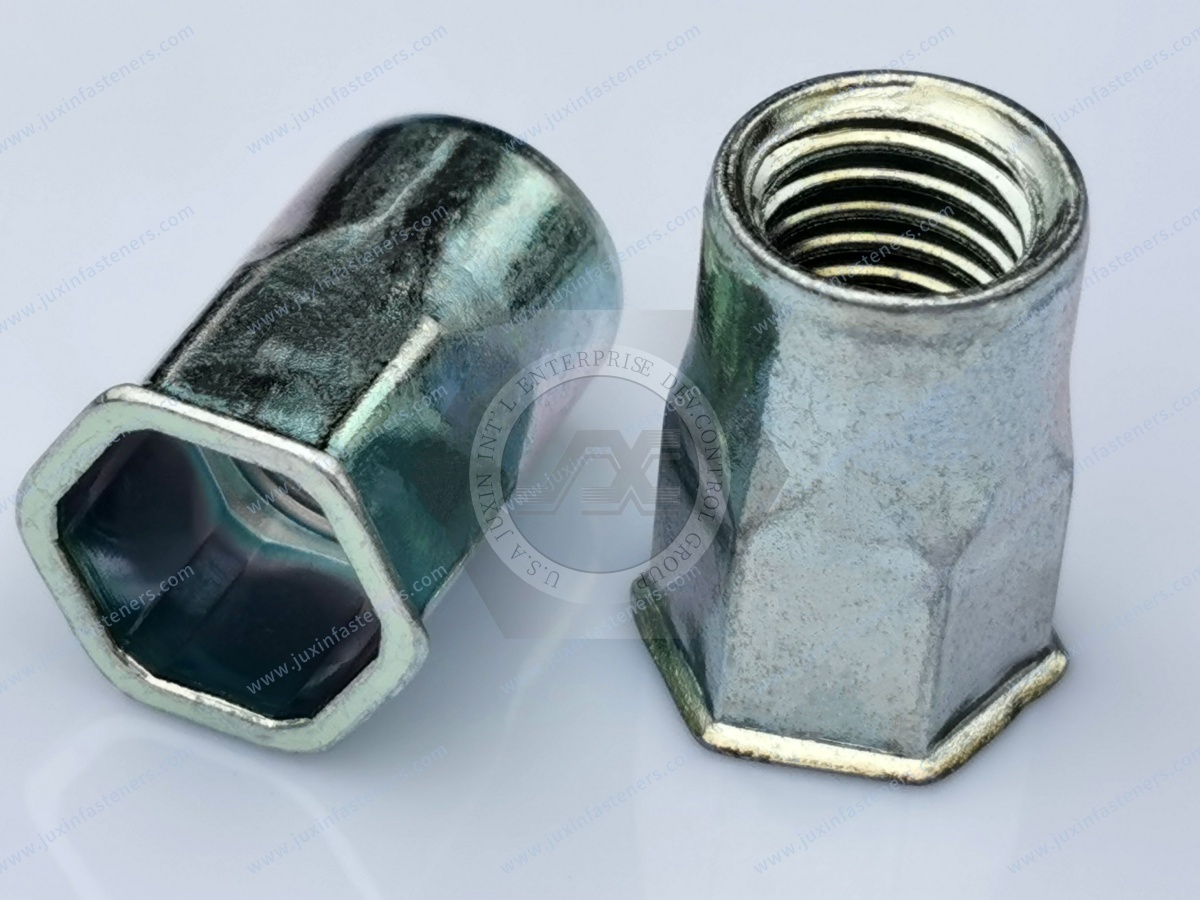
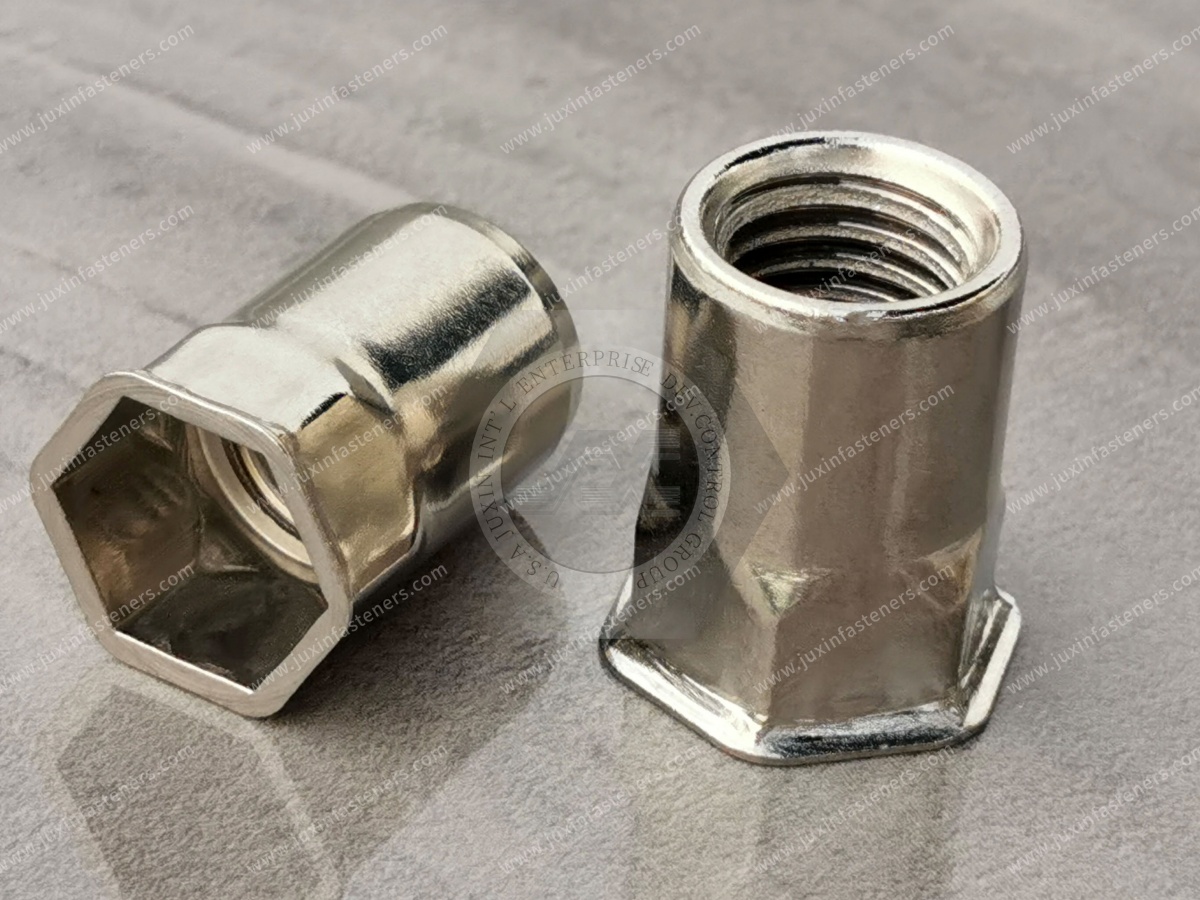
Also called a countersunk hex rivet nut, low-profile hex rivnut, hex body nutsert, or countersunk hex blind threaded insert,
this fastener creates a reusable internal thread in thin material using one-side installation.
JUXIN FASTENERS supplies steel, stainless steel and aluminum small countersunk hex rivet nuts,
together with custom blind threaded inserts for OEM applications in automotive and EV equipment, industrial machinery, electrical enclosures, transportation equipment, HVAC systems and fabricated sheet-metal assemblies.
The correct selection depends on the complete installed system:
Thread × Grip Range × Head Geometry × Hex Body × Hex Hole × Parent Material × Setting Process × Service Load
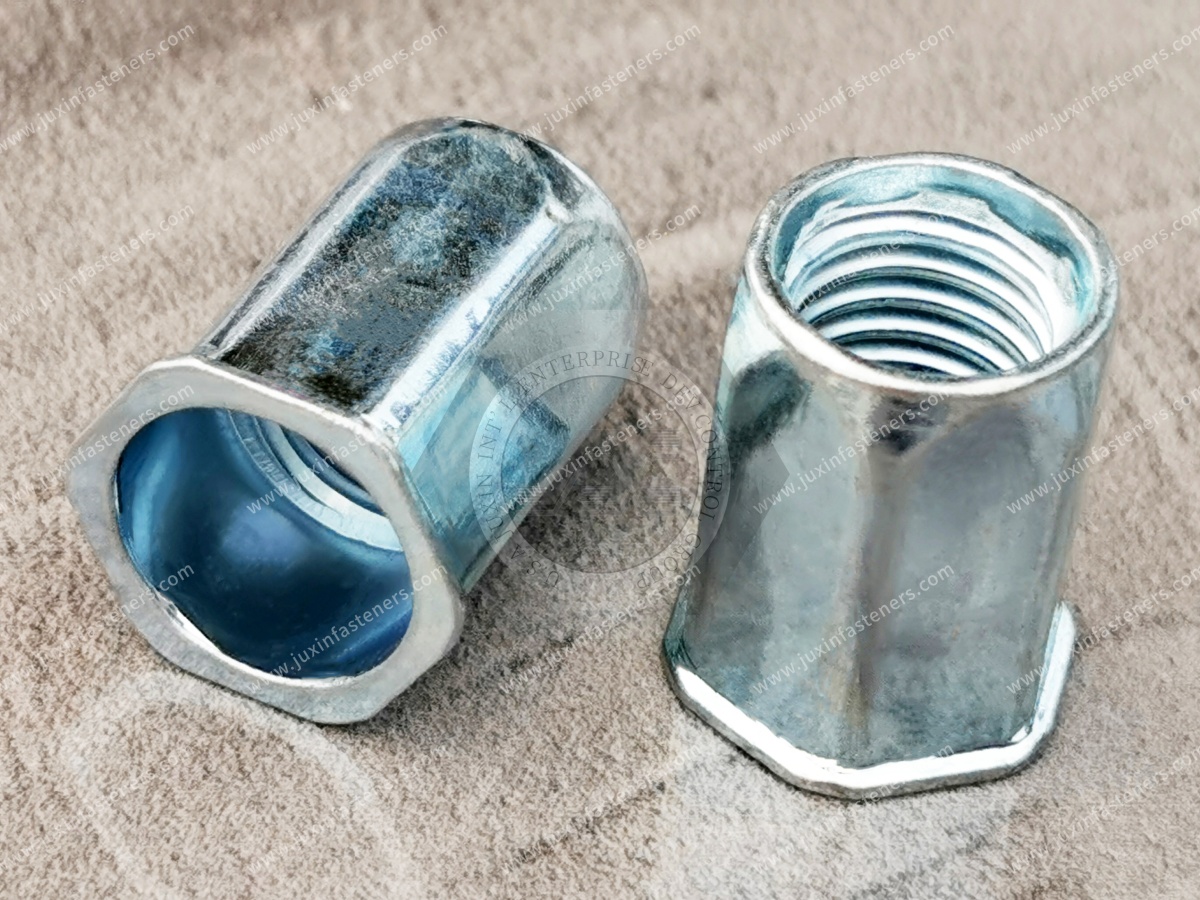
A small countersunk head hex rivet nut is an internally threaded blind fastener combining:
a reduced-profile or countersunk head at the front of the panel;
a hexagonal external body that fits a corresponding hex-shaped installation hole;
a deformation zone that forms behind the parent material during setting;
an internal machine thread for subsequent bolt installation.
The fastener is installed from one accessible side.
During setting, the deformable portion of the body collapses behind the panel, creating axial retention.
At the same time, the hexagonal section mechanically engages the prepared hex hole, providing rotational restraint.
The installed joint therefore uses three functional zones:
Head → Front-Side Support / Surface Interface
Collapsed Body → Axial Retention
Hex Body + Hex Hole → Rotational Retention
This distinction is fundamental to correct rivet nut selection.
The combination makes sense when the assembly needs both low projection and enhanced resistance to rotation.
For example, an enclosure may have very little clearance between an outer panel and a mating component. A large-flange rivet nut could interfere with the assembly.
At the same time, the threaded connection may be opened repeatedly for maintenance. Insert rotation would therefore be undesirable.
A small countersunk hex rivet nut can address both constraints.
But these features should not be confused:
A smaller head does not create anti-rotation.
A hex body does not create a flush surface.
They solve different engineering problems.
Not automatically.
This is one of the most important specification issues for this product family.
Commercial terminology such as:
small countersunk head;
reduced head;
low profile;
flush head;
does not always describe identical geometry across suppliers.
Actual installed projection depends on:
head diameter;
head thickness;
head profile;
panel preparation;
panel thickness;
countersink geometry where applicable;
installation setting.
Therefore:
Countersunk Name ≠ Guaranteed Zero Projection
If flushness is functionally important, specify a measurable maximum installed projection on the drawing.
For example, a requirement such as:
Installed head projection ≤ specified project limit
is more useful than simply stating:
“Flush rivet nut required.”
A round-body rivet nut installed in a round hole relies on a combination of:
friction;
body deformation;
knurling or external features;
clamping condition;
parent-material interaction.
A hex-body rivet nut introduces positive geometric engagement.
Its flats and corners fit into a corresponding hexagonal hole.
For the installed insert to rotate, the surrounding material must deform around that non-round geometry.
The basic relationship is:
Controlled Hex Hole + Matching Hex Body + Correct Setting = Mechanical Resistance to Rotation
This can make hex-body designs useful where repeated bolt installation or higher service torque challenges a conventional round-body insert.
This product is easiest to understand through a two-axis selection model.
| Requirement | Relevant Feature |
|---|---|
| Reduce front-side projection | Small countersunk / reduced head |
| Increase front bearing area | Larger flange |
| Increase geometric resistance to rotation | Hex body |
| Simplify hole production | Round body |
| Support blind installation | Rivet nut system |
| Match thin-panel thickness | Correct grip range |
This means engineers should not ask:
“Is a small countersunk hex rivet nut better?”
The useful question is:
“Does this joint require both reduced head projection and geometric anti-rotation?”
If only one requirement exists, another rivet nut design may be simpler and more economical.
Both designs can use a hex body for rotational resistance.
The primary difference is the head interface.
A standard or larger-flange hex rivet nut generally provides:
greater front-side bearing area;
more support around the installation hole;
greater head projection.
A small countersunk hex rivet nut generally provides:
lower surface projection;
reduced interference with mating components;
a smaller front-side bearing footprint.
Therefore:
Standard Hex Head → More Bearing Area
Small Countersunk Hex Head → Less Projection
The correct choice depends on the parent material and assembly envelope.
Both products can provide a low-profile front interface.
The difference is rotational retention.
A round-body design can be attractive because round holes are easier and often less expensive to manufacture.
A hex-body design requires a matching non-round hole but provides stronger geometric resistance to rotation.
A practical decision path is:
Is low projection required? → Yes
Then:
Is the rotational resistance of the selected round/knurled body sufficient?
If yes → a round low-profile rivet nut may be more economical.
If no → evaluate a hex-body low-profile rivet nut.
With this fastener, the installation hole performs a mechanical function.
It is not merely clearance for inserting the component.
The hole must provide sufficient dimensional compatibility with the hex body to permit installation while retaining meaningful geometric engagement.
An oversized hex hole can lead to:
rotational play;
reduced anti-rotation performance;
poor positioning;
inconsistent installation.
An undersized or distorted hole can cause:
difficult insertion;
coating damage;
fastener distortion;
poor head seating.
For this reason, the finished hex hole should be treated as a critical assembly feature.
An M6 internal thread does not define the external hex body.
Different rivet nut designs can have different:
across-flats dimensions;
corner geometry;
body lengths;
head diameters;
grip ranges.
Therefore:
M6 Thread ≠ Universal M6 Hex Hole
This is especially important when changing suppliers.
A replacement part should be checked against the existing production hole and complete drawing rather than approved solely because the thread designation matches.
The optimum manufacturing method depends on production conditions.
Possible processes include:
punching;
stamping;
laser cutting;
other controlled sheet-fabrication methods.
High-volume sheet-metal manufacturing may justify dedicated punching or stamping tooling.
Prototype and lower-volume production may use another appropriate fabrication method.
The objective is not to prescribe one process universally.
The objective is to produce a repeatable hole that meets the dimensional and edge-condition requirements of the selected rivet nut.
Hole burrs and distortion can interfere with proper seating.
Possible effects include:
head rocking;
visible gaps;
increased installed projection;
tilted inserts;
coating damage;
inconsistent setting.
Because this product is often selected specifically for a clean low-profile surface, poor hole quality can defeat the original design objective.
The production drawing should therefore address hole and burr requirements where surface condition is critical.
A hex body does not eliminate the normal grip-range requirements of a blind rivet nut.
Grip range identifies the parent-material thickness over which the rivet nut is intended to deform and clamp correctly.
Using the wrong grip range can result in:
incomplete backside formation;
excessive deformation;
reduced clamping;
poor head seating;
inconsistent rotational resistance;
panel damage.
Two rivet nuts can both be described as:
M6 Small Countersunk Hex Rivet Nut
while being designed for different panel thicknesses.
The complete specification must therefore include the required grip range.
Reducing head diameter or thickness improves clearance but reduces the available front-side bearing area.
This becomes important in:
thin aluminum;
soft steel;
plastics;
composites;
weak or flexible panels.
A small countersunk head may fit the assembly perfectly but provide less support around the hole than a larger flange.
The selection trade-off is:
Lower Projection ↔ Lower Front Bearing Area
For soft or very thin parent materials, prototype testing is important.
Hex rivet nuts are often selected because of rotational performance.
However, resistance to rotation and resistance to axial extraction are separate joint characteristics.
Torque-Out / Spin Resistance
evaluates resistance to rotation.
Pull-Out Resistance
evaluates resistance to axial extraction from the panel.
A hex body may significantly improve rotational retention while axial performance remains dependent on:
backside formation;
head support;
panel thickness;
parent-material strength;
grip range;
setting quality.
Therefore:
High Anti-Rotation ≠ Automatically High Pull-Out Strength
Both requirements should be evaluated where relevant.
A hex body can provide strong resistance to spinning, but every installed joint has mechanical limits.
Excessive bolt tightening can still cause:
thread stripping;
bolt failure;
panel deformation;
insert rotation;
backside deformation failure.
Final assembly torque should therefore be established for the complete joint.
Do not interpret the term anti-rotation rivet nut as permission to apply unrestricted tightening torque.
Steel is commonly used where mechanical strength, manufacturability and cost efficiency are important.
Possible applications include:
automotive assemblies;
machinery;
electrical enclosures;
HVAC equipment;
fabricated sheet-metal systems.
Surface treatments can include, depending on project requirements:
zinc plating;
zinc-nickel plating;
zinc-flake coating systems;
other specified finishes.
Coating selection should be based on required corrosion performance and OEM specifications.
Stainless steel can be selected where increased corrosion resistance is required.
Depending on product design and availability, materials can include:
304-type stainless steel;
316-type stainless steel.
Potential applications include:
outdoor equipment;
food-processing machinery;
chemical equipment;
transportation systems;
marine-related equipment.
However, stainless steel may require greater setting capability.
Before changing from plated steel or aluminum to stainless steel, verify compatibility with the production installation equipment.
Aluminum can be useful where:
weight reduction matters;
lower setting force is desirable;
the service load is compatible with the material.
Applications may include:
lightweight transportation equipment;
electronics;
aluminum fabricated assemblies;
commercial equipment.
Material selection should consider the complete load case rather than weight alone.
Potentially, but the application requires additional validation.
The hex geometry introduces corners into the parent-material interface, while the small head provides less front-side bearing area.
Possible substrate failure modes include:
cracking;
corner stress concentration;
local crushing;
creep;
pull-through;
hole deformation.
A configuration that performs well in sheet steel should not automatically be transferred to plastic or composite material.
For soft or brittle substrates, another rivet nut or threaded-insert technology may be more appropriate.
The rivet nut is retained axially by controlled deformation during installation.
Under-setting can cause:
weak backside formation;
low clamping;
possible rotation;
poor head seating.
Over-setting can cause:
thread distortion;
panel deformation;
body damage;
visible surface distortion.
For small countersunk designs, excessive setting can be especially undesirable because panel deformation can increase visible irregularity around the head.
The target is:
Repeatable Controlled Setting
not maximum installation force.
A common procurement substitution is:
Same Dimensions → Change Material
But changing from aluminum to steel or from steel to stainless steel can change the force required to set the rivet nut.
Therefore a material substitution should trigger review of:
installation equipment capacity;
setting parameters;
mandrel compatibility;
production consistency.
Dimensional interchangeability does not guarantee process interchangeability.
Small countersunk hex rivet nuts can be relevant where automotive assemblies combine:
thin sheet;
blind-side access;
restricted surface clearance;
repeated servicing;
anti-rotation requirements.
Potential applications include:
interior assemblies;
electrical equipment;
serviceable panels;
brackets;
selected battery enclosure components;
lightweight structures.
For EV battery systems, the fastener should be evaluated as part of the complete enclosure or component design. Sealing, corrosion,
electrical requirements and OEM validation remain separate engineering considerations.
Applications can include:
control cabinets;
switchgear housings;
industrial control panels;
power equipment;
electronic enclosures.
The combination of low projection and rotational stability can be useful where panels have limited clearance and covers are repeatedly removed for servicing.
Where environmental ingress is important, sealing must be evaluated separately. A small countersunk head does not inherently create a sealed joint.
Potential uses include:
machine covers;
protective guards;
automation enclosures;
access panels;
equipment frames.
Repeated maintenance can place rotational demands on blind threaded inserts.
A hex body can help resist spinning, while the low-profile head minimizes interference with adjacent machine components.
Fabricated sheet-metal equipment can use low-profile hex rivet nuts in:
service panels;
equipment housings;
control boxes;
ventilation equipment;
mounting brackets.
Where moisture or condensation is present, material and coating selection should be based on the operating environment.
Suitable transportation applications may include:
interior panels;
equipment cabinets;
lighting assemblies;
electrical equipment;
service covers;
fabricated brackets.
Rail projects can impose additional requirements involving:
vibration;
corrosion;
traceability;
maintenance;
project documentation;
fire and smoke requirements for associated non-metallic materials.
The applicable project specification should govern final selection.
Selected applications can include:
equipment enclosures;
network cabinets;
power-distribution equipment;
telecommunications housings.
A low-profile hex rivet nut may be useful where a permanent threaded insert is required and rotational stability matters.
However, equipment racks may also use cage nuts when replaceability and positional float are more important.
The engineering decision should compare:
Permanent Thread + Low Profile + Anti-Rotation
against:
Replaceability + Float + Field Serviceability
Use the following decision path.
Is blind-side installation required?
If no → evaluate conventional nuts, weld nuts, tapped threads or other systems.
If yes →
Is low head projection required?
If no → evaluate standard flange rivet nuts.
If yes →
Is enhanced anti-rotation also required?
If no → evaluate a suitable round or knurled low-profile rivet nut.
If yes →
Can the manufacturing process produce a controlled hex hole?
If yes → a small countersunk hex rivet nut becomes a logical candidate.
Then define:
Thread → Grip Range → Head Geometry → Hex Body → Hole Geometry → Material → Coating → Setting → Service Requirements
It may not be the most economical or technically appropriate solution when:
a round-hole rivet nut already provides sufficient torque resistance;
a large flange is needed for better bearing support;
the production process cannot economically produce controlled hex holes;
a replaceable cage nut is preferable;
welding is already integrated and a weld nut better suits the joint;
the substrate is poorly suited to the small-head/hex-hole combination.
More features do not automatically mean a better fastening system.
Depending on the application, define:
internal thread size;
thread pitch or TPI;
thread tolerance;
head diameter;
head thickness/profile;
permitted installed projection where critical;
full-hex or half-hex body configuration;
across-flats body dimension;
body length;
grip range;
installation-hole dimensions;
countersink or panel preparation where applicable;
material;
surface treatment;
dimensional tolerances;
burr requirements;
inspection requirements;
applicable international or customer specification.
Where anti-rotation is important, the hex installation hole should be controlled on the assembly drawing.
For efficient technical and commercial evaluation, provide:
drawing or existing part specification;
thread size and pitch/TPI;
head style;
required installed projection;
full-hex or half-hex body;
grip range;
panel material;
finished panel thickness;
hex-hole dimensions;
rivet nut material;
surface treatment;
corrosion requirement;
expected assembly torque where relevant;
application environment;
installation equipment;
prototype quantity;
production quantity;
annual demand;
inspection requirements;
documentation requirements;
packaging requirements.
An RFQ stating only:
“M6 Small Countersunk Hex Rivet Nut — 10,000 pcs”
does not fully define the component.
For this product family, loose-component inspection alone cannot confirm final application performance.
Depending on the project, validation can include:
dimensional inspection;
thread inspection;
head geometry;
hex-body dimensions;
installation-hole fit;
installed projection;
backside formation;
torque-out / spin resistance;
pull-out resistance;
final bolt assembly;
corrosion requirement.
Testing should use representative production material whenever possible.
A useful prototype test should reproduce:
Production Panel Material + Finished Thickness + Actual Hex Hole + Surface Finish + Rivet Nut + Setting Tool + Installation Parameters + Mating Bolt
This matters because the same fastener can perform differently when:
panel material changes;
panel thickness changes;
hole tolerance changes;
coating changes;
setting parameters change.
For low-profile applications, the prototype should also verify actual installed head projection.
For anti-rotation applications, it should verify the rotational behavior required by the joint.
Standard components should be evaluated first when they satisfy the design.
Custom manufacturing may be appropriate where the OEM requires:
special head diameter;
controlled installed projection;
special hex-body dimensions;
non-standard grip range;
unusual thread;
custom material;
special coating;
closed-end configuration;
restricted assembly envelope.
Custom development should start with the functional requirement rather than modifying dimensions without a defined engineering objective.
This page should occupy the specific search entity:
Small Countersunk Hex Rivet Nut → Low Profile + Anti-Rotation
Link upward to:
Blind Rivet Nut Selection Guide — Article 6
for general rivet nut selection.
Link laterally to:
Hex Rivet Nuts — Article 7
for applications where anti-rotation is the primary requirement.
Small Countersunk Rivet Nuts — Article 8
for applications where low-profile installation is the primary requirement.
Also connect to:
Knurled Rivet Nuts;
Large-Flange Rivet Nuts;
Closed-End Rivet Nuts;
Stainless Steel Rivet Nuts;
Aluminum Rivet Nuts;
Rivet Nuts for Plastic and Composite Materials.
Alternative fastening-system links should include:
Weld Nuts;
Cage Nuts;
Threaded Inserts;
Industrial Nut Selection Guide.
The cluster architecture becomes:
Blind Thread
→ General Selection — Article 6
→ Need Anti-Rotation — Article 7
→ Need Low Profile — Article 8
→ Need Both Low Profile + Anti-Rotation — Article 9
→ Product / Drawing / RFQ
This gives Article 9 a distinct search purpose instead of duplicating Articles 7 and 8.
JUXIN FASTENERS supports industrial OEM customers sourcing:
small countersunk hex rivet nuts;
low-profile hex rivnuts;
full-hex and half-hex rivet nut configurations;
steel hex rivet nuts;
stainless steel hex rivet nuts;
aluminum hex rivet nuts;
custom blind threaded inserts.
Project review can include:
drawing review;
thread requirements;
head geometry;
installed projection requirements;
grip range;
hex-body dimensions;
installation-hole requirements;
parent material;
material and coating requirements;
sample requirements;
manufacturing feasibility;
inspection requirements;
production quantities;
packaging requirements;
repeat OEM supply.
If your project requires a small countersunk hex rivet nut, low-profile hex rivnut, countersunk hex nutsert, stainless steel hex rivet nut,
anti-rotation blind threaded insert or custom rivet nut, send JUXIN FASTENERS your drawing or application requirements for review.
For faster evaluation, provide:
Thread + Panel Material + Finished Thickness + Grip Range + Hex Hole + Head / Projection Requirement + Body Style + Material + Surface Treatment + Quantity
If the current assembly has either a rivet nut spinning problem or excessive head projection, provide the existing fastener dimensions,
production hole information and assembly requirements. This allows the fastening system to be reviewed around the actual engineering problem instead of simply replacing one rivet nut with another.
JUXIN FASTENERS
Website: www.juxinfasteners.com
Email: info@juxinfasteners.com
Contact Us
Tel.:
+86 020 8621 0320
+86 020 3121 6067
E-mail:
Technical Support:
Navigation
SEND INQUIREY