
Call Us
+86 136 6007 9809
Call Us
+86 136 6007 9809

Jun. 10, 2024
Fasteners for Hazardous Area Equipment: ISO Bolts, Socket Screws and OEM Sourcing
Industrial equipment installed in potentially explosive atmospheres requires carefully specified mechanical components, including bolts, screws, nuts and other threaded fasteners.
These applications are found in oil and gas facilities, chemical processing plants, mining operations and industrial installations where flammable gases, vapors or combustible dust may be present.
For original equipment manufacturers, fastener selection involves more than choosing a corrosion-resistant material or a high-strength bolt.
The correct component must match its intended mechanical function, mating structure, installation process and the requirements of the approved equipment design.
A standard hexagon bolt may be suitable for an external equipment mounting bracket. A socket head cap screw may be specified for an enclosure cover.
A socket set screw may secure an internal shaft-mounted component.
However, these fasteners are not interchangeable simply because they have similar nominal dimensions or are installed on the same machine.
The most important distinction is whether the fastener is part of a critical explosion-protection assembly or serves an ordinary structural or auxiliary function.
JUXIN FASTENERS supplies industrial bolts, screws, nuts and drawing-based OEM fastening components for international equipment manufacturers.
This guide explains how to select and source standard and customized fasteners for hazardous-area equipment while maintaining the necessary
distinction between fastener specifications and equipment-level explosion-protection requirements.
Understanding Fastener Requirements in Hazardous-Area Equipment
Equipment used in hazardous areas may employ different explosion-protection concepts.
Examples under the IEC 60079 series include:
Ex d: flameproof enclosure protection
Ex e: increased safety
Ex i: intrinsic safety
Ex p: pressurization
Ex t: protection by enclosure for explosive dust atmospheres
Each concept has its own equipment construction and protection requirements.
Important Engineering Distinction
Not every fastener installed in explosion-protected equipment performs the same safety function.
A bolt securing a certified flameproof enclosure cover may be subject to specific approved construction requirements.
A screw securing a noncritical internal bracket may have different requirements.
The equipment manufacturer must identify the fastener's function before establishing its specification.
Critical Fasteners vs. Auxiliary Fasteners
A practical OEM purchasing specification should distinguish at least two categories.
Fasteners Affecting the Explosion-Protection Construction
These may include certain enclosure cover screws, structural fastening components or other fasteners identified in the approved design.
Their replacement, modification and qualification must follow the applicable equipment requirements.
Auxiliary Equipment Fasteners
These may include suitable fasteners for:
Internal mounting brackets
Cable management components
Noncritical equipment supports
Instrument mounting accessories
External mechanical attachments
These components must still meet their mechanical and environmental requirements, but they should not automatically be described as certified explosion-protection fasteners.
Why This Classification Matters
The classification determines how drawings, material specifications, inspection requirements and supplier changes should be controlled.
International Standards for Industrial Fasteners
Industrial fastener specifications often reference ISO or DIN product standards.
These standards may define dimensions, product characteristics or mechanical-property requirements.
They do not independently establish that a fastener is approved for a particular explosion-protected enclosure.
Relevant Fastener Standards
| Standard | Fastener type | Typical sourcing purpose |
|---|---|---|
| ISO 4014 | Hexagon head bolts with partially threaded shanks | Standardized hex bolt geometry |
| ISO 4017 | Hexagon head screws with full-length threads | Standardized fully threaded hex screws |
| ISO 4016 | Hexagon head bolts, product grade C | Applications specifically permitting that dimensional grade |
| ISO 4762 | Hexagon socket head cap screws | Compact tool-operated screw arrangements |
| ISO 4026 | Hexagon socket set screws with flat points | Positioning or retaining applications |
| ISO 4027 | Hexagon socket set screws with cone points | Point-contact retaining applications |
| ISO 4028 | Hexagon socket set screws with dog points | Locating or retaining applications |
| ISO 4029 | Hexagon socket set screws with cup points | Selected shaft or component retention |
Legacy DIN designations may appear on existing OEM drawings.
For example, DIN 912 is commonly associated with the ISO 4762 socket head cap screw family.
DIN 931 and DIN 933 are frequently encountered in specifications for hexagon head bolts and screws.
Procurement Recommendation
When replacing a legacy DIN part with an ISO-designated component, confirm the applicable edition, dimensions, tolerances, material and other specified characteristics.
Do not assume complete interchangeability from the standard designation alone.
Hexagon Head Bolts for Industrial Equipment
Hexagon head bolts are used in a wide range of mechanical fastening applications.
Potential uses include:
Equipment support structures
Machinery mounting assemblies
External brackets
Mechanical frames
Selected approved enclosure assemblies
Their suitability depends on the actual joint.
ISO 4014 Hexagon Head Bolts
ISO 4014 specifies hexagon head bolts with partially threaded shanks.
A partially threaded bolt may be appropriate when the joint design benefits from a defined unthreaded shank region.
Engineering Considerations
Grip length
Threaded length
Hole clearance
Bearing surface
Mechanical loading
Nut or tapped-hole compatibility
ISO 4017 Hexagon Head Screws
ISO 4017 covers fully threaded hexagon head screws.
These may be selected where full-length threading is required by the assembly design.
Important Distinction
A fully threaded screw and a partially threaded bolt are not always functionally equivalent.
The unthreaded shank, grip length and location of the threads can influence joint behavior.
ISO 4016 Product Grade C Bolts
ISO 4016 specifies hexagon head bolts of product grade C.
Product grade C concerns dimensional characteristics and should not be confused with a mechanical strength class.
Engineering Recommendation
Use the product grade specified on the approved drawing.
A different dimensional grade should not be substituted without checking the complete fit and functional requirements.
Socket Head Cap Screws for Compact Assemblies
ISO 4762 socket head cap screws use an internal hexagon drive.
They may be useful where:
External wrench clearance is limited
Compact head geometry is required
Controlled tool access is desirable
The assembly specifies socket-driven installation
Potential applications include industrial instrumentation housings, machinery brackets and selected electrical equipment assemblies.
Important Limitation
A socket head cap screw does not inherently provide superior resistance to vibration-induced loosening merely because it has an internal hexagon drive.
Loosening resistance depends on the complete joint, including clamp load, loading conditions and any approved retention features.
Socket Set Screws for Positioning and Retention
Socket set screws are different from conventional bolts used to clamp two structural members together.
They are commonly used to position or retain components through localized contact.
Examples include:
Shaft-mounted collars
Mechanical adjustment components
Selected coupling arrangements
Equipment positioning mechanisms
ISO 4026 Flat Point Set Screws
Flat point set screws provide a relatively flat contact geometry.
Their suitability depends on the mating component and the required retention method.
ISO 4027 Cone Point Set Screws
Cone point screws create concentrated contact and may be used in selected positioning or retention applications.
The mating surface must be evaluated for potential indentation or damage.
ISO 4028 Dog Point Set Screws
Dog point screws incorporate a projecting cylindrical point.
They may be used with a corresponding locating feature where specified.
ISO 4029 Cup Point Set Screws
Cup point screws provide a defined contact geometry for selected retention applications.
Their performance depends on the mating material and assembly conditions.
Critical Application Restriction
Set screws should not be presented as substitutes for approved structural cover bolts in flameproof enclosures.
Their typical mechanical function is different.
Tool-Operated Fasteners and Equipment Access
Certain explosion-protection concepts and equipment constructions impose requirements concerning fastener access or the use of tools.
These requirements must be determined from the applicable standard and approved equipment design.
Possible tool-operated fastener configurations include:
External hexagon drives
Internal hexagon drives
Other specified screw drive systems
Important Distinction
A screw is not automatically suitable for explosion-protected equipment simply because a tool is needed to remove it.
The complete fastener and enclosure arrangement must meet the applicable requirements.
Fastener Material Selection
Material selection depends on the mechanical and environmental requirements of the equipment.
Potential materials include:
Carbon steel
Alloy steel
Austenitic stainless steel
Other specified engineering alloys
Carbon Steel and Alloy Steel
These materials may be suitable for applications requiring defined mechanical properties.
ISO 898-1 provides relevant mechanical-property requirements for applicable carbon steel and alloy steel bolts, screws and studs.
The required property class must be established by the equipment design.
Stainless Steel Fasteners
Stainless steel may be selected where corrosion resistance is important.
Common designations include:
A2 stainless steel
A4 stainless steel
These designations are associated with the ISO 3506 fastener material and mechanical-property system.
They should not be treated as exact substitutes for all specifications referring to stainless steel 304 or 316 without checking the relevant requirements.
Material Selection Considerations
Required mechanical properties
Exposure environment
Temperature
Mating materials
Thread galling risk
Surface condition
Approved equipment specifications
Why Material Substitution Requires Review
A stainless steel screw and a high-strength alloy steel screw may differ significantly in mechanical properties.
Changing from one material to another can also affect installation friction and corrosion behavior.
Engineering Recommendation
Use the material and property class required by the drawing.
Do not substitute a material solely because it appears more corrosion resistant.
Corrosion Protection and Surface Treatments
Industrial equipment may operate in environments involving:
Humidity
Salt-containing atmospheres
Chemical exposure
Outdoor weathering
Temperature variation
Potential fastener surface treatments include:
Zinc plating
Zinc-nickel plating
Zinc-flake coating systems
Black oxide
Nickel plating
Selected application-specific coatings
Not every coating is appropriate for every fastener or equipment application.
Coating Selection Factors
Corrosion requirements
Base material
Thread fit
Friction characteristics
Temperature
Chemical exposure
Mating component compatibility
Important Procurement Principle
A coating change can affect more than appearance.
It may change friction, assembly torque, thread fit or corrosion performance.
For fasteners forming part of approved explosion-protection construction, coating changes require the appropriate technical review.
Salt Spray Testing
Neutral salt spray testing may be specified according to ISO 9227 or another applicable customer-approved method.
However, a salt spray duration is not a universal prediction of real-world service life.
The test conditions, acceptance criteria and required documentation must be defined in the purchase specification.
Engineering Recommendation
Request a clearly defined coating specification rather than relying on a general statement such as "high corrosion resistance."
Thread Design and Dimensional Compatibility
Thread selection affects:
Mechanical engagement
Installation
Assembly interchangeability
Maintenance
Supply-chain consistency
Metric Threads
ISO metric threads may be specified using relevant ISO thread standards.
For example:
ISO 261 covers general-purpose metric thread series.
ISO 965 covers applicable metric thread tolerances.
Common tolerance designations such as 6g for external threads and 6H for internal threads may appear on drawings.
However, these are not universal requirements for all equipment fasteners.
Unified Inch Threads
UNC and UNF threads may be specified under ASME B1.1.
These are separate thread systems from ISO metric threads.
Important Compatibility Rule
Metric, UNC, UNF, BSW and BSF threads must not be treated as directly interchangeable.
A similar nominal diameter does not establish compatibility.
Custom Threads
Drawing-based threads may be evaluated where standard products do not meet the customer's design.
The drawing should define:
Thread form
Nominal diameter
Pitch or threads per inch
Tolerance
Thread length
Inspection requirements
Thread Engagement and Mating Materials
The correct thread engagement depends on the complete joint.
Relevant factors include:
Fastener strength
Internal-thread material
Thread diameter
Pitch
Loading
Hole geometry
Engagement length
Steel Housing Threads
Steel internal threads may have different load-carrying characteristics from aluminum threads.
Aluminum Housing Threads
Aluminum housings may require particular attention to internal-thread strength and repeated service.
Blind Tapped Holes
Blind-hole assemblies must account for screw penetration, usable thread depth and bottom clearance.
Engineering Recommendation
Do not use bolt tensile strength as the sole basis for evaluating a tapped-hole connection.
Fastener Installation and Production-Line Compatibility
Production managers must consider how the selected fastener performs during repeated assembly operations.
Important factors include:
Tool access
Fastener feeding
Drive engagement
Installation torque
Thread alignment
Cross-threading risk
Part identification
Inspection accessibility
Socket-Driven Assembly
Internal hexagon screws require suitable tooling and engagement.
Incorrect tools or damaged drives can cause installation and maintenance problems.
Hexagon Head Assembly
External hexagon heads may offer convenient wrench access where adequate clearance is available.
Set Screw Installation
Set screws may require particular attention to contact position and tightening requirements.
Production Recommendation
Choose fastener geometry in coordination with the actual assembly equipment and work instructions.
Vibration and Anti-Loosening Design
Hazardous-area equipment may experience vibration from motors, pumps, compressors or machinery.
Potential joint concerns include:
Loss of clamp load
Relative movement
Fastener rotation
Thread wear
Fatigue
Possible retention approaches in suitable applications include:
Prevailing-torque fasteners
Approved locking devices
Thread-locking materials
Appropriate joint preload and design
Important Limitation
No locking feature should be assumed suitable for every joint.
For fasteners affecting certified enclosure construction, only the approved retention method should be used.
Quality Control for OEM Fasteners
The appropriate inspection plan depends on the drawing and purchase specification.
Potential inspection characteristics include:
Material identification
Dimensional conformance
Thread gauges
Head geometry
Screw length
Mechanical properties
Surface finish
Visual condition
Additional testing or documentation may be required for particular projects.
Important Quality Distinction
A fastener meeting ISO dimensional and mechanical-property requirements is not automatically qualified for a certified explosion-protected assembly.
Equipment-level conformity remains a separate requirement.
Incoming Inspection vs. Functional Qualification
These activities serve different purposes.
Incoming Inspection
Confirms specified fastener characteristics.
Functional Qualification
Evaluates the component within its intended equipment assembly.
Engineering Recommendation
Where the fastener performs a critical equipment function, define the relevant assembly-level validation and approval requirements.
Supplier Qualification for Hazardous-Area Equipment Fasteners
A structured sourcing process should address three areas.
Technical Conformance
Correct standard or approved drawing
Material and mechanical properties
Thread specification
Surface finish
Dimensional tolerances
Inspection requirements
Manufacturing Compatibility
Installation method
Tooling
Mating materials
Assembly repeatability
Packaging and handling
Commercial Supply
MOQ
Sample requirements
Initial order volume
Annual forecast
Lead time
Delivery schedule
Supplier change control
Second-Source Development
A second supplier may offer commercial benefits, but fastener substitutions require careful technical comparison.
Potential Differences
Head geometry
Thread length
Mechanical properties
Coating
Friction
Dimensional tolerances
Procurement Recommendation
Approve replacement parts against the actual drawing and equipment requirements rather than relying only on nominal size or catalog descriptions.
OEM Custom Fastener Development
Standard ISO and DIN fasteners may not meet every equipment design.
Drawing-based components may require:
Special head geometry
Nonstandard length
Modified shank
Specific thread configuration
Selected material
Defined surface finish
Application-specific tolerances
Custom Fastener RFQ Requirements
Provide:
2D drawing or 3D model
Material specification
Thread details
Mechanical-property requirements
Surface treatment
Critical dimensions
Inspection requirements
Expected annual volume
For equipment used in hazardous areas, identify whether the fastener forms part of the approved explosion-protection construction.

Industrial Applications
Oil and Gas Equipment
Potential fastening applications include:
Industrial instrumentation housings
Mechanical equipment supports
Hazardous-area electrical equipment
Control-system mounting components
Chemical Processing Equipment
Relevant requirements may include corrosion resistance, mechanical strength and equipment-specific approval constraints.
Mining Equipment
Applications may involve equipment mounting, mechanical retention and explosion-protected electrical assemblies.
Industrial Automation
Fasteners may be used in control equipment, machinery brackets and selected equipment housings.
Energy and Power Equipment
Industrial fasteners may be required for power conversion equipment, mechanical support structures and electrical enclosures.
Important Application Distinction
A solar inverter cabinet or battery energy storage enclosure is not automatically explosion-protected equipment.
The applicable equipment classification and protection concept must be confirmed.
Common Fastener Sourcing and Assembly Problems
| Problem | Potential cause | Engineering or purchasing action |
|---|---|---|
| Incorrect bolt selected | Standard designation mismatch | Check drawing and applicable edition |
| Screw bottoms in tapped hole | Excessive length | Review hole depth and penetration |
| Thread stripping | Inadequate engagement | Review mating material and thread design |
| Corrosion | Unsuitable finish | Specify exposure and coating requirements |
| Installation inconsistency | Friction or tool variation | Validate assembly procedure |
| Fastener loosening | Joint design or preload issue | Review complete joint |
| Supplier replacement fails | Material or geometry difference | Perform technical equivalence review |
| Assembly delays | Inconsistent part identification | Improve packaging and traceability |
| Critical part changed without approval | Inadequate change control | Apply equipment approval requirements |
Frequently Asked Questions
What fasteners are used in hazardous-area equipment?
Depending on the equipment design, components may include hexagon bolts, socket head cap screws, set screws, nuts, washers and custom fastening parts.
Are standard ISO bolts automatically approved for explosion-proof equipment?
No. ISO fastener standards and equipment explosion-protection requirements serve different purposes.
What is the difference between ISO 4014 and ISO 4017?
ISO 4014 covers partially threaded hexagon head bolts, while ISO 4017 covers fully threaded hexagon head screws.
Are socket head cap screws suitable for Ex d enclosures?
They may be suitable where specified by the approved equipment design. Their suitability cannot be determined from head style alone.
Can set screws replace enclosure cover bolts?
Not as a general substitution. Their mechanical function and application requirements differ.
Are stainless steel screws always better than alloy steel screws?
No. Selection depends on required mechanical properties, corrosion environment and approved specifications.
Can metric screws replace UNC or UNF screws?
No. The thread systems are different and should not be treated as directly interchangeable.
Does zinc-nickel plating automatically make a fastener suitable for offshore equipment?
No. Corrosion performance depends on the coating specification, environment and complete assembly.
What should an OEM buyer provide for a custom fastener quotation?
A drawing, material, thread specification, mechanical requirements, surface finish, quality requirements and purchasing volume.
Can JUXIN FASTENERS review custom fastener drawings for industrial equipment?
Yes. Customers may submit their drawings and application requirements for technical feasibility and quotation review.
JUXIN FASTENERS: Standard and Custom Industrial Fasteners
JUXIN FASTENERS supplies industrial fastening components for international OEM manufacturing and equipment assembly.
Relevant product families include:
Hexagon head bolts
Fully threaded hexagon screws
Socket head cap screws
Socket set screws
Stainless steel fasteners
Carbon steel and alloy steel fasteners
Hex nuts and locking nuts
Washers
Studs
Drawing-based custom bolts and screws
For hazardous-area equipment, customers should identify the applicable equipment protection concept and approved fastener specification.
Material, finish, dimensional requirements and production feasibility can then be reviewed against the submitted technical documents.
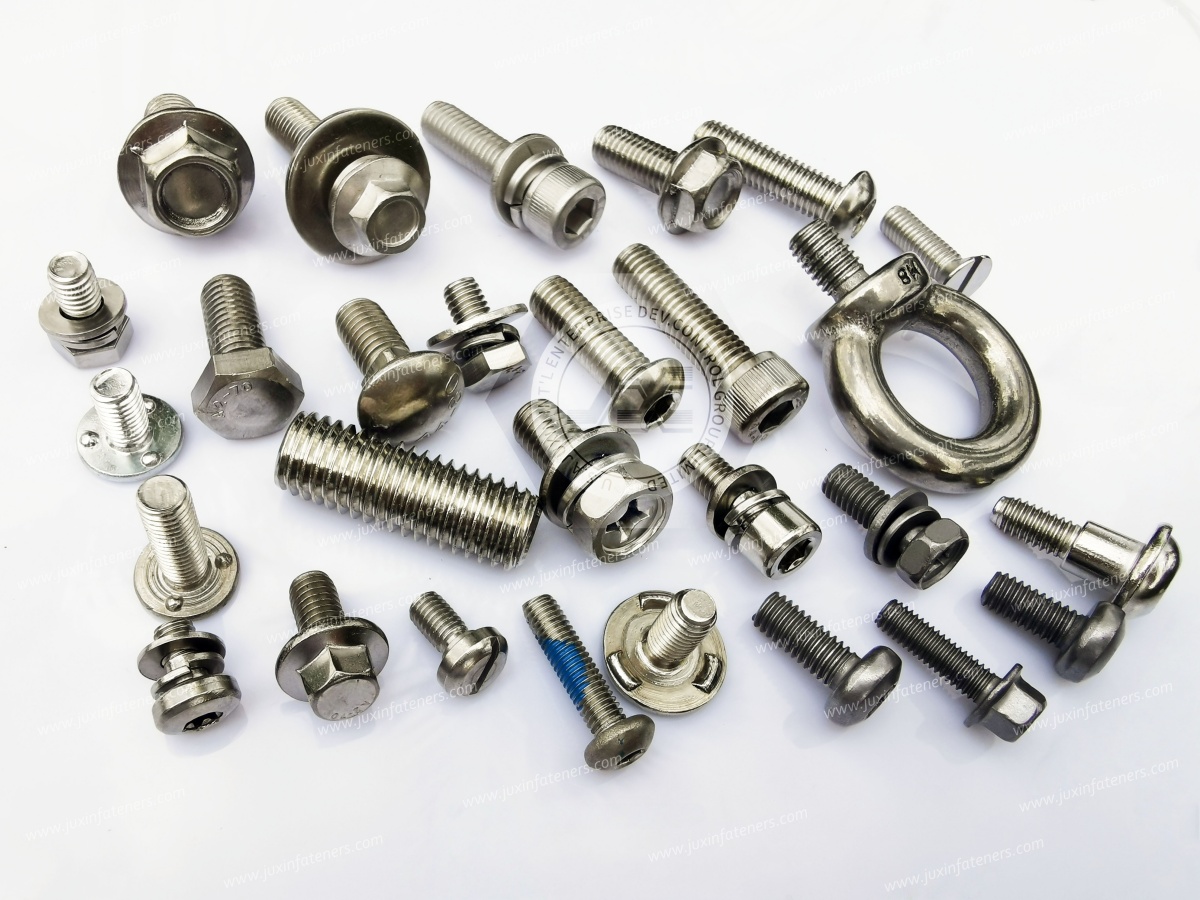
Request an OEM Fastener Drawing Review and RFQ
Are you sourcing ISO hexagon bolts, socket head cap screws, set screws or custom threaded components for industrial equipment?
JUXIN FASTENERS welcomes inquiries from OEM manufacturers, mechanical engineers, production teams, procurement specialists and supplier-development departments.
For an efficient technical and commercial review, send:
Fastener drawing or standard designation + material and property class + thread specification + surface finish + application requirements + annual purchasing volume
If the component is intended for certified explosion-protected equipment, include the approved fastener requirements and relevant equipment information.
JUXIN FASTENERS can review the submitted specifications and discuss suitable standard or drawing-based fastening options.
Final equipment conformity, approval of critical component substitutions and compliance with applicable explosion-protection requirements remain the responsibility
of the equipment manufacturer and relevant approval process.
Company: JUXIN FASTENERS
Website: https://www.juxinfasteners.com/
Email: info@juxinfasteners.com
Send your industrial fastener drawings and OEM RFQ requirements to JUXIN FASTENERS for technical evaluation and quotation.
Contact Us
Tel.:
+86 020 8621 0320
+86 020 3121 6067
E-mail:
Technical Support:
Navigation
SEND INQUIREY



