
Call Us
+86 136 6007 9809
Call Us
+86 136 6007 9809

Jun. 11, 2024
Stainless Steel Weld Nuts: DIN 928, DIN 929, Welding Design and OEM Sourcing
Stainless steel weld nuts are used to create permanent threaded attachment points in welded metal assemblies where corrosion resistance,
mechanical reliability and repeatable production are important.
Unlike a loose nut installed during final assembly, a weld nut is attached to a metal component before the mating bolt or screw is installed.
This approach can simplify subsequent assembly, particularly when access to the rear side of a panel is restricted.
However, successful weld nut selection requires more than choosing a stainless steel grade and nominal thread diameter.
The nut geometry, base material, welding process, sheet thickness, thread condition and final joint loading must be considered together.
For design engineers, the priority is developing a reliable threaded connection.
For manufacturing engineers and production managers, the challenge is achieving repeatable weld quality without damaging the internal thread.
For procurement and supplier-development teams, the objective is sourcing weld nuts with consistent geometry, appropriate materials and clearly defined quality requirements.
JUXIN FASTENERS supplies industrial weld nuts and drawing-based OEM fastening components for international manufacturing applications.
This guide focuses specifically on stainless steel weld nuts, including DIN 928 square weld nuts, DIN 929 hexagonal weld nuts and custom welded threaded components.
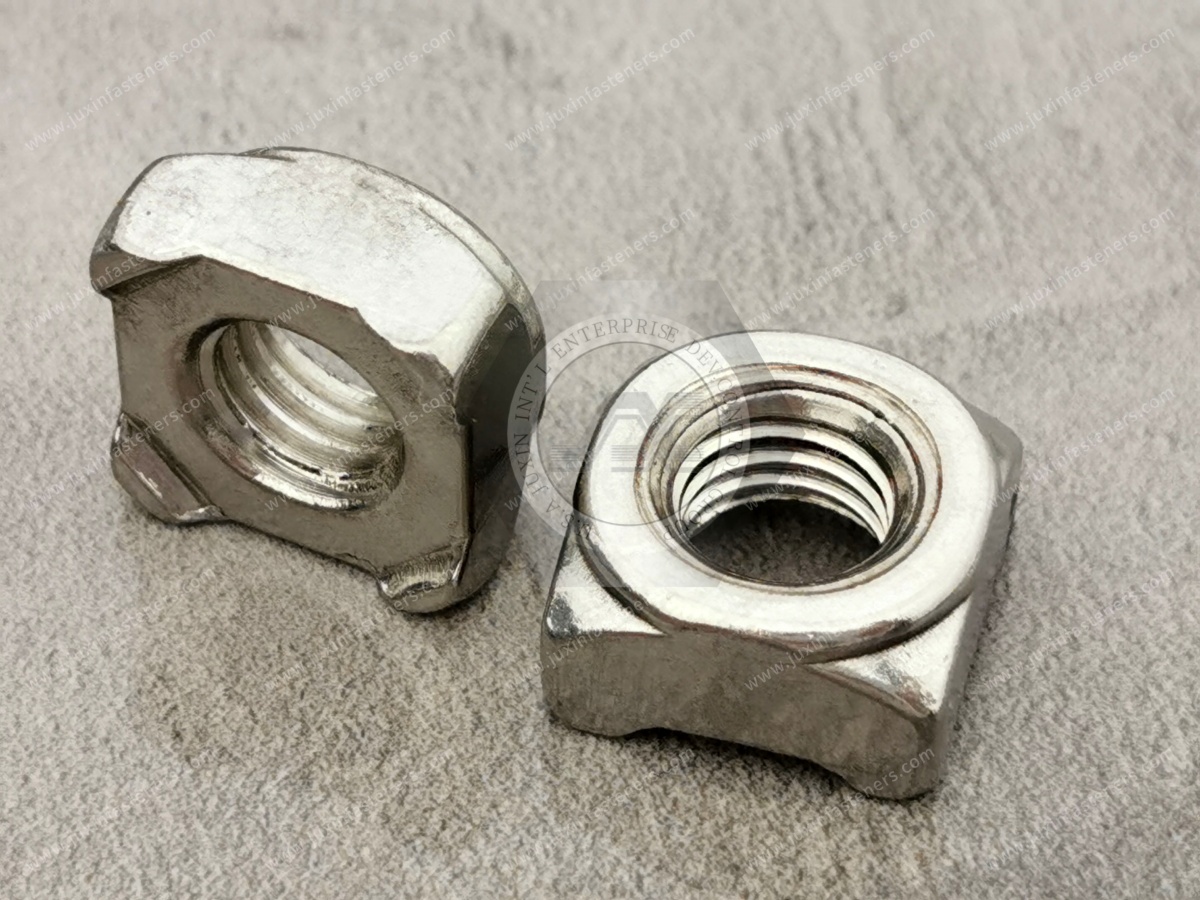
What Is a Stainless Steel Weld Nut?
A stainless steel weld nut is an internally threaded fastener designed to be attached to a suitable metal component through a welding process.
Once installed, it provides a fixed threaded connection for a mating bolt or screw.
Typical assembly arrangements may include:
Weld nuts attached to sheet metal panels
Weld nuts installed on fabricated brackets
Weld nuts incorporated into metal equipment housings
Welded threaded attachments in suitable machinery structures
The nut is generally installed during fabrication, while the mating bolt is installed during a later assembly operation.
Important Engineering Distinction
A welded nut does not automatically provide a stronger connection than every alternative fastening method.
Its performance depends on the weld, base material, thread engagement and joint design.
Why Use Stainless Steel Weld Nuts?
Stainless steel weld nuts may be considered where the assembly requires a combination of:
Corrosion resistance
Permanent nut positioning
Repeatable threaded attachment
Suitable mechanical properties
Reduced need for rear-side access during final assembly
These benefits depend on the specific material and installation process.
When Stainless Steel Weld Nuts Are Not the Best Choice
A stainless steel weld nut may be unsuitable when:
The base material cannot be welded using the proposed process
The assembly cannot tolerate welding heat or distortion
The joint requires a removable nut
The welding process cannot be controlled consistently
The application requires a different material or joining method
Alternative fastening methods may include self-clinching nuts, blind rivet nuts, threaded inserts or conventional bolt-and-nut connections.
The appropriate choice depends on the base material, access conditions, required strength and manufacturing sequence.
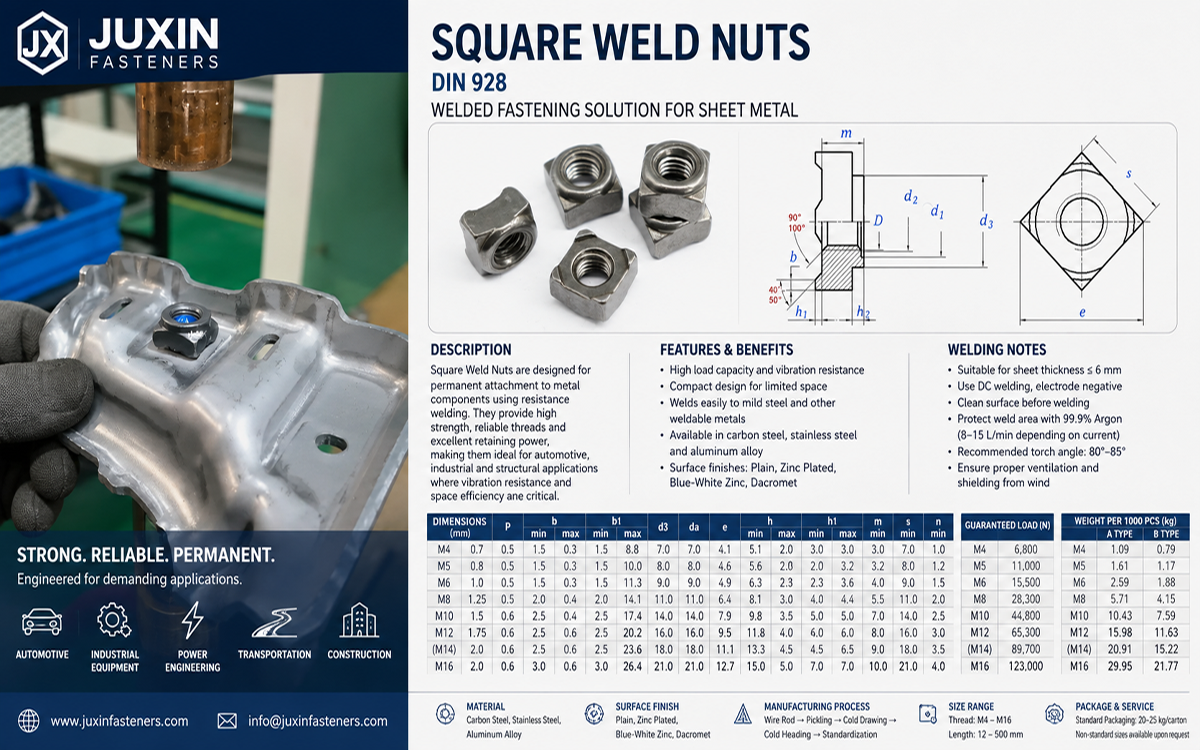
DIN 928 Square Weld Nuts
DIN 928 identifies a standardized family of square weld nuts.
These components are commonly specified for welded threaded connections in suitable metal assemblies.
Engineering Characteristics
Square body geometry
Defined threaded connection
Welding features associated with the specified design
Potential compatibility with suitable resistance projection welding processes
The actual welding configuration must be confirmed from the product drawing and applicable standard.
Potential Applications
Industrial sheet metal fabrication
Machinery brackets
Equipment housings
Metal support structures
Selected appliance assemblies
Design Considerations
Engineers should review:
Nut dimensions
Thread designation
Projection geometry
Base material
Sheet thickness
Welding access
Required joint loading
Important Limitation
The square shape alone does not establish superior torque resistance.
The completed welded joint must be evaluated.
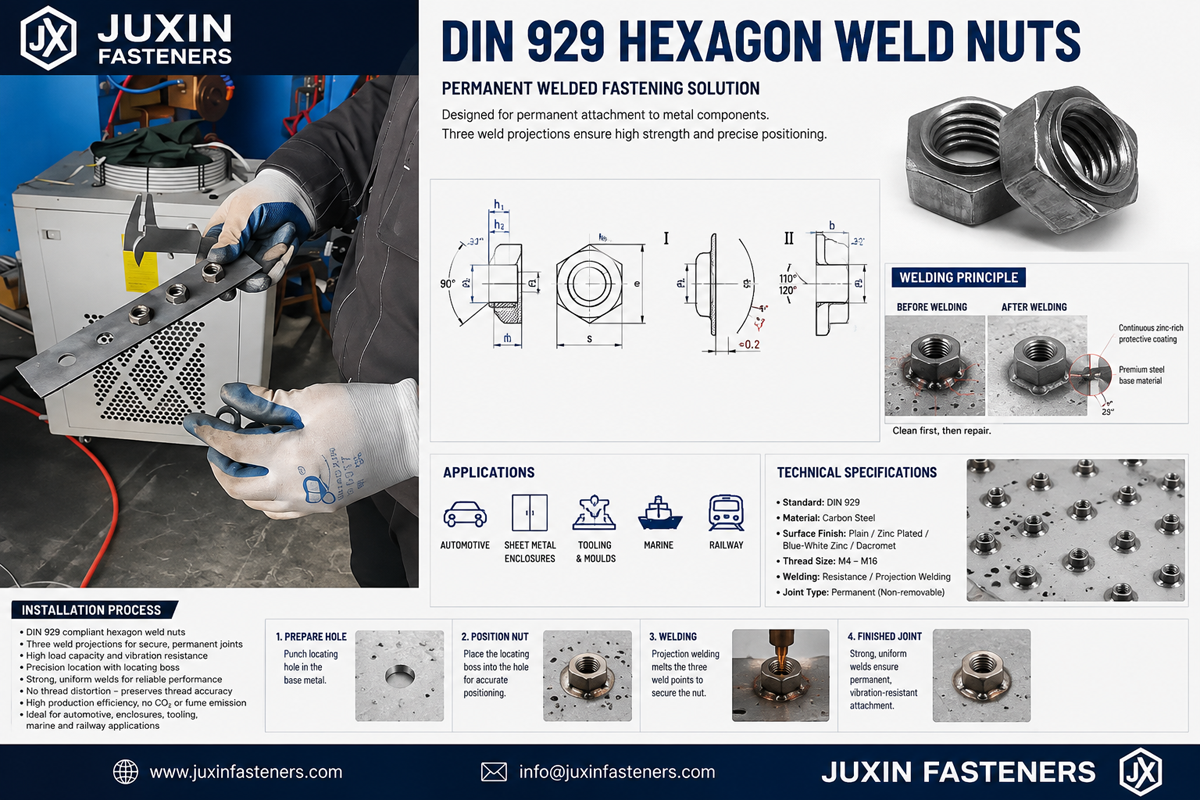
DIN 929 Hexagonal Weld Nuts
DIN 929 identifies a standardized family of hexagonal weld nuts.
Hexagonal weld nuts are used where the approved design specifies this geometry and a suitable welding arrangement.
Engineering Characteristics
Hexagonal body
Internal machine thread
Defined welding features
Compatibility with selected welding processes when properly specified
Potential Applications
Metal equipment structures
Sheet metal assemblies
Industrial enclosures
Fabricated machinery components
Selected automotive or appliance assemblies
DIN 928 vs. DIN 929: Selection Comparison
| Selection factor | DIN 928 square weld nut | DIN 929 hexagonal weld nut |
|---|---|---|
| Body geometry | Square | Hexagonal |
| Primary specification | DIN 928 | DIN 929 |
| Installation | Requires a validated welding process | Requires a validated welding process |
| Base-material suitability | Must be confirmed | Must be confirmed |
| Joint strength | Depends on weld and assembly | Depends on weld and assembly |
| OEM selection | Based on drawing, space and process | Based on drawing, space and process |
Engineering Recommendation
Do not assume that DIN 928 and DIN 929 weld nuts are directly interchangeable.
Their geometry, welding features and installation conditions differ.
304 Stainless Steel Weld Nuts
Type 304 stainless steel is an austenitic stainless steel widely used in industrial equipment.
It may be selected for weld nut applications requiring corrosion resistance in suitable environments.
Potential Applications
Indoor industrial equipment
Selected food-processing machinery
Appliance components
Stainless steel fabricated structures
Equipment housings
Engineering Considerations
Exposure environment
Base-material compatibility
Welding behavior
Mechanical requirements
Post-weld surface condition
Important Limitation
304 stainless steel is not universally resistant to chloride-containing environments or all industrial chemicals.
316 Stainless Steel Weld Nuts
Type 316 stainless steel contains molybdenum and generally offers improved resistance to certain chloride-related corrosion conditions compared with 304 stainless steel.
It may be considered for suitable applications involving:
Coastal equipment
Certain chemical processing environments
Outdoor industrial equipment
Selected marine-related machinery
Corrosion-resistant fabricated assemblies
Important Engineering Distinction
316 stainless steel is not immune to pitting, crevice corrosion or stress-corrosion cracking.
Its suitability depends on chloride concentration, temperature, exposure conditions and the complete assembly.
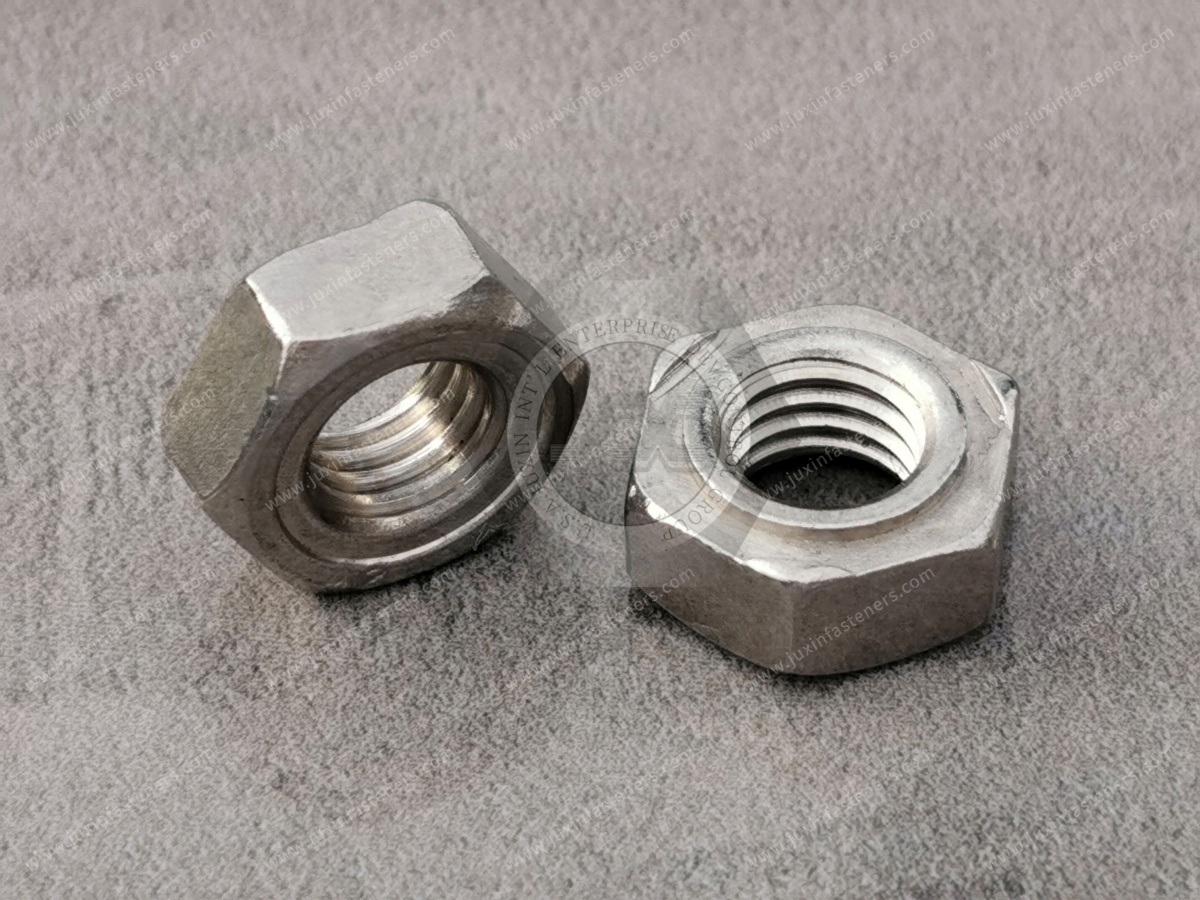
304 vs. 316 Stainless Steel Weld Nuts
| Selection factor | 304 stainless steel | 316 stainless steel |
|---|---|---|
| General corrosion resistance | Suitable for many environments | Often preferred for more demanding exposure |
| Chloride resistance | More limited | Generally improved, but not unlimited |
| Material cost | Typically lower | Typically higher |
| Welding requirements | Process qualification required | Process qualification required |
| Typical selection basis | General industrial corrosion conditions | More demanding corrosion conditions |
The final material must be specified according to the actual application.
Other Stainless Steel Grades
Special stainless steel grades may be considered where the application requires different temperature, corrosion or mechanical characteristics.
However, grades such as 310 stainless steel should not be treated as standard stock options without confirming product availability and manufacturing feasibility.
Stainless Steel Material Verification
For OEM sourcing, the drawing or purchase specification should define the required material.
Depending on the project, material verification may involve:
Material designation
Chemical composition requirements
Applicable material specification
Material documentation
Customer-specific inspection criteria
Important Procurement Recommendation
Avoid specifying only "stainless steel" when the application requires a particular alloy.
Projection Welding of Stainless Steel Weld Nuts
Resistance projection welding is a common installation method for suitable weld nut designs.
The nut includes welding features intended to concentrate current and force at defined contact locations.
During welding, electrical resistance generates heat at the interface.
The welding electrodes apply force while the material is heated and the joint forms.
Typical Process Stages
Position the weld nut on the prepared component.
Align the nut and workpiece.
Apply electrode force.
Deliver the controlled welding current.
Form the welded joint.
Allow the joint to cool as required by the process.
Inspect the installed nut and relevant weld characteristics.
The exact sequence and process settings depend on the welding equipment, material and joint design.
Important Engineering Principle
A stainless steel weld nut should not automatically use the same welding parameters as a carbon steel weld nut.
Differences in electrical resistance, thermal properties, material behavior and surface condition can affect weld formation.
Welding Process Variables
Important variables include:
Welding current
Welding time
Electrode force
Projection geometry
Electrode condition
Base-material thickness
Surface condition
Part alignment
Why These Variables Matter
Insufficient heat input may result in inadequate bonding.
Excessive heat input may cause expulsion, deformation or thread damage.
Poor alignment can produce uneven welding across the projections.
Manufacturing Recommendation
Establish welding parameters using the actual nut, base material, sheet thickness and production equipment.
Manual vs. Automated Welding
Stainless steel weld nuts may be installed using manually loaded welding equipment or automated systems, depending on the process and production volume.
Manual or Semi-Automated Production
Potentially appropriate for:
Lower-volume fabrication
Prototype evaluation
Selected customized assemblies
Automated Production
May be considered for:
Repetitive OEM production
High-volume sheet metal fabrication
Integrated manufacturing lines
Production Considerations
Part feeding
Nut orientation
Positioning accuracy
Electrode maintenance
Weld monitoring
Post-weld inspection
Important Distinction
Automation does not guarantee weld quality by itself.
A stable, validated welding process is required.
Base-Material Compatibility
The weld nut material must be evaluated together with the workpiece material.
Potential workpieces include:
Stainless steel sheet
Carbon steel sheet
Other weldable metal components
Stainless Steel to Stainless Steel
This arrangement may be suitable where the nut and base material can be joined using an appropriate welding process.
Stainless Steel to Carbon Steel
Dissimilar-metal welding introduces additional considerations.
These may include:
Weldability
Interface behavior
Metallurgical compatibility
Corrosion risk
Process qualification
Important Engineering Recommendation
Do not assume that a stainless steel weld nut can be welded reliably to every metal sheet.
The actual material combination must be evaluated.
Sheet Thickness and Weld Nut Installation
Sheet thickness influences the mechanical and thermal behavior of the welded connection.
Potential concerns include:
Local sheet deformation
Burn-through
Inadequate weld formation
Excessive indentation
Limited joint strength
Thin Sheet Metal
Thin sheets may require particular attention to welding energy and local support.
Thicker Components
Thicker materials may change heat flow and welding requirements.
Engineering Recommendation
Define the base-material thickness range when developing the welding process.
A weld nut qualified on one sheet thickness should not automatically be assumed suitable for another.
Hole Geometry and Nut Positioning
Weld nut installation may involve a clearance hole or another drawing-defined feature.
Important dimensions include:
Hole diameter
Hole position
Nut alignment
Edge distance
Distance from bends
Access for welding electrodes
Why Hole Alignment Matters
Misalignment can interfere with the mating screw during final assembly.
It may also affect the available thread opening and the positioning of the welded nut.
Production Recommendation
Control both the nut position and the workpiece hole location.
Weld Nut Thread Distortion
The welding process can affect the internal thread.
Potential problems include:
Thermal distortion
Weld spatter contamination
Misalignment
Local deformation
Thread damage
Consequences
Increased screw installation torque
Cross-threading
Rework
Assembly-line stoppages
Rejected components
Engineering Recommendation
Where required by the drawing or quality plan, verify thread functionality after welding.
Thread Inspection
Inspection may involve:
Go/no-go thread gauges
Functional screw engagement checks
Visual inspection
Customer-specific acceptance criteria
Important Distinction
A nut that passes a thread gauge before welding may not necessarily remain acceptable after installation.
Weld Nut Pull-Out Resistance
Pull-out resistance describes the ability of the installed nut and welded joint to resist loading that tends to separate the nut from the workpiece.
Performance depends on:
Weld quality
Nut geometry
Base-material thickness
Base-material strength
Loading direction
Joint design
Engineering Recommendation
Do not specify pull-out strength based solely on the stainless steel grade or nut thread size.
Testing should represent the actual welded assembly.
Weld Nut Torque Resistance
Torque resistance is important because the installed nut must remain attached while the mating bolt is tightened or removed.
Potential failure modes include:
Weld fracture
Nut rotation
Base-material deformation
Thread damage
Important Engineering Distinction
A hexagonal or square nut body does not independently guarantee the required torque resistance after welding.
The completed welded joint determines the actual performance.
Weld Nut Push-Out and Other Joint Tests
Depending on the assembly, validation may include:
Push-out testing
Pull-out testing
Torque resistance testing
Weld fracture examination
Other customer-defined joint tests
The appropriate methods and acceptance criteria must be established for the actual application.
Welding Inspection and Quality Control
An OEM quality plan may include:
Before Welding
Nut material verification
Dimensional inspection
Projection geometry inspection
Thread inspection
Surface condition review
During Welding
Equipment setting control
Electrode condition
Part positioning
Process monitoring
After Welding
Visual inspection
Thread functionality
Weld integrity checks
Mechanical joint testing where specified
Important Procurement Distinction
Fastener dimensional inspection and welded assembly qualification are separate activities.
The nut supplier and equipment manufacturer should clearly define their respective responsibilities.
Corrosion Resistance After Welding
Stainless steel corrosion performance can be affected by welding and subsequent surface condition.
Potential concerns include:
Heat tint
Surface contamination
Crevice formation
Dissimilar-metal corrosion
Inadequate post-weld cleaning
Heat Tint
Heat tint may indicate changes in the oxide condition of the stainless steel surface.
Depending on the application, appropriate post-weld cleaning or surface treatment may be required.
Passivation
Passivation may be specified for suitable stainless steel components.
However, passivation does not automatically remove all welding-related surface defects or restore every damaged surface condition.
Engineering Recommendation
Define post-weld surface requirements according to the service environment and manufacturing process.
Galvanic Corrosion
When stainless steel is joined to a dissimilar metal, galvanic corrosion may occur under suitable environmental conditions.
The risk depends on:
Material combination
Presence of an electrolyte
Surface condition
Relative exposed areas
Joint geometry
Engineering Recommendation
Evaluate corrosion behavior of the complete welded assembly.
Stainless Steel Weld Nuts in Automotive and EV Equipment
Potential applications include suitable:
Body-related brackets
Equipment housings
Battery-system support components
Auxiliary structural assemblies
Metal equipment panels
Important Application Distinction
Not every automotive weld nut is stainless steel.
Carbon steel weld nuts may be preferred for many automotive structures depending on the design and manufacturing process.
For stainless steel weld nuts, the material and welding process must be justified by the actual assembly requirements.
Machinery and Industrial Equipment
Potential applications include:
Machine frames
Equipment covers
Fabricated brackets
Industrial automation assemblies
Stainless steel machinery structures
Selection considerations include vibration, mechanical loading, maintenance and environmental exposure.
Chemical Processing Equipment
Stainless steel weld nuts may be considered in suitable chemical-processing assemblies.
Relevant applications include:
Equipment panels
Instrument supports
Machinery housings
Fabricated structural components
Engineering Recommendation
Material selection must account for the actual chemical environment rather than assuming all stainless steel grades are universally resistant.
Home Appliances and HVAC Equipment
Potential applications include:
Appliance housings
Metal brackets
Equipment supports
Selected HVAC structures
Manufacturing considerations include:
Production volume
Sheet thickness
Welding automation
Assembly access
Cost
Marine and Coastal Equipment
Stainless steel weld nuts may be evaluated for suitable marine-related or coastal equipment.
However, the material and weld design must be assessed for chloride exposure, crevice corrosion and service conditions.
Food and Beverage Processing Equipment
Stainless steel weld nuts may be used in suitable machinery structures and equipment components.
Important Hygiene Consideration
A stainless steel weld nut is not automatically suitable for every hygienic or product-contact surface.
The completed assembly must meet the applicable equipment design, cleanability and hygiene requirements.
High-Temperature Industrial Equipment
Selected stainless steel grades may be used in elevated-temperature applications.
However, temperature capability depends on:
Stainless steel grade
Mechanical loading
Exposure duration
Oxidation conditions
Welded joint behavior
Engineering Recommendation
Do not select a weld nut for high-temperature service solely because it is made from stainless steel.
Common Stainless Steel Weld Nut Failures
| Problem | Potential cause | Engineering review |
|---|---|---|
| Nut separates from sheet | Inadequate weld formation | Welding parameters and joint design |
| Nut rotates during tightening | Insufficient welded joint torque resistance | Weld quality and assembly loading |
| Internal thread becomes damaged | Heat distortion or contamination | Welding process and thread inspection |
| Sheet deforms | Excessive heat or force | Sheet thickness and process settings |
| Weld projections fail to form correctly | Incompatible process or geometry | Nut design and welding setup |
| Corrosion near weld | Heat tint, contamination or environment | Post-weld surface condition |
| Nut position varies | Feeding or fixture issue | Positioning and automation control |
| Assembly screw does not engage | Misalignment or thread damage | Hole position and thread condition |
| Weld quality varies between batches | Material or process variation | Incoming inspection and process monitoring |
OEM Weld Nut Selection Workflow
Identify the Base Material
Confirm the sheet or component material.
Define the Joint Function
Determine the required mechanical loading and assembly sequence.
Select Nut Geometry
Compare DIN 928, DIN 929 or drawing-based alternatives.
Specify Stainless Steel Grade
Select the material according to corrosion, mechanical and welding requirements.
Define Welding Conditions
Identify the welding process, equipment and base-material thickness.
Establish Quality Requirements
Define dimensional inspection, thread acceptance and welded joint testing where applicable.
Confirm Commercial Supply
Review MOQ, sample requirements, annual forecast and delivery schedule.
Metric and Inch Thread Requirements
Stainless steel weld nuts may be specified with metric or inch threads where the product design and manufacturing feasibility permit.
Metric Threads
ISO metric thread requirements may reference applicable ISO thread standards.
UNC and UNF Threads
Unified inch threads may be specified under ASME B1.1.
Important Compatibility Rule
Metric, UNC, UNF, BSW and BSF threads are separate systems.
They must not be described as directly interchangeable.
Procurement Recommendation
Provide the exact thread designation and tolerance requirements on the drawing.
Custom Stainless Steel Weld Nuts
Standard DIN weld nuts may not meet every OEM design.
Drawing-based requirements may include:
Modified body geometry
Custom projection design
Nonstandard thread dimensions
Special material specifications
Application-specific tolerances
Defined surface condition
Customer-specific packaging
Important Manufacturing Consideration
Custom nut geometry must be evaluated together with the intended welding process.
Changing projection geometry can alter weld formation and joint performance.
Supplier Qualification for Stainless Steel Weld Nuts
Procurement and supplier-development teams should evaluate more than the quoted unit price.
Technical Requirements
Standard or approved drawing
Stainless steel material designation
Thread specification
Nut geometry
Projection geometry
Dimensional tolerances
Surface condition
Quality Requirements
Inspection characteristics
Material documentation
Thread verification
Customer-defined testing
Change control
Commercial Requirements
MOQ
Sample quantity
Annual forecast
Packaging
Lead time
Delivery destination
Second-Source Qualification
A replacement weld nut should not be accepted solely because its nominal thread and outer dimensions match.
Differences in projection geometry, material condition or surface characteristics may affect welding performance.
Engineering Recommendation
Validate the replacement component in the actual welding process before approving it for production.
Frequently Asked Questions
What is the difference between DIN 928 and DIN 929 weld nuts?
DIN 928 specifies square weld nuts, while DIN 929 specifies hexagonal weld nuts. Their geometries and welding features differ.
Can 304 stainless steel weld nuts be used outdoors?
They may be suitable for certain outdoor environments, but corrosion performance depends on exposure conditions.
Are 316 stainless steel weld nuts suitable for marine applications?
They may offer improved corrosion resistance compared with 304 in some environments, but they are not immune to chloride-related corrosion.
Can stainless steel weld nuts be welded to carbon steel?
Some dissimilar-metal combinations may be feasible, but the welding process and joint performance must be evaluated.
Are stainless steel weld nuts stronger than carbon steel weld nuts?
Not necessarily. Mechanical performance depends on the material grade, nut geometry, weld and complete joint.
Can the same projection welding settings be used for stainless steel and carbon steel nuts?
Not automatically. The process should be established for the actual material combination.
How is weld nut torque resistance verified?
Through an appropriate test of the installed nut and welded assembly, using customer-defined requirements.
Why can a weld nut thread fail after welding?
Potential causes include thermal distortion, contamination, misalignment and excessive process loading.
Can a DIN 928 square weld nut replace a DIN 929 hex weld nut?
Not without evaluating geometry, welding features and assembly requirements.
What information is needed for a stainless steel weld nut RFQ?
The drawing, material grade, thread, nut geometry, base material, sheet thickness, welding method, quality requirements and purchasing volume.
JUXIN FASTENERS: Stainless Steel Weld Nuts for OEM Manufacturing
JUXIN FASTENERS supplies industrial weld nuts and drawing-based fastening components for international OEM applications.
Relevant product categories include:
DIN 928 square weld nuts
DIN 929 hexagonal weld nuts
Stainless steel welding nuts
Custom weld nuts
Industrial nuts
Selected welded threaded components
Drawing-based OEM fasteners
Material grades, thread sizes, welding features, inspection requirements and manufacturing feasibility should be confirmed for each project.
JUXIN FASTENERS can review customer drawings and technical specifications to discuss suitable fastening options.
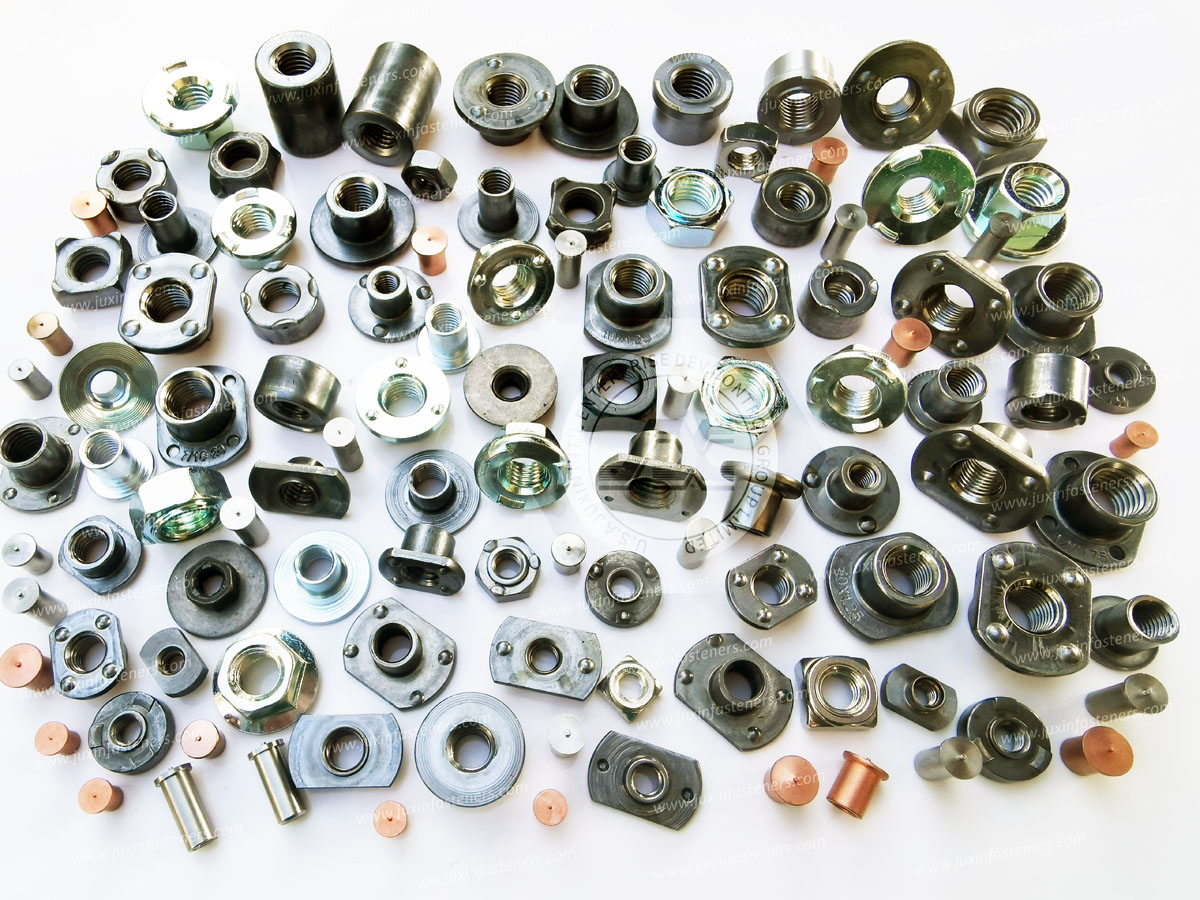
Request a Stainless Steel Weld Nut Drawing Review and RFQ
Are you sourcing DIN 928 square weld nuts, DIN 929 hexagonal weld nuts or custom stainless steel welding nuts for an OEM project?
JUXIN FASTENERS welcomes inquiries from equipment manufacturers, design engineers, manufacturing engineers, production managers, procurement teams and supplier-development departments.
For efficient technical and commercial review, provide:
Weld nut drawing + stainless steel grade + thread specification + base material and sheet thickness + welding method + inspection requirements + annual purchasing volume
Where relevant, include the required welded joint torque resistance, pull-out performance and post-weld corrosion requirements.
These details help establish the correct product specification and support an informed quotation.
Company: JUXIN FASTENERS
Website: https://www.juxinfasteners.com/
Email: info@juxinfasteners.com
Send your stainless steel weld nut drawings and OEM RFQ requirements to JUXIN FASTENERS for technical evaluation and quotation.
Contact Us
Tel.:
+86 020 8621 0320
+86 020 3121 6067
E-mail:
Technical Support:
Navigation
SEND INQUIREY



