
Call Us
+86 136 6007 9809
Call Us
+86 136 6007 9809

Nov. 02, 2023
Spring clip nuts are compact threaded fastening components used to create a reusable threaded attachment point on sheet metal, panels, brackets and similar structures.
Depending on geometry and industry terminology, related products may be described as spring clip nuts, U-nuts, U-clip nuts, panel nuts, threaded clip nuts or spring steel nuts.
They are widely used where conventional loose nuts are difficult to position, where rear-side access is limited during assembly,
or where manufacturers need a fastening component that can be installed onto a panel before the mating screw is introduced.
Typical applications include automotive body and trim assemblies, electrical enclosures, industrial machinery, equipment cabinets, HVAC assemblies, communications equipment and transportation systems.
For engineers, however, selecting a spring clip nut involves more than matching the thread size.
Panel thickness, mounting-edge geometry, hole position, clip reach, spring retention, material, coating,
mating screw and service environment all influence whether the fastening system will function correctly.
For procurement and supplier-development teams, these same parameters determine whether an existing commercial part can be sourced or whether a drawing-controlled custom spring nut is required.
JUXIN FASTENERS supplies standard and custom spring nuts, clip nuts,
U-nuts, panel fasteners and drawing-based metal fastening components for industrial OEM and manufacturing applications.
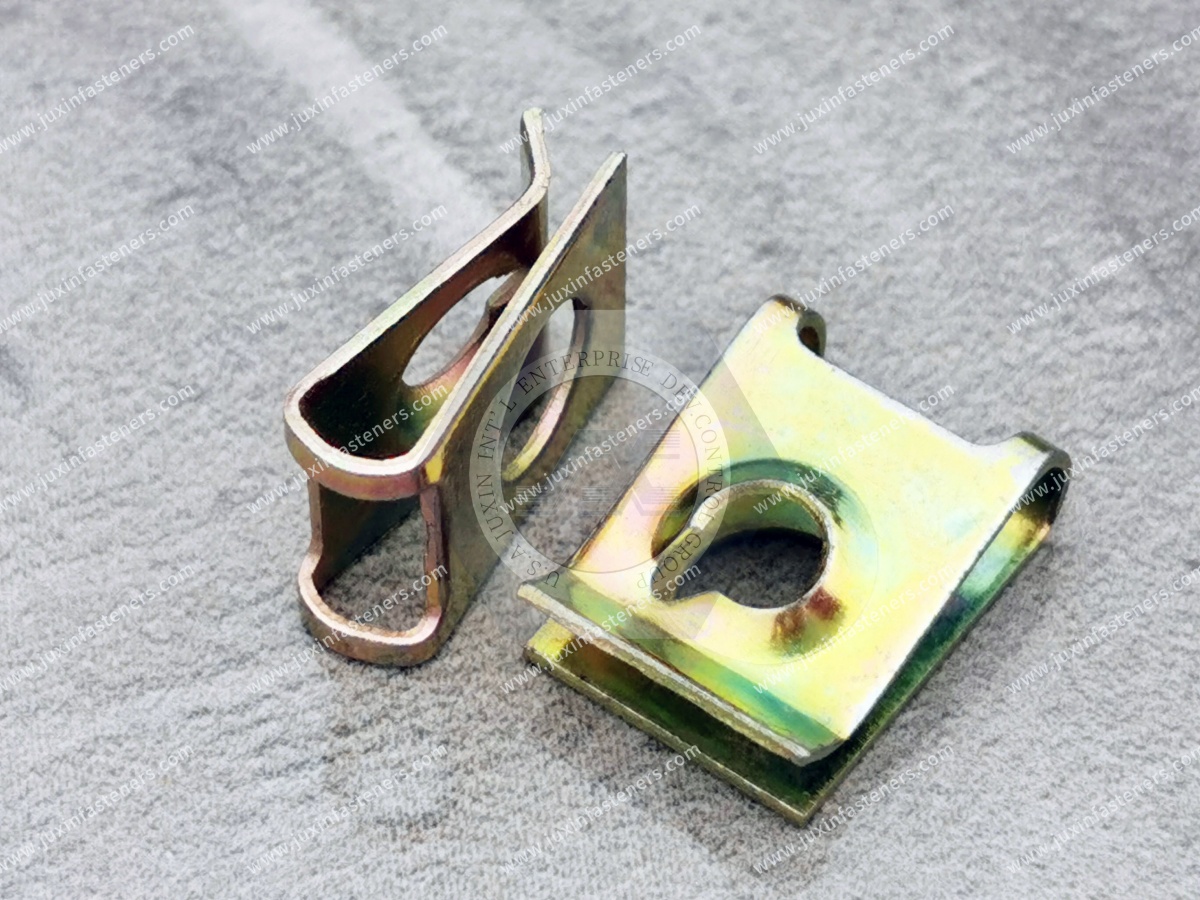
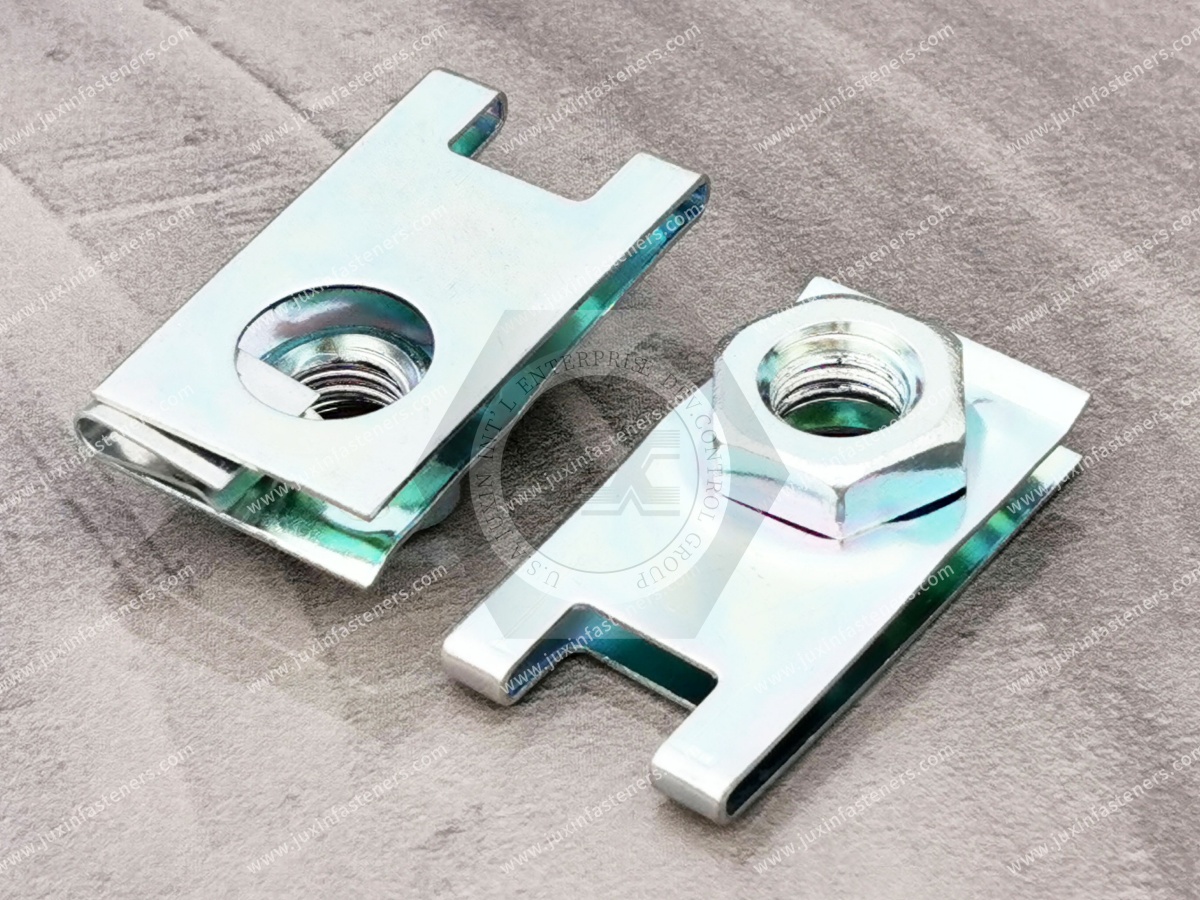
A spring clip nut is a formed metal fastener that combines a spring clip structure with a threaded feature or nut element.
The clip portion engages a panel, sheet edge or prepared mounting location. The threaded portion provides the connection for a mating screw or bolt.
This arrangement can eliminate the need to manually hold a conventional loose nut behind the panel during assembly.
Depending on the design, a spring clip nut may also provide a degree of positional accommodation between the panel hole and mating screw.
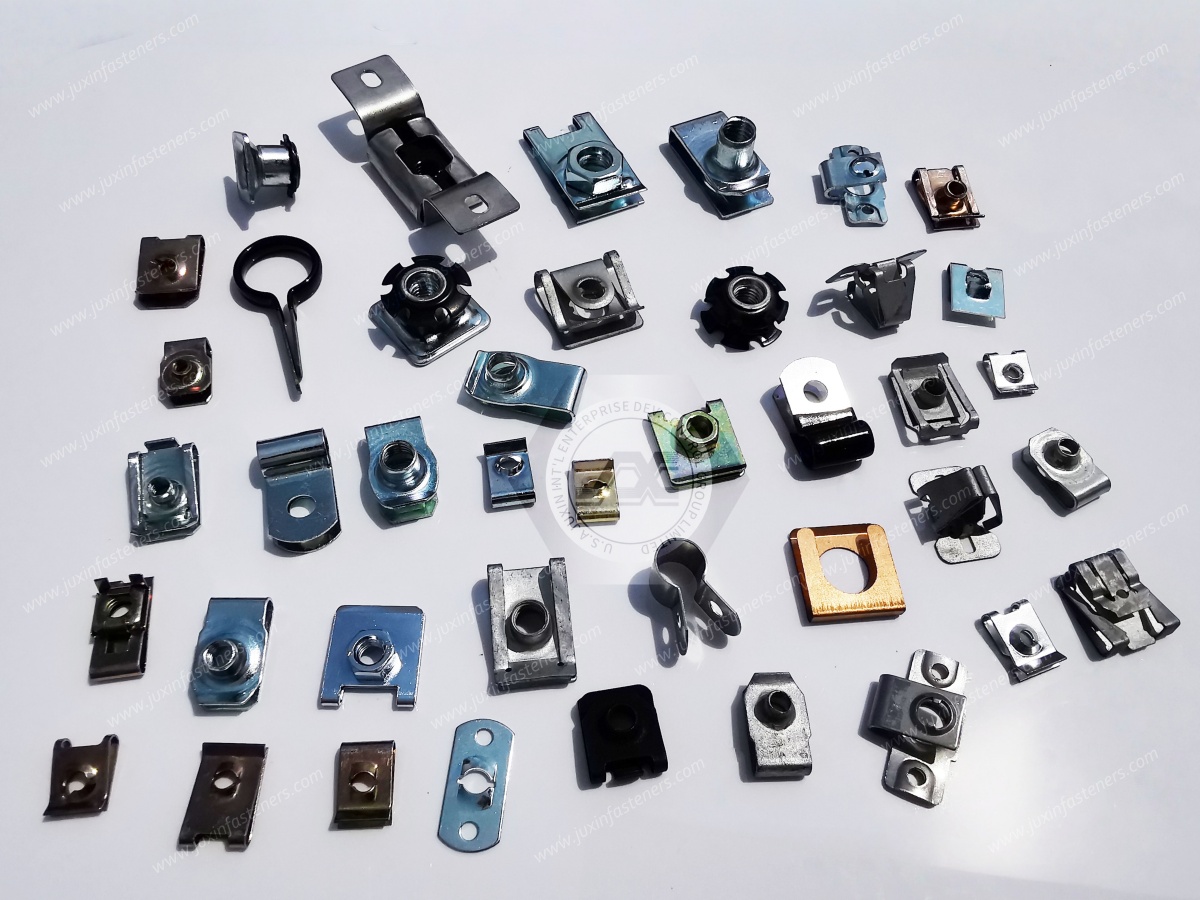
Common configurations include:
U-shaped threaded clip nuts
U-nuts
J-type clip nuts
Panel-edge nuts
Threaded spring clips
Clip-on sheet metal nuts
Automotive panel nuts
Custom stamped spring nuts
The exact terminology varies between industries and manufacturers. For an OEM project, the drawing,
dimensions and functional requirements are more reliable identifiers than the commercial product name alone.
These terms are sometimes mixed together in catalogs and online searches, but they should not automatically be treated as interchangeable fasteners.
These normally use a formed spring clip that engages a panel or sheet-metal edge and positions a threaded feature for the mating screw.
Typical applications include automotive panels, equipment housings, brackets and sheet-metal assemblies.
A cage nut normally consists of a nut retained within a cage or spring-steel housing. The cage may permit controlled movement of the nut to accommodate assembly alignment.
Cage nuts are commonly associated with racks, cabinets and sheet-metal structures, but their geometry and installation method differ from typical U-shaped clip nuts.
Channel nuts are designed to interface with compatible strut or framing channels. Some designs incorporate springs to assist positioning inside the channel.
The presence of a spring does not make a strut channel nut equivalent to a spring clip nut used on sheet-metal edges.
Self-clinching nuts create retained threaded features by mechanically displacing panel material during installation.
They require suitable panel material, thickness and installation conditions and should be evaluated separately from clip-on spring nuts.
Understanding these boundaries prevents a common sourcing problem: selecting a product because its commercial name appears similar while its installation mechanism is completely different.
The primary engineering value of a spring clip nut is often assembly architecture, rather than simply “anti-loosening.”
A clip nut may be useful when:
The rear side of the panel is difficult to access during final assembly.
A loose nut would complicate production-line handling.
The threaded component needs to remain associated with the panel before screw installation.
Installation from a panel edge is practical.
Assembly speed is important.
Limited positional accommodation is required.
Welding a nut is undesirable for the specific assembly.
The component may need to be serviced or replaced later.
The correct solution depends on the joint design.
Spring clip nuts should therefore not automatically be selected simply because an application experiences vibration.
Not automatically.
This is an important distinction for design engineers.
The spring portion of a clip nut primarily performs functions such as panel retention, positioning and accommodation of the threaded element, depending on the specific design.
That does not mean every spring clip nut provides a validated prevailing-torque locking function.
Vibration loosening of a threaded joint depends on multiple factors, including:
Joint preload
Mating screw geometry
Thread condition
Friction
Joint stiffness
Transverse movement
Bearing surfaces
Material behavior
Locking features
Assembly process
Where resistance to rotational loosening is a critical requirement,
engineers should determine whether the selected clip nut incorporates an appropriate locking feature or whether another locking strategy is required.
A clip nut and a prevailing-torque lock nut therefore solve different engineering problems unless a specific design intentionally combines those functions.
One of the first dimensions to establish is the thickness of the panel that the clip must engage.
The clip opening and spring geometry must be compatible with the actual sheet thickness or panel stack.
If the panel is outside the intended range, several problems may occur:
Excessive installation force
Insufficient retention
Clip deformation
Poor alignment
Damage to the coating or panel surface
Difficulty positioning the mating screw
Clip movement during assembly
For this reason, an RFQ stating only “M6 spring nut” is usually insufficient for accurate product selection.
The supplier should also know the panel thickness and mounting geometry.
For edge-mounted U-nuts and clip nuts, the relationship between the panel edge and the screw-hole centerline is critical.
The clip must position the threaded feature correctly relative to the panel hole.
Engineers should consider:
Distance from panel edge to hole center
Clip overall length
Throat or reach dimension
Hole diameter or slot geometry
Thread location
Installation direction
Available surrounding clearance
Two clip nuts with the same thread size can therefore be functionally incompatible if their reach dimensions differ.
This is one reason physical samples, 2D drawings and installation sketches are valuable when developing an alternative supplier.
The threaded feature must match the mating fastener and assembly requirements.
Depending on the project, specifications may include:
Metric thread
Unified inch thread
Thread size and pitch
Thread tolerance requirements
Mating screw type
Required engagement geometry
Special locking characteristics
Thread selection should follow the applicable customer drawing, assembly specification or relevant international thread standard.
For replacement or second-source projects, compatibility should not be determined solely from nominal thread diameter. Thread pitch and mating-component requirements must also be confirmed.
Material selection depends on both the spring function and the operating environment.
Steel is commonly considered where the clip requires suitable elastic behavior, forming characteristics, strength and cost efficiency.
The exact material and heat-treatment condition should be selected according to the required geometry, spring response and application.
Stainless steel may be appropriate where corrosion resistance is important or where the application environment makes plated carbon steel less desirable.
However, “stainless steel” should not be treated as a universal specification.
The actual stainless grade, mechanical behavior, forming requirements, mating materials and corrosion environment should be evaluated.
For a custom clip nut, engineers should consider:
forming requirement → spring behavior → retention requirement → thread function → environment → corrosion strategy → mating materials → production process
Selecting a material solely because it is stronger or more corrosion resistant can overlook the forming and elastic characteristics required by the clip geometry.
Carbon-steel spring clips frequently require a surface treatment selected according to the assembly environment and customer specification.
Possible finishes may include:
Zinc-based coatings
Zinc-nickel coatings
Nickel-based finishes
Black finishes where appropriate
Customer-specified corrosion-protection systems
The correct coating cannot be selected by appearance alone.
Engineers and sourcing teams should consider:
Corrosion environment
Indoor or outdoor exposure
Humidity
Temperature
Contact with other metals
Coating thickness
Dimensional effect on threads
Friction requirements
Assembly behavior
Customer-specific restricted-substance requirements
For high-strength steel components where applicable, the relationship between material condition,
processing route and hydrogen-embrittlement risk should also be evaluated rather than assuming every electroplated coating is equally suitable.
Where corrosion performance is a project requirement, specify the required test method and acceptance criteria rather than simply requesting a “corrosion-resistant coating.”
Spring clip nuts are frequently installed on metal panels and then connected using another metallic fastener.
This creates a multi-material assembly.
Where dissimilar metals are exposed to an electrolyte, galvanic interaction may become part of the corrosion assessment.
The fastening system should therefore be evaluated as:
panel material + clip nut material/coating + mating screw + environmental exposure
rather than evaluating the clip nut in isolation.
This becomes increasingly important in transportation, outdoor electrical equipment and other assemblies exposed to moisture or corrosive environments.
For many clip-nut applications, the relevant functional question is not simply:
“Is the spring strong?”
The better questions are:
Can the clip be installed without damaging the panel?
Will it remain positioned before the screw is installed?
Does it maintain sufficient retention during handling and assembly?
Can the screw enter the thread without pushing the clip out of position?
Does repeated servicing affect retention?
Does the clip deform after installation?
Is the thread properly aligned with the mating hole?
Retention requirements depend on geometry, material condition, panel thickness and the intended assembly process.
A universal spring-force value should therefore not be assumed across different designs.
Understanding failure modes is useful both during design and supplier qualification.
Possible causes include:
Incorrect panel-thickness range
Insufficient spring engagement
Incorrect clip geometry
Material or heat-treatment mismatch
Dimensional variation
Possible causes include:
Panel too thick for the selected clip
Clip opening too small
Excessive spring stiffness
Coating buildup
Incorrect geometry
Possible causes include:
Incorrect clip reach
Hole-position variation
Clip installed from the wrong direction
Incorrect part selected
Insufficient floating allowance where required
This can indicate inadequate retention, incorrect panel compatibility or unsuitable installation geometry.
The cause may involve the clip material, coating, coating damage during installation, mating materials or the actual service environment.
Potential contributors include poor alignment, incompatible threads, thread damage, incorrect screw entry or excessive assembly speed.
These failure modes demonstrate why spring clip nuts should be selected as part of the entire assembly rather than as isolated catalog hardware.
Automotive manufacturing is a major application area for clip-on threaded fasteners because vehicle assemblies contain numerous sheet-metal, bracket, trim and equipment attachment points.
Depending on vehicle design, spring clip nuts may be considered for:
Body-panel attachments
Interior structures
Trim mounting
Brackets
Electrical modules
Equipment covers
Underbody or enclosure components
HVAC-related assemblies
Access panels
Automotive selection should account for vibration, corrosion exposure, assembly sequence, serviceability, panel geometry and the specific OEM or Tier supplier drawing.
Where the project requires a non-standard geometry, custom automotive fasteners can be developed around the actual panel and assembly interface rather than forcing the design to accept an unsuitable catalog component.
Spring clip nuts can simplify assembly of:
Electrical cabinets
Control panels
Equipment housings
Communications enclosures
Server-related equipment
Power-distribution equipment
They are particularly useful where a threaded attachment must be added to sheet metal without requiring an operator to hold a loose nut behind the panel.
For enclosure applications, designers should also evaluate:
Electrical bonding requirements
Coating interference
Corrosion conditions
Service access
Panel thickness
Repeated maintenance
Grounding strategy where applicable
The clip nut itself should not automatically be assumed to provide an electrical bonding function unless the complete joint has been designed and validated for that purpose.
Industrial equipment frequently uses removable covers, brackets, guards and sheet-metal structures.
Spring clip nuts can support efficient assembly in:
Automation equipment
Machine enclosures
Conveyor systems
Robotics equipment
Control cabinets
Production machinery
Service panels
For equipment exposed to repeated vibration, the designer should separately evaluate the threaded joint's locking strategy rather than relying solely on the spring clip structure.
Transportation equipment can expose fasteners to vibration, repeated servicing and environmental changes.
Possible spring clip nut applications include:
Interior panels
Equipment enclosures
Electrical assemblies
Access panels
Auxiliary equipment mounting
Material, coating, retention and locking requirements should be established according to the specific transportation application and customer specification.
Engineers often have several ways to create a threaded attachment point in sheet metal.
The appropriate option depends on the manufacturing and service requirements.
Clip-on installation is compatible with the panel geometry.
Rear-side loose-nut handling should be avoided.
Edge access is available.
A removable or replaceable component is useful.
Welding is undesirable for the assembly.
Production assembly benefits from pre-positioning the threaded fastener.
The assembly is designed for a welded threaded component.
Welding is integrated into the production process.
The nut geometry, sheet material and weld process are compatible.
Permanent attachment before final assembly is required.
The panel and installation process support self-clinching technology.
A permanently retained threaded feature is preferred.
Suitable press installation is available.
Panel material and thickness meet the requirements of the selected self-clinching design.
These technologies should not be selected only by unit price.
A more useful comparison is:
component cost + installation process + tooling/equipment + assembly time + serviceability + validation + lifecycle requirements
A standard clip nut may be sufficient when the required thread, panel thickness, reach and installation geometry match an established design.
A custom spring nut becomes relevant when the application requires:
Special panel thickness
Non-standard reach
Unique mounting geometry
Special thread specification
Modified retention features
Special material
Customer-specific coating
Restricted installation space
Integration with an existing OEM assembly
Replacement of a legacy or difficult-to-source component
For custom development, the existing sample and mating panel can be just as important as the fastener drawing.
JUXIN FASTENERS supports drawing- and sample-based sourcing of spring clip nuts, U-nuts, panel nuts, stamped fasteners and custom metal fastening components.
Depending on the project, development may involve forming, stamping, threading and other manufacturing operations appropriate to the component design.
The manufacturing route should be determined by the actual geometry, material, production volume and functional requirements rather than assuming that every spring nut uses the same process.
For supplier-development projects, the objective is to reproduce the functional interface, not merely the visible shape of the existing part.
That means reviewing:
Panel engagement
Thread location
Spring retention
Critical dimensions
Material condition
Coating
Mating screw
Assembly sequence
Functional requirements
For OEM and Tier-level sourcing, purchasing price is only one part of supplier evaluation.
Procurement and supplier-development teams should consider whether the supplier can work from controlled technical requirements and support appropriate verification.
Depending on project requirements, evaluation may include:
Drawing review
Material specification
Dimensional inspection
Thread verification
Surface-finish requirements
Functional fit testing
Spring-retention evaluation
Sample validation
Packaging requirements
Lot identification or traceability requirements
Required material or inspection documentation
The required validation level should be established by the customer specification and application risk.
Second-source development requires more than sending the supplier a photograph and nominal thread size.
A more reliable process is:
Provide the current drawing, specification, physical sample or part number where available.
Provide panel thickness, hole position, installation direction and mating screw information.
Determine which dimensions and functions directly affect assembly.
These may include clip opening, reach, thread location and retention behavior.
Avoid assuming the replacement part can use a different material or coating simply because it looks similar.
A dimensionally similar clip can still behave differently during installation.
Functional assembly validation is therefore important before production approval.
Once the part is approved, the drawing and agreed requirements should become the basis for future production and inspection.
This approach reduces the risk of qualifying a replacement component based only on visual similarity.
For faster and more accurate technical review, provide as much of the following information as available:
2D engineering drawing
3D model where relevant
Existing physical sample
Product or reference part number
Thread size and pitch
Mating screw specification
Panel material
Panel thickness
Panel-hole dimensions
Distance from panel edge to hole center
Installation direction
Material requirement
Surface treatment
Critical dimensions and tolerances
Retention or functional requirements
Operating environment
Corrosion requirement and applicable test specification
Required documentation
Sample quantity
Production quantity
Estimated annual demand
Packaging requirements
For an existing part without a complete drawing, photographs plus a physical sample and information about the mating panel can help establish the correct starting point for technical review.
A U-nut is one common type of spring clip nut, but “spring nut” is a broader commercial term that may also be used for other fastener designs.
The geometry should therefore be confirmed rather than relying solely on the product name.
Sometimes the assembly can be redesigned around a clip nut, but the technologies are not direct universal replacements.
Panel geometry, load path, installation process, serviceability and joint requirements must be evaluated.
They can be used in equipment exposed to vibration where the specific design is suitable, but the spring clip alone should not automatically be considered a complete thread-locking solution.
The entire joint must be evaluated.
Not universally.
The appropriate material depends on corrosion conditions, forming requirements, spring behavior, strength requirements, mating materials, cost and the complete assembly environment.
Thread size alone is not enough.
Panel thickness, clip reach, hole position, material, finish, mating screw and installation geometry are among the key parameters needed for correct selection.
A small spring clip nut can have a significant effect on assembly efficiency and product reliability.
The most effective sourcing process therefore begins with the joint rather than the catalog:
application → panel geometry → assembly sequence → thread → retention → material → coating → environment → validation → production sourcing
For engineering teams, this approach helps prevent incorrect component selection.
For procurement and supplier-development teams, it creates a clearer technical basis for supplier comparison, alternative sourcing and production approval.
JUXIN FASTENERS supports standard and custom spring clip nuts, U-nuts, panel nuts, sheet-metal fasteners,
automotive fasteners and drawing-based fastening components for OEM and industrial manufacturing projects.
For a new design, existing component replacement or second-source development project, send your drawing, physical sample or assembly requirements for technical review and quotation.
JUXIN FASTENERS
Industrial Fastening Solutions Since 2003
Website: www.juxinfasteners.com
Email: info@juxinfasteners.com
 MORE NEWS
Sep. 27, 2026
Sep. 27, 2026
Sep. 27, 2026
Contact Us
Tel.:
+86 020 8621 0320
+86 020 3121 6067
E-mail:
Technical Support:
Navigation
SEND INQUIREY