
Call Us
+86 136 6007 9809
Call Us
+86 136 6007 9809

Oct. 22, 2023
Outer-tongue lock washers are stamped mechanical locking components used in compatible shaft, bearing locknut and slotted round-nut assemblies.
Depending on the specific design, these washers use locating tongues, tabs or lugs to create a positive anti-rotation relationship between the shaft, washer and locknut.
Their function is mechanical locking—not fluid sealing.
An outer-tongue or tab-type lock washer should therefore be engineered as part of a complete fastening interface rather than treated as a generic flat washer, spring washer or gasket.
JUXIN FASTENERS supplies standard and custom tab lock washers, bearing nut lock washers, shaft locking washers, retaining components and drawing-based stamped fasteners for industrial OEM applications.
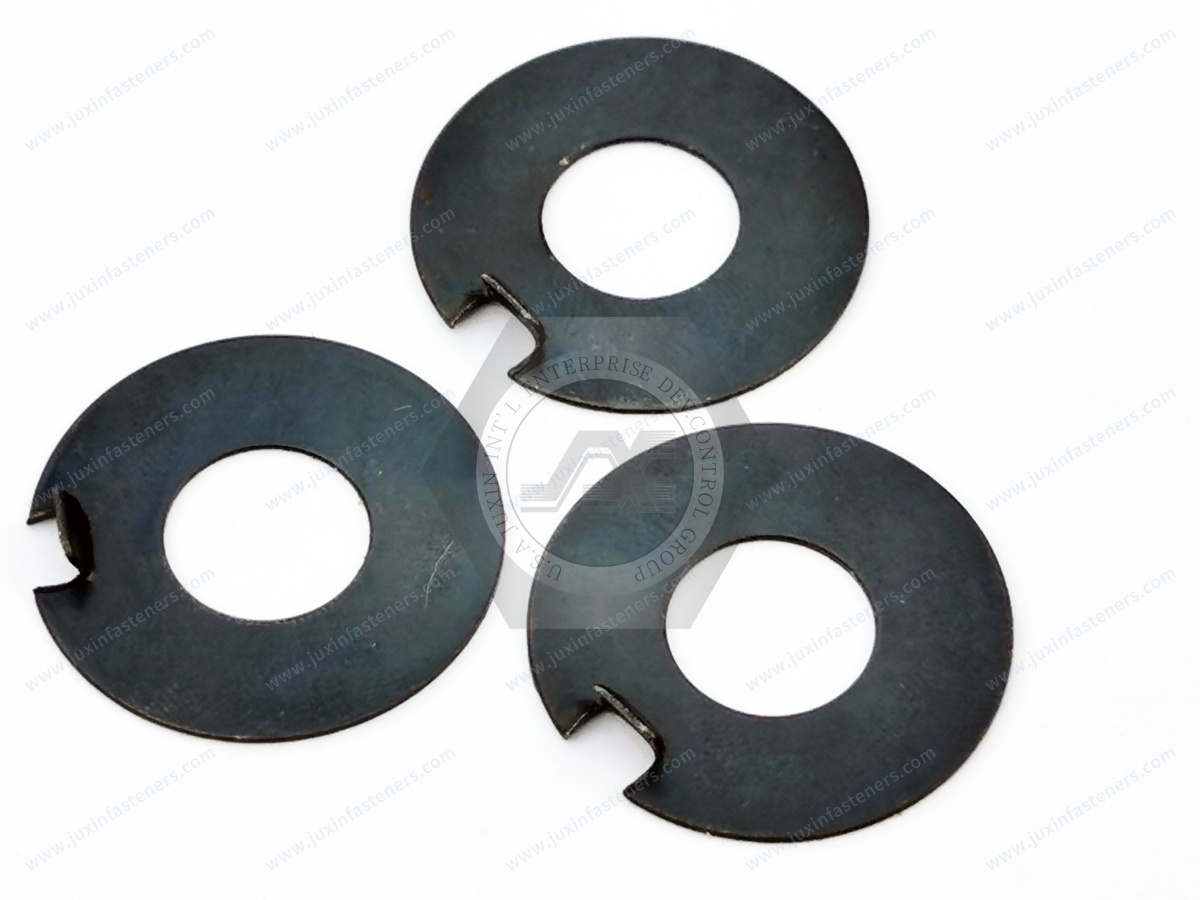
An outer-tongue lock washer is a formed or stamped metal washer incorporating one or more projecting tongues or tabs that interact with adjacent assembly features.
Depending on the washer architecture, the locking system may use:
an internal tongue engaging a shaft keyway;
an external tongue engaging a stationary component;
an external tab engaging a nut slot;
multiple tabs providing alternative locking positions;
combinations of these features.
The exact terminology varies between standards, manufacturers and industries.
For this reason, procurement teams should not approve a replacement component based only on the commercial name "outer tongue washer."
The actual geometry determines the function.
The washer helps prevent unintended relative rotation within a threaded assembly.
A typical positive locking system can create a mechanical path such as:
shaft → locating feature → washer → locking tab → locknut
or, depending on the design:
stationary component → external tongue → washer → locking feature → nut
The key engineering principle is the same:
the washer must be restrained at one interface and mechanically engage the fastener at another.
Without both interfaces, a positive locking path may not exist.
This washer family is frequently misidentified because similar-looking stamped parts can use different locking geometries.
An internal tongue projects toward the washer bore and may engage a shaft keyway or slot.
Its purpose is normally to prevent rotation of the washer relative to the shaft.
An external tongue projects beyond the washer outside diameter and may engage a stationary structural feature.
Its exact function depends on the assembly design.
Multiple tabs around the washer circumference can provide alternative positions for engagement with a slotted or castellated locking feature on the nut.
These features should not be treated as interchangeable simply because they are all called "tabs."
For engineers and sourcing teams, this is one of the most important lessons when specifying tab-type lock washers.
Two washers may have:
the same nominal shaft diameter;
similar outside diameters;
similar thicknesses;
similar overall appearance;
yet still be incompatible.
Differences in the following features can completely change functionality:
tongue width;
tongue depth;
tongue orientation;
tab length;
tab angular spacing;
washer thickness;
bore geometry;
nut-slot interface.
Therefore, cross-referencing by nominal diameter alone is not sufficient.
Outer-tongue and tab-type washers generally belong to the positive mechanical locking family.
This is fundamentally different from friction-dependent locking methods.
A physical feature restricts relative rotation.
Examples include:
tab washers;
tongue washers;
lock plates;
certain cotter-pin locking systems.
Resistance to loosening depends more heavily on friction, preload or prevailing torque.
Examples can include:
prevailing-torque nuts;
serrated interfaces;
certain spring-locking systems;
threadlocking compounds.
Neither principle should automatically be described as universally superior.
The correct choice depends on the assembly architecture, service conditions, maintenance strategy and validation requirements.
These terms can overlap, but they should not automatically be treated as synonyms.
A bearing nut lock washer is usually selected as part of a defined:
shaft + washer + locknut
system.
An outer-tongue washer describes a geometric feature and may be used in other locking arrangements.
When sourcing a replacement, engineers should identify the functional interfaces instead of relying on the product name alone.
This distinction is critical.
An outer-tongue lock washer is not automatically a gasket.
A gasket is primarily intended to control leakage across a joint by creating an appropriate sealing interface.
A tab lock washer is primarily intended to restrict unwanted fastener rotation.
Therefore, outer-tongue lock washers should not automatically be specified according to:
pipeline pressure;
process fluid;
gasket compression;
flange sealing class;
media compatibility.
Those belong to sealing-system design unless the specific component drawing explicitly incorporates another function.
Some fastening systems use specialized bonded, metallic or elastomeric sealing washers.
That does not make all metal lock washers sealing components.
A stamped tab washer should not be claimed to prevent:
oil leakage;
gas leakage;
water leakage;
chemical leakage;
unless the complete assembly has specifically been engineered and validated for that purpose.
A conventional spring washer uses elastic deformation and contact mechanics as part of its function.
An outer-tongue washer instead uses geometric engagement to restrict rotation.
Calling every tab-type locking washer a "spring lock washer" can therefore create confusion during engineering review and procurement.
The drawing or applicable standard should control the identification.
A retaining ring normally provides axial retention by engaging a shaft or bore groove.
A tongue lock washer typically participates in preventing rotation of a threaded locking component.
These are different functions.
When designing a shaft assembly, first determine whether the requirement is:
nut anti-rotation;
axial component retention;
bearing adjustment;
spacing;
or another mechanical function.
Only then should the component family be selected.
A useful engineering review divides the component into several functional interfaces.
The washer bore must be compatible with the shaft geometry.
Check:
inside diameter;
clearance;
shaft thread;
available shoulder;
installation direction.
Where a tongue provides anti-rotation, its geometry must correctly engage the corresponding feature.
Important dimensions may include:
tongue width;
tongue length;
tongue depth;
radial location;
angular orientation.
Where tabs engage a slotted locknut, their geometry must allow reliable engagement after the nut reaches its required installed position.
Check:
tab width;
tab length;
tab spacing;
nut-slot width;
nut-slot position;
available forming access.
Washer thickness contributes to the assembly stack.
In space-constrained shaft systems, changing washer thickness can affect:
available thread engagement;
locknut position;
adjacent component clearance;
assembly geometry.
Thickness should therefore not be treated as a cosmetic dimension.
A reliable selection process starts with the mating assembly.
Determine what must be prevented from rotating.
Is the washer locking:
a bearing locknut;
a round nut;
a shaft nut;
another threaded component?
Determine what restrains the washer.
This may be:
a shaft keyway;
a housing feature;
a slot;
another mechanical stop.
Confirm how the washer engages the fastener.
Possible features include:
nut slots;
nut flats;
castellations;
other dedicated locking geometry.
A theoretically compatible washer may still be unsuitable if the assembly does not provide tool access for bending the locking tab.
Material selection should reflect both the service environment and the forming operation.
If the tab undergoes permanent deformation during installation, determine whether the maintenance procedure requires a new washer after disassembly.
Material should be selected according to the complete mechanical and environmental requirements.
Common engineering options can include suitable carbon steels and stainless steels.
The selected material should provide the required balance of:
strength;
ductility;
formability;
corrosion resistance;
dimensional stability;
compatibility with the assembly.
A locking tab must normally be bent during final assembly.
If the material or heat-treatment condition is too brittle for the intended forming operation, the tab can crack.
If it is too soft for the required mechanical function, permanent deformation may occur where it is not intended.
Material specification therefore cannot be separated from tab geometry and installation requirements.
Carbon steel can be suitable for many machinery and general industrial applications.
Depending on the environment, the component may require an appropriate protective finish.
When specifying a coated tab washer, engineers should consider that the tab will be bent after manufacture.
The bend region may experience coating deformation or local damage.
Stainless steel can be appropriate where increased corrosion resistance is required.
However, stainless steel should not be selected solely because "stainless is better."
Different stainless grades have different:
mechanical properties;
forming behavior;
work-hardening characteristics;
corrosion performance.
The material must remain compatible with both manufacturing and field installation.
Surface finish can influence:
corrosion resistance;
dimensional stack-up;
appearance;
handling;
interaction with mating components.
For tab-type parts, the finishing system should also tolerate the expected forming process as far as practical.
If coating integrity after tab bending is critical, this should be evaluated during sample qualification.
These washers are commonly produced from sheet or strip material using stamping and forming operations.
Typical manufacturing stages can include:
material preparation;
blanking;
piercing;
tongue and tab formation;
deburring;
heat treatment where specified;
surface treatment where specified;
dimensional inspection;
packaging.
For higher-volume OEM programs, progressive stamping can provide efficient and repeatable production.
Not every dimension on a stamped washer has equal functional importance.
A control plan should identify the dimensions that directly influence assembly.
These can include:
inside diameter;
outside diameter;
thickness;
internal tongue width;
tongue length;
tongue position;
external tab width;
external tab length;
angular spacing;
flatness;
burr condition.
The exact critical characteristics should be determined from the drawing and mating components.
Stamped components naturally develop characteristic edge conditions depending on the cutting process.
In some assemblies, burr direction or edge condition can influence:
seating;
mating-surface contact;
assembly orientation;
handling;
interference.
For custom OEM washers, burr requirements should therefore be defined where functionally important.
A lock washer does not necessarily need the same flatness requirement as a precision ground washer.
However, excessive distortion can affect:
assembly seating;
axial stack-up;
tab alignment;
automated feeding.
Flatness requirements should match the actual application rather than being over-specified or ignored.
The exact installation procedure should follow the component drawing, applicable standard or equipment manufacturer's instructions.
A typical positive-locking sequence may include:
inspect the shaft, washer and locknut;
position the washer with the correct orientation;
engage the locating tongue with its mating feature;
install and tighten the compatible locknut;
identify the appropriate locking tab;
bend the tab into or against the specified locking feature;
inspect the final engagement.
The nut should reach its required installed condition before the locking feature is finalized.
The tab is a locking feature, not a substitute for the correct nut-installation method.
The locknut should be installed using the specified procedure and appropriate tooling.
The washer tab is then used to secure the resulting position.
Tab washers often undergo plastic deformation during installation.
Repeated bending and straightening can cause:
work hardening;
cracking;
distortion;
coating damage;
reduced locking reliability.
For service-critical assemblies, replacement after disassembly can provide a more controlled locking condition.
Follow the applicable maintenance specification.
A tongue that does not correctly fit the mating slot or keyway may not provide the intended anti-rotation function.
A tab that cannot align with the locknut feature may make correct installation difficult or impossible.
Burrs can interfere with seating, handling or automated assembly.
Possible contributors include:
unsuitable material;
excessive hardness;
inappropriate bend radius;
coating condition;
repeated bending.
Thickness variation can influence assembly stack-up and tab behavior.
A geometrically identical washer made from a different material may behave differently during tab forming and service.
For drawing-based or reverse-engineered tab washers, sample validation should confirm more than appearance.
The customer should evaluate the sample in the actual mating assembly for:
fit;
tongue engagement;
tab alignment;
tab-forming behavior;
seating;
installation access;
final locking condition.
This is particularly important when replacing an obsolete component without the original manufacturing specification.
Bearing locknut systems can use mechanical locking washers to secure the final nut position where the shaft architecture is designed for this method.
The washer should be evaluated together with:
shaft geometry;
bearing arrangement;
locknut;
spacers;
adjacent components.
The washer alone does not determine bearing preload or clearance.
Gearboxes frequently contain threaded shaft assemblies, bearings and gears that require controlled axial positioning.
Where a slotted locknut system is specified, a compatible locking washer can provide a visible mechanical anti-rotation feature.
Motors, fans, pumps and related equipment can incorporate bearing and shaft-retention systems.
For replacement sourcing, engineers should verify the actual washer geometry rather than assuming all shaft lock washers are interchangeable.
Maintenance-driven industries often need replacement locking components during overhaul.
A useful replacement RFQ should include the mating shaft and locknut information, particularly where the original component is obsolete.
Conveyors, rollers, drives and automated machinery can use various shaft-retention methods.
Where tab-type lock washers are specified, their compact stamped construction can support repeatable OEM assembly.
Heavy machinery can expose fasteners to vibration, shock, contamination and repeated maintenance.
Positive mechanical locking may be useful where the original equipment architecture has been designed around a tab-and-locknut system.
Use a standard component when the complete assembly corresponds to an established standard system.
Consider a custom stamped washer when:
the shaft geometry is proprietary;
tongue dimensions differ from standard;
tab positions are application-specific;
outside diameter is constrained;
thickness is non-standard;
the mating nut is proprietary;
an obsolete washer must be reproduced.
Custom does not automatically mean complicated.
For high-volume stamped components, relatively simple custom geometry can be commercially practical once tooling and validation are established.
When qualifying an alternative supplier, compare more than the catalog description.
Verify:
standard or customer drawing;
nominal size;
inside diameter;
outside diameter;
thickness;
tongue geometry;
tab geometry;
angular position;
material;
hardness where specified;
surface finish;
burr requirements;
flatness where relevant;
packaging;
traceability requirements.
This helps avoid false cross-references based on appearance alone.
If the original drawing is unavailable, JUXIN FASTENERS can review a physical sample for manufacturing feasibility.
Where possible, provide an unused sample.
A used component may have:
bent tabs;
distorted geometry;
wear;
corrosion;
coating damage.
The mating components are also valuable.
For a shaft-locking washer, provide:
shaft dimensions;
shaft keyway dimensions;
mating locknut;
photographs of the assembly;
application information;
required quantity.
Engineers and sourcing professionals often search for the same component differently.
An engineer may search:
how does an outer tongue lock washer work;
lock washer for slotted bearing nut;
shaft keyway locking washer;
bearing locknut anti-rotation method;
tab washer vs retaining ring;
bearing lock washer installation.
The engineering question is:
Will this geometry function correctly in my assembly?
A buyer may search:
outer tongue lock washer supplier;
bearing lock washer manufacturer;
metric tab washer supplier;
custom stamped lock washer;
replacement bearing nut washer;
lock washer OEM manufacturer.
The procurement question is:
Can the supplier reproduce and control the required part consistently?
A successful sourcing project must answer both questions.
Use the following decision path when specifying or replacing an outer-tongue lock washer:
What component must be locked?
↓
What feature prevents the washer itself from rotating?
↓
How does the washer engage the nut?
↓
Are tongue and tab geometry compatible with the mating components?
↓
Is there sufficient installation and bending access?
↓
What material and finish are required?
↓
Will the washer be replaced after service disassembly?
↓
What dimensions must be controlled during production inspection?
This approach focuses on the actual mechanical interfaces rather than the product name alone.
For efficient engineering review and quotation, provide:
applicable DIN, ISO or customer specification where available;
2D drawing or 3D model;
nominal size;
shaft diameter;
shaft thread;
shaft keyway dimensions;
mating locknut drawing or part number;
washer ID;
washer OD;
thickness;
tongue dimensions;
tab dimensions;
material;
hardness if specified;
surface finish;
quantity per order;
estimated annual volume;
application;
operating environment;
inspection requirements;
packaging requirements.
For reverse-engineering projects, send an unused sample and mating components where practical.
No. Their primary function is mechanical locking unless a specific engineered design explicitly provides another function.
A standard tab-type lock washer should not be treated as a pipeline gasket.
That description belongs to gasket and sealing-component families. Mechanical tab lock washers are normally metallic components designed around locking geometry.
A tongue or tab engages a stationary feature while another locking feature engages the nut, creating a mechanical anti-rotation path.
Not always. "Outer tongue" describes a geometric feature, while bearing lock washers are a functional component family. The actual drawing determines compatibility.
Not safely based on ID alone. Tongue geometry, tab position, thickness, material and mating-nut interface should also be checked.
Yes, subject to engineering review. An unused sample plus the mating shaft and nut information provides a better basis for evaluation.
Reuse should not automatically be assumed because locking tabs can undergo permanent deformation during installation.
Yes. JUXIN FASTENERS supports drawing-based stamped washers and custom locking components for suitable OEM applications.
The most important sourcing principle is simple:
Do not source the washer independently from its mating geometry.
For engineers, the locking path must be understood.
For maintenance teams, the replacement part must restore the original functional interfaces.
For procurement teams, a successful cross-reference must match more than nominal diameter and appearance.
JUXIN FASTENERS supplies standard and custom outer-tongue lock washers, bearing nut lock washers, tab washers,
shaft locking washers, retaining components and precision stamped fasteners for industrial OEM applications.
For standard components, send the applicable standard, size, material and finish.
For custom components, send the 2D drawing or 3D model.
For replacement or obsolete components, send an unused sample where possible together with the mating shaft, keyway and locknut information.
We can support technical review, sample evaluation, cross-reference analysis, manufacturing feasibility, custom tooling, prototype/sample qualification and volume production.
Email: info@juxinfasteners.com
Website: www.juxinfasteners.com
 MORE NEWS
Sep. 27, 2026
Sep. 27, 2026
Sep. 27, 2026
Contact Us
Tel.:
+86 020 8621 0320
+86 020 3121 6067
E-mail:
Technical Support:
Navigation
SEND INQUIREY