
Call Us
+86 136 6007 9809
Call Us
+86 136 6007 9809

Nov. 04, 2023
Spring pins and dowel pins can both connect, retain or position components, but they solve different mechanical problems.
A spring pin, often called a roll pin, is a resilient pin designed to compress during installation and exert radial force against the wall of the mating hole.
A dowel pin, also called a cylindrical pin, parallel pin or precision locating pin, is normally a solid precision component used to establish controlled alignment between mating parts.
For design engineers, the most useful question is therefore not:
“Which pin is stronger?”
The better question is:
“What function must the pin perform in the joint?”
Does the assembly require precise location, self-retention, tolerance accommodation, shear-load transfer, shock resistance, pivoting, repeated disassembly or economical high-volume installation?
JUXIN FASTENERS manufactures slotted spring pins, coiled spring pins, precision dowel pins, cylindrical pins,
hardened locating pins and custom precision pins for automotive, industrial machinery, automation, robotics, electrical equipment and OEM manufacturing applications.
This guide explains how to select the appropriate pin family based on the actual engineering function rather than treating spring pins and solid dowel pins as interchangeable products.
A spring pin is a hollow resilient pin designed so that its free diameter is larger than the recommended installation hole.
During installation, the pin compresses.
Its spring action then generates radial contact with the hole wall, helping retain the pin in the assembly.
Two major spring-pin families are:
Slotted spring pins
Coiled spring pins
Spring pins may be used for:
Component retention
Hinges and pivots
Shaft connections
Mechanical linkages
Dynamic assemblies
Selected shear applications
Alignment where precision dowel-pin accuracy is not required
The key engineering characteristic is elastic compliance.
A spring pin is designed to deform elastically as part of its installation and operating behavior.
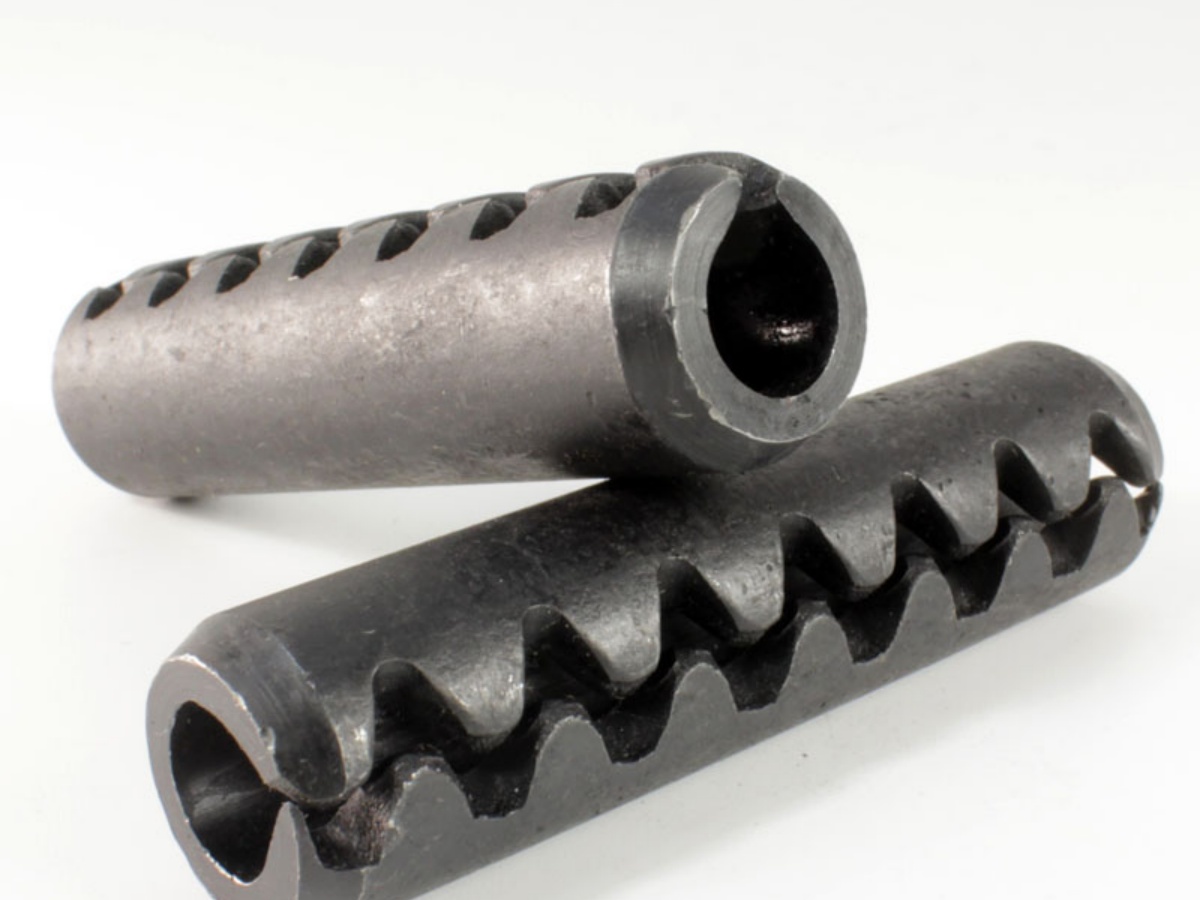
A slotted spring pin is formed from spring material with a longitudinal slot running along its body.
The slot allows the pin diameter to contract during insertion.
Slotted spring pins are widely used because they can provide a practical combination of:
Self-retention
Simple installation
Tolerance accommodation
Economical production
Dynamic joint capability
ISO 8752 is one internationally recognized standard associated with slotted spring pins.
Depending on the project, material, dimensions and other requirements should be confirmed against the applicable standard or customer drawing.
A coiled spring pin is formed from material wrapped into multiple coils.
Instead of relying on a single longitudinal slot, its coiled structure allows the pin to compress across its circumference.
Coiled spring pins are available in different duty configurations depending on the applicable specification and application requirements.
They may be considered where engineers need characteristics such as:
Controlled flexibility
Dynamic loading capability
Shock absorption
Contact distribution
Retention
Pin compliance
However, a coiled spring pin should not automatically be described as superior to a slotted spring pin.
The correct choice depends on the joint.
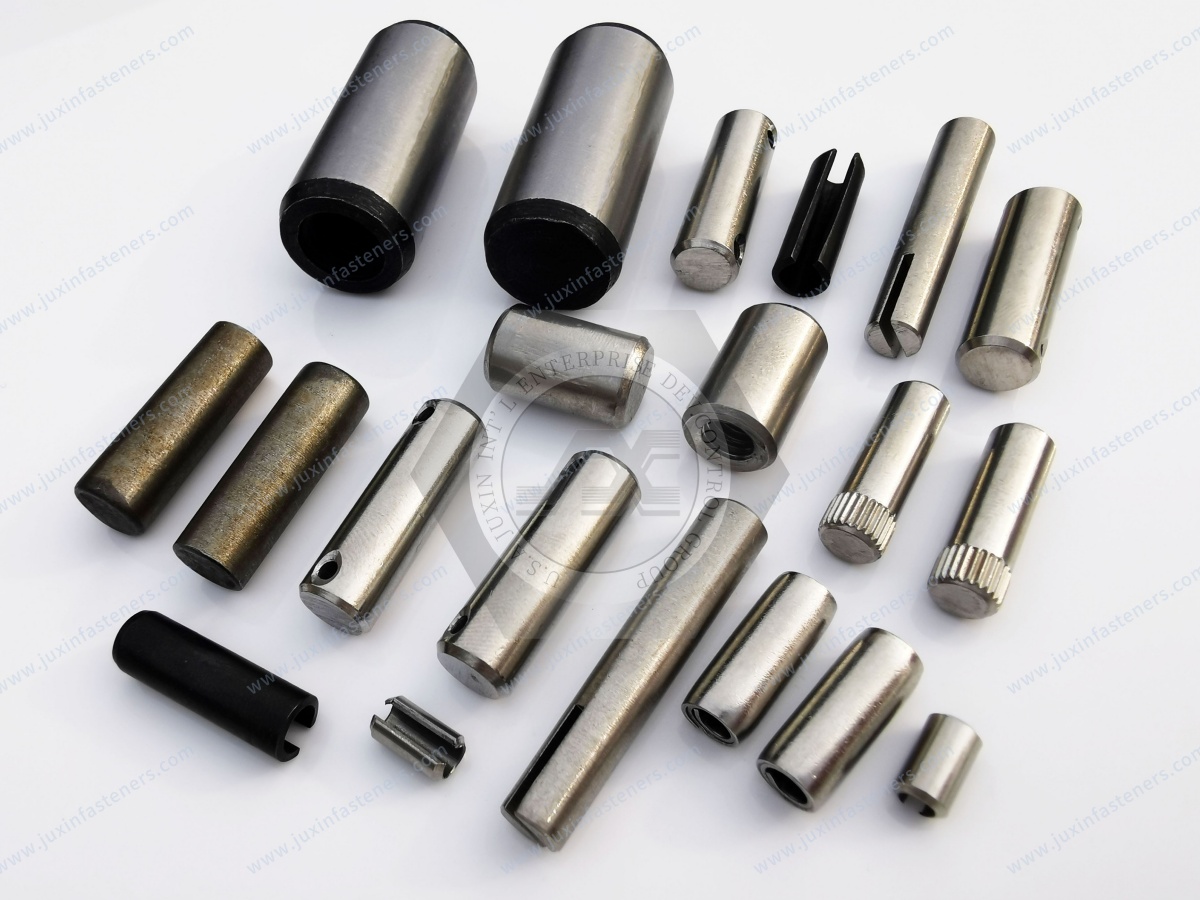
A dowel pin is normally a solid cylindrical precision component used to locate mating parts.
Common terminology includes:
Dowel pin
Cylindrical pin
Parallel pin
Locating pin
Alignment pin
Unlike a spring pin, a solid dowel pin is not designed primarily around radial elastic compression.
Instead, its performance depends heavily on:
Precision diameter
Pin tolerance
Hole diameter
Hole tolerance
Material
Surface condition
Fit
Position of the mating holes
This makes dowel pins particularly important in assemblies requiring repeatable positioning.
Typical functions include:
Locating machine components
Aligning housings
Registering tooling
Positioning fixtures
Aligning molds and dies
Establishing assembly datums
Maintaining repeatable component position
Supporting designed shear-load transfer
Recognized international cylindrical and parallel pin standards include specifications such as ISO 8734 and ISO 2338 for their respective pin categories.
The applicable standard should be selected according to the actual material, dimensional and functional requirements.
The simplest engineering distinction is:
Spring pin = compliant, self-retaining pin
Dowel pin = precision solid locating pin
That difference affects almost every aspect of joint design.
| Engineering Factor | Spring Pin | Dowel / Cylindrical Pin |
|---|---|---|
| Basic Construction | Hollow resilient structure | Usually solid precision cylinder |
| Primary Design Principle | Elastic compression | Controlled geometry and fit |
| Self-Retention | Characteristic of the design | Depends on fit and joint design |
| Precision Location | Application-dependent | Common primary function |
| Hole Requirements | Designed around spring-pin installation | Controlled according to required locating fit |
| Tolerance Accommodation | Can accommodate some variation by elastic compression | Depends strongly on precision fit |
| Dynamic Loading | Often a reason for selecting a spring pin | Depends on joint design and material |
| Shock Response | Compliance can be useful | Solid pin behaves differently |
| Shear Load | Must be evaluated by pin design and application | Must be evaluated by material, geometry and joint |
| Repeated Assembly | Application-dependent | Fit strategy must account for serviceability |
| Installation | Typically pressed or driven into specified hole | Depends on fit; may require controlled pressing |
| Main Selection Driver | Retention and compliance | Positioning and dimensional control |
This table should be used as a selection framework rather than a universal performance ranking.
Before selecting a pin, define its primary function.
Ask:
Is the pin locating the components?
Is it retaining the components?
Is it acting as a pivot?
Is it transferring shear load?
Is it absorbing dynamic movement?
Must the assembly be repeatedly removed?
Is high positional repeatability required?
Different answers lead to different pin families.
If the primary requirement is accurate relative positioning between two components, a precision dowel pin is usually the more relevant family to evaluate.
Typical examples include:
Gearbox housing alignment
Machine-tool assemblies
CNC fixtures
Inspection fixtures
Injection molds
Stamping dies
Automation tooling
Precision equipment housings
The design objective is not merely to keep the parts together.
It is to make them return to a controlled position.
A spring pin becomes particularly relevant when the assembly benefits from the pin's ability to compress and remain retained against the hole wall.
Potential applications include:
Mechanical linkages
Hinges
Latches
Shafts
Handles
Levers
Automotive mechanisms
Agricultural equipment
Industrial machinery
Here, the assembly may not require the same locating precision as a ground dowel-pin system.
One of the biggest mistakes when switching between pin types is assuming the same hole can be used.
It should not be assumed.
A spring pin and a precision dowel pin interact with the mating hole differently.
The spring pin is designed to compress when installed into an appropriately specified hole.
The hole therefore influences:
Installed pin diameter
Retention
Insertion force
Pin stress
Joint behavior
The correct hole should be determined from the applicable pin specification, pin size, material and application requirements.
Using an undersized hole does not simply make the joint “stronger.”
It may increase installation stress or create assembly problems.
A precision dowel-pin hole is part of a controlled fit system.
The designer must consider:
pin diameter + pin tolerance + hole diameter + hole tolerance + material + temperature + surface condition
Depending on the application, the design may require:
Interference fit
Transition fit
Clearance fit
Fixed pin on one side and removable mating component on the other
There is no universal dowel-pin hole tolerance appropriate for every assembly.
Because a spring pin is compliant, it can accommodate a degree of hole variation within the limits of the selected design.
That does not mean hole tolerance is unimportant.
Excessive variation can still affect:
Retention
Installation force
Joint movement
Fatigue behavior
Pin performance
“Spring pin” should never be interpreted as “no precision required.”
A precision dowel pin cannot compensate for poor mating-hole position simply because its diameter is accurately ground.
If two locating holes are incorrectly positioned, forcing precision pins into them can create:
Assembly difficulty
Internal stress
Distortion
Binding
Loss of repeatability
This is why dowel-pin design must consider both size tolerance and positional tolerance.
It is tempting to say:
Spring pin = vibration resistant
and
Dowel pin = not vibration resistant.
That is too simplistic.
Spring pins can be useful in dynamic assemblies because their elastic design maintains contact with the hole and can accommodate certain joint conditions.
But a properly designed dowel-pin joint can also operate successfully in equipment exposed to vibration.
The correct question is:
What is causing movement in the joint, and what role is the pin expected to play?
Vibration performance depends on the complete assembly, not the product name alone.
A compliant spring pin behaves differently from a rigid solid pin under impact.
This can make spring pins useful in some dynamic mechanisms.
However, shock resistance cannot be selected from the words “spring pin” alone.
Engineers should evaluate:
Pin type
Diameter
Material
Hole condition
Joint geometry
Load direction
Load magnitude
Load frequency
Required life
A coiled or slotted pin should be selected according to the actual dynamic requirements.
There is no universal answer.
A solid hardened steel dowel pin may provide substantial shear capability in an appropriately designed joint.
A spring pin can also transfer shear loads in applications for which it is correctly selected.
But comparing them only by nominal diameter is incomplete.
Shear performance depends on:
Pin construction
Material
Heat treatment
Diameter
Wall or coil configuration
Number of shear planes
Mating material
Hole geometry
Static or cyclic loading
For load-critical applications, use engineering calculations and applicable manufacturer or standard data rather than generic statements such as “very high shear strength.”
A dowel pin can locate parts and may also participate in load transfer.
But engineers should determine whether the pin is intended to:
locate the components
or
carry operating load
or both.
In a bolted assembly, bolts may provide clamp load while dowel pins establish location.
The friction created by the clamped joint may carry part of the operating load.
Understanding the load path is essential.
Spring pins can be used in certain hinge and pivot mechanisms.
Solid pins can also be designed as pivot pins.
But a precision dowel pin should not automatically be used as a rotating bearing surface merely because it is cylindrical.
For pivot applications, engineers should evaluate:
Rotation angle
Frequency
Bearing pressure
Lubrication
Wear
Pin hardness
Mating material
Retention
Replacement requirements
If the primary function is pivoting rather than locating, another pin family may sometimes be more appropriate.
Repeated disassembly changes the selection logic.
A tight solid interference-fit pin may be appropriate for permanent retention but inconvenient if frequent removal is required.
Possible alternatives include:
Internally threaded dowel pins
Removable locating pins
Controlled clearance locating systems
Quick-release pins
Other serviceable pin designs
Spring pins can also be removed and replaced in many assemblies, but reusability should not be assumed universally.
The condition of both the pin and hole must be considered.
Once a spring pin has been selected, the next decision may be whether the application requires a slotted or coiled design.
A slotted spring pin may offer:
Simple construction
Broad industrial use
Efficient installation
Economical fastening
A coiled spring pin may be considered where the joint benefits from:
Different flexibility characteristics
Distributed contact
Dynamic performance
Shock management
Application-specific duty requirements
The decision should be based on the joint requirements rather than assuming one design is universally more advanced.
ISO 8734 hardened parallel pins and spring pins represent two very different locating and fastening strategies.
An ISO 8734 pin is particularly relevant where the assembly requires a standardized hardened precision locating component.
A spring pin is more relevant where elastic compression and self-retention are part of the joint design.
If the application primarily requires:
precision repeatable location → evaluate ISO 8734 / precision dowel pins
If it primarily requires:
compliant retention → evaluate spring pins
For detailed standardized locating-pin selection, see our ISO 8734 Parallel Pins engineering guide.
Spring pins require materials and processing capable of providing the elastic behavior required by the design.
Depending on specification and application, materials can include appropriate spring steels and stainless steel grades.
Material selection should consider:
Required spring behavior
Strength
Fatigue
Corrosion
Temperature
Surface finish
Environment
A material should not be substituted simply because both options are described as “steel.”
Dowel pins can be manufactured from materials such as:
Hardened carbon or alloy steel
Martensitic stainless steel
Austenitic stainless steel
Aluminum
Other drawing-specified materials
The appropriate material depends on:
Precision requirement
Wear
Load
Corrosion
Temperature
Weight
Mating material
Cost
For high-wear locating applications, see our Hardened Steel & Martensitic Stainless Steel Dowel Pins guide.
For lightweight applications, see our Aluminum Dowel Pins & Precision Locating Pins guide.
The term “stainless spring pin” or “stainless dowel pin” does not define one corrosion performance level.
304, 316 and martensitic stainless grades have different properties.
Environmental evaluation should consider:
Moisture
Chlorides
Chemicals
Cleaning agents
Temperature
Mating materials
For marine or chemical equipment, material selection should be based on the actual exposure condition rather than the generic word “stainless.”
Spring pins can be used in selected automotive mechanisms and production equipment where retention, movement or dynamic behavior makes their compliant design useful.
Potential applications include:
Linkages
Hinges
Latches
Seat mechanisms
Actuation systems
Production tooling
Assembly equipment
Final selection should follow the customer's drawing and validation requirements.
Precision dowel pins may be used for:
Machined housing alignment
Transmission-related assemblies
Production fixtures
Welding fixtures
Inspection tooling
Assembly equipment
Here, repeatable alignment can be more important than elastic retention.
Both pin families can be relevant to automation equipment but for different reasons.
Spring pins may be used in:
Mechanical linkages
Hinges
Retaining connections
Moving mechanisms
Dowel pins may be used in:
Fixture positioning
Tooling alignment
Robot cell components
Machine-module alignment
Inspection equipment
The required function determines the product family.
Equipment exposed to shock, dirt and repeated mechanical movement can use different pin systems throughout the same machine.
Spring pins may be selected for certain retained or moving joints.
Precision solid pins may be used where accurate alignment or controlled load transfer is required.
Heavy equipment therefore should not be treated as a “spring pin application” or a “dowel pin application” in general.
Each joint should be evaluated independently.
Electrical cabinets, power equipment and industrial machinery can use pins for:
Hinges
Alignment
Mechanism retention
Assembly fixtures
Equipment positioning
Material and pin family should be selected according to:
Mechanical function
Corrosion environment
Electrical requirements
Serviceability
Production method
Potential problems can include:
Incorrect hole size
Excessive installation force
Inadequate retention
Pin fatigue
Hole wear
Incorrect material
Wrong pin duty or construction
Improper installation
These issues are often joint-design problems rather than simply “bad pins.”
Potential problems can include:
Incorrect fit
Hole-position error
Galling
Pin wear
Mating-hole wear
Excessive interference
Difficult removal
Corrosion
Heat-treatment distortion
Improper surface treatment
Again, the pin and mating component should be treated as one engineering system.
Use this sequence during early design.
If yes, evaluate a precision dowel or cylindrical pin.
If yes, evaluate a spring pin.
Evaluate the load cycle, shock, hole condition and pin construction before choosing slotted, coiled or solid designs.
Calculate the joint using the actual pin material, geometry and load condition.
Consider removal, hole wear, extraction features and replaceability.
Specify the actual material grade and environment rather than simply requesting “stainless.”
Where possible, evaluate standardized pin families before creating an unnecessary custom component.
A standard spring or dowel pin may be appropriate when:
Standard geometry satisfies the joint
Standard material satisfies the environment
Replacement availability matters
Production cost benefits from standardization
A custom pin may be appropriate when the design requires:
Special diameter
Special length
Stepped geometry
Shoulder
Thread
Groove
Cross hole
Special end geometry
Special material
Special tolerance
Multiple functions in one component
Custom manufacturing should solve a functional problem rather than create complexity without benefit.
For spring-pin sourcing, provide:
Pin type: slotted or coiled
Applicable standard
Diameter
Length
Material
Finish
Mating-hole diameter and tolerance where relevant
Mating material
Joint function
Load condition
Corrosion environment
Installation method
Prototype quantity
Production quantity
Estimated annual volume
Inspection requirements
Documentation requirements
For precision dowel-pin sourcing, provide:
Applicable standard or customer drawing
Nominal diameter
Diameter tolerance
Length
Material
Heat treatment
Hardness where required
Surface finish
Surface treatment
Mating-hole information
Mating material
Fit requirement
Operating temperature
Load condition
Assembly/disassembly frequency
Inspection requirements
Prototype quantity
Production quantity
Estimated annual volume
“Roll pin” is commonly used as a market term for spring pins, although the exact pin construction should still be identified as slotted, coiled or another specified design.
No.
A conventional dowel pin is generally a solid precision locating component, while a spring pin uses elastic compression as a fundamental part of its installation and retention.
A precision dowel or cylindrical pin is generally the more relevant product family when accurate repeatable location is the primary design requirement.
The actual accuracy still depends on both the pin and mating-hole system.
There is no universal answer.
Spring pins are often selected for dynamic joints because of their compliant design, but vibration performance depends on the entire assembly.
Nominal pin type alone is insufficient to answer this.
Material, geometry, construction, diameter, joint configuration and loading must be evaluated.
Not automatically.
Changing from a solid precision pin to a spring pin changes the fit, retention mechanism, stiffness and potentially the locating behavior of the joint.
The assembly should be reviewed before substitution.
Not automatically.
A solid pin may require different hole dimensions and may eliminate the compliance and self-retention that were part of the original design.
It depends on the application, pin condition, hole condition and applicable requirements.
For critical joints, reusability should be defined by the engineering specification rather than assumed.
Not always.
The required fit depends on whether the pin must be permanently retained, removable, used as a locator, or used in another assembly strategy.
Yes. JUXIN FASTENERS supports standard and drawing-based slotted spring pins, coiled spring pins, precision dowel pins, cylindrical pins, locating pins and custom machined pin components for OEM applications.
Choosing between a spring pin and a dowel pin starts with the joint function—not with the product name.
For engineers, the selection path is:
function → precision → retention → load → dynamics → hole → material → fit → environment → validation
For procurement and supplier-development teams, the sourcing path is:
standard/drawing → material → dimensions → mating-hole requirements → application review → quotation → sample → validation → production
JUXIN FASTENERS supplies slotted spring pins, coiled spring pins, hardened dowel pins, precision cylindrical pins,
stainless steel locating pins and custom precision pins for automotive, machinery, automation, electrical equipment and global OEM manufacturing projects.
For related engineering information, explore our guides to Precision Dowel Pins, ISO 8734 Parallel Pins, Aluminum Dowel Pins, and Hardened Steel & Martensitic Stainless Steel Dowel Pins.
Send us your drawing, sample, 3D model or technical requirements for engineering review and quotation.
JUXIN FASTENERS
FASTENING SOLUTIONS FOR GLOBAL OEMS
Website: www.juxinfasteners.com
Email: info@juxinfasteners.com
 MORE NEWS
Sep. 27, 2026
Sep. 27, 2026
Sep. 27, 2026
Contact Us
Tel.:
+86 020 8621 0320
+86 020 3121 6067
E-mail:
Technical Support:
Navigation
SEND INQUIREY