
Call Us
+86 136 6007 9809
Call Us
+86 136 6007 9809

Sep. 09, 2023
Flat washers, spring washers and products commonly called lock washers are used throughout industrial fastening systems,
but they should not be treated as three equivalent washer categories with simply increasing levels of locking performance.
They solve different engineering problems.
A flat washer is primarily a bearing-interface component.
A spring washer uses elastic geometry to provide spring behavior.
A locking washer system is intended to resist unwanted fastener rotation through a defined mechanical or frictional mechanism.
The terminology becomes confusing because some traditional spring washers are themselves historically called spring lock washers.
Therefore, the better engineering question is not:
“Which washer is strongest?”
It is:
“What function does this bolted joint require?”
A practical selection path is:
Joint Requirement → Bearing / Elastic / Locking Function → Washer Mechanism → Fastener Interface → Parent Material → Dimensions → Material → Finish → Validation
JUXIN FASTENERS supplies industrial washers, spring washers, screws, bolts, nuts, locking fasteners and custom fastening components for OEM and drawing-controlled industrial applications.
| Washer / System | Primary Engineering Function | Main Selection Question |
|---|---|---|
| Flat washer | Bearing load distribution and surface protection | What bearing area and interface does the joint require? |
| Split spring washer | Elastic washer behavior; traditional spring-lock application | Does the approved joint actually require this washer geometry? |
| Wave washer | Axial compliance / clearance control | What load-deflection behavior is required? |
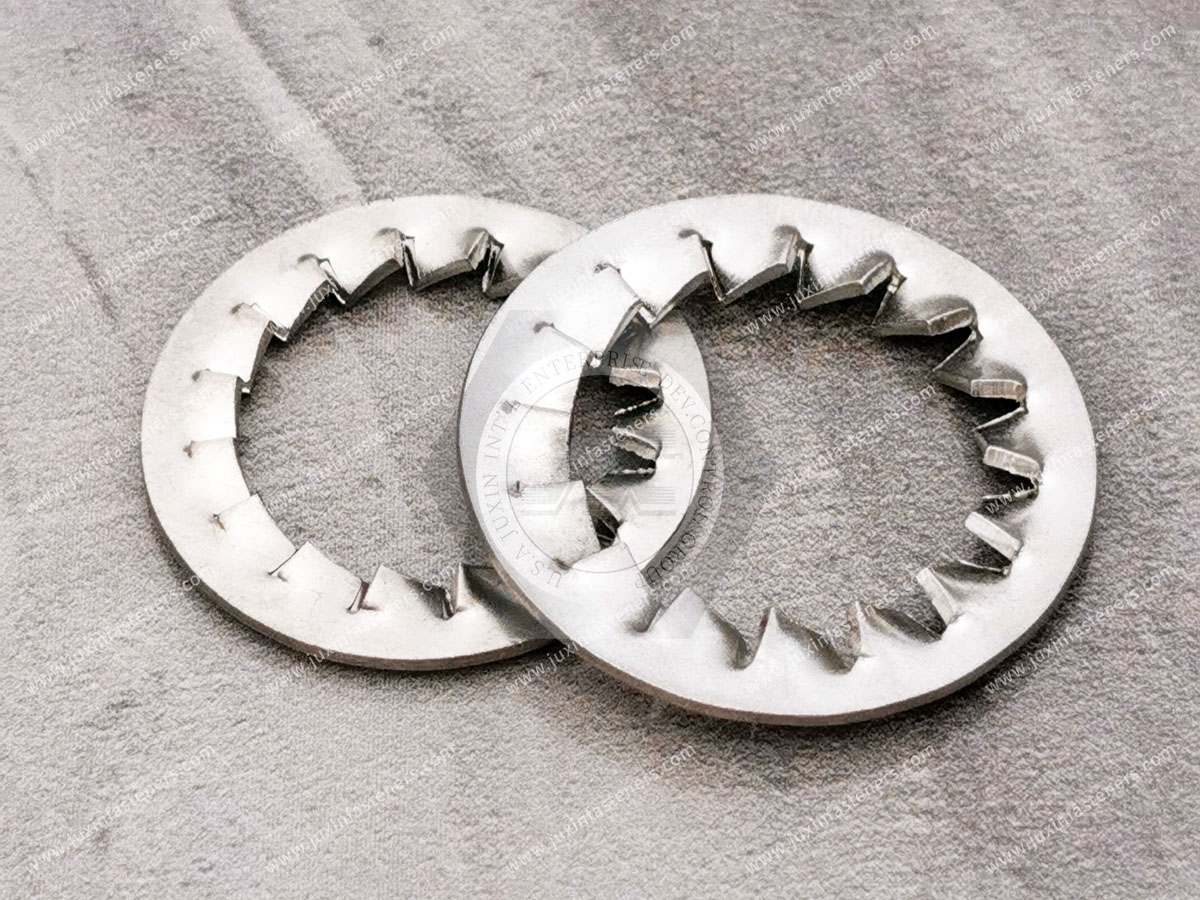
| Toothed lock washer | Surface-interaction locking mechanism | Are the mating surfaces compatible with the teeth? |
| Wedge-locking washer pair | Engineered resistance to rotational self-loosening | Does the joint require dedicated vibration-resistant locking? |
| Sealing washer | Sealing interface | What fluid, pressure, temperature and surface conditions apply? |
This comparison is more useful than ranking washers as having “low,” “medium” or “high” locking ability.
Different washer designs operate through different physical mechanisms.
This is an important terminology issue.
The term flat washer generally describes a plain washer geometry.
The term spring washer describes a broad family of washers designed to provide elastic behavior.
The term lock washer is a functional or historical product description that can include different geometries.
For example, ASME B18.21.1 covers applicable inch-series:
helical spring-lock washers;
tooth-lock washers;
plain washers.
This means a helical spring washer may itself be called a spring-lock washer.
Therefore:
Spring Washer vs Lock Washer
is not always a comparison between two mutually exclusive product families.
The exact washer geometry must be identified.
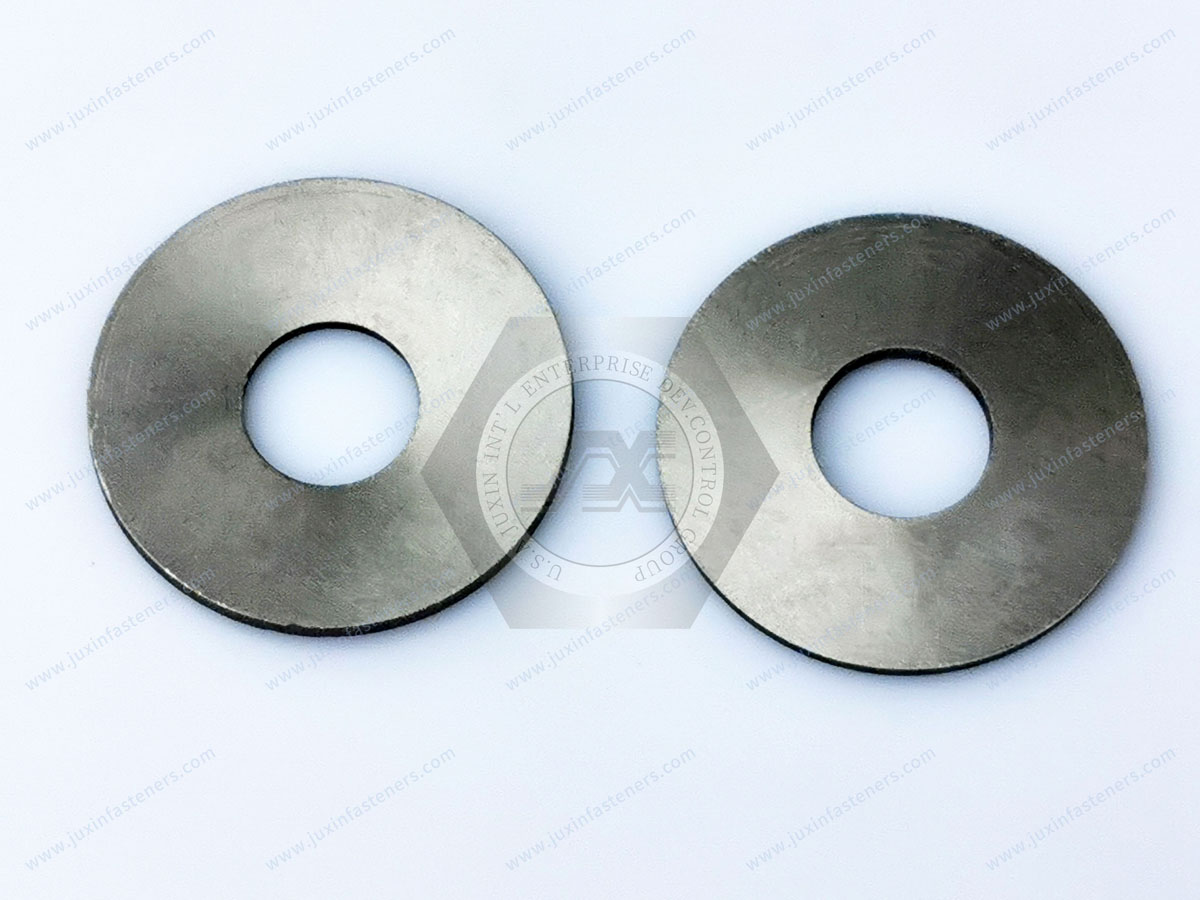
A flat washer is generally a flat annular component installed under a bolt head, screw head or nut.
Its principal function is usually related to the bearing interface rather than locking.
Depending on the joint, a flat washer may:
distribute bearing load;
protect a mating surface;
reduce localized indentation;
bridge an appropriate clearance hole;
provide a controlled bearing surface;
support a specified bolted-joint configuration.
A flat washer should not automatically be treated as an anti-loosening component.
When a bolt or nut is tightened, clamp load is transferred through its bearing surface into the connected component.
A suitably selected washer can increase the effective bearing area.
This can be useful when the parent material is:
relatively soft;
thin;
coated;
aluminum;
polymeric;
otherwise sensitive to localized bearing pressure.
However:
Larger Washer ≠ Automatically Stronger Joint
Engineers must also consider:
washer thickness;
hole diameter;
edge distance;
parent-material strength;
fastener preload;
surrounding geometry.
High-strength fasteners can develop substantial clamp loads.
The bearing interface therefore becomes an important part of the joint.
Depending on the applicable fastener system, engineers may need to specify:
washer standard;
dimensions;
hardness;
material;
surface treatment.
A general-purpose flat washer should not automatically be substituted for a specified hardened washer.
For more detail, see Flat Washer Hardness & Bolt Grade Selection Guide.
A spring washer uses elastic geometry to deform under load.
However, spring washer is a broad term rather than one single product.
Examples can include:
split/helical spring washers;
wave washers;
curved spring washers;
disc springs;
other engineered spring washer geometries.
These products do not all perform the same function.
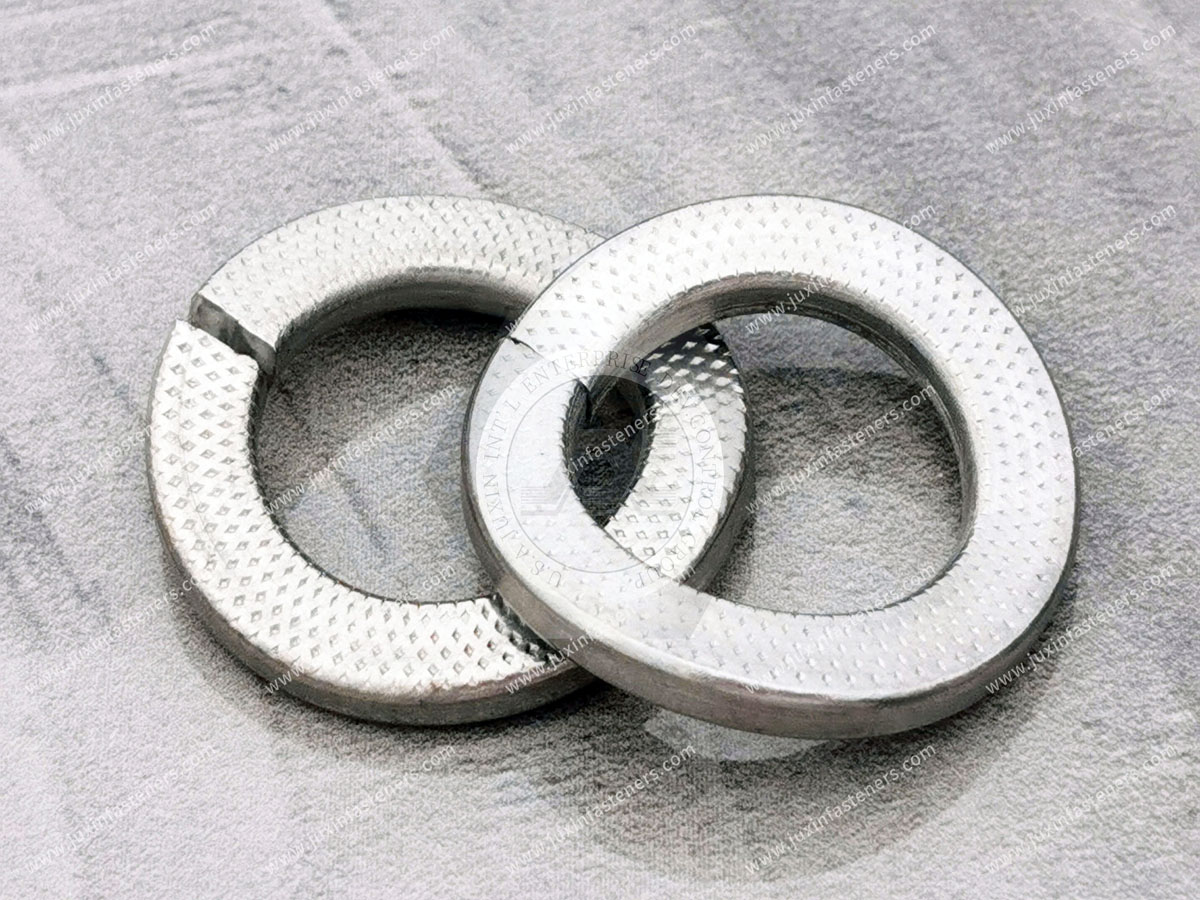
The familiar split spring washer has a helical ring geometry with a split.
During tightening, it compresses toward a flatter condition.
Historically, it has been used in assemblies where a spring-lock washer is specified.
However, the existence of spring force does not mean the washer can automatically maintain the full preload of a bolted joint.
This distinction is important:
Spring Washer Force ≠ Bolt Preload
Split/helical spring washers are frequently called:
spring lock washers;
split lock washers;
helical spring-lock washers.
The word lock can create an expectation that the washer guarantees resistance to loosening.
That is not the correct engineering interpretation.
ASME B18.21.1 notes that the word “lock” in these product names is a generic term historically associated with product identification and does not imply indefinite permanency of the attachment.
Therefore:
Product Name ≠ Guaranteed Locking Performance
Not reliably in every joint.
Its behavior depends on:
preload;
washer geometry;
mating surfaces;
joint stiffness;
external loading;
transverse movement;
friction;
installation condition.
For severe vibration or safety-critical applications, engineers should not assume that a conventional split washer alone provides sufficient rotational locking.
For a deeper analysis, see Do Spring Washers Prevent Bolt Loosening?.
Engineering guidance for high-consequence fastening systems provides a useful warning against relying on product names.
NASA fastener guidance states that free-spinning split lock washers provide minimal, if any, locking and should not be used as secondary locking features.
That guidance applies to NASA's own high-reliability context rather than every commercial machine.
However, it illustrates an important engineering principle:
Do not assume locking performance solely because a washer is called a “lock washer.”
The term lock washer can describe different products intended to resist unwanted fastener rotation.
There is no single universal lock-washer mechanism.
Depending on the design, locking can involve:
surface interaction;
teeth;
serrations;
wedge geometry;
elastic geometry;
other engineered features.
This means a purchasing specification such as:
“M8 lock washer”
may be incomplete.
The buyer should identify the actual locking-washer type.
Toothed lock washers use teeth that interact with adjacent bearing surfaces.
Depending on the design, teeth can be:
internal;
external;
arranged according to the specific product geometry.
Their function depends on interaction between the teeth and mating surfaces.
This creates important selection questions.
A toothed washer can only interact with the bearing surface according to the mechanical properties of that interface.
Engineers should consider:
mating-surface hardness;
washer hardness;
coating;
paint;
plating;
parent material;
surface-finish requirements.
If the teeth damage a functional coating or decorative surface, the washer may create a new problem while attempting to solve loosening.
A toothed washer may increase resistance to relative rotation in an appropriate joint.
However, it should not automatically be described as a universal high-vibration solution.
Locking performance depends on the complete joint.
If the joint itself slips under transverse loading, engineers need to understand that movement rather than relying solely on washer teeth.
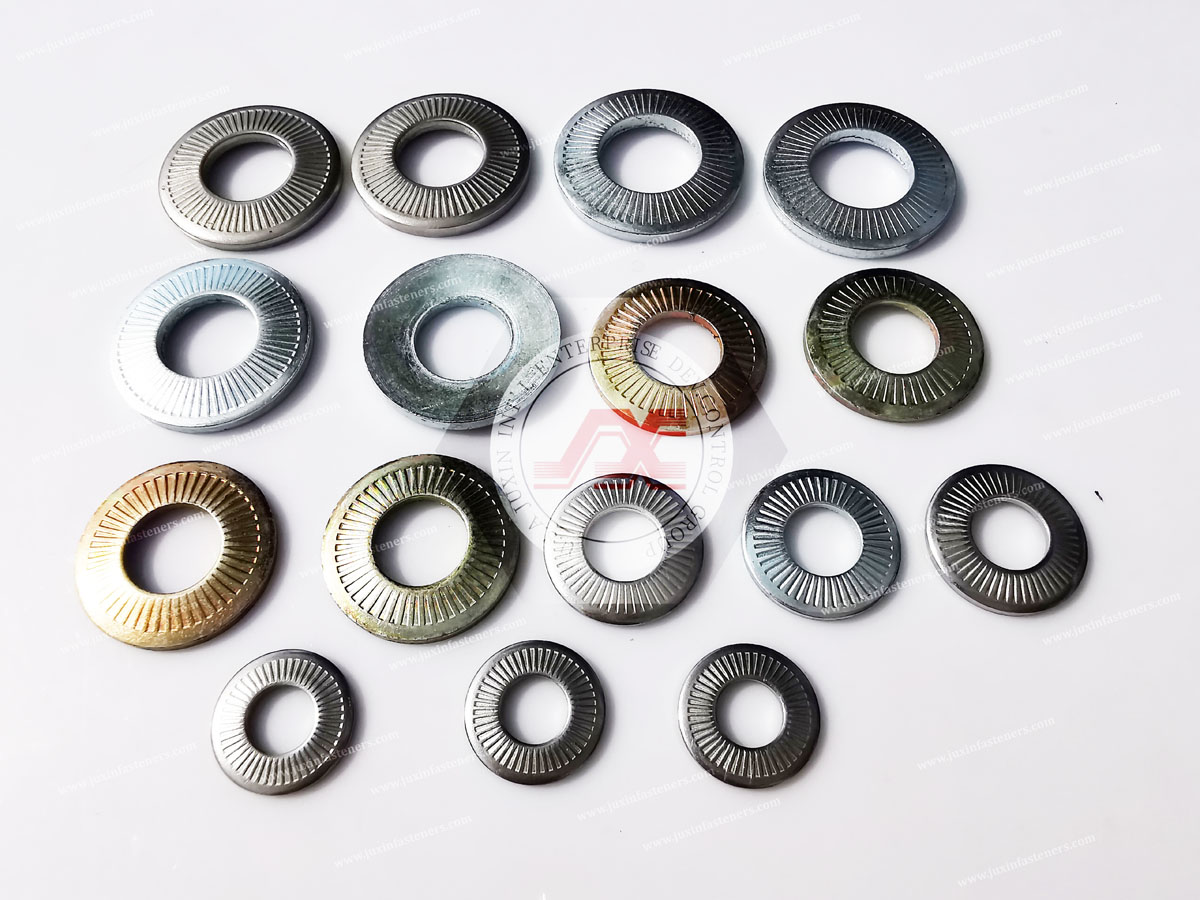
Wedge-locking washers use a fundamentally different mechanism from conventional split spring washers.
A typical wedge-locking system consists of a matched pair of washers.
The washers use engineered cam geometry on their mating faces and surface features on the external faces.
During attempted loosening, relative movement across the cam interface can create a wedge effect that opposes fastener rotation.
This is a dedicated locking mechanism rather than simply spring action.
These products should not be grouped together merely because both can be marketed as locking washers.
Uses a helical elastic washer geometry.
Uses engineered cam geometry between two matched washers.
The mechanical principles are different.
Therefore:
Split Washer ≠ Wedge-Locking Washer
Commercial wedge-locking systems are specifically engineered for bolted joints exposed to vibration and dynamic loading.
For example, established wedge-locking technology uses paired cam washers where the cam angle is designed relative to the thread geometry so attempted loosening creates a wedge effect.
This type of system should be evaluated according to the specific manufacturer's technical requirements, joint geometry and validation data.
JUXIN FASTENERS should not claim that an unspecified generic washer automatically provides equivalent performance to a proprietary engineered wedge-locking system.
The original version of this article used a simple comparison:
Flat Washer → Low
Spring Washer → Medium
Lock Washer → High
That model is misleading.
A flat washer may not be intended to lock at all.
A split spring washer uses one mechanism.
A toothed washer uses another.
A wedge-locking pair uses another.
A sealing washer solves a different problem entirely.
The better comparison is:
Function + Mechanism + Joint Condition + Validation
not:
Low + Medium + High
Use this comparison when the decision is primarily between bearing support and elastic washer behavior.
Typically selected for:
bearing load distribution;
surface protection;
controlled bearing interface.
Selected where the particular spring geometry provides a required elastic function or where an approved drawing specifies that washer.
The choice depends on function rather than vibration alone.
These products solve different problems.
A flat washer primarily manages the bearing interface.
A locking washer is intended to resist unwanted rotation through a specific mechanism.
In some assemblies, both bearing and locking functions may be required.
However, that does not automatically mean two washers should be stacked together.
This comparison requires careful terminology.
A split spring washer can itself be a type of lock washer.
Therefore, engineers should instead ask:
Split Spring Washer vs Toothed Lock Washer?
or:
Split Spring Washer vs Wedge-Locking Washer?
That produces a technically meaningful comparison.
Traditional assemblies sometimes place a flat washer and spring washer in the same fastener stack.
But:
More Washers ≠ Better Joint
Adding components can change:
stack height;
thread engagement;
bearing interfaces;
friction;
settlement behavior;
installation consistency.
If an existing approved drawing requires both, follow the specification.
For a new design, the washer stack should have a defined engineering purpose.
Every additional component introduces another interface into the joint.
These interfaces can affect:
friction;
embedment;
settlement;
tolerance stack-up;
assembly height.
Therefore, washer stacking should not be treated as a universal method for improving locking.
A wave washer is another type of spring washer.
Its function is usually different from that of a split spring-lock washer.
Wave washers can provide axial compliance in applications such as:
bearings;
electric motors;
shaft assemblies;
compact mechanical mechanisms.
Selection is commonly based on required load-deflection behavior and installation geometry.
A wave washer should not automatically be selected because an assembly experiences vibration.
Its primary purpose may be:
axial preload;
clearance compensation;
tolerance management.
This demonstrates why spring washer is too broad a term for precise engineering selection.
A disc spring is a conical spring component capable of generating defined axial force through controlled deflection.
Selection can involve:
outside diameter;
inside diameter;
thickness;
free height;
installed height;
load;
deflection;
stacking arrangement;
fatigue requirement.
Disc springs are engineered spring elements and should not be treated as ordinary lock washers.
A useful way to classify washers is by required function.
| Required Function | Washer / Fastener Direction |
|---|---|
| Bearing load distribution | Flat/plain washer |
| Surface protection | Flat/plain washer |
| High-load bearing interface | Applicable hardened washer |
| Axial compliance | Wave washer / spring element |
| Defined high spring force | Disc spring where appropriate |
| Traditional split spring-lock geometry | Split/helical spring washer |
| Surface-interaction locking | Toothed/serrated system where appropriate |
| Dedicated wedge locking | Engineered wedge-locking washer pair |
| Fluid sealing | Dedicated sealing washer/system |
| Rotational locking without washer dependence | Evaluate prevailing-torque or positive-locking fasteners |
This is more useful than choosing a washer by appearance.
A washer-based locking system is not the only way to resist unwanted fastener rotation.
Prevailing-torque nuts can provide rotational resistance through the threaded interface.
These can include:
nylon-insert locknuts;
all-metal prevailing-torque nuts.
The correct choice depends on:
temperature;
thread size;
bolt specification;
environment;
disassembly;
reuse;
joint requirements.
For polymer-insert locking systems, see Nylon Insert Locknuts for Anti-Vibration Applications.
Thread-locking compounds operate at the thread interface rather than through washer geometry.
Selection can depend on:
required locking strength;
temperature;
chemical exposure;
surface condition;
production process;
serviceability.
A chemical thread-locking system and a mechanical washer-based system should not be treated as identical solutions.
Some high-consequence applications use positive mechanical locking.
Examples can include:
castellated nuts with cotter pins;
locking plates;
tab washers;
safety wire in appropriate controlled applications.
These physically restrict fastener rotation or disengagement.
They operate differently from friction-based or washer-based systems.
Rotational self-loosening can occur when cyclic loading creates sufficient relative movement in the joint.
Transverse movement is particularly important.
Therefore, when a bolt loosens, engineers should evaluate:
preload;
joint stiffness;
clamp length;
external load;
interface slip;
bearing surfaces;
friction;
installation consistency.
Simply changing washer type may not solve the root cause.
A joint can lose clamp force without the nut or bolt rotating.
Possible causes include:
embedment;
material relaxation;
creep;
thermal effects;
gasket compression;
parent-material deformation.
If preload is being lost without rotation, installing a more aggressive “lock washer” may not address the failure mechanism.
When the parent material is relatively soft, a flat washer may be useful for distributing bearing load.
Examples can include:
aluminum;
polymers;
thin sheet;
coated surfaces.
However, the washer does not eliminate the need to evaluate:
bearing pressure;
material creep;
local deformation;
edge distance;
hole geometry.
Toothed or serrated locking washers may interact aggressively with a coated surface.
This can:
damage paint;
penetrate plating;
expose substrate material;
affect corrosion protection;
change electrical contact.
This may be intentional in a specifically designed system, or it may be unacceptable.
The surface requirement must therefore be known before selecting the locking mechanism.
Stainless steel washers can be appropriate for corrosion-sensitive applications, but stainless steel is not universally corrosion-proof.
Selection should consider:
stainless grade;
chlorides;
humidity;
chemicals;
temperature;
mating materials;
galvanic compatibility.
Material grade should be specified rather than simply requesting “stainless washer.”
Carbon steel washers are widely used in industrial equipment.
Depending on the project, they may require:
zinc-based coating;
trivalent chromium passivation;
other customer-specified surface treatments.
For applicable JUXIN FASTENERS projects, environmentally compliant trivalent chromium zinc systems can be evaluated where required.
Where salt spray/fog testing is specified, ASTM B117 may be used as a test method.
However:
Salt Spray Hours ≠ Direct Service-Life Prediction
The project should define:
coating;
test duration;
acceptance criteria.
A corrosion-test method alone does not establish field durability.
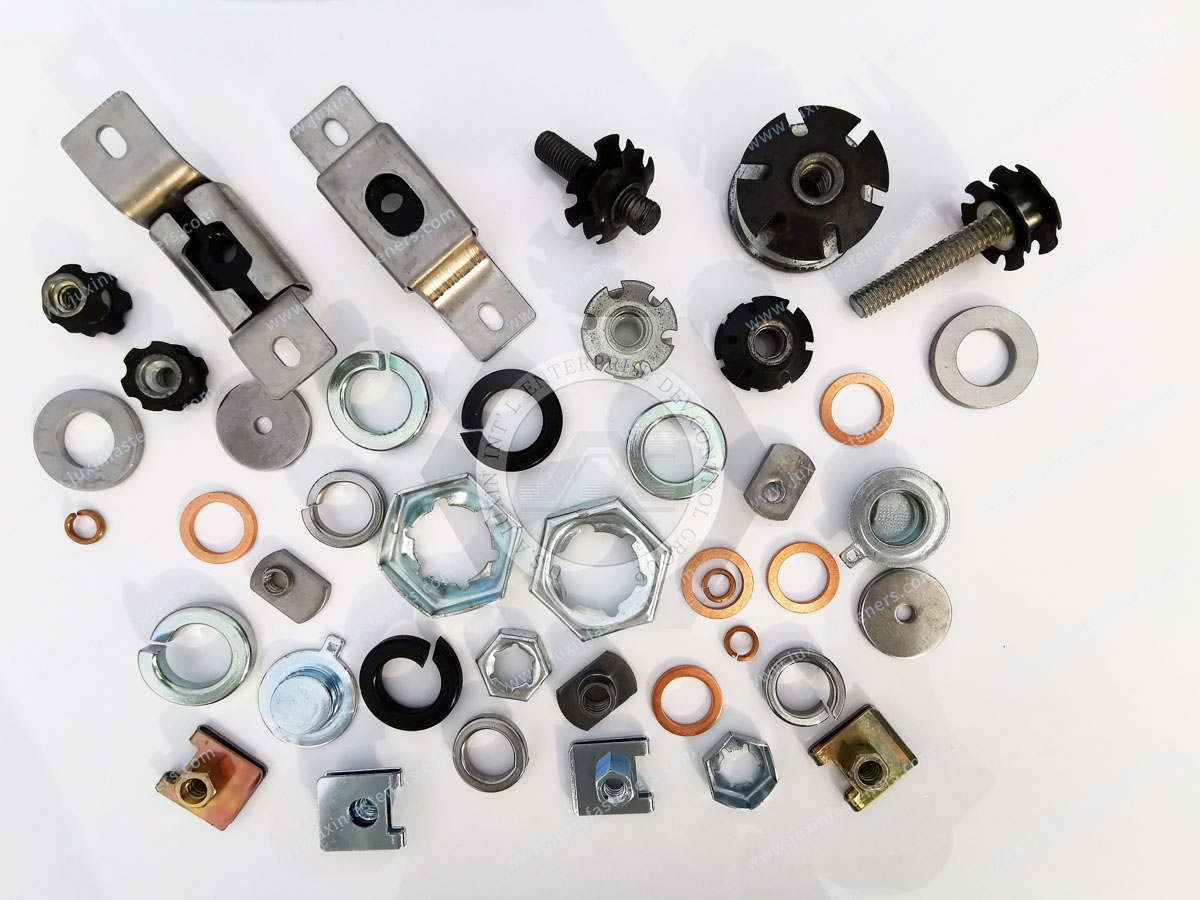
DIN 127 spring lock washers continue to appear in older industrial drawings and replacement-part requirements.
However, DIN 127 is a withdrawn standard.
That creates an important sourcing distinction:
Legacy Replacement ≠ New Design Recommendation
If an existing customer drawing specifies DIN 127, procurement should determine whether the requirement is:
exact legacy replacement;
compatibility with existing equipment;
or redesign using a current fastening strategy.
The original drawing should not be silently changed by the supplier.
For applicable inch-series products, ASME B18.21.1 covers dimensional requirements, physical properties and related test methods for:
helical spring-lock washers;
tooth-lock washers;
plain washers.
The standard also provides an important terminology warning: the word “lock” is historically associated with product identification and does not imply indefinite permanency of the attachment.
This makes ASME B18.21.1 especially relevant to understanding why washer names and actual joint performance must be separated.
Automotive equipment contains many different washer applications.
Flat washers may be used where a controlled bearing interface is required.
Spring washers may appear in existing equipment designs.
Dedicated locking systems may be required where rotational self-loosening is a concern.
Potential applications can include:
brackets;
electrical equipment;
auxiliary systems;
equipment mounts;
serviceable assemblies.
Safety-critical wheel, brake, steering, suspension or crash-related joints require application-specific engineering and validation.
EV and power electronics assemblies can contain washers in:
electronics housings;
auxiliary brackets;
power-conversion equipment;
service structures;
thermal-management equipment;
enclosure hardware.
The washer function should be explicitly defined.
A generic washer should not automatically be described as providing:
IP sealing;
grounding;
EMI/RFI shielding;
battery enclosure structural integrity.
AI data centers, HPC infrastructure and power-conversion systems contain numerous bolted mechanical assemblies.
Potential washer applications include:
server and equipment racks;
power distribution systems;
UPS equipment;
cooling equipment;
electrical enclosures;
auxiliary mounting structures.
Selection should follow the actual mechanical requirement rather than simply specifying a washer because vibration may exist.
HVAC equipment can experience vibration from:
motors;
fans;
compressors;
pumps.
The presence of vibration does not automatically mean a split spring washer is the correct solution.
Engineers should determine:
whether the joint is slipping;
whether the fastener is rotating;
whether preload is being lost;
whether frequent service is required.
Then the locking strategy can be selected.
Machinery applications include:
motors;
pumps;
compressors;
gearboxes;
equipment frames;
guards;
brackets;
service panels.
Different locations within the same machine may require different washer functions.
There is no universal “machine washer.”
Automation equipment can contain:
servo systems;
actuators;
machine frames;
sensors;
equipment covers;
control cabinets.
Some joints require frequent adjustment or disassembly.
Others remain fixed for long service periods.
Serviceability should therefore be included in locking-method selection.
Railway equipment includes ordinary mechanical assemblies as well as highly controlled safety-related joints.
A generic washer should not be represented as suitable for every railway fastening application.
The exact railway project specification and joint classification should control selection.
Construction, agricultural and mining machinery can expose bolted joints to:
shock;
vibration;
contamination;
outdoor exposure;
repeated service.
These conditions make joint analysis particularly important.
A locking washer should not be selected by appearance alone.
Flat washers and other washer types may be used in:
electrical cabinets;
UPS systems;
power distribution equipment;
control enclosures;
mounting structures.
Where electrical bonding or grounding is required, the electrical interface must be separately specified.
A generic toothed washer should not automatically be represented as a qualified grounding solution.
Washers may appear in mechanical assemblies for:
diagnostic equipment;
laboratory equipment;
carts;
housings;
internal brackets;
service panels.
The applicable equipment specification should determine material, finish and cleaning requirements.
A generic stainless washer should not automatically be described as medically certified or sterile-compatible.
An engineer searching:
flat washer vs spring washer
is usually not looking for three product definitions.
They are trying to answer:
Which mechanism does my joint need?
Other engineering searches can include:
spring washer vs lock washer;
lock washer vs flat washer;
split washer vs wedge lock washer;
do lock washers work;
washer for vibration;
flat washer under spring washer;
washer for high-strength bolt;
best locking method for vibrating bolt.
These are decision-stage searches.
Procurement searches can include:
flat washer supplier;
spring washer manufacturer;
lock washer supplier;
split lock washer manufacturer;
industrial washer supplier;
custom washer manufacturer;
OEM washer supplier;
anti-loosening fastener supplier.
The buyer still needs engineering to define which washer mechanism has been approved.
A purchasing request such as:
“Need 50,000 pcs M8 lock washers”
still leaves important questions unanswered.
Which type?
split spring?
toothed?
another locking geometry?
Which standard?
Which material?
Which finish?
Which application?
Which mating fastener?
A professional RFQ should eliminate this ambiguity.
| Engineering Question | Selection Direction |
|---|---|
| Need to distribute bearing load? | Evaluate flat/plain washer |
| Need to protect a soft surface? | Evaluate suitable flat washer dimensions/material |
| Need axial compliance? | Evaluate appropriate spring/wave washer |
| Existing drawing specifies split spring washer? | Follow drawing and applicable specification |
| Need surface-interaction locking? | Evaluate suitable toothed/serrated system |
| Severe rotational self-loosening concern? | Evaluate dedicated locking strategy |
| Need sealing? | Use dedicated sealing system |
| Need electrical isolation? | Evaluate suitable insulating washer/material |
| Need frequent disassembly? | Include serviceability in locking selection |
| High-consequence joint? | Use application-approved locking strategy and validation |
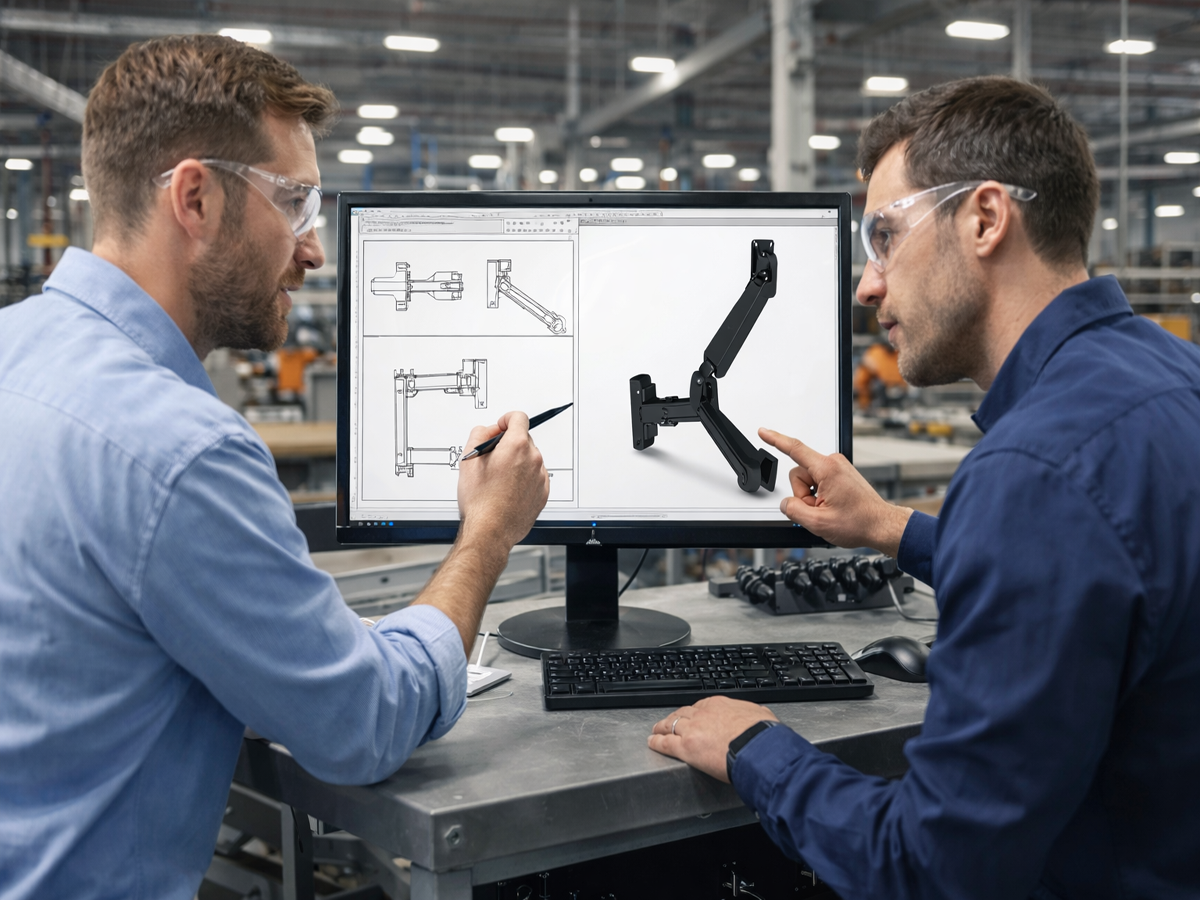
For technical evaluation by JUXIN FASTENERS, provide where applicable:
2D drawing;
3D model where relevant;
physical sample;
customer part number;
existing/reference part number;
washer type;
required washer function;
applicable ISO, DIN, ASME/ANSI, ASTM, SAE, EN, BS or customer specification;
metric or inch system;
mating bolt or screw size;
thread size;
bolt property class or specification;
mating nut specification;
washer inside diameter;
washer outside diameter;
washer thickness;
spring geometry where applicable;
material;
material grade;
hardness requirement;
surface treatment;
coating thickness where specified;
trivalent chromium zinc requirement where applicable;
RoHS/REACH requirement where applicable;
corrosion-test requirement;
parent material;
parent-material thickness;
mating-surface hardness where relevant;
painted or coated surface condition;
hole diameter;
slot dimensions where applicable;
expected vibration;
expected joint movement;
tightening requirement;
operating temperature;
corrosion environment;
locking requirement;
disassembly requirement;
reuse requirement where applicable;
safety classification where applicable;
sample quantity;
production quantity;
annual demand;
packaging requirements;
labeling requirements;
inspection requirements;
customer-specific requirements.
A flat washer primarily provides a bearing interface and can distribute load.
A spring washer uses elastic geometry and is selected for a defined spring-related function.
Sometimes the terminology overlaps.
A split/helical spring washer is commonly called a spring lock washer.
However, other lock washers use completely different mechanisms, such as teeth or wedge-locking geometry.
Neither is universally better.
They serve different functions.
The correct selection depends on the joint requirement.
There is no universal best washer for every vibration environment.
First determine whether the joint experiences rotational self-loosening, preload loss, slip or another failure mechanism.
Then select and validate the appropriate locking strategy.
A conventional split spring washer should not automatically be relied upon as a robust locking solution for severe vibration.
Its suitability depends on the joint and application.
No.
A split washer uses helical spring geometry.
A wedge-locking system uses paired washers with engineered cam geometry to resist rotational loosening.
Some approved designs use washer combinations.
However, stacking washers should have a defined engineering purpose.
More washers do not automatically improve joint reliability.
Not automatically.
A nylon-insert locknut already uses a prevailing-torque locking mechanism.
Additional components should only be added when required by the approved joint design.
They can interact with or penetrate mating surfaces depending on material hardness, coating and installation conditions.
Surface-protection and corrosion requirements should therefore be considered before selection.
Specify the exact washer type, standard or drawing, dimensions, material, hardness where applicable, finish, mating fastener and application requirement.
A search may begin with:
“Spring washer vs flat washer?”
But a professional sourcing process should continue:
What Is the Joint Problem? → What Function Is Required? → Which Mechanism Solves It?
→ Which Washer/Fastener Type? → Which Standard? → Which Material & Finish? → How Will It Be Validated? → Approved Specification → Supplier RFQ
That is a more reliable process than choosing a washer from a generic product comparison chart.
JUXIN FASTENERS supports OEM sourcing of flat washers, spring washers, industrial washers, locking nuts, screws,
bolts and custom fastening components for machinery, automotive equipment, EV systems, electrical equipment, power electronics, HVAC, industrial automation, heavy equipment and other engineered assemblies.
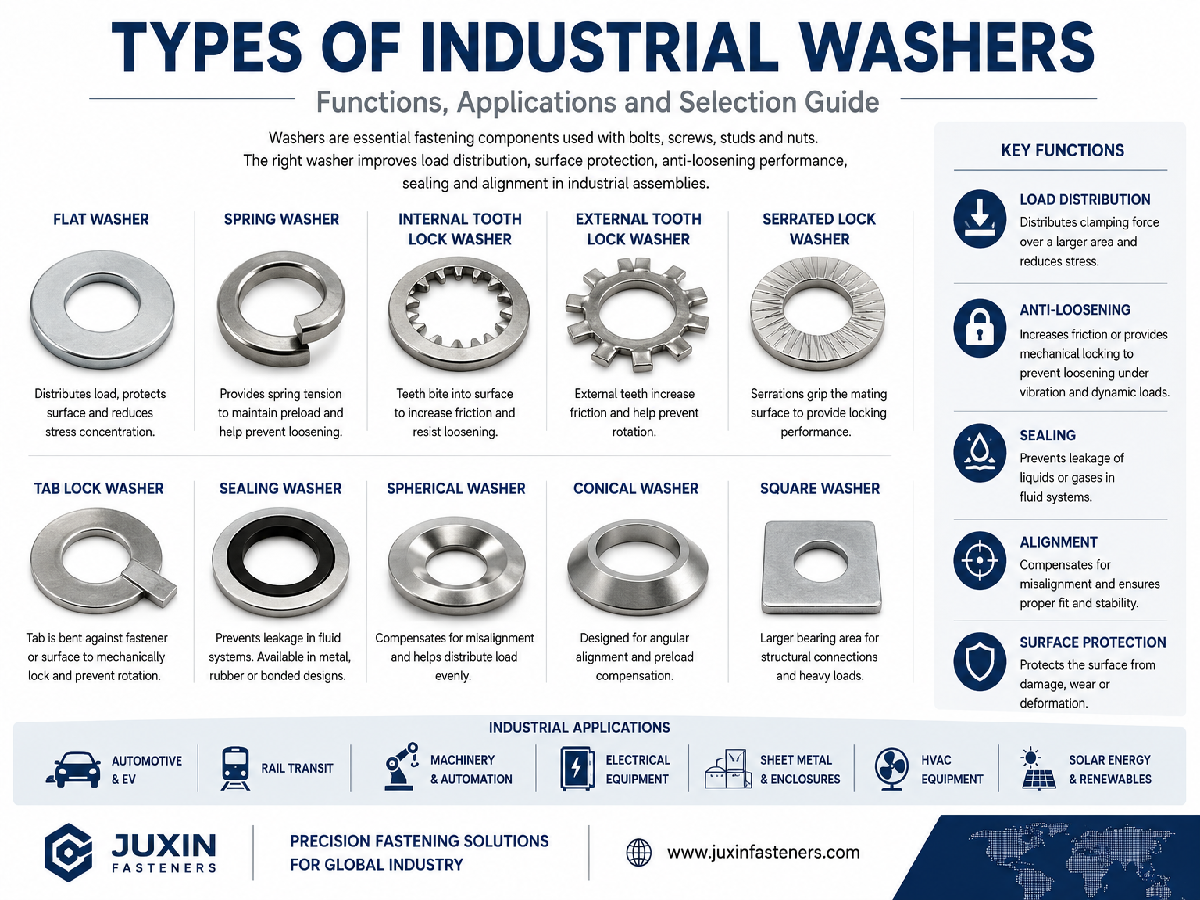
For the complete washer family, see Industrial Washers: Types, Functions & Selection Guide.
For spring-washer loosening analysis, see Do Spring Washers Prevent Bolt Loosening?.
For complete bolted-joint washer selection, see Washers and Bolts: Fastening Systems Selection Guide.
For prevailing-torque locking alternatives, see Nylon Insert Locknuts for Anti-Vibration Applications.
For OEM washer and locking-fastener RFQs, send your drawing, washer function, applicable standard, dimensions, mating fastener, material, surface treatment, application and estimated demand to:
The right question is not simply:
“Flat washer, spring washer or lock washer?”
The right question is:
“Which mechanical function does this joint actually require?”
 MORE NEWS
Sep. 25, 2026
Sep. 25, 2026
Sep. 25, 2026
Contact Us
Tel.:
+86 020 8621 0320
+86 020 3121 6067
E-mail:
Technical Support:
Navigation
SEND INQUIREY