
Call Us
+86 136 6007 9809
Call Us
+86 136 6007 9809

Aug. 16, 2023
In precision mechanical assemblies, automated motion systems, power transmission equipment, and industrial machinery,
set screws are frequently used to secure components such as rotating shafts, timing pulleys, gears, collars, hubs, knobs, fixtures, and positioning components.
The engineering challenge is not simply to create clamping force. The contact between the set screw and the mating shaft must also be considered.
Aggressive tip geometries can intentionally penetrate or deform the shaft surface to increase mechanical resistance to movement.
That can be useful in some permanent or high-retention applications, but it may be undesirable when the shaft must remain reusable, adjustable, or cosmetically and dimensionally intact.
Stainless steel flat-tip set screws provide an alternative approach.
Their flat contact surface distributes the applied load over a relatively larger area than a pointed or cup-shaped tip,
reducing localized surface pressure and helping minimize scoring or indentation when the application is designed around surface preservation.
This makes flat-tip set screws relevant to machinery, automation, robotics, instrumentation, power transmission, electrical equipment, fixtures,
and other OEM assemblies where component retention and surface protection must be considered together.
The correct selection depends on the complete interface: screw geometry, thread engagement, material, installation torque, mating shaft condition,
required retention, vibration, environment, and whether the shaft contains a machined flat or other positive locating feature.
A flat-tip set screw is a headless threaded fastener with an internal drive, commonly a hex socket, and a flat contact surface at the working end.
Unlike a conventional bolt with an external head, the set screw is normally installed into a threaded hole in a collar, hub, housing, fixture, or other component. Tightening the screw forces its tip against the mating surface.
The resulting retention can come primarily from clamping and friction at the interface, while the surrounding assembly geometry may provide additional resistance to rotation or axial movement.
Stainless steel versions are selected when corrosion resistance, material compatibility, cleanliness, or application environment makes stainless steel appropriate.
Common application examples include:
Shaft collars
Gear hubs
Timing pulleys
Couplings
Bearing-related assemblies
Knobs and control components
Automation fixtures
Positioning mechanisms
Machine tooling
Instrumentation
Robotics
Electrical and electronic equipment
Industrial machinery
For OEM applications, the set screw should be treated as part of the complete mechanical interface rather than as an isolated commodity fastener.
Tip geometry is one of the most important variables when selecting a set screw.
Cup-point set screws have a concave working surface with an edge designed to grip the mating material.
This geometry can provide strong resistance to movement because the edge can penetrate or bite into the shaft surface.
The trade-off is permanent surface marking. If the shaft must be repeatedly repositioned, removed, or reused, the resulting indentation may become undesirable.
Cone-point set screws use a pointed tip that can penetrate the mating surface.
They can provide strong mechanical location and are often considered when permanent or semi-permanent positioning is required.
However, the concentrated contact area can produce significant local stress and surface damage.
Flat-tip set screws have a flat working face.
The larger contact area can reduce localized pressure compared with pointed geometries and can help protect the mating surface when the assembly is properly designed.
They are particularly relevant where:
Shaft surfaces should remain relatively undamaged
Components may need repositioning
Adjustment or maintenance is expected
The shaft is expensive or precision-machined
Cosmetic surface condition matters
A shaft flat or other positive locating feature is available
The assembly requires adjustable clamping rather than aggressive penetration
The correct choice is application-dependent. A flat tip is not automatically the highest-retention solution, just as a cup point is not automatically the best solution for every shaft.
For metric hexagon socket flat point set screws, ISO 4026 is a key international product standard, with DIN 913 commonly associated with the corresponding German designation.
These standards provide dimensional and product requirements for applicable flat point set screws.
For inch-series socket set screws, ASME B18.3 is a relevant reference where the specific product falls within its scope.
Material requirements for stainless steel fasteners may also be specified using applicable stainless fastener standards such as ISO 3506, depending on the product type, material designation, property requirements, and customer specification.
For OEM sourcing, the governing requirement should always be identified on the drawing or purchasing specification. Product geometry, material grade, mechanical requirements, surface treatment, and inspection requirements should not be assumed solely from a general product name.
| Fastener Category | Typical Standard Reference | Material Considerations | Typical Applications |
|---|---|---|---|
| Hex Socket Flat Point Set Screw | ISO 4026 / DIN 913 | Stainless steel or other specified fastener materials | Shafts, collars, hubs, pulleys |
| Stainless Steel Flat Point Set Screw | Applicable ISO / customer specification | A2 or A4 stainless grades where applicable | Machinery, automation, instrumentation |
| Precision Flat-Tip Set Screw | Customer drawing / applicable standard | 303, 316 or other specified stainless steel | Instruments, actuators, precision mechanisms |
| Custom Flat-Tip Set Screw | Customer drawing | Material selected for application | OEM equipment and special assemblies |
| Inch Flat-Point Socket Set Screw | ASME B18.3 where applicable | Stainless steel or specified alloy | North American industrial equipment |
Material and dimensional availability should be confirmed against the actual customer drawing, application, and required production specification.
One of the most important design considerations is that surface protection and maximum holding force are not the same engineering objective.
A pointed or cup-shaped set screw can increase resistance to movement by mechanically engaging the mating surface.
A flat-tip set screw instead provides a broader contact interface.
This means engineers should not simply ask:
“Which set screw has the highest holding force?”
A better engineering question is:
“What level of retention is required, and how much surface deformation can the mating component accept?”
For a reusable shaft, a small reduction in aggressive mechanical engagement may be acceptable if the assembly can provide additional positional
or rotational control through a shaft flat, keyway, clamp, collar geometry, or other design feature.
This is a system-level decision rather than a fastener-only decision.
A particularly useful design approach is to combine a flat-tip set screw with a machined shaft flat.
Instead of forcing the screw into the cylindrical surface of the shaft, the flat tip contacts the prepared flat.
This can provide several advantages:
Reduced damage to the main shaft journal
More predictable contact geometry
Improved resistance to rotational movement
Better repeatability during component repositioning
Easier maintenance and adjustment
Reduced dependence on penetration into the shaft surface
However, the shaft flat itself becomes part of the mechanical design.
Its width, depth, length, orientation, location, and relationship to the hub or collar must be compatible with the intended load path.
The shaft flat should therefore be specified together with the set screw rather than treated as an unrelated machining detail.
Rotating shafts introduce additional considerations.
The set screw must resist the forces generated by the application while maintaining the intended component position.
Examples include:
Motor shafts
Gear shafts
Encoder shafts
Drive shafts
Roller assemblies
Timing pulley shafts
Fan and blower assemblies
Actuator shafts
Robotics joints
Conveyor components
The engineer should consider:
Shaft diameter
Shaft material and hardness
Surface finish
Shaft flat or keyway
Hub or collar material
Required retention
Rotation speed
Vibration
Temperature
Installation torque
Expected service cycles
Maintenance frequency
A set screw should not be selected solely by nominal thread size.
When a flat-tip set screw presses against a shaft, the resulting contact force contributes to frictional resistance.
In simplified form, frictional holding behavior is related to:
Frictional resistance ≈ coefficient of friction × normal clamping force
The actual performance of an assembly is more complicated because contact geometry, surface condition, material pair, shaft loading, eccentricity, vibration, installation method, and other mechanical features can affect the result.
Therefore, a specified tightening torque should not automatically be interpreted as a guaranteed shaft-holding capacity.
This distinction is especially important in OEM design.
Installation torque, preload, frictional holding force, and transmitted torque are related but are not interchangeable specifications.
For critical assemblies, the complete interface should be validated under representative loading.
A flat-tip set screw becomes considerably more useful when the mating component is designed around it.
For example, an engineer may have two options:
Option A:
Flat-tip screw → cylindrical shaft surface → friction-dominated retention
Option B:
Flat-tip screw → machined shaft flat → clamping plus geometric resistance to rotation
The second arrangement can reduce dependence on friction alone.
This is why fastener selection should happen together with shaft and hub design.
For OEM equipment, the drawing package can identify:
Set screw location
Shaft flat location
Shaft flat dimensions
Thread specification
Set screw length
Contact orientation
Installation torque
Inspection requirements
This provides a much clearer manufacturing and sourcing requirement than simply specifying “stainless steel set screw.”
Stainless steel selection should be based on the actual operating environment rather than on the word “stainless” alone.
Common stainless fastener families include:
A2 stainless steel, commonly associated with chromium-nickel austenitic stainless fasteners
A4 stainless steel, commonly associated with chromium-nickel-molybdenum austenitic stainless fasteners
The appropriate material designation depends on the required corrosion resistance, mechanical properties, temperature, chemical exposure, mating materials, and applicable standard.
For some precision machining applications, stainless steel grades such as 303 or 316 may also be specified according to the customer's drawing and manufacturing requirements.
The material designation should therefore be written explicitly in an OEM purchasing specification.
Stainless steel fasteners can be susceptible to galling under certain installation conditions.
Galling is adhesive wear that can occur when mating metal surfaces experience pressure and sliding during tightening.
Risk factors can include:
Stainless steel-to-stainless steel contact
High tightening force
High friction
Repeated installation
Damaged or contaminated threads
Excessive installation speed
Inappropriate lubrication conditions
For stainless steel flat-tip set screws, engineers should consider the complete threaded interface rather than focusing only on the screw material.
Depending on the application, thread condition, lubrication strategy, installation method, and mating material may all influence assembly behavior.
For repeated service applications, the installation process should be validated rather than relying only on nominal material selection.
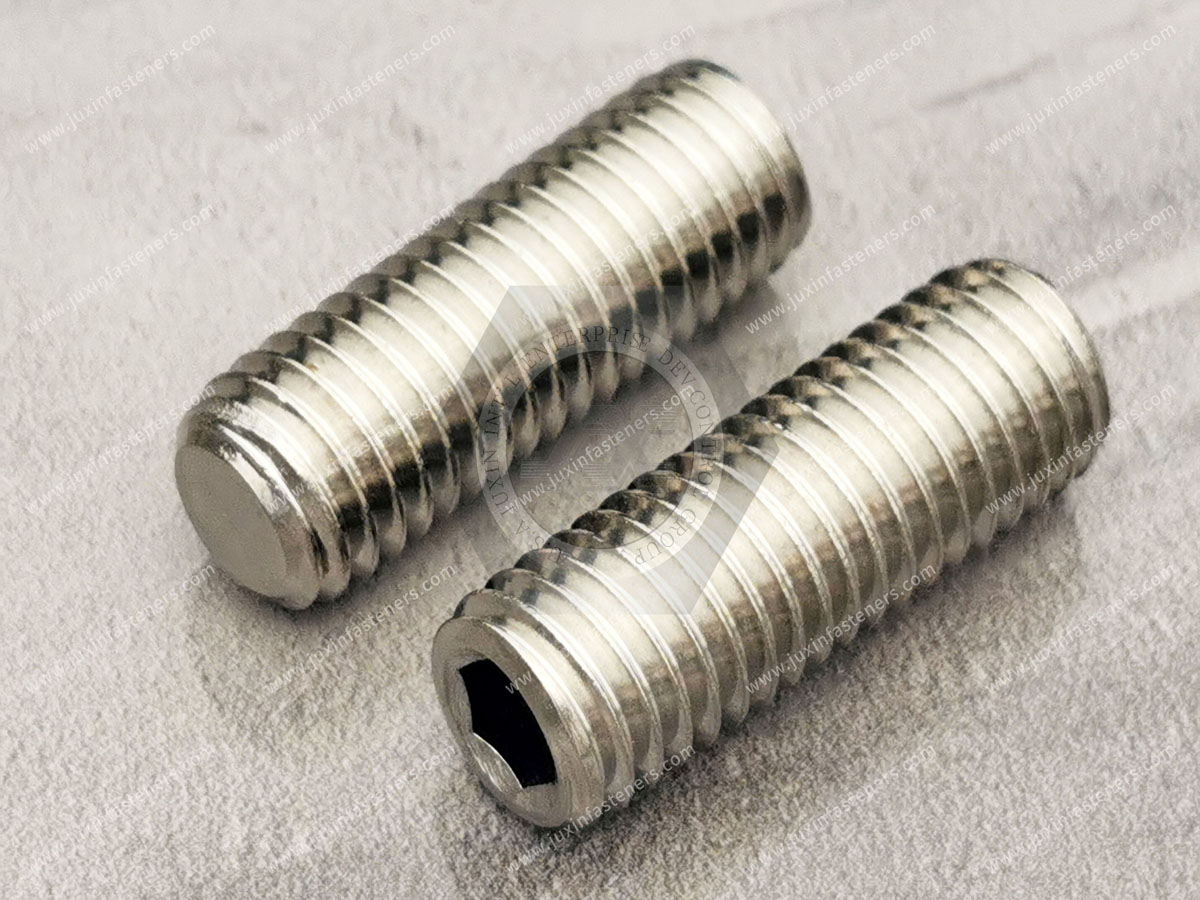
Most headless set screws use an internal drive, commonly a hex socket.
The socket must provide sufficient engagement with the installation tool.
Important considerations include:
Socket size
Socket depth
Tool access
Tool condition
Installation angle
Required tightening torque
Risk of socket damage
Frequency of installation and removal
In compact automation equipment, the fastener may be located deep inside a bore or behind another component.
In such cases, access to the hex socket can become a practical design constraint.
A theoretically suitable screw may become difficult to assemble if the tool cannot engage the socket properly.
Socket dimensions are not merely a catalog detail.
The set screw creates an interface between:
Fastener → Drive Tool → Assembly Process
If the socket is too shallow for the required installation condition, the tool may not engage reliably.
If the tool access angle is poor, installation torque may not be transmitted consistently.
If repeated removal is expected, socket durability becomes more important.
For automated production, the engineering team should therefore consider the screw's drive interface together with the actual assembly tooling.
This is particularly relevant to robotics, automated assembly lines, fixtures, and high-volume OEM production.
Automation equipment frequently uses adjustable mechanical interfaces.
Examples include:
Linear positioning mechanisms
Guide assemblies
Sensor mounts
Actuator components
Fixture components
Adjustable stops
Machine-tool accessories
Robotics equipment
Pick-and-place mechanisms
In these applications, components may need to be repositioned during machine setup or maintenance.
A flat-tip set screw can be appropriate where repeated adjustment is required and aggressive shaft penetration would create an undesirable wear pattern.
The final design should still verify whether frictional retention is sufficient for the actual operating loads.
Robotic systems may contain numerous small rotating or positioning components.
Set screws may be used in:
Encoder assemblies
Couplings
Pulleys
Knobs
Positioning collars
Fixture mechanisms
Actuator assemblies
In such applications, surface damage can affect future maintenance or replacement.
A flat-tip geometry can help reduce concentrated contact on a precision shaft, especially when combined with an intentionally designed shaft flat.
For high-cycle systems, engineers should also evaluate vibration, repeated adjustment, wear, and the possibility of loosening.
Instrumentation often requires compact fastening solutions while maintaining component alignment and serviceability.
Stainless steel flat-tip set screws may be considered for:
Instrument knobs
Adjustment mechanisms
Sensor assemblies
Optical equipment
Measurement equipment
Laboratory mechanisms
Precision fixtures
Material selection should account for the surrounding environment and mating materials.
Where dimensional stability and repeatability are important, the fastener and mating component should be specified together.
Flat-tip set screws can also appear in electrical and electronic mechanical assemblies where components must be positioned or retained without unnecessarily damaging mating surfaces.
Potential applications include:
Control equipment
Electrical cabinets
Instrument housings
Mechanical adjustment systems
Connector-related mechanisms
Equipment fixtures
The set screw itself should not be assumed to provide electrical grounding, sealing, EMI shielding, or environmental protection unless the complete assembly has been specifically designed and validated for those functions.
Set screws may be used in selected automotive and transportation mechanisms for adjustment, positioning, fixtures, shafts, and non-safety-critical mechanical assemblies.
The engineering requirements may include:
Vibration resistance
Corrosion considerations
Compact installation
Repeatable positioning
Surface protection
Serviceability
For automotive applications, the fastener specification should be linked to the actual component and assembly requirements.
A set screw used in a general adjustment mechanism should not automatically be treated as a safety-critical fastener.
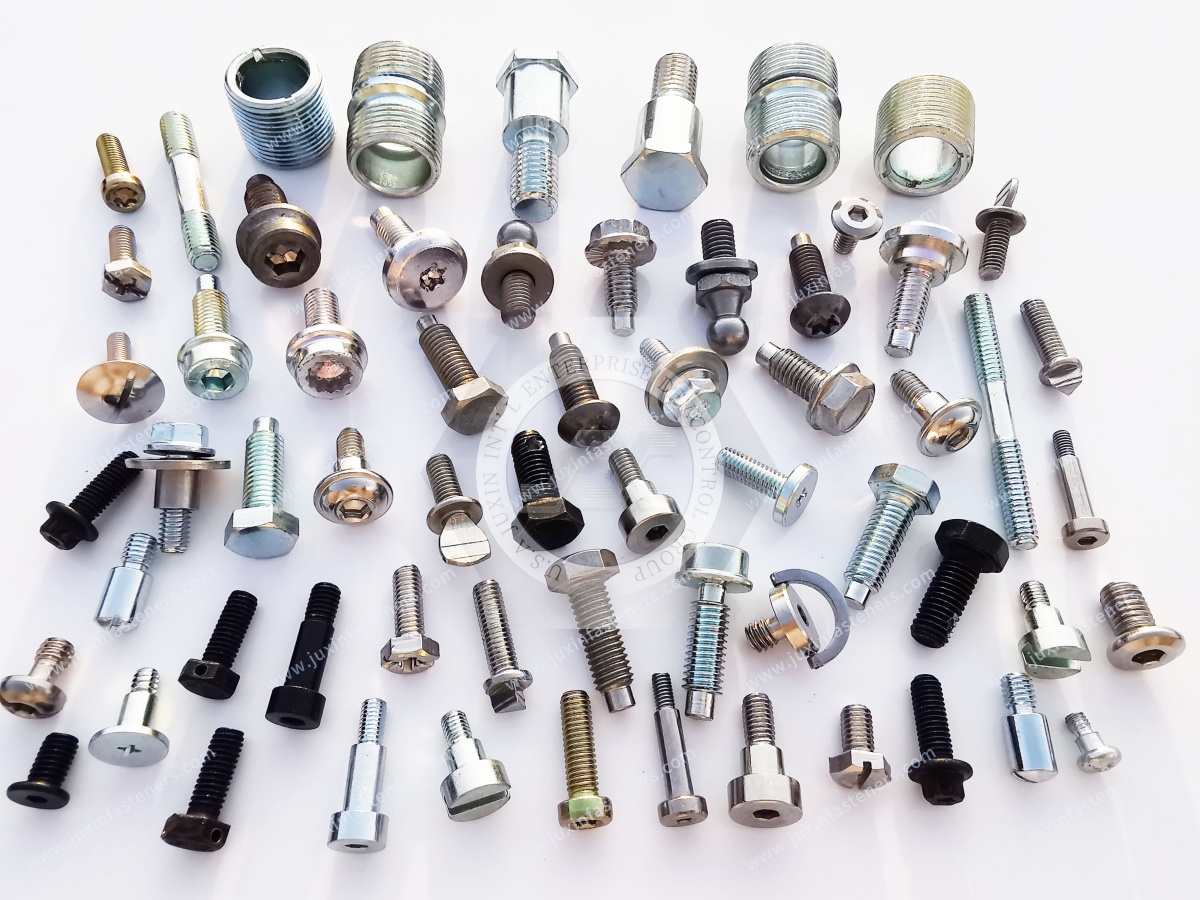
For broader automotive fastening requirements, JUXIN FASTENERS also supports industrial fastening solutions such as industrial and automotive bolts and nuts.
Industrial machinery frequently combines shafts, collars, gears, pulleys, bearings, fixtures, and adjustment mechanisms.
Flat-tip set screws can be useful when the assembly requires:
Adjustable positioning
Repeated maintenance
Reduced shaft marking
Compact headless fastening
Controlled clamping
Corrosion-resistant material options
The final specification should identify the exact function of the screw within the machine.
The phrase “surface-safe” should be understood as an engineering objective, not an absolute guarantee.
A flat tip can reduce concentrated contact compared with a sharp point, but surface damage can still occur depending on:
Contact pressure
Installation torque
Shaft material
Shaft hardness
Surface finish
Edge condition
Vibration
Relative movement
Repeated adjustment
Contamination
A high clamping load applied to a soft shaft can still leave an impression.
Therefore, if shaft preservation is critical, the mating interface should be designed and validated rather than relying only on the tip shape.
When frequent adjustment is expected, several design measures can reduce the risk of surface damage.
Possible approaches include:
A prepared flat provides a controlled contact surface.
Flat point geometry is often preferable where broad contact is desired.
Excessive torque can increase contact pressure without necessarily improving the overall assembly design.
Hardness and material pairing influence contact behavior.
Repeated movement under load can create wear even with a flat tip.
Where shaft damage is unacceptable, representative adjustment and service testing can reveal behavior that catalog specifications cannot predict.
Set screws serve a different function from conventional bolts.
| Feature | Flat-Tip Set Screw | Conventional Bolt |
|---|---|---|
| Head | Headless | External or internal head |
| Primary Function | Component positioning / retention | Joint clamping |
| Installation | Threaded into host component | Passes through or into threaded joint |
| Space Requirement | Compact | Usually greater head clearance |
| Shaft Contact | Direct tip contact | Usually indirect through joint |
| Adjustment | Often convenient | Depends on assembly |
| Surface Protection | Dependent on tip and interface design | Usually no direct shaft-tip contact |
| Typical Applications | Collars, hubs, fixtures, shafts | Structural and mechanical joints |
The correct fastener depends on the mechanical function.
For applications requiring structural joint clamping, a conventional bolt may be more appropriate. For compact component positioning on a shaft or within a housing, a set screw may be appropriate.
JUXIN FASTENERS also supplies high-strength bolts and nuts for applications where a conventional bolted joint is the required fastening architecture.
Stainless steel may be selected when the application requires a combination of corrosion resistance, material compatibility, appearance, or environmental durability.
Potential environments include:
Outdoor equipment
Industrial machinery
Instrumentation
Food-related equipment
Chemical-exposure environments
Marine-adjacent applications
Clean equipment
General corrosion-sensitive assemblies
However, stainless steel should not be selected solely because an application is outdoors.
Chemical exposure, temperature, crevice conditions, galvanic interactions, surface treatment, and the mating materials should all be considered.
When stainless steel fasteners are assembled with dissimilar metals, galvanic corrosion can become a system-level consideration.
The actual risk depends on factors including:
Metal combination
Electrochemical potential
Moisture exposure
Electrolyte presence
Contact area relationship
Environmental conditions
Protective measures
For outdoor or corrosive applications, engineers should therefore evaluate the complete material pair rather than assuming that stainless steel alone eliminates corrosion concerns.
A common sourcing mistake is to specify only the fastener.
For flat-tip set screws, the mating surface directly influences performance.
A useful engineering specification should consider:
Set Screw + Threaded Host + Shaft + Contact Surface + Installation Process
For example, the same stainless steel flat-tip set screw can behave differently against:
Hardened steel
Mild steel
Stainless steel
Aluminum
Brass
Engineering plastics
Therefore, a supplier RFQ should include the mating material and application wherever possible.
Set screw length should provide adequate thread engagement while allowing the tip to reach the intended contact surface.
Important considerations include:
Host material thickness
Thread depth
Shaft diameter
Required engagement
Available installation space
Bottoming risk
Required protrusion
Shaft flat location
An excessively long set screw can bottom out in a blind threaded hole or interfere with another component.
An excessively short screw may provide insufficient engagement.
The correct length is therefore an assembly dimension, not simply a catalog preference.
Thread engagement must be considered together with the host material.
A stainless steel set screw installed into an aluminum housing presents a different thread-strength situation from one installed into a steel hub.
The engineer should consider:
Host material
Thread size
Thread depth
Engagement length
Load
Installation torque
Repeated removal
Potential thread wear
For critical applications, the host thread should be evaluated as part of the assembly rather than assuming that the set screw is the limiting component.
OEM applications may require specifications beyond a standard catalog configuration.
Custom requirements can include:
Non-standard length
Specific thread size
Metric or inch thread
Stainless steel material
Special socket configuration
Controlled tip geometry
Special dimensional requirements
Customer-specific packaging
Drawing-controlled inspection requirements
JUXIN FASTENERS can evaluate custom fastener requirements based on the customer's technical specification, drawing, material requirement, quantity, and application.
For precision metal component requirements beyond fasteners, JUXIN FASTENERS also provides stainless steel CNC machining parts.
Small mechanical assemblies often require miniature set screws where installation space is limited.
Potential applications include:
Micro-positioning systems
Compact actuators
Instrument mechanisms
Sensors
Optical equipment
Electronic mechanisms
Small automation components
At miniature dimensions, socket depth, thread engagement, tip geometry, and installation tooling become increasingly important.
The final dimensions should be controlled by the customer drawing or applicable product standard.
For procurement teams, purchasing managers, and supplier development professionals, a useful RFQ should contain more than the words “stainless steel flat-tip set screw.”
A complete specification can include:
Product type
Tip type
Thread size
Thread pitch
Thread system
Overall length
Material grade
Socket size
Applicable standard
Surface finish
Quantity
Packaging requirement
Inspection requirement
Material documentation
Certificate of Conformance requirement
Drawing revision
Application
Mating shaft material
Installation torque, if specified
Special quality requirements
This information reduces ambiguity during supplier quotation and technical review.
Different users search for the same product for different reasons.
Will the flat tip damage the shaft?
Should I use a flat, cup, or cone point?
Do I need a shaft flat?
What stainless grade is appropriate?
How much thread engagement is required?
What socket size is available?
Can the component be repeatedly adjusted?
How should the interface be validated?
Can the supplier manufacture the required configuration?
What standard applies?
What materials are available?
Can the supplier work from our drawing?
What inspection documents are available?
What are the MOQ and production requirements?
Can packaging match our production process?
Can the supplier support repeat OEM orders?
A commercially useful supplier page should answer both groups.
Before approving a set screw supplier, procurement and supplier development teams can evaluate:
Understanding of applicable standards
Drawing interpretation
Material control
Thread control
Tip geometry control
Socket manufacturing
Dimensional inspection
Incoming material control
In-process inspection
Final inspection
Thread gauging where applicable
Dimensional records
Traceability according to customer requirements
Production capacity appropriate to the order
Packaging flexibility
Export documentation
Repeat-order support
Communication with engineering and purchasing teams
Depending on the purchase specification, documentation may include:
Certificate of Conformance
Material documentation
Dimensional inspection records
Customer-specific quality documents
Documentation should be agreed during quotation rather than assumed after production.
Important inspection characteristics can include:
Thread size
Thread pitch
Overall length
Tip geometry
Tip flatness or configuration
Socket dimensions
Socket depth
Surface condition
Material identification
Finish, where specified
Inspection methods should correspond to the actual drawing and product specification.
For production sourcing, the inspection plan should distinguish between critical dimensions and routine dimensions.
Where stainless steel material is specified, procurement teams may require documentation supporting the supplied material.
The exact documentation depends on:
Customer requirements
Material specification
Order size
Industry
Regulatory requirements
Supplier quality agreement
A Certificate of Conformance can confirm conformity to the applicable purchase specification when properly issued.
Material certificates may also be requested where traceability is required.
These requirements should be established before order placement.
For international OEM supply, customers may specify environmental or substance restrictions such as applicable RoHS and REACH requirements.
The supplier's documentation and product compliance should be evaluated against the specific customer requirement and applicable product configuration.
“Stainless steel” alone does not automatically mean that every environmental or regulatory requirement has been satisfied.
Procurement should identify the applicable compliance requirement during supplier qualification and quotation.
High-cycle machinery requires additional consideration because repeated loading can change the behavior of the interface.
Potential issues include:
Loosening
Wear
Surface fretting
Thread wear
Tip wear
Vibration
Repeated adjustment damage
A flat-tip set screw may help reduce concentrated shaft marking, but it does not automatically solve vibration-related loosening.
If the application experiences significant vibration, the complete retention strategy should be reviewed.
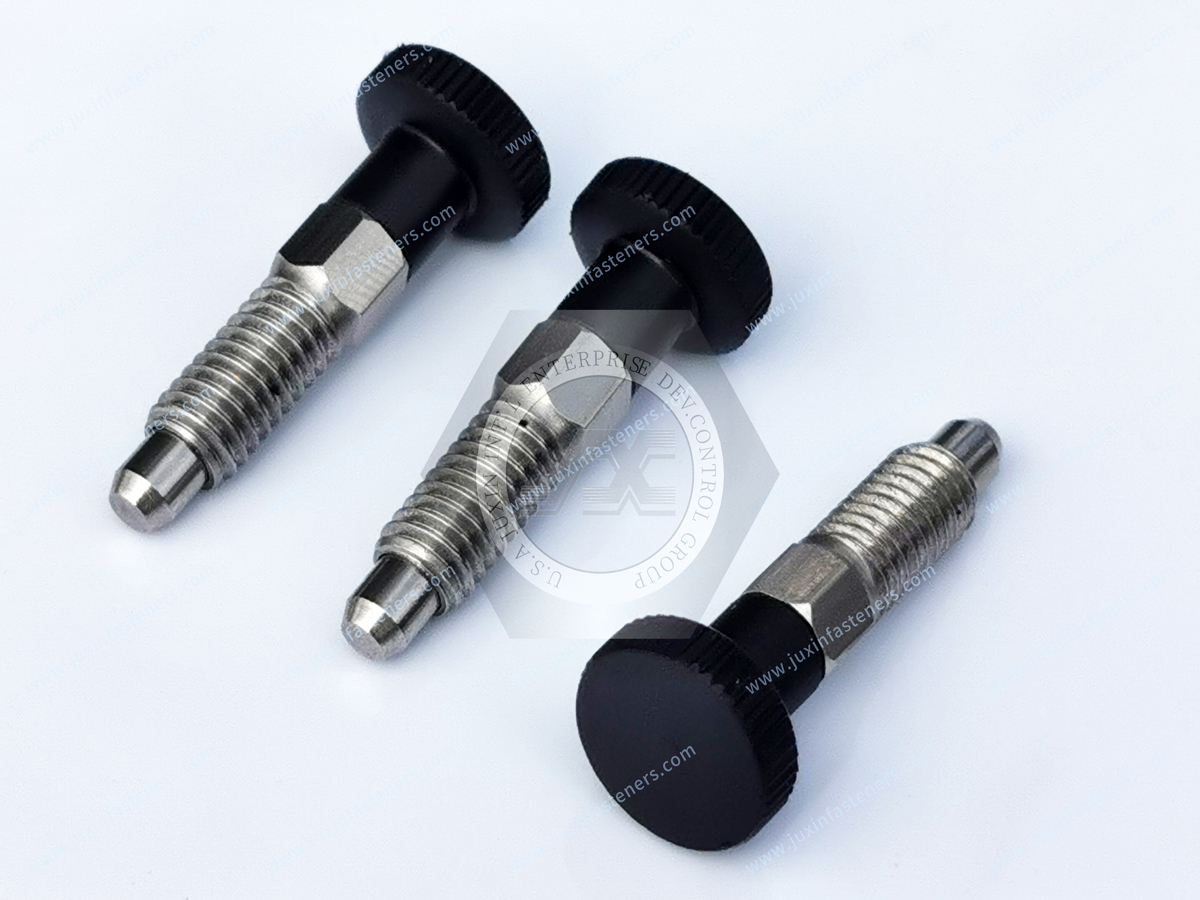
A set screw is generally used for positioning, retention, or component locking.
It should not automatically be substituted for a structural bolt.
For example:
Set screw:
Retains a pulley on a shaft.
Structural bolt:
Clamps two structural components together.
These are fundamentally different load paths.
Understanding this distinction helps prevent incorrect fastener selection during both engineering design and procurement.
Many industrial assemblies use multiple fastening technologies.
A machine may combine:
Set screws
Bolts
Nuts
Washers
Retaining components
CNC-machined parts
Plastic hardware
Positioning components
The correct solution depends on the function of each interface.
JUXIN FASTENERS supplies a broader range of industrial fastening components, allowing OEM teams to evaluate different fastening functions within a single sourcing program.
For applications involving non-metallic components, see the automotive plastic fasteners solution guide.
A strong OEM specification starts with the mechanical function.
Instead of beginning with:
“M6 stainless steel set screw”
define:
“Adjustable shaft retention for a 20 mm rotating steel shaft, with minimal permanent surface marking.”
The specification can then be translated into:
Flat point
M6 thread
Required length
Stainless steel grade
Applicable standard
Socket requirement
Shaft flat
Installation torque
Environmental conditions
Inspection requirements
This approach helps engineering and procurement teams avoid choosing a catalog part before understanding the actual mechanical requirement.
When requesting a quotation, provide the following wherever available:
Product
Flat-tip / flat-point set screw
Metric or inch thread
Thread size
Thread pitch
Length
Material
Stainless steel grade
Required mechanical specification
Surface finish, if applicable
Geometry
Tip configuration
Socket size
Socket depth
Special dimensions
Application
Shaft diameter
Shaft material
Shaft hardness, if relevant
Shaft flat or cylindrical surface
Rotational or static application
Vibration level
Operating environment
Quality
Applicable standard
Drawing revision
Inspection requirements
CoC requirement
Material documentation requirement
Commercial
Estimated annual quantity
Initial order quantity
Packaging requirements
Delivery requirements
Destination market
This information gives the supplier a much stronger basis for technical and commercial quotation.
A practical commercial conversion process is:
Application Requirement
↓
Mating Shaft and Host Material
↓
Required Retention
↓
Surface Protection Requirement
↓
Tip Geometry
↓
Thread and Length
↓
Stainless Steel Grade
↓
Socket and Installation Requirement
↓
Environmental Conditions
↓
Inspection and Documentation
↓
Supplier Qualification
↓
Production RFQ
This process connects engineering requirements directly to procurement requirements.
It also reduces the risk of receiving quotations for technically similar but functionally different set screws.
A supplier can quote a standard product from a simple dimensional description.
However, application information can reveal potential engineering issues before production.
For example, if the supplier knows that:
The shaft is aluminum
The component is frequently repositioned
The shaft must remain reusable
The machine operates under vibration
The environment is corrosive
The set screw is installed deep inside a housing
then material, tip geometry, length, installation process, and inspection requirements can be evaluated more intelligently.
This is particularly important for OEM development and repeat production.
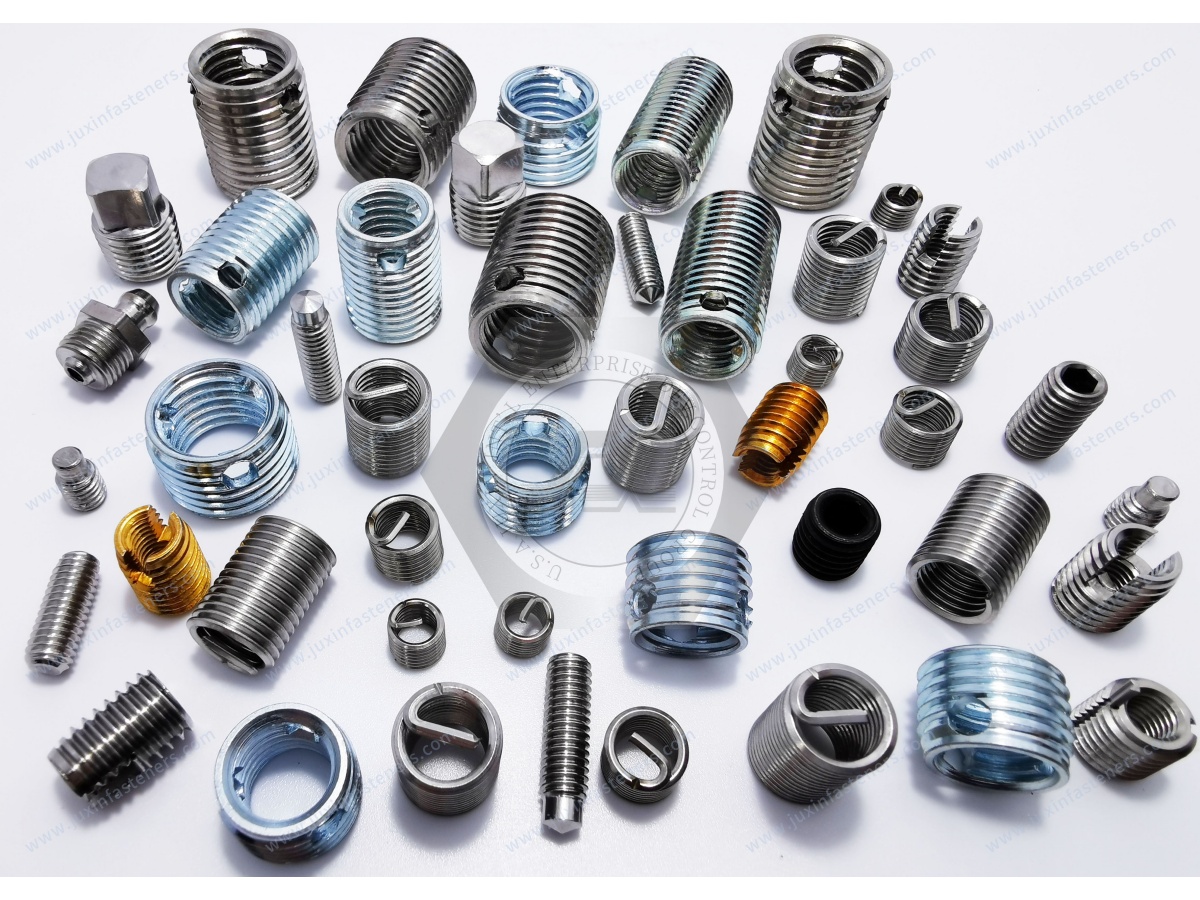
JUXIN FASTENERS supports OEM and industrial customers requiring stainless steel fasteners, custom screws, precision fastening components, and application-specific mechanical hardware.
For stainless steel flat-tip set screws, the sourcing process can be based on:
Customer drawings
Product specifications
Required standards
Material requirements
Application information
Quantity requirements
Inspection requirements
Documentation requirements
The goal is not simply to supply a generic screw, but to align the fastener specification with the customer's actual mechanical application.
For a technical quotation, provide your drawing or specification together with the required quantity and application information.
Useful RFQ information includes:
Thread size and pitch
Length
Flat-tip geometry
Stainless steel grade
Applicable standard
Socket requirement
Shaft diameter
Shaft material
Shaft flat or cylindrical contact
Operating environment
Estimated quantity
Inspection and documentation requirements
JUXIN FASTENERS can review the available information and evaluate the appropriate manufacturing and sourcing route for the requested configuration.
Whether the requirement is a standard ISO/DIN configuration or a customer-specific OEM drawing, clear technical information helps create a more efficient quotation and supplier qualification process.
JUXIN FASTENERS
20+ Years of Fastener Experience
Stainless Steel Flat-Tip Set Screws, Precision Fasteners and OEM Mechanical Components
Website: www.juxinfasteners.com
Email: info@juxinfasteners.com
For your next stainless steel flat-tip set screw requirement, send the drawing, specification, quantity, and application details to info@juxinfasteners.com.
 MORE NEWS
Sep. 25, 2026
Sep. 25, 2026
Sep. 25, 2026
Contact Us
Tel.:
+86 020 8621 0320
+86 020 3121 6067
E-mail:
Technical Support:
Navigation
SEND INQUIREY