
Call Us
+86 136 6007 9809
Call Us
+86 136 6007 9809

Oct. 27, 2023
A stainless steel hose clamp may look like a simple component, but specifying one correctly requires more than writing “stainless hose clamp” on an RFQ.
For engineering and procurement teams, several questions matter:
Is only the band stainless steel, or are the housing and screw also stainless?
Which stainless steel material is required?
What hose and fitting will the clamp contact?
Is the assembly exposed to moisture, road splash, chemicals, salt-containing environments, or outdoor weather?
Will the connection experience temperature cycling or vibration?
Is the clamp intended for an existing OEM assembly or a new design?
What dimensions and construction features must a second source reproduce?
These questions become particularly important in automotive, HVAC, thermal management, industrial machinery, marine equipment, agricultural machinery, and liquid-cooling applications.
The correct selection path is:
application environment → hose and fitting → clamp architecture → component materials → dimensions → installation → validation
This guide explains how engineers and procurement teams should evaluate stainless steel hose clamps without relying on vague commercial descriptions.
A stainless steel hose clamp is a clamping component in which one or more structural components are manufactured from stainless steel.
Depending on the clamp design, components can include:
Band
Housing
Screw
Bolt
Nut
Bridge
Ear or closure feature
A critical sourcing point is that the phrase “stainless steel hose clamp” does not necessarily define the material of every component.
For example, one product may use a stainless steel band with a different screw material, while another may use stainless steel for the band, housing, and screw.
For OEM sourcing, these configurations should not be treated as automatically equivalent.
Stainless steel describes a broad family of corrosion-resistant alloys rather than one universal material.
Commercial hose clamps may be offered in different stainless material families or component combinations.
Therefore, an RFQ that says only:
“Need stainless steel hose clamps”
leaves several important questions unanswered.
Procurement should clarify:
Required clamp type
Band material
Housing material
Screw material
Diameter range
Band width
Application environment
Hose specification
Fitting material
Quantity and annual demand
Where a customer drawing specifies a particular material, that drawing requirement should control.
A worm-drive hose clamp is a system of interacting components.
The band surrounds the hose and transfers clamping action around the circumference.
Important characteristics include:
Material
Width
Thickness where controlled
Perforated or non-perforated construction
Edge geometry
Diameter range
The housing supports the screw and helps maintain the required screw-to-band relationship.
Its material and geometry can influence:
Structural behavior
Corrosion exposure
Screw alignment
Long-term condition
The screw drives adjustment of a worm-drive clamp.
Important considerations include:
Material
Thread geometry
Drive configuration
Surface condition
Compatibility with the band and housing
When corrosion resistance is important, the material requirement for all three components should be reviewed rather than assuming that the word “stainless” defines the entire assembly.
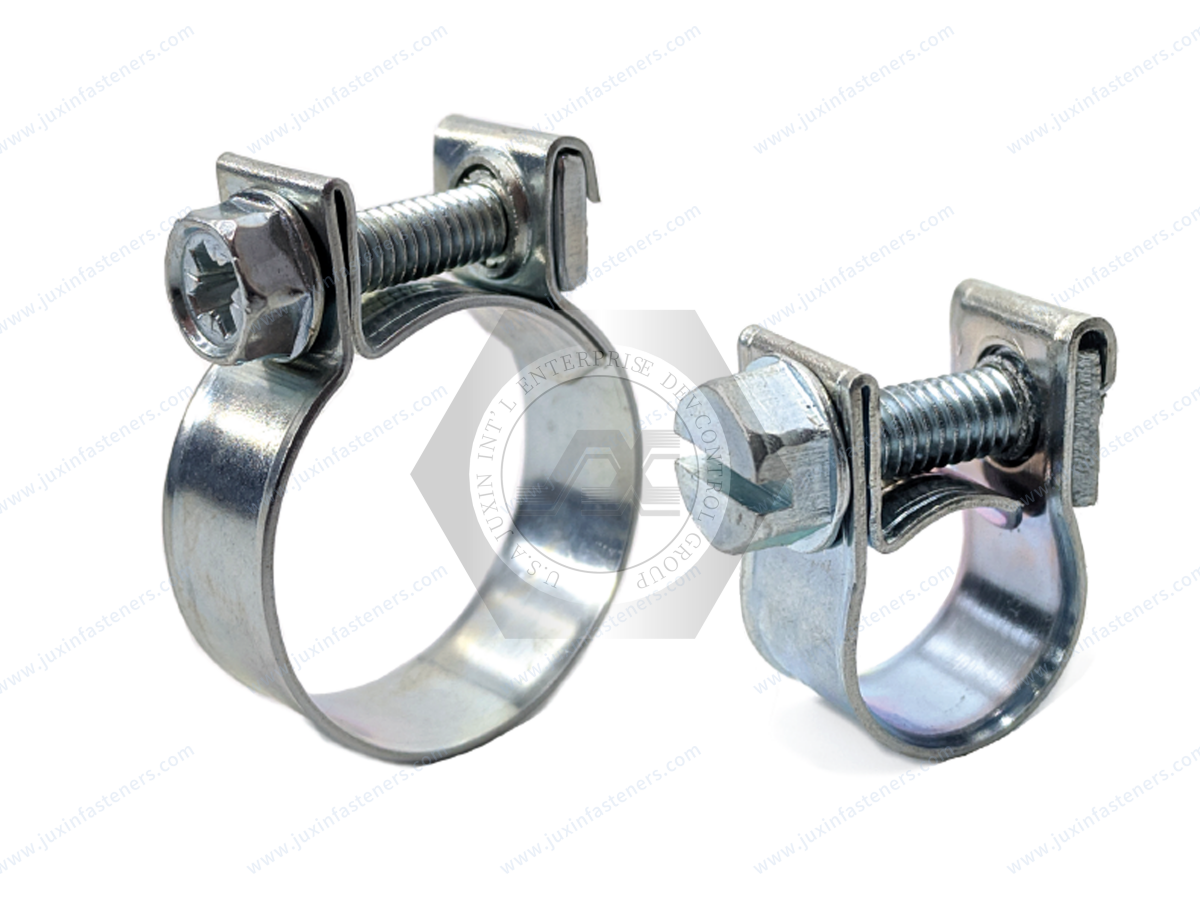
In procurement language, “all stainless” generally indicates that the principal clamp components are intended to be stainless steel rather than a mixture of stainless and carbon-steel components.
However, this description should still be verified against the supplier specification or customer drawing.
For a worm-drive clamp, confirm at minimum:
Band material
Housing material
Screw material
For another clamp architecture, verify the material of every functionally important component.
Different stainless steel families provide different combinations of:
Corrosion behavior
Formability
Strength
Cost
Manufacturing characteristics
The correct material depends on the application rather than on the assumption that one stainless grade is universally superior.
Where the customer's drawing defines the stainless steel grade, follow that specification.
Where the material has not yet been defined, engineers should consider the actual service environment before making a selection.
Commercial stainless hose clamps may be described using broad stainless steel families such as 200 series, 300 series, or 400 series.
These descriptions indicate different alloy families, but the family name alone is still not a complete engineering specification.
Corrosion performance can vary by:
Specific grade
Metallurgical condition
Manufacturing process
Surface condition
Environment
Therefore, engineers should avoid making purchasing decisions based only on a generic statement such as “300 series is good” or “stainless will not rust.”
The required material should be selected for the actual environment and customer specification.
Stainless steel forms a protective passive surface, but stainless steel is not immune to corrosion under every condition.
Relevant environmental factors can include:
Moisture
Chlorides
Salt-containing environments
Cleaning chemicals
Process fluids
Road contamination
Outdoor exposure
Temperature
Crevices
Deposits
This is why a hose clamp that performs adequately in an indoor industrial enclosure may not be appropriate for a marine or road-exposed application.
Chloride-containing environments can be particularly important when selecting stainless components.
Potential exposure can come from:
Marine environments
Coastal air
Road salts
Certain process fluids
Cleaning chemicals
Material selection should therefore be based on the actual exposure rather than the general label “stainless steel.”
Where corrosion performance is critical, the application should be validated under appropriate service or qualification conditions.
A common commercial misunderstanding is that stainless steel cannot corrode.
That is incorrect.
Corrosion behavior depends on the material, surface condition, environment, geometry, and exposure.
For procurement teams, this means:
stainless ≠ universally corrosion-proof
The appropriate question is:
Which material configuration is suitable for this specific service environment?
The clamp does not operate in isolation.
The complete interface may include:
Stainless steel clamp
Aluminum fitting
Carbon steel fitting
Stainless fitting
Polymer fitting
Other metallic or nonmetallic components
When dissimilar metals are used in an electrically conductive environment, galvanic interaction may become an engineering consideration.
Whether this is significant depends on factors including:
Material combination
Electrical contact
Electrolyte exposure
Geometry
Surface condition
Environmental severity
The complete assembly should therefore be reviewed where galvanic corrosion is a concern.
Clamp material selection is only one part of the design.
The clamp also interacts mechanically with the hose.
Relevant hose characteristics include:
Material
Wall thickness
Reinforcement
Hardness
Compressibility
Surface condition
Temperature behavior
Rubber, silicone, thermoplastic, and reinforced hoses can respond differently to clamp pressure.
The clamp architecture and band geometry should therefore be evaluated with the actual hose.
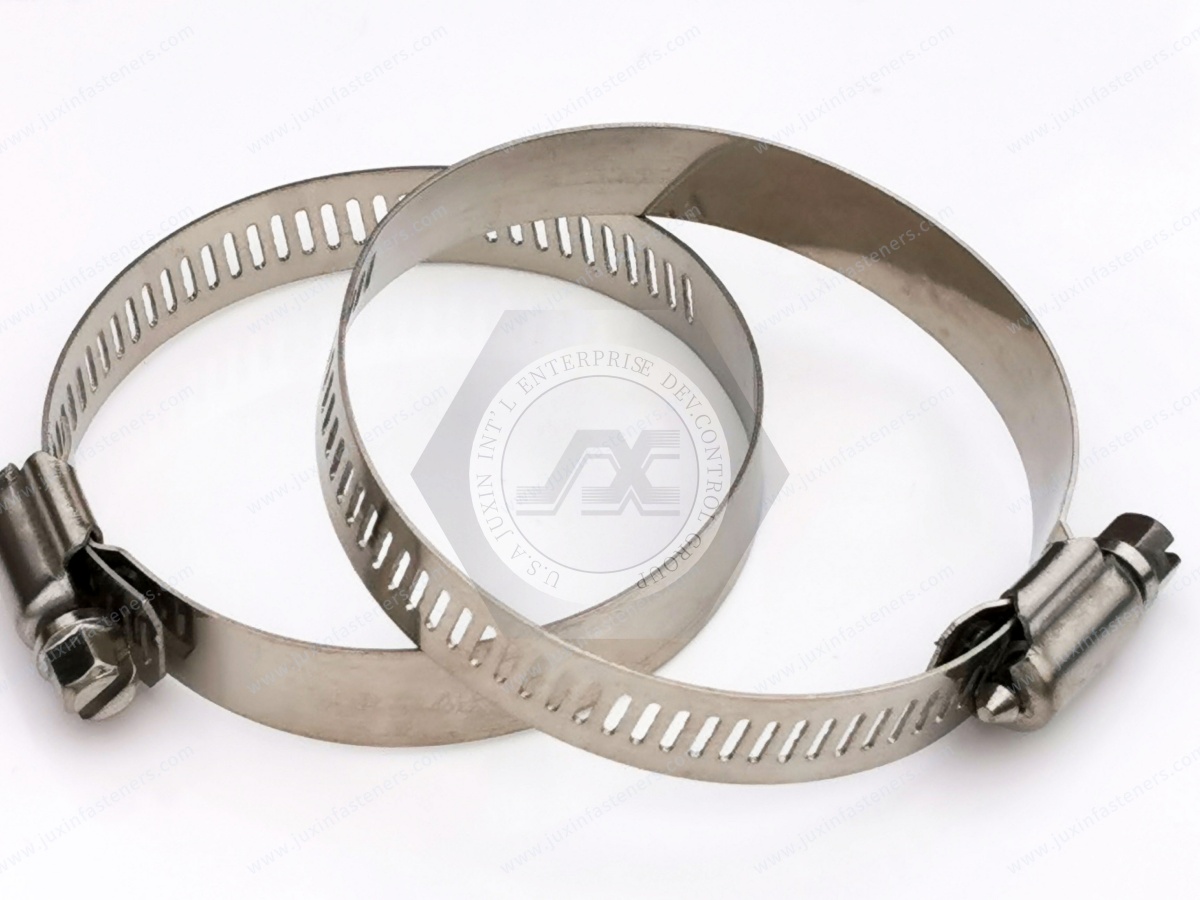
One common stainless clamp architecture uses a perforated band.
The screw engages openings in the band to adjust the clamp diameter.
This style is frequently marketed as an American-style hose clamp.
The commercial term can be useful when searching or sourcing, but it should not replace the technical specification.
For OEM programs, define:
Clamp range
Band width
Band geometry
Band material
Housing material
Screw material
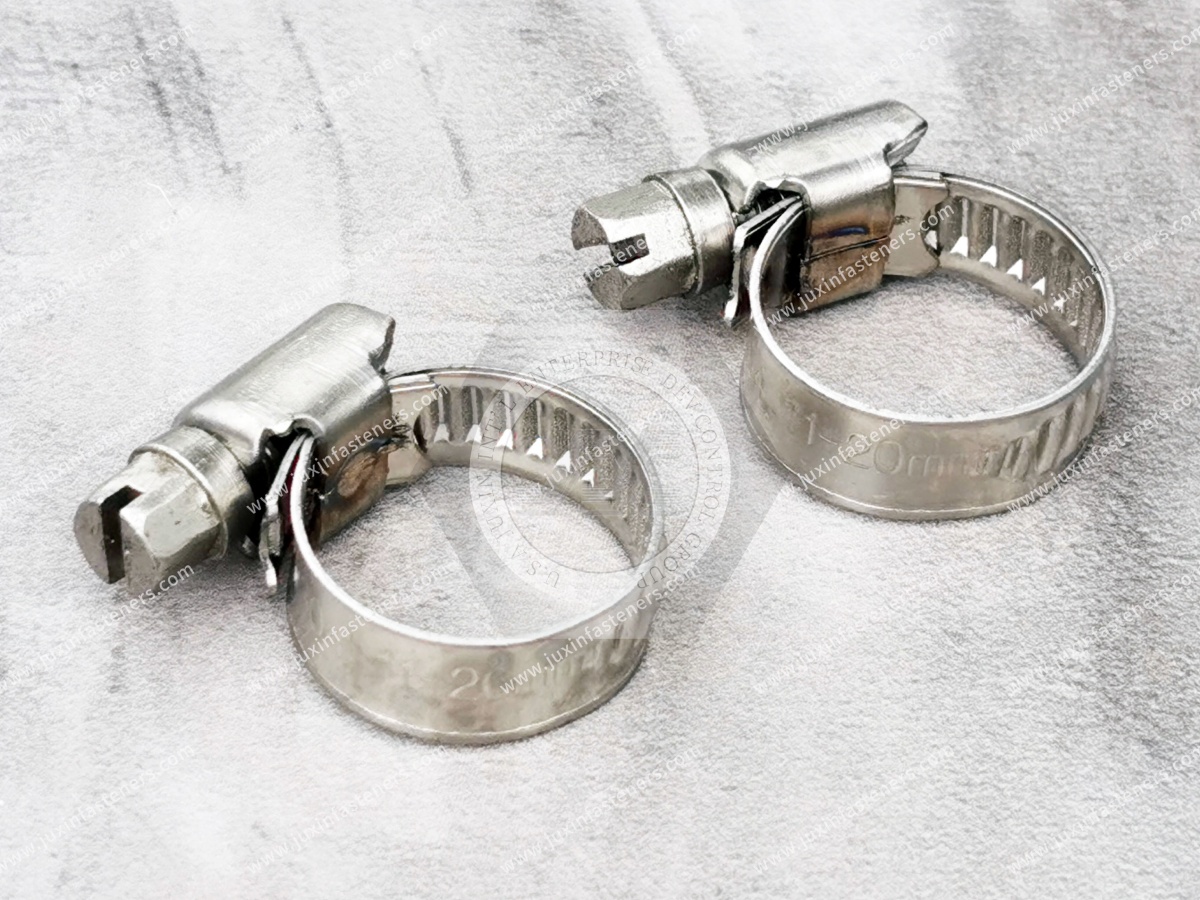
Another architecture uses embossed or formed engagement features rather than fully perforated openings.
This design is often commercially described as a German-style hose clamp.
The non-perforated band provides a different hose-contact surface.
This may be relevant for certain hose materials or assembly requirements.
However, engineers should not assume that a non-perforated clamp is universally better than a perforated clamp.
Selection depends on the actual joint.
Global fastener sourcing frequently uses terms such as:
American-style hose clamp
German-style hose clamp
British-style hose clamp
These descriptions should not automatically be interpreted as formal ASME, ANSI, DIN, EN, or BS standards.
They are commonly used commercial product-family descriptions.
This distinction matters.
An OEM drawing should define the actual technical requirements rather than relying solely on a regional style name.
Imagine an OEM purchasing team sends the same RFQ to three suppliers:
“Stainless steel German-style hose clamp.”
The three suppliers may interpret that description differently.
Possible differences include:
Band width
Band thickness
Clamp range
Screw geometry
Housing geometry
Stainless grade
Component material combination
The result can be three quotations for products that share a commercial name but are not technically equivalent.
For global sourcing, specification clarity reduces this risk.
Clamp size should be selected around the actual hose and fitting assembly.
Do not choose a clamp solely from the nominal hose designation.
Important dimensions include:
Hose ID
Hose OD before assembly
Fitting OD
Installed hose OD over the fitting
Required clamp operating range
The clamp should operate appropriately within its intended range.
A clamp may physically fit around the hose but still operate at an unsuitable point in its adjustment range.
This can affect:
Band overlap
Housing position
Screw engagement
Installation access
Circularity
Likewise, using an excessively large clamp and tightening it down to a much smaller diameter may create an undesirable installation geometry.
The clamp range should match the actual installed OD.
Band width affects the area over which the clamp interacts with the hose.
However:
wider ≠ automatically better
The correct width depends on:
Hose geometry
Fitting engagement length
Available space
Hose material
Clamp architecture
A wide band that extends beyond the intended fitting region can create a different problem rather than solving one.
Buyers sometimes compare hose clamps only by band thickness.
This is incomplete.
A hose clamp is a mechanical system consisting of:
band + housing + screw/closure mechanism + material + geometry
A thicker band does not automatically provide better overall performance if other design features are unsuitable.
Second-source comparison should therefore evaluate the complete clamp.
Automotive systems can expose hose clamps to combinations of:
Vibration
Temperature cycling
Moisture
Road contamination
Fluids
Packaging constraints
Potential applications can include suitable:
Cooling hose connections
Heater-related connections
Air-handling assemblies
Auxiliary fluid circuits
Thermal-management equipment
The required clamp architecture and material should follow the OEM specification and actual service conditions.
EV systems can contain coolant circuits around:
Battery thermal-management components
Power electronics
Electric drive systems
Pumps
Heat exchangers
Where hose clamps are used, engineers should evaluate:
Coolant
Hose
Fitting
Temperature cycling
Vibration
Corrosion environment
Assembly method
Leak-control requirements
The clamp should be treated as part of the complete coolant connection rather than as an isolated commodity component.
Stainless hose clamps can be considered in suitable HVAC and thermal-management systems involving:
Pumps
Heat exchangers
Chillers
Cooling loops
Flexible hose assemblies
Material selection should consider the actual equipment environment, including condensation, fluid exposure, and maintenance conditions.
Liquid cooling for data centers and AI/HPC infrastructure can include flexible hose connections in certain equipment architectures.
Examples may include connections associated with:
Cooling distribution equipment
Pumps
Heat exchangers
Auxiliary coolant loops
Where stainless steel hose clamps are considered, engineers should define:
Coolant
Hose material
Fitting material
Temperature
Pressure requirements
Corrosion environment
Installation process
Leak-control requirements
The complete assembly should be validated according to the equipment manufacturer's requirements.
Industrial machinery can use stainless clamps in fluid and air systems involving:
Cooling
Lubrication
Pumps
Air handling
Process support systems
Stainless materials can be considered where the operating environment justifies them.
However, the required grade and component configuration should be specified rather than inferred from the industry name.
Agricultural and outdoor equipment can expose clamps to:
Water
Dirt
Fertilizers
Chemicals
Vibration
Temperature variation
The environment should therefore be defined before selecting a stainless material.
Outdoor exposure alone does not establish which stainless configuration is appropriate.
Marine environments can create demanding corrosion conditions.
For marine equipment, engineers should review:
Stainless grade
Band material
Screw material
Housing material
Fitting material
Chloride exposure
Crevice conditions
Inspection and maintenance requirements
Do not assume that every stainless hose clamp is equally suited to marine exposure.
Chemical compatibility requires application-specific review.
The fact that a clamp is stainless steel does not establish compatibility with every chemical or process environment.
Engineering teams should define:
Chemical or media
Concentration where relevant
Temperature
Exposure mode
Adjacent materials
The appropriate material should then be evaluated against those conditions.
A general-purpose stainless hose clamp should not automatically be treated as a sanitary process connection.
Food, beverage, pharmaceutical, and biotechnology equipment may require dedicated hygienic connection systems,
controlled materials, surface conditions, and application-specific compliance.
A general-purpose hose clamp and a sanitary process clamp are different technologies.
They should not be conflated.
Both may use stainless materials, but their mechanical principles differ.
Uses screw adjustment to change clamp diameter.
Potential advantages include:
Adjustability
Service access
Removal capability where appropriate
Uses mechanical deformation of an ear during installation.
Potential advantages can include:
Compact geometry
Production-oriented installation
No adjustment screw
Material alone does not make these technologies interchangeable.
A T-bolt clamp uses a different tightening architecture.
The selection should consider:
Hose size
Joint geometry
Available space
Installation method
Application requirements
The decision should not be based solely on which clamp looks heavier.
Material selection should be driven by the application.
A plated carbon steel clamp and a stainless steel clamp can offer different combinations of:
Cost
Corrosion behavior
Material characteristics
Manufacturing considerations
Stainless steel is not automatically required for every application.
Likewise, a plated carbon steel clamp should not be substituted into a stainless-specified application without engineering review.
A clamp assembly can contain components with different corrosion behavior.
For example, the band may remain in acceptable condition while another component shows deterioration.
This is one reason engineers should identify the material of the:
Band
Housing
Screw
rather than treating the clamp as one homogeneous material.
If the clamp is poorly matched to the installed hose OD, the assembly may experience:
Poor band geometry
Unsuitable housing position
Inadequate adjustment
Installation difficulty
Changing to stainless steel will not solve a dimensional-selection problem.
Potential contributors can include:
Inappropriate band geometry
Incorrect band width
Band edge condition
Excessive tightening
Hose incompatibility
Incorrect clamp position
Material selection and mechanical interface design must therefore be considered together.
Changing from carbon steel to stainless steel does not inherently solve leakage.
Leakage can result from:
Hose damage
Incorrect hose size
Fitting geometry
Clamp position
Installation
Hose relaxation
Thermal cycling
Surface contamination
First diagnose the interface.
Then determine whether clamp material is actually part of the problem.
These are different failure categories.
May involve deterioration associated with:
Environment
Material selection
Surface condition
Dissimilar materials
May involve:
Screw stripping
Band deformation
Housing deformation
Over-tightening
Incorrect sizing
The root cause should be identified before changing the specification.
When qualifying an alternative supplier, compare more than the words “stainless steel.”
Review:
Diameter range
Band width
Band thickness where controlled
Housing dimensions
Screw dimensions
Band architecture
Band material
Housing material
Screw material
Hose
Fitting
Installed OD
Clamp position
Temperature
Corrosion exposure
Vibration
Fluid or coolant
Tool
Tightening method
Customer assembly requirements
The customer's validation process should determine final qualification.
For an existing OEM component, an approved physical sample can provide information that may not be obvious from a purchasing description.
It can help evaluate:
Band form
Edge geometry
Housing construction
Screw design
Surface condition
Assembly relationship
Where possible, combine the approved sample with the controlled drawing.
Depending on the design, useful drawing requirements can include:
Clamp architecture
Diameter range
Band width
Band thickness
Band construction
Band material
Housing material
Screw material
Finish where applicable
Critical dimensions
Customer-specific requirements
Where a material standard or grade is required, identify it explicitly rather than relying on the word “stainless.”
For standard sourcing, provide:
Clamp type
Required diameter range
Actual installed hose OD
Band width
Required stainless material
Component material requirements
Application
Environment
Quantity
Annual demand
For a new hose connection, provide:
Hose specification
Hose ID and OD
Fitting drawing or dimensions
Fitting material
Fluid or coolant
Temperature conditions
Pressure requirements
Vibration conditions
Corrosion environment
Installation requirements
Expected annual volume
This information allows the clamp architecture and material to be reviewed as part of the complete connection.
For an existing production clamp, provide where available:
drawing + unused approved sample + current part specification + hose information + fitting information + installed OD + material requirements + annual demand
Also identify the sourcing objective:
Alternative supplier qualification
Supply continuity
Capacity expansion
Lead-time reduction
Cost review
Regional sourcing
The goal should be technical equivalence to the required specification, not simply visual similarity.
Related engineering and sourcing resources include:
Hose Clamp Types
Worm-Drive Hose Clamps
How Worm-Drive Hose Clamps Work
Hose Clamps for Reducer Connections
Stainless Steel Fasteners
Automotive Fasteners
HVAC Fasteners
Thermal Management Fasteners
Custom Fasteners
Second-Source Fasteners
These resources help engineering and procurement teams evaluate the complete assembly and sourcing requirements.
JUXIN FASTENERS supports industrial fasteners, hose clamps, and drawing-controlled components for OEM and equipment-manufacturing projects.
Technical review can begin from:
Customer drawing
Existing specification
Approved sample
Hose information
Fitting information
Required material
Application environment
Installation requirements
Order quantity
Annual demand
For second-source development, JUXIN FASTENERS can review the available drawing and sample information against the required component geometry, material configuration, and application interface.
For engineers, the selection path should be:
environment → hose → fitting → clamp architecture → band/housing/screw materials → dimensions → installation → validation
For procurement and supplier-development teams:
drawing/sample → clamp construction → component materials → dimensional interface → environment → annual demand → qualification requirements
A good stainless steel hose clamp specification therefore answers more than:
“Is it stainless?”
It answers:
Which components are stainless, which material is required, what environment will the clamp operate in, and what hose/fitting interface must it secure?
If you require stainless steel worm-drive hose clamps, other industrial hose clamps, custom clamp sourcing, or second-source development for an existing OEM program,
send JUXIN FASTENERS your available technical information.
For an existing production part, provide the drawing and unused approved sample where available.
For a new application, provide the hose specification, fitting information, installed hose OD, required material, operating environment, and expected annual volume.
For second-source development, provide the existing specification, approved sample, component material requirements, mating hose and fitting information, and annual demand for technical review.
Email: info@juxinfasteners.com
Website: www.juxinfasteners.com
 MORE NEWS
Sep. 27, 2026
Sep. 27, 2026
Sep. 27, 2026
Contact Us
Tel.:
+86 020 8621 0320
+86 020 3121 6067
E-mail:
Technical Support:
Navigation
SEND INQUIREY