
Call Us
+86 136 6007 9809
Call Us
+86 136 6007 9809

Jul. 16, 2024
Automotive Stainless Steel Lock Nuts: OEM Selection, Validation and Supplier Qualification
Automotive fastening systems must perform reliably under mechanical vibration, thermal cycling, moisture exposure, manufacturing variation and long-term service conditions.
In selected vehicle assemblies, stainless steel self-locking nuts may provide a useful combination of corrosion resistance and resistance to unintended thread rotation.
Common product categories include stainless steel nylon insert lock nuts, all-metal prevailing-torque lock nuts, distorted-thread lock nuts and locking flange nuts.
However, an automotive locking nut cannot be selected solely by nominal thread size, stainless steel grade or its ability to resist rotation.
Automotive OEM approval depends on the complete joint design, mating fastener, operating environment, installation process and customer-specific validation requirements.
For design and mechanical engineers, the priority is to determine whether a locking nut is compatible with the intended connection.
For manufacturing engineers and production managers, the challenge is achieving consistent assembly without galling, thread damage or unacceptable installation variation.
For purchasing managers, procurement development teams and Tier-1/Tier-2 suppliers, the objective is to source a qualified component that meets the approved specification and can be supplied consistently.
This guide examines automotive stainless steel locking nuts from those engineering, production and sourcing perspectives.
Juxin Fasteners supplies industrial locking nuts and related fasteners and welcomes automotive OEM inquiries for standard and drawing-based components, subject to technical review and project qualification.
What Are Automotive Self-Locking Nuts?
Automotive self-locking nuts incorporate a feature designed to resist unintended relative rotation between the nut and mating threaded fastener.
Many are classified as prevailing-torque lock nuts.
Their locking feature produces rotational resistance independently of the clamp load created when the nut is tightened against the joint.
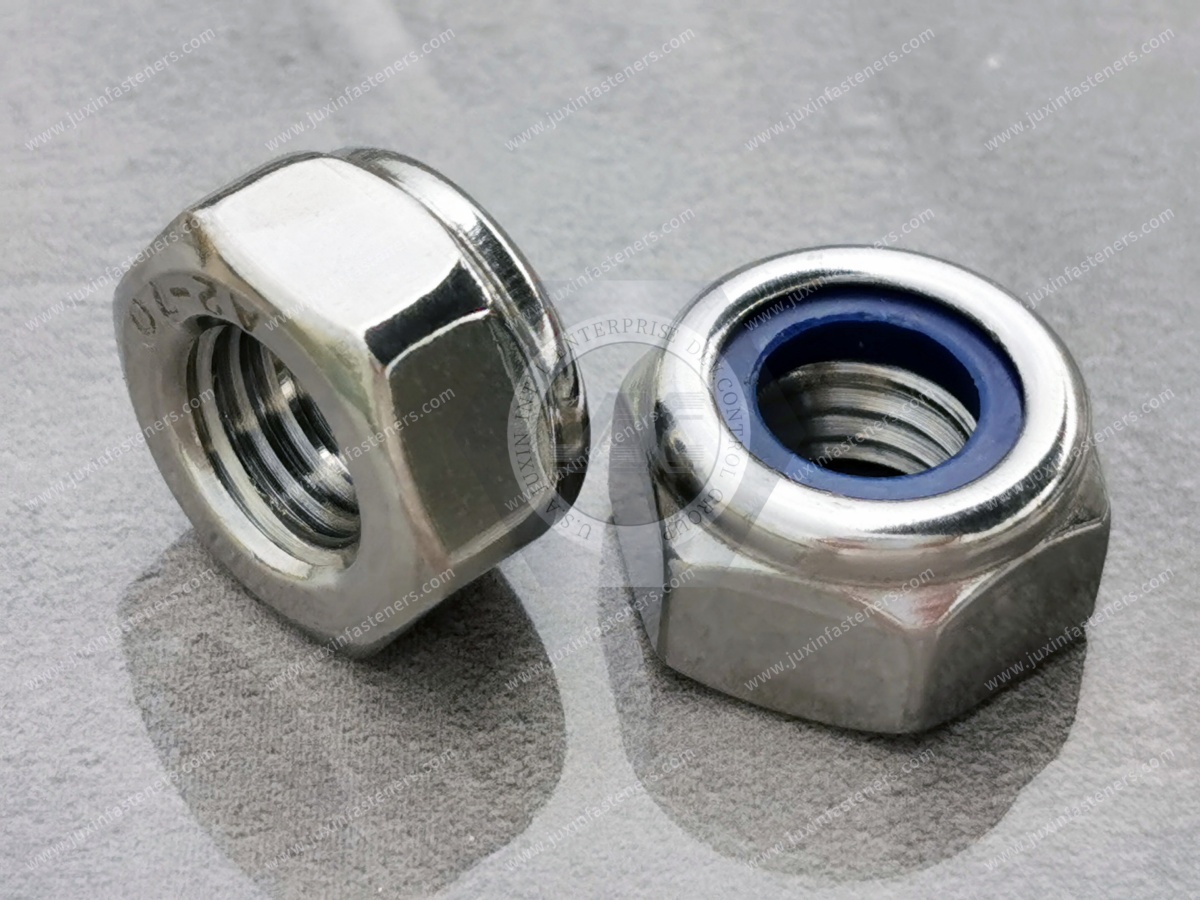
Common Locking Mechanisms
Nylon insert interference
Metallic thread deformation
Distorted-thread interference
Other specified prevailing-torque features
The mechanism should be selected according to the approved joint requirements.
Important Engineering Distinction
A self-locking nut does not automatically maintain a constant clamping force.
The joint may still lose preload through embedding, relaxation, temperature changes or other mechanisms.
Automotive qualification must therefore evaluate the complete assembly rather than assuming that a locking feature eliminates all loosening risks.
Why Automotive Locking-Nut Selection Differs From General Industrial Selection
Automotive components may experience combinations of:
Road-induced vibration
Mechanical shock
Thermal cycling
Moisture and road contaminants
Corrosion exposure
Production-line installation variation
Repeated service operations
The relative importance of these conditions depends on the component location and function.
A locking nut suitable for an auxiliary interior bracket may be inappropriate for an exhaust-adjacent assembly.
Likewise, a nut approved for one vehicle platform should not automatically be substituted into another.
Engineering Principle
Automotive suitability is application-specific and must be established through the approved engineering and supplier qualification process.
Nylon Insert Lock Nuts for Automotive Assemblies
Nylon insert lock nuts use a polymer insert to create resistance to rotation when engaged by the mating bolt.
They may be considered for selected automotive applications where their operating conditions are compatible with the insert.
Potential Applications
Subject to OEM approval:
Nonstructural interior brackets
Auxiliary equipment housings
Selected enclosure hardware
Service-access assemblies
Certain exterior accessories
Engineering Considerations
Operating temperature
Chemical exposure
Thread engagement
Installation torque
Prevailing-torque requirements
Reuse expectations
Temperature Limitation
The acceptable temperature range depends on the specific insert material and applicable product specification.
A stainless steel nut body does not eliminate the polymer insert's temperature limitations.
Automotive Design Recommendation
Confirm the actual temperature exposure at the fastener location rather than relying on a general vehicle operating-temperature assumption.
All-Metal Prevailing-Torque Lock Nuts for Automotive Assemblies
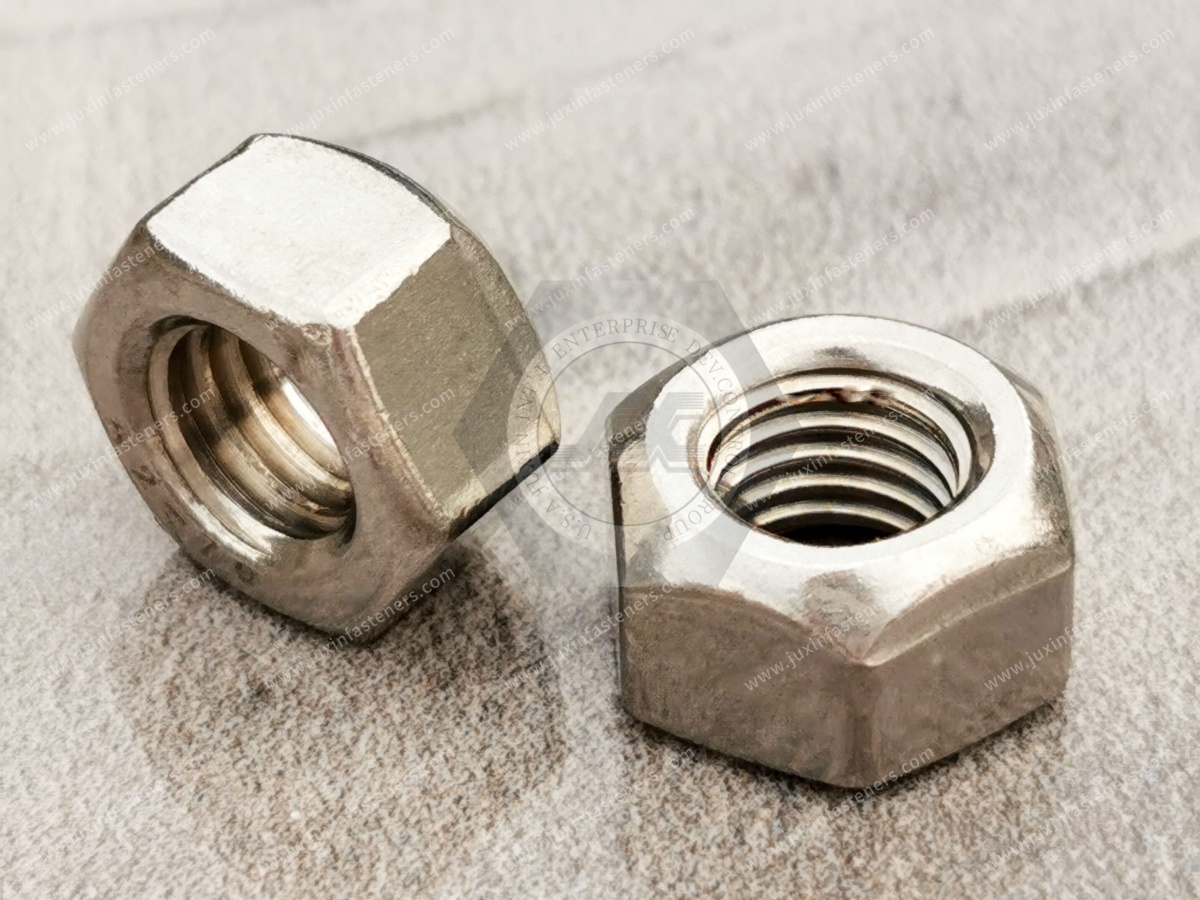
All-metal locking nuts generate rotational resistance through a metallic locking feature.
They may be considered where a polymer insert is unsuitable or where the approved joint design specifies an all-metal configuration.
Potential Applications
Subject to engineering qualification:
Auxiliary engine-compartment brackets
Selected mechanical equipment mounts
Exterior equipment hardware
Other approved threaded connections
Engineering Considerations
Metallic locking-feature geometry
Prevailing-torque performance
Temperature exposure
Bolt material
Thread condition
Galling risk
Reuse requirements
Important Limitation
An all-metal locking nut is not automatically approved for high-temperature or safety-critical automotive service.
The specific design and performance requirements must be validated.
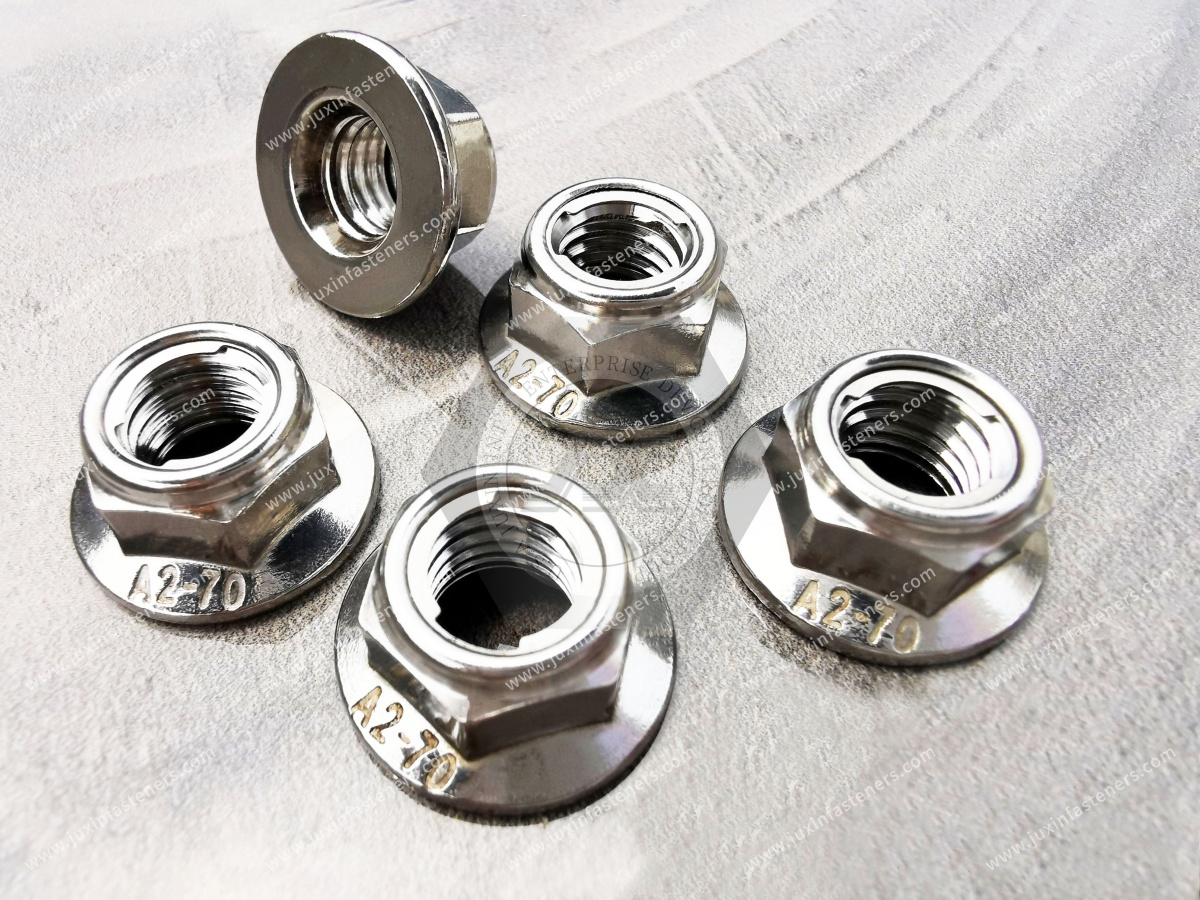
Distorted-Thread and Center-Lock Nut Designs
Distorted-thread locking nuts create interference through controlled deformation of the internal thread or another specified metallic feature.
Different configurations may place the locking feature at different locations.
Why Geometry Matters
The location and shape of the locking feature may affect:
Installation behavior
Prevailing-torque characteristics
Thread engagement
Reuse behavior
Manufacturing consistency
OEM Supplier Qualification Insight
Two nuts with similar external dimensions may produce different installation torque and locking performance.
A replacement should not be approved solely because its nominal dimensions match.
Automotive Locking-Nut Material Selection
Stainless steel grade selection should reflect both corrosion exposure and mechanical requirements.
304 Stainless Steel
304 may be considered for selected automotive applications where its corrosion resistance and mechanical properties satisfy the approved specification.
316 Stainless Steel
316 generally provides improved resistance to certain localized corrosion mechanisms compared with 304.
It may be considered for selected components exposed to more demanding moisture or chloride conditions.
A2 and A4 Material Groups
A2 and A4 are material groups used in relevant ISO stainless steel fastener specifications.
The mechanical-property class must be specified separately.
410 Stainless Steel
410 is a martensitic stainless steel that may be heat treated.
Its mechanical and corrosion characteristics differ from those of common austenitic stainless steels.
Important Limitation
Material grade alone does not establish:
Locking performance
Fatigue resistance
Required strength
Temperature capability
Automotive qualification
Corrosion Exposure in Automotive Fastening Systems
Automotive fasteners may be exposed to:
Rainwater
Road salt
Condensation
Cleaning chemicals
Humidity
Temperature fluctuations
Corrosion performance depends on the actual material, surface condition, assembly geometry and environment.
Crevice Conditions
Moisture retained in narrow joint interfaces can create localized corrosion conditions.
Mixed-Metal Assemblies
Stainless steel in contact with aluminum or other metals may require galvanic-corrosion evaluation.
Material Selection Recommendation
Specify corrosion requirements for the complete fastening assembly, not only for the nut.
Prevailing Torque Is Not the Same as Retained Clamp Load
This distinction is particularly important in automotive applications.
Prevailing Torque
Prevailing torque is the resistance to rotation generated by the nut's locking feature under specified conditions.
Installation Torque
Installation torque is the torque applied during tightening.
Clamp Load
Clamp load is the compressive force developed between the joined components.
Why Automotive Engineers Must Distinguish Them
A locking nut may retain rotational resistance even when the joint has experienced a reduction in preload.
Similarly, a nut with excessive prevailing torque may produce installation difficulties without improving the joint's functional performance.
Engineering Recommendation
Where clamp load is important, validate the complete bolt-and-nut assembly under the approved installation and service conditions.
Vibration Validation for Automotive Locking Nuts
Vehicle vibration can contribute to relative movement in threaded joints.
However, a locking feature alone does not establish complete vibration reliability.
Potential Validation Considerations
Joint loading
Installation preload
Prevailing-torque performance
Relative movement
Retained clamp load
Thread condition
Functional performance after testing
Important Distinction
The appropriate test method and acceptance criteria depend on the OEM specification and joint function.
Engineering Insight
A nut that performs well in an isolated prevailing-torque test may still be unsuitable for a poorly designed or inadequately preloaded joint.

Thermal Cycling and Locking Performance
Vehicle assemblies may experience repeated heating and cooling.
Thermal cycling can influence:
Joint preload
Differential expansion
Polymer insert behavior
Material relaxation
Locking-feature performance
Nylon Insert Designs
The polymer insert must remain suitable for the actual temperature and chemical environment.
All-Metal Designs
All-metal configurations avoid polymer insert limitations but still require temperature-dependent mechanical and locking-performance evaluation.
Engineering Recommendation
Include relevant operating and peak temperature conditions in the approved specification and RFQ.
Stainless Steel Galling During Automotive Assembly
Stainless steel threaded fasteners may experience galling under certain installation conditions.
Galling involves adhesive surface damage and may cause the nut and bolt to seize.
Potential Contributing Factors
Material pairing
Thread interference
High contact pressure
Installation speed
Misalignment
Surface condition
Inappropriate lubrication
Why Locking Nuts Require Special Attention
Prevailing-torque locking features intentionally create thread interference.
This can increase installation resistance.
Potential Engineering Measures
Depending on the approved joint:
Suitable material combinations
Controlled installation speed
Correct alignment
Appropriate surface treatment
Approved lubrication
Representative assembly trials
Important Limitation
Changes to coatings or lubricants may affect friction and achieved preload.
They require review before implementation.
Automotive Production-Line Installation Requirements
A technically suitable locking nut must also support repeatable manufacturing.
Assembly Process Considerations
Nut feeding
Thread alignment
Driver access
Tool compatibility
Tightening sequence
Torque monitoring
Thread engagement
Inspection
Production Risks
Potential problems include:
Cross-threading
Galling
Incorrect nut orientation
Incomplete locking-feature engagement
Excessive installation torque
Damaged threads
Inconsistent tightening
Production Manager's Perspective
A locking nut that increases installation variation may lead to additional rework, inspection time and line interruptions.
The selection process should therefore include production-line compatibility and assembly cycle-time considerations.
Practical Manufacturing Recommendation
Where required, establish an approved tightening process using representative production parts and equipment.
Automotive Service and Lock Nut Reuse
Vehicle service procedures may involve removing and reinstalling threaded fasteners.
Prevailing-torque locking performance can change after repeated use.
Reuse Depends On
Locking mechanism
Thread condition
Insert condition
Installation cycles
Product specification
OEM service requirements
Important Limitation
Do not assume that a stainless steel locking nut can be reused a fixed number of times.
For joints designated as single-use, follow the approved service procedure.
Engineering Recommendation
Reuse criteria should be documented rather than left to technician judgment.
Automotive Interior and Auxiliary Bracket Applications
Selected non-safety-critical vehicle assemblies may use locking nuts where approved.
Potential applications include:
Auxiliary mounting brackets
Nonstructural equipment housings
Selected interior equipment mounts
Service-access assemblies
Exterior accessory hardware
Engineering Priorities
Vibration
Corrosion exposure
Installation access
Serviceability
Dimensional compatibility
Important Limitation
Interior location does not automatically establish that a connection is non-safety-critical.
The actual component function must be reviewed.
Engine Compartment and Thermal Management Accessories
Selected auxiliary engine-compartment components may use locking nuts when the temperature and mechanical conditions are compatible.
Potential applications include:
Nonstructural equipment brackets
Auxiliary covers
Selected thermal-management accessories
Instrument mounting hardware
Engineering Priorities
Local operating temperature
Vibration
Chemical exposure
Installation access
Corrosion resistance
Important Limitation
Cylinder head, turbocharger, exhaust manifold and other highly loaded or temperature-sensitive joints require application-specific fastening systems.
General-purpose stainless steel locking nuts should not be substituted without approval.
Automotive Exterior Accessories
Potential applications include:
Nonstructural exterior trim brackets
Selected lighting mounts
License plate brackets
Auxiliary equipment housings
Engineering Priorities
Road salt exposure
Moisture
Vibration
Corrosion compatibility
Service access
Important Limitation
The use of a locking nut should be justified by the actual retention requirements.
Not every exterior accessory requires a prevailing-torque nut.
EV Auxiliary Equipment and Enclosures
Electric vehicles may incorporate auxiliary electronic housings, sensors and equipment brackets.
Potential applications include:
Nonstructural electronic equipment mounts
Auxiliary enclosure hardware
Selected low-voltage equipment brackets
Service-access covers
Engineering Priorities
Electrical clearance
Vibration
Corrosion exposure
Thermal cycling
Installation consistency
Important Electrical Safety Limitation
High-voltage electrical connections, busbar joints, battery structural retention and battery safety-related connections require separate engineering validation and approval.
A general-purpose stainless steel locking nut should not be substituted into these applications without authorization.
Safety-Critical Automotive Connections
Certain automotive joints have significant safety implications.
Examples include:
Braking systems
Steering systems
Suspension components
Wheel retention
Seat belt anchorage
Occupant restraint systems
Primary chassis connections
Structural battery connections
Important Qualification Rule
These applications require approved fastener specifications, joint-level engineering and appropriate validation.
Stainless steel locking nuts should never be substituted for specified safety-critical fasteners based solely on corrosion resistance or nominal thread size.
International Standards and Automotive OEM Specifications
The applicable standards depend on the exact locking nut and mating fastener.
ISO 3506-2
Defines mechanical-property requirements for specified corrosion-resistant stainless steel nuts.
ISO 10511
Defines dimensional requirements for certain prevailing-torque-type hexagon thin nuts with non-metallic inserts.
ISO 7040
Defines dimensional requirements for certain prevailing-torque-type hexagon regular nuts with non-metallic inserts.
ISO 2320
Specifies functional-property requirements for prevailing-torque-type steel nuts within its defined scope. Its applicability to a particular stainless steel locking nut must be checked rather than assumed.
ASTM F594
May apply to specified stainless steel nuts within its scope.
OEM Drawings and Specifications
Customer requirements may additionally define:
Locking mechanism
Prevailing-torque criteria
Material
Mechanical properties
Surface treatment
Corrosion requirements
Installation conditions
Inspection criteria
Important Standards Distinction
Dimensional compliance does not automatically establish mechanical performance or OEM approval.
PPAP and Customer-Specific Automotive Approval
Some automotive customers require Production Part Approval Process documentation or other supplier qualification records.
Requirements vary by customer and project.
Potential documentation may include:
Approved drawings
Material specifications
Dimensional inspection results
Functional test results
Process-related documentation
Change-control records
Important Limitation
PPAP capability, submission level and required documentation must be confirmed for the specific supplier and project.
No certification or approval should be assumed without supporting evidence.
Automotive Lock Nut Supplier Qualification
Supplier development teams should evaluate both the component and its manufacturing consistency.
Product Definition
Confirm the approved standard or drawing.
Material
Identify the required grade and mechanical-property class.
Locking Feature
Specify the correct mechanism and geometry.
Functional Requirements
Define prevailing-torque criteria and any relevant reuse requirements.
Installation Compatibility
Review the mating bolt and production tightening process.
Corrosion Requirements
Identify the actual vehicle environment and acceptance criteria.
Inspection
Define critical dimensions and functional characteristics.
Change Control
Review changes to material, locking geometry, coatings or manufacturing processes against customer approval requirements.
Commercial Evaluation
Review:
Sample availability
MOQ
Annual volume
Packaging
Delivery schedule
Supply continuity
Total assembly cost
Supplier Development Insight
A lower unit price may not represent a lower total cost if the alternative nut increases installation defects or qualification effort.
Custom Automotive Self-Locking Nuts
Some automotive OEM projects require nonstandard locking nut configurations.
Potential drawing-based requirements include:
Special nut height
Flange geometry
Specific locking-feature design
Nonstandard thread specifications
Defined material
Surface treatment
Critical dimensional tolerances
Engineering Review
The project should evaluate:
Mating bolt compatibility
Joint loading
Prevailing-torque requirements
Temperature
Corrosion
Manufacturing feasibility
Inspection requirements
Commercial Review
Sample quantities, MOQ, tooling considerations and production schedules should be confirmed during quotation.
Important Limitation
Custom manufacturing does not automatically establish automotive qualification.
Any required functional validation and customer approval must be completed separately.
Preparing an Automotive Lock Nut RFQ
A complete RFQ should include the following information.
Product Specification
Approved drawing or standard
Locking mechanism
Thread designation
Dimensions
Material and mechanical properties
Mating Fastener
Bolt drawing or standard
Thread specification
Material
Surface condition
Functional Requirements
Prevailing-torque criteria
Joint loading
Installation method
Temperature range
Corrosion environment
Reuse requirements
Quality Requirements
Inspection criteria
Functional acceptance criteria
Sample approval
Customer-specific documentation
Change-control requirements
Commercial Requirements
Sample quantity
Annual demand
Production quantity
Packaging
Target delivery schedule
Practical Procurement Recommendation
For replacement projects, include the currently approved nut and mating bolt specifications.
This helps identify differences in locking behavior, thread compatibility and installation requirements before a substitution is considered.
Frequently Asked Questions
What is an automotive stainless steel self-locking nut?
It is a stainless steel nut with an integrated locking feature intended to resist unintended relative thread rotation in an approved automotive assembly.
Do automotive self-locking nuts maintain constant preload?
Not automatically. Locking resistance and retained clamp load are different performance characteristics.
Are nylon insert lock nuts suitable for engine compartments?
Only where the insert material, temperature exposure and approved specification are compatible.
Are all-metal lock nuts suitable for automotive applications?
They may be suitable for specific approved joints, but material, temperature, mechanical and locking requirements must be validated.
Can automotive lock nuts be reused?
Reuse depends on the product specification and OEM service requirements.
Can stainless steel lock nuts replace carbon steel lock nuts?
Not automatically. Mechanical properties, locking performance, corrosion conditions and joint requirements must be reviewed.
Are stainless steel locking nuts suitable for brake or suspension systems?
Only when specifically approved and qualified for the relevant safety-critical joint.
What is the difference between prevailing torque and clamp load?
Prevailing torque is rotational resistance from the locking feature. Clamp load is the compressive force developed in the joint.
What should automotive OEM buyers specify when sourcing lock nuts?
The approved drawing, material, thread, locking mechanism, functional requirements, mating bolt, installation conditions, inspection criteria and production quantities.
Juxin Fasteners: Automotive Stainless Steel Lock Nuts and OEM Fastening Components
Juxin Fasteners supplies industrial fastening components and welcomes automotive OEM inquiries for standard and drawing-based locking nuts.
Relevant product categories include:
Stainless steel nylon insert lock nuts
Stainless steel all-metal lock nuts
Stainless steel distorted-thread lock nuts
Stainless steel flange lock nuts
Stainless steel hex nuts
Stainless steel hex bolts
Stainless steel washers
Custom threaded components
Specific materials, dimensions, locking performance, samples, MOQ, inspection requirements and delivery schedules are subject to technical and commercial confirmation.
Request an Automotive Stainless Steel Lock Nut RFQ
Are you sourcing stainless steel self-locking nuts for automotive auxiliary assemblies, exterior equipment, EV enclosures or other approved vehicle components?
Do you need to qualify an alternative supplier, evaluate a custom locking-nut design or prepare a recurring production sourcing program?
Juxin Fasteners welcomes inquiries from automotive design engineers, mechanical engineers, manufacturing engineers, production managers,
purchasing specialists, procurement managers, supplier development teams and supply chain managers.
For technical review and quotation, please provide:
Approved nut drawing or standard + locking mechanism + thread designation + material and mechanical-property requirements + mating bolt specification
+ prevailing-torque criteria + joint loading + operating temperature + corrosion environment + installation process + reuse requirements
+ inspection criteria + sample quantity + annual demand + production quantity + packaging requirements + target delivery schedule.
For replacement projects, identify the existing approved part and any proposed changes.
Company: Juxin Fasteners
Website: https://www.juxinfasteners.com/
Email: info@juxinfasteners.com
Send your automotive locking-nut drawings and OEM RFQ to Juxin Fasteners for technical review and quotation.
Contact Us
Tel.:
+86 020 8621 0320
+86 020 3121 6067
E-mail:
Technical Support:
Navigation
SEND INQUIREY



