Call Us
+86 136 6007 9809
Call Us
+86 136 6007 9809

Aug. 12, 2026
Stainless Steel Screws Selection Guide: 304 vs 316 Stainless Steel Fasteners for Industrial Applications
Engineering Guide to A2/A4 Stainless Steel, Corrosion Resistance, Mechanical Properties, Thread Galling, Industrial Assembly and OEM Fastener Sourcing
Stainless steel screws are widely used in industrial manufacturing because they combine useful mechanical properties with corrosion resistance and a broad range of fastening configurations.
They are found in electrical equipment, machinery, automotive accessories, electronic enclosures, food-processing equipment, laboratory instruments, marine-related equipment and industrial infrastructure.
However, selecting the correct stainless steel screw requires more than choosing between 304 and 316 material.
A reliable industrial fastening design must account for:
Stainless steel grade and composition
Mechanical property class
Corrosion environment
Thread type and tolerance
Screw head and drive configuration
Mating material
Thread engagement
Tightening torque and clamp load
Thread galling
Surface condition and passivation
Assembly process
Inspection and supplier qualification
A screw that performs reliably inside a controlled electrical cabinet may be unsuitable for a coastal enclosure exposed to chloride deposits.
Likewise, a 316 stainless steel screw may offer improved resistance to certain corrosive environments without providing the mechanical strength required to replace a high-strength alloy steel fastener.
For OEM manufacturers, the correct solution must satisfy the complete connection design, production process and long-term service requirements.
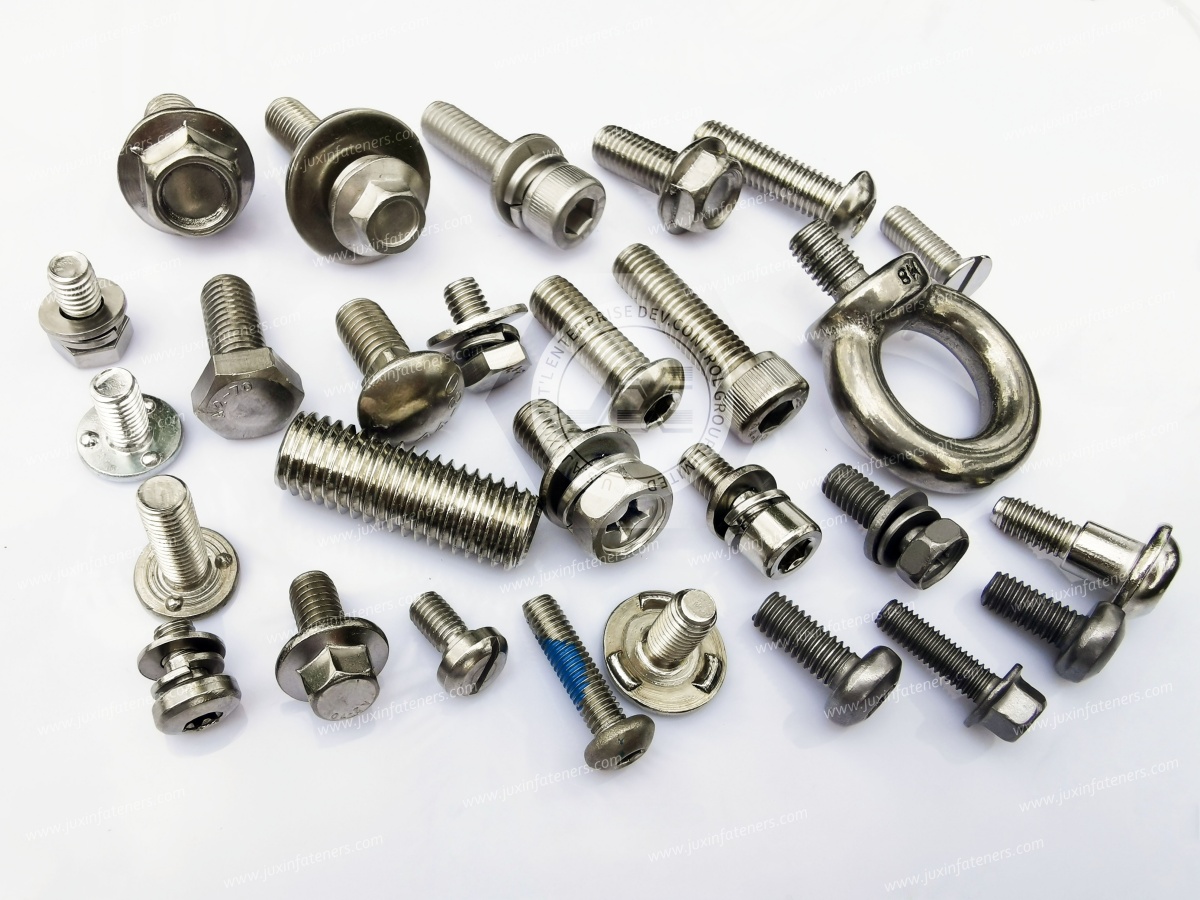
Juxin Fasteners supports industrial customers with stainless steel screws, threaded fastening components, stainless steel blind rivet nuts, selected self-clinching fasteners, threaded inserts and drawing-based customized components.
This guide explains how engineers, manufacturing teams and procurement professionals can select suitable stainless steel fastening systems for real industrial applications.
What Are Stainless Steel Screws?
Stainless steel screws are externally threaded fasteners made from stainless steel materials containing sufficient chromium to develop a protective passive surface film under suitable conditions.
Their corrosion resistance depends on alloy composition, surface condition and operating environment.
Stainless steel is not a single material.
Different stainless steel families provide different combinations of:
Corrosion resistance
Mechanical strength
Hardness
Ductility
Formability
Magnetic behavior
Manufacturing characteristics
Common materials used in industrial screw applications include:
304 austenitic stainless steel
316 austenitic stainless steel
410 martensitic stainless steel
Other specified stainless steel grades for specialized applications
In North American commercial terminology, 18-8 stainless steel is also widely used for certain austenitic fasteners.
However, the term 18-8 does not necessarily establish one exact material grade or a complete mechanical property specification.
For controlled OEM purchasing, material identity and mechanical performance should be defined separately.
304 vs 316 Stainless Steel Screws: What Is the Difference?
Both 304 and 316 belong to the austenitic stainless steel family.
They are commonly selected for corrosion-resistant mechanical fastening applications.
The principal material distinction is that 316 contains molybdenum, which generally improves resistance to localized corrosion in many chloride-containing environments compared with 304.
However, neither grade is universally corrosion-proof.
304 Stainless Steel Screws
304 stainless steel is widely used for general industrial equipment and many indoor or moderately exposed applications.
Potential advantages include:
Good general corrosion resistance
Good formability
Broad industrial familiarity
Suitable appearance for exposed hardware
Competitive material cost relative to 316 in many markets
Potential applications include:
Indoor industrial machinery
Electrical cabinet accessories
Electronic equipment housings
Laboratory fixtures
General equipment brackets
Selected outdoor installations with manageable exposure
Engineering Limitation
304 stainless steel may be vulnerable to localized corrosion in environments containing chloride deposits, stagnant moisture or aggressive cleaning chemicals.
Its suitability depends on the actual exposure conditions.
316 Stainless Steel Screws
316 stainless steel contains molybdenum and is frequently considered for more demanding corrosion environments.
Potential advantages include:
Improved resistance to certain chloride-related corrosion conditions
Improved localized corrosion resistance relative to 304 in many environments
Suitability for selected chemical and coastal equipment applications
Potential applications include:
Coastal electrical enclosures
Marine-related auxiliary equipment
Food-processing machinery
Outdoor industrial equipment
Selected chemical-processing accessories
Equipment exposed to more demanding cleaning environments
Engineering Limitation
316 stainless steel can still suffer pitting, crevice corrosion, stress corrosion cracking or galvanic corrosion under unfavorable conditions.
Continuous seawater exposure, elevated temperature and stagnant chloride-containing environments may require additional corrosion engineering or alternative materials.
304 vs 316 Stainless Steel Screws: Engineering Comparison
| Selection factor | 304 stainless steel | 316 stainless steel |
|---|---|---|
| Material family | Austenitic | Austenitic |
| Molybdenum addition | Not normally specified as an intentional alloying addition | Contains molybdenum |
| General corrosion resistance | Good in many environments | Good in many environments |
| Chloride-related localized corrosion | More vulnerable in many comparable conditions | Generally improved resistance |
| Indoor industrial equipment | Frequently suitable | Frequently suitable |
| Coastal exposure | Requires careful evaluation | Often preferred for evaluation |
| Continuous seawater exposure | Not generally a default choice | Not automatically suitable |
| Mechanical strength | Depends on fastener property class | Depends on fastener property class |
| Thread galling | Possible | Possible |
| Relative material cost | Often lower | Often higher |
| OEM selection basis | Actual environment and mechanical specification | Actual environment and mechanical specification |
Practical Selection Rule
Choose 304 when its verified corrosion resistance and mechanical properties are sufficient for the application.
Consider 316 when chloride exposure or another corrosive condition justifies the additional alloying cost.
Do not select 316 solely because it sounds more premium.
A2 vs A4 Stainless Steel Screws: Are They the Same as 304 and 316?
European and international fastener specifications commonly use the ISO 3506 designation system.
A2 and A4 are stainless steel fastener grade designations associated with particular austenitic stainless steel composition groups.
They are commonly linked commercially with 304-type and 316-type stainless steels, respectively.
However, the designations should not be treated as perfectly interchangeable material names.
A2 Stainless Steel Fasteners
A2 is commonly associated with stainless steels in the 304-type family.
A4 Stainless Steel Fasteners
A4 is commonly associated with molybdenum-bearing stainless steels in the 316-type family.
Why the Distinction Matters
A drawing that specifies 316 material may contain chemical composition requirements that must be verified.
A drawing specifying A4-70 includes a stainless steel fastener grade and mechanical property class.
These are related but not identical ways of defining a product.
A2-70 vs A4-70
The designation combines:
Stainless steel grade group
Mechanical property class
For example:
A2-70
Austenitic stainless steel grade A2 with property class 70.
A4-70
Austenitic stainless steel grade A4 with property class 70.
The property class 70 denotes a specified minimum tensile strength level of 700 MPa under the applicable ISO 3506-1 requirements.
This is not a universal guarantee of joint strength, fatigue performance or clamp load.
Important Engineering Distinction
A4-70 is not automatically stronger than A2-70.
Both use property class 70, although their corrosion characteristics may differ.
The geometry, manufacturing condition and complete joint design remain important.
Can A2-70 or A4-70 Replace Class 8.8 or 10.9 Steel Screws?
Not automatically.
Carbon steel and stainless steel fasteners use different material and mechanical property designation systems.
ISO property classes 8.8 and 10.9 are not equivalent to A2-70 or A4-70.
A replacement decision must evaluate:
Required tensile capacity
Proof or yield-related properties
Joint preload
Fatigue loading
Thread engagement
Corrosion
Temperature
Fastener geometry
Engineering Example
An OEM drawing specifies a class 10.9 alloy steel screw for a highly loaded mechanical joint.
Replacing it with A4-70 solely to improve corrosion resistance may reduce the available mechanical capacity.
A proper material substitution requires engineering calculations and validation.
International Standards for Stainless Steel Screws
ISO 3506-1:2020
Specifies mechanical and physical properties for applicable corrosion-resistant stainless steel bolts, screws and studs.
It covers specified stainless steel grades and property classes within its defined scope.
The standard does not independently establish fatigue strength, shear strength, torque/clamp-force behavior or weldability.
ISO 3506-6:2020
Provides general guidance on stainless steel and nickel alloy selection for fasteners.
ISO 3506-4:2025
Addresses stainless steel tapping screws with specified grades and hardness classes.
This is particularly relevant when evaluating certain stainless steel screws that form mating threads in suitable materials.
ISO 3506-2
Addresses applicable corrosion-resistant stainless steel nuts.
ISO 261 and ISO 965
Relevant to ISO metric thread dimensions and tolerances.
ISO 4762
Relevant to hexagon socket head cap screw geometry.
ISO 7045 and Other Applicable Product Standards
Certain head and drive configurations are defined by their own product standards.
The correct standard depends on the exact screw design.
ASTM F593
Relevant to specified stainless steel bolts, hex cap screws and studs within its scope.
ASTM A967/A967M
Relevant to chemical passivation treatments for stainless steel parts.
ASTM B117 and ISO 9227
Provide salt spray test methods.
They do not establish a universal conversion between test hours and actual outdoor service life.
Important Standards Principle
A stainless steel screw specification may require separate references for:
Material
Mechanical properties
Product dimensions
Thread tolerances
Surface treatment
Testing
A drawing stating only “316 stainless screw” may be insufficient for controlled industrial production.
410 Stainless Steel Screws: When Hardness Matters More Than Austenitic Corrosion Resistance
410 stainless steel is a martensitic stainless steel.
Unlike typical austenitic 304 and 316 grades, suitable 410 material can be hardened through heat treatment.
This makes it relevant to certain applications requiring increased hardness.
Potential Applications
Selected self-tapping screws
Certain self-drilling screw designs
Screws requiring a hardened thread or drilling feature
Important Engineering Distinction
410 stainless steel should not be treated as a direct corrosion-performance equivalent to 304 or 316.
Its corrosion resistance is generally more limited in many environments.
Likewise, a self-drilling screw requires suitable hardness, tip geometry and installation performance.
The designation “410 stainless steel” alone does not guarantee successful drilling or thread formation.
304 vs 316 vs 410: Material Selection Matrix
| Requirement | 304 | 316 | 410 |
|---|---|---|---|
| General corrosion resistance | Good | Good, often improved in chloride conditions | More limited in many conditions |
| Austenitic stainless steel | Yes | Yes | No |
| Heat-treatable to high hardness | Not by conventional hardening heat treatment | Not by conventional hardening heat treatment | Yes |
| General machine screws | Common | Common | Application-dependent |
| Certain self-tapping screws | Application-dependent | Application-dependent | Common candidate |
| Certain self-drilling screws | Requires specific design | Requires specific design | Common candidate |
| Coastal exposure | Evaluate carefully | Often preferred for evaluation | Requires careful evaluation |
| Thread galling | Possible | Possible | Depends on material pairing and condition |
How to Select the Correct Stainless Steel Screw Head
The screw head affects installation access, bearing area, appearance and mechanical loadability.
Hex Head Screws
Hex head screws allow wrench-based installation.
Potential applications include:
Industrial machinery
Mechanical brackets
Equipment frames
Serviceable assemblies
Engineering Considerations
Wrench clearance
Bearing surface
Head dimensions
Installation torque
Mating component strength
Flange Head Screws
Flange head screws incorporate an enlarged bearing surface.
Potential benefits include:
Reduced loose washer handling
Larger bearing area
Potential assembly simplification
However, a flange does not automatically replace every washer configuration.
Button Head Screws
Button head screws provide a rounded, relatively low-profile head.
Potential applications include:
Equipment housings
Electronic enclosures
Accessory panels
Exposed industrial components
Important Limitation
Reduced head geometry can affect the fastener's loadability.
A button head screw should not automatically be assumed to provide the same head strength as a standard socket head cap screw of the same diameter and material.
Pan Head Screws
Pan head screws are widely used for general equipment assembly.
Potential applications include:
Electrical equipment
Control panels
Electronic housings
Industrial accessories
Socket Head Cap Screws
Socket head cap screws are commonly used in machinery and precision equipment.
Engineering considerations include:
Socket engagement
Head clearance
Mechanical property class
Tool access
Tightening procedure
Choosing the Correct Screw Drive for OEM Production
Drive selection affects assembly speed, tool wear and the risk of damage during tightening.
Phillips Drive
Common in general equipment assembly.
Potential considerations include:
Tool availability
Alignment
Cam-out behavior
Assembly torque
Hex Socket Drive
Common in industrial machinery and precision equipment.
Potential considerations include:
Socket depth
Tool engagement
Available installation space
Head geometry
Hexalobular Drive
Often referred to commercially as Torx-type drive.
Potential advantages include efficient torque transmission and reduced cam-out when the drive and tooling are correctly matched.
Production Engineering Insight
The best drive system depends on the required tightening process.
A drive type that works well in manual assembly may not be the best option for a high-speed automated screwdriving station.
Production teams should evaluate:
Bit life
Screw feeding
Alignment
Drive engagement
Tightening consistency
Tool maintenance
Rework rate
Thread Design: Metric, UNC and UNF Stainless Steel Screws
International industrial customers use multiple thread systems.
Metric Screws
Common examples include:
M3 × 0.5
M4 × 0.7
M5 × 0.8
M6 × 1.0
M8 × 1.25
M10 × 1.5
M12 × 1.75
Unified Inch Screws
Common examples include:
1/4-20 UNC
5/16-18 UNC
3/8-16 UNC
3/8-24 UNF
Unified inch thread requirements are commonly specified using ASME B1.1.
Important Compatibility Rule
Metric, UNC and UNF threads are different systems.
They cannot be treated as directly interchangeable simply because their nominal diameters are similar.
Thread Engagement
For screws installed in tapped holes, engineers must consider:
Parent material
Thread engagement length
Internal thread strength
Screw strength
Repeated assembly
Blind-hole clearance
A stainless steel screw installed into aluminum or another lower-strength material may be limited by the internal thread rather than the screw itself.
Stainless Steel Thread Galling: Why Screws Seize During Assembly
Thread galling is an important engineering risk in stainless steel fastening.
It can occur when contacting metal surfaces experience adhesive damage during sliding.
In threaded assemblies, galling may cause:
Sudden tightening resistance
Damaged threads
Seized nuts and screws
Broken fasteners
Assembly rejection
Difficult maintenance
Why Stainless Steel Screws Are Vulnerable
Austenitic stainless steel materials can be susceptible to adhesive wear under unfavorable contact conditions.
Risk factors include:
Similar mating materials
High contact pressure
Surface roughness
Thread damage
Inadequate lubrication
Uncontrolled tightening
Repeated assembly
How to Reduce Galling Risk
Material Pairing
Consider whether different compatible materials or surface conditions may reduce adhesive wear.
Any alternative must still meet corrosion and mechanical requirements.
Thread Quality
Verify the condition and fit of mating threads.
Lubrication
Suitable lubrication may reduce friction and galling risk.
However, lubrication also changes torque/preload behavior.
Controlled Assembly
Validate the tightening process, including tool speed, torque and alignment.
Surface Treatment
Selected coatings or treatments may help in appropriate applications, subject to qualification.
Production Manager Insight
If a stainless steel assembly repeatedly seizes on the production line, simply increasing tightening torque is not a reliable corrective action.
The manufacturing team should review the material combination, thread quality, friction condition and installation process.
Tightening Torque and Clamp Load for Stainless Steel Screws
Tightening torque is not the same as clamp load.
Applied torque is influenced by:
Thread friction
Bearing friction
Surface condition
Lubrication
Coating
Thread geometry
Installation equipment
A lubricated stainless steel screw may develop a different clamp load from an unlubricated screw at the same tightening torque.

Important Engineering Rule
Do not apply one universal tightening torque to all 304 or 316 stainless steel screws.
Torque must be determined according to the actual fastener, mating component, joint design and installation requirements.
For suitable applications, the OEM may require torque/clamp-force testing or assembly trials.
Corrosion Engineering: Why Stainless Steel Screws Still Fail
Stainless steel can experience several corrosion mechanisms.
Pitting Corrosion
Localized corrosion may occur when the protective passive film breaks down under aggressive environmental conditions.
Chloride exposure is a common concern.
Crevice Corrosion
Crevice corrosion may develop in narrow gaps where moisture and aggressive species accumulate.
Potential locations include:
Under screw heads
Under washers
Between overlapping components
Inside poorly drained joints
Galvanic Corrosion
When dissimilar metals are electrically connected in a conductive environment, galvanic corrosion may affect the less noble material.
For example, stainless steel fasteners used in aluminum equipment may require additional consideration of:
Electrical contact
Exposed surface area
Moisture
Coatings
Joint design
Stress Corrosion Cracking
Certain stainless steels may be susceptible to stress corrosion cracking under specific combinations of stress, temperature and environment.
Corrosion Engineering Insight
Selecting 316 rather than 304 may improve resistance to some corrosion mechanisms,
but it does not eliminate poor drainage, trapped moisture or incompatible material combinations.
Surface Treatments for Stainless Steel Screws
Passivation
Passivation treatments can help remove certain surface contaminants and support the formation or maintenance of a suitable passive surface.
Applicable requirements may reference ASTM A967/A967M or other relevant specifications.
Important Distinction
Passivation is not a substitute for selecting the correct stainless steel grade.
Black Surface Finishes
Blackened stainless steel screws may be selected for appearance or optical requirements.
The finish must be evaluated for:
Adhesion
Corrosion behavior
Dimensional effect
Wear
Customer appearance requirements
PTFE-Containing Coatings
Selected PTFE-containing or other engineered coating systems may be used to modify friction or other surface characteristics.
However, a coating should not be described as universally preventing galling.
Important Limitation
Coating suitability depends on:
Temperature
Chemical environment
Adhesion
Thread fit
Tightening behavior
Service requirements
Salt Spray Testing
Salt spray tests can support comparison or acceptance of specified coating systems.
However, salt spray hours are not a direct prediction of years of field service.
Stainless Steel Screw Solutions for Automotive and EV Manufacturing
Automotive and EV equipment contain many fastening interfaces with different corrosion, mechanical and production requirements.
Potential Applications
Noncritical electronic module housings
Auxiliary battery enclosure accessories
Cable-management brackets
Interior equipment supports
Thermal-management accessories
Protective covers
Engineering Challenges
Vibration
Temperature cycling
Mixed materials
Corrosion
Production consistency
Tightening control
Potential Solutions
A2 stainless steel machine screws
A4 stainless steel screws where justified by exposure
Stainless steel threaded components
Locking fasteners
Self-clinching hardware
Stainless steel blind rivet nuts
Important Limitation
Battery safety-critical, high-voltage, restraint, braking and primary structural connections require OEM-specific engineering approval.
AI Data Centers and Server Equipment
AI data center infrastructure contains server racks, fan assemblies, electrical cabinets and mechanical accessories.
Potential Applications
Server cabinet accessories
Fan mounting brackets
Equipment covers
Cable-management components
Auxiliary power cabinet hardware
Engineering Challenges
Maintenance access
Vibration
Restricted installation space
Electrical bonding
Assembly efficiency
Potential Solutions
Stainless steel machine screws
Cage nuts
Self-clinching nuts
Self-clinching standoffs
Selected threaded inserts
Engineering Insight
Stainless steel is not automatically required for every indoor server rack application.
Material selection should be justified by the operating environment, mechanical requirements and cost.
Liquid Cooling and Thermal Management Equipment
Liquid cooling equipment used in data centers, power electronics and EV systems may require corrosion-resistant fastening components.
Potential Applications
Pump accessory brackets
Heat exchanger supports
Auxiliary enclosure hardware
Service panels
Mechanical mounting components
Engineering Challenges
Condensation
Coolant exposure
Temperature cycling
Vibration
Galvanic corrosion
Potential Solutions
304 stainless steel screws for suitable environments
316 stainless steel screws where corrosion conditions justify them
Stainless steel rivet nuts
Custom machined threaded components
Important Limitation
A corrosion-resistant screw does not independently establish leak-tightness or pressure-system integrity.
Electrical Cabinets and Power Distribution Equipment
Electrical cabinets often contain thin sheet metal and limited installation space.
Potential Applications
Cabinet accessories
Equipment mounting brackets
Mechanical covers
Auxiliary supports
Engineering Challenges
Sheet thickness
Internal thread strength
Electrical bonding
Corrosion
Assembly access
Potential Solutions
Stainless steel machine screws
Self-clinching nuts
Blind rivet nuts
Cage nuts
Clip-on nuts
Welded threaded components
Selection Insight
For thin sheet metal, the most important design decision may be how the internal thread is created.
A stainless steel screw alone cannot compensate for insufficient thread engagement in the parent sheet.
Semiconductor and Precision Equipment
Precision equipment may require controlled fastening geometry and material selection.
Potential Applications
Instrument housings
Sensor brackets
Equipment covers
Precision mechanical fixtures
Engineering Challenges
Dimensional consistency
Surface cleanliness
Particle generation
Vibration
Maintenance
Potential Solutions
Stainless steel machine screws
Socket head screws
Precision machined spacers
Threaded inserts
Cleanroom or process-specific compatibility must be separately verified.
Industrial Automation and Robotics
Industrial automation equipment may contain repeatedly loaded mechanical connections.
Potential Applications
Sensor mounts
Equipment covers
Auxiliary brackets
Automation fixtures
Engineering Challenges
Cyclic loading
Vibration
Precision positioning
Maintenance access
Potential Solutions
Stainless steel socket head screws
Machine screws
Locking fasteners
Custom threaded components
Important Limitation
Primary structural robotic joints may require higher-strength materials or specially validated fastening systems.
Marine and Coastal Equipment
Marine-related equipment presents corrosion challenges due to chloride exposure and moisture.
Potential Applications
Coastal electrical cabinets
Auxiliary marine equipment housings
Instrument brackets
Noncritical service panels
Engineering Challenges
Chloride deposits
Crevice corrosion
Galvanic corrosion
Maintenance
Material compatibility
Potential Solutions
316 stainless steel may be preferred over 304 for evaluation in certain coastal conditions.
However, severe marine environments may require alternative alloys or a different joint design.
Do Not Assume
A screw described as “marine grade 316” is automatically suitable for continuous seawater immersion or every offshore application.
Food-Processing Machinery
Food-processing equipment may require resistance to moisture, cleaning chemicals and repeated washdown.
Potential Applications
External machine frames
Packaging equipment
Protective covers
Auxiliary brackets
Engineering Challenges
Cleaning chemicals
Crevice formation
Surface contamination
Corrosion
Maintenance
Potential Solutions
304 stainless steel screws
316 stainless steel screws where justified
Suitable passivated components
Customized corrosion-resistant fasteners
Important Limitation
A stainless steel screw is not automatically food-contact approved.
The complete equipment design and applicable hygiene requirements must be evaluated.
Medical and Laboratory Equipment
Medical and laboratory equipment may require precise, corrosion-resistant fastening components.
Potential Applications
Noncritical instrument frames
Laboratory equipment housings
Protective covers
Mechanical accessories
Engineering Challenges
Cleaning and disinfection
Corrosion
Surface condition
Dimensional precision
Traceability
Potential Solutions
Stainless steel machine screws
Precision screws
Selected passivated components
Custom threaded parts
Important Limitation
Material grade or passivation alone does not establish medical-device regulatory compliance.
Outdoor Infrastructure and Renewable Energy Equipment
Outdoor equipment may experience moisture, UV exposure, temperature cycling and airborne contaminants.
Potential Applications
Solar equipment accessories
Outdoor control cabinets
Communication enclosures
Auxiliary equipment brackets
Engineering Challenges
Atmospheric corrosion
Temperature cycling
Mixed materials
Maintenance access
Potential Solutions
304 stainless steel screws where suitable
316 stainless steel screws where exposure justifies them
Stainless steel nuts
Corrosion-resistant threaded inserts
Primary structural and safety-critical connections require project-specific approval.
Industrial Stainless Steel Fastener Application Matrix
| Application | Main engineering concern | Potential solution |
|---|---|---|
| Indoor electrical cabinet | General corrosion and assembly access | A2 machine screws |
| Coastal equipment enclosure | Chloride exposure | Evaluate A4 screws |
| Stainless steel nut-and-screw joint | Thread galling | Material pairing and validated assembly |
| Thin sheet-metal panel | Limited thread engagement | Self-clinching nut or rivet nut |
| EV auxiliary enclosure | Mixed materials and vibration | Approved stainless fastening system |
| AI server rack | Service access | Machine screws and cage nuts |
| Liquid cooling pump bracket | Condensation and vibration | Corrosion-resistant screw assembly |
| Semiconductor equipment | Precision and cleanliness | Specified stainless precision screws |
| Food-processing machinery | Cleaning chemicals | Suitable 304 or 316 fastening system |
| Marine-related accessory | Chloride and crevice corrosion | Evaluate 316 and joint geometry |
| Plastic equipment housing | Internal thread durability | Threaded insert |
| Outdoor communication cabinet | Corrosion and maintenance | Suitable stainless hardware |
Stainless Steel Screws for Thin Sheet Metal: Beyond Conventional Screws
Many industrial assemblies use thin sheet metal.
The parent sheet may not provide sufficient thread engagement for a conventional machine screw.
In these cases, engineers may need an integrated threaded fastening component.
Stainless Steel Blind Rivet Nuts
Blind rivet nuts provide internal threads in suitable sheet-metal or hollow-section assemblies.
Potential configurations include:
Round body
Knurled body
Half-hexagonal body
Full-hexagonal body
Open end
Closed end
Flat head
Reduced head
Engineering Considerations
Sheet thickness
Grip range
Hole diameter
Anti-rotation requirements
Installation force
Pull-out resistance
Torque resistance
Stainless Steel Self-Clinching Fasteners
Self-clinching nuts, studs and standoffs can be considered for suitable sheet materials.
Engineering Considerations
Sheet hardness
Minimum sheet thickness
Hole preparation
Edge distance
Installation force
Push-out resistance
Torque-out resistance
Weld Nuts and Weld Studs
Welded threaded components may be appropriate for selected metal assemblies.
The welding process, base material, distortion and inspection requirements must be evaluated.
Threaded Inserts for Plastics
Plastic housings may use:
Brass threaded inserts
Stainless steel threaded inserts
Heat-set inserts
Ultrasonic inserts
Molded-in inserts
The insert and installation method should be selected according to the plastic material and mechanical requirements.
Engineering Principle
A stainless steel screw is only one part of the fastening system.
The strength and reliability of the internal thread can determine the performance of the complete connection.
Manufacturing Engineering: Improving Stainless Steel Screw Assembly Reliability
For production managers and manufacturing engineers, a suitable fastener must also be compatible with the assembly process.
Automated Screw Feeding
Fastener geometry affects:
Feeding
Orientation
Head engagement
Installation repeatability
Torque Control
The tightening process must account for friction and galling risks.
Thread Starting
Misalignment can cause cross-threading and damaged components.
Drive Wear
Incorrect tooling can damage screw heads or reduce assembly reliability.
Material Consistency
Variations in screw material, surface condition or coating can affect installation performance.
Assembly Validation
Before volume production, the OEM may need to confirm:
Installation torque
Clamp-load behavior
Thread engagement
Galling risk
Repeated assembly performance
Inspection criteria
Production Cost Insight
A low-cost screw that causes repeated assembly stoppages can be more expensive than a better-specified component.
The correct selection should consider total installed cost rather than unit price alone.
Common Stainless Steel Screw Failures and Corrective Actions
| Failure | Potential cause | Engineering response |
|---|---|---|
| Thread galling | Adhesive wear and high friction | Review material pairing, lubrication and tightening |
| Pitting corrosion | Aggressive chloride exposure | Review grade and environment |
| Crevice corrosion | Trapped moisture and poor drainage | Improve joint geometry and material selection |
| Galvanic corrosion | Dissimilar metals in conductive conditions | Review material pairing and isolation |
| Thread stripping | Insufficient engagement or weak parent material | Review engagement or use an insert |
| Insufficient preload | Friction variation or poor tightening | Validate assembly process |
| Screw head damage | Incorrect tooling or head geometry | Review drive and installation method |
| Fatigue failure | Cyclic loading and joint movement | Review preload, stiffness and load path |
| Assembly seizure | Galling or thread damage | Review mating threads and installation |
| Coating failure | Unsuitable surface treatment | Review coating specification and validation |
OEM Supplier Qualification for Stainless Steel Screws
Purchasing teams should evaluate both product conformity and long-term supply requirements.
Material Identification
Confirm the specified stainless steel grade.
Where required, request material documentation and appropriate verification.
Mechanical Properties
Confirm the applicable property class or mechanical requirements.
Dimensional Inspection
Verify:
Diameter
Length
Head geometry
Drive dimensions
Thread pitch
Thread tolerance
Critical drawing dimensions
Surface Inspection
Verify:
Appearance
Surface defects
Passivation or coating requirements
Customer-specific acceptance criteria
Functional Testing
Depending on the application, qualification may require:
Assembly trials
Tightening performance
Thread engagement verification
Galling assessment
Corrosion testing
Documentation
Customers may require:
Material certificates
Inspection reports
Test reports
Lot identification
Traceability documentation
Important Supplier Qualification Rule
A supplier should not be considered approved merely because its catalog lists 304 or 316 stainless steel.
The actual fastener must meet the agreed drawing, material, mechanical, dimensional and functional requirements.
Cost Optimization: When Is 316 Worth the Additional Cost?
316 stainless steel is often more expensive than 304.
However, the correct economic comparison is not simply the price per screw.
Consider:
Corrosion exposure
Required service life
Maintenance access
Replacement cost
Assembly cost
Failure consequences
Inspection requirements
Supplier availability
Example: Indoor Equipment Cabinet
If 304 meets the corrosion and mechanical requirements, changing to 316 may increase cost without providing meaningful operational benefit.
Example: Coastal Electrical Enclosure
If chloride exposure creates unacceptable corrosion risk for 304, evaluating 316 may be economically justified.
Example: Stainless Steel Assembly with Galling Problems
Changing from 304 to 316 may not resolve thread galling.
The better solution may involve surface condition, material pairing, lubrication or tightening control.
Example: Thin Sheet-Metal Assembly
Changing screw material may not resolve internal thread failure.
A self-clinching nut or blind rivet nut may provide a more effective design solution.
OEM Purchasing Insight
Material selection and joint design should be evaluated together.
Juxin Fasteners: Stainless Steel Screws and Related Industrial Fastening Solutions
Juxin Fasteners supports international OEM manufacturers, engineering teams and procurement departments with industrial fastening requirements.
Relevant product families include:
Stainless Steel Screws and Threaded Components
Machine screws
Socket screws
Selected hex head screws
Selected flange screws
Drawing-based custom screws
Stainless Steel Locking Fasteners
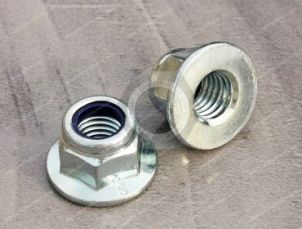
Stainless steel nylon insert lock nuts
Selected all-metal locking nuts
Stainless steel flange locking nuts
Stainless Steel Sheet-Metal Fasteners
Stainless steel blind rivet nuts
Selected stainless steel self-clinching components
Stainless steel threaded studs and related hardware
Threaded Inserts
Stainless steel threaded inserts
Brass threaded inserts
Heat-set inserts
Molded-in inserts
Thread repair inserts
Custom Machined Components
Stainless steel spacers
Standoffs
Threaded components
Drawing-based CNC parts
Specific availability, dimensions, grades, coatings, production methods and quality requirements should be confirmed for each project.
Frequently Asked Questions
Is 316 stainless steel always better than 304 for screws?
No. 316 generally offers improved resistance to certain chloride-related corrosion conditions,
but 304 may be sufficient for many industrial environments at a lower material cost.
Is A2 stainless steel the same as 304?
A2 is commonly associated with 304-type stainless steels, but A2 is a fastener grade designation and should not automatically be treated as one exact material specification.
Is A4 stainless steel the same as 316?
A4 is commonly associated with molybdenum-bearing 316-type stainless steels. The exact material and fastener requirements must be verified.
Is A4-70 stronger than A2-70?
Not solely because it is A4. Both designations specify property class 70 within the applicable standard.
Can 316 stainless steel screws rust?
Yes. Under unfavorable conditions, 316 stainless steel may experience localized corrosion or other corrosion damage.
Are 316 stainless steel screws suitable for seawater?
Suitability depends on exposure, temperature, oxygen availability, crevice geometry and service conditions.
Continuous seawater exposure requires careful evaluation.
Why do stainless steel screws seize during installation?
Thread galling, damaged threads, high friction, poor alignment and unsuitable tightening conditions may contribute to seizure.
How can galling be reduced?
Possible measures include suitable material pairing, thread quality control, lubrication and validated tightening procedures.
Can stainless steel screws replace class 10.9 alloy steel screws?
Not automatically. Mechanical properties and complete joint requirements must be evaluated before substitution.
Is 410 stainless steel better for self-drilling screws?
410 may be suitable for certain self-drilling applications because it can be hardened.
However, drilling performance depends on the complete screw design and manufacturing process.
Do stainless steel screws need passivation?
Not every application requires an additional passivation treatment.
The need depends on manufacturing condition, surface contamination and customer requirements.
Are stainless steel screws suitable for food-processing equipment?
They may be suitable for selected equipment applications, but cleaning chemicals, joint geometry and hygiene requirements must be evaluated.
Are stainless steel screws suitable for medical equipment?
They may be suitable for certain applications, but material selection alone does not establish medical regulatory compliance.
Which stainless steel screws are best for electrical cabinets?
The answer depends on corrosion exposure, mechanical loading, thread engagement, grounding requirements and assembly access.
Can Juxin Fasteners provide customized stainless steel fastening components?
Juxin Fasteners accepts drawing-based industrial fastening inquiries, subject to technical review and production feasibility confirmation.
OEM Stainless Steel Screw RFQ Checklist
To obtain an accurate quotation, customers should provide:
Product Definition
2D drawing
3D model where available
Product standard and edition
Head style
Drive type
Thread designation
Diameter
Length
Critical tolerances
Material Requirements
304, 316, 410 or specified alternative
A2, A4 or other applicable fastener grade
Mechanical property class
Required material documentation
Thread Requirements
Metric, UNC or UNF
Pitch or threads per inch
Thread tolerance
Mating nut or tapped-hole specification
Surface Requirements
Passivation
Surface finish
Coating requirements
Appearance requirements
Corrosion acceptance criteria
Application Requirements
Operating environment
Temperature
Chloride or chemical exposure
Mechanical loading
Vibration
Repeated assembly
Parent material
Required preload
Quality Requirements
Dimensional inspection
Thread inspection
Material verification
Mechanical testing
Surface inspection
Functional testing
Traceability
Commercial Requirements
Sample quantity
Initial order quantity
Annual forecast
MOQ expectations
Target lead time
Packaging requirements
Delivery destination
Request a Stainless Steel Screw or Custom OEM Fastener Quotation
Juxin Fasteners welcomes inquiries from industrial OEM manufacturers, purchasing managers, procurement specialists,
supplier development teams, mechanical engineers, structural engineers, manufacturing engineers and production managers.
Whether your project requires 304 stainless steel machine screws, 316 corrosion-resistant fasteners,
stainless steel threaded components, blind rivet nuts, self-clinching hardware or customized fastening solutions,
the correct selection begins with the actual engineering requirements.
Send your drawings, material specifications, application conditions and estimated purchasing quantities for technical review and quotation.
Company: Juxin Fasteners
Website: https://www.juxinfasteners.com/
Email: info@juxinfasteners.com
Reliable stainless steel fastening depends on selecting the correct material, mechanical property class,
joint geometry, surface condition and assembly process—not simply choosing the highest alloy grade.
Contact Us
Tel.:
+86 020 8621 0320
+86 020 3121 6067
E-mail:
Technical Support:
Navigation
SEND INQUIREY