
Call Us
+86 136 6007 9809
Call Us
+86 136 6007 9809

Aug. 16, 2023
In municipal infrastructure, electrical power equipment, railway systems, highway equipment, public utilities, telecommunications enclosures and unattended outdoor installations,
exposed fasteners can become an access point for unauthorized removal.
Standard screws and bolts are often designed for convenient installation and maintenance using commonly available tools.
Where equipment is installed in publicly accessible or unattended locations, this accessibility may not be desirable.
Stainless steel security screws combine two different engineering functions:
Stainless steel material selection for corrosion and environmental requirements
Specialized drive geometry for controlled access and tamper resistance
These functions should be evaluated separately.
A stainless steel fastener is not automatically an anti-theft fastener, and a security drive does not automatically make a fastener corrosion-resistant.
The correct solution depends on the material, environment, security objective, maintenance strategy, joint design and installation process.
JUXIN FASTENERS supplies stainless steel security screws, custom screws and industrial fastening components for OEM and industrial applications, with more than 20 years of fastener experience.
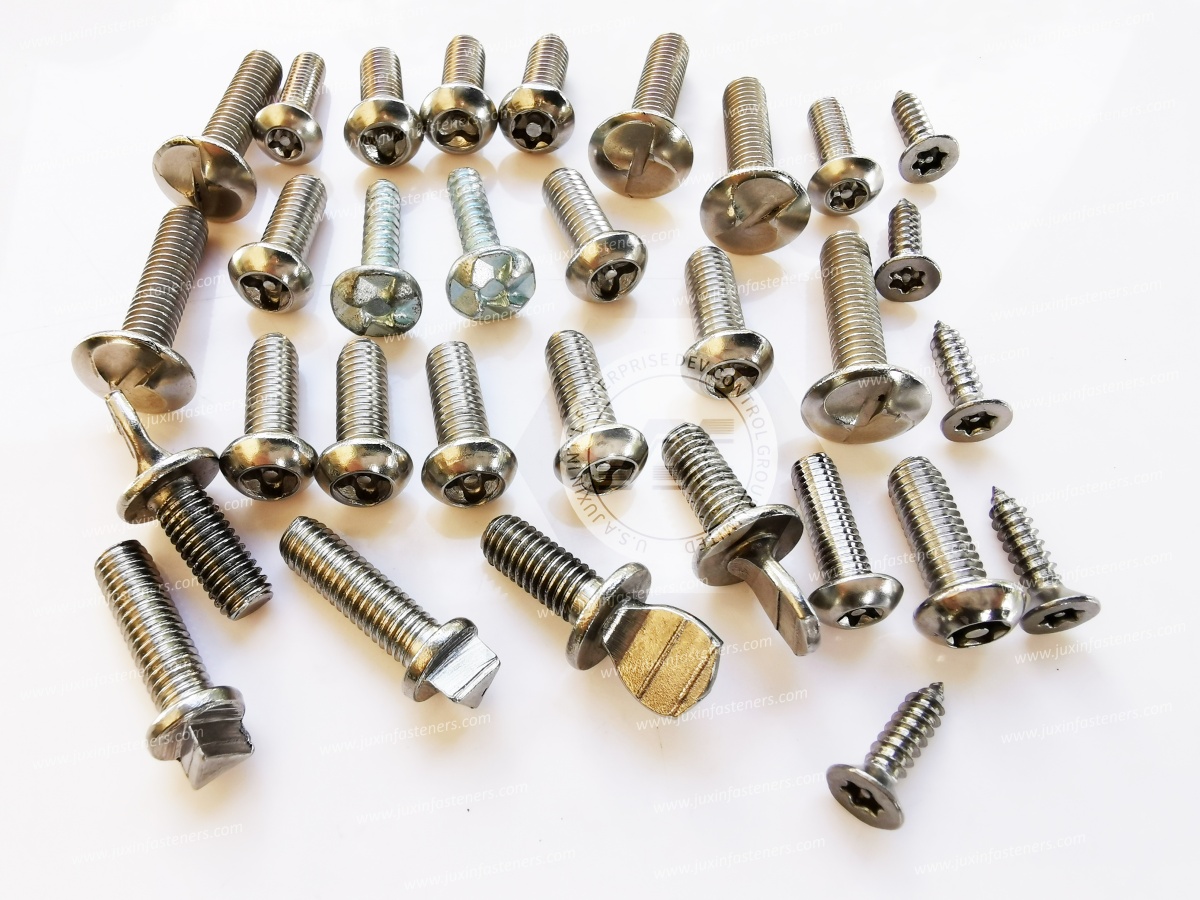
Stainless steel security screws are commonly considered when an application combines:
Outdoor exposure
Corrosion concerns
Public or semi-public access
Unauthorized removal risk
Long service intervals
Equipment protection requirements
Controlled maintenance access
Typical applications include:
Electrical equipment
Power infrastructure
Railway and transit equipment
Street lighting
Telecommunications equipment
Outdoor electronics
Industrial enclosures
Public facilities
HVAC equipment
Utility equipment
The engineering objective is not simply to make the fastener difficult to remove.
A practical security fastening system should provide the required balance between:
Corrosion resistance + removal resistance + installation reliability + maintenance access
A frequent specification mistake is treating “stainless steel security screw” as one single performance category.
There are actually several independent variables.
Corrosion resistance
Mechanical properties
Temperature suitability
Material compatibility
Appearance
Galling behavior
Tool accessibility
Unauthorized removal resistance
Installation interface
Authorized maintenance access
Tool control
For example, an A4 stainless steel screw with a conventional Phillips drive is corrosion-resistant but not necessarily tamper-resistant.
Conversely, a carbon steel one-way screw may provide a specialized removal interface but require a different corrosion-protection strategy.
This distinction is important when engineers create an OEM drawing.
Common security drive concepts include:
Internal pentagon drives
Y-type or specialized angular drives
Pin Torx drives
Triangular drives
Eccentric or asymmetric drives
One-way slot drives
Other application-specific security profiles
The correct drive depends on the required level of access control and maintenance strategy.
Internal pentagon drives use a non-standard polygonal interface.
They can be useful where authorized technicians need a dedicated tool while common hexagonal or slotted tools should not provide normal access.
Y-type or other specialized drives can provide an additional barrier against casual removal where a conventional Phillips, slotted or hex driver is not suitable.
One-way drives are designed primarily for installation in one direction.
They are commonly considered where routine authorized removal is not expected.
Specialized asymmetric drive profiles can be used where a customer requires a controlled mating tool and a non-standard interface.
For custom applications, the exact drive geometry should be controlled by the engineering drawing.
This distinction is simple but important.
Stainless steel and anti-theft functionality solve different problems.
Stainless steel addresses material and environmental requirements.
A security drive addresses tool access and unauthorized removal.
Therefore, the complete specification may need to define:
Stainless steel grade
Security drive
Head style
Thread
Length
Installation requirements
Environmental exposure
Maintenance strategy
This prevents a common procurement mistake in which a buyer requests “stainless security screws” without defining what security means for the actual installation.
A2 and A4 stainless steel fasteners are commonly used in industrial applications where corrosion resistance is required.
The appropriate material depends on the application environment.
Factors to consider include:
Humidity
Outdoor exposure
Chloride exposure
Marine or coastal conditions
Industrial chemicals
Cleaning agents
Temperature
Contact with other metals
ISO 3506 provides an international framework for mechanical and physical properties of corrosion-resistant stainless steel fasteners where applicable to the selected product type.
The material designation should therefore be selected together with the required mechanical property and application conditions.
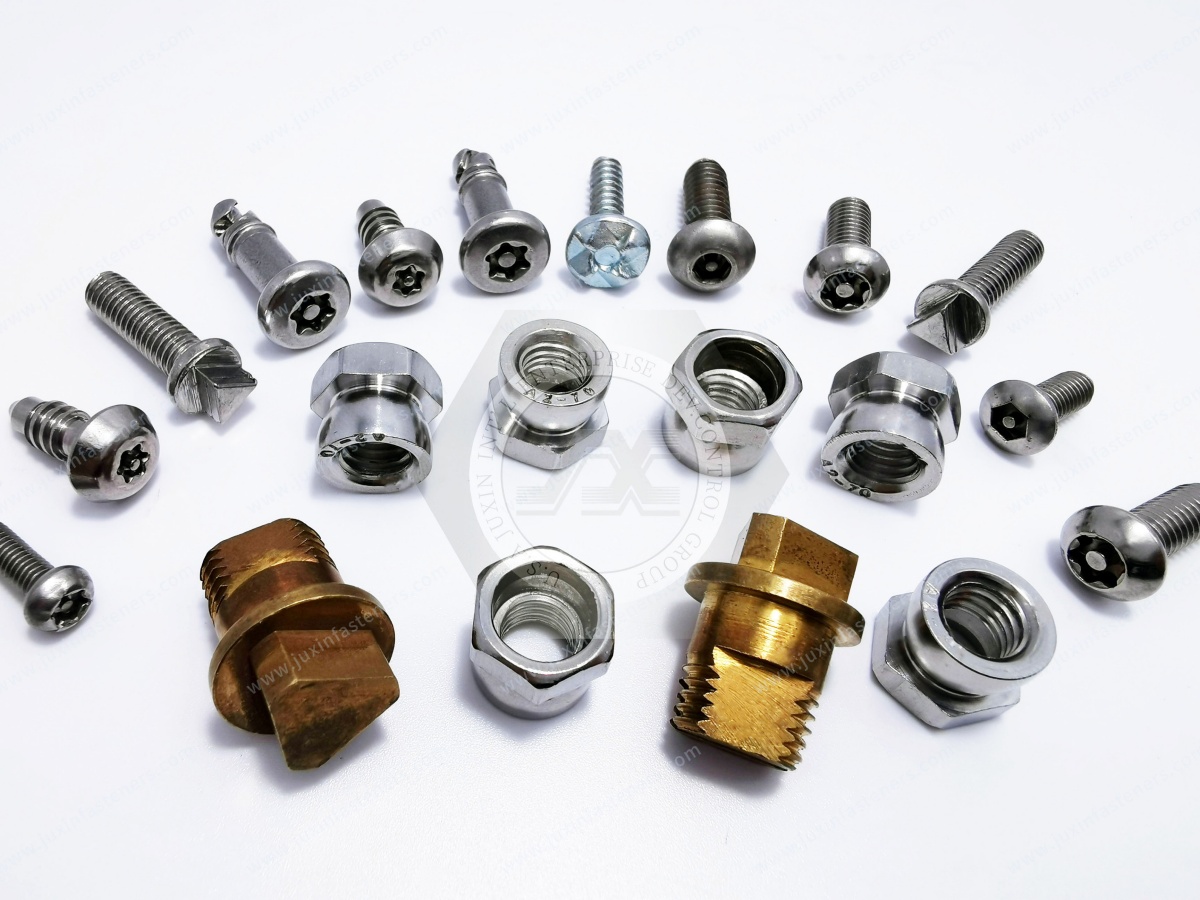
A2 stainless steel is commonly selected for many general industrial and outdoor applications where corrosion resistance is required.
Potential applications include:
Electrical enclosures
Industrial equipment
General outdoor equipment
HVAC equipment
Machinery panels
Telecommunications hardware
Public equipment
However, “outdoor” does not describe one single corrosion environment.
An installation in a dry inland location and an installation exposed to salt spray can have very different material requirements.
A4 stainless steel is often considered when the application has more demanding corrosion exposure, particularly where chloride-containing environments are relevant.
Potential applications can include:
Coastal infrastructure
Outdoor utility equipment
Transportation equipment
Marine-influenced environments
Industrial installations with more aggressive exposure
Material selection should still follow the actual environmental specification rather than assuming A4 is universally required.
A security screw may have both mechanical and security requirements.
Mechanical requirements can include:
Tensile strength
Proof load
Thread strength
Shear loading
Joint preload
Fatigue requirements
Security requirements can include:
Specialized drive
Controlled tooling
Resistance to conventional removal
Authorized maintenance access
These characteristics should be specified independently.
For example, increasing security-drive complexity does not automatically increase tensile strength.
Similarly, selecting a higher mechanical property does not automatically improve anti-theft performance.
For applications requiring higher mechanical performance, JUXIN FASTENERS also supplies high-strength bolts and nuts for industrial and OEM fastening requirements.
One-way stainless steel screws combine corrosion-resistant material with a drive designed primarily for one-direction installation.
They can be considered for applications such as:
Public signage
Outdoor equipment
Utility covers
Street equipment
Public facilities
Equipment access panels where routine removal is not required
The major design consideration is future service.
If the equipment may need regular internal access, a reusable security drive can be more practical.
If the fastener is intended to remain installed for the life of the assembly, a one-way configuration may be appropriate.
One-way fasteners can provide strong resistance to conventional reverse removal, but this creates a lifecycle question:
What happens when an authorized technician needs access?
Before selecting a permanent or one-way security fastener, the OEM should determine:
Who performs maintenance?
How frequently is access required?
Is a dedicated removal tool available?
Is destructive removal acceptable?
How will replacement fasteners be supplied?
Can the equipment be safely serviced in the field?
A fastener that provides excellent tamper resistance but creates unnecessary service downtime may not be the correct overall engineering solution.
Reusable security screws are appropriate when authorized maintenance personnel need controlled access.
Examples include:
Pin Torx
Security Torx
Pentagon
Triangular
Y-type
Specialized reusable drives
The maintenance team should have access to the correct mating tool throughout the product lifecycle.
For OEM products with long service lives, the security tool should be treated as part of the maintenance system rather than as an incidental accessory.
Austenitic stainless steel fasteners can experience thread galling under certain installation conditions.
Risk can be affected by:
Thread condition
Installation speed
Applied torque
Surface condition
Material pairing
Repeated installation
Lubrication
This is especially relevant for stainless steel security screws because a damaged specialized drive or seized thread can make authorized maintenance more difficult.
For repeated-service applications, the OEM should evaluate:
Fastener material + thread condition + installation method + lubrication strategy + tool engagement
Where lubrication is permitted by the customer's specification, an appropriate compatible lubricant can be considered as part of the installation process.
Stainless steel can still participate in galvanic corrosion when paired with dissimilar metals under suitable environmental conditions.
This is particularly important in outdoor assemblies.
For example, the engineer may need to consider the interaction between:
Stainless steel fasteners
Aluminum panels
Carbon steel structures
Zinc-coated components
Copper-containing components
Other factors include:
Moisture
Salt
Electrical contact
Surface coatings
Joint geometry
Therefore, specifying stainless steel alone does not eliminate galvanic-corrosion considerations.
The complete assembly should be evaluated.
Electrical and control enclosures may require controlled access to internal equipment.
Potential applications include:
Electrical cabinets
Control panels
Power equipment
Outdoor electrical boxes
Telecommunications cabinets
Industrial control systems
Security screw selection should consider:
Panel thickness
Thread configuration
Corrosion environment
Access frequency
Drive type
Installation tooling
Where regular maintenance is expected, a reusable security drive may be preferable to a one-way fastener.
For broader sheet-metal fastening requirements, JUXIN FASTENERS also provides automotive and industrial fastening solutions covering a range of OEM fastening applications.
Power infrastructure can include equipment that is:
Outdoors
Unattended
Publicly accessible
Exposed to weather
Subject to maintenance restrictions
Security fasteners may be used on selected:
Equipment covers
Electrical enclosures
Utility cabinets
Control equipment
Protective panels
The fastener should not be treated as the sole security mechanism.
The equipment architecture, enclosure design, access points and maintenance procedures should also be considered.
Railway and transit equipment can combine:
Outdoor exposure
Vibration
Repeated maintenance
Public access
Corrosion concerns
Long service requirements
Potential applications include:
Equipment panels
Electrical cabinets
Signage
Infrastructure covers
Communication equipment
Transit hardware
The security fastener must still be selected according to the mechanical and environmental requirements of the specific application.
For structural or safety-related components, applicable project and customer specifications take precedence over a generic security-fastener designation.
Street lighting equipment can be exposed to:
Rain
Humidity
Temperature cycling
Road contaminants
Public access
Security screws can help reduce casual unauthorized access to equipment covers and service compartments.
The design should consider:
Corrosion environment
Security drive
Maintenance frequency
Tool accessibility
Fastener replacement
Head clearance
A reusable security drive may be useful when authorized technicians routinely service the equipment.
Outdoor telecommunications equipment may include:
Antenna-related equipment
Communication cabinets
Remote equipment enclosures
Outdoor electronics
Network hardware
Security fasteners can provide controlled access to equipment covers and panels.
For these applications, material selection should consider environmental exposure while drive selection should consider the maintenance strategy.
These are separate engineering decisions.
Public utility equipment may be located where direct supervision is limited.
Examples include:
Utility access panels
Public equipment enclosures
Infrastructure signage
Outdoor control equipment
Monitoring equipment
Security screws can reduce casual access using commonly available hand tools.
However, the required security level should be defined according to the actual risk.
Not every exposed screw requires a permanent one-way fastener.
Industrial equipment installed outdoors may require both corrosion resistance and controlled access.
Typical equipment may include:
Industrial control cabinets
Outdoor machinery
Pump equipment
HVAC equipment
Monitoring systems
Equipment housings
The complete fastening system should consider:
Environment → Material → Security Drive → Thread → Installation → Maintenance
This sequence provides a more reliable design path than selecting a screw based only on material or appearance.
A useful OEM specification can divide requirements into two sections.
For example:
Stainless steel grade
Mechanical property
Surface condition
Environmental exposure
Mating-material compatibility
For example:
Security drive
Authorized tool
Reusable or one-way configuration
Head geometry
Maintenance strategy
This separation makes procurement clearer and reduces ambiguity between engineering, purchasing and suppliers.
Stainless steel security screws can be produced in different head configurations depending on the application.
Common options include:
Button head
Pan head
Round head
Countersunk head
Specialized security head
Useful where a rounded, relatively low-profile head is preferred.
Useful where the design requires the fastener head to sit approximately flush with the mating surface and the appropriate countersink is provided.
Useful for a range of enclosure, panel and equipment applications depending on bearing requirements and available clearance.
The head geometry should be specified together with the drive.
Sheet-metal applications require particular attention to the relationship between:
Screw thread
Sheet thickness
Hole size
Thread engagement
Installation torque
Material hardness
Possible configurations include:
Security machine screws with threaded nuts
Security screws with self-clinching nuts
Security screws with rivet nuts
Thread-forming security screws
Self-tapping security screws
The correct solution depends on the enclosure or panel architecture.
For thin sheet, simply increasing screw length does not necessarily solve insufficient thread engagement.
JUXIN FASTENERS also supplies stainless steel CNC machining parts when custom stainless components,
precision turned parts or machined fastening components are required alongside standard or custom fasteners.
In sheet-metal assemblies, stainless steel security screws can be paired with:
Self-clinching nuts
Self-clinching studs
Rivet nuts
Threaded inserts
Custom nuts
This can be particularly useful for panels that require repeated authorized service.
The security screw controls access to the joint, while the threaded component provides the required internal thread.
JUXIN FASTENERS supplies self-clinching fasteners, rivet nuts, threaded components and custom screws for industrial sheet-metal applications.
Installation torque should be treated carefully.
Torque is affected by:
Thread friction
Surface condition
Lubrication
Coating
Material pairing
Tool accuracy
Drive engagement
For a given nominal screw size, changing the material, finish or lubrication can change the relationship between applied torque and resulting preload.
Therefore, a generic torque value should not automatically be transferred from one security screw configuration to another.
Where the customer specifies a controlled installation torque, the fastener and joint should be evaluated under the actual assembly conditions.
The security drive is a functional interface.
Installation reliability depends on:
Correct tool size
Full engagement
Proper alignment
Recess geometry
Tool condition
Operator access
Required torque
A specialized drive with insufficient engagement can increase the risk of:
Cam-out
Drive deformation
Tool damage
Installation delay
Difficulty during future removal
For OEM production, the mating tool should therefore be considered during fastener design.
Security fastener validation can address different requirements.
Verify:
Head dimensions
Drive geometry
Thread dimensions
Overall length
Critical drawing features
Evaluate:
Tool engagement
Installation process
Required torque where applicable
Drive integrity
Assembly consistency
For reusable security fasteners, evaluate authorized removal using the specified tool.
For one-way fasteners, evaluate the intended installation and the required resistance to conventional removal methods according to the customer's security requirement.
Where corrosion or environmental exposure is critical, the complete assembly may require testing according to the customer's applicable specification and test method.
There is no single stainless steel grade that automatically provides a defined level of anti-theft performance.
Anti-theft performance depends on the complete system:
Drive Geometry + Tool Access + Head Design + Installation + Equipment Architecture + Maintenance Strategy
Material selection addresses a different dimension:
Material + Environment + Corrosion + Mechanical Requirement
This is why engineers should avoid specifying security screws using only one phrase such as:
“316 stainless anti-theft screw.”
A production-ready specification should define the actual functional requirements.
Inspection should cover both conventional fastener dimensions and security-specific characteristics.
Depending on the customer drawing and inspection plan, this may include:
Nominal diameter
Thread pitch
Thread length
Overall length
Head dimensions
Drive geometry
Drive depth
Surface condition
Material designation
Coating or finish where applicable
Critical dimensional features
Thread gauges may be used where appropriate for thread verification.
For custom security drives, the drive profile itself should be treated as a controlled feature.
OEM procurement teams may require documentation based on the application and purchasing specification.
Potential documentation includes:
Material designation
Applicable standard
Mechanical property information
Certificate of Conformance
Inspection records
Surface-treatment documentation where applicable
Lot or batch identification
Drawing revision
Packaging identification
The exact documentation package should be agreed before production.
This helps prevent a common supply-chain problem: discovering documentation requirements only after the parts have been manufactured.
Electrical, electronics and industrial OEM programs may include RoHS, REACH and other material-information requirements.
RoHS and REACH are regulatory frameworks rather than fastener dimensional or mechanical standards.
For applicable programs, procurement teams may require material and substance information covering both:
Base material
Surface treatment
This is particularly important when stainless steel security screws use additional coatings, lubricants or specialized finishes.
Documentation should follow the customer's actual product and market requirements.
A practical engineering selection sequence is:
Determine whether the goal is:
Casual tampering deterrence
Controlled access
Public-access protection
Equipment protection
Permanent installation
Consider:
Indoor
Outdoor
Humid
Coastal
Chloride exposure
Chemical exposure
Temperature
Evaluate:
A2 stainless steel
A4 stainless steel
Other specified stainless grades
Possible choices include:
Pentagon
Y-type
Pin Torx
Triangular
Asymmetric
One-way
Custom drive
Consider:
Button
Pan
Round
Countersunk
Custom head
Specify:
Metric or inch
Diameter
Pitch
Thread length
Machine screw or thread-forming configuration
Determine whether the fastener is:
Reusable
Controlled-access reusable
One-way
Intended for permanent installation
Identify the critical characteristics before production.
Specify:
CoC
Material documentation
Inspection reports
Surface-treatment information
Traceability requirements
Provide the supplier with the drawing, sample or complete specification.
For procurement managers and supplier development teams, stainless steel security screws require control of both material and geometry.
Supplier evaluation can include:
Ability to manufacture the specified drive
Material control
Thread consistency
Dimensional inspection
Surface-finish control
Documentation
Lot identification
Drawing revision control
Packaging
Change management
The security drive should receive the same attention as other critical product dimensions because it directly affects installation and maintenance.
An effective OEM RFQ should include:
Part number
2D drawing
3D model if available
Security drive type
Head style
Nominal diameter
Thread pitch
Thread length
Overall length
Stainless steel grade
Mechanical property requirement
Surface finish
Application environment
Mating material
Installation method
Installation torque if specified
Authorized removal requirement
Reuse requirement
Annual volume
Order quantity
Packaging requirements
Inspection requirements
Documentation requirements
Regulatory/material-information requirements
Drawing revision
Application description
Delivery requirements
The more complete the RFQ, the less likely the supplier is to quote a visually similar but functionally different fastener.
JUXIN FASTENERS provides stainless steel security screws and custom industrial fastening components for OEM and industrial applications.
Solution directions can include:
Stainless steel security screws
Tamper-resistant screws
Pentagon security screws
Specialized Y-type drives
Pin Torx security screws
Triangular security screws
One-way security screws
Custom stainless steel screws
Security machine screws
Security sheet-metal screws
Custom head and thread configurations
Other application-specific fastening components
Material, drive geometry, dimensions, finish and inspection requirements can be established according to the customer's drawing and application specification.
For projects requiring broader stainless precision components, customers can also review the JUXIN FASTENERS stainless steel CNC machining parts solution.
For applications requiring higher mechanical-performance fastening components, our high-strength bolts and nuts solution provides a separate engineering reference.
A practical development path is:
Anti-Theft Requirement
↓
Unauthorized Access Risk
↓
Maintenance Strategy
↓
Environmental Assessment
↓
Stainless Material Selection
↓
Security Drive Selection
↓
Head and Thread Configuration
↓
Installation Tool
↓
Application Validation
↓
Inspection Requirements
↓
Supplier Qualification
↓
Production RFQ
This approach connects engineering design with procurement requirements.
The result is a security fastener specification that is measurable, manufacturable and easier to control throughout the product lifecycle.
A stainless steel security screw should not be evaluated in isolation.
The actual assembly may include:
Fastener
Nut or threaded insert
Sheet metal
Structural component
Enclosure
Gasket
Coating
Installation tool
Maintenance procedure
Each component can influence the final performance.
For outdoor equipment, the corrosion system matters.
For public infrastructure, the access-control strategy matters.
For industrial production, the tool-fastener interface matters.
For procurement, documentation and consistency matter.
This is why security screw sourcing should begin with the application rather than only the product name.
JUXIN FASTENERS can work from customer-provided:
2D drawings
3D models
Samples
Part specifications
Application information
Material requirements
Security-drive requirements
The engineering discussion can focus on:
Drive selection
Head configuration
Thread design
Material selection
Environmental requirements
Installation requirements
Inspection characteristics
The sourcing process can be organized around:
Part specification
Quantity
Material
Surface treatment
Quality requirements
Documentation
Packaging
Drawing revision
Production requirements
This helps purchasing teams compare suppliers against the same technical requirements.
Security fastener development is most effective when the specification is established before mass production.
For a new project, the supplier should understand:
What the fastener protects
Who is authorized to access it
Whether the fastener must be reusable
What environment it will experience
What material is required
What installation process will be used
Which dimensions are critical
What documentation is required
This allows the security screw to be developed as an engineered OEM component rather than treated as a generic catalog item.
JUXIN FASTENERS also supports broader OEM fastening requirements through solutions such as custom industrial and automotive bolts and nuts, depending on the application and drawing requirements.
If you are sourcing stainless steel security screws for power infrastructure, railway equipment, public utilities, electrical enclosures,
telecommunications equipment, street lighting, HVAC systems, industrial machinery or other OEM applications, JUXIN FASTENERS can review your requirements.
Please provide your 2D drawing, 3D model, sample, specification or application information where available.
The RFQ can include:
Stainless steel grade
Security drive
Head style
Thread specification
Dimensions
Surface finish
Environmental requirements
Installation requirements
Maintenance requirements
Inspection requirements
Documentation requirements
Production quantity
JUXIN FASTENERS
20+ Years of Fastener Experience
Custom Screws, Stainless Steel Security Fasteners and Industrial OEM Components
Website: www.juxinfasteners.com
Email: info@juxinfasteners.com
 MORE NEWS
Sep. 25, 2026
Sep. 25, 2026
Sep. 25, 2026
Contact Us
Tel.:
+86 020 8621 0320
+86 020 3121 6067
E-mail:
Technical Support:
Navigation
SEND INQUIREY