Call Us
+86 136 6007 9809
Call Us
+86 136 6007 9809

Mar. 30, 2026
Asymmetrical Drive Security Screws: Driver Fit, Stainless Steel Button Heads and OEM Assembly
Equipment manufacturers increasingly require fastening solutions that balance mechanical reliability, corrosion resistance, controlled maintenance access and production efficiency.
In electrical equipment, industrial machinery, electronics, transportation systems and public-facing installations,
standard screws may allow internal components to be accessed using commonly available tools.
For applications requiring an additional barrier against casual or unauthorized disassembly,
tamper-resistant asymmetrical drive stainless steel button head screws offer a specialized fastening option.
These fasteners combine:
A nonstandard asymmetrical drive recess
A compatible specialized installation driver
A smooth, rounded button head
Stainless steel material options
Standard or drawing-specific threaded connections
The engineering challenge is not simply choosing an unusual drive shape.
The complete fastening system must provide suitable driver engagement, tightening capability, thread strength, corrosion performance, installation repeatability and authorized service access.
Juxin Fasteners welcomes OEM inquiries for stainless steel security screws, asymmetrical drive fasteners and drawing-specific anti-tamper fastening components.
What Is an Asymmetrical Drive Security Screw?
An asymmetrical drive security screw uses a drive recess with a nonuniform geometric profile.
Unlike conventional drive systems such as Phillips, slotted, hex socket or standard six-lobe drives, the asymmetrical profile is intended to engage a matching specialized driver.
Depending on the actual geometry, the design may make removal with ordinary tools more difficult.
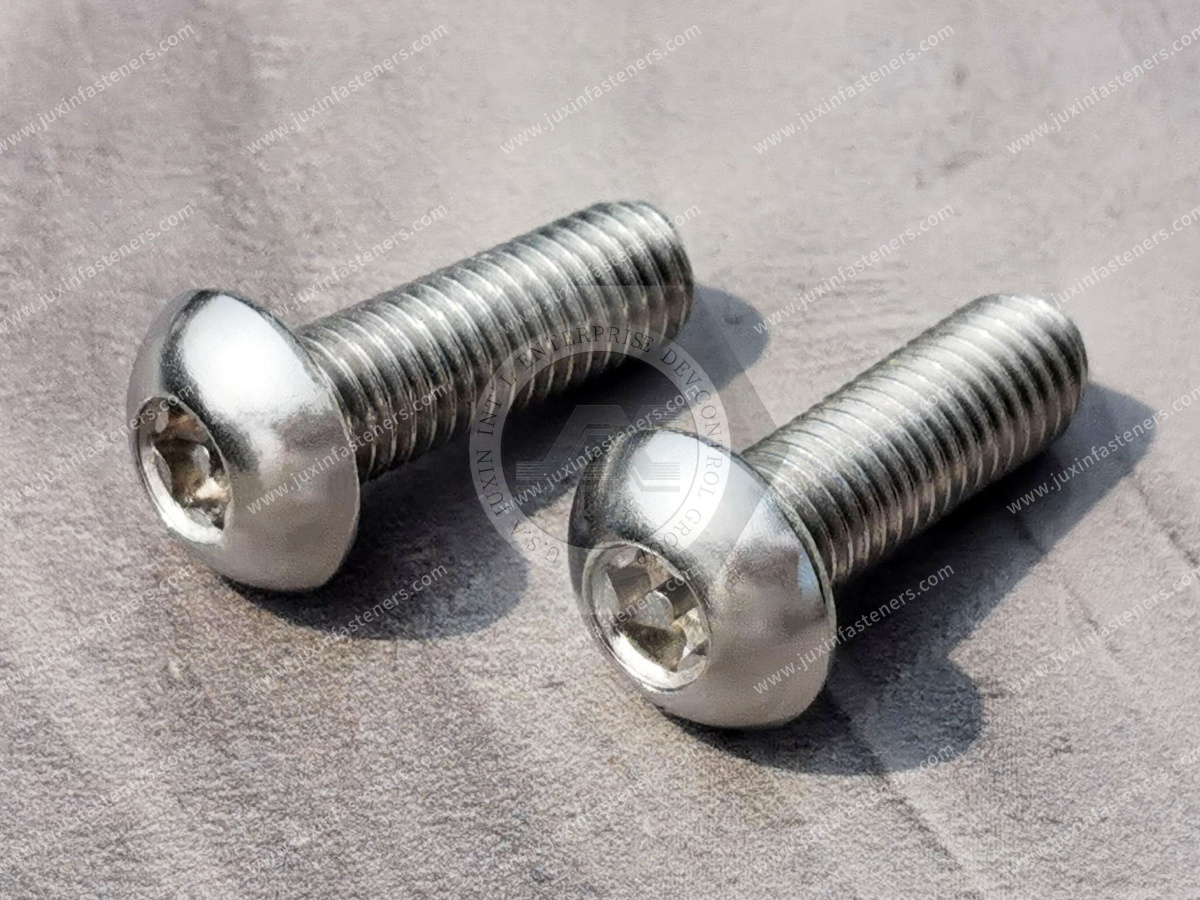
Typical Product Characteristics
Nonstandard drive geometry
Dedicated mating driver
Button head configuration
Stainless steel construction
Machine screw thread
Optional drawing-specific dimensions
Important Engineering Distinction
An asymmetrical drive is not automatically equivalent to a one-way screw.
Some security drive designs permit installation and removal using a matching tool. Others may have direction-dependent engagement characteristics.
The actual removal behavior must be established from the specific screw and driver design.
Tamper Resistance Is Not Absolute Security
A specialized drive can discourage casual tampering, but it cannot guarantee that a determined person will be unable to remove the fastener.
Security performance depends on:
Drive geometry
Tool availability
Head accessibility
Fastener material
Installation condition
Equipment design
For high-security applications, evaluate the fastener as part of a broader physical access-control system.
Why OEM Manufacturers Use Tamper-Resistant Screws
Security fasteners can help equipment manufacturers manage access to components that should be serviced only by authorized personnel.
Potential applications include:
Electrical enclosures
Industrial machine panels
Automotive interior components
Electronic equipment housings
Public utility cabinets
Transportation equipment
Communication systems
Controlled Maintenance Access
A specialized driver can help distinguish authorized service procedures from routine consumer access.
Reduced Casual Tampering
Nonstandard drive geometry may discourage removal with commonly available tools.
Visible Product Appearance
A stainless steel button head provides a rounded, finished appearance for exposed fastener locations.
Environmental Durability
Appropriately selected stainless steel can provide corrosion resistance in humid or outdoor environments.
Important Limitation
Security screws do not, by themselves, establish electrical safety compliance, machinery guarding compliance or resistance to vibration loosening.
Those requirements must be addressed through the complete product design and applicable validation.
Asymmetrical Drive Geometry and Driver Engagement
The drive recess is the defining feature of this fastener.
Its geometry determines how torque is transmitted between the installation tool and screw head.
Critical Drive Characteristics
Recess profile
Recess depth
Drive feature dimensions
Contact geometry
Manufacturing tolerances
Driver fit
Material deformation resistance
Why Driver Fit Matters
An incorrectly matched driver can produce:
Poor torque transfer
Drive recess damage
Tool slippage
Incomplete tightening
Increased assembly scrap
Maintenance difficulties
Information Gain: A Security Drive Must Be Evaluated as a Tool-and-Fastener System
For standard screws, installation tools are commonly available in established drive sizes.
For proprietary or drawing-specific security screws, driver compatibility may become a production and supply-chain risk.
A screw can be dimensionally acceptable while still causing assembly problems if the driver does not engage correctly.
Engineering Recommendation
When developing a custom asymmetrical drive screw, evaluate the screw and driver together.
The technical specification should identify:
Approved drive geometry
Matching driver specification
Intended installation direction
Required removal behavior
Target tightening conditions
Drive durability requirements
Installation Torque and Drive Failure
The ability of a security drive to transmit torque depends on the geometry, material, driver engagement and installation conditions.
Potential failure modes include:
Drive recess rounding
Localized deformation
Driver cam-out or slippage
Head cracking
Thread stripping
Screw fracture
Engineering Recommendation
Do not assume that a custom drive profile can transmit the same torque as a conventional drive of similar nominal screw size.
Validate the complete assembly using the actual driver and specified installation equipment.
Stainless Steel Material Selection
Stainless steel is commonly selected for security screws used in equipment requiring corrosion resistance and an attractive appearance.
However, stainless steel grades differ in corrosion resistance, mechanical properties and manufacturing behavior.
A2 / 304-Type Stainless Steel
A2 stainless steel is commonly associated with austenitic stainless steel grades used for general corrosion-resistant fastening applications.
Potential applications include:
Indoor electrical equipment
Industrial control panels
General machinery covers
Electronic enclosures
Moderately exposed outdoor equipment
A4 / 316-Type Stainless Steel
A4 stainless steel is commonly associated with molybdenum-containing austenitic stainless steels used where improved resistance to certain corrosive environments is needed.
Potential applications include:
Coastal installations
Selected marine-related equipment
Outdoor utility cabinets
Chemical exposure environments
Important Material Limitation
Neither A2 nor A4 stainless steel is immune to corrosion.
Chloride concentration, temperature, crevices, cleaning chemicals and actual exposure conditions must be evaluated.
Mechanical Properties
Stainless steel fasteners should be specified using applicable material and mechanical property requirements.
ISO 3506-1 provides mechanical and physical property requirements for corrosion-resistant stainless steel bolts, screws and studs within its scope.
The exact stainless steel grade and property class must be confirmed from the product specification.
Engineering Recommendation
Do not automatically substitute stainless steel security screws for higher-strength alloy steel screws.
Material strength, required preload, thread engagement and joint loading must be evaluated before substitution.
Button Head Design for OEM Equipment
Button head screws have a rounded, relatively low-profile head compared with many conventional cylindrical-head designs.
Their shape can be useful for visible assemblies and equipment panels.
Potential Advantages
Rounded external profile
Clean appearance
Reduced exposed sharp-edge geometry
Suitability for selected panel and enclosure applications
Important Design Limitations
A button head is not necessarily the lowest-profile screw head available.
Head height, head diameter, drive depth and available tool access must be checked against the equipment design.
Head Clearance
Verify clearance for:
Adjacent components
Moving equipment
Cable routing
Access panels
Maintenance tools
Bearing Surface
Evaluate the contact area beneath the screw head.
Thin panels and softer materials may require additional bearing support or a suitable washer, depending on the design.
Head Strength
The drive recess reduces the available material in the screw head.
The remaining head geometry must support the intended tightening conditions.
Information Gain: Head Height and Drive Depth Are Linked
Reducing head height while maintaining a deep, specialized drive recess can reduce the remaining material beneath the recess.
This may affect the head's ability to transmit installation torque.
Engineering Recommendation
For custom button head security screws, assess head height, recess depth and torque capability together rather than treating them as independent dimensions.
Thread Design and International Standards
The drive recess and thread are separate design features.
A proprietary security drive can be combined with an appropriately specified standard thread.
Metric Thread Systems
Relevant references include:
ISO 261 for general-purpose metric thread dimensions
ISO 965 series for metric thread tolerances
Unified Inch Thread Systems
ASME B1.1 covers Unified inch screw threads, including applicable UNC and UNF thread designations.
Important Compatibility Rule
Metric, UNC, UNF, BSW and BSF thread systems are not directly interchangeable.
For nominal diameter reference only:
| Metric diameter | Approximate inch equivalent |
|---|---|
| M3 | 0.118 in |
| M4 | 0.157 in |
| M5 | 0.197 in |
| M6 | 0.236 in |
| M8 | 0.315 in |
These are dimensional conversions only, not equivalent thread specifications.
Engineering Recommendation
For OEM drawings, specify the complete thread designation, pitch or threads per inch, tolerance class and mating component requirements.
Installation Torque Control in OEM Assembly
Correct tightening is essential for security screws used in industrial production.
The installation process must provide adequate clamp load without damaging the screw, mating thread or drive recess.
Important Assembly Variables
Screw diameter
Thread pitch
Stainless steel grade
Mating thread material
Surface condition
Lubrication
Under-head friction
Driver engagement
Tool calibration
Joint stiffness
Risks of Excessive Torque
Thread stripping
Head damage
Driver recess deformation
Mating component damage
Screw fracture
Risks of Insufficient Tightening
Inadequate clamp load
Joint movement
Loss of assembly stability
Increased loosening risk
Engineering Recommendation
Develop installation torque requirements from the actual joint and fastener system.
Do not apply a generic tightening torque solely because the nominal thread size matches a standard screw.
Stainless Steel Thread Galling
Austenitic stainless steel threaded connections may be susceptible to galling under certain assembly conditions.
Galling can cause:
Thread seizure
Increased tightening torque
Damaged mating threads
Difficult maintenance removal
Potential countermeasures may include appropriate material pairing, compatible lubrication, controlled tightening speed and validated surface treatments.
Any treatment must remain compatible with the intended corrosion, cleanliness and electrical requirements.
Production Manager's Considerations
In automated or semi-automated assembly, specialized security screws may require:
Dedicated driver bits
Controlled bit replacement
Tool engagement monitoring
Stable screw feeding
Operator training
Defined rework procedures
Information Gain: Security Tooling Is Part of the Production Cost
A custom security screw may have an acceptable unit price but create additional production costs if the driver wears rapidly or requires frequent manual alignment.
Evaluate:
Screw feeding reliability
Driver life
Installation cycle time
Rework rate
Tool availability
Authorized maintenance procedures
Tamper Resistance vs Vibration Resistance
This distinction is critical in industrial fastening design.
Tamper resistance refers to the difficulty of removing a screw without the intended tool.
Vibration resistance refers to the threaded joint's ability to maintain the required mechanical condition under dynamic loading.
These are different functions.
An asymmetrical drive does not automatically prevent self-loosening.
Potential Causes of Threaded Joint Loosening
Inadequate preload
Joint settlement
Transverse movement
Thermal cycling
Insufficient thread engagement
Unsuitable joint design
Potential Countermeasures
Depending on the application:
Controlled tightening
Suitable prevailing-torque locking nuts
Compatible thread-locking compounds
Pre-applied locking features
Proper joint stiffness and preload design
Engineering Recommendation
Where both security and vibration resistance are required, specify and validate the two functions separately.
A specialized drive profile should not be treated as a substitute for a qualified anti-loosening solution.
Industry Applications
Automotive Components
Potential applications include:
Interior trim panels
Dashboard assemblies
Selected electronic module covers
Noncritical access panels
Specialized equipment enclosures
Engineering Priorities
Drive compatibility
Corrosion resistance
Vibration-related joint validation
Assembly accessibility
Product appearance
Safety-related automotive applications require additional engineering validation and approval.
Electrical and Electronic Equipment
Potential applications include:
Electrical control boxes
Communication enclosures
Server and networking equipment
Industrial electronic housings
Restricted-access panels
Engineering Priorities
Controlled access
Thread engagement
Corrosion resistance
Electrical clearance
Authorized service access
Industrial Machinery
Potential applications include:
Machine covers
Selected access panels
Protective enclosures
Control system housings
Equipment guards
Engineering Priorities
Installation consistency
Maintenance access
Vibration performance
Drive durability
Corrosion protection
Important Safety Limitation
Security screws do not replace the required design and safety validation of machine guarding or access-control systems.
Public Infrastructure and Transportation Equipment
Potential applications include:
Public utility enclosures
Transportation equipment
Outdoor electronic cabinets
Communication installations
Public-facing fixtures
Engineering Priorities
Resistance to casual tampering
Corrosion protection
Tool control
Authorized maintenance
Replacement fastener availability
Asymmetrical Drive Security Screws vs Standard Screws
| Selection factor | Standard drive screw | Asymmetrical security drive screw |
|---|---|---|
| Tool availability | Commonly available | Specialized driver typically required |
| Casual tamper resistance | Generally limited | May provide increased resistance |
| Installation tooling | Standard tools | Matching driver required |
| Driver compatibility | Established drive systems | Geometry-specific |
| Corrosion resistance | Depends on material | Depends on material |
| Vibration resistance | Depends on joint design | Depends on joint design |
| Maintenance access | Generally straightforward | Requires authorized tool access |
| Production complexity | Often lower | May require additional tooling control |
| OEM customization | Available | Available through drawing-specific designs |
Engineering Selection Rule
Choose an asymmetrical security drive when restricted tool access provides meaningful value.
Do not select it solely to solve corrosion, vibration or joint-strength problems.
Common Security Screw Failure Modes
Drive Recess Damage
Possible causes:
Incorrect driver
Excessive torque
Inadequate recess depth
Poor geometry control
Driver wear
Thread Stripping
Possible causes:
Insufficient engagement
Incorrect mating thread
Excessive tightening
Weak parent material
Head Fracture
Possible causes:
Excessive torque
Inadequate remaining head material
Material defects
Unsuitable geometry
Corrosion
Possible causes:
Incorrect stainless steel grade
Chloride exposure
Crevice conditions
Surface contamination
Unauthorized Removal
Possible causes:
Common availability of matching tools
Exposed head geometry
Insufficient overall access-control design
Assembly Line Delays
Possible causes:
Specialized driver shortages
Poor feeding
Tool misalignment
Inconsistent recess dimensions
Engineering Recommendation
Failure analysis should identify whether the issue originates from the fastener, driver, joint design, installation process or service environment.
OEM Manufacturing Quality Requirements
Precision manufacturing is important because the security drive must engage consistently with the intended tool.
Critical Product Characteristics
Drive recess geometry
Drive depth
Head diameter
Head height
Thread dimensions
Overall length
Material grade
Surface condition
Screw straightness
Drive Compatibility Verification
Potential verification activities include:
Dimensional inspection
Driver engagement checks
Defined torque application tests
Drive durability evaluation
Assembly trials
Thread Quality Verification
Relevant methods may include:
Thread gauging
Dimensional inspection
Visual inspection
Mating component fit checks
Material Verification
Depending on customer requirements:
Material documentation
Chemical composition verification
Mechanical property testing
Corrosion evaluation
Production Consistency
For high-volume OEM programs, quality planning may address:
Critical dimensions
Inspection frequency
Process capability
Traceability
Change control
Packaging protection
Important Qualification Principle
A fastener that meets dimensional specifications is not automatically qualified for a specific assembly.
The OEM should validate the fastener and installation process together.
Custom Security Screw Development
Drawing-specific security screws may be considered when standard designs do not satisfy:
Restricted-access requirements
Head clearance
Tool engagement
Corrosion performance
Thread specification
Appearance
Automated assembly compatibility
Custom Design Considerations
Drive Geometry
Define the intended asymmetrical profile and driver compatibility.
Head Geometry
Specify button head dimensions and allowable recess depth.
Thread
Specify metric or unified inch thread dimensions and tolerances.
Material
Specify the required stainless steel grade and mechanical properties.
Surface Finish
Define appearance, cleanliness and corrosion-related requirements.
Installation
Specify tool type, tightening conditions and any special handling requirements.
Quality
Identify critical characteristics and acceptance criteria.
Commercial
Provide expected quantities, annual forecasts and delivery requirements.
Information Gain: Control the Driver Supply Chain
For a custom security screw, procurement planning should address both the fastener and its mating tool.
Before approving a proprietary drive, confirm:
Driver availability
Replacement driver sourcing
Driver dimensional control
Service-tool distribution
Tool wear management
Long-term support requirements
Without a suitable driver supply strategy, a successful security design can become a maintenance and production bottleneck.
OEM Procurement and Supplier Qualification
Procurement managers and supplier development teams should evaluate technical compliance and total installed cost.
Technical Qualification
Approved drawings
Material specifications
Thread requirements
Drive geometry
Dimensional tolerances
Driver compatibility
Application validation
Production Qualification
Manufacturing consistency
Inspection planning
Packaging suitability
Production assembly compatibility
Change management
Commercial Qualification
Prototype requirements
MOQ confirmation
Volume pricing
Tooling requirements
Lead time
Annual demand forecast
Supply continuity
Total Installed Cost
The total cost of using security screws may include:
Fastener purchase cost
Specialized driver tooling
Assembly labor
Tool maintenance
Inspection
Rework
Scrap
Service tooling
Engineering Recommendation
Compare the cost per accepted installed assembly rather than the screw purchase price alone.
RFQ Checklist for Custom Asymmetrical Drive Security Screws
| RFQ requirement | Information to provide |
|---|---|
| Product drawing | Part number and revision |
| Drive geometry | Profile and dimensional requirements |
| Matching driver | Drawing or specification |
| Head type | Button head dimensions |
| Thread | Metric, UNC or UNF designation |
| Thread tolerance | Applicable class |
| Length | Nominal dimension and tolerance |
| Material | Stainless steel grade |
| Mechanical properties | Required property class or test criteria |
| Surface condition | Finish and cleanliness |
| Application | Equipment and installation location |
| Corrosion environment | Indoor, outdoor, coastal or chemical |
| Tightening | Torque and assembly requirements |
| Security requirement | Intended tamper-resistance function |
| Inspection | Customer acceptance criteria |
| Prototype quantity | Initial sample requirement |
| Annual volume | Forecast demand |
| MOQ | Commercial confirmation |
| Lead time | Required delivery schedule |
| Packaging | Bulk or automated assembly requirements |
Frequently Asked Questions
What makes an asymmetrical drive screw tamper-resistant?
Its nonstandard drive geometry requires a matching specialized tool, potentially making casual removal more difficult.
Can an asymmetrical drive screw be removed?
Removal depends on the specific drive design and availability of the correct tool. Many security screws are intended to remain serviceable by authorized personnel.
Are asymmetrical drive screws the same as one-way screws?
Not necessarily. A one-way screw is designed to restrict reverse driving, while an asymmetrical security drive may have different intended installation and removal behavior.
Do security screws prevent vibration loosening?
No. Vibration resistance depends on the complete threaded joint and any appropriate locking features.
Why use stainless steel button head security screws?
They combine a specialized drive, corrosion-resistant material options and a rounded head suitable for selected visible assemblies.
Is 316 stainless steel always better than 304?
Not in every application. Material selection depends on corrosion exposure, mechanical requirements, manufacturing and cost.
Can a standard driver install an asymmetrical drive screw?
The design generally requires a matching specialized driver. Using an unsuitable tool may damage the recess.
Can custom security screws be used in automated assembly?
Potentially, but driver engagement, screw feeding, orientation, tooling and process repeatability must be validated.
What causes security screw drive failure?
Possible causes include excessive torque, poor driver engagement, incorrect geometry, material deformation and tool wear.
What should OEM buyers provide when requesting a quotation?
A drawing, drive specification, thread dimensions, material requirements, annual quantity and intended assembly conditions are important starting points.
Juxin Fasteners: OEM Security Screws and Custom Fastening Solutions
Juxin Fasteners welcomes inquiries for security fasteners used in industrial equipment, electronics, electrical systems, automotive components and specialized OEM products.
Relevant product categories include:
Tamper-resistant stainless steel screws
Asymmetrical drive security screws
Stainless steel button head screws
Custom drive recess screws
Drawing-specific industrial security fasteners
Specific drive geometries, materials, mechanical properties, dimensions, tooling arrangements, MOQ,
inspection documentation and delivery schedules require confirmation against customer requirements.
Request an OEM Security Screw Quotation
Are you developing an electrical enclosure, industrial machine, electronic product or public-facing equipment that requires controlled-access fastening?
Juxin Fasteners welcomes technical inquiries from:
Mechanical engineers
Design engineers
Structural engineers
Manufacturing engineers
Production managers
Procurement specialists
Purchasing managers
Supplier development teams
Supply chain managers
Please provide:
Product drawing + drive geometry + matching driver requirements + head dimensions + thread specification + stainless steel grade
+ installation torque requirements + corrosion environment + prototype quantity + annual forecast + inspection requirements + packaging + delivery schedule.
Our team can review the supplied requirements and confirm available product options, technical feasibility and quotation conditions.
Company: Juxin Fasteners
Website: https://www.juxinfasteners.com/
Email: info@juxinfasteners.com
Send your security screw drawings and OEM RFQ to Juxin Fasteners for technical confirmation and quotation.
Contact Us
Tel.:
+86 020 8621 0320
+86 020 3121 6067
E-mail:
Technical Support:
Navigation
SEND INQUIREY