
Call Us
+86 136 6007 9809
Call Us
+86 136 6007 9809

Mar. 30, 2026
Threaded Inserts for Electrical Enclosures: Materials, Installation and OEM Design
Modern electrical equipment increasingly uses compact enclosures, lightweight materials and modular component designs.
Industrial control cabinets, junction boxes, electronic housings, operator panels and electrical distribution equipment must
provide reliable mechanical connections while supporting production efficiency and maintenance access.
Many of these assemblies incorporate:
Engineering plastics
Thin-gauge sheet metal
Aluminum components
Composite materials
Lightweight enclosure structures
These materials can offer important design and manufacturing advantages, but their fastening requirements differ substantially.
Direct threads in certain plastics may wear after repeated assembly. Thin sheet metal may not provide sufficient thread engagement for a conventional machine screw.
Some enclosure designs also require controlled screw tightening, electrical isolation, protective bonding or environmental sealing.
Threaded inserts for electrical enclosures can provide reusable internal threads when selected for the correct host material and installation method.
For mechanical and design engineers, the key requirements include thread strength, boss geometry, sheet thickness, joint loading and service life.
For manufacturing engineers and production managers, installation cycle time, tool compatibility, process monitoring and consistent assembly quality are essential.
For procurement and supplier development teams, drawing compliance, material specifications, inspection requirements,
production quantities and long-term availability influence sourcing decisions.
Juxin Fasteners welcomes OEM inquiries for threaded inserts and custom fastening components used in electrical and industrial equipment.
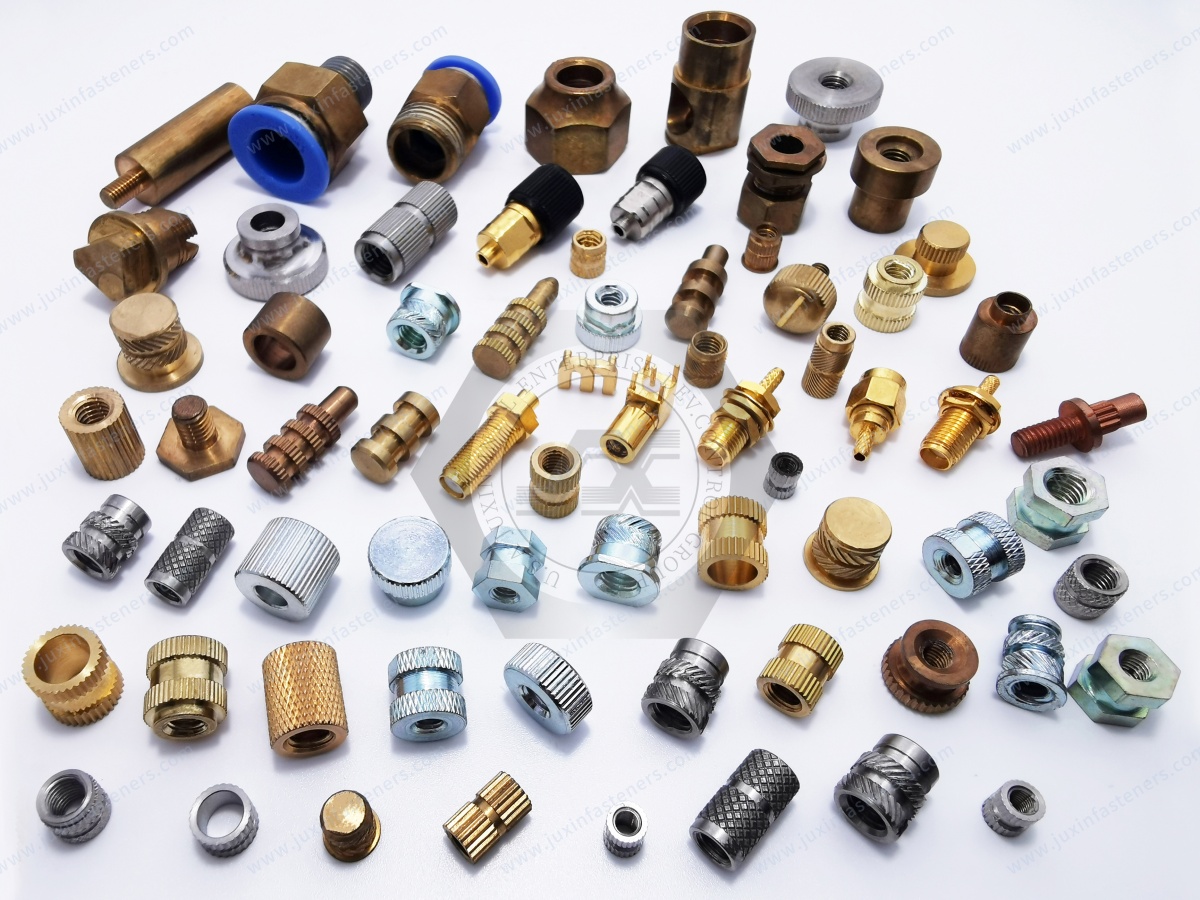
Why Are Threaded Inserts Used in Electrical Enclosures?
Electrical equipment often requires repeated access during installation, inspection, maintenance and component replacement.
Typical serviceable assemblies include:
Enclosure covers
Access panels
Instrument housings
Electronic module supports
Control system components
Operator interface assemblies
Directly formed threads in certain plastics may experience wear or damage after repeated screw installation.
Thin sheet metal may also have insufficient thickness to provide the required thread engagement.
A properly selected threaded insert creates a separate metal female thread within the host component.
Potential Engineering Benefits
Reusable machine screw connections
Improved resistance to thread wear
Reduced damage during repeated maintenance
Greater flexibility in screw selection
Consistent mating thread geometry
Improved suitability for controlled production assembly
Actual performance depends on insert geometry, host material, installation quality and joint loading.
Important Engineering Distinction
A threaded insert does not automatically prevent screw loosening, maintain electrical grounding or provide environmental sealing.
These functions must be addressed through the complete enclosure design.
Plastic Electrical Enclosures vs Thin-Metal Enclosures
One of the most important selection decisions is identifying the host material.
A threaded insert intended for a thermoplastic housing is not necessarily suitable for thin sheet metal.
Plastic Enclosure Applications
Typical fastening solutions may include:
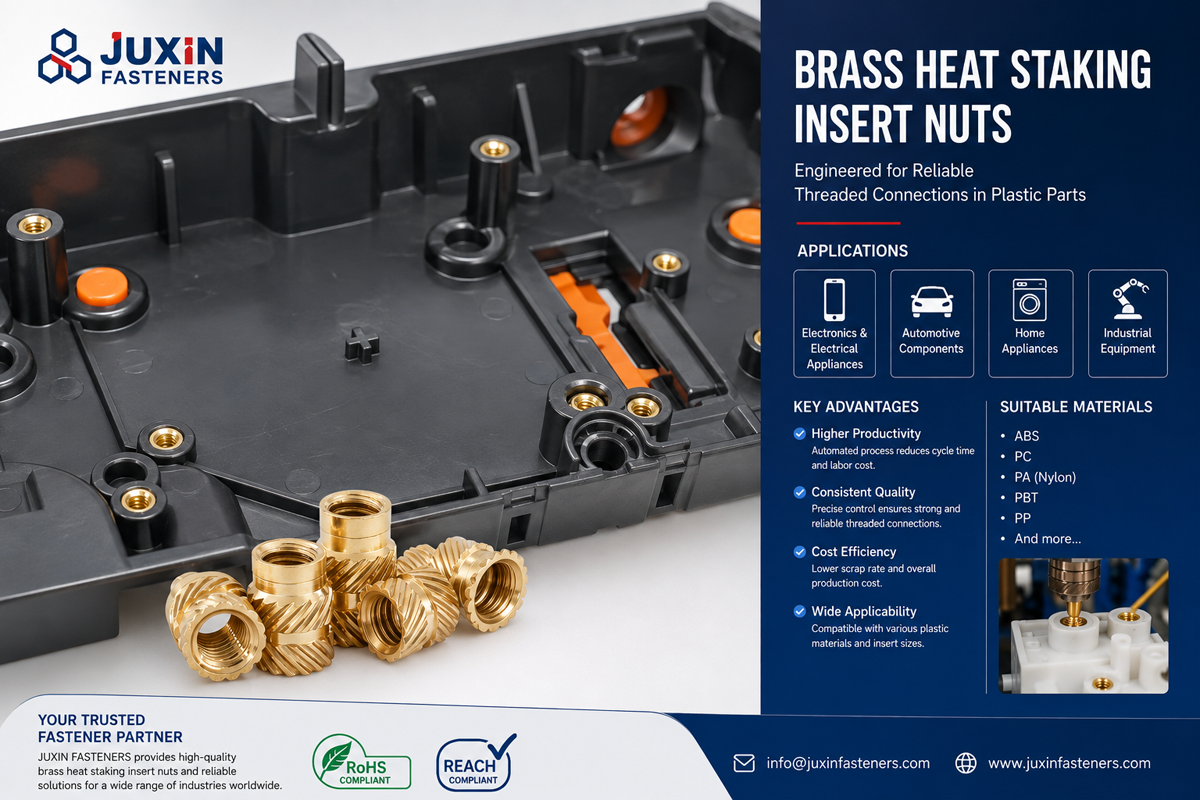
Heat-set threaded inserts
Molded-in threaded inserts
Suitable press-in inserts
Self-tapping inserts designed for the selected plastic
The surrounding plastic geometry determines much of the installed retention performance.
Thin-Metal Enclosure Applications
Depending on the sheet material, thickness and access conditions, suitable fastening systems may include:
Self-clinching threaded nuts
Rivet nuts
Weld nuts
Sheet-metal-specific threaded inserts
Other engineered captive fastening systems
These products use different retention mechanisms and should not be treated as interchangeable.
Engineering Recommendation
Before selecting an insert, identify:
Host material
Material thickness
Access to one or both sides
Required thread size
Joint loading
Maintenance frequency
Installation equipment
Brass Threaded Inserts for Electrical Equipment
Brass is commonly used for threaded inserts in suitable thermoplastic components.
Potential advantages include:
Good machinability
Durable internal metal threads
Compatibility with many heat-insertion designs
Useful corrosion resistance in appropriate environments
Established manufacturing methods
Typical Applications
Plastic control boxes
Instrument housings
Electronic enclosures
Operator interface components
Sensor housings
Serviceable plastic covers
Electrical Conductivity Considerations
Brass is electrically conductive.
This may be relevant where the insert is near electrical components or conductive mounting structures.
However, an embedded brass insert does not automatically establish a reliable grounding connection.
Likewise, surrounding plastic does not eliminate the need to evaluate electrical clearance and insulation requirements.
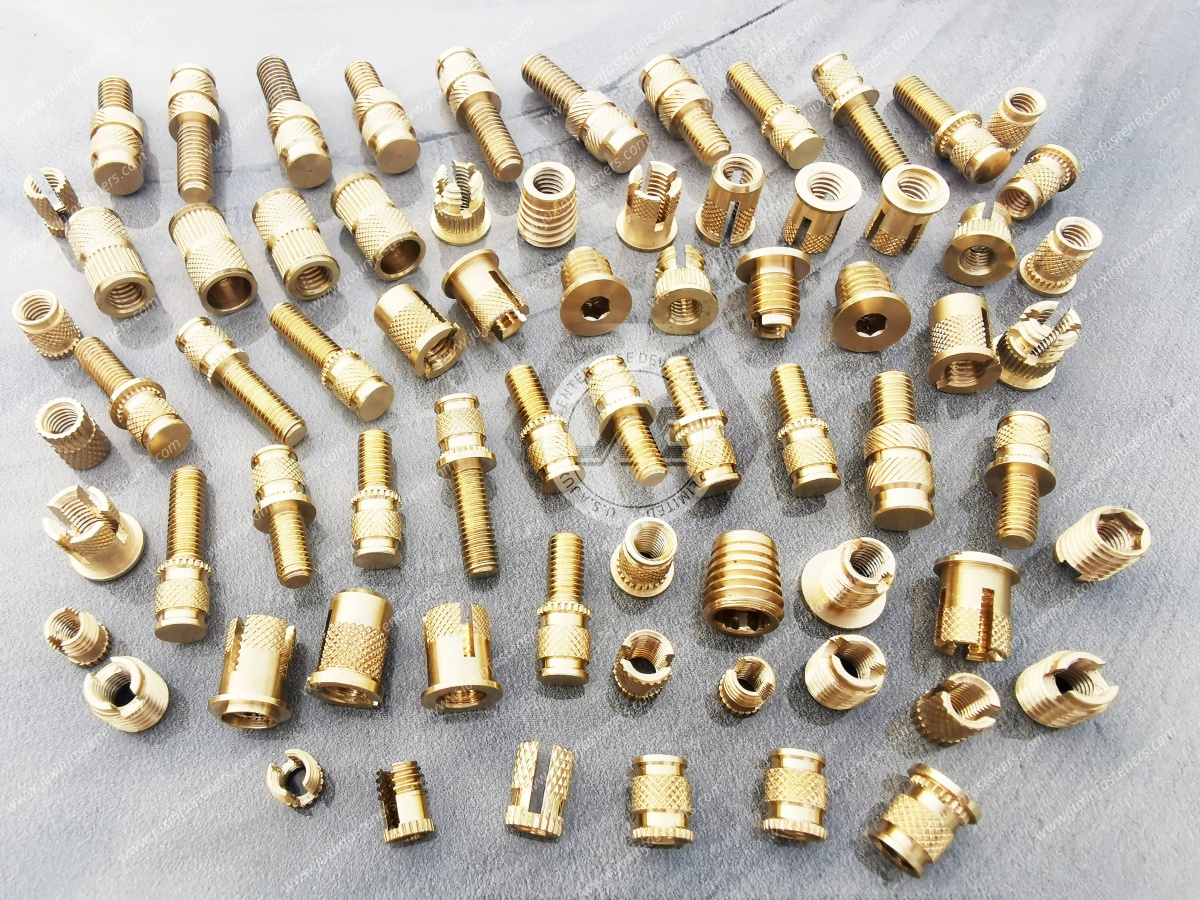
Engineering Recommendation
Review the insert location, mating screw length and surrounding electrical components as part of the enclosure's insulation design.
Plastic Creep Considerations
Brass inserts provide metal internal threads, but the surrounding plastic may still deform under sustained load.
The complete joint must be evaluated for long-term compression, temperature exposure and material creep.
Stainless Steel Threaded Inserts
Stainless steel inserts may be considered where particular corrosion resistance or mechanical properties are required.
Potential applications include:
Outdoor electrical equipment
Moisture-exposed enclosures
Industrial control systems
Specialized instrumentation
Selected demanding environments
Material Selection Factors
Stainless steel grade
Mechanical properties
Corrosion exposure
Mating screw material
Installation process
Thread galling risk
Cost
Stainless steel corrosion resistance depends on the selected grade and actual environment.
Important Limitation
Stainless steel is not universally immune to corrosion.
For chloride-containing or chemically aggressive environments, material selection requires additional evaluation.
Aluminum Threaded Inserts
Aluminum inserts may be considered in selected lightweight enclosure applications.
Potential benefits include:
Lower density
Reduced component mass
Compatibility with certain lightweight design concepts
Engineering Considerations
Aluminum alloy
Internal thread wear
Surface treatment
Galvanic corrosion
Repeated assembly requirements
Installation method
Aluminum inserts are not automatically the most economical option.
The appropriate selection depends on material, processing and lifecycle requirements.
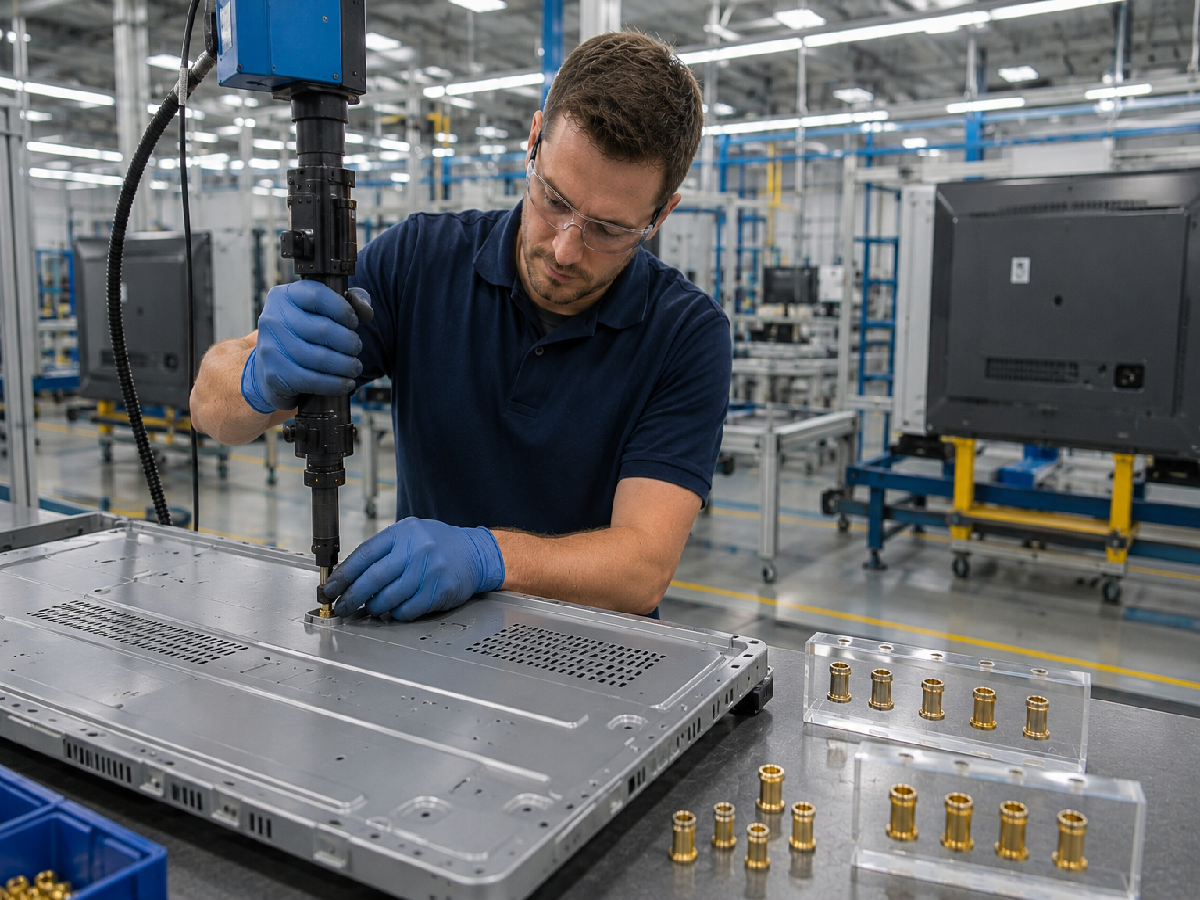
Material Selection Comparison
| Selection factor | Brass | Stainless steel | Aluminum |
|---|---|---|---|
| Density | Relatively high | Relatively high | Lower |
| Corrosion behavior | Environment-dependent | Grade-dependent | Alloy and finish-dependent |
| Electrical conductivity | Conductive | Conductive | Conductive |
| Internal thread durability | Design-dependent | Grade-dependent | Alloy-dependent |
| Installation compatibility | Common in suitable plastic designs | Process-dependent | Process-dependent |
| Main consideration | Plastic compatibility and retention | Corrosion and mechanical requirements | Weight and thread performance |
Engineering Recommendation
Do not select insert material based on a single property.
Consider the complete assembly, operating environment, installation process and procurement requirements.
Self-Tapping Threaded Inserts
Self-tapping threaded inserts are designed to establish external engagement with a compatible host material during installation.
The insert contains an internal machine screw thread, while its exterior cutting or forming features engage the surrounding material.
Important Clarification
A self-tapping insert does not normally create its own internal thread during installation.
Its internal thread is already manufactured.
The installation process establishes the insert's engagement with the host material.
Potential Advantages
Post-molding installation
Mechanical retention in suitable substrates
No separate heat-insertion step for compatible designs
Flexible use in selected production processes
Engineering Limitations
Pilot hole dimensions are critical
Installation torque must be controlled
Brittle plastics may crack
Thin bosses may deform
Insert alignment affects final thread position
Potential Applications
Industrial control housings
Suitable plastic electrical cabinets
Equipment covers
Instrument components
Molded-In Threaded Inserts
Molded-in inserts are positioned in a mold before the plastic component is formed.
During injection molding, plastic flows around the insert and its retention features.
Potential Advantages
Integrated insert placement
No separate post-molding insertion operation
Suitable for certain high-volume production processes
Potential for effective mechanical retention
Engineering Limitations
Insert positioning must be controlled
Mold loading can influence cycle time
Plastic flow must be evaluated
Insert displacement can create defects
Tooling design may be more complex
Important Clarification
Molded-in inserts do not automatically provide maximum pull-out or torque-out resistance.
Retention depends on insert geometry, plastic material, molding conditions and component design.
Press-In Threaded Inserts
Press-in inserts are installed into suitable preformed holes using controlled mechanical force.
Their retention features engage the host material.
Potential Advantages
Relatively simple installation for compatible designs
No heating requirement
Potential for efficient production
Suitability for selected enclosure components
Engineering Limitations
Not all plastics are suitable
Hole diameter is critical
Excessive insertion force may crack the boss
Retention strength depends on insert and host geometry
Pull-out and torque-out performance require validation
Potential Applications
Selected plastic covers
Instrument housings
Lightweight equipment components
Serviceable electrical enclosures
Important Distinction
Press-in inserts for plastics should not be confused with self-clinching nuts designed for sheet metal.
The installation processes and host material requirements differ.
Heat-Set Inserts as an Additional Option
For suitable thermoplastic enclosures, heat-set threaded inserts may provide another fastening solution.
A controlled heating process softens the surrounding plastic and allows the insert's retention features to become embedded.
Potential Advantages
Suitable for many engineering thermoplastics
Post-molding installation
Established process methods
Reusable internal threads
Engineering Limitations
Installation temperature must be controlled
Pilot hole geometry affects retention
Excessive heat can damage the component
Incomplete insertion may affect assembly
Not suitable for every polymer type
Engineering Recommendation
Compare heat-set, molded-in, press-in and self-tapping designs according to the exact enclosure material and production process.
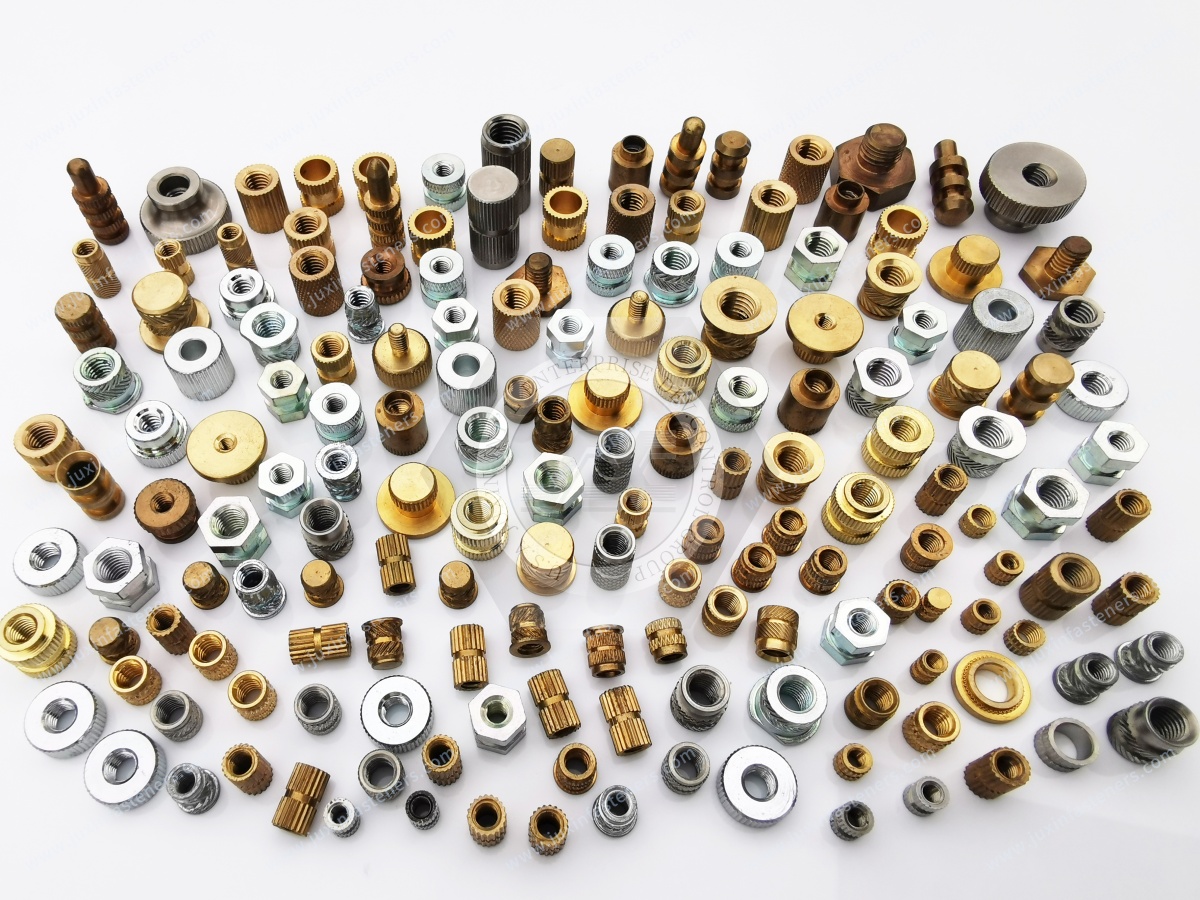
Selecting Threaded Inserts by Enclosure Material
| Enclosure material | Potential fastening approach | Key engineering concern |
|---|---|---|
| ABS thermoplastic | Suitable heat-set, molded-in or other compatible insert | Boss strength and installation |
| Polycarbonate | Application-specific plastic insert | Cracking and residual stress |
| PA / Nylon | Compatible insert design | Moisture and dimensional changes |
| PBT | Suitable plastic insert | Temperature and retention |
| Thin steel sheet | Self-clinching nut, rivet nut or other suitable system | Sheet thickness and access |
| Thin aluminum sheet | Compatible sheet-metal fastening system | Sheet hardness and deformation |
| Composite enclosure | Application-specific insert or backing solution | Delamination and local loading |
The listed approaches are potential design options, not universal recommendations.
Plastic Boss Design for Electrical Enclosures
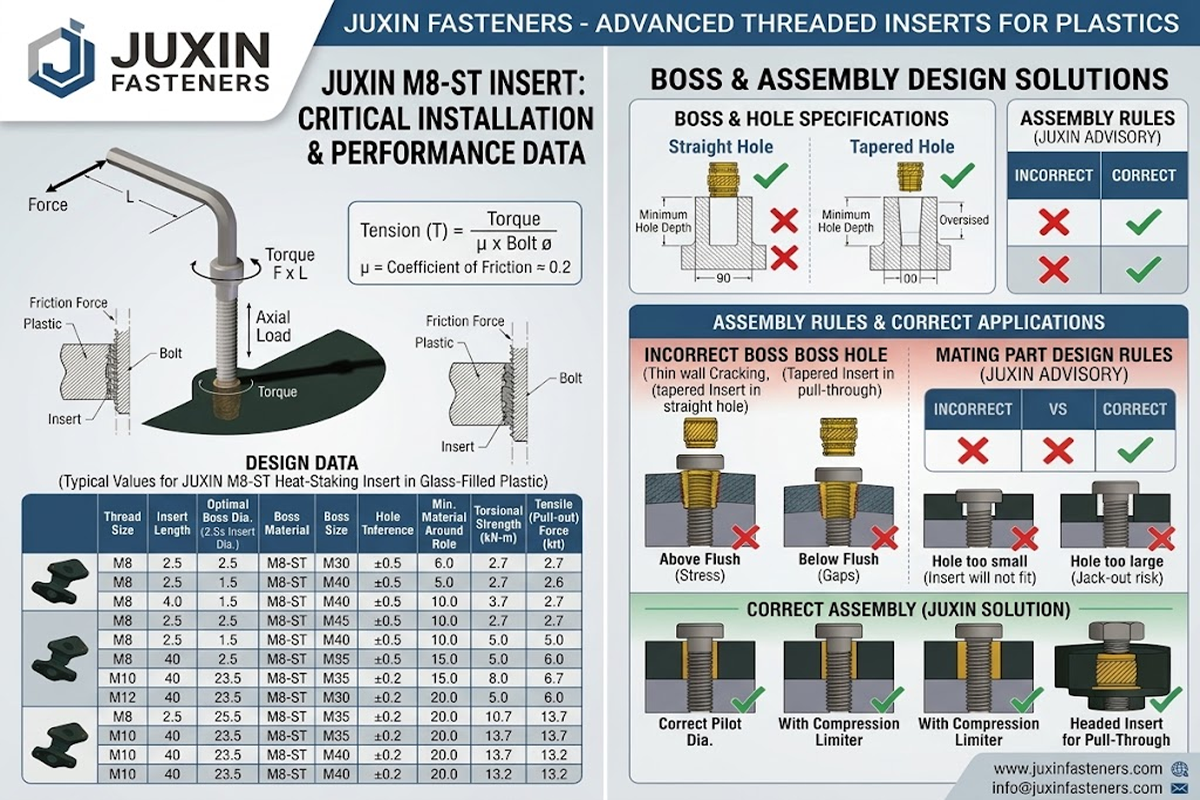
The surrounding plastic boss strongly influences the retention performance of a threaded insert.
Pilot Hole Diameter
An oversized hole may reduce engagement.
An undersized hole may increase insertion stress and cause cracking.
Boss Outside Diameter
The boss must provide sufficient surrounding material to withstand insertion forces and service loads.
Boss Height
Boss height affects insert engagement and available screw depth.
Hole Depth
Blind holes must provide clearance for the insert and mating screw.
Edge Distance
Inserts near unsupported edges may create stress concentrations.
Rib Design
Properly designed ribs may improve stiffness, but poorly positioned ribs can contribute to molding defects.
Engineering Recommendation
Confirm the following before tooling release:
Insert outside diameter
Insert length
Pilot hole diameter
Pilot hole depth
Boss outside diameter
Boss height
Edge distance
Mating screw engagement
Clearance beneath the screw
Pull-Out Resistance vs Torque-Out Resistance
These are two different characteristics of installed insert performance.
Pull-Out Resistance
Pull-out resistance describes the ability of the insert to resist axial extraction from the host material.
Torque-Out Resistance
Torque-out resistance describes the ability of the insert to resist rotation within the host material.
Why the Difference Matters
An insert may resist axial extraction but rotate when a screw is tightened.
Alternatively, an insert may resist rotation but still be pulled out under axial loading.
Engineering Recommendation
Where required, validate both characteristics using representative production components.
Do not rely solely on generic catalog values.
Plastic Creep and Clamp Load Retention
Plastic components can deform under sustained loading.
This behavior is commonly referred to as creep.
Threaded inserts provide durable internal metal threads, but they do not eliminate deformation of the surrounding plastic.
Potential consequences include:
Reduced joint compression
Changes in screw preload
Local boss deformation
Insert movement
Increased maintenance requirements
Engineering Recommendation
Evaluate joint compression, plastic creep and thermal aging for applications requiring long-term clamp load.
Repeated Assembly and Maintenance Access
Electrical enclosures frequently require servicing.
Typical activities include:
Component replacement
Wiring inspection
Instrument maintenance
Control module upgrades
Equipment repair
Threaded inserts can reduce wear associated with repeated screw installation in plastic.
However, repeated service performance depends on:
Insert retention
Mating screw condition
Installation torque
Thread alignment
Material wear
Service procedures
Engineering Recommendation
Validate the required number of assembly cycles where repeated maintenance is part of the product specification.
Electrical Grounding and Protective Bonding
Electrical enclosure fastening involves considerations beyond mechanical retention.
Some assemblies require protective bonding between conductive components.
Other assemblies require electrical isolation.
These are different design objectives.
Conductive Metal Enclosures
Where a fastening connection forms part of a protective bonding path, electrical continuity must be evaluated.
Relevant factors may include:
Contact resistance
Surface coatings
Oxidation
Fastener loosening
Corrosion
Mechanical stability
Plastic Enclosures
A metal insert embedded in plastic does not automatically create a protective earth connection.
Its conductive position must also be considered in the insulation design.
Important Engineering Recommendation
Do not assume that a threaded insert independently satisfies protective bonding or electrical insulation requirements.
IEC 60204-1 may be relevant to the electrical equipment of machinery, depending on the application.
The applicable product and equipment requirements must be determined for the actual design.
IP Sealing and Environmental Protection
Electrical enclosures may require protection against dust and water ingress.
Threaded inserts can support cover fastening, but they do not independently create an environmental seal.
The complete sealing system may include:
Gaskets
Sealing surfaces
Appropriate cover stiffness
Controlled compression
Suitable fastener spacing
Sealed openings
IEC 60529 defines the IP code classification system for enclosure protection.
Important Clarification
An enclosure IP rating applies to the tested enclosure configuration.
It does not automatically apply to an individual threaded insert or fastener.
Engineering Recommendation
Validate the enclosure with the actual fasteners, gasket and assembly process.
Vibration Resistance and Thread Loosening
Threaded inserts create reusable metal threads but do not inherently prevent screw loosening.
Potential causes of loosening include:
Inadequate preload
Joint settlement
Transverse vibration
Plastic creep
Thermal expansion
Insufficient joint stiffness
Where required, an appropriate locking method or other validated retention feature may be necessary.
Engineering Recommendation
Evaluate insert retention and screw loosening as separate requirements.
Thread Standards and Dimensional Compatibility
Thread dimensions must match the mating screw.
Metric Threads
Relevant references include ISO 261 and the ISO 965 series for applicable metric thread dimensions and tolerances.
Unified Inch Threads
ASME B1.1 covers Unified inch screw threads, including UNC and UNF designations.
Metric and Inch Diameter References
| Metric size | Approximate nominal diameter in inches |
|---|---|
| M3 | 0.118 in |
| M4 | 0.157 in |
| M5 | 0.197 in |
| M6 | 0.236 in |
| M8 | 0.315 in |
These values are dimensional conversions only.
Metric, UNC, UNF, BSW and BSF thread systems are not directly interchangeable.
Specific size and thread availability must be confirmed against the product drawing.
Production Installation and Process Control
For manufacturing engineers and production managers, insert selection must account for repeatable assembly.
Installation Process Variables
Depending on the insert type, these may include:
Hole dimensions
Installation force
Installation torque
Insertion temperature
Alignment
Seating depth
Tool condition
Material conditioning
Production Quality Indicators
Useful indicators may include:
Installation cycle time
Insert seating accuracy
Reject rate
Rework rate
Tool wear
Dimensional consistency
Pull-out or torque-out test results
Information Gain: Installation Quality Can Control Real-World Reliability
An insert may have suitable nominal retention characteristics but still fail in production if installation conditions are inconsistent.
For example, variations in pilot hole diameter or installation alignment may create different retention levels across otherwise similar enclosures.
Engineering Recommendation
Validate the intended production process rather than approving an insert solely from dimensional drawings.
Typical Electrical Equipment Applications
Industrial Control Cabinets
Threaded inserts may support serviceable components such as:
Control system covers
Operator interface housings
Electronic mounting structures
Internal equipment panels
Engineering Priorities
Maintenance access
Thread durability
Installation consistency
Enclosure integrity
Junction Boxes
Plastic junction boxes may require reusable fastening points for covers and internal components.
Engineering Priorities
Boss geometry
Screw tightening
Environmental sealing
Electrical clearance
Switchgear and Distribution Equipment
Selected insulating housings and auxiliary components may use threaded inserts.
Engineering Priorities
Electrical insulation
Thermal behavior
Mechanical retention
Applicable equipment requirements
Important Limitation
Threaded inserts should not be assumed suitable for current-carrying connections or safety-critical assemblies without dedicated validation.
Industrial Automation Equipment
Potential applications include:
Controller housings
Operator interfaces
Sensor enclosures
Equipment covers
Engineering Priorities
Repeatable assembly
Maintenance access
Vibration-related joint design
Component replacement
Instrument and Measurement Housings
Potential applications include:
Measurement equipment
Electronic instruments
Sensor housings
Calibration-access covers
Engineering Priorities
Dimensional stability
Repeated servicing
Corrosion resistance
Installation quality
Common Failure Modes and Engineering Prevention
| Failure mode | Potential cause | Recommended evaluation |
|---|---|---|
| Insert pulls out | Insufficient retention or weak host material | Review geometry and axial loading |
| Insert rotates | Inadequate anti-rotation engagement | Review insert design and torque-out |
| Plastic boss cracks | Excessive insertion stress | Review hole size and installation |
| Internal thread strips | Incorrect screw or excessive torque | Review thread fit and tightening |
| Insert sits above surface | Incorrect seating process | Verify insertion depth |
| Joint loses preload | Plastic creep or settlement | Evaluate joint relaxation |
| Corrosion develops | Unsuitable material or environment | Review material and coating |
| Grounding continuity is inadequate | Unverified conductive path | Validate protective bonding |
| Enclosure leaks | Inadequate gasket or cover compression | Test complete sealing system |
| Production defects increase | Process variation | Improve installation controls |
Quality Control for Electrical Enclosure Threaded Inserts
OEM quality requirements should reflect the actual application.
Incoming Product Inspection
Potential inspection characteristics include:
Material grade
Internal thread dimensions
Outside diameter
Insert length
Retention geometry
Surface condition
Visual defects
Installed Insert Inspection
Potential checks include:
Position
Seating depth
Perpendicularity
Host material damage
Thread condition
Insert movement
Mechanical Validation
Depending on the application:
Pull-out testing
Torque-out testing
Repeated assembly testing
Screw tightening trials
Joint load testing
Environmental Validation
Where relevant:
Thermal cycling
Temperature aging
Humidity exposure
Corrosion testing
Vibration testing
Enclosure sealing verification
Important Qualification Principle
A correctly manufactured insert is not automatically suitable for every electrical enclosure.
The complete joint and enclosure must meet the applicable design requirements.
Total Installed Cost for OEM Production
For production managers and procurement teams, the lowest insert unit price does not always produce the lowest assembly cost.
Relevant cost elements include:
Insert purchase price
Installation labor
Tooling
Equipment depreciation
Inspection
Scrap
Rework
Maintenance
Replacement components
Information Gain: Evaluate Cost per Accepted Assembly
A useful production comparison is:
Total relevant production and installation costs ÷ accepted assembly quantity
Use a consistent production period and avoid double-counting costs.
This approach can reveal whether a more expensive insert reduces total assembly cost through improved installation consistency or lower rework.
Custom Threaded Inserts for Electrical Equipment OEMs
Some electrical equipment manufacturers require drawing-specific inserts.
Potential custom requirements include:
Internal thread size
Thread pitch
Insert length
Outside diameter
Retention geometry
Material grade
Surface finish
Installation method
Packaging requirements
Engineering Recommendation
Provide the complete insert drawing and host component information.
The host material and installation process are important to evaluating actual performance.
Supplier Qualification and Bulk Procurement
Supplier development and purchasing teams should evaluate both technical and commercial requirements.
Technical Evaluation
Drawing compliance
Material specification
Thread accuracy
Retention geometry
Surface finish
Inspection requirements
Manufacturing Evaluation
Dimensional consistency
Process control
Traceability where required
Engineering change management
Packaging suitability
Commercial Evaluation
Prototype requirements
MOQ
Annual purchasing volume
Unit price
Lead time
Production planning
Long-term availability
Specific commercial conditions require confirmation against the RFQ.
OEM RFQ Checklist
| RFQ item | Information to provide |
|---|---|
| Product drawing | Part number and revision |
| Insert type | Self-tapping, molded-in, press-in, heat-set or specified |
| Thread | Metric or inch thread designation |
| Insert dimensions | OD, length and tolerances |
| Material | Brass, stainless steel, aluminum or specified grade |
| Host material | Plastic grade, sheet metal or composite |
| Host geometry | Boss or sheet thickness and hole dimensions |
| Installation | Method and equipment |
| Loading | Axial, torsional and service loads |
| Temperature | Operating and validation range |
| Environment | Indoor, outdoor, humidity or chemicals |
| Electrical requirements | Insulation or bonding requirements |
| Sealing requirements | Enclosure protection requirements |
| Testing | Pull-out, torque-out or other specified tests |
| Samples | Prototype quantity |
| Annual demand | Volume forecast |
| MOQ | Commercial confirmation |
| Lead time | Required schedule |
| Packaging | Bulk or production-compatible |
Frequently Asked Questions
What are threaded inserts used for in electrical enclosures?
They provide reusable internal metal threads in selected plastic, composite and thin-metal components when a suitable insert design and installation method are used.
Are brass inserts suitable for plastic electrical boxes?
They may be suitable for compatible engineering plastics, subject to retention, temperature and electrical design requirements.
Can threaded inserts be installed in thin sheet metal?
Yes, but the correct sheet-metal fastening system must be selected. Self-clinching nuts, rivet nuts and other designs may be more appropriate than plastic inserts.
Do threaded inserts prevent plastic creep?
No. They provide metal threads, but the surrounding plastic may still deform under sustained loading.
Can a threaded insert provide electrical grounding?
Not automatically. Protective bonding must be established and verified through the complete conductive path.
Do threaded inserts maintain an IP rating?
Not independently. The complete enclosure, gasket and fastener arrangement must be validated.
Which installation method provides the highest pull-out strength?
No method is universally strongest. Performance depends on the insert geometry, host material and installation conditions.
Can threaded inserts support repeated maintenance?
Yes, suitable designs can provide reusable machine screw threads, subject to installed retention and service validation.
Can electrical enclosure inserts use UNC or UNF threads?
Such requirements can be reviewed against the drawing.
Specific availability must be confirmed, and Unified inch threads are not interchangeable with metric threads.
What information is needed for an OEM quotation?
A drawing, material, thread specification, host material, installation method, expected volume and application requirements are important.
Juxin Fasteners: Electrical Enclosure Threaded Insert Solutions
Juxin Fasteners welcomes inquiries for threaded inserts and custom industrial fastening components.
Relevant product categories include:
Brass threaded inserts
Stainless steel threaded inserts
Aluminum threaded inserts
Self-tapping threaded inserts
Molded-in threaded inserts
Press-in threaded inserts
Heat-set threaded inserts
Custom threaded inserts
Drawing-specific industrial fastening components
Specific dimensions, material grades, installation requirements, inspection, MOQ and delivery schedules require confirmation.
Request a Threaded Insert Quotation for Electrical Enclosures
Are you developing an electrical cabinet, junction box, control panel, switchgear housing,
industrial controller or electronic enclosure requiring reusable threaded connections?
Juxin Fasteners welcomes inquiries from:
Electrical equipment design engineers
Mechanical engineers
Structural engineers
Manufacturing engineers
Production managers
Purchasing specialists
Procurement managers
Supplier development teams
Supply chain managers
For technical review, please provide:
Insert drawing + thread specification + material grade + host material + boss or sheet thickness + hole dimensions
+ installation method + load requirements + operating environment + electrical requirements + sealing requirements
+ inspection criteria + prototype quantity + annual demand + packaging + delivery schedule.
Our team can review the requirements and confirm suitable product options, technical feasibility and quotation conditions.
Company: Juxin Fasteners
Website: https://www.juxinfasteners.com/
Email: info@juxinfasteners.com
Send your electrical enclosure threaded insert drawings and OEM RFQ to Juxin Fasteners for technical confirmation and quotation.
Contact Us
Tel.:
+86 020 8621 0320
+86 020 3121 6067
E-mail:
Technical Support:
Navigation
SEND INQUIREY



