Call Us
+86 136 6007 9809
Call Us
+86 136 6007 9809

Mar. 30, 2026
Threaded Inserts for Industrial Machinery Panels: Design, Vibration and OEM Assembly
Industrial machinery is expected to operate reliably while remaining accessible for inspection, adjustment, repair and component replacement.
Production equipment, conveyor systems, motor assemblies and automated machinery frequently incorporate removable panels, protective covers and modular housings.
These components may be manufactured from:
Aluminum sheet and machined aluminum
Thin-gauge steel
Engineering plastics
Composite materials
Other lightweight industrial materials
Each substrate presents different fastening challenges.
Repeated screw removal may damage directly formed threads in softer materials. Thin panels may not provide sufficient thread engagement.
Dynamic machine loading can also affect joint preload and fastener retention.
Threaded inserts for industrial machinery panels provide reusable metal threads in appropriately designed host components.
However, selecting the correct insert requires more than choosing a nominal thread size.
Mechanical engineers must evaluate substrate strength, panel thickness, load direction and joint design.
Manufacturing engineers and production managers must consider installation equipment, assembly cycle time, repeatability and quality control.
Procurement and supplier development teams must evaluate drawing compliance, material specifications, total installed cost and supply continuity.
Juxin Fasteners welcomes technical drawings and OEM inquiries for industrial threaded inserts, blind rivet nuts and custom fastening components.
Why Industrial Machinery Panels Need Reusable Threaded Connections
Machinery panels are often removed more frequently than permanent structural components.
Typical maintenance activities include:
Inspection of internal mechanisms
Lubrication and servicing
Replacement of electrical or mechanical components
Adjustment of sensors and actuators
Troubleshooting
Equipment upgrades
Direct threading into a soft or thin host material may not provide adequate durability over repeated service cycles.
Potential failure modes include:
Internal thread wear
Thread stripping
Panel deformation
Loss of screw preload
Damaged mounting holes
Increased repair time
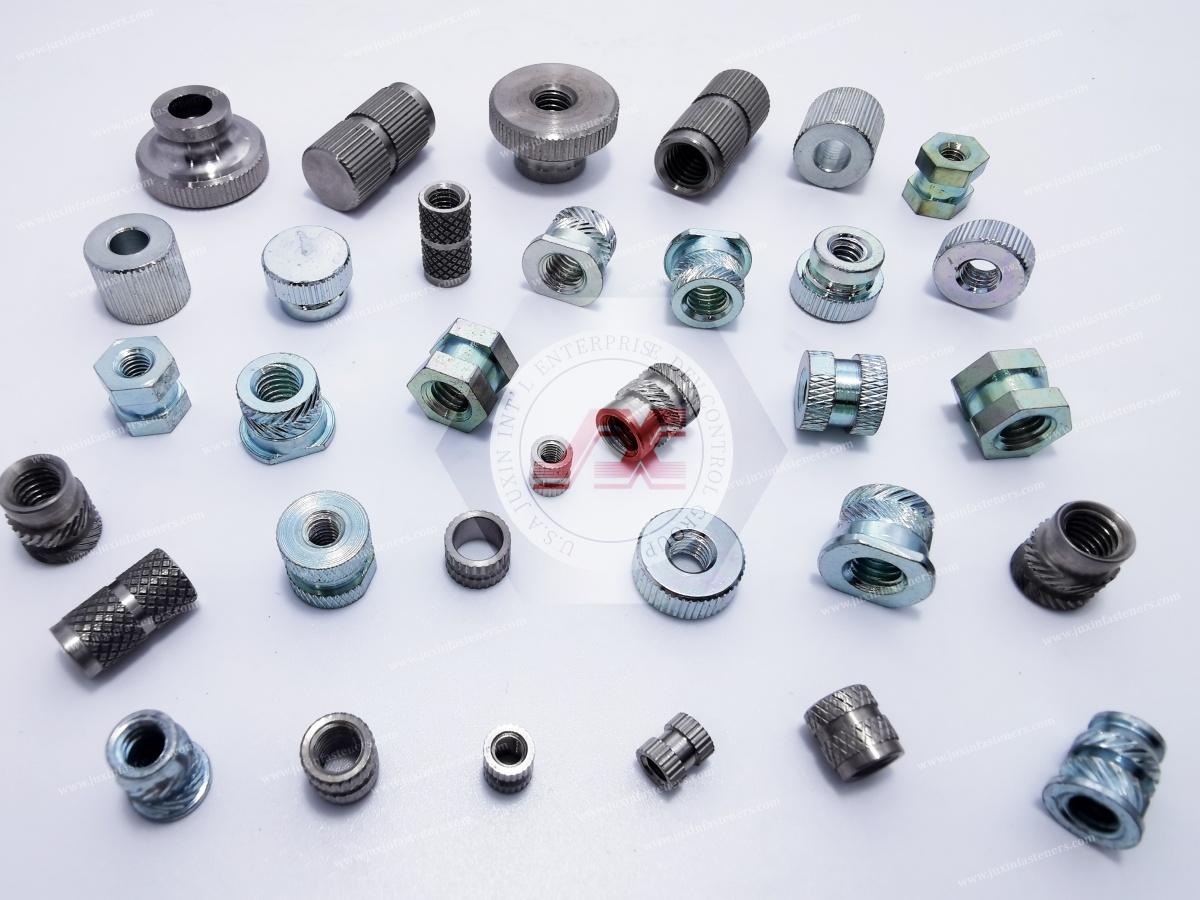
A suitable threaded insert provides a separate internal metal thread that can improve the durability of the screw connection.
Important Engineering Distinction
Threaded inserts improve the available thread interface, but they do not automatically prevent screw loosening or guarantee higher joint strength.
The complete connection must be designed for the intended loads and service conditions.
Choosing Inserts by Machinery Panel Material
The first selection decision should be based on the actual panel material.
Engineering Plastic Panels
Suitable options may include:
Self-tapping threaded inserts designed for plastics
Press-in threaded inserts
Molded-in threaded inserts
Heat-set inserts for compatible thermoplastics
The plastic boss geometry and installation method strongly influence retention.
Aluminum Panels and Components
Depending on thickness and geometry, possible solutions include:
Compatible self-tapping threaded inserts
Application-specific threaded bushings
Thread-repair inserts
Blind rivet nuts for suitable sheet constructions
Other engineered threaded fastening systems
Thin Steel Panels
Possible solutions include:
Blind rivet nuts
Self-clinching threaded nuts
Weld nuts
Other sheet-metal-specific fasteners
Important Distinction
A threaded insert intended for plastic is not automatically suitable for steel or aluminum sheet.
Different fastening systems rely on different retention mechanisms.
Engineering Recommendation
Confirm substrate material, thickness, access conditions and loading before selecting the insert type.
Brass Threaded Inserts for Plastic Machine Components
Brass threaded inserts are commonly used in suitable engineering plastic components.
Potential advantages include:
Good machinability
Durable internal threads
Compatibility with many established plastic insertion designs
Useful corrosion resistance in appropriate environments
Potential Applications
Plastic machinery covers
Automation equipment housings
Instrument panels
Control system components
Sensor mounting structures
Engineering Considerations
Host polymer grade
Boss dimensions
Installation temperature or force
Pull-out resistance
Torque-out resistance
Repeated assembly requirements
Brass inserts do not eliminate creep or deformation of the surrounding plastic.
Stainless Steel Threaded Inserts
Stainless steel inserts may be considered for selected applications requiring particular corrosion resistance or mechanical properties.
Potential environments include:
Outdoor machinery
High-humidity facilities
Chemical processing equipment
Food processing machinery
Industrial washdown areas
Engineering Considerations
Stainless steel grade
Corrosion exposure
Mechanical properties
Mating screw material
Thread galling
Installation compatibility
Important Limitation
Stainless steel corrosion resistance is grade- and environment-dependent.
Washdown chemicals, chlorides and other aggressive substances require appropriate material evaluation.
Aluminum Threaded Inserts
Aluminum inserts may be considered for selected lightweight equipment designs.
Potential benefits include:
Low density
Compatibility with certain lightweight assembly concepts
Reduced component mass
Engineering Considerations
Alloy selection
Thread wear
Mechanical strength
Surface treatment
Galvanic corrosion
Repeated maintenance
Important Clarification
Aluminum inserts are not universally stronger or more economical than other materials.
Selection must be based on the specific joint and operating environment.
Self-Tapping Threaded Inserts for Industrial Equipment
Self-tapping threaded inserts establish external engagement with a compatible host material during installation.
They contain a premanufactured internal machine thread.
The external cutting or forming features create the required engagement with the substrate.
Potential Advantages
Post-production installation
Mechanical retention in compatible materials
Flexible assembly processes
Suitable for certain machinery components
Engineering Limitations
Pilot hole dimensions must be controlled
Installation torque must be monitored
Brittle substrates may crack
Thin walls may deform
Misalignment may damage the component
Potential Applications
Selected aluminum components
Compatible plastic machinery covers
Equipment housings
Serviceable mounting structures
Engineering Recommendation
Use the installation specifications for the exact insert design and host material.
Press-In Threaded Inserts
Press-in inserts are installed into appropriately prepared holes using controlled force.
Their retention features engage the surrounding material.
Potential Advantages
Relatively straightforward installation
No heating requirement
Potential for efficient production
Suitability for selected low- or moderate-load applications
Engineering Limitations
Substrate compatibility is critical
Hole diameter affects retention
Excessive insertion force may damage the panel
Pull-out and torque-out performance require validation
Important Distinction
Press-in inserts designed for plastics are not equivalent to self-clinching nuts designed for sheet metal.
Molded-In Threaded Inserts
Molded-in inserts are positioned in a mold before a plastic component is formed.
Plastic flows around the insert during molding.
Potential Advantages
Integrated insert placement
No separate post-molding insertion operation
Suitable for selected high-volume production
Potential for effective mechanical retention
Engineering Limitations
Insert positioning must be controlled
Mold loading affects production workflow
Plastic flow requires evaluation
Insert movement may create defects
Tooling complexity may increase
Important Clarification
Molded-in inserts do not automatically provide the highest pull-out or torque-out strength.
Retention depends on the complete insert and host component design.
Blind Rivet Nuts for Thin Machinery Panels
Blind rivet nuts are particularly relevant where thin sheet metal requires an internal machine thread.
They are installed from one side of a suitable panel and mechanically deform to create retention.
Potential Applications
Sheet-metal access panels
Machinery covers
Equipment enclosures
Conveyor guards
Modular machine structures
Engineering Advantages
One-sided installation access
Reusable internal threads
Suitability for selected thin sheet materials
Potential for efficient assembly
Engineering Considerations
Sheet thickness and grip range
Hole diameter
Material hardness
Installation stroke or force
Spin-out resistance
Pull-out resistance
Panel deformation
Engineering Recommendation
Blind rivet nuts should be evaluated as a distinct fastening system rather than treated as interchangeable with plastic threaded inserts.
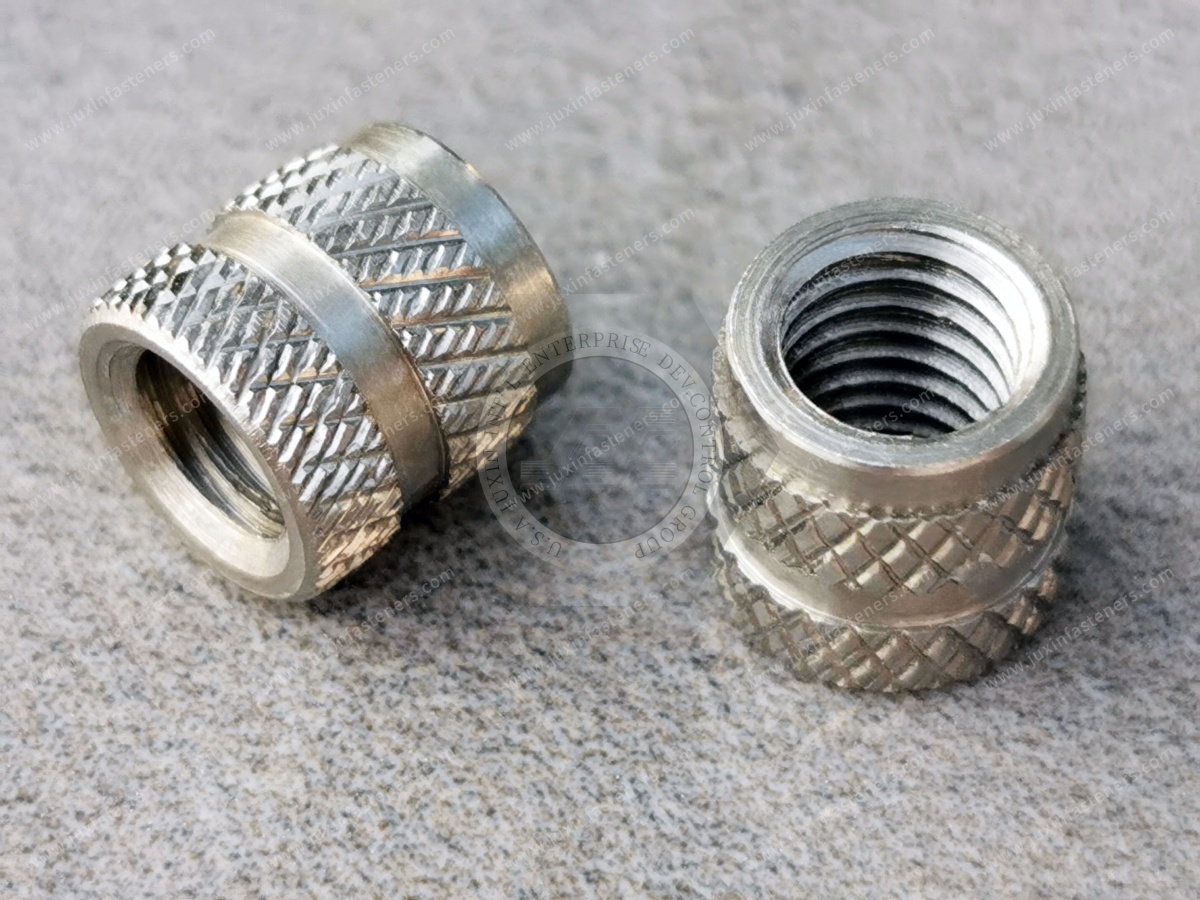
Threaded Insert Selection by Host Material
| Host material | Potential fastening solution | Main engineering concern |
|---|---|---|
| Engineering plastic | Suitable self-tapping, press-in, heat-set or molded-in insert | Boss strength and retention |
| Aluminum sheet | Blind rivet nut or compatible sheet-metal system | Thickness and installation |
| Machined aluminum | Application-specific threaded insert or threaded bushing | Engagement and loading |
| Thin steel sheet | Blind rivet nut, self-clinching nut or weld nut | Sheet thickness and access |
| Composite panel | Application-specific insert or backing solution | Local damage and delamination |
| Repeated-service panel | Suitable reusable threaded fastening system | Maintenance durability |
The final choice must be validated for the actual application.
Panel Thickness and Hole Design
Panel thickness is a major factor in selecting machinery fastening systems.
Thin Sheet Metal
Thin sheet may not provide sufficient engagement for a conventional tapped thread.
A captive threaded fastener or blind rivet nut may be more suitable.
Machined Aluminum
A thicker aluminum component may support directly tapped threads or a suitable insert.
The decision depends on thread engagement, load and service frequency.
Engineering Plastics
Plastic inserts typically require sufficient surrounding material.
Relevant dimensions include:
Pilot hole diameter
Hole depth
Boss outside diameter
Boss height
Edge distance
Insert length
Screw engagement depth
Engineering Recommendation
Do not specify a threaded insert using only the screw diameter.
The host component geometry must be reviewed.
Pull-Out Resistance and Torque-Out Resistance
Two important characteristics of installed inserts are pull-out and torque-out resistance.
Pull-Out Resistance
Pull-out resistance measures resistance to axial extraction from the host material.
Torque-Out Resistance
Torque-out resistance measures resistance to rotation within the host material.
Why Both Matter
An insert may remain secure under axial load but rotate during screw tightening.
Another insert may resist rotation but pull out under service loading.
Engineering Recommendation
Validate both characteristics where required using representative production parts.
Vibration Resistance in Industrial Machinery
Industrial machinery may operate under continuous vibration, intermittent shock and repeated start-stop cycles.
Potential applications include:
Motors
Conveyor systems
Packaging machinery
Industrial automation
Production equipment
Important Engineering Distinction
A threaded insert does not inherently prevent the mating screw from loosening under vibration.
Joint loosening may result from:
Inadequate preload
Transverse vibration
Joint settlement
Material deformation
Thermal expansion
Insufficient joint stiffness
Where required, the joint may need a suitable locking feature or another validated anti-loosening method.
Engineering Recommendation
Evaluate insert retention and screw loosening separately.
Repeated Assembly and Maintenance Durability
Maintenance access is one of the strongest reasons to use reusable threaded fastening systems.
Potential advantages include:
Reduced wear of directly formed threads
Easier screw replacement
More consistent maintenance procedures
Reduced risk of panel replacement caused by damaged threads
However, repeated assembly performance depends on:
Insert retention
Screw condition
Thread alignment
Tightening torque
Service environment
Operator practices
Engineering Recommendation
If a panel is expected to be removed frequently, define the required assembly-cycle performance and validate it.
Machine Guarding and Safety Considerations
Some machinery panels function as protective guards.
These components may be subject to additional safety requirements.
Important Clarification
A threaded insert does not independently establish compliance with machinery safety requirements.
For example, ISO 14120 addresses general requirements for the design and construction of fixed and movable guards.
Where relevant, the complete guard and fastening arrangement must be evaluated against applicable safety requirements.
Engineering Recommendation
Do not replace an engineered guard fastening system solely on the basis of insert thread strength.
Corrosion and Environmental Exposure
Industrial machinery may operate in environments involving:
Humidity
Cleaning chemicals
Oils and lubricants
Outdoor exposure
Temperature variation
Process contamination
Material selection should consider the complete joint.
Potential Risks
Corrosion of the insert
Corrosion of the mating screw
Galvanic interaction
Thread seizure
Surface degradation
Reduced serviceability
Engineering Recommendation
Review the insert material, screw material, host material and environment together.
Installation Process Control for OEM Production
Manufacturing engineers and production managers must consider whether an insert can be installed consistently at the required production volume.
Relevant Variables
Depending on insert type:
Pilot hole diameter
Installation torque
Insertion force
Insertion temperature
Seating depth
Alignment
Tool condition
Substrate condition
Production Quality Indicators
Useful measurements may include:
Installation cycle time
Seating depth variation
Reject rate
Rework rate
Tool wear
Dimensional consistency
Retention test results
Information Gain: A Strong Insert Is Not Enough if Installation Varies
An insert design may perform well during prototype testing but produce inconsistent results in production if installation conditions vary.
For example, differences in hole diameter or insertion alignment may create different retention levels across similar panels.
Engineering Recommendation
Validate the intended installation process as well as the insert geometry.
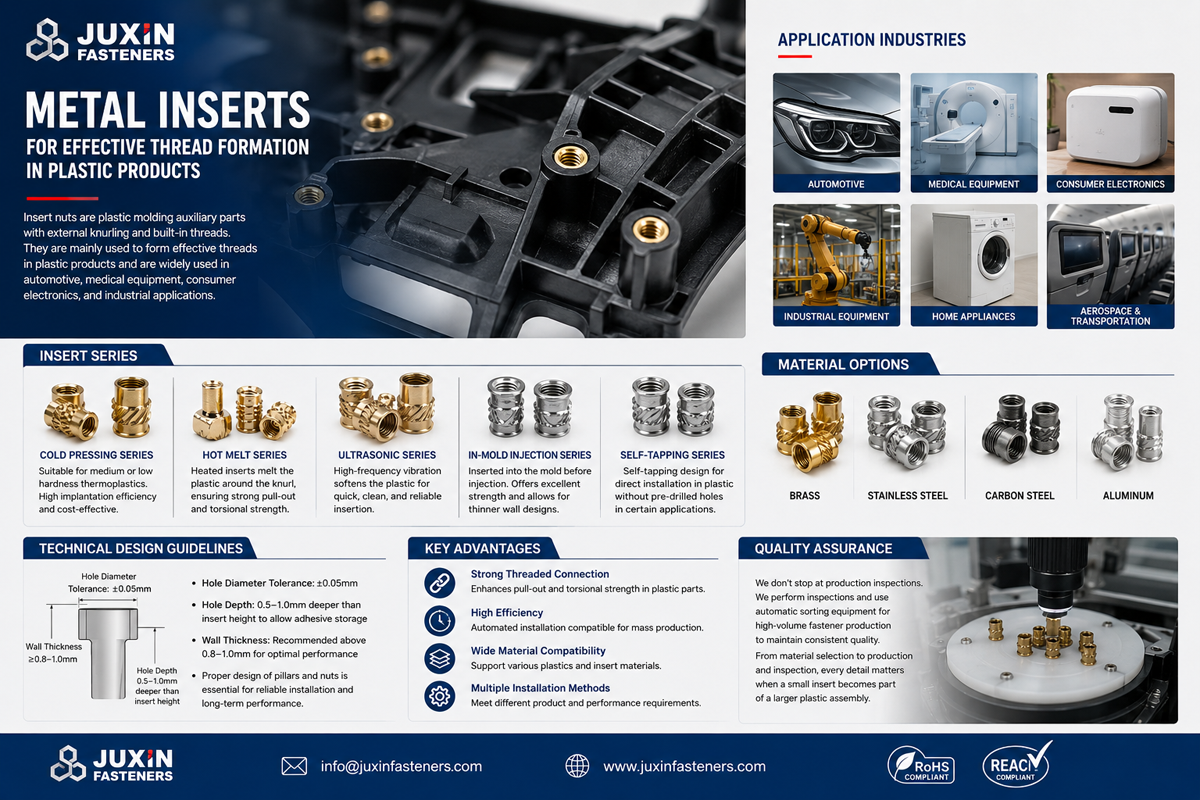
Quality Control for Industrial Threaded Inserts
OEM quality requirements should reflect the actual joint function.
Incoming Product Inspection
Potential characteristics include:
Material grade
Internal thread dimensions
Outside diameter
Insert length
Retention geometry
Surface finish
Visual defects
Installed Insert Inspection
Potential checks include:
Position
Seating depth
Perpendicularity
Host material damage
Insert movement
Thread condition
Mechanical Testing
Depending on the application:
Pull-out testing
Torque-out testing
Repeated assembly testing
Screw tightening trials
Joint load testing
Environmental Testing
Where relevant:
Vibration testing
Thermal cycling
Humidity exposure
Corrosion evaluation
Temperature aging
Important Qualification Principle
Dimensional compliance alone does not establish suitability for a specific machinery joint.
The installed connection must be evaluated under representative conditions.
Thread Standards and Size Compatibility
Thread dimensions must match the mating screw.
Metric Threads
ISO 261 and the ISO 965 series may be relevant to applicable metric thread dimensions and tolerances.
Unified Inch Threads
ASME B1.1 covers Unified inch screw threads, including UNC and UNF designations.
Metric-to-Inch Diameter References
| Metric size | Approximate nominal diameter |
|---|---|
| M3 | 0.118 in |
| M4 | 0.157 in |
| M5 | 0.197 in |
| M6 | 0.236 in |
| M8 | 0.315 in |
These are dimensional conversions only.
Metric, UNC, UNF, BSW and BSF threads are not directly interchangeable.
Specific thread availability must be confirmed against the drawing.
Typical Industrial Machinery Applications
Access Covers and Maintenance Panels
Reusable threaded fastening points may support repeated service operations.
Engineering Priorities
Maintenance frequency
Thread durability
Panel thickness
Installation access
Motor Housings and Drive Equipment
Selected covers and auxiliary components may require reusable threaded connections.
Engineering Priorities
Vibration
Temperature
Mechanical loading
Serviceability
Industrial Automation Equipment
Potential applications include:
Sensor mounting components
Controller housings
Equipment covers
Modular machine panels
Engineering Priorities
Installation repeatability
Maintenance access
Component replacement
Production efficiency
Conveyor Systems
Potential applications include:
Inspection covers
Protective panels
Auxiliary mounting structures
Serviceable equipment housings
Engineering Priorities
Dynamic loading
Vibration
Maintenance access
Corrosion exposure
Modular Production Equipment
Modular machines may require fastening systems that support assembly, replacement and reconfiguration.
Engineering Priorities
Repeatable assembly
Component interchangeability
Joint durability
Installation consistency
Common Failure Modes and Engineering Prevention
| Failure mode | Potential cause | Recommended evaluation |
|---|---|---|
| Insert pulls out | Insufficient retention or weak substrate | Review geometry and axial loading |
| Insert rotates | Inadequate anti-rotation engagement | Review retention features and torque-out |
| Panel deforms | Excessive installation or clamp load | Review material thickness and support |
| Plastic boss cracks | Excessive insertion stress | Review hole and boss geometry |
| Internal thread strips | Incorrect screw or excessive torque | Review thread fit and tightening |
| Joint loosens | Inadequate preload or vibration | Evaluate complete joint design |
| Insert corrodes | Unsuitable material or environment | Review material pairing |
| Maintenance damage occurs | Misalignment or over-tightening | Improve service procedures |
| Production defects increase | Installation variation | Improve process control |
Total Installed Cost and Maintenance Economics
For machinery OEMs, the lowest fastener purchase price does not always produce the lowest lifecycle cost.
Relevant cost elements include:
Insert purchase cost
Installation labor
Tooling
Equipment depreciation
Inspection
Scrap and rework
Maintenance labor
Panel replacement
Equipment downtime
Information Gain: Evaluate Cost per Accepted Assembly
A useful production comparison is:
Total relevant installation and production costs ÷ accepted assembly quantity
For serviceable equipment, the evaluation may also include expected maintenance operations and replacement costs.
Engineering Recommendation
Compare fastening alternatives using both production cost and expected service requirements.
OEM Supplier Qualification and Procurement Requirements
Supplier development and purchasing teams should evaluate technical and commercial factors together.
Technical Requirements
Drawing compliance
Material specification
Thread accuracy
Retention geometry
Surface treatment
Inspection requirements
Production Requirements
Dimensional consistency
Installation compatibility
Traceability where required
Packaging
Engineering change control
Commercial Requirements
Prototype quantities
MOQ
Annual demand
Unit pricing
Lead time
Delivery schedule
Supply continuity
Specific commercial terms must be confirmed for each RFQ.
OEM RFQ Checklist
| RFQ item | Information to provide |
|---|---|
| Product drawing | Part number and revision |
| Fastener type | Self-tapping, press-in, molded-in, rivet nut or specified |
| Thread | Metric or inch designation |
| Insert dimensions | OD, length and tolerances |
| Material | Brass, stainless steel, aluminum or specified grade |
| Host material | Plastic, aluminum, steel or composite |
| Panel thickness | Actual thickness or grip range |
| Hole dimensions | Diameter, depth and tolerances |
| Installation | Method and equipment |
| Loading | Axial, torsional and service loads |
| Vibration | Operating conditions |
| Temperature | Operating range |
| Environment | Humidity, chemicals or outdoor exposure |
| Maintenance | Expected assembly cycles |
| Testing | Pull-out, torque-out or other requirements |
| Samples | Prototype quantity |
| Annual demand | Volume forecast |
| MOQ | Commercial confirmation |
| Lead time | Required schedule |
| Packaging | Bulk or production-compatible |
Frequently Asked Questions
What are threaded inserts used for in industrial machinery panels?
They provide reusable internal metal threads in suitable host materials, supporting serviceable panels, covers and equipment components.
Can threaded inserts be used in aluminum panels?
Yes, but the correct insert type depends on aluminum thickness, geometry and loading. Thin aluminum sheet may require a rivet nut or another sheet-metal-specific fastening system.
Are threaded inserts suitable for thin sheet metal?
Some fastening systems are specifically designed for thin sheet metal, including blind rivet nuts and self-clinching nuts.
Do threaded inserts prevent vibration loosening?
Not automatically. Insert retention and screw loosening must be evaluated separately.
Which insert type has the highest pull-out strength?
There is no universal answer. Performance depends on insert geometry, host material and installation conditions.
Can threaded inserts be reused?
The internal metal thread can support repeated screw installation in suitable designs, but service-cycle durability must be validated.
What is the difference between pull-out and torque-out resistance?
Pull-out resistance concerns axial extraction. Torque-out resistance concerns rotation of the insert within the host material.
Are stainless steel inserts always better for industrial machinery?
No. Material selection depends on corrosion exposure, mechanical requirements, host material and cost.
Can industrial threaded inserts use UNC or UNF threads?
Such requirements can be reviewed against the product drawing.
Availability must be confirmed, and Unified inch threads are not interchangeable with metric threads.
What information is needed for a bulk OEM quotation?
Provide the drawing, material, thread, panel thickness, installation method, application requirements, annual demand and delivery schedule.
Juxin Fasteners: Industrial Machinery Threaded Insert Solutions
Juxin Fasteners welcomes inquiries for industrial threaded inserts and custom fastening components.
Relevant product categories include:
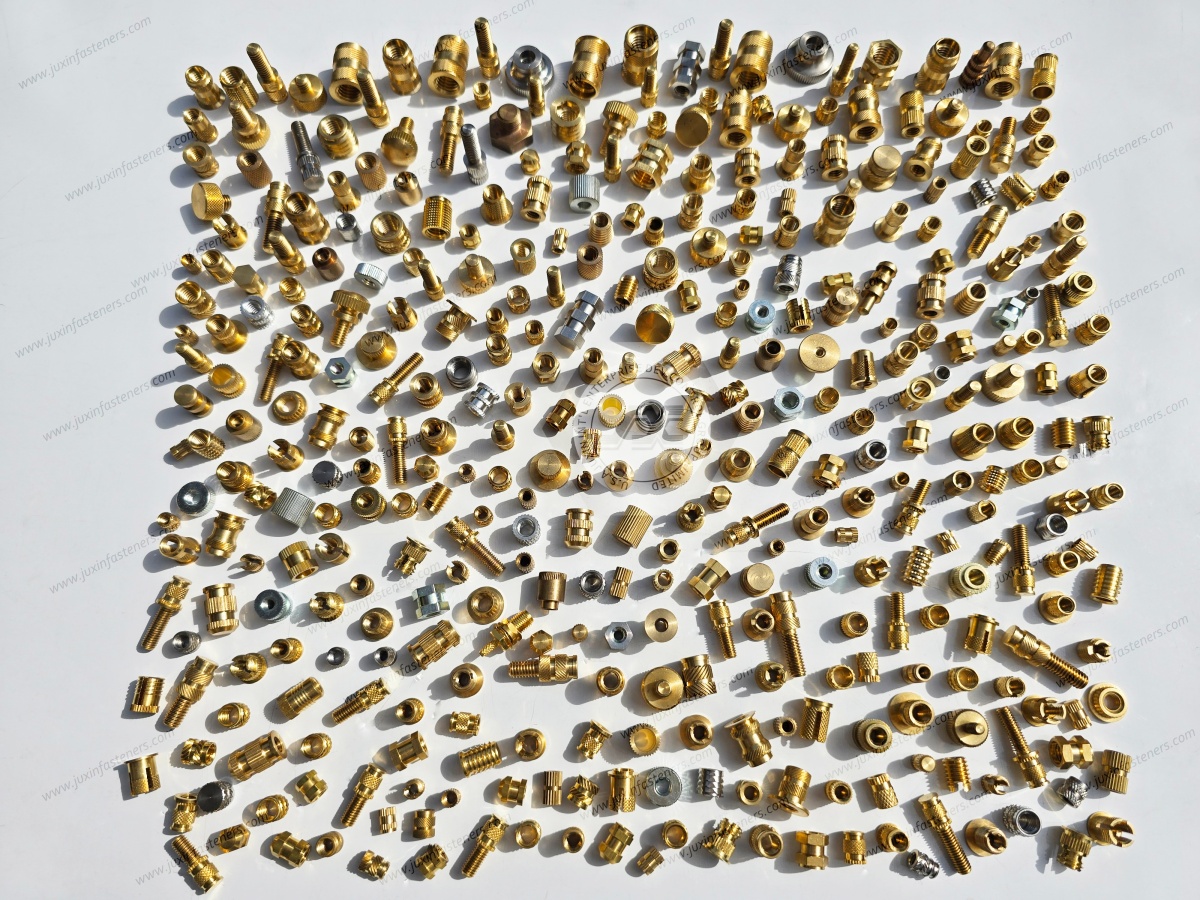
Thread insert nuts
Brass threaded inserts
Stainless steel threaded inserts
Aluminum threaded inserts
Self-tapping threaded inserts
Press-in threaded inserts
Molded-in threaded inserts
Blind rivet nuts
Custom OEM fastening components
Specific materials, dimensions, installation requirements, inspection criteria, MOQ and delivery schedules require confirmation.
Request an Industrial Threaded Insert Quotation
Are you developing industrial machinery panels, serviceable covers, aluminum equipment housings, conveyor components or automation equipment requiring reusable threaded connections?
Juxin Fasteners welcomes technical and commercial inquiries from:
Mechanical engineers
Design engineers
Structural engineers
Manufacturing engineers
Production managers
Purchasing specialists
Procurement managers
Supplier development teams
Supply chain managers
For technical review, please provide:
Product drawing + thread specification + material grade + host material + panel thickness + hole dimensions + installation method
+ load requirements + vibration conditions + maintenance cycles + inspection requirements + prototype quantity + annual demand + packaging + delivery schedule.
Our team can review the requirements and confirm suitable product options, technical feasibility and quotation conditions.
Company: Juxin Fasteners
Website: https://www.juxinfasteners.com/
Email: info@juxinfasteners.com
Send your industrial machinery threaded insert drawings and OEM RFQ to Juxin Fasteners for technical confirmation and quotation.
Contact Us
Tel.:
+86 020 8621 0320
+86 020 3121 6067
E-mail:
Technical Support:
Navigation
SEND INQUIREY