
Call Us
+86 136 6007 9809
Call Us
+86 136 6007 9809

Mar. 29, 2023
Thread Insert Nuts Installation Guide and Industrial Applications
Thread insert nuts are widely used fastening components designed to provide durable, reusable internal threads in plastic and lightweight materials.
By embedding a threaded metal insert into a plastic or soft metal component, manufacturers can significantly improve the strength, reliability, and service life of threaded joints.
Thread insert nuts are commonly used in industries such as automotive electronics, electrical equipment, consumer devices, and industrial machinery, where lightweight materials are widely used.
3. Determining Proper Insert Installation
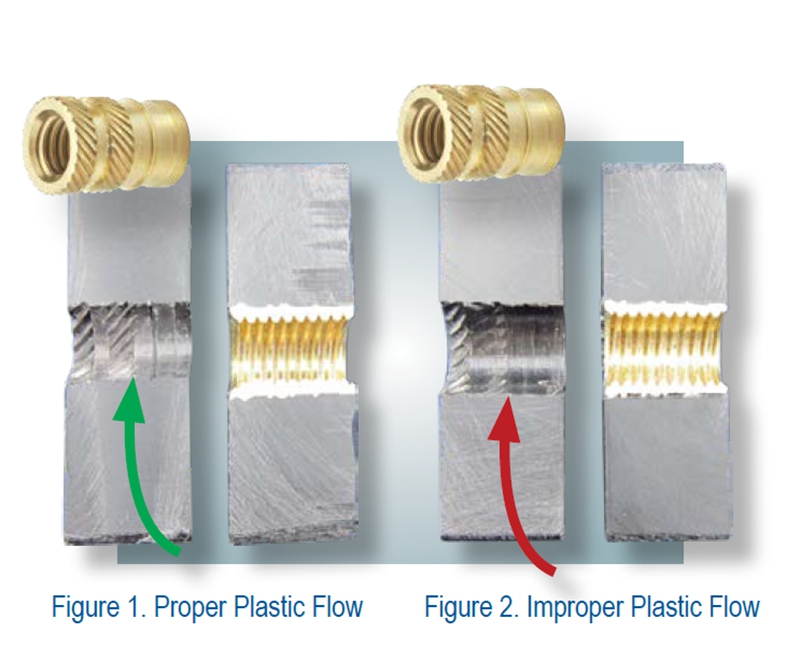
For installing nuts in plastic components, proper plastic flow into the retention features is essential.
Retention features such as:
knurls
barbs
undercuts
must be filled by the surrounding plastic to achieve maximum performance.
A reliable method to verify proper installation is to perform a cross-section inspection of the installed insert.
If the plastic fully conforms to the insert's external features, the joint will achieve optimal torque resistance and pull-out strength.
Insufficient plastic flow into these features can significantly reduce insert performance.
4. Types of Thread Insert Nuts and Installation Methods
Different insert designs are available depending on the installation method and application requirements.
Self-Tapping Thread Insert Nuts
Self-tapping inserts are designed for post-mold installation in plastic components.
These inserts feature specially designed external threads that cut into the plastic during installation.
Advantages
Excellent pull-out resistance
High torque performance
Reliable mechanical locking in plastic materials
The thread profile is typically thin to minimize stress on the plastic, while the pitch is relatively coarse to maximize the plastic shear surface area.
Proper pilot hole design is critical to ensure straight and accurate installation.
Press-In Thread Insert Nuts
Press-in inserts are designed to reduce installation costs and simplify assembly.
These inserts typically feature helical knurls that create resistance to both rotation and pull-out.
Key Features
Lower installation cost
Simple press-fit installation
Suitable for high-volume production
However, compared with other insert types, press-in inserts generally provide lower torque and pull-out resistance.
Molded-In Thread Insert Nuts
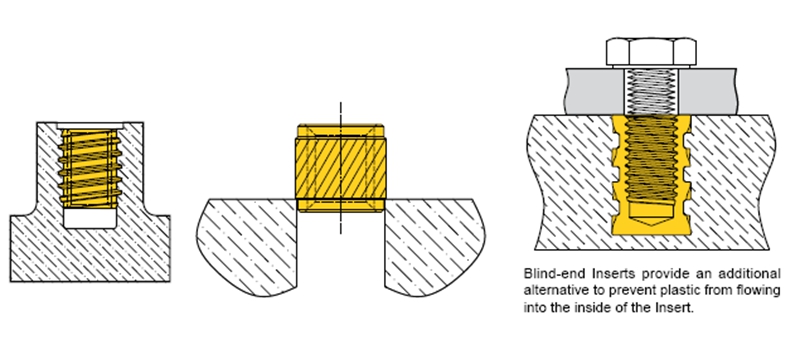
Molded-in inserts are placed directly into the injection mold before the plastic component is formed.
This method provides the highest mechanical performance among all insert installation techniques.
During the molding process, molten plastic flows around the insert, fully encapsulating its retention features.
Advantages
Maximum pull-out resistance
High torque performance
Superior long-term durability
Although molded-in inserts require additional handling during molding, they offer the most robust threaded connection for demanding applications.
5. Thread Insert Design Guidelines
Proper design of the host component is essential for achieving reliable insert performance.
Hole Depth
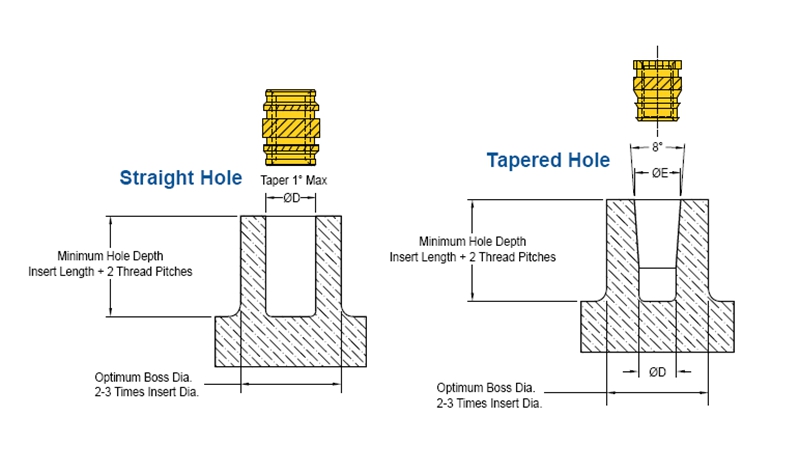
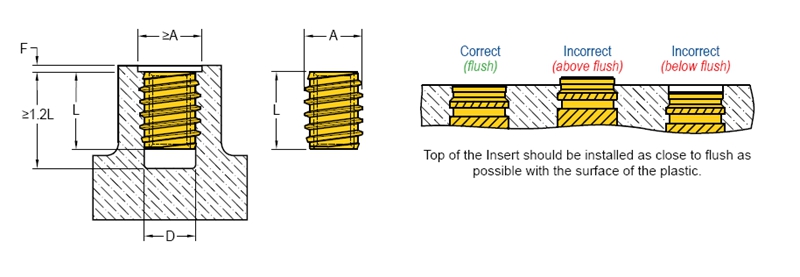
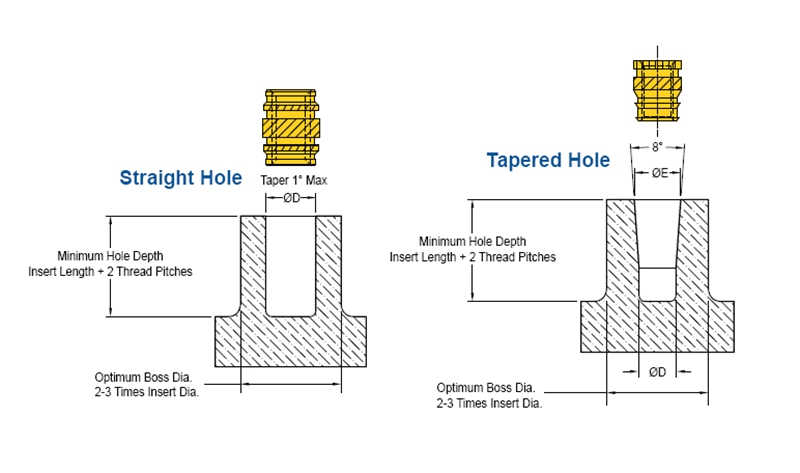
For post-mold installation, the hole depth should always exceed the insert length.
Recommended guidelines:
Self-tapping inserts: minimum depth of 1.2× the insert length
Other insert types: insert length + two thread pitches
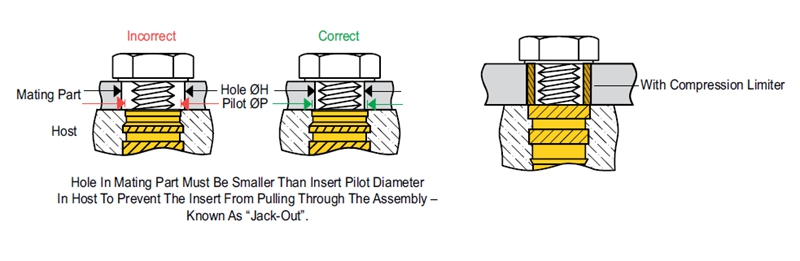
The assembly screw should never bottom out in the hole, as this may cause jack-out failure.
Correct Hole Size
Hole size is critical for insert performance.
Oversized holes reduce torque and pull-out strength
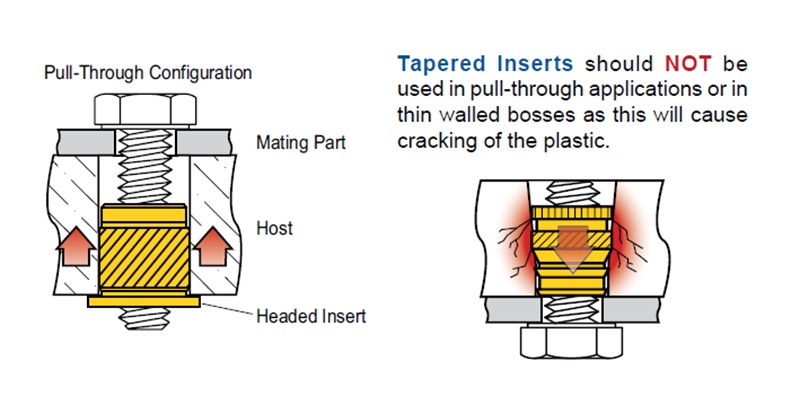
Undersized holes may cause excessive stress or cracking in plastic materials
If the plastic contains fillers such as glass fibers, the hole dimensions should be adjusted:
≥15% filler: increase hole diameter by 0.08 mm
≥35% filler: increase hole diameter by 0.15 mm
Molded Holes vs Drilled Holes
Whenever possible, molded holes are preferred over drilled holes.
Molded holes provide a denser, stronger plastic surface, improving insert retention and overall performance.
Boss Diameter and Wall Thickness
The diameter of the plastic boss surrounding the insert must be sufficient to support installation loads.
Typical design recommendation:
Boss diameter = 2 to 3 × insert diameter
This helps prevent:
bulging during installation
cracking of the plastic component
Additional ribs can be added to increase structural strength.
6. Thread Insert Nuts in Industrial Applications
Thread insert nuts are widely used across many industries where plastic or lightweight materials are common.
Automotive Electronics
Thread insert nuts are used in:
automotive control units
sensor housings
battery management systems
They provide reliable threaded connections in plastic electronic housings.
Electrical Equipment Manufacturing
In electrical equipment and control cabinets, thread inserts are used to mount:
switches
brackets
circuit boards
internal modules
They ensure secure threaded connections even after repeated maintenance operations.
Consumer Electronics
Thread insert nuts are widely used in plastic housings for:
household appliances
communication devices
electronic enclosures
They improve the durability of threaded connections in high-cycle assembly environments.
Industrial Equipment
Thread inserts are also used in industrial machinery components where plastic structures must support mechanical loads.
Typical applications include:
equipment covers
instrument housings
mounting brackets
7. Engineering Support and Custom Solutions
Selecting the correct thread insert design requires consideration of several factors:
plastic material type
mechanical load requirements
installation method
production volume
Our engineering team provides professional technical support to help customers select the most suitable thread insert nuts for their applications.
With advanced manufacturing capabilities and strict quality control systems, we supply both standard and customized insert solutions for global industrial customers.
8. Quality and Manufacturing Capability
Our thread insert nuts are manufactured using advanced production technology and strict quality management systems.
We offer:
a broad range of standard insert nuts
custom design capabilities
competitive production for both short and long runs
Our quality management system follows international standards such as ISO 9001, ensuring consistent product performance and reliability.
STANDARD MATERIALS&ORDER DESCRIPTION
| Type | Grade | INS (Series #) / Thread Size / Length Material Finish Example: INS 29 / 8-32 / .321L EK | |||||||
| A - Aluminum High Strength Aluminum Alloy | ASTM B211 2024 ISO AlCu4Mg1 | ||||||||
| E - Brass Free-Cutting Brass | ASTM B16 UNS C36000 EN 12164 CW603N CuZn36Pb3 | ||||||||
| RoHS compliant | |||||||||
Previous: Features of knurled nuts
 MORE NEWS
Contact Us
Tel.:
+86 020 8621 0320
+86 020 3121 6067
E-mail:
Technical Support:
Navigation
SEND INQUIREY