
Call Us
+86 136 6007 9809
Call Us
+86 136 6007 9809

Dec. 13, 2024
Pre-Applied Thread Locking Adhesive Fasteners: Coating Design, Vibration Resistance and OEM Assembly Solutions
Threaded fasteners used in automotive equipment, EV battery assemblies, industrial machinery,
electrical cabinets and robotic systems may experience vibration, dynamic loading, thermal cycling and repeated operating stresses.
Under unfavorable joint conditions, these loads can contribute to relative movement, loss of preload and unintended fastener rotation.
One method of improving resistance to rotational loosening is to use pre-applied thread locking adhesive fasteners.
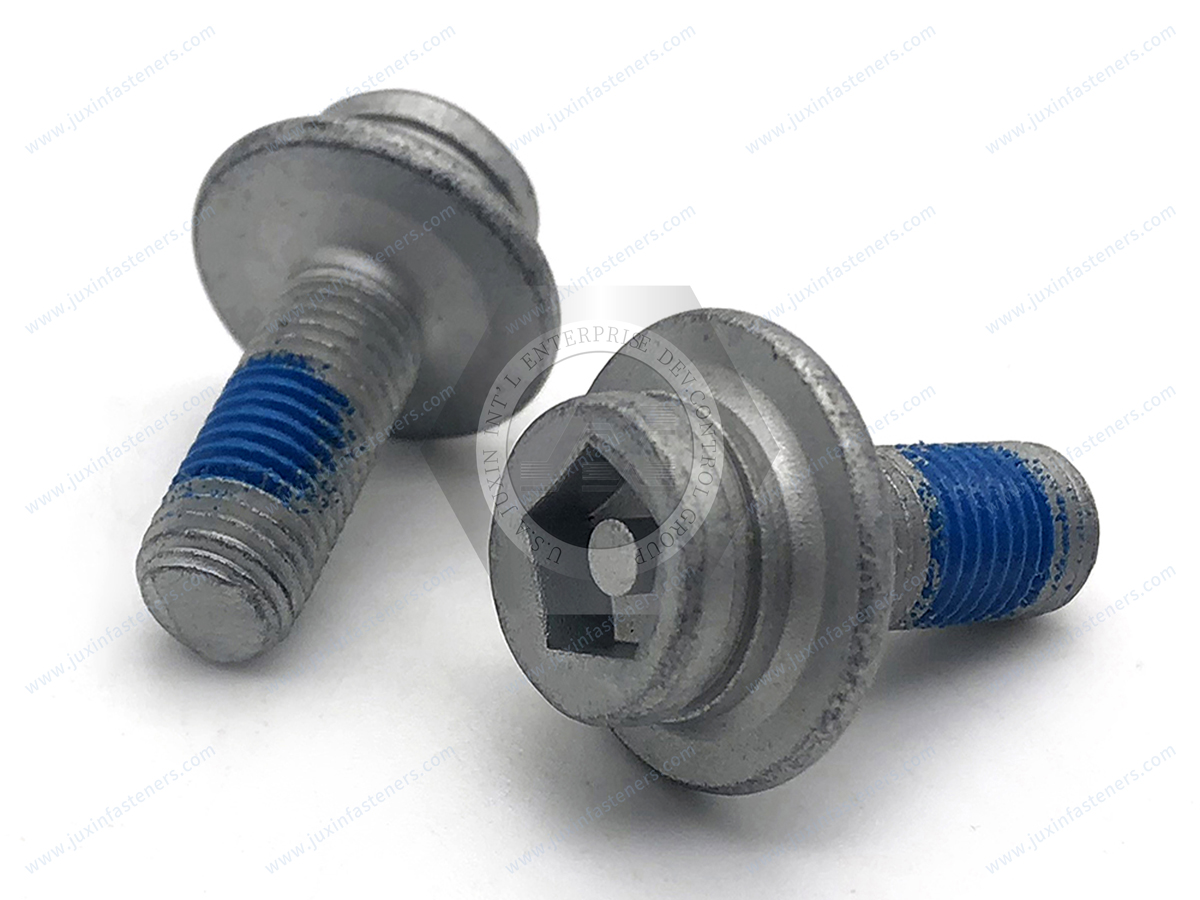
These are screws, bolts or studs supplied with a locking compound applied to a defined region of the external thread before installation.
Depending on the adhesive technology, installation activates or initiates the locking mechanism, producing resistance to subsequent loosening.
For OEM manufacturers, pre-applied locking fasteners may eliminate a separate adhesive dispensing operation and help standardize assembly conditions.
However, successful performance requires more than simply adding adhesive to a screw.
The coating chemistry, location, coverage, thread geometry, surface condition, tightening process and service environment must be considered as a complete fastening system.
This guide explains how pre-applied adhesive locking fasteners work, how to specify them and how to evaluate their suitability for OEM production.
Juxin Fasteners welcomes inquiries for industrial bolts, screws and drawing-specific locking fastener configurations, subject to technical confirmation.
What Are Pre-Applied Thread Locking Adhesive Fasteners?
Pre-applied adhesive locking fasteners are threaded components with a locking material deposited onto a specified thread region before the fastener reaches the final assembly station.
For certain microencapsulated systems, the coating contains reactive materials that are activated when the external and internal threads engage.
After the adhesive develops the required properties, it can increase resistance to unintended rotation.
The technology may be used on suitable:
Hex head bolts and flange bolts
Socket head cap screws
Machine screws
Threaded studs
Drawing-specific OEM screws and bolts
The actual coating technology and its compatibility with a fastener must be verified.
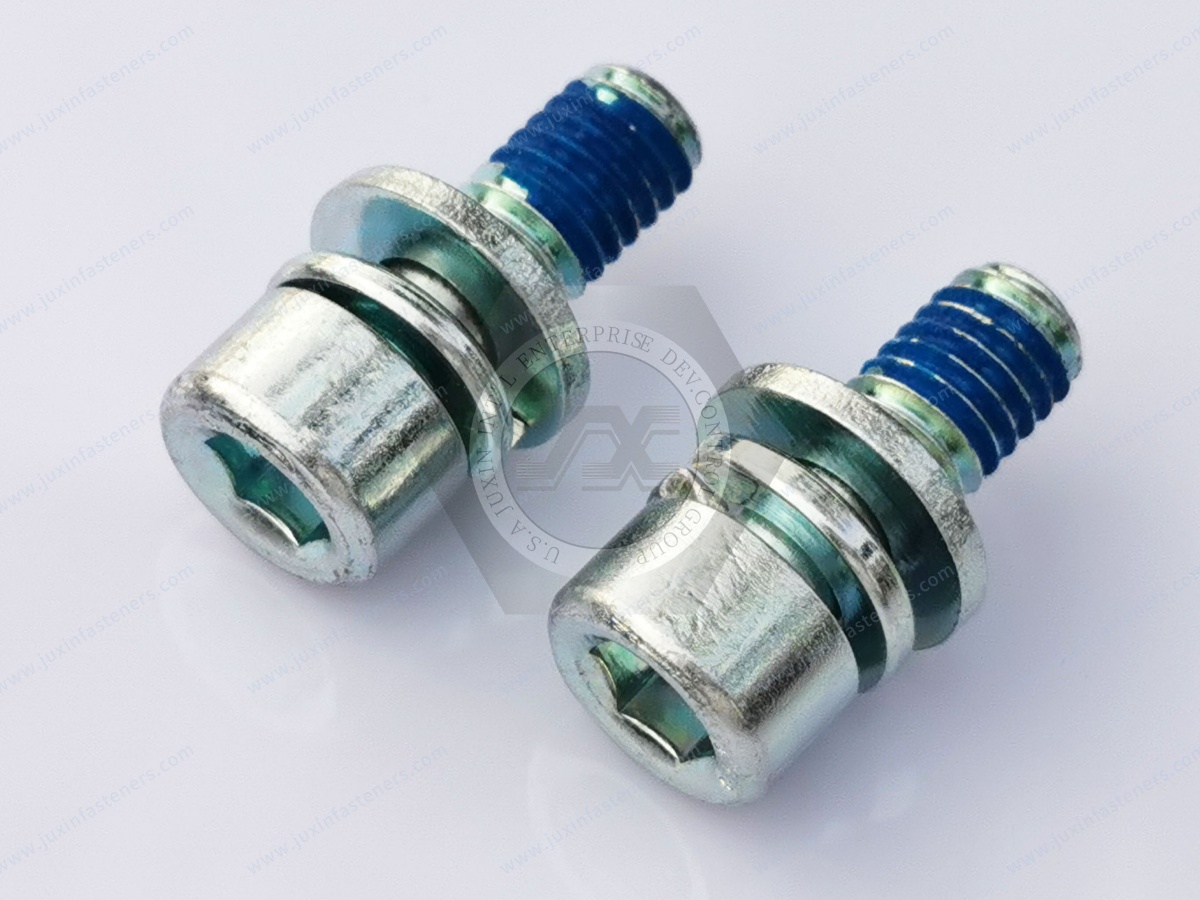
What Does the Adhesive Do?
A suitable adhesive can occupy clearances between mating thread surfaces and develop resistance to relative rotation.
It may help limit rotational loosening, but it does not automatically correct inadequate preload, insufficient thread engagement or an unsuitable joint design.
Important Engineering Distinction
A threadlocker is not a substitute for calculating the required bolt strength, clamp force, joint stiffness or fatigue resistance.
The adhesive is one element of the complete joint design.
Microencapsulated Adhesive, Anaerobic Threadlocker and Polymer Patch: Key Differences
Several technologies are commonly grouped under the term pre-applied threadlocker.
They should not be treated as equivalent.
| Locking technology | Operating principle | OEM selection consideration |
|---|---|---|
| Microencapsulated reactive adhesive | Installation disrupts capsules or otherwise activates reactive components | Activation, cure, coating placement and shelf life |
| Liquid anaerobic threadlocker | Cures under suitable conditions between mating metal surfaces | Dispensing, surface compatibility and cure |
| Pre-applied anaerobic-type system | Uses a formulation designed for pre-application and subsequent activation or cure | Product-specific chemistry and application requirements |
| Non-curing polymer patch | Provides interference-based resistance to rotation | Prevailing torque, patch geometry and repeated-use performance |
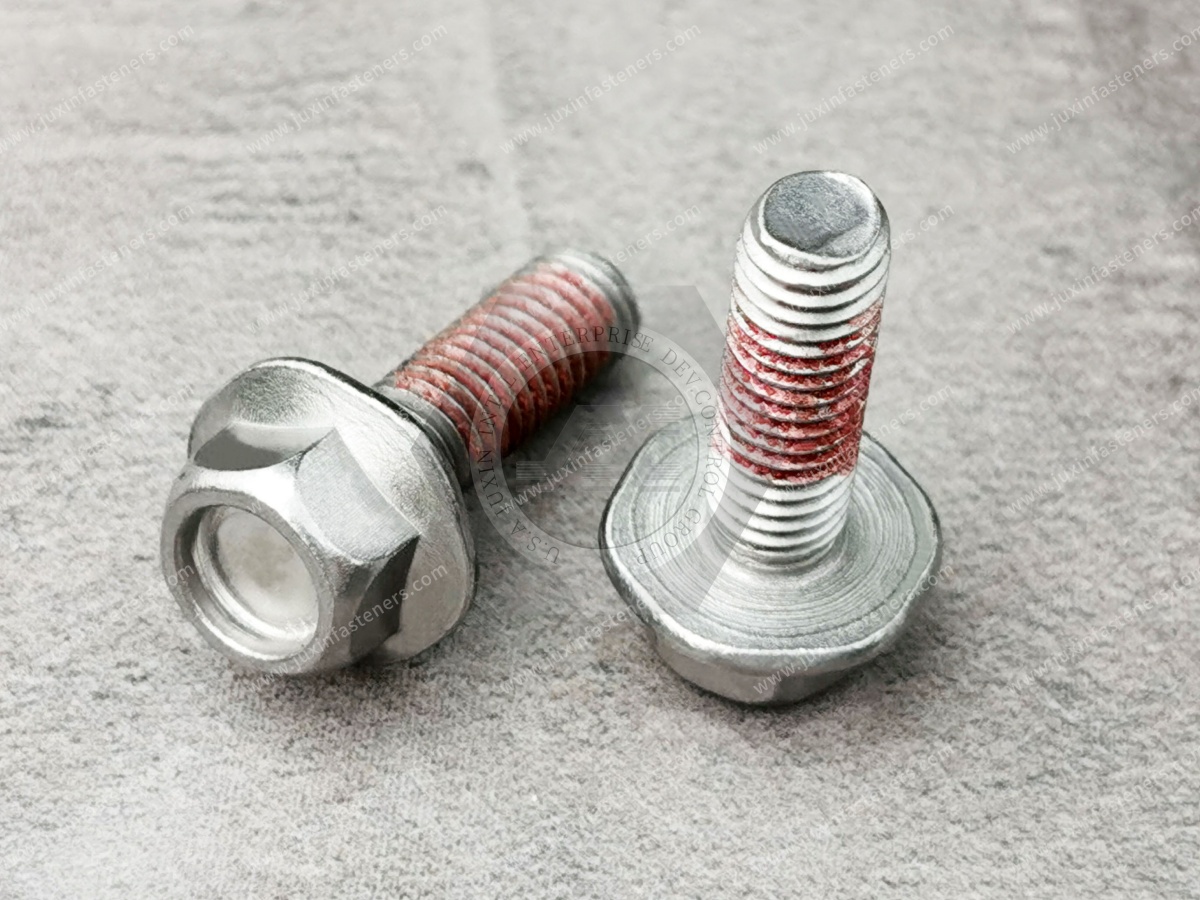
Microencapsulated Adhesive Fasteners
In a representative microencapsulated system, thread contact during installation ruptures capsules containing reactive components.
The released materials react under the conditions specified for that formulation.
The resulting adhesive can develop a locking bond between the mating threads.
However, not every pre-applied adhesive system uses identical capsule chemistry or curing behavior.
Liquid Anaerobic Threadlockers
Liquid anaerobic products are typically applied during assembly.
Their curing behavior depends on the formulation, mating surfaces, oxygen exclusion and other conditions.
Polymer-Patch Locking Screws
A polymer patch may generate prevailing torque through mechanical interference without relying on a cured adhesive bond.
Some patch systems are designed for defined multiple installation cycles.
OEM Recommendation
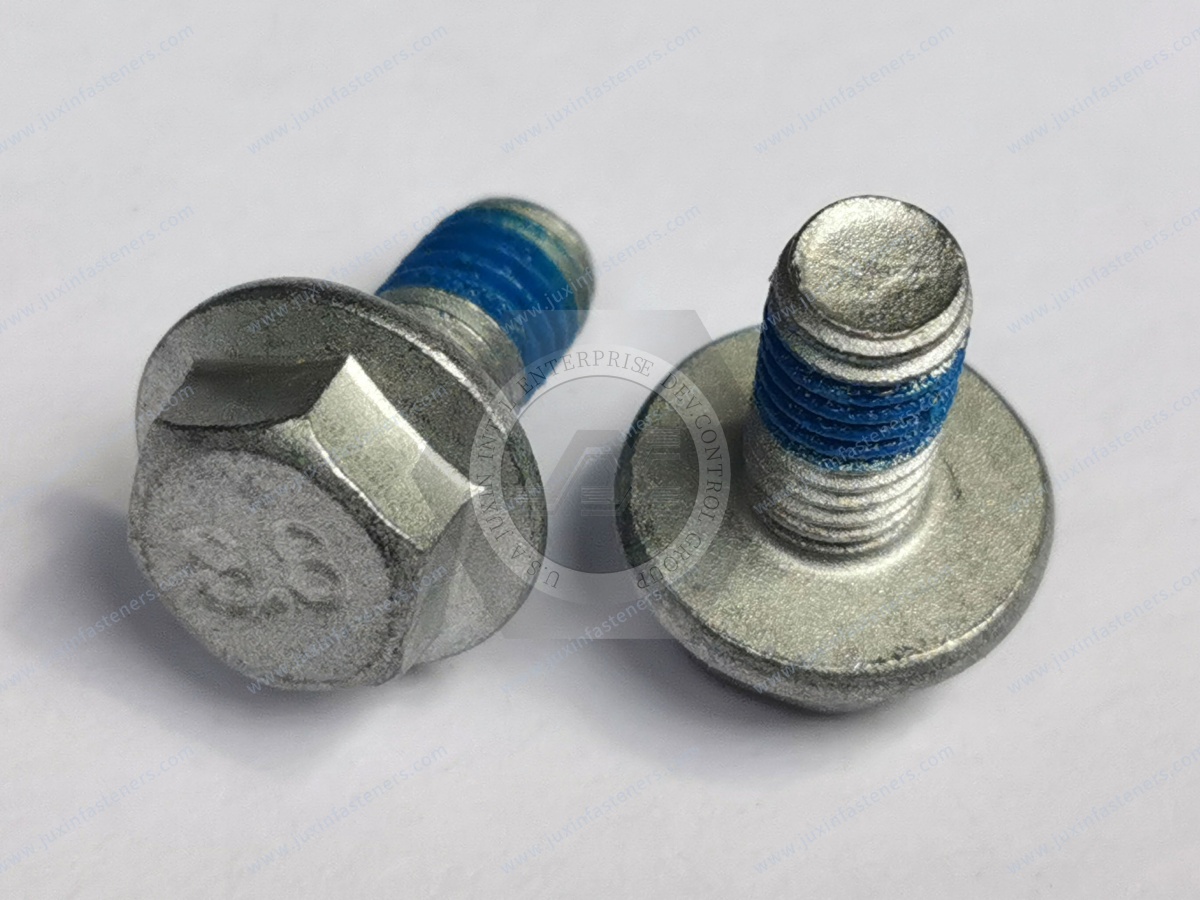
Specify the actual locking technology, not simply blue patch, threadlocker screw or anti-loosening bolt.
Color alone does not reliably identify the chemistry, locking strength or temperature capability.
How Microencapsulated Thread Locking Adhesive Works
A typical microencapsulated adhesive locking process includes four functional stages.
Coating Application
A controlled quantity of adhesive material is applied to a designated region of the fastener thread.
The coating may be localized rather than extending over the entire threaded length.
Installation Activation
As the fastener engages the mating thread, contact and deformation activate the system according to its design.
For capsule-based products, this can involve rupture of microcapsules and release of reactive components.
Adhesive Development
The formulation develops its locking properties under the specified conditions.
The required time and environmental conditions depend on the chemistry and mating materials.
Resistance to Removal
After the adhesive has developed the intended bond, removal may require additional torque to overcome the locking resistance.
Why Cure Time Matters
A fastener installed immediately before vibration testing may not perform the same as one that has completed the required curing period.
The assembly process and testing procedure must therefore specify the relevant conditioning time.
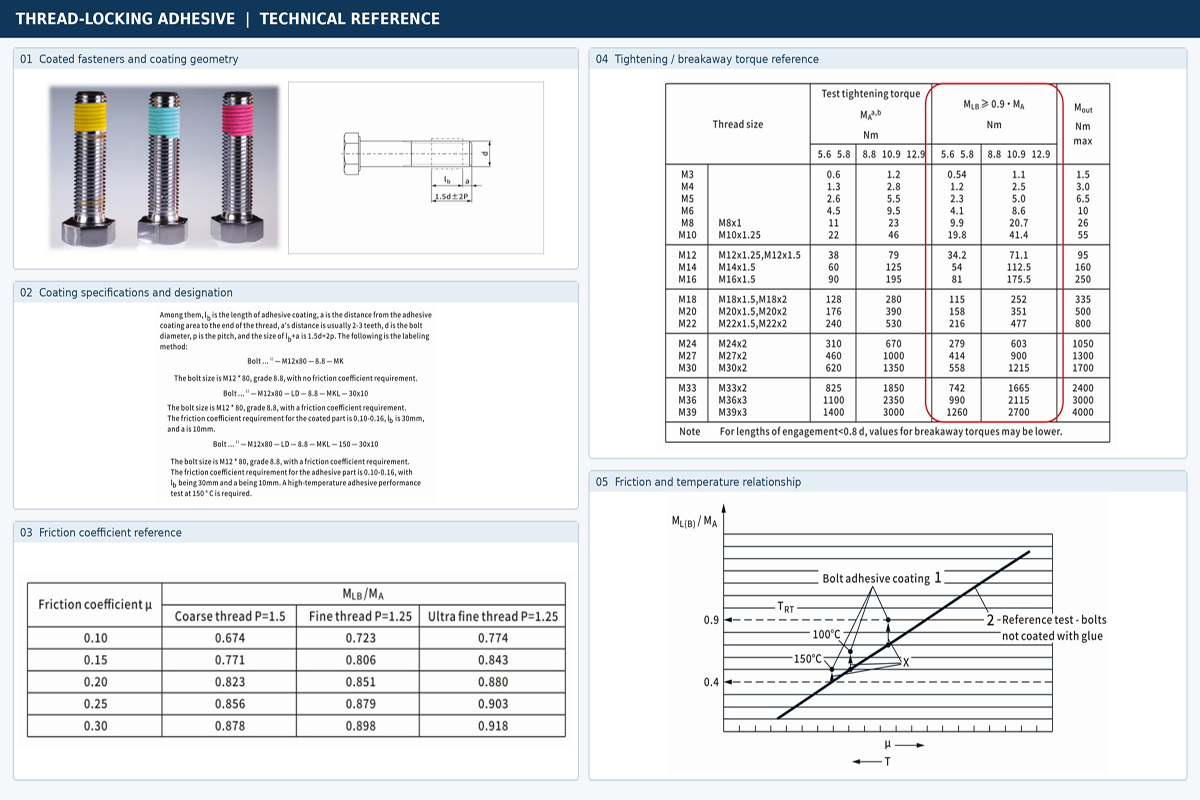
Threadlocker Coating Length and Position: How Engineers Should Specify Them
The effectiveness of a pre-applied adhesive depends partly on where the coating is located and how much of the mating thread is covered.
The original engineering drawing may use the following dimensional symbols:
Lb: axial length of the adhesive-coated region
A: distance from the thread end to the start of the coated region
d: nominal external thread diameter
p: thread pitch
These dimensions are useful for describing the coating geometry.
However, there is no universal coating length or position suitable for every threadlocker formulation and joint.
Coating Length, Lb
The coating should engage an appropriate portion of the mating internal thread during final installation.
A coating region that is too short may not develop the required locking performance.
An unnecessarily long coating region may increase installation resistance, material consumption or interference with the intended assembly process.
Distance from Thread End, A
The distance between the bolt tip and the start of the coating can influence initial thread engagement, coating activation and final coating position.
The original article referenced a distance of two to three thread pitches.
This may be a product-specific design reference, but it should not be presented as a universal requirement.
Nominal Diameter, d
Thread diameter influences the geometry and available contact region.
It does not independently determine the correct adhesive coverage.
Thread Pitch, p
Pitch affects thread geometry and the relationship between axial engagement length and the number of engaged thread turns.
Engineering Recommendation
Define the coating start position, axial length, coverage and dimensional tolerances on the approved drawing or coating specification.
The selected values should be based on the adhesive supplier's requirements and validated assembly performance.
Why Universal Coating Ratios Can Lead to Incorrect Specifications
Some technical references use simplified coating-length ratios or example dimensions for particular fasteners.
For instance, a proposed coating length may be expressed as a multiple of nominal diameter.
Such relationships may be useful within a defined product system, but they cannot establish universal performance.
The required coating geometry also depends on:
Adhesive formulation and application process
External and internal thread tolerances
Thread engagement length
Surface coating and lubrication
Installation speed and torque
Required breakaway or removal torque
Cure conditions and service environment
Illustrative M12 × 80 Bolt
Consider a metric M12 × 80 property class 8.8 bolt.
Before specifying the adhesive-coated region, the engineer must establish the actual thread pitch, threaded length, mating component and installed position.
The nominal bolt dimensions alone are insufficient to justify a specific adhesive length or location.
A coating length of 30 mm, for example, should not be accepted solely because the bolt is M12 × 80.
It must be supported by the coating specification and the required functional tests.
A Common Blind-Hole Design Error
A screw may carry an adhesive patch that remains partly outside the tapped hole after tightening.
In that condition, the actual adhesive contact length can be substantially less than the nominal coated length.
Practical Design Rule
Evaluate the adhesive's final position after installation, not only its position on the uninstalled fastener.
Breakaway Torque, Prevailing Torque and Loosening Resistance
Thread locking performance is often evaluated using torque measurements.
However, several torque characteristics must be distinguished.
Tightening Torque
Tightening torque is the torque applied during installation.
It is influenced by thread friction, bearing friction and the process of generating bolt preload.
Breakaway Torque
Breakaway torque generally refers to the torque needed to initiate rotation during a specified removal test.
The result depends on the test method, joint condition, preload, adhesive and environmental history.
Prevailing Torque
Prevailing torque is rotational resistance associated with a locking feature under defined conditions.
It is not equivalent to the clamp force produced by tightening.
Removal Torque After Breakaway
Once initial rotation begins, the torque required to continue removal may differ from the initial breakaway value.
This distinction can matter when assessing adhesive locking behavior.
Why Torque Definitions Matter
A supplier may report a high breakaway torque while another reports prevailing torque measured over a defined angular interval.
These results cannot be compared directly unless the test methods and conditions are equivalent.
Engineering Recommendation
For an OEM specification, define the measurement method, conditioning time, test temperature, mating components and acceptance limits.
Is the Breakaway-to-Tightening Torque Ratio a Reliable Locking Metric?
Some technical evaluations compare loosening torque with tightening torque using a ratio such as:
R = ML / MA
Where:
ML = loosening torque measured under a defined procedure
MA = applied tightening torque
This ratio can provide comparative information within a controlled test program.
However, it should not be treated as a universal measure of locking efficiency.
Why the Ratio Can Be Misleading
Tightening torque is strongly influenced by friction and the clamp force generated during installation.
Loosening torque may also include contributions from preload, friction and the adhesive bond.
As a result, two assemblies with different friction conditions may show different ratios even when their adhesive performance is similar.
Likewise, a higher ratio does not necessarily prove superior resistance to vibration-induced self-loosening.
Original Example Values
The original article referenced an M10 test condition with a friction coefficient of approximately 0.15 and a loosening-to-tightening torque ratio near 0.77.
Without the complete test method, adhesive specification, conditioning conditions and supporting data, that figure cannot be treated as a general benchmark.
Relevant Specification
DIN 267-27 is associated with screw locking features and related requirements.
Its applicability must be checked against the specific product, locking system and relevant edition.
It should not be interpreted as establishing one universal loosening torque ratio for all pre-applied adhesive fasteners.
Engineering Recommendation
Use product-specific test requirements and distinguish comparative laboratory results from validated performance in the intended OEM joint.
Vibration Resistance: Why Breakaway Torque Is Not Enough
A threaded joint can lose preload without the bolt immediately rotating.
Embedment, relaxation, thermal effects and deformation of clamped components can reduce clamp force.
Rotational self-loosening may occur when loading conditions produce sufficient relative movement in the joint.
A threadlocker can add resistance to rotation, but its effectiveness depends on the actual joint conditions.
Transverse Vibration
Repeated transverse displacement can promote self-loosening in susceptible joints.
A locking adhesive may help resist rotation, but the complete joint must still be designed for the imposed loading.
Axial Loading
External axial loading changes the force distribution between the bolt and clamped components.
The adhesive does not eliminate the need for appropriate preload and strength calculations.
Thermal Cycling
Different thermal expansion characteristics can alter joint forces and influence the adhesive environment.
Recommended Validation Approach
For demanding applications, consider a test program that evaluates:
Initial tightening and achieved clamp force
Adhesive curing or conditioning
Vibration exposure under representative conditions
Residual clamp force or loosening behavior
Breakaway and removal torque
Physical condition after testing
Test conditions and acceptance criteria must be defined for the actual joint.
High-Temperature Performance of Thread Locking Adhesives
Adhesive performance depends on temperature and exposure duration.
At elevated temperatures, some formulations may experience reduced mechanical strength, altered removal torque or accelerated degradation.
However, the behavior varies significantly by chemistry.
Automotive Engine Compartments
Fasteners may experience elevated operating temperatures and thermal cycling.
The adhesive must be selected for the actual temperature profile and required service life.
HVAC and Industrial Equipment
Equipment exposed to repeated heating and cooling may require evaluation of both adhesive performance and joint preload retention.
Electrical and Power Equipment
Temperature exposure may arise from ambient conditions or equipment operation.
The fastener design must account for the actual service environment.
How to Evaluate Temperature Resistance
A suitable qualification plan should define:
Maximum and minimum service temperatures
Exposure duration
Thermal cycling conditions
Cure or conditioning requirements
Post-exposure removal torque
Relevant joint performance criteria
The original article suggested testing at 150°C.
That temperature can be used only as an illustrative test condition unless it matches the actual adhesive specification or OEM requirement.
A product should not be described as suitable for continuous 150°C operation merely because it completed a short laboratory exposure.
Engineering Recommendation
Select the adhesive using verified temperature capability and application-specific testing rather than relying on a generic high-temperature claim.
Oil, Grease and Surface Coating Compatibility
Surface condition is a major variable in adhesive locking performance.
Potentially relevant substances include:
Manufacturing oils
Rust-preventive compounds
Grease
Lubricating coatings
Cleaning residues
Plating passivation layers
Other surface treatments
Some adhesives are formulated to tolerate particular surface conditions.
Others require more restrictive cleaning or preparation.
Why Oil Contamination Matters
Oil or grease can interfere with adhesive contact, activation or curing for certain formulations.
The effect depends on the chemistry and contamination level.
Why Lubrication Cannot Simply Be Removed
Changing lubrication may also change the torque–preload relationship.
Removing or adding a lubricant without reviewing the tightening specification can create a different joint performance problem.
Correct Manufacturing Sequence
The coating and surface treatment sequence must follow the validated process for the specific adhesive system.
For many pre-applied locking fasteners, the metallic surface treatment is completed before the adhesive coating is applied.
Other formulations may require different preparation or processing steps.
There is no universal requirement to apply the locking adhesive first and then complete plating or lubrication.
Production Recommendation
The approved manufacturing and assembly specification should define the surface condition before coating, any permitted lubricants and the required curing or conditioning procedure.
Coating Length Too Short: Failure Mechanisms and Corrective Actions
Insufficient adhesive coverage can reduce the available bonded thread area.
However, a longer coating is not automatically better.
Possible Problems With Short Coverage
Too few coated threads engage the mating component
Coating is positioned outside the functional engagement region
Adhesive volume is insufficient for the intended design
Coverage becomes inconsistent because of application tolerances
Possible Problems With Excessive Coverage
Increased installation resistance
Interference with assembly
Unnecessary coating consumption
Greater sensitivity to coating thickness variation
Difficulties with disassembly or maintenance
Practical Corrective Actions
Review the installed engagement geometry, coating location, adhesive formulation and actual test results.
A universal minimum coating length such as 0.8 times the bolt diameter should not be used without validation for the specified locking system.
Production-Line Benefits of Pre-Applied Thread Locking Screws
Pre-applied adhesive locking fasteners can offer advantages over manually dispensed liquid threadlockers.
The actual benefit depends on the coating process and production requirements.
Reduced Assembly Operations
A pre-coated fastener may eliminate the need for adhesive dispensing at the assembly station.
This can simplify work instructions and reduce the number of manual steps.
Controlled Coating Geometry
A specified pre-applied coating can provide defined coverage and location.
However, coating uniformity and performance still require appropriate process control.
Cleaner Assembly
Pre-applied systems may reduce handling of liquid adhesive during installation.
Automated Screw Feeding
Fasteners intended for automatic feeding must be evaluated for coating durability, handling and compatibility with the feeding system.
Reduced Process Variation
A qualified pre-applied coating may reduce some variation associated with manual adhesive application.
It does not eliminate variation caused by threads, surface friction, tightening equipment or mating components.
Production Manager's Checklist
Before releasing a pre-coated screw to volume production, verify:
Correct fastener identification
Coating location and visual condition
Storage and shelf-life requirements
Automatic feeding compatibility
Installation torque or torque-angle behavior
Required cure time before downstream testing
Rework and replacement instructions
Thread Locking Adhesive Fasteners for Automotive OEM Applications
Automotive assemblies may include threaded joints exposed to vibration, thermal cycling and repeated operating loads.
Potential applications include selected engine-related components, brackets, housings and body assemblies.
Pre-applied locking screws may be considered where the OEM joint design calls for additional rotational locking resistance.
Engineering Considerations
The design must address joint preload, temperature, thread material, coating compatibility and serviceability.
Supplier Qualification
Automotive projects may require customer-specific documentation and validation.
The use of a locking adhesive does not itself establish approval for a safety-critical automotive connection.
EV Battery Pack and Battery Enclosure Fasteners
EV battery equipment may use bolts and screws in aluminum housings, brackets, cooling-related components and enclosure assemblies.
Pre-applied locking systems may be relevant to selected joints, subject to electrical, thermal, mechanical and maintenance requirements.
Aluminum Threaded Components
Internal thread strength must be checked independently of adhesive locking performance.
Sealing Requirements
Thread locking and thread sealing are different functions.
A locking adhesive should not be assumed to provide a qualified fluid or environmental seal unless that function is specifically supported by the product specification and validation.
Serviceability
Battery enclosure designs may require future removal.
The selected adhesive strength and removal procedure must be compatible with the approved maintenance strategy.
Rail Transportation and Other Vibration-Sensitive Equipment
Rail applications may impose demanding vibration, fatigue and inspection requirements.
Any locking adhesive used in such equipment must satisfy the applicable design and qualification specifications.
A general-purpose pre-applied threadlocker is not automatically qualified for rail service.
Aerospace and Medical Equipment
These sectors may require specialized product approvals, traceability and documented performance verification.
Material selection or adhesive strength alone does not establish suitability.
Electrical Cabinets and Sheet Metal Assemblies
Electrical cabinets, industrial control equipment and sheet metal enclosures frequently use removable screws and threaded components.
Potential mating components include:
Weld nuts
Rivet nuts
Self-clinching nuts
Tapped brackets
Threaded inserts
Pre-applied locking screws may be considered for selected joints exposed to vibration or repeated equipment operation.
Important Distinction
The retention of a rivet nut or self-clinching nut in sheet metal is a separate design issue from the rotational locking performance of the screw.
Both functions must be evaluated.
Machinery, Robotics and Industrial Automation
Industrial machinery may experience repeated dynamic loads, vibration and maintenance operations.
A pre-applied locking screw may simplify installation in selected assemblies.
However, the adhesive must be compatible with the joint's service temperature, operating environment and maintenance requirements.
For equipment requiring frequent disassembly, a reusable mechanical locking system may be more suitable than a single-use adhesive locking arrangement.
Pre-Applied Adhesive Versus Mechanical Locking: Selection Tradeoffs
| Selection factor | Pre-applied reactive adhesive | Prevailing-torque nut or polymer patch | Other mechanical locking method |
|---|---|---|---|
| Locking mechanism | Adhesive bond after activation or cure | Interference-based rotational resistance | Depends on specific design |
| Assembly process | Pre-coated component installed directly | Locking feature engages during installation | May require additional components |
| Cure time | May be required | Generally no adhesive cure | Generally no adhesive cure |
| Reuse | Product-specific; cured adhesive often disrupted | Depends on validated reuse performance | Depends on design |
| Temperature capability | Formulation-dependent | Material and design-dependent | Material and design-dependent |
| Maintenance | Removal and renewal procedure required | May permit defined reuse | Depends on locking mechanism |
| OEM qualification | Adhesive, coating and joint validation | Prevailing-torque and joint validation | Functional joint validation |
Selection Principle
Choose the locking method according to the required joint function, environment, assembly process and maintenance strategy.
Do not select solely on the basis of the highest reported removal torque.
Relevant International Standards and Test Methods
The appropriate standards depend on the locking technology and fastener design.
DIN 267-27
May be relevant to specified screw locking features and associated performance requirements.
The applicable edition, product type and test method must be confirmed.
ISO 16047
Provides a framework for torque–clamp force testing of threaded fasteners within its scope.
It can support evaluation of how a locking coating affects tightening behavior and friction-related performance.
ISO 898-1
Defines mechanical property requirements for applicable carbon and alloy steel bolts, screws and studs.
The addition of adhesive does not replace the underlying fastener's mechanical property requirements.
ISO Metric Thread Standards
Relevant metric thread specifications may include ISO 68-1, ISO 724 and ISO 965, depending on the design.
Metric and Inch Thread Compatibility
Metric, UNC/UNF and BSW/BSF thread systems must be specified separately.
An approximate inch conversion of a metric dimension does not establish interchangeability.
The actual external and internal thread specifications must match.
OEM Qualification Plan for Pre-Applied Thread Locking Fasteners
A useful qualification plan connects the coating design with actual assembly performance.
| Evaluation | Engineering purpose |
|---|---|
| Coating location and length | Confirm correct engagement position |
| Coating coverage and condition | Evaluate consistency of applied material |
| Thread fit and installation | Identify interference or abnormal assembly |
| Tightening torque and clamp force | Assess installation behavior |
| Cure or conditioning time | Confirm required adhesive development |
| Breakaway torque | Evaluate initial removal resistance |
| Removal torque after rotation | Characterize continued resistance |
| Vibration testing | Evaluate relevant self-loosening behavior |
| Temperature exposure | Assess environmental suitability |
| Oil or surface compatibility | Confirm substrate and process conditions |
| Storage and shelf life | Support production inventory control |
| Removal and reinstallation | Establish maintenance requirements |
The test sequence, sample size, acceptance limits and environmental conditions must be defined for the specific product.
Failure Analysis: When a Threadlocker Does Not Prevent Loosening
If a pre-applied adhesive locking screw loosens during service, the investigation should distinguish between adhesive failure and other joint mechanisms.
Possible Adhesive-Related Causes
Incorrect coating formulation
Insufficient coating coverage
Coating outside the effective engagement region
Inadequate curing or conditioning
Incompatible surface contamination
Temperature beyond the validated capability
Possible Joint-Related Causes
Insufficient initial preload
Joint settlement or relaxation
Inadequate thread engagement
Mating thread damage
Excessive transverse movement
Incorrect tightening procedure
Practical Troubleshooting Sequence
First confirm the installed fastener and coating specification.
Then review tightening records, mating thread condition, cure conditions and service environment.
Finally, evaluate whether the observed failure involved rotational loosening, preload loss without rotation or another mechanical failure.
Information Gain: The Difference Between Coating Qualification and Joint Qualification
A common OEM sourcing mistake is to approve a threadlocker solely because it achieves a specified breakaway torque in a laboratory test.
That result establishes only part of the required performance.
A coating can meet its laboratory removal-torque target while the final joint remains vulnerable to insufficient preload, relaxation or transverse slip.
Conversely, a joint with appropriate preload and geometry may perform satisfactorily with a lower locking torque than another application requires.
Therefore, OEM qualification should have two levels:
Level 1 — Coated Fastener Qualification
Verify the coating type, dimensions, application consistency, storage requirements and specified locking performance.
Level 2 — Installed Joint Qualification
Verify the actual assembly using the mating components, tightening procedure, operating environment and functional load conditions.
This distinction is particularly important when transferring an approved locking screw to a new product platform.
The same fastener may behave differently in a steel nut, aluminum tapped hole or coated threaded insert.
OEM Purchasing and Supplier Development Considerations
For purchasing teams, pre-applied locking screws should be specified as complete engineered components.
A description such as M8 × 25 bolt with blue threadlocker may be insufficient.
The RFQ should identify the base fastener and locking coating separately.
Base Fastener Requirements
Confirm the head style, product standard, thread, length, material, property class and surface treatment.
Coating Requirements
Specify the locking technology, coating region, performance requirements and any relevant storage or curing conditions.
Supplier Substitution
A substitute adhesive or coating process should not be approved solely because it has a similar color or nominal removal torque.
Changes may affect installation torque, cure time, temperature capability and serviceability.
Cost Evaluation
Pre-applied locking may reduce assembly operations, but the total cost should include coating qualification, handling, storage, inspection, replacement and maintenance.
OEM RFQ Checklist for Pre-Applied Thread Locking Screws
| RFQ requirement | Information to provide |
|---|---|
| Fastener drawing | Drawing number and revision |
| Fastener type | Bolt, screw or stud |
| Thread | Diameter, pitch and tolerance |
| Dimensions | Length, head geometry and threaded length |
| Material | Required grade or specification |
| Surface treatment | Plating, coating and lubrication condition |
| Locking technology | Microencapsulated adhesive, polymer patch or specified system |
| Coating position | Distance from thread end |
| Coating length | Axial coverage and tolerance |
| Mating component | Nut, tapped hole or threaded insert |
| Assembly process | Tightening method and required preload |
| Locking performance | Defined breakaway or removal torque criteria |
| Environmental conditions | Temperature, vibration, fluids and corrosion |
| Storage requirements | Shelf life and handling conditions |
| Maintenance | Removal and replacement requirements |
| Quality requirements | Inspection and validation documentation |
| Commercial information | Samples, annual demand, MOQ, packaging and delivery |
Frequently Asked Questions
What is a pre-applied thread locking screw?
It is a screw supplied with a locking material already applied to a specified thread region before final assembly.
How does microencapsulated threadlocker work?
In suitable systems, installation activates reactive components within the coating, allowing an adhesive bond to develop between mating threads.
Does pre-applied threadlocker prevent all bolt loosening?
No. It can increase resistance to unintended rotation but does not eliminate preload loss, joint separation or other design-related failure mechanisms.
How long should the adhesive patch be?
The required length depends on the formulation, thread geometry, engagement, performance requirements and validated coating specification.
Is a coating length of 0.8 times bolt diameter always sufficient?
No. Such a ratio is not a universal qualification criterion.
Does a high breakaway torque prove vibration resistance?
No. Breakaway torque and vibration resistance measure different aspects of fastening performance.
Can pre-applied adhesive locking screws be reused?
It depends on the technology and approved procedure. Cured adhesive bonds are commonly disrupted during removal,
while some polymer-patch products are designed for defined repeated use.
Can threadlocker be applied to plated bolts?
Potentially, provided the adhesive system is compatible with the surface treatment and the process has been validated.
Is a threadlocker also a thread sealant?
Not necessarily. Sealing performance must be separately specified and verified.
Can Juxin Fasteners supply custom pre-applied locking bolts?
Juxin Fasteners welcomes drawing-based inquiries for suitable locking fastener configurations.
Coating technology, performance, production feasibility and commercial conditions require confirmation.
Juxin Fasteners: OEM Thread Locking Screws and Custom Fastening Solutions
Juxin Fasteners supplies industrial bolts, screws, nuts and drawing-specific fastening components for OEM manufacturing applications.
For projects requiring pre-applied thread locking features, the technical review should address the base fastener,
coating technology, application geometry and functional performance requirements.
Relevant inquiries may include:
Pre-applied thread locking screws
Microencapsulated adhesive locking bolts
Thread locking flange bolts
Socket head screws with specified locking features
Automotive and EV assembly fasteners
Industrial machinery locking screws
Custom bolts and screws with drawing-defined coating requirements
Exact coating availability, dimensions, testing arrangements, MOQ and delivery schedules are subject to technical and commercial confirmation.
Request Pre-Applied Thread Locking Fasteners and OEM Quotations
Are you developing or sourcing pre-applied adhesive locking bolts, microencapsulated threadlocker screws,
vibration-resistant threaded fasteners or custom OEM locking screws?
Juxin Fasteners welcomes inquiries from design engineers, mechanical engineers, manufacturing engineers, production managers,
purchasing specialists, procurement managers and supplier development teams.
For technical review and quotation, please provide:
Fastener drawing and revision + thread designation + material and property class + surface treatment + locking technology
+ coating length and location + mating component + tightening procedure + locking performance requirements
+ service environment + prototype quantity + annual demand + packaging + target delivery schedule.
Company: Juxin Fasteners
Website: https://www.juxinfasteners.com/
Email: info@juxinfasteners.com
Send your drawings and pre-applied thread locking fastener RFQ to Juxin Fasteners for technical confirmation and quotation.
Contact Us
Tel.:
+86 020 8621 0320
+86 020 3121 6067
E-mail:
Technical Support:
Navigation
SEND INQUIREY



