
Call Us
+86 136 6007 9809
Call Us
+86 136 6007 9809

Jul. 11, 2023
Thumb wing nuts, commonly called wing nuts or butterfly nuts, are designed for applications where a threaded connection needs to be installed, adjusted,
or removed by hand without a conventional wrench or socket.
The extended wings provide a gripping surface that allows an operator to rotate the nut manually.
This makes wing nuts particularly useful for removable covers, access panels, fixtures, equipment adjustments, laboratory and electronic equipment, industrial machinery,
and applications requiring frequent maintenance access.
However, a wing nut is not simply a conventional hex nut with two wings added.
The wing geometry, material, thread specification, internal thread quality, installation environment, required clamping force, vibration level,
and frequency of removal all influence whether a wing nut is appropriate for the application.
Metal wing nuts can provide a robust reusable fastening solution, while nylon and other engineering-plastic wing nuts can offer advantages in weight, electrical insulation, corrosion resistance, and operator handling.
JUXIN FASTENERS supplies metal and plastic fastening components for industrial and OEM applications, including customer-specified wing nuts and related threaded hardware.
With more than 20 years of fastener experience, JUXIN FASTENERS supports requirements involving material selection, thread specifications, dimensions, surface treatments, inspection, packaging, and production quantities.
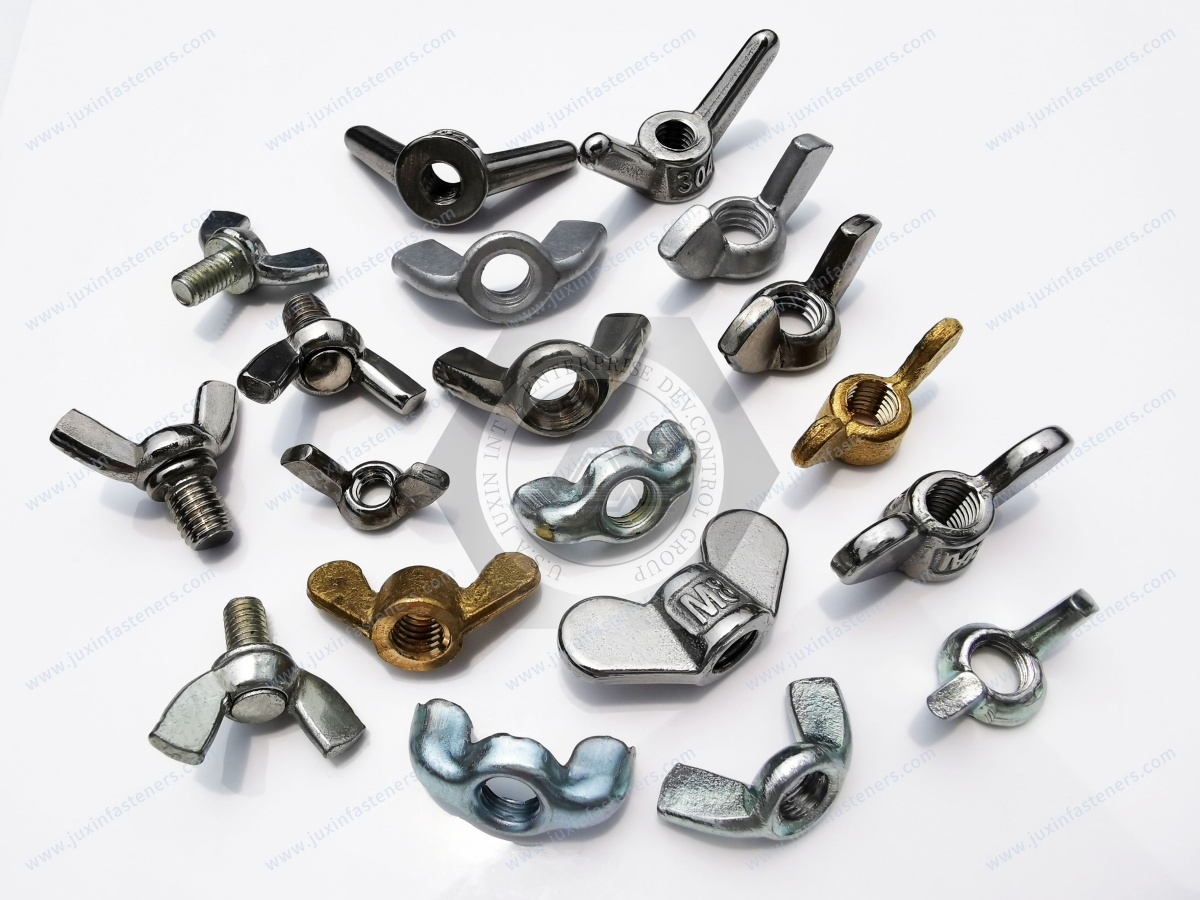
A thumb wing nut is a threaded nut with one or more extended external wings that provide a surface for manual tightening and loosening.
The primary advantage is tool-free installation.
Instead of requiring a wrench, the operator can grip the wings and rotate the nut directly.
Typical applications include:
Removable machine covers
Electrical enclosure panels
Equipment access doors
Laboratory equipment
Electronic equipment
Fixtures and jigs
Inspection covers
Adjustable brackets
Lighting equipment
Industrial machinery
Maintenance panels
Consumer and commercial equipment
The suitability of a wing nut depends on the required clamping force and service conditions.
A wing nut should not automatically replace a standard hex nut in a structural or highly loaded joint simply because it is easier to operate.
The terms wing nut and butterfly nut are frequently used interchangeably.
In general industrial search terminology, both terms can refer to a manually operated nut with wing-shaped projections.
Other related terms include:
Thumb wing nut
Wing nut
Butterfly nut
Butterfly fastener
Hand-tightened nut
Hand-operated nut
Plastic wing nut
Metal wing nut
The actual geometry can vary considerably between manufacturers.
For procurement, the drawing, standard, dimensions, material, and thread specification should therefore take priority over the product name.
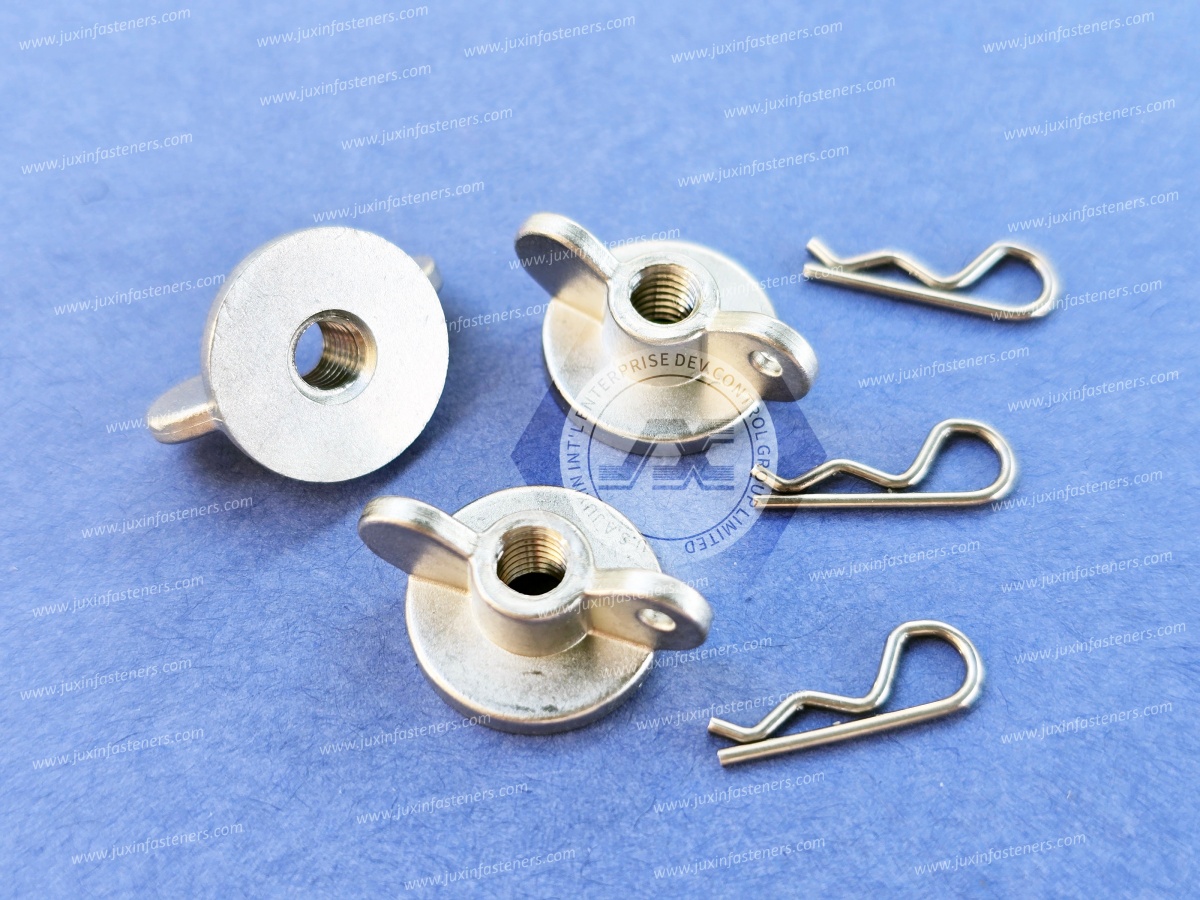
Wing nuts are most useful when the fastening system needs frequent manual access.
Typical reasons for choosing a wing nut include:
Tool-free installation
Tool-free removal
Frequent panel access
Manual adjustment
Short maintenance cycles
Limited tool access
Field service requirements
Temporary fixtures
Adjustable equipment
A wing nut can be especially convenient when a technician needs to remove a cover repeatedly during inspection or maintenance.
However, if a joint requires precisely controlled preload, high tightening torque, or a high level of resistance to loosening under severe dynamic loads, another fastener configuration may be more appropriate.
One of the most important design distinctions is that manual tightening is not the same as controlled torque tightening.
A hex nut installed with a calibrated tool can be associated with a defined tightening procedure.
A hand-tightened wing nut normally relies on operator-applied force.
The resulting clamping force can vary with:
Operator strength
Wing geometry
Nut material
Thread friction
Surface treatment
Lubrication
Thread condition
Assembly technique
Repeated installation
Therefore, wing nuts are particularly appropriate where the application can tolerate variation in manual clamping force.
For joints requiring a tightly controlled preload, a standard bolted assembly with a defined tightening procedure may be more appropriate.
This distinction is important when engineers consider replacing a conventional hex nut with a wing nut.
DIN 315 is a commonly referenced standard for wing nuts.
It provides dimensional definitions for specific wing-nut configurations.
For a standard product, specifying DIN 315 can help establish the basic geometry.
However, a complete RFQ may still need to define:
Thread size
Thread pitch
Material
Surface treatment
Thread tolerance
Quantity
Packaging
Inspection requirements
For custom wing nuts that do not correspond to the standard geometry, the customer drawing should control the final product dimensions.
Wing nuts can be produced for different thread systems depending on the application and market.
Metric applications may use ISO metric threads.
Inch-thread applications may use Unified Thread Standard configurations covered by applicable ASME standards, including ASME B1.1 where relevant.
For example, an RFQ may specify:
M6 × 1.0
or:
1/4-20 UNC
The supplier should not infer the thread system only from the outside diameter.
The complete thread designation should be provided whenever possible.
The internal thread tolerance influences how smoothly the wing nut runs onto the mating bolt or stud.
For metric threads, tolerance classes such as 6H may be used where applicable.
For Unified inch threads, the appropriate class should be defined according to the applicable thread standard.
The correct tolerance should be selected based on:
Mating bolt specification
Assembly method
Required fit
Coating thickness
Operating environment
Production requirements
A generic statement such as “all wing nuts use 6H” is not appropriate for every product configuration.
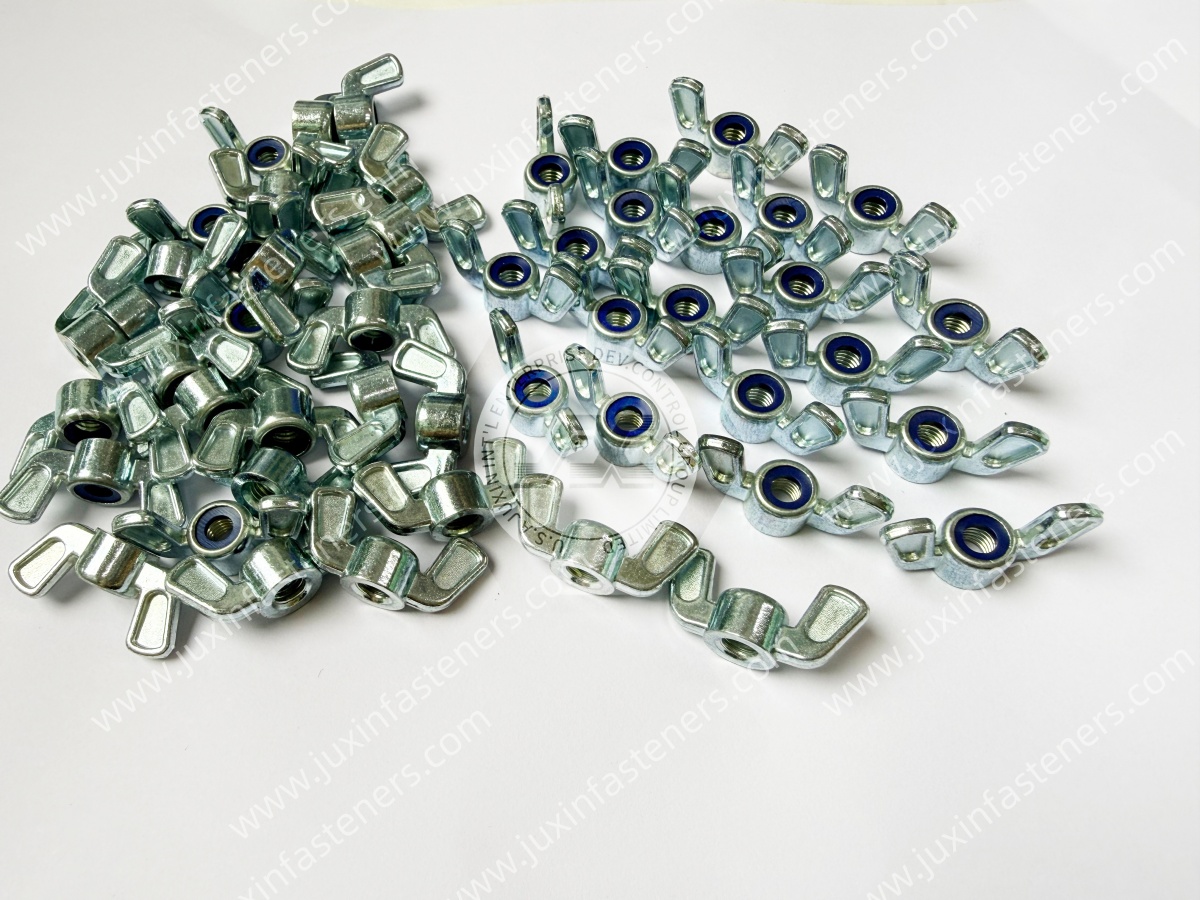
Metal wing nuts are commonly selected when the application requires higher mechanical robustness, repeated assembly, or resistance to handling damage.
Potential materials include:
Carbon steel
Alloy steel
Stainless steel
Brass
Bronze
Other customer-specified alloys
The material should be selected according to the actual application.
Carbon steel provides a practical solution for many general industrial applications.
A surface treatment may be applied where corrosion protection is required.
Possible finishes include:
Zinc plating
Trivalent zinc systems
Zinc-nickel coatings
Zinc-flake systems
Black finishes
Other customer-specified coatings
Stainless steel wing nuts are often considered where corrosion resistance and appearance are important.
Austenitic stainless steel families such as A2 and A4 may be specified under applicable ISO 3506 requirements.
The actual grade should be selected according to the environment and mechanical requirements.
Stainless steel should not automatically be described as suitable for every marine, chemical, or medical application without evaluating the actual environment.
Brass wing nuts can be considered when appearance, electrical characteristics, corrosion behavior, or material compatibility make brass appropriate.
The exact brass alloy should be defined when material performance is important.
Bronze and other copper alloys may be considered for specialized applications.
Where a particular alloy is required, the exact material designation should be included in the drawing or purchasing specification.
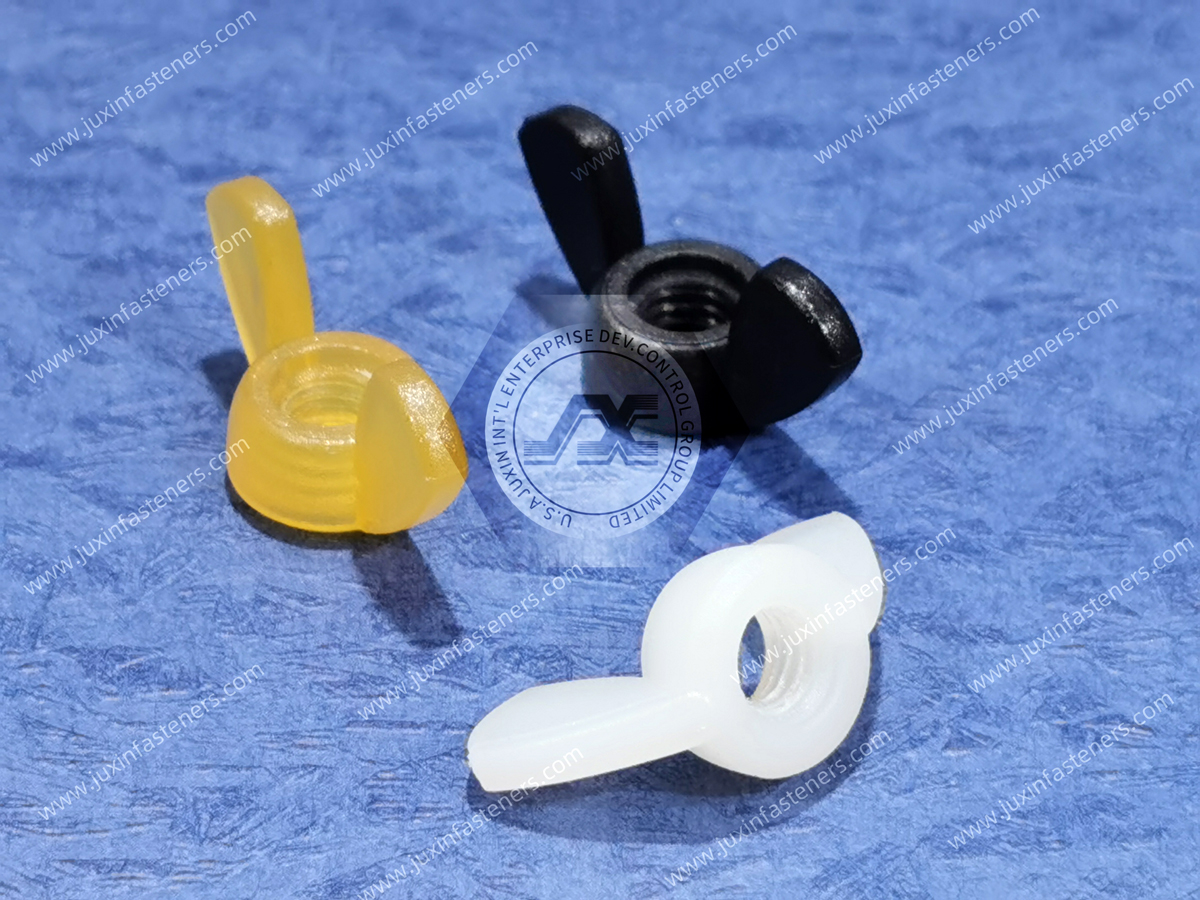
Plastic wing nuts provide a different set of engineering characteristics from metal wing nuts.
Potential advantages can include:
Low weight
Electrical insulation
Corrosion resistance
Non-metallic contact
Ease of manual handling
Reduced risk of scratching adjacent surfaces
Compatibility with certain electronic assemblies
Potential engineering plastics include:
PA6
PA66
Glass-filled PA66
POM
PVDF
PEEK
Other customer-specified engineering plastics
The appropriate material depends on the temperature, chemical environment, mechanical load, electrical requirements, dimensional stability, and expected service life.
The material should not be selected based only on the word “nylon.”
Glass-filled PA66 can provide higher stiffness and dimensional stability than unfilled nylon in suitable applications.
The addition of glass fiber can change:
Tensile modulus
Stiffness
Creep behavior
Dimensional stability
Thermal behavior
Impact characteristics
However, the exact performance depends on the specific resin grade and reinforcement level.
Therefore, a specification such as “PA66 + 30% glass fiber” should only be used when that exact material grade is required and available.
It should not be assumed that every plastic wing nut uses this material.
One of the most important differences between plastic and metal wing nuts is long-term deformation under load.
Engineering plastics can exhibit creep when continuously exposed to:
Mechanical stress
Elevated temperature
Long-duration clamping
Environmental conditions
This means a plastic wing nut that performs well during initial assembly may behave differently after prolonged loading.
For applications requiring continuous clamping force, engineers should consider:
Material grade
Temperature
Initial tightening force
Joint geometry
Duration of loading
Chemical environment
Required retention performance
This is an important reason to select engineering plastic by application rather than treating all nylon as equivalent.
Plastic wing nuts can be useful where electrical insulation or non-metallic contact is required.
Potential applications include:
Electrical cabinets
Electronic enclosures
PCB-related equipment
Instrumentation
Communication equipment
Test equipment
Control panels
Low-voltage equipment
Sensor assemblies
However, plastic should not automatically be described as an EMI-shielding solution.
If electromagnetic shielding is required, the overall enclosure and grounding design must be evaluated separately.
Plastic materials can offer useful corrosion resistance because they do not undergo metallic red-rust corrosion.
However, outdoor suitability depends on the polymer and environment.
Important factors include:
UV exposure
Temperature
Moisture
Chemicals
Mechanical loading
Creep
Impact
Weathering
A generic “nylon wing nut” should therefore not automatically be treated as suitable for all outdoor applications.
The resin grade and application environment should be matched.
The choice between metal and plastic should be based on the functional requirements.
| Requirement | Metal Wing Nut | Plastic / Nylon Wing Nut |
|---|---|---|
| Mechanical robustness | Generally higher | Application dependent |
| Weight | Higher | Lower |
| Electrical insulation | No | Yes, depending on material |
| Corrosion behavior | Depends on material/coating | No metallic red rust |
| Long-term creep | Generally lower | Material dependent |
| Surface protection | Coating may be required | Material dependent |
| Temperature capability | Material dependent | Material dependent |
| Manual handling | Good | Good |
| Decorative appearance | Broad finish options | Broad polymer options |
| High preload applications | More suitable when properly designed | Requires careful evaluation |
This table is a design comparison, not a universal performance ranking.
The wing geometry determines how easily an operator can grip and rotate the nut.
Important dimensions can include:
Wing length
Wing height
Wing thickness
Wing radius
Overall nut diameter
Clearance between wings
Edge geometry
For frequently serviced equipment, poor wing geometry can make the fastener uncomfortable to operate.
A well-designed wing nut should provide sufficient grip without creating unnecessarily sharp edges or excessive interference with surrounding components.
Increasing wing size can make a wing nut easier to grip, but larger wings can also create disadvantages.
Potential problems include:
Increased installation envelope
Interference with nearby components
Greater material consumption
Higher manufacturing cost
Increased risk of accidental impact
Reduced accessibility in confined spaces
The optimum wing geometry is therefore a balance between:
manual grip + available space + required tightening force + manufacturing feasibility + cost.
This is particularly important for compact equipment and high-density enclosures.
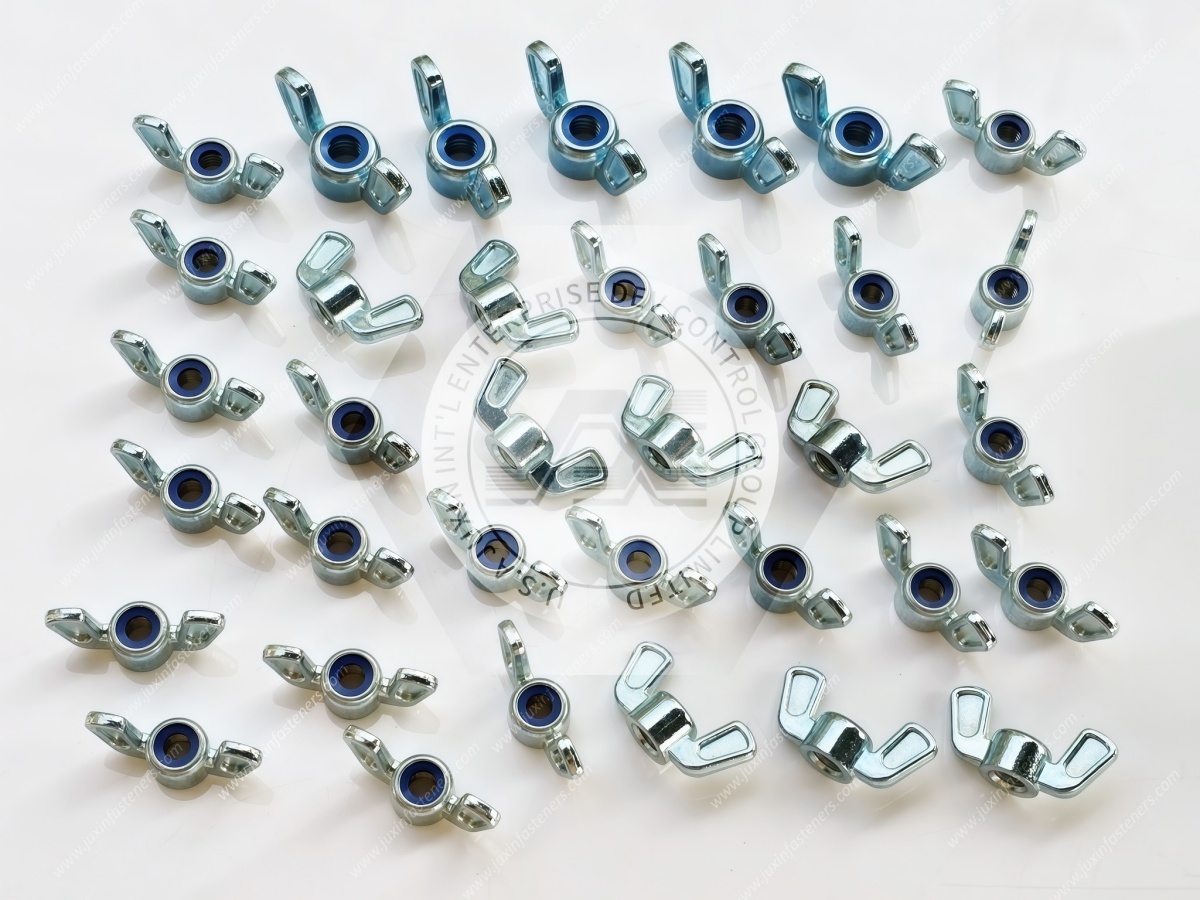
Metal wing nuts can be manufactured using different processes depending on geometry, material, quantity, and dimensional requirements.
Potential manufacturing processes include:
Cold forming
Stamping
Forging
Machining
Tapping
Secondary machining
Combination forming and machining
Cold forming can be advantageous for suitable high-volume geometries because material is formed rather than removed from a solid bar.
Machining can be more practical for:
Low-volume custom products
Complex geometries
Special materials
Prototypes
Customer-specific features
The manufacturing process should be selected based on the actual product rather than assuming that every wing nut requires one specific technology.
The transition between the wing and the central nut body is an important design area.
The wing root may experience local bending forces during repeated manual tightening.
The design should consider:
Wing thickness
Root radius
Material
Forming process
Required manual force
Number of installation cycles
Environmental temperature
A stronger metal material does not automatically eliminate a poor geometric design.
The wing shape and root transition must also be appropriate for the expected handling conditions.
Wing nuts are normally designed for manual operation.
However, “hand-tight” does not represent one universal torque value.
Actual manual torque varies significantly between operators.
Factors include:
Wing dimensions
Material
Operator grip
Thread friction
Surface finish
Lubrication
Nut diameter
Installation posture
Therefore, when a joint requires a repeatable and tightly controlled clamping force, the design team should evaluate whether a wing nut is the correct fastening method.
A standard wing nut should not automatically be considered vibration-resistant.
Vibration can cause threaded fasteners to lose preload depending on joint design, transverse movement, friction, and other conditions.
For vibration-prone applications, the design may require:
Prevailing-torque locking
Nylon-insert locking
All-metal locking
Thread-locking compound
Mechanical locking features
Improved joint design
A locking wing-nut configuration should be specified when the application requires it.
The exact locking mechanism should be compatible with temperature, chemical exposure, assembly cycles, and maintenance requirements.
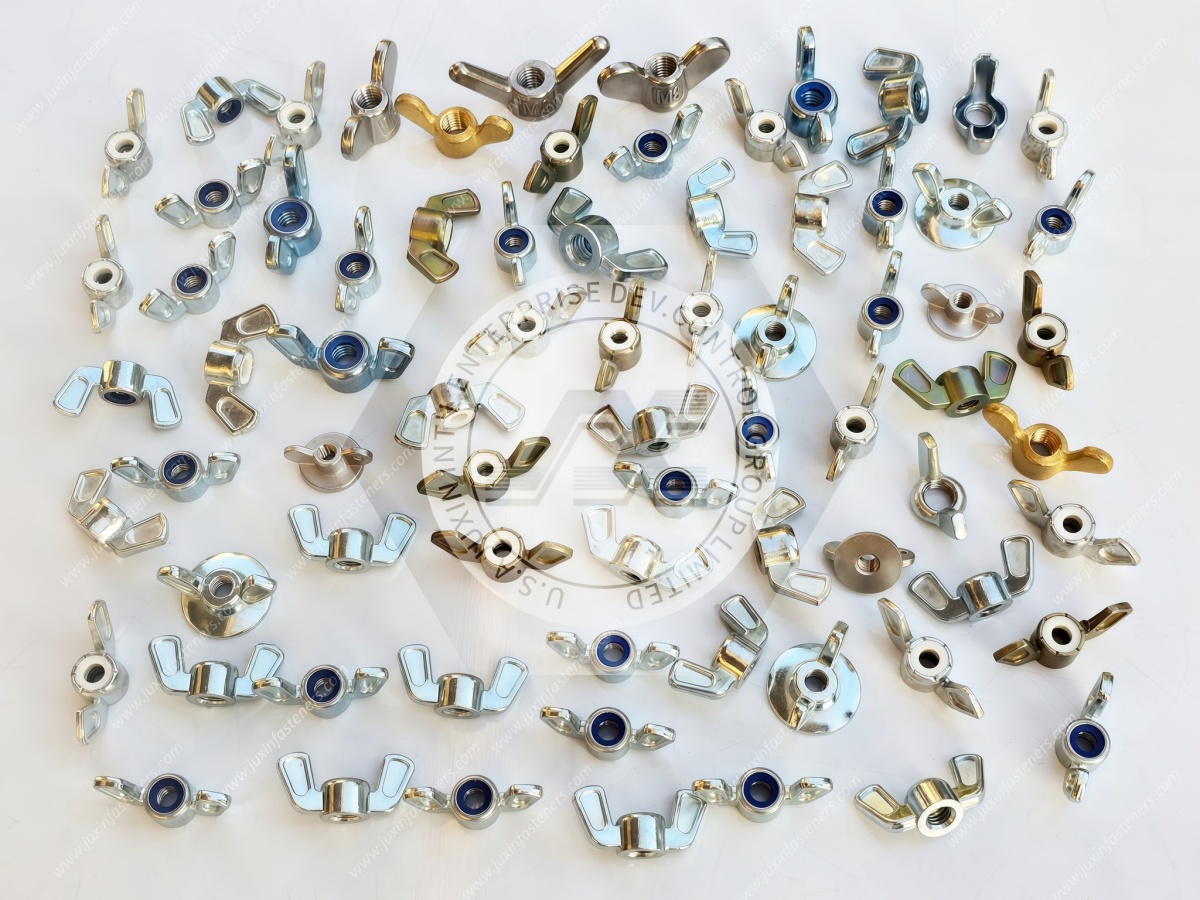
A nylon-insert wing nut combines manual operation with a prevailing-torque function.
The nylon insert creates additional resistance during thread engagement.
However, the performance of the locking feature depends on:
Insert material
Temperature
Thread condition
Installation cycles
Bolt material
Surface treatment
Applicable locking requirements
A nylon insert should therefore not be treated as a universal solution for every vibration environment.
For applications requiring defined prevailing torque, the applicable product and testing requirements should be specified.
The appropriate corrosion-protection method depends on the base material and environment.
Possible approaches include:
Stainless steel
Zinc plating
Zinc-nickel alloy
Zinc-flake coating
Other specified protective coatings
Outdoor applications should consider:
Humidity
Salt exposure
Condensation
Temperature
Chemicals
Cleaning agents
UV exposure where relevant to adjacent components
The correct coating should be selected based on the actual environment rather than simply choosing the most visually attractive finish.
ASTM B117 is a standard practice describing an apparatus and procedure for operating salt-spray testing.
It is important to understand that ASTM B117 is a test method, not a universal statement that a product is “corrosion resistant for 500 hours” or “1,000 hours.”
A salt-spray result is influenced by:
Test conditions
Coating system
Substrate
Coating thickness
Test specimen
Evaluation criteria
Customer specification
Therefore, corrosion claims should always identify the actual coating system and required test criteria.
A supplier should not claim that every black-coated wing nut automatically provides a specific number of hours of salt-spray resistance.
Coatings can change the effective dimensions of threaded components.
This is particularly important for:
Electroplated coatings
Zinc-nickel coatings
Zinc-flake systems
Decorative nickel/chrome systems
The coating specification should therefore be compatible with the thread tolerance and assembly requirement.
For critical production applications, the relationship between coating thickness, thread fit, and installation behavior should be evaluated before mass production.
Telecommunication cabinets and equipment frequently require maintenance access.
Wing nuts may be considered for:
Removable covers
Access panels
Internal brackets
Service fixtures
Equipment adjustment systems
Metal or plastic wing nuts can be selected depending on:
Electrical isolation
Mechanical requirements
Corrosion environment
Weight
Temperature
Maintenance frequency
For outdoor telecom equipment, the complete enclosure environment should be evaluated rather than relying on the fastener coating alone.
Electrical cabinets may use hand-operated fastening solutions for covers and removable components.
Potential benefits include:
Tool-free access
Faster maintenance
Reduced risk of lost tools
Simple manual adjustment
Plastic wing nuts may be useful where electrical insulation or non-metallic contact is desirable.
Metal wing nuts may be preferable where greater mechanical robustness is required.
The final choice should be based on the electrical and mechanical design of the enclosure.
Industrial machinery often requires access panels to be removed during maintenance.
Wing nuts can be useful when:
The panel is frequently removed
Tool-free access is desirable
The clamping load requirement is moderate
The operator can reach the fastener directly
For automated production equipment, engineers should also consider whether the wing geometry interferes with moving components, sensors, guards, or tooling.
Wing nuts can be considered for certain laboratory and equipment-access applications where frequent manual adjustment is useful.
Potential applications include:
Equipment covers
Adjustable fixtures
Laboratory hardware
Instrument housings
Service panels
However, using a wing nut in medical equipment does not by itself imply medical-device certification or regulatory approval.
The complete equipment, material selection, cleaning process, biocompatibility requirements where applicable, and customer regulatory framework must be considered separately.
Wing nuts can be considered for selected automotive or transportation equipment applications where manual access is important.
Possible uses include:
Service panels
Removable covers
Adjustable fixtures
Equipment brackets
Non-critical access hardware
For safety-critical joints, engineers should verify whether a manually tightened wing nut is appropriate.
A wing nut should not be substituted for a controlled bolted connection where the application requires a defined preload or highly controlled mechanical performance.
A production wing nut may require inspection of both the central threaded body and the external wing geometry.
Typical characteristics include:
Thread size
Thread pitch
Thread tolerance
Overall height
Wing width
Wing thickness
Wing symmetry
Across-wing dimension
Surface finish
Material
Special functional dimensions
The inspection method should correspond to the drawing and customer requirements.
Thread gauges or other appropriate measurement methods may be used depending on the specified thread system.
Depending on the customer's requirements, documentation may include:
Certificate of Conformance
Material documentation
Dimensional inspection report
Surface-treatment records
Lot identification
Customer-specific quality documents
Packaging records
Not every order requires the same documentation package.
The required documents should be defined in the RFQ, drawing, purchase order, or quality agreement.
Industrial and electronics customers may require information related to restricted substances and chemical compliance.
Depending on the product and market, requirements may include:
RoHS-related declarations
REACH-related substance information
Material declarations
Coating composition information
Customer-specific restricted-substance requirements
These requirements should be evaluated according to the actual product, material, coating, and destination market.
They should not be presented as a blanket certification claim for every fastener.
A design engineer usually needs to determine:
Will the wing nut perform the required mechanical and functional role in the assembly?
Procurement needs to determine:
Can the supplier manufacture the required product consistently and supply it under the customer's commercial and quality requirements?
These two questions require different information.
Key technical information includes:
Thread
Material
Wing geometry
Internal thread depth
Surface treatment
Locking function
Installation method
Service environment
Required clamping condition
Key sourcing information includes:
Part number
Drawing revision
Material
Finish
MOQ
Quantity
Packaging
Inspection
Documentation
Traceability
Delivery requirements
An effective OEM supplier must be able to support both sides of the decision.
Custom wing nuts can be developed when a standard DIN or catalog configuration does not meet the application.
Custom features may include:
Special wing geometry
Modified wing length
Increased or reduced wing thickness
Special overall height
Custom thread
Special material
Locking feature
Custom surface treatment
Special markings
Customer-specific packaging
A complete technical drawing is the preferred starting point for a custom product.
Where the geometry is complex, a 3D model can provide additional design information.
For an accurate commercial and technical quotation, provide:
2D drawing
3D model where applicable
Part number
Thread size
Thread pitch
Thread system
Thread tolerance
Material
Surface treatment
Wing dimensions
Overall dimensions
Locking requirement
Application
Operating environment
Annual quantity
Initial order quantity
Packaging requirements
Inspection requirements
Documentation requirements
Delivery destination
For plastic wing nuts, also specify:
Polymer grade
Reinforcement level where applicable
Temperature requirements
Chemical exposure
Electrical requirements
Color
UV requirements where relevant
When qualifying a wing-nut supplier, procurement and supplier-development teams should evaluate:
Standard wing nuts
Custom wing nuts
Metal materials
Engineering plastics
Custom threads
Surface treatments
Drawing review
Material evaluation
Manufacturing-process evaluation
Thread specification review
Custom geometry support
Dimensional inspection
Thread verification
Material documentation
Surface-treatment control
Lot identification
Nonconformance control
MOQ
Production volume
Packaging
Delivery
Export documentation
Repeat-order capability
Production planning
Packaging consistency
Part identification
Change control
Communication
Customer-specific requirements
For recurring OEM programs, these factors can be more important than the initial unit price alone.
JUXIN FASTENERS supplies fastening components for industrial and OEM applications, including customer-specified metal and plastic fastening solutions.
For thumb wing nut and butterfly fastener applications, potential configurations include:
Metal wing nuts
Stainless steel wing nuts
Carbon steel wing nuts
Brass wing nuts
Custom metal wing nuts
Nylon wing nuts
Engineering-plastic wing nuts
Glass-filled plastic configurations
Locking wing-nut configurations
Customer-drawing wing nuts
The available material, manufacturing process, finish, and geometry depend on the final product specification.
JUXIN FASTENERS does not treat every wing nut as a generic catalog item.
For OEM applications, the product should be defined according to the customer's actual drawing, application, quantity, and quality requirements.
Wing nuts are part of a broader category of plastic and nylon hardware used in industrial assemblies.
Depending on the application, related products can include:
Nylon screws
Nylon nuts
Plastic rivets
Cable clamps
Cable holders
Plastic retaining components
Insulating hardware
Custom plastic fastening components
The correct material and geometry depend on the application.
For electronic and electrical equipment, plastic hardware can be especially useful when electrical insulation, low weight, or non-metallic contact is required.
JUXIN FASTENERS has more than 20 years of fastener experience supporting industrial and OEM customers.
For wing nuts and butterfly fasteners, the sourcing process can begin with:
Application → drawing/specification → material → thread → geometry → surface treatment → quantity → inspection → quotation → production
This approach helps engineers and procurement teams define the actual fastening requirement before selecting a supplier.
For standard products, a recognized international standard can simplify specification.
For custom products, the customer's drawing and approved specification should control the final product.
Before selecting a wing nut, confirm:
1. Is manual tightening really required?
Wing nuts are designed for tool-free operation.
2. Does the joint require controlled preload?
If precise preload is critical, consider whether a manually tightened wing nut is appropriate.
3. Is vibration present?
A standard wing nut is not automatically a locking fastener.
4. What material is required?
Metal and engineering plastics provide different mechanical, electrical, thermal, and environmental characteristics.
5. What thread system is required?
Specify metric or inch thread clearly.
6. What wing geometry is required?
Grip, clearance, assembly access, and interference should all be considered.
7. What surface treatment is required?
Define the coating according to the application rather than using a generic color description.
8. What documentation is required?
Establish material, inspection, CoC, traceability, and other customer-specific documentation requirements.
9. Is the product standard or custom?
DIN 315 may be relevant for applicable standard wing-nut configurations, while a custom drawing should control non-standard designs.
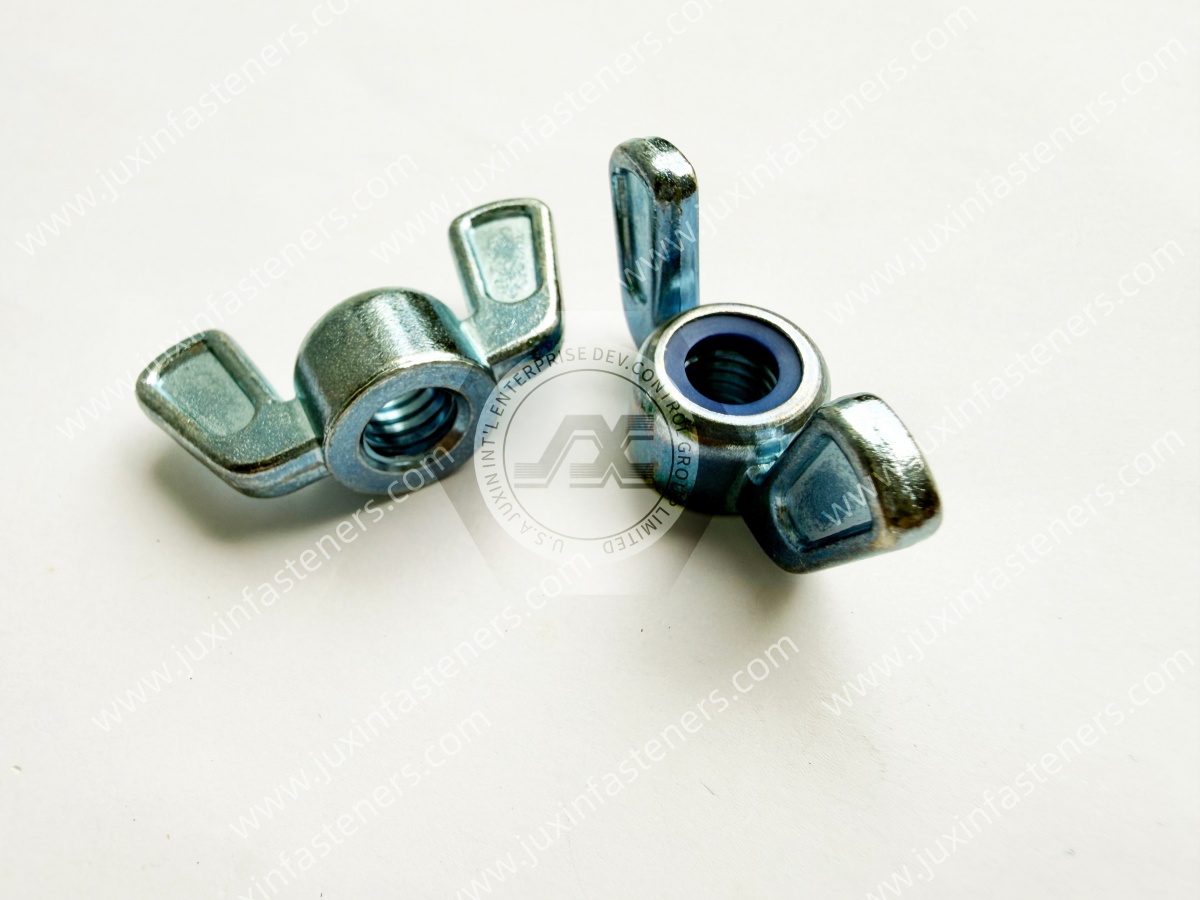
If you are sourcing metal wing nuts, butterfly nuts, nylon wing nuts, plastic wing fasteners, or customized hand-operated fastening components for machinery,
electronics, electrical cabinets, automotive equipment, telecommunications, laboratory equipment, or other industrial applications, JUXIN FASTENERS can review your drawing, specification, sample, or existing part information.
Please provide the available details, including:
Drawing or specification
Thread size and pitch
Material
Wing dimensions
Surface treatment
Locking requirement
Application
Quantity
Packaging requirements
Inspection requirements
Documentation requirements
Our engineering and sourcing team can review the requirements and develop an appropriate fastening solution for your application.
JUXIN FASTENERS
More than 20 years of fastener experience
Website: juxinfasteners.com
Email: info@juxinfasteners.com
 MORE NEWS
Sep. 25, 2026
Sep. 25, 2026
Sep. 25, 2026
Contact Us
Tel.:
+86 020 8621 0320
+86 020 3121 6067
E-mail:
Technical Support:
Navigation
SEND INQUIREY