
Call Us
+86 136 6007 9809
Call Us
+86 136 6007 9809

Oct. 18, 2023
Wave spring washers, commonly called wave washers or wavy spring washers, are compact elastic components used to provide axial spring force within mechanical assemblies.
Unlike flat washers, which primarily distribute bearing pressure, or locking washers intended to address specific fastener-retention requirements,
a wave spring washer is designed to deflect under axial compression.
This makes wave washers particularly useful for applications requiring:
Axial preload
End-play reduction
Tolerance compensation
Bearing preload
Component take-up
Thermal-movement compensation
Rattle reduction
Compact spring action
Three-wave washers are a common configuration, but the number, geometry, height, and distribution of waves can vary according to the required load-deflection behavior.
For engineers and sourcing teams, the critical point is that a wave washer should not be selected only by inside diameter or nominal bolt size.
Its performance depends on the relationship between geometry, material, free height, working height, deflection, and required axial force.
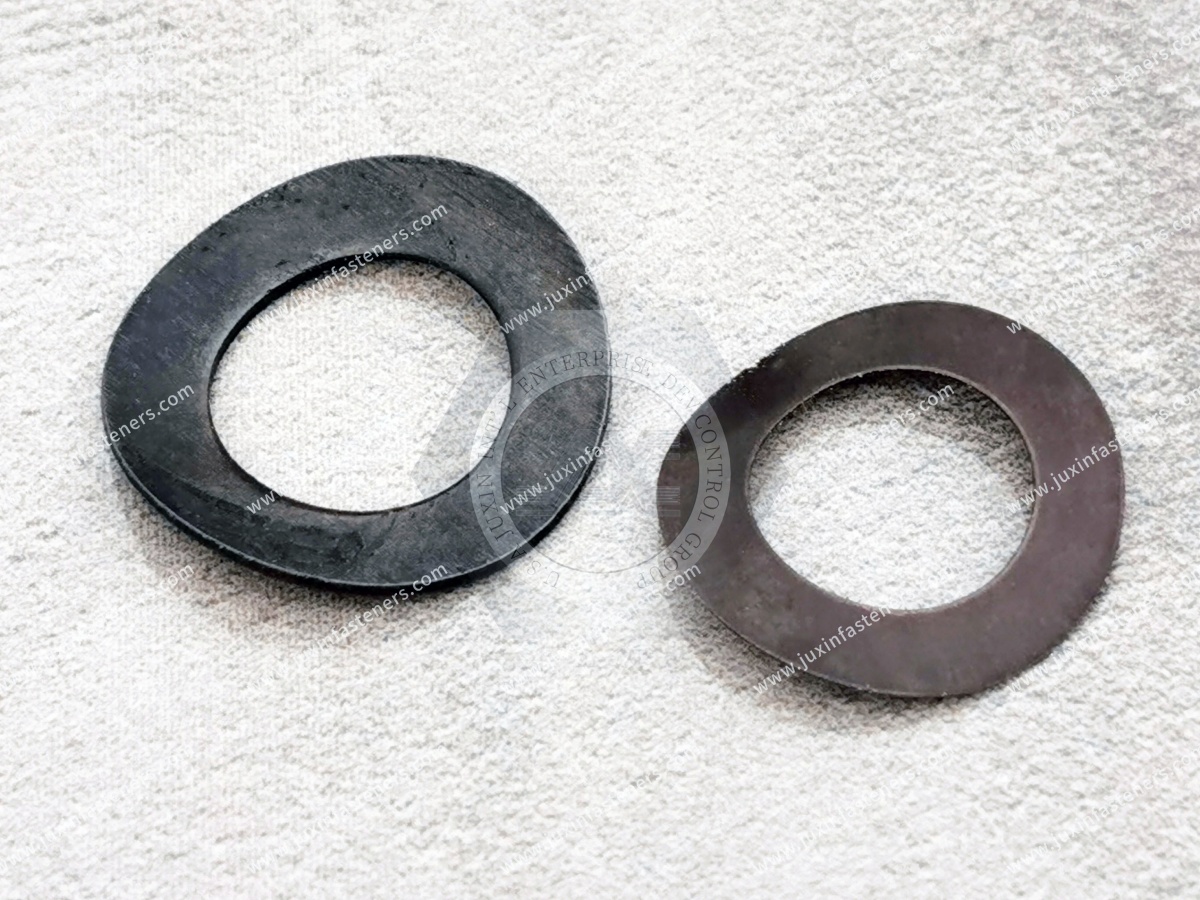
A wave spring washer is a thin annular spring component formed with waves around its circumference.
When the washer is compressed axially, the wave peaks deflect and generate a restoring force.
A simplified functional relationship is:
Free Height → Axial Compression → Wave Deflection → Spring Reaction Force
The washer can therefore occupy the clearance between components while applying an axial force.
This is why wave washers are frequently used in bearings, electric motors, gear assemblies, housings, actuators, instruments, and other mechanical systems where designers need spring action but have limited axial installation space.
A three-wave washer is a wave spring washer formed with three principal wave regions around its circumference.
The three-wave configuration provides distributed contact points while allowing the washer to compress axially.
Important dimensional and functional parameters can include:
Inside diameter
Outside diameter
Material thickness
Free height
Number of waves
Wave amplitude
Working height
Available deflection
Required axial load
Two washers with similar inside and outside diameters can therefore behave very differently if their material thickness, wave geometry, heat treatment, or free height differs.
This is especially important when sourcing replacement or custom wave washers.
One of the most useful ways to understand a wave washer is as an axial take-up element.
Consider an assembly containing a bearing inside a housing.
Manufacturing tolerances may create a small axial clearance between the bearing and the housing shoulder or cover.
A rigid spacer must be manufactured closely enough to match the available space.
A wave washer can instead occupy part of that space while providing an elastic axial force.
The basic system becomes:
Housing Shoulder → Bearing → Wave Washer → Cover
As the cover is installed, the wave washer compresses.
The resulting spring force can help maintain axial contact as component dimensions vary within the designed tolerance range.
This is one reason wave washers are commonly considered for bearing preload and tolerance-compensation applications.
A flat washer and a wave washer perform fundamentally different functions.
A flat washer is generally used to:
Distribute bearing pressure
Protect mating surfaces
Increase bearing area
Provide a controlled interface beneath a bolt head or nut
It is not normally intended to provide significant elastic axial travel.
A wave washer is primarily an elastic component.
It can be used to:
Apply axial preload
Take up clearance
Compensate for dimensional variation
Reduce axial movement
Maintain contact between assembled components
A wave washer should therefore not be treated as a direct replacement for a flat washer simply because both products have an annular shape.
Curved spring washers and wave washers both use elastic deformation, but their geometry and typical engineering applications differ.
A curved washer generally uses a simpler curved or arched profile.
A wave washer contains multiple waves around the circumference and is frequently selected for applications where controlled axial take-up is required.
A practical distinction is:
Simple Elastic Compensation in a Fastened Assembly → Evaluate Curved Spring Washer
Axial Take-Up, Bearing Preload or Clearance Compensation → Evaluate Wave Washer
The final choice should depend on the actual load-deflection requirement and assembly geometry.
Disc springs, often called Belleville springs, use a conical geometry.
They are frequently selected where substantial axial force must be generated within a relatively small axial envelope.
Wave washers serve a different part of the spring-component spectrum.
They are commonly evaluated where:
Axial space is limited
Deflection is required
Moderate spring force is needed
Assembly tolerances must be absorbed
Bearing or component preload must be maintained
A useful preliminary decision path is:
Need Load Distribution Only → Flat Washer
Need Axial Take-Up → Wave Washer
Need Higher Engineered Spring Force → Evaluate Disc Spring
Actual selection requires the load, deflection, space, fatigue, and environmental requirements of the application.
A conventional compression coil spring can provide significant travel and a broad range of spring characteristics, but it also requires axial installation space.
A wave washer provides spring action in a much thinner package.
This can be valuable in compact assemblies such as:
Electric motors
Small gearboxes
Bearing housings
Actuators
Precision instruments
Compact mechanical drives
However, a wave washer should not automatically be considered a direct substitute for a coil spring.
Available deflection, force, fatigue life, and installation envelope must be evaluated.
Bearing systems are one of the most important application areas for wave spring washers.
Depending on bearing type and assembly design, a wave washer may be used to apply an axial force to a bearing ring.
Potential engineering objectives include:
Reducing unwanted axial clearance
Maintaining component contact
Compensating for housing tolerances
Supporting controlled bearing preload
Reducing rattle or axial movement
However, more preload is not automatically better.
Excessive bearing preload may increase:
Friction
Heat generation
Torque
Bearing stress
Wear
Insufficient preload may fail to control the intended axial movement.
The wave washer must therefore be selected as part of the complete bearing system rather than as an isolated fastener.
One of the most important but frequently overlooked wave-washer parameters is working height.
A wave washer has a free height before assembly.
After installation, it is compressed to an operating height.
The difference represents the installed deflection.
If the washer is compressed too little, it may not generate the required force.
If it is compressed beyond its intended working range, the spring behavior may change or the component may experience permanent deformation.
For engineering and supplier qualification, specifying only:
ID × OD × Thickness
may therefore be insufficient.
For functional applications, the drawing may also need to control:
Free height
Working height
Deflection
Load at specified height
Wave geometry
The useful performance of a wave washer is defined by how much force it produces at a given deflection.
In practical terms, the design question is not:
"Is this a three-wave washer?"
The more useful question is:
"What axial force must this washer provide at the installed height?"
This distinction becomes critical when qualifying an alternative supplier.
Two suppliers can produce washers that look nearly identical but generate different spring forces because of differences in:
Material thickness
Material properties
Hardness
Heat treatment
Wave amplitude
Forming process
Free height
For functional wave washers, dimensional inspection alone may therefore be insufficient.
Wave washers can be particularly useful when several manufactured components contribute to an axial tolerance stack.
Consider:
Housing + Bearing + Spacer + Cover
Each component has dimensional tolerance.
The final available space may therefore vary from assembly to assembly.
A wave washer can absorb part of that variation if the complete tolerance range remains within the washer's designed working range.
The engineering process should evaluate:
Minimum available installation space
Maximum available installation space
Required axial force
Washer force at both tolerance extremes
Risk of over-compression
Risk of insufficient preload
This is more reliable than choosing a washer from nominal dimensions alone.
Assemblies containing different materials may change dimension differently as temperature changes.
For example, a system may combine:
Steel shafts
Aluminum housings
Polymer components
Bearings
Stainless steel components
Different coefficients of thermal expansion can change axial clearances during operation.
A properly selected wave washer can provide additional elastic travel that may help accommodate limited dimensional movement.
The required force and deflection must still be evaluated across the actual operating-temperature range.
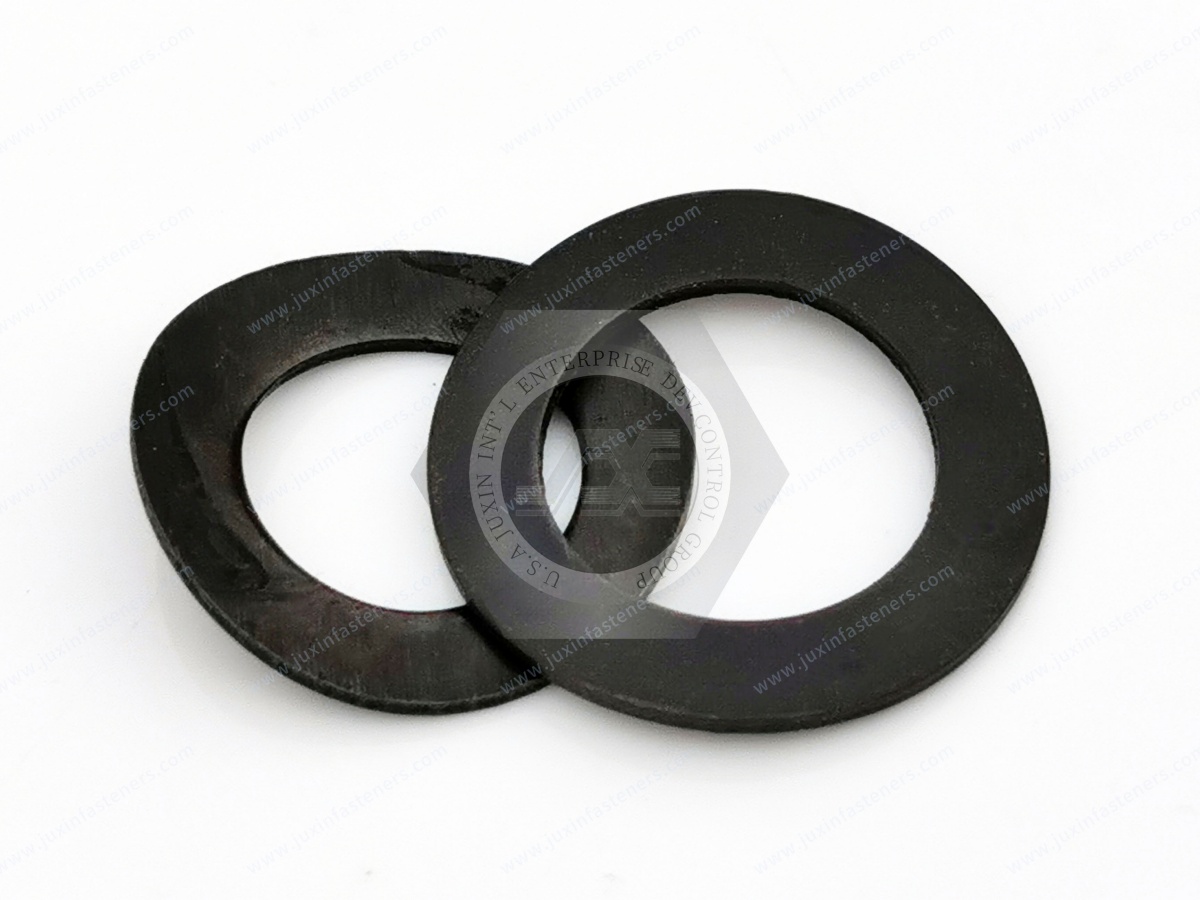
Wave washers are sometimes described broadly as anti-loosening washers.
That description should be used carefully.
Their primary engineering function is spring action and axial compensation, not guaranteed prevention of rotational self-loosening.
Fastener loosening depends on factors such as:
Joint preload
Transverse movement
Joint stiffness
Vibration
Fastener geometry
Friction
Surface coatings
Temperature
Mating materials
If the primary engineering problem is severe vibration-induced rotational loosening, a dedicated locking strategy may be more appropriate.
Wave washers should therefore be selected because the joint needs their spring characteristics—not simply because the equipment vibrates.
They can in suitable assemblies.
Noise can occur when components have enough clearance to move and repeatedly contact neighboring surfaces.
A wave washer can apply an axial bias force that keeps components in contact.
Potential results may include reduced:
Axial play
Component chatter
Rattle
Intermittent metal-to-metal contact
This can be useful in:
Electric motors
Gear assemblies
Instruments
Small mechanical mechanisms
Automotive subassemblies
Actuators
Whether noise is reduced depends on the actual source of the vibration or movement.
Material selection must balance spring performance with the operating environment.
Spring steels are commonly used where elastic performance, fatigue resistance, and cost efficiency are important.
Potential applications include:
Motors
Pumps
Gearboxes
Industrial machinery
Mechanical actuators
General equipment
Heat treatment and hardness should be controlled according to the required mechanical characteristics.
Stainless steel may be selected where corrosion resistance is important.
Potential applications include:
Medical equipment
Food-service machinery
HVAC systems
Liquid-cooling equipment
Outdoor equipment
Electronics
Laboratory equipment
Common stainless steel families may include 300-series grades, but the specific grade should be selected according to mechanical and environmental requirements.
"Stainless steel" alone is not a complete material specification.
Applications involving elevated temperatures, aggressive chemicals, special fatigue requirements, or other demanding conditions may require engineered spring alloys.
For these projects, procurement should provide the required material designation and operating conditions rather than allowing material substitution based only on nominal dimensions.
Carbon and alloy steel wave washers may require protective finishes.
Depending on the project, options can include:
Black oxide
Phosphate-based finishes
Zinc coatings
Zinc-nickel coatings
Zinc-flake coatings
Customer-specified protective systems
Selection should consider:
Corrosion exposure
Coating thickness
Dimensional tolerance
Friction requirements
Material hardness
Hydrogen-embrittlement considerations
Customer specifications
A coating that works well on a conventional bolt may not automatically be appropriate for every spring component.
Electric motors are a natural application area for wave washers because their assemblies often combine:
Bearings
Shafts
Housings
End covers
Limited axial space
A wave washer may be positioned between a bearing and an end cover to provide controlled axial force.
Potential objectives include:
Bearing preload
Axial clearance compensation
Rattle reduction
Tolerance take-up
The required washer characteristics should be determined from the motor design and bearing requirements.
Pumps and compressors contain rotating components, bearings, housings, and mechanical assemblies that may require controlled axial positioning.
Wave washers may be evaluated for:
Bearing assemblies
Auxiliary mechanisms
Actuator systems
Compact mechanical subassemblies
Operating temperature, vibration, corrosion exposure, and fatigue requirements should be considered.
Gearboxes often contain tolerance-sensitive bearing and shaft assemblies.
Potential wave washer functions include:
Bearing take-up
End-play management
Component positioning
Axial compensation
For higher loads or precisely controlled bearing arrangements, the designer should evaluate whether a wave washer, shim system, disc spring, or another preload method is most appropriate.
Automotive and electric-vehicle systems contain numerous compact mechanical assemblies.
Potential wave washer applications may include:
Electric motors
Small gear mechanisms
Actuators
Pumps
Seat mechanisms
Steering-related subassemblies
Auxiliary drives
Thermal-management equipment
Application suitability should be determined from the OEM drawing and validated joint or mechanism design.
A generic wave washer should not be assumed to be suitable for safety-critical automotive assemblies without application-specific qualification.
EV battery systems depend on pumps, valves, cooling equipment, electrical enclosures, and manufacturing machinery.
Wave washers may be relevant in mechanical subassemblies requiring:
Compact axial preload
Clearance compensation
Component positioning
Spring take-up
Electrical, sealing, and structural requirements must be evaluated independently where those functions are involved.
High-density AI infrastructure is increasing demand for pumps, fans, cooling units, power equipment, and precision mechanical systems.
Potential wave washer applications can occur within:
Cooling pumps
Fan assemblies
Electric motors
Actuators
Chillers
Mechanical control systems
Power equipment
The value of the wave washer in these applications is not that it is a "data-center fastener."
Its value is that many supporting mechanical systems require compact spring elements for bearing preload, clearance compensation, and component take-up.
HVAC systems contain many rotating and actuated assemblies, including:
Fans
Motors
Pumps
Compressors
Dampers
Valves
Wave washers may be considered where these systems require controlled axial force or tolerance compensation.
Material and coating selection should reflect humidity, condensation, temperature, and chemical exposure.

Automation equipment often requires compact mechanisms with repeatable movement.
Potential applications include:
Servo-related assemblies
Actuators
Small gear mechanisms
Robotic joints
Packaging equipment
Conveyor mechanisms
Precision fixtures
Wave washers can help manage axial play where the required force and deflection are compatible with the design.
Precision equipment may use wave washers in:
Small motors
Actuators
Adjustment mechanisms
Pumps
Instrument assemblies
For regulated equipment, material traceability, cleanliness, documentation, and customer qualification requirements should be addressed separately.
Telecommunications infrastructure uses:
Cooling fans
Motors
Outdoor cabinets
Actuators
Power equipment
Mechanical adjustment systems
Wave washers may be incorporated into suitable mechanical subassemblies where axial compensation is required.
Outdoor applications should also consider corrosion resistance.
A useful selection process is:
Application → Required Axial Force → Available Space → Deflection → Material → Environment → Fatigue Requirement → Validation
Determine whether the washer is intended to provide:
Bearing preload
End-play control
Tolerance compensation
Rattle reduction
Thermal compensation
General axial take-up
Specify:
Inside diameter
Outside diameter
Maximum available height
Minimum installed height
Mating component geometry
Identify the required axial load at the operating position.
For functional applications, this is far more meaningful than simply specifying "three-wave washer."
Evaluate dimensional tolerances throughout the assembly.
The washer should remain within its intended operating range across the tolerance stack.
Consider:
Temperature
Corrosion
Fatigue
Mechanical properties
Coating requirements
Where the washer controls bearing preload or another functional characteristic, prototype testing should confirm performance in the actual mechanism.
Standard wave washers can be suitable when existing dimensions and spring characteristics match the assembly.
Custom wave washers may be required when the application needs:
Non-standard ID or OD
Special material thickness
Specific free height
Different number of waves
Modified wave geometry
Defined load at working height
Special material
Special coating
Restricted axial envelope
For these applications, the component should preferably be controlled by drawing.
A procurement team may send an existing wave washer and request:
"Please make the same part."
A supplier can measure:
ID
OD
Thickness
Free height
Wave count
Approximate profile
But those measurements do not necessarily reveal:
Exact material
Heat treatment
Hardness
Spring force
Fatigue requirement
Original working height
A visually accurate replacement can therefore have different mechanical behavior.
For functional wave washers, the preferred sourcing package is:
Drawing + Material + Load/Height Requirement + Finish + Application Information
When qualifying a new supplier, engineering and procurement teams should compare both dimensional and functional characteristics.
A practical qualification sequence is:
Drawing Review → Material Review → Dimensional Inspection → Heat Treatment / Hardness → Load-Deflection Evaluation → Surface Finish → Assembly Test → Pilot Lot → Production Approval
Where appropriate, evaluation can include:
ID
OD
Thickness
Free height
Wave profile
Material
Hardness
Surface treatment
Load at specified height
Permanent set after compression
Application performance
This reduces the risk of approving a replacement that matches the drawing visually but behaves differently in service.
For faster technical review and more accurate quotation, provide:
Customer drawing
Applicable standard if any
Existing part number
Revision level
Inside diameter
Outside diameter
Thickness
Free height
Number of waves
Working height where specified
Required load at specified height
Required deflection
Available axial space
Preload requirement
Application type
Material grade
Heat-treatment requirement
Hardness where specified
Coating or finish
Corrosion requirement
Coating specification
Prototype quantity
Production quantity
Estimated annual usage
Packaging
Documentation requirements
Delivery schedule
This information allows suppliers to quote a functional component rather than simply a washer with similar dimensions.
Engineering teams may search for:
wave spring washer
three wave washer
wave washer for bearing preload
axial preload washer
wave washer load deflection
wave washer for end play
wave washer vs Belleville washer
wave washer vs curved washer
spring washer for axial clearance
These searches indicate a design problem.
Procurement teams may search for:
wave washer manufacturer
wave spring washer supplier
custom wave washer manufacturer
stainless steel wave washer supplier
three wave washer supplier
OEM wave washer
custom spring washer
bearing preload washer supplier
These searches indicate a sourcing problem.
An effective industrial supply program must connect the engineering requirement to a manufacturable and commercially scalable component.
For curved elastic washers used in bolted assemblies, review our Curved Spring Washer Solutions.
For standardized curved spring washers, review our DIN 128A Curved Spring Washer Solutions.
For simple single-coil spring compensation, review our Curved Single-Coil Spring Washer Solutions.
For higher-load conical spring applications, review our Disc Spring and Belleville Washer Solutions.
For high-loaded bolted joints using conical washer geometry, review our DIN 6796 Conical Spring Washer Solutions.
For conventional bearing-area and load-distribution requirements, review our Flat Washer Solutions.
For angular misalignment compensation, review our Spherical Washer Solutions.
These product families should be internally linked according to engineering function rather than treated as interchangeable washer categories.
JUXIN FASTENERS supports industrial sourcing projects involving:
Wave spring washers
Three-wave washers
Bearing preload washers
Spring steel wave washers
Stainless steel wave washers
Custom wave washers
Drawing-based spring components
Replacement and second-source components
Projects can be evaluated from:
Customer drawings
Existing samples
Dimensional requirements
Material specifications
Surface-treatment requirements
Load-deflection requirements
Application conditions
For functional wave washers, our objective is not simply to reproduce the appearance of the component.
The sourcing objective is to understand and reproduce the dimensional and mechanical characteristics required by the assembly.
For a new project, a practical sourcing path is:
Application Requirement → Axial Load → Deflection → Installation Envelope → Washer Geometry → Material → Finish → Prototype → Functional Validation → Production
For an existing component or second-source project:
Existing Drawing / Sample → Dimensional Review → Material → Spring Characteristics → Finish → Sample Production → Assembly Validation → Production Approval
This approach is particularly important for wave washers because apparently similar components can produce different axial forces.
If you are sourcing wave spring washers, three-wave washers, bearing preload washers, stainless steel wave washers, spring steel wave washers, or custom wave washer components, send us:
Drawing or sample information
Required dimensions
Material
Required load / working height if available
Surface treatment
Prototype and production quantities
Annual demand where available
Application information
Quality and documentation requirements
Email: info@juxinfasteners.com
JUXIN FASTENERS can review the engineering and commercial requirements and evaluate a suitable standard, modified-standard, or custom wave washer solution for your project.
 MORE NEWS
Sep. 27, 2026
Sep. 27, 2026
Sep. 27, 2026
Contact Us
Tel.:
+86 020 8621 0320
+86 020 3121 6067
E-mail:
Technical Support:
Navigation
SEND INQUIREY