
Call Us
+86 136 6007 9809
Call Us
+86 136 6007 9809

Sep. 16, 2023
Bearing preload wave washers are compact spring components used to apply a controlled axial force to a bearing while accommodating dimensional variation within the assembly.
They are commonly used in electric motors, pumps, gear systems, fans, blowers, actuators and other rotating equipment where engineers need to control bearing play without creating an excessively rigid axial stack.
The engineering task is not simply:
“Find a wave washer that fits the bearing.”
The more useful question is:
“What preload force must the washer provide across the complete installed-height tolerance range?”
That changes the selection process from:
Bearing Diameter → Washer Size
to:
Bearing Requirement → Axial Preload → Assembly Tolerance Stack → Working Height Range → Load Range → Washer Geometry → Material → Validation
This distinction matters because two wave washers with similar inside and outside diameters can generate very different axial forces.
For engineers and procurement teams, bearing preload wave washers should therefore be treated as spring components with dimensional and load-deflection requirements, not simply as another washer size.
JUXIN FASTENERS supports standard and custom wave washers, spring washers, disc springs and related precision fastening components for industrial motors, pumps,
rotating equipment, automation, automotive-related equipment, HVAC systems, cooling equipment and other engineered assemblies.
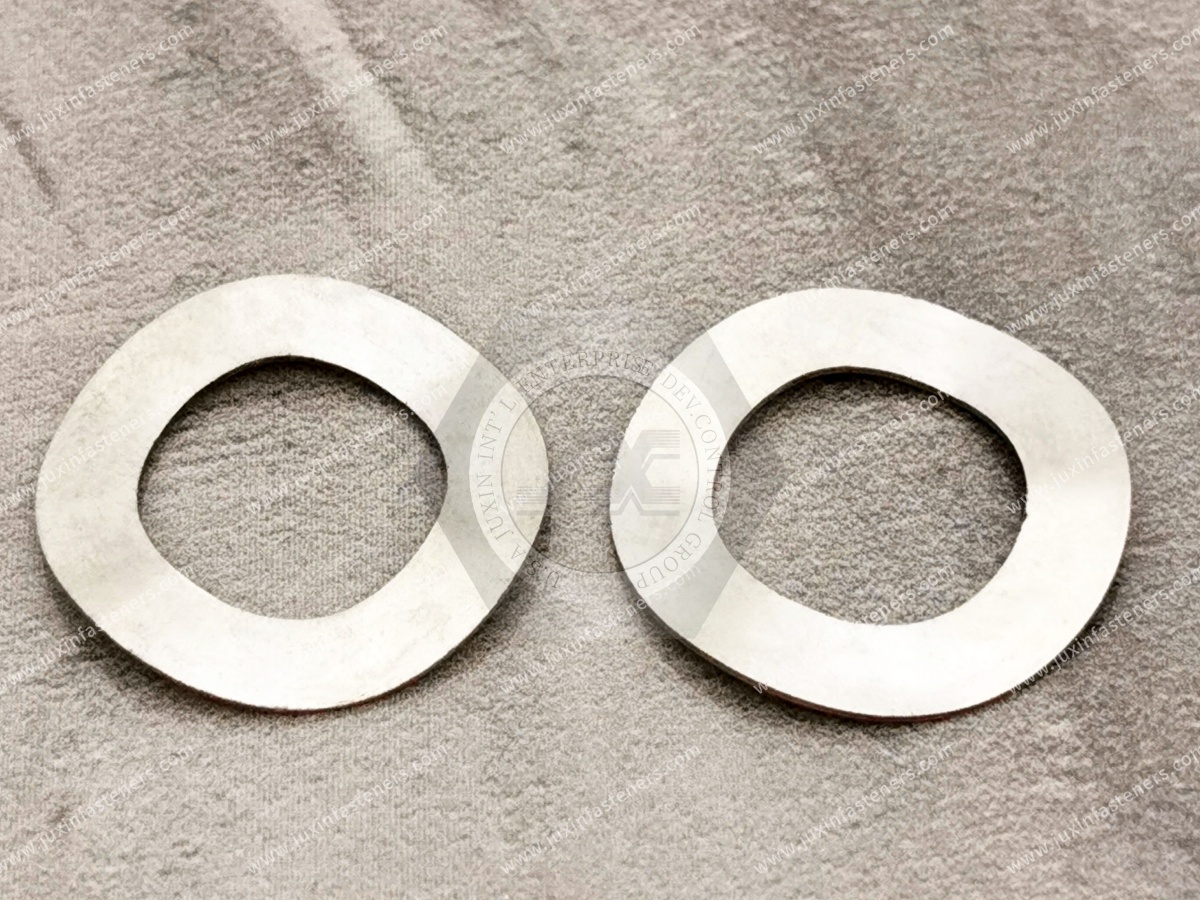
Bearing preload is an intentionally applied load that reduces or controls internal clearance within a bearing arrangement.
For many ball-bearing applications, an axial preload helps maintain contact between rolling elements and bearing races.
Depending on the bearing system, appropriate preload can help control:
axial play;
radial play associated with the bearing arrangement;
positioning accuracy;
operating noise;
vibration associated with excessive clearance;
bearing response under changing operating conditions.
However:
Bearing Preload Must Be Controlled
Too little preload and too much preload can both create problems.
Bearing preload can be created through different mechanical architectures.
Two important approaches are:
The bearing arrangement is mechanically positioned so that a defined relationship between the bearing races produces preload.
This approach can provide precise positioning but may be more sensitive to:
dimensional tolerances;
thermal expansion;
assembly variation.
A spring component applies axial force to the bearing.
A wave washer or single-turn wave spring can provide this function while allowing some axial movement.
The spring can therefore help accommodate:
manufacturing tolerance;
assembly tolerance;
thermal dimensional variation.
This is one reason wave spring technology is widely used for bearing preload.
A wave washer can generate axial spring force in a relatively small axial package.
A typical arrangement may be represented as:
Housing Shoulder → Bearing → Wave Washer → End Cover
or:
Housing → Wave Washer → Bearing Outer Race → Opposing Bearing Location
The exact architecture depends on the bearing arrangement.
The washer compresses from its free height to an installed working height.
That compression generates axial force.
A flat washer primarily provides a bearing surface.
A bearing preload wave washer provides elastic axial force.
Therefore:
Flat Washer → Bearing Interface / Load Distribution
Wave Washer → Spring Preload / Axial Compensation
Their engineering roles are different.
A split spring lock washer is associated with threaded fastening applications.
A bearing preload wave washer is selected primarily for controlled axial spring force.
Therefore:
Bearing Preload Washer ≠ Bolt Lock Washer
Using the word “spring washer” for both does not make them interchangeable.
This distinction is critical.
Clamp force generated by tightening a threaded fastener.
A controlled load intentionally applied to a bearing arrangement.
A wave washer can apply bearing preload without controlling the main clamp force of a bolted joint.
Therefore:
Wave Washer Spring Force ≠ Bolt Preload
A bearing preload wave washer is commonly controlled by five related parameters:
Inside / Shaft Clearance Diameter
Outside / Bore Diameter
Free Height
Working Height
Load at Working Height
Material thickness, wave count and material condition also influence performance.
For an engineered application, the most important commercial specification is often not simply the washer diameter.
It is:
Required Load at Required Working Height
Free height is the washer's axial height before compression.
It represents the unloaded spring condition.
However, free height alone does not tell the engineer how much force the washer will generate in the assembly.
That requires the working condition.
Working height is the installed axial height at which the washer is intended to operate.
Conceptually:
Deflection = Free Height − Working Height
As the washer is compressed, it generates spring force.
For procurement:
Free Height Without Working Height = Incomplete Spring Specification
This is one of the most commercially useful parameters for a bearing preload washer.
A supplier may need to know:
Required Load: ___ N
At Working Height: ___ mm
This is much more meaningful than:
“Need an M20 wave washer.”
Current commercial bearing-preload wave spring ranges are explicitly catalogued using parameters including load, work height, free height, number of waves, thickness and spring rate.
Consider two motors using bearings with similar outside diameters.
Motor A may require relatively light axial preload.
Motor B may require a substantially different preload because of:
bearing design;
operating speed;
rotor arrangement;
housing geometry;
temperature;
tolerance stack.
A washer selected only from bearing OD may physically fit both systems while being mechanically suitable for only one.
Therefore:
Physical Fit ≠ Correct Bearing Preload
Real assemblies contain multiple toleranced dimensions.
For example:
Housing Depth
+ Bearing Width
+ Cover Position
+ Shoulder Location
= Installed Washer Cavity
Every dimension can vary.
As a result, the wave washer may not operate at one exact height.
It may operate across a range.
A more professional bearing-preload analysis considers:
Minimum Working Height
Nominal Working Height
Maximum Working Height
Because wave-washer force changes with deflection, each working height can produce a different preload.
The engineering requirement is therefore not:
“Does the washer produce the correct force at nominal?”
It is:
“Does the washer produce an acceptable force across the entire assembly tolerance range?”
Consider:
Minimum Cavity Height → Least Washer Compression → Lower Spring Load
and:
Maximum Compression Condition → Greater Washer Deflection → Higher Spring Load
The actual direction depends on how the assembly dimensions are defined, but the principle remains:
Tolerance Stack Changes Working Height
and:
Working Height Changes Spring Load
This is one of the most important Information Gain points for wave-washer selection.
If spring preload is too low, the bearing arrangement may retain excessive internal movement.
Depending on the system, potential effects can include:
excessive play;
increased noise;
reduced positioning stability;
undesirable dynamic behavior.
Smalley identifies bearing spring preload as a means of reducing or eliminating play and maintaining contact between bearing elements and races.
More preload is not automatically better.
Excessive preload can increase:
bearing friction;
operating temperature;
contact stress;
power loss;
wear.
For this reason:
Maximum Washer Load Must Be Checked
not merely minimum load.
The bearing manufacturer or validated equipment design should define the acceptable preload range.
A wave washer should apply force through the intended bearing race.
The washer should not accidentally create an undesirable load path through components not designed to carry that spring force.
Engineers should define:
which race is axially located;
which race receives spring preload;
which race must remain free to accommodate thermal or assembly movement.
The correct arrangement depends on the bearing system.
Rotating equipment rarely remains at assembly-room temperature.
During operation:
shaft temperature can change;
housing temperature can change;
bearing temperature can change.
Different materials also have different thermal expansion behavior.
This can change the axial relationship between components.
A spring-preloaded arrangement can accommodate limited dimensional variation while continuing to apply force.
Smalley specifically identifies tolerance stack-up and thermal expansion/misalignment as reasons for using wave springs in bearing-preload systems.
A wave washer has finite travel.
If thermal movement exceeds its usable deflection range, the spring may become:
insufficiently loaded;
excessively compressed;
permanently deformed.
Therefore:
Spring Preload Can Accommodate Thermal Variation
but:
Wave Washer ≠ Unlimited Thermal Compensation
Spring rate describes how rapidly force changes with deflection.
Conceptually:
Spring Rate = ΔForce / ΔDeflection
A high spring rate means a small dimensional change can produce a larger change in force.
A lower spring rate can make preload less sensitive to dimensional variation.
However, the appropriate spring rate depends on:
required preload;
available travel;
assembly tolerance;
bearing requirement.
Imagine an assembly with unavoidable axial tolerance variation.
If the spring is extremely stiff, a small height variation may cause a large change in preload.
A more compliant spring may provide a narrower force variation across the same tolerance range.
This can be useful in bearing preload design.
But the spring must still provide sufficient minimum load.
For critical applications, the engineering team should consider the actual load-deflection curve rather than relying only on a nominal spring-rate number.
The curve can show how the washer behaves between:
minimum compression;
nominal compression;
maximum compression.
For custom parts, this can become an important inspection and validation requirement.
Depending on spring design and supplier methodology, free height may be treated as a reference dimension while the functional requirement is controlled by load at working height.
For example, current commercial wave-spring product tables may identify free height and spring rate as reference values while directly specifying load and work height.
This suggests a useful procurement principle:
Control the Functional Spring Requirement—not only the unloaded geometry.
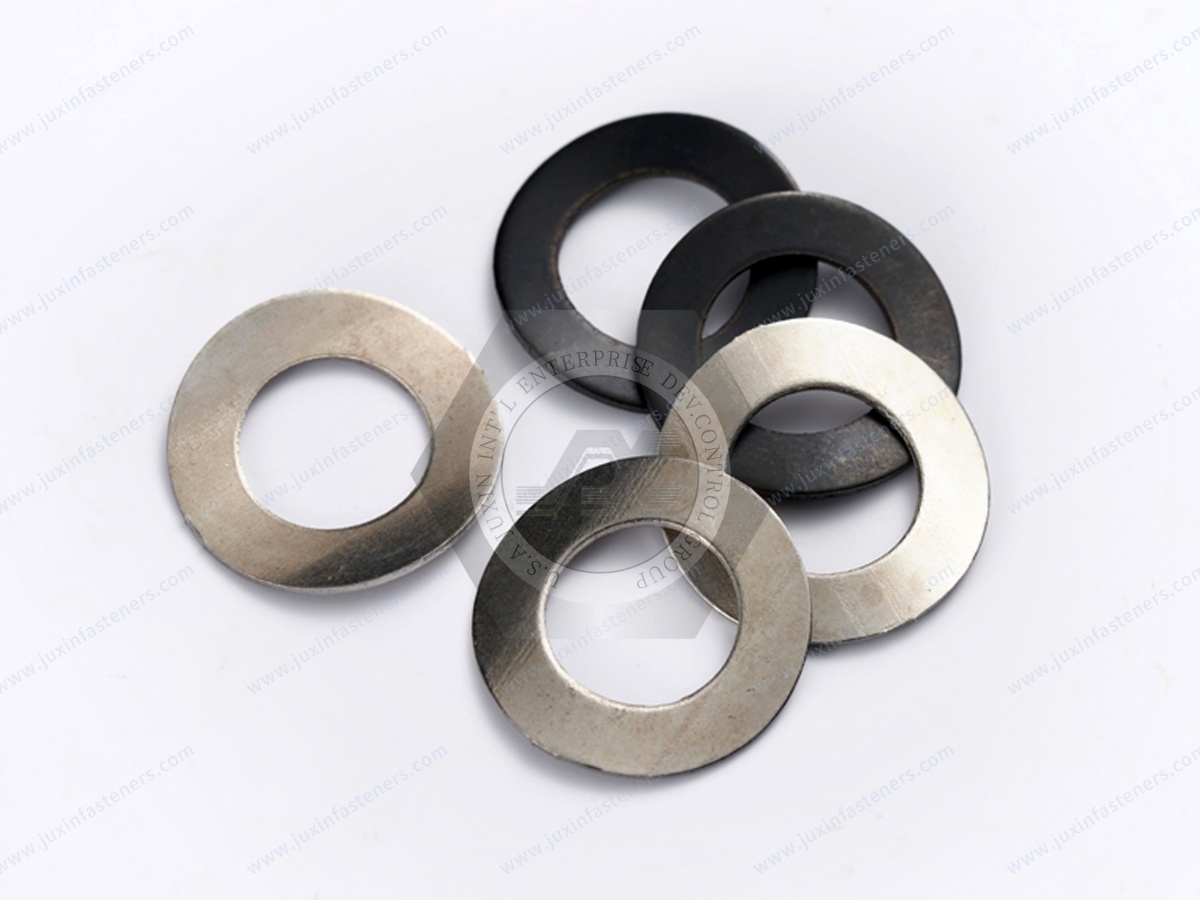
Single-turn wave springs are widely used for bearing preload.
They can be designed to fit within the bearing housing while applying a controlled axial load.
Current commercial bearing-preload series are available specifically to match common bearing sizes.
Commercial terminology can overlap.
Traditional stamped wave washers and single-turn wave springs can both provide axial spring loading.
However, they may differ in:
manufacturing method;
radial behavior;
gap or overlap configuration;
spring characteristics;
available sizes;
precision.
For RFQs, use a drawing or sample rather than relying only on the phrase “wave washer.”
Some single-turn wave springs incorporate a circumferential gap.
This can allow radial expansion as the spring compresses and help avoid binding in a bore.
This design can be particularly relevant when radial space is tightly controlled.
Overlap configurations are another available architecture.
The appropriate type depends on:
installation envelope;
required spring characteristics;
radial movement;
assembly design.
Do not substitute gap and overlap types automatically without review.
The number, height and shape of waves influence the spring's load-deflection behavior.
Therefore:
Same OD + Same ID ≠ Same Spring Force
Two visually similar wave washers may perform very differently.
Material thickness strongly influences spring behavior.
A small thickness change can materially change spring force.
For this reason, custom wave-washer procurement should control thickness tolerance where spring performance is important.
Bearing preload wave washers may be manufactured from materials such as:
carbon spring steel;
stainless spring material;
other engineered spring alloys.
Material choice can affect:
spring behavior;
corrosion resistance;
temperature capability;
fatigue performance.
The exact material should follow the application requirement.
Carbon spring steel can provide suitable elastic properties for many industrial applications.
Where corrosion protection is required, the finish must be considered separately.
Do not assume bare spring steel is appropriate for every environment.
Stainless spring materials can be considered where corrosion resistance is required.
Commercial bearing-preload wave springs are available in carbon and stainless steel.
However:
Stainless Steel ≠ Corrosion-Proof
The actual alloy and environment remain important.
Where applicable, specify:
material;
coating;
passivation;
corrosion requirement.
Do not define a generic coating merely because the component is called a wave washer.
Electric motors are one of the strongest application areas for bearing preload wave washers.
A simplified arrangement may include:
Motor Housing → Bearing → Wave Washer → End Bell
The wave washer can help:
control axial play;
accommodate assembly variation;
maintain an axial load on the bearing.
The exact preload must follow the motor and bearing design.
Excessive clearance within a rotating assembly can contribute to unwanted movement and noise.
Appropriate spring preload can reduce bearing play.
Smalley identifies reduced play, noise and vibration among the potential benefits of properly designed bearing preload.
This should not be interpreted as:
Wave Washer = General Vibration Damper
The benefit is associated with controlling bearing clearance in the specific assembly.
Pump assemblies can use spring preload in selected bearing systems.
Wave washers may help manage:
axial bearing position;
tolerance variation;
thermal movement.
However:
Bearing Preload Washer ≠ Pump Seal
Fluid sealing must be handled by the appropriate sealing architecture.
Electric fans and blowers can use wave washers in motor bearing assemblies.
Potential engineering objectives include:
controlling end play;
reducing unwanted bearing movement;
accommodating housing tolerances.
This can be relevant to:
HVAC blowers;
industrial ventilation equipment;
electronics cooling;
data-center cooling systems.
HVAC systems contain numerous:
motors;
fans;
blowers;
actuators;
pumps.
Bearing preload wave washers can therefore be relevant to selected electromechanical components.
They should not be described as refrigerant seals or air seals.
AI and HPC infrastructure requires substantial thermal-management hardware.
Potential wave-washer applications can exist in:
cooling fans;
blowers;
pumps;
motor-driven thermal-management equipment.
The relevant engineering path is:
Rotating Equipment → Bearing System → Preload Requirement → Wave Washer
not simply:
AI Data Center → Special Washer
Automation equipment can use bearing preload wave washers in:
servo-related mechanisms;
small motors;
actuators;
gear drives;
positioning systems.
Where positioning accuracy matters, axial play and bearing behavior become particularly important.
Potential applications include:
actuator motors;
compact gear systems;
rotating joints;
precision drive assemblies.
The preload requirement should be established from the bearing and mechanism design.
Wave washers may be used in selected:
electric motors;
pumps;
actuators;
auxiliary drives;
thermal-management equipment;
seat and adjustment mechanisms.
For safety-critical vehicle systems, application-specific validation and customer requirements control component approval.
Power conversion and thermal-management systems may contain:
fans;
pumps;
compact motors.
Wave washers can support the bearing systems inside these components where controlled axial spring force is required.
Telecommunications hardware may use compact fans and motor-driven cooling systems.
Bearing preload washers can therefore appear inside the electromechanical equipment rather than in the structural cabinet joint itself.
Potential non-sterile applications include:
laboratory motors;
diagnostic-equipment mechanisms;
pumps;
precision positioning equipment.
A generic industrial wave washer should not automatically be described as medical-grade or biocompatible.
Wave springs and preload components can be used in aerospace engineering.
However, a generic industrial wave washer should not automatically be promoted as flight-qualified.
Aerospace applications can require:
controlled material;
traceability;
process qualification;
inspection;
customer approval.
JUXIN FASTENERS should therefore evaluate aerospace inquiries against the specific drawing and qualification requirements rather than making a general aerospace-compliance claim.
| Engineering Condition | Selection Consideration |
|---|---|
| Need to reduce axial bearing play | Evaluate spring preload |
| Tight axial packaging | Wave washer may be suitable |
| Wide tolerance stack | Evaluate load across full working-height range |
| Thermal dimensional variation | Verify spring travel remains available |
| High minimum preload required | Check load at maximum working height |
| Maximum bearing load limited | Check load at minimum working height |
| Very high spring force | Evaluate disc spring or alternative architecture |
| Large axial travel | Evaluate wave spring or another spring system |
| Need fluid sealing | Use dedicated seal |
| Need bolt locking | Use dedicated locking method |
| Corrosive environment | Evaluate spring material and finish |
| High cycle count | Validate fatigue performance |
A practical design review can use two boundary conditions.
Determine:
installed height;
washer force.
Ask:
Is preload still high enough?
Determine:
installed height;
washer force.
Ask:
Is preload still low enough to protect the bearing?
A good design must satisfy both.
One of the most common engineering mistakes is testing only the nominal assembly.
A production line does not build only nominal dimensions.
Therefore:
Nominal Fit ≠ Production Robustness
Tolerance extremes should be considered before releasing the design.
For a new bearing-preload application, prototype validation can include:
installed height;
axial preload;
end play;
rotational behavior;
motor current where relevant;
bearing temperature;
operating noise;
thermal behavior;
long-duration performance.
The validation plan should match the actual equipment requirement.
A bearing preload washer can experience repeated load variation during service.
Fatigue performance depends on:
material;
stress;
working deflection;
temperature;
manufacturing process;
cycle count.
Do not make a universal fatigue-life claim without application-specific data.
Excessive compression can permanently reduce wave height.
This may reduce future preload.
Therefore:
More Compression ≠ More Reliable
The washer should operate within its intended elastic range.
A wave washer is not a conventional flat washer waiting to be flattened.
Completely flattening the wave profile may exceed the intended working condition.
Installed height should come from the spring requirement.
For many annular wave-washer designs, there is no generic rule that one “wave side” must face the bearing.
Follow:
drawing;
spring geometry;
assembly instructions.
Do not create an orientation requirement without a functional reason.
The old claim that wave washers seal:
oil;
water;
gas;
refrigerant;
hydraulic fluid
should not be used as a generic product function.
A bearing preload wave washer is a spring component.
Metal O-rings are engineered sealing components.
Bearing preload wave washers are engineered spring components.
Their circular shapes do not make them interchangeable.
Bearing preload and threaded fastener locking are separate engineering tasks.
If a threaded joint requires anti-loosening performance, specify a locking mechanism independently.
A preload washer is selected around spring behavior.
If protection of a cosmetic or soft surface is the primary requirement, a plain, polymer or protective washer may be more appropriate.
Physical fit does not define spring force.
Load depends on deflection.
Production assemblies operate across a tolerance range.
Excessive preload can harm bearing performance.
Operating temperature can change the bearing stack.
They are different mechanical functions.
Spring force does not create an engineered fluid seal.
Axial spring force does not automatically stop threaded rotation.
This may exceed the intended spring range.
A functional RFQ should include load and working height.
Engineers may search:
bearing preload wave washer;
wave washer for ball bearing;
motor bearing preload washer;
bearing preload spring;
wave washer load;
wave washer working height;
wave washer spring rate;
axial preload washer;
wave washer for motor bearing;
bearing end play washer;
bearing tolerance compensation;
wave washer load deflection.
These searches indicate a real mechanical design task.
Purchasing and supplier-development teams may search:
bearing preload wave washer manufacturer;
bearing preload washer supplier;
motor wave washer supplier;
custom wave washer manufacturer;
stainless bearing preload washer;
spring steel wave washer supplier;
precision wave washer;
custom bearing spring washer;
OEM wave washer supplier.
These searches are much closer to commercial RFQ intent.
For technical and commercial evaluation by JUXIN FASTENERS, provide where applicable:
2D drawing;
3D model where relevant;
physical sample;
customer part number;
application;
bearing manufacturer and designation where permitted;
bearing type;
bearing ID;
bearing OD;
bearing width;
race receiving preload;
required minimum preload;
required nominal preload;
allowable maximum preload;
minimum working height;
nominal working height;
maximum working height;
free height;
washer ID / shaft clearance;
washer OD / housing bore;
material thickness;
wave count;
gap or overlap requirement where applicable;
required spring rate where controlled;
load-deflection requirement;
tolerance stack;
axial end-play requirement;
operating temperature;
thermal expansion requirement;
operating speed where relevant;
cycle requirement;
material;
carbon spring-steel requirement;
stainless spring-material requirement;
surface finish;
corrosion requirement;
sample quantity;
prototype quantity;
production quantity;
estimated annual demand;
load-test requirement;
dimensional inspection requirement;
packaging requirement;
labeling requirement;
customer-specific requirements.
It is an elastic wave-shaped component used to apply controlled axial spring force to a bearing.
Appropriate preload can reduce or control bearing play and maintain contact between rolling elements and bearing races.
Spring preload can accommodate limited manufacturing tolerance and thermal dimensional variation while maintaining axial force.
Yes.
The acceptable preload range depends on the bearing and equipment design. Excessive preload can increase friction, temperature and stress.
Start with required preload and assembly tolerance range. Then determine the required force at minimum, nominal and maximum working height.
No.
For a functional spring application, working height and load can be more important than free height alone.
It is the installed axial height at which the spring operates.
Spring rate describes how force changes as spring deflection changes.
Yes, within its designed working range. Bearing-preload wave springs are specifically used to accommodate dimensional variation.
It can accommodate limited thermal dimensional change if the spring remains within its acceptable travel and force range.
No inherent threaded-fastener locking capability should be assumed.
No. Fluid sealing requires a dedicated sealing component or system.
No. Metal O-rings are sealing components.
For a simple replacement, a controlled drawing or exact part number may be sufficient. For a new engineered application, load and working height should also be defined.
Custom requirements can be evaluated from a drawing, physical sample or defined installation envelope together with the required load, working height, material and quantity.
A purchasing inquiry may begin with:
“We need a wave washer for a 6203 bearing.”
That identifies the bearing.
It does not yet define the spring.
The engineering process should continue:
Which Bearing Race Receives the Axial Load?
What Preload Does the Bearing Arrangement Require?
What Is the Minimum Acceptable Preload?
What Is the Maximum Allowable Preload?
What Is the Minimum Installed Height?
What Is the Maximum Installed Height?
How Does Temperature Change the Stack?
What ID and OD Envelope Is Available?
What Material and Corrosion Requirement Apply?
The commercial sourcing path becomes:
Bearing → Preload Requirement → Tolerance Stack → Working Height Range → Force Range → Installation Envelope
→ Wave Geometry → Material → Prototype → Load Validation → OEM Approval → Production RFQ
This converts a generic washer inquiry into an engineered spring-component specification.
JUXIN FASTENERS supports OEM sourcing and customization of bearing preload wave washers, wave spring washers,
curved spring washers, disc springs, plain washers, locking washers and related industrial fastening components.
Potential applications include:
electric motors;
industrial fans;
blowers;
pumps;
gear systems;
automation equipment;
robotics;
HVAC equipment;
cooling systems;
automotive and EV auxiliary systems;
telecommunications equipment;
AI data center cooling equipment;
industrial machinery.
For the broader wave-washer engineering topic, refer to the JUXIN FASTENERS Wave Spring Washers: Bearing Preload, Axial Play, Load-Deflection & Selection Guide.
For broader washer-family selection, see Industrial Washers: Types, Functions & Selection Guide.
For general washer-and-bolt selection, see Washers and Bolts: Fastening Systems Selection Guide.
For higher-load conical spring systems, refer to the JUXIN FASTENERS Disc Springs & Belleville Washers: Load, Deflection, Stacking & Selection Guide.
For legacy bowed spring washers, refer to the JUXIN FASTENERS DIN 137 A Curved Spring Washers: Design, Selection, Load Behavior & Replacement Guide.
For anti-loosening requirements separate from bearing preload, see Nylon Insert Locknuts for Anti-Vibration Applications.
For bearing preload wave washer OEM RFQs, send your drawing or sample, bearing information, ID, OD, free height, working-height range,
required preload range, material, finish, quantity and estimated annual demand to:
For a bearing preload wave washer, the most useful purchasing question is not:
“What washer fits this bearing?”
It is:
“What spring force must this washer maintain across the complete production tolerance and operating range?”
 MORE NEWS
Sep. 27, 2026
Sep. 27, 2026
Sep. 27, 2026
Contact Us
Tel.:
+86 020 8621 0320
+86 020 3121 6067
E-mail:
Technical Support:
Navigation
SEND INQUIREY