
Call Us
+86 136 6007 9809
Call Us
+86 136 6007 9809

Oct. 27, 2023
Worm-drive hose clamps are adjustable mechanical clamps used to secure flexible hose or tubing over a fitting, nipple, pipe, or other connection interface.
They are commonly found in automotive systems, industrial machinery, HVAC and thermal-management equipment, agricultural equipment, pumps, commercial equipment, and other fluid-handling assemblies.
A typical worm-drive hose clamp consists of:
Metal band
Screw
Housing
Worm-drive engagement feature
Turning the screw moves the band through the housing, reducing or increasing the clamp diameter.
The principle is simple.
Selecting the correct hose clamp is not.
For engineering applications, the clamp should be considered as part of a complete connection:
hose + fitting + clamp + installation process + operating environment
A clamp that fits around the hose is not necessarily the correct clamp for the joint.
Engineers and procurement teams should evaluate the complete interface before selecting or substituting a worm-drive hose clamp.
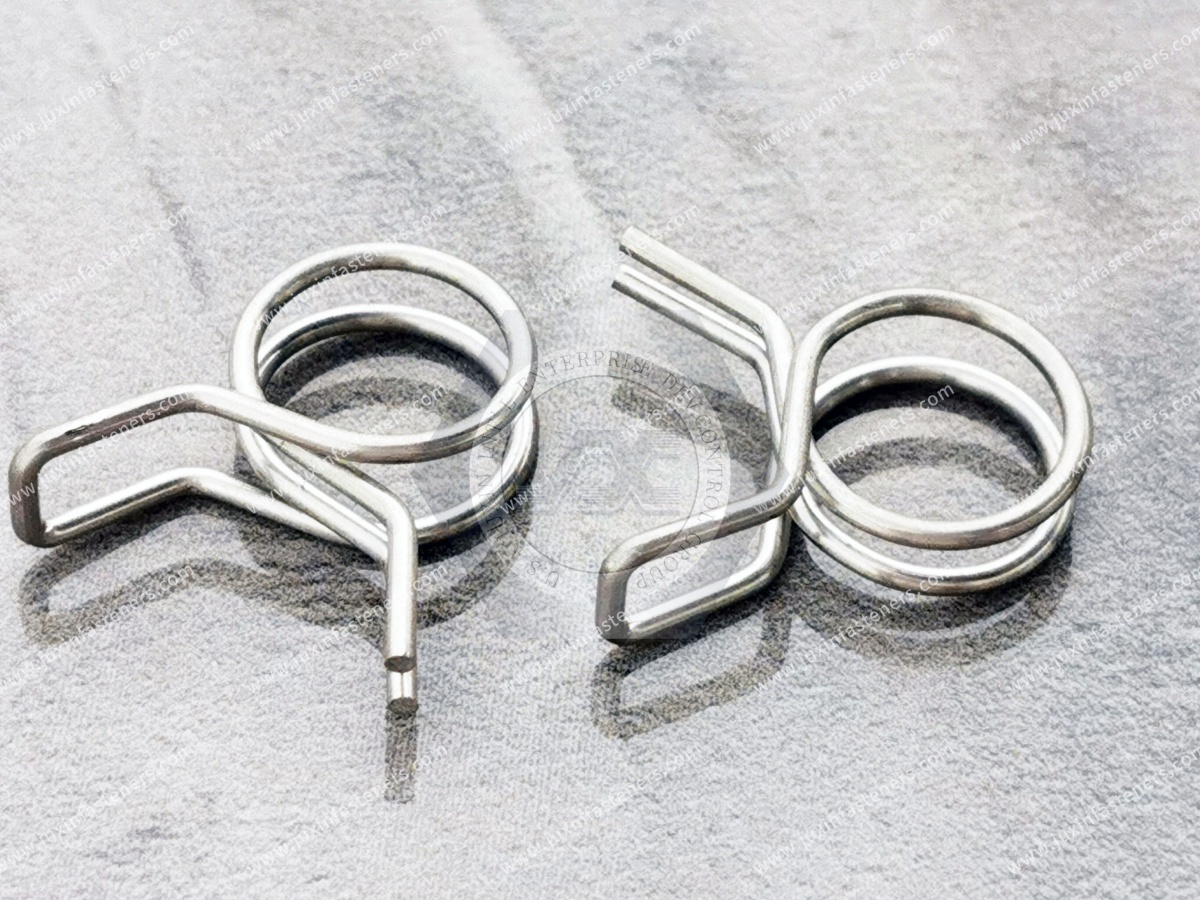
A worm-drive hose clamp, also called a worm gear hose clamp or worm screw clamp, uses a screw-driven mechanism to adjust the diameter of a metal band around a hose.
As the screw rotates, its thread engages features in the band and draws the band through the housing.
This allows one clamp size to accommodate a defined diameter range.
Worm-drive clamps are popular because they provide:
Adjustable diameter
Relatively simple installation
Compact construction
Broad availability
Multiple material options
Serviceability in many applications
However, these advantages do not mean one clamp design is suitable for every hose, fitting, pressure, temperature, vibration, or corrosion environment.
When a hose connection leaks, the clamp is often blamed first.
But the joint consists of several interacting components.
A useful engineering model is:
fitting geometry → hose material → hose wall → clamp → installation → service conditions
A leak or retention problem can originate from any of these elements.
Possible causes include:
Incorrect hose size
Incorrect fitting geometry
Damaged fitting
Wrong clamp diameter
Clamp positioned incorrectly
Hose relaxation
Excessive tightening
Insufficient tightening
Material incompatibility
Thermal cycling
Corrosion
Vibration
Replacing the clamp with a “stronger” clamp does not automatically solve an interface problem.
One of the most common sourcing mistakes is specifying a hose clamp only by nominal hose size.
The clamp actually surrounds the outside diameter of the assembled hose.
That diameter can depend on:
Hose inside diameter
Hose wall thickness
Fitting outside diameter
Hose construction
Reinforcement
Manufacturing tolerance
Compression after installation
For this reason, clamp selection should be based on the actual assembled interface rather than assuming that nominal hose ID determines the required clamp.
A worm-drive clamp has a defined minimum and maximum operating diameter.
The selected clamp should accommodate the actual installed hose OD while providing suitable adjustment capability.
Do not select a clamp simply because the maximum listed diameter is larger than the hose.
The engineer should consider where the actual assembly sits within the clamp's usable range.
A clamp operating very close to an extreme of its range may have a different geometry around the hose than one operating nearer the intended working region.
For OEM programs, define the required clamping range on the drawing or purchase specification.
Band width affects how clamp load is distributed over the hose surface.
A wider band can distribute load across a larger area, but that does not automatically make it better.
The appropriate width depends on:
Hose geometry
Available installation space
Fitting length
Hose material
Clamp construction
Adjacent components
A clamp that is too wide for the available fitting interface can extend beyond the intended sealing region.
A narrow clamp can create a more concentrated contact condition.
Selection should therefore consider the actual hose-and-fitting geometry.
A thicker band may change stiffness and mechanical behavior, but band thickness alone does not define clamp performance.
Performance depends on the complete clamp:
Band
Housing
Screw
Engagement geometry
Material
Manufacturing quality
Installed diameter
For procurement, comparing two suppliers only by band thickness can therefore be misleading.
The complete design should be evaluated.
Worm-drive clamps are available with different band architectures.
The screw engages openings formed through the band.
This design is widely recognized in many worm-drive clamp families.
The screw engages formed features without the same fully perforated band construction.
Depending on the design, this can provide a different hose-contact surface and mechanical behavior.
Neither architecture should automatically be described as universally superior.
The correct choice depends on:
Hose material
Application
Clamp specification
Installation requirements
Customer preference
Commercial markets often use regional descriptions such as:
American-type hose clamp
German-type hose clamp
British-type hose clamp
These terms can be useful when identifying a general product family.
However, they are not sufficient engineering specifications by themselves.
Different suppliers may use these labels for clamps with different:
Band widths
Band profiles
Perforation designs
Housing geometry
Screw geometry
Material combinations
Diameter ranges
For an OEM project, specify the actual required geometry and performance requirements rather than relying only on a regional product name.
Material selection should consider the complete service environment.
Common construction options can include carbon steel and stainless steel, depending on the clamp design and customer specification.
But a clamp described as “stainless” should be reviewed carefully.
The band, housing, and screw may not necessarily use identical materials.
For sourcing, define which components require stainless steel rather than assuming that the phrase “stainless hose clamp” fully defines the assembly.
Stainless steel can be considered where corrosion resistance is important.
Potential applications can include:
Outdoor equipment
HVAC systems
Thermal-management equipment
Marine-related equipment
Industrial machinery
Fluid-handling equipment
The appropriate stainless grade depends on the environment and customer requirements.
Do not assume all stainless grades provide identical corrosion performance.
For OEM sourcing, specify the required material grade when it is technically important.
Carbon steel clamps with protective finishes can be suitable for many applications depending on the operating environment.
Selection should consider:
Moisture
Chemical exposure
Temperature
Corrosion requirements
Expected service conditions
Customer specification
A plated carbon steel clamp should not automatically be substituted for stainless steel, or vice versa, without reviewing the application.
Some hose clamps can use different materials for:
Band
Housing
Screw
This matters for procurement.
Two products may both be marketed under a similar commercial description while having different component material combinations.
For drawing-controlled or OEM applications, define the required material for each critical component where necessary.
A clamp does not behave the same way on every hose.
Potential hose materials and constructions include:
Rubber
Silicone
Thermoplastic
Reinforced hose
Multi-layer hose
Their response to compression can differ.
Relevant characteristics can include:
Hardness
Wall thickness
Reinforcement
Compression behavior
Temperature response
Creep or stress relaxation
Clamp selection should therefore be validated with the actual hose construction.
Some hose materials can relax after assembly, particularly under temperature and time-dependent conditions.
This can change contact pressure at the joint.
The degree of relaxation depends on:
Hose material
Temperature
Clamp design
Initial installation condition
Fitting geometry
Service duration
A worm-drive clamp should not automatically be described as providing constant clamping force throughout all service conditions.
Applications sensitive to relaxation or thermal cycling may require a different clamp architecture or additional validation.
The fitting underneath the hose plays a major role in connection performance.
Relevant features can include:
Outside diameter
Bead
Barb
Surface condition
Sealing region
Insertion depth
The clamp should be positioned relative to the intended fitting geometry.
A high-quality clamp cannot compensate for an incompatible hose-to-fitting interface.
Clamp position should correspond to the designed sealing and retention area of the hose connection.
Incorrect placement can contribute to:
Poor sealing
Hose damage
Clamp instability
Reduced retention
For example, positioning the clamp away from the intended fitting feature can change the way pressure is transferred through the hose.
The correct position should follow the assembly design.
There is no single universal tightening torque for all worm-drive hose clamps.
The appropriate installation condition depends on factors including:
Clamp size
Clamp design
Screw
Band
Hose material
Hose wall
Fitting geometry
Surface condition
Customer specification
Too little tightening may provide insufficient retention or sealing.
Too much tightening can damage:
Hose
Band
Housing
Screw engagement
Fitting
Use the clamp manufacturer's or customer's validated installation requirements where applicable.
A common field response to a leaking hose connection is to tighten the clamp further.
That may not solve the underlying problem.
Excessive tightening can:
Cut or damage the hose
Distort soft tubing
Damage clamp engagement
Deform a thin-wall fitting
Create localized stress
If a connection continues to leak, inspect the entire interface.
The pressure capability of a hose connection cannot be determined from the clamp alone.
It depends on the complete system:
hose + fitting + clamp + installation + fluid + temperature + operating conditions
Therefore, JUXIN FASTENERS should not claim a universal pressure rating for a worm-drive clamp without a defined assembly and validated requirement.
The complete hose assembly should be qualified for its intended service.
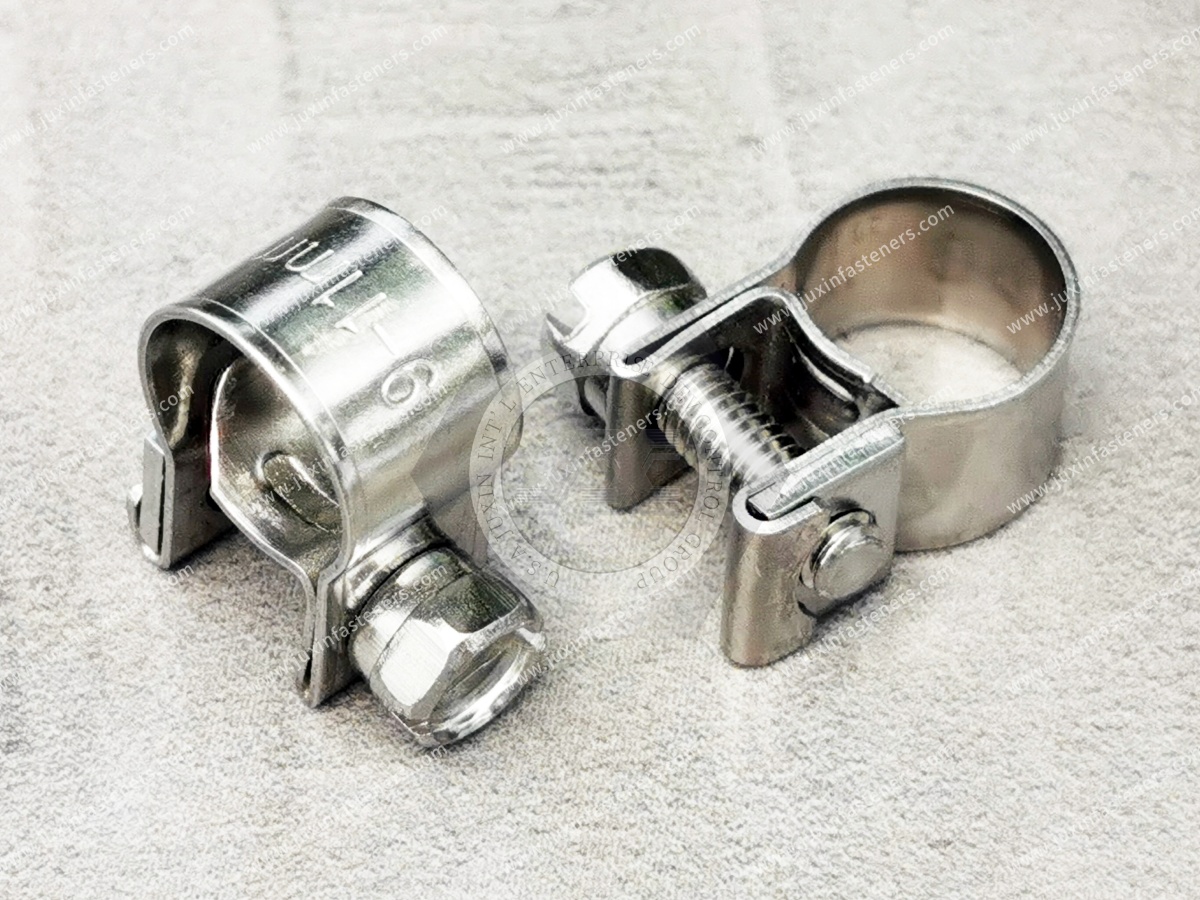
A metal clamp may tolerate temperatures that the hose or coating cannot.
Conversely, thermal expansion and contraction can alter joint behavior even when the clamp material itself remains within an acceptable temperature range.
Temperature evaluation should consider:
Hose
Fitting
Clamp
Finish
Fluid
Thermal cycling
Do not assign a universal hose-clamp temperature limit without a defined specification.
Automotive and industrial equipment can expose hose connections to vibration and movement.
Important factors can include:
Hose routing
Clamp position
Fitting support
Engine or equipment movement
Pressure pulsation
Thermal cycling
A worm-drive clamp may be suitable for many dynamic applications, but “vibration-proof” should not be used as an unconditional claim.
The complete assembly should be validated under actual service conditions.
Potential causes include:
Clamp too large
Clamp too small
Incorrect clamp position
Damaged hose
Incorrect hose size
Damaged fitting
Insufficient tightening
Excessive tightening
Hose relaxation
Thermal cycling
Surface contamination
The first troubleshooting step should be to identify where the sealing interface failed.
A loose clamp can result from:
Incorrect initial installation
Hose compression or relaxation
Thermal cycling
Incorrect clamp size
Housing or screw damage
Dynamic movement
Do not assume that every loosening problem is caused by poor screw locking.
The hose itself may have changed dimension.
Possible causes include:
Excessive tightening
Incompatible band geometry
Hose too soft for the selected clamp
Incorrect band width
Poor clamp positioning
Damaged band edge
Changing to a different clamp architecture may be more appropriate than simply reducing or increasing torque.
This can indicate:
Damaged band engagement
Damaged screw
Housing deformation
Clamp operating outside its intended range
Excessive prior tightening
The clamp should be inspected and replaced if its engagement mechanism is damaged.
Possible causes include:
Material unsuitable for the environment
Inappropriate coating
Chemical exposure
Moisture retention
Galvanic interaction
Incorrect assumption about component materials
For corrosive applications, define the environment during sourcing rather than requesting simply a “rust-proof hose clamp.”
Worm-drive hose clamps can be used in suitable automotive and vehicle-related assemblies such as:
Cooling-related hose connections
Air and ventilation connections
Fluid lines where the joint architecture permits
Service and maintenance connections
Auxiliary equipment
Not every automotive hose joint should use a worm-drive clamp.
Production automotive systems may use other clamp technologies depending on the hose, fitting, assembly process, and OEM requirements.
Hose clamps can be used in suitable HVAC and thermal-management systems involving:
Flexible hoses
Cooling loops
Pumps
Heat-exchange equipment
Auxiliary fluid circuits
For these applications, engineers should consider:
Fluid
Hose material
Operating temperature
Pressure
Vibration
Corrosion environment
Serviceability
This is particularly relevant for industrial cooling and thermal-management equipment.
Modern data centers and AI/HPC infrastructure increasingly use liquid-cooling equipment in addition to traditional air cooling.
Depending on the equipment architecture, flexible hose connections can appear in:
Cooling distribution equipment
Pump assemblies
Heat-exchange equipment
Auxiliary cooling loops
A worm-drive hose clamp should only be used where it is compatible with the specific hose-and-fitting design.
For liquid-cooling systems, leak-control requirements can be stringent, so the complete connection should be validated according to the equipment manufacturer's engineering requirements.
Industrial machines use hose connections for functions such as:
Cooling
Lubrication
Air handling
Low- and application-specific fluid circuits
Clamp selection should consider equipment vibration, hose routing, maintenance requirements, and operating environment.
For OEM machinery, consistent clamp dimensions can also support repeatable assembly.
Agricultural machinery and outdoor equipment can expose hose clamps to:
Water
Dirt
Fertilizers
Chemicals
Vibration
Temperature changes
Material and coating selection should therefore be based on the actual environment.
Stainless steel may be considered for suitable applications, but the required grade and complete clamp construction should be defined according to the project.
Marine-related applications require careful material selection.
Simply specifying “stainless steel” may not provide enough information.
Consider:
Stainless grade
Band material
Screw material
Housing material
Chloride exposure
Dissimilar-metal contact
Maintenance environment
The complete assembly should be reviewed for the intended service conditions.
A worm-drive clamp is manually adjusted to a defined installed condition.
A constant-tension clamp uses a different mechanical architecture intended to accommodate dimensional changes within its designed operating range.
Where substantial thermal cycling or hose relaxation is expected, engineers may compare these technologies.
They should not be treated as identical products.
T-bolt clamps use a different tightening and band architecture and may be selected for applications with different load, size, or joint requirements.
A T-bolt clamp is not automatically “better” than a worm-drive clamp.
Selection should follow the hose connection requirements.
Spring-band clamps use elastic spring behavior to maintain clamping action over their designed range.
They can be appropriate for certain applications involving dimensional changes or production assembly requirements.
Again, the technology differs from a worm-drive clamp.
The correct choice depends on:
Hose
Fitting
Temperature
Service environment
Assembly process
Maintenance requirements
For an OEM or drawing-controlled hose clamp, relevant characteristics can include:
Minimum clamping diameter
Maximum clamping diameter
Band width
Band thickness where required
Band architecture
Housing geometry
Screw specification
Band material
Housing material
Screw material
Finish
Critical dimensions
Customer-specific requirements
Performance requirements should only be specified where they are technically defined and can be appropriately validated.
For second-source development, sending only the existing clamp can be insufficient.
The supplier may reproduce the clamp geometry accurately but still not understand the actual operating interface.
Where possible, provide:
Approved clamp sample
Hose specification
Fitting drawing or sample
Installed hose OD
Application environment
This provides a stronger basis for technical review.
When qualifying an alternative supplier, compare more than clamp diameter.
Review:
Diameter range
Band width
Band thickness where controlled
Band design
Housing
Screw
Component materials
Finish
Installation requirements
Hose compatibility
Application requirements
For production programs, dimensional and assembly validation should be performed according to the customer's qualification process.
Provide:
Required clamping range
Hose OD
Band width
Material
Finish where applicable
Quantity
Application
Service environment
If you are replacing an existing catalog clamp, include the manufacturer and part number where available.
Provide:
2D drawing
Required diameter range
Band width
Band geometry
Component materials
Finish
Hose specification
Fitting information
Application
Order quantity
Annual volume
Any special performance requirements should be clearly defined rather than assumed.
For an existing production clamp, provide where available:
drawing + unused approved sample + hose specification + fitting information + installed OD + material + finish + annual demand.
Also identify the reason for second-source development, such as:
Supply continuity
Capacity
Regional sourcing
Lead-time reduction
Cost review
Supplier discontinuation
Quality improvement
This helps align technical qualification with the commercial sourcing objective.
Related engineering and sourcing resources include:
Stainless Steel Fasteners
Custom Fasteners
Automotive Fasteners
HVAC Fasteners
Industrial Machinery Fasteners
Custom Stamped Components
CNC Machined Components
Second-Source Fasteners
These resources can support OEM projects where the hose clamp is part of a larger mechanical assembly or sourcing package.
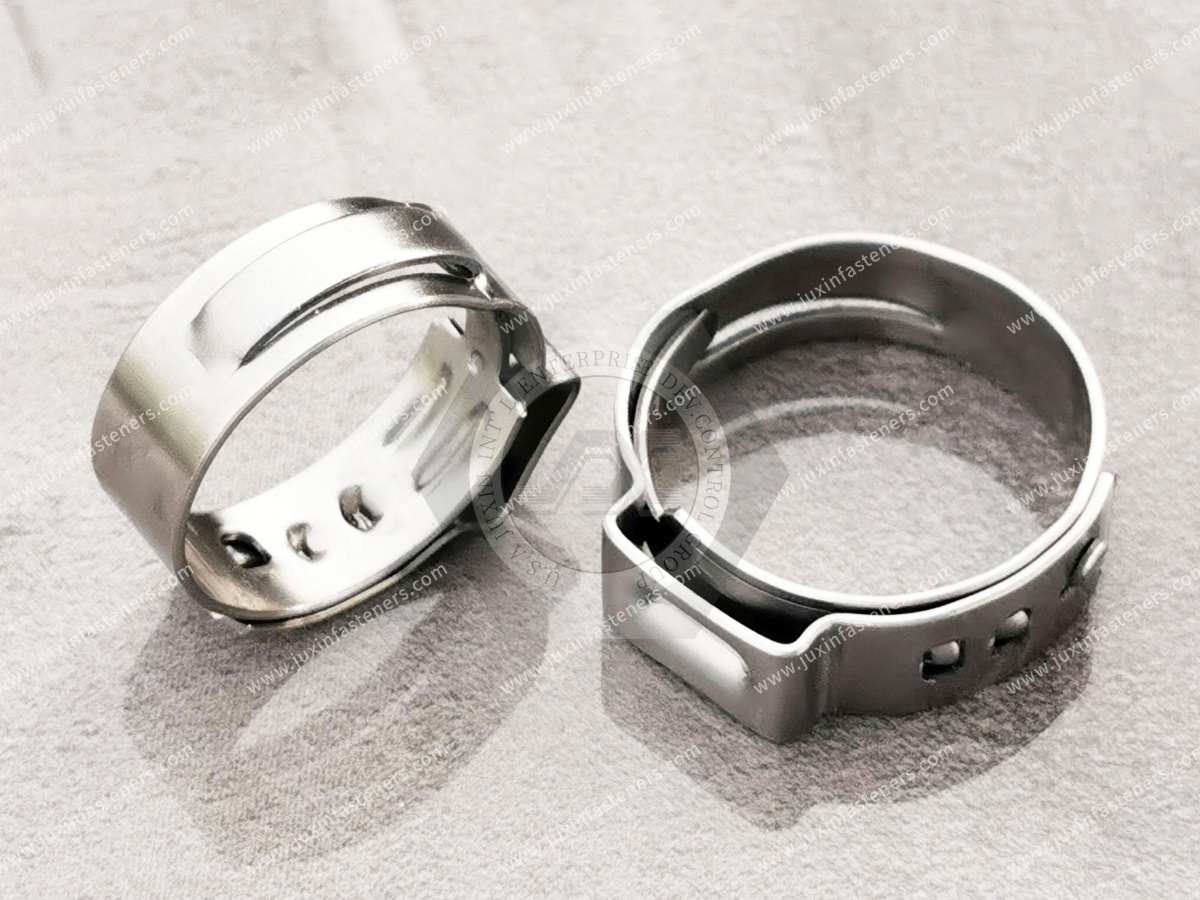
JUXIN FASTENERS supports industrial fasteners and custom components for global OEM, equipment-manufacturing, and supply-chain projects.
For hose clamp sourcing, technical review can begin from:
Existing product specification
Customer drawing
Approved sample
Hose and fitting information
Material requirements
Application requirements
Annual volume
For second-source programs, the objective should be to match the required interface and specification rather than simply finding a clamp with a similar appearance.
The most important engineering principle is:
A hose clamp should be selected as part of the complete hose-to-fitting connection.
For engineers, the decision path should be:
fluid and environment → hose → fitting → installed hose OD → clamp architecture → diameter range → material → installation → validation.
For procurement teams, the sourcing path should be:
drawing or existing sample → clamp range → band geometry → component materials → hose/fitting interface → application → annual demand → qualification requirements.
If you require worm-drive hose clamps, stainless steel hose clamps, custom clamps, or an alternative supplier for an existing OEM program, send JUXIN FASTENERS your available technical information.
For an existing part, provide the drawing and unused approved sample where available.
For a new application, provide the hose OD, hose specification, fitting information, required clamp range, material, environment, and expected quantity.
For second-source development, include the existing clamp, hose/fitting interface information, current specification,
and annual demand so the proposed component can be evaluated against the actual assembly.
Email: info@juxinfasteners.com
Website: www.juxinfasteners.com
Previous: Hose Clamps for Reducers
 MORE NEWS
Sep. 27, 2026
Sep. 27, 2026
Sep. 27, 2026
Contact Us
Tel.:
+86 020 8621 0320
+86 020 3121 6067
E-mail:
Technical Support:
Navigation
SEND INQUIREY