
Call Us
+86 136 6007 9809
Call Us
+86 136 6007 9809

Aug. 11, 2026
Visual Appearance of Electroplated Fasteners (Engineering Reference Only)
At Juxin Fasteners, we often receive inquiries from global customers regarding the visual appearance of zinc-plated fasteners, especially when comparing
parts from different suppliers or production batches.
This guide is intended to help engineers, buyers, and quality control teams better understand the natural variation in zinc plating color and surface finish.
The appearance of the electroplated surface should be treated as a visual reference only, not as an acceptance standard unless explicitly agreed upon in advance.
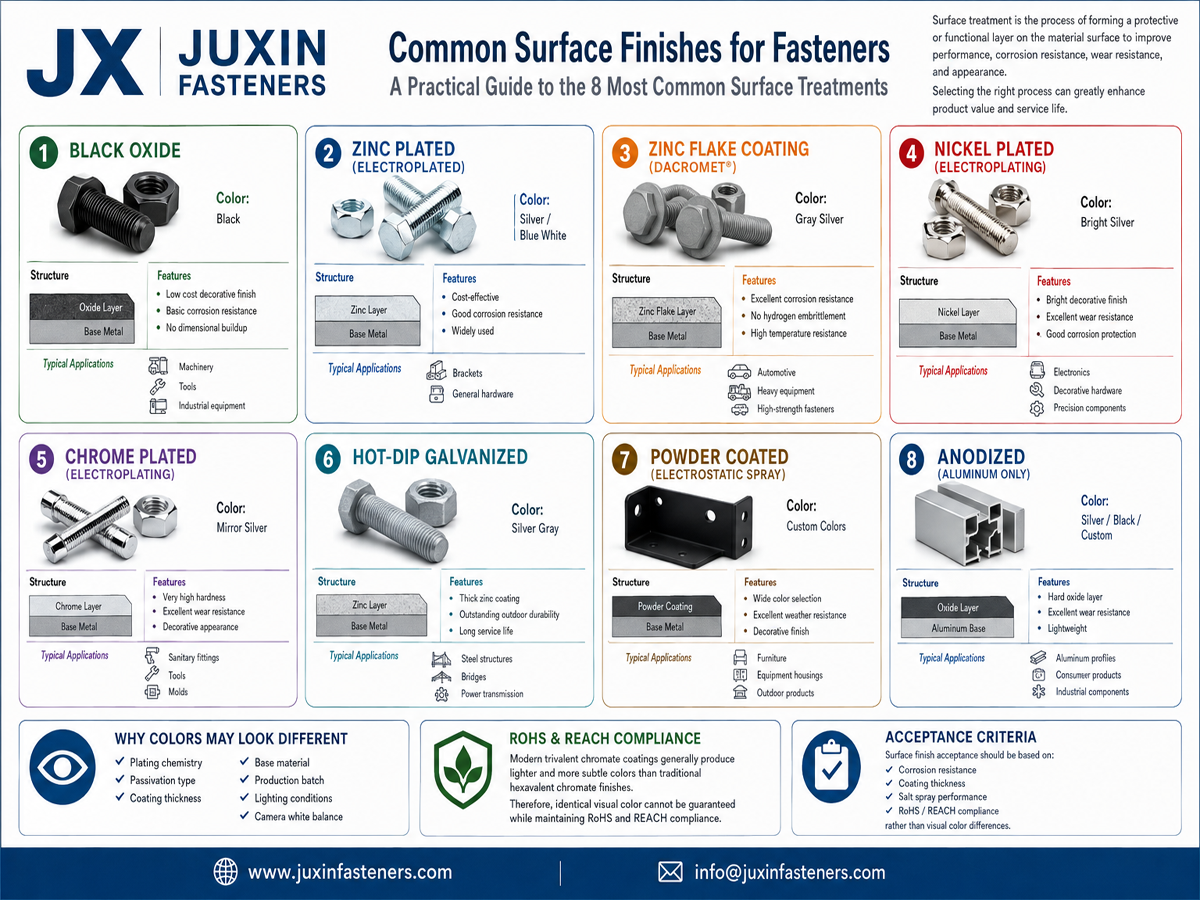
Important Notice: Zinc Plating Appearance Variations
The appearance of zinc-plated parts may vary depending on multiple process and environmental factors, including:
Plating chemistry and process control
Passivation type (trivalent or hexavalent chromate)
Substrate material and steel composition
Coating thickness
Production batch differences
Lighting conditions during inspection
Photography and display settings
Color should never be used as the sole acceptance criterion unless the supplier and the customer have agreed upon a specific visual standard
or master sample.
Zinc Plating Color Reference (Industry Typical Appearance)
1. Clear / Blue Zinc (Trivalent Zinc Plating)
Most commonly used in modern RoHS-compliant fasteners and automotive applications.
Typical appearance:
Silver
Light blue tint
Slight rainbow reflection
Key characteristics:
✔ RoHS & REACH compliant
✔ Widely used in automotive & electronics
✔ Balanced corrosion resistance and cost
2. Yellow Zinc (Chromate Conversion Coating)
Traditional appearance used in general industrial fasteners.
Typical appearance:
Golden yellow
Light yellow
Iridescent yellow
Notes:
Color variation is significant between suppliers
Trivalent yellow zinc differs visually from hexavalent yellow zinc
Often used where higher corrosion resistance is required
3. Black Zinc
Widely used in automotive trim and industrial assemblies requiring darker aesthetics.
Typical appearance:
Matte black
Gloss black
Dark gray
Notes:
Organic sealing can deepen color tone
Appearance varies depending on passivation process
4. Olive Drab Zinc (Military / Industrial Applications)
Typical appearance:
Military green
Dark olive green tones
Used in:
Defense applications
Heavy industrial equipment
Special OEM projects
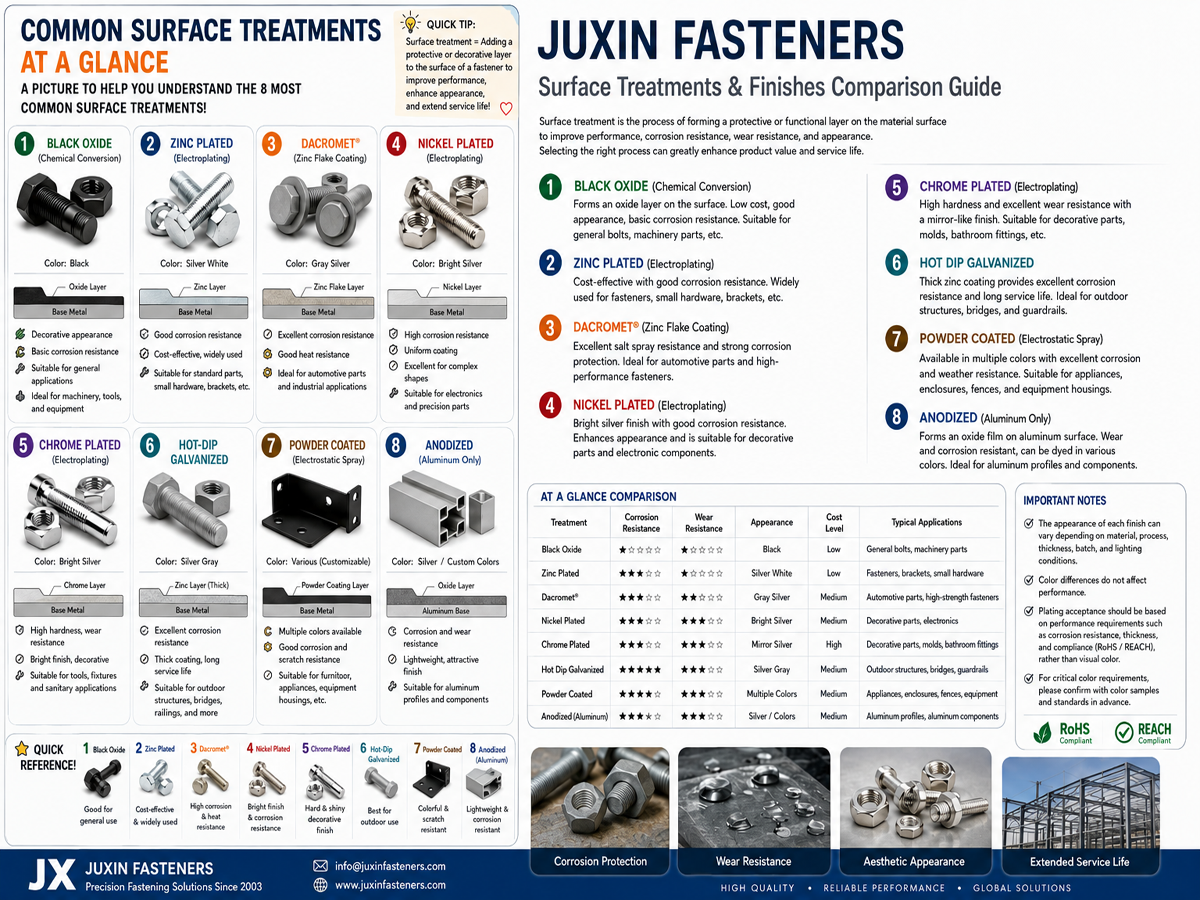
5. Zinc Nickel Coating (High Corrosion Resistance)
One of the most important coatings for modern OEM fasteners, especially in EV and new energy industries.
Typical appearance:
Silver gray
Light gray
Slight blue-gray tone
Key performance:
✔ 720h+ salt spray resistance
✔ Up to 1000h+ depending on system
✔ Widely used in new energy vehicles and high-end automotive systems
This coating is a core solution for corrosion-resistant fasteners and automotive-grade zinc-nickel-plated components.
6. Mechanical Galvanized
Typical appearance:
Matte gray
Rough surface texture
Characteristics:
Cold mechanical coating process
No electroplating
Used for high-durability industrial parts
7. Hot Dip Galvanized
Typical appearance:
Dark gray
Rough and thick coating layer
Characteristics:
Very high coating thickness
Excellent corrosion resistance
Common in construction and outdoor structural fasteners
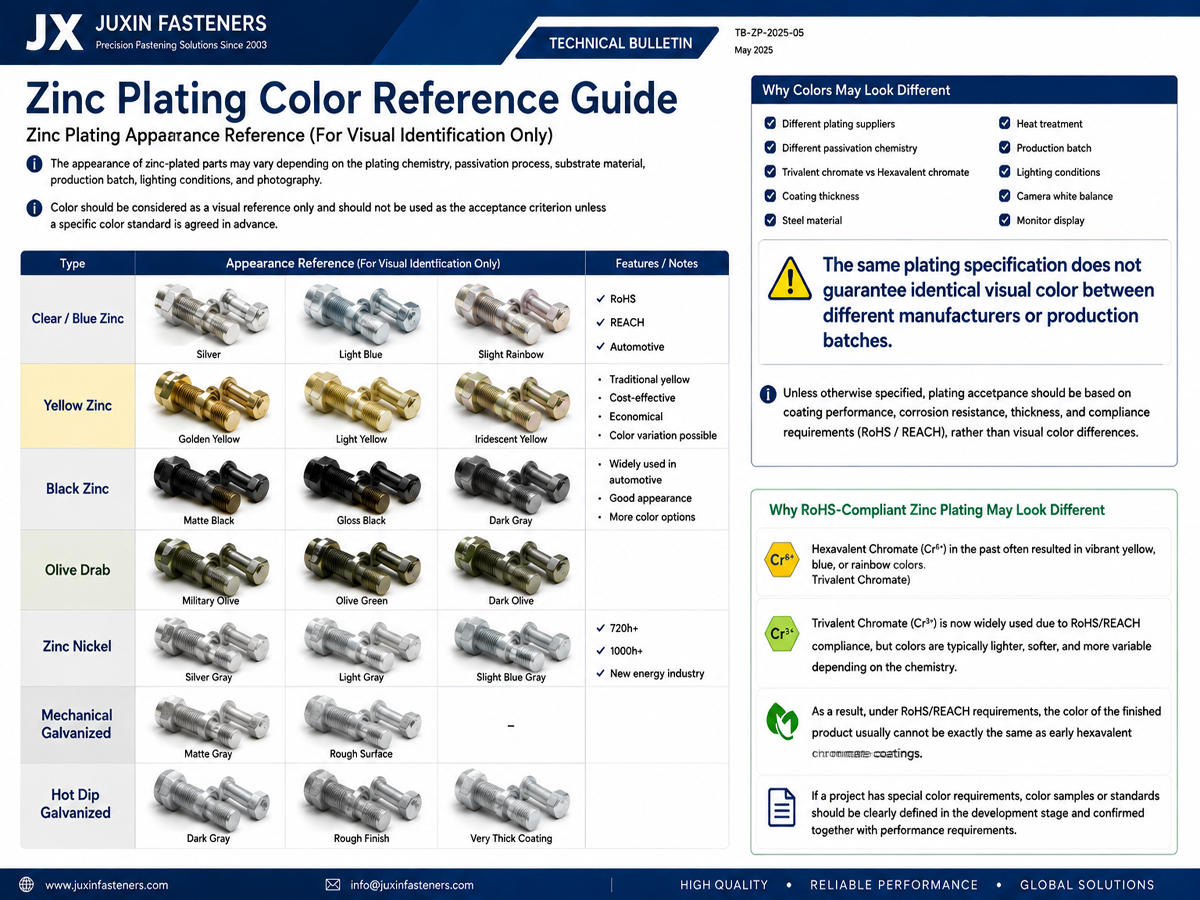
Why Zinc Plating Colors May Look Different
Color differences are among the most common sources of misunderstanding in global fastener procurement.
The same plating specification does NOT guarantee identical visual color between different manufacturers or production batches.
This is due to:
Different plating suppliers
Different passivation chemistry systems
Trivalent vs hexavalent chromate processes
Coating thickness variation
Steel substrate differences
Heat treatment conditions
Production batch variation
Lighting conditions during inspection
Camera white balance differences
Monitor or screen display variation
The same plating specification does NOT guarantee identical visual color between different manufacturers or production batches.
Engineering Acceptance Principle
Unless otherwise specified, plating acceptance should be based on:
Coating thickness
Corrosion resistance (salt spray performance)
Mechanical performance
RoHS / REACH compliance
Functional durability
NOT visual color differences.
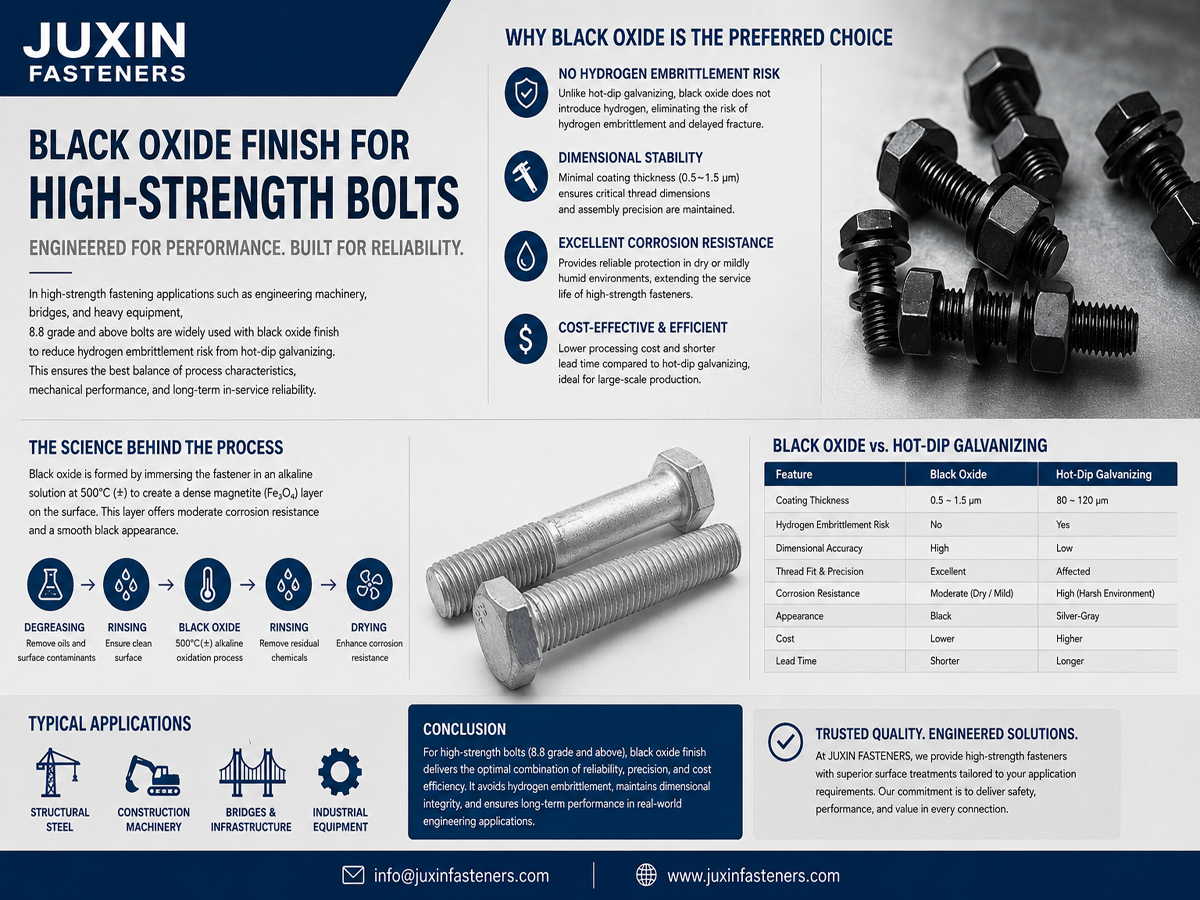
Why RoHS-Compliant Zinc Plating May Look Different
Many customers expect modern plating to match older visual references, but this is often not technically possible.
Historically, hexavalent chromate (Cr6+) coatings produced:
Bright yellow tones
Strong rainbow iridescence
Highly saturated blue/yellow finishes
However, due to environmental regulations, the industry has shifted toward:
Trivalent chromate (Cr3+) systems
RoHS & REACH compliant coatings
Safer and more stable chemical processes
As a result:
Colors are typically lighter and softer
Yellow tones are less intense
Batch-to-batch variation is more noticeable
Different chemical systems produce different visual outputs
If a project requires both RoHS compliance and strict color matching, this must be defined at the engineering stage with agreed visual samples.
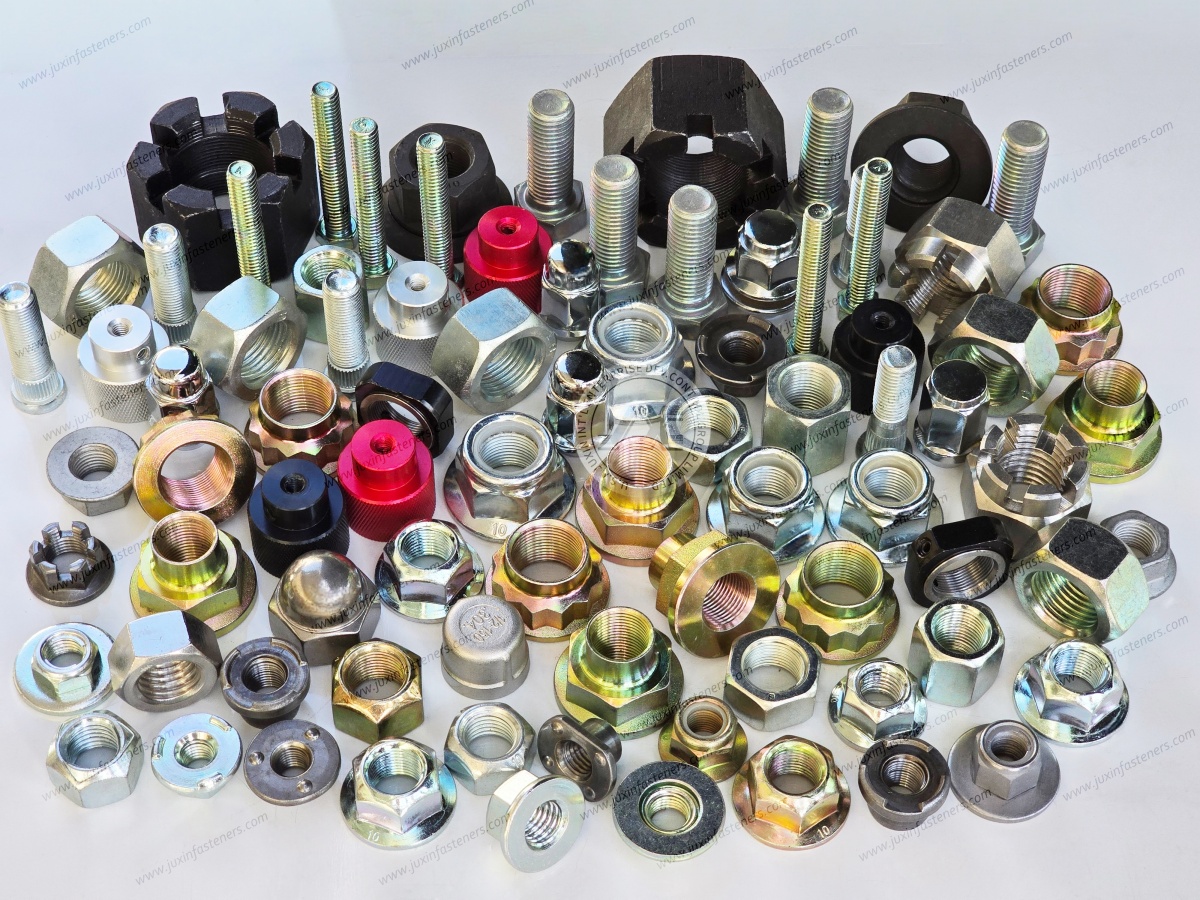
Application in OEM Fasteners & Precision Components
At Juxin Fasteners, we supply a wide range of:
Zinc plated fasteners
Zinc nickel coated fasteners
Custom CNC machining parts
Non-standard OEM fastener solutions
Our coatings are widely used in:
Automotive manufacturing
New energy vehicles (EV systems)
Electrical enclosures
Industrial equipment
Construction and infrastructure
Telecom and electronics assemblies
We support full-process manufacturing including:
CNC machining
Cold forging
Stamping
Threading
Full inspection control
Conclusion
The appearance of zinc plating is influenced by chemistry, process, and environment. It should always be treated as a reference characteristic,
not a strict acceptance criterion.
For engineering-grade procurement, performance and compliance are more important than visual color consistency.
Need Technical Support?
If your project requires:
Stable zinc plating quality
Zinc nickel corrosion protection systems
RoHS / REACH compliant fasteners
OEM custom fastening solutions
You can contact us at:
Email: info@juxinfasteners.com
 MORE NEWS
Sep. 27, 2026
Sep. 27, 2026
Sep. 27, 2026
Contact Us
Tel.:
+86 020 8621 0320
+86 020 3121 6067
E-mail:
Technical Support:
Navigation
SEND INQUIREY