Call Us
+86 136 6007 9809
Call Us
+86 136 6007 9809

Why High-Strength Bolts Are More Prone to Hydrogen Embrittlement Failure
Engineering Prevention Strategy for Critical Fastener Applications (Wind Energy, Automotive & Chemical Equipment)
Hydrogen embrittlement (HE) is one of the most dangerous and unpredictable failure modes in high-strength fastener systems. It is especially common in critical applications such as:
Wind turbine tower flange bolted joints
Automotive chassis and suspension fasteners
Chemical processing equipment bolted connections
Pressure vessels and high-load structural assemblies
A striking engineering paradox is often observed:
Higher-strength bolts (10.9, 12.9 grades) fail more frequently than lower-strength bolts (4.8, 6.8 grades).
This “stronger but more fragile” phenomenon is not accidental—it is governed by deep interactions between metallurgy, electrochemistry, and stress mechanics in ISO/DIN high-strength bolt systems.
Product Specification
Why High-Strength Bolts Are More Prone to Hydrogen Embrittlement Failure
Engineering Prevention Strategy for Critical Fastener Applications (Wind Energy, Automotive & Chemical Equipment)
Hydrogen embrittlement (HE) is one of the most dangerous and unpredictable failure modes in high-strength fastener systems. It is especially common in critical applications such as:
Wind turbine tower flange bolted joints
Automotive chassis and suspension fasteners
Chemical processing equipment bolted connections
Pressure vessels and high-load structural assemblies
A striking engineering paradox is often observed:
Higher-strength bolts (10.9, 12.9 grades) fail more frequently than lower-strength bolts (4.8, 6.8 grades).
This “stronger but more fragile” phenomenon is not accidental—it is governed by deep interactions between metallurgy, electrochemistry, and stress mechanics in ISO/DIN high-strength bolt systems.
1. Conditions Required for Hydrogen Embrittlement in Fasteners
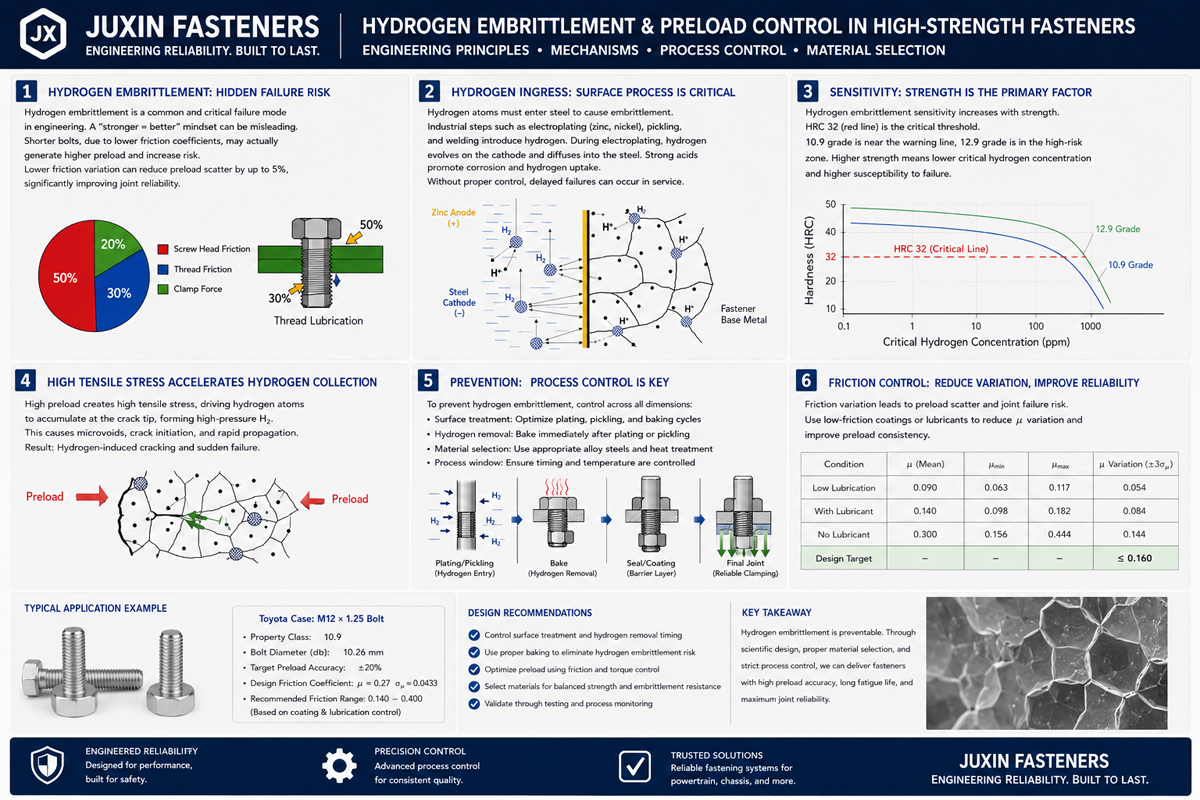
Hydrogen embrittlement does not occur randomly. It requires three simultaneous conditions:
1.1 Susceptible material: high-strength steel as a “precondition.”
Hydrogen embrittlement primarily affects:
Quenched and tempered steels ≥ 8.8 grade
Especially ISO 10.9 and ISO 12.9 high-strength bolts
These materials contain:
Martensitic or tempered martensitic structures
High dislocation density
Crystal lattice defects acting as hydrogen traps
In contrast:
Low-carbon steels (4.8, 6.8 grades) have fewer lattice defects
Lower hydrogen trapping ability
Significantly lower embrittlement sensitivity
1.2 Hydrogen source: surface treatment as the main entry path
Hydrogen enters steel through industrial processes such as:
Acid pickling before electroplating
Electro-galvanizing or zinc electroplating
Welding and thermal processing
Service corrosion in humid or H₂S environments
During electroplating:
Hydrogen ions are reduced and absorbed into the steel lattice under an electric current.
This makes fastener surface-treatment processes the most critical risk factor for hydrogen embrittlement.
1.3 Tensile stress: the driving force for crack formation
Hydrogen embrittlement occurs only under tensile stress.
In high-strength bolted joints:
Preload often reaches 70–90% of yield strength
Thread root stress concentration factor = 3–5
This creates a high-stress zone that:
Attracts hydrogen atoms
Promotes hydrogen accumulation at grain boundaries
Triggers micro-crack formation and delayed fracture
1.4 Temperature sensitivity: Room temperature is the most dangerous
Hydrogen embrittlement is most critical at:
Room temperature (service condition)
At extreme temperatures:
Low temperature → hydrogen diffusion slows
High temperature → hydrogen escapes from steel
This explains why failures often occur:
Hours, days, or even months after installation of high-strength industrial fasteners
2. Why High-Strength Bolts Are More Vulnerable
The contradiction lies in the relationship between strength and brittleness.
2.1 Hardness threshold effect (HRC 32 critical limit)
Hydrogen embrittlement risk increases exponentially with hardness:
8.8 grade bolts: HRC 22–32 (near threshold)
10.9 grade bolts: HRC 32–39 (high risk zone)
12.9 grade bolts: HRC 39–44 (critical embrittlement zone)
Above HRC 32, grain boundary cohesion decreases, making crack propagation easier.
2.2 High tensile stress accelerates hydrogen accumulation
High-strength bolts are designed for high preload, but this increases risk:
Stress concentration enhances hydrogen diffusion
Crack tips attract hydrogen atoms
Local hydrogen concentration increases dramatically
This creates a self-accelerating failure loop:
Stress → hydrogen accumulation → crack growth → more hydrogen concentration
2.3 Reduced ductility: no warning before fracture
Compared with lower-grade bolts:
12.9 bolts: elongation ≥ 8%
8.8 bolts: elongation ≥ 12%
Although the difference appears small, in hydrogen environments:
Plastic deformation capacity is drastically reduced
Crack propagation becomes extremely fast
No visible necking before fracture
This makes failure:
Sudden, brittle, and highly dangerous in structural bolted joint systems
3. Engineering Prevention Strategy for Hydrogen Embrittlement
Effective hydrogen embrittlement control requires a system-level approach:
Reduce hydrogen + remove hydrogen + control stress + optimize material selection
3.1 Surface treatment: eliminate hydrogen sources
The most effective solution is avoiding hydrogen-generating processes:
Preferred options for industrial fasteners:
Mechanical galvanizing
Zinc-aluminum flake coating (Dacromet / Geomet-type systems)
Non-electrolytic coating systems
These methods eliminate electrochemical hydrogen generation.
If electroplating is unavoidable:
Minimize acid pickling time
Avoid rework plating cycles
Perform baking immediately after plating
3.2 Hydrogen relief baking: time-critical process
Hydrogen removal must be performed quickly after plating:
Recommended parameters:
Temperature: 200 ± 10°C
Duration:
10.9 grade: ≥ 2 hours
12.9 grade: 3–4 hours
Critical rule:
Baking must occur before passivation.
Otherwise, hydrogen becomes trapped beneath the coating layer, increasing the risk of failure in high-strength fastener systems.
3.3 Material selection: balancing strength and safety
Preferred materials:
42CrMo
35CrMo
These medium-carbon alloy steels:
Provide balanced strength and toughness
Have lower hydrogen trap density
Exhibit improved resistance to delayed fracture
Avoid:
Over-hardened tool steels
Improperly tempered high-carbon steels
3.4 Design optimization: stress control strategy
Engineering design should reduce hydrogen-triggering stress:
Limit preload to 70–80% of yield strength
Avoid over-tightening in critical joints
Prefer lower-grade bolts (≤ 8.8) for coated systems when possible
Introduce shot peening to create compressive surface stress
These methods significantly reduce the risk in ISO/DIN bolted structural connections.
4. Engineering Insight: The Real Root Cause
Hydrogen embrittlement is not solely a material defect.
It is the result of a coupled system:
High-strength microstructure
Hydrogen diffusion mechanisms
High tensile stress fields
The fundamental contradiction is:
Higher strength simultaneously increases hydrogen-trapping sensitivity and stress concentration.
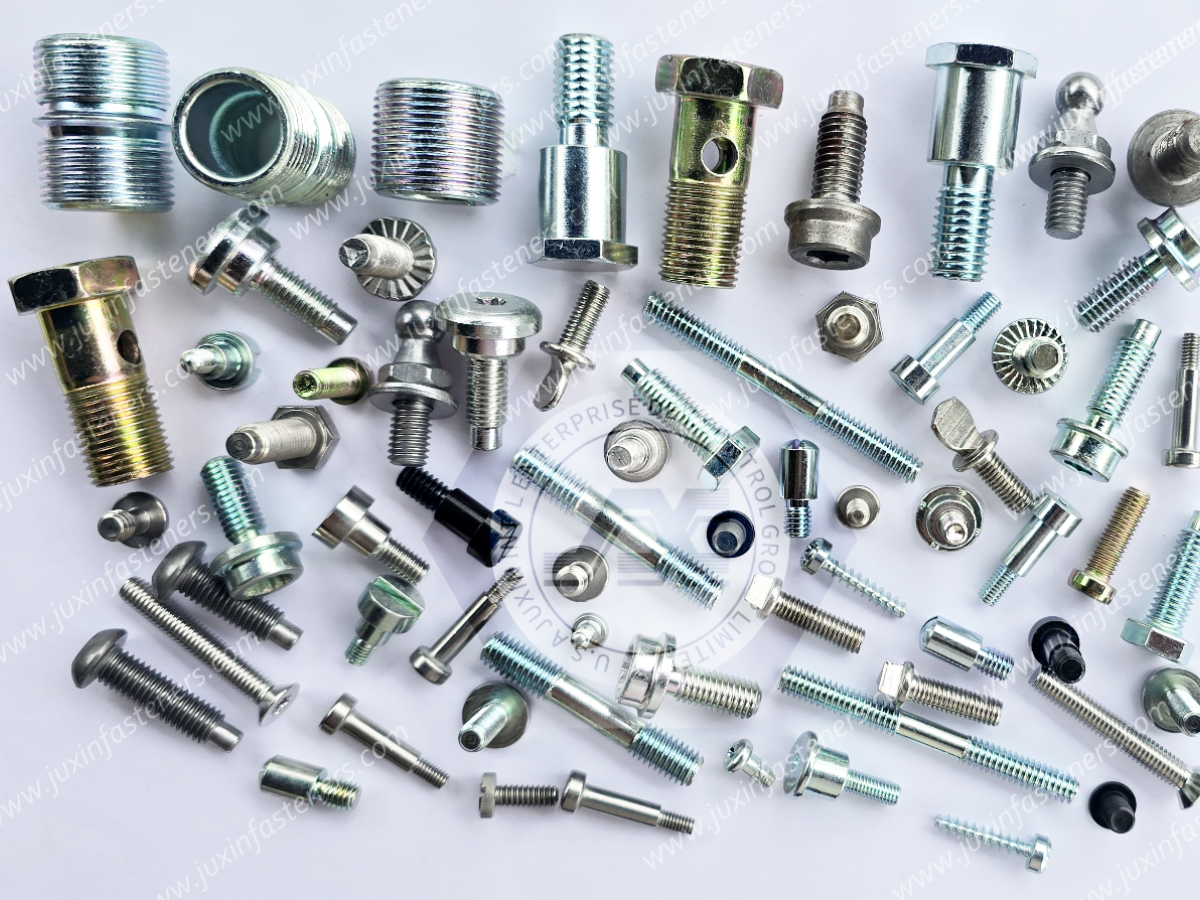
5. Engineering Fastener Solutions from JUXIN FASTENERS
At JUXIN FASTENERS, we provide engineered fastening solutions designed for hydrogen-sensitive environments, including:
Zinc-aluminum flake-coated high-strength fasteners (hydrogen-free coating systems)
ISO/DIN compliant structural bolts for wind energy applications
Automotive-grade fasteners with controlled hydrogen embrittlement risk
Chemically resistant fastener systems for corrosive environments
Customized coating and preload-controlled fastening solutions
Our engineering focus:
Preventing failure not by increasing strength alone, but by controlling hydrogen, stress, and surface chemistry as a system.
Conclusion
High-strength bolts are more susceptible to hydrogen embrittlement because:
Their microstructure traps hydrogen more easily
Their high preload creates strong tensile stress fields
Their low ductility allows no warning before fracture
Effective prevention requires:
Hydrogen-free surface treatments
Strict baking process control
Rational material selection
Controlled preload and structural design
In modern industrial fastener engineering, reliability is not achieved by maximum strength—but by balanced control of material, process, and stress interaction.
Product Packaging
Packaging Standard
At Juxin Fasteners, we apply standardized export packaging to ensure product protection, traceability, and compliance with international logistics requirements.
1. Standard Export Packaging
Unless otherwise specified, all products will be packed according to our factory standard export packaging, which includes:
Moisture-resistant inner protection
Poly bag or small box packing as required
Reinforced export cartons
Clear labeling with part number, specification, batch number, and quantity
Palletizing for sea or air shipment when necessary
Our standard packaging is designed to ensure safe transportation, efficient warehousing, and long-distance international shipping.
2. Customized Packaging Options
We also provide customized packaging solutions according to customer requirements, including but not limited to:
Private labeling
Customized barcodes
Specific carton dimensions
Retail packaging
Special pallet configuration
Customer-specific marking and identification
So that you know, customized packaging may involve additional costs and extended lead time depending on the complexity of the requirements.
3. Compliance & Quality Assurance
All packaging processes are controlled under our ISO 9001 quality management system to ensure consistency, traceability, and product integrity throughout the supply chain.
Product Pictures
Contact Us
Tel.:
+86 020 8621 0320
+86 020 3121 6067
E-mail:
Technical Support:
Navigation
SEND INQUIREY