Call Us
+86 136 6007 9809
Call Us
+86 136 6007 9809

How to Determine Tightening Torque When Bolt Friction Coefficient Is Not Specified
Engineering Solution for Preload Control in Industrial Fastener Systems
In industrial engineering, bolted joints and threaded fasteners are widely used in machinery, automotive systems, wind energy structures, and heavy equipment. However, one critical design challenge is often overlooked:
When the friction coefficient of fasteners is not clearly specified, how can engineers accurately determine tightening torque?
This issue directly affects bolt preload consistency, fatigue life, and joint reliability, especially in high-strength bolt systems designed according to ISO 898-1 / DIN EN ISO 4762 / ISO bolted joint engineering practices.
Product Specification
How to Determine Tightening Torque When Bolt Friction Coefficient Is Not Specified
Engineering Solution for Preload Control in Industrial Fastener Systems
In industrial engineering, bolted joints and threaded fasteners are widely used in machinery, automotive systems, wind energy structures, and heavy equipment. However, one critical design challenge is often overlooked:
When the friction coefficient of fasteners is not clearly specified, how can engineers accurately determine tightening torque?
This issue directly affects bolt preload consistency, fatigue life, and joint reliability, especially in high-strength bolt systems designed according to ISO 898-1 / DIN EN ISO 4762 / ISO bolted joint engineering practices.
1. Why Friction Coefficient Is Critical in Fastener Torque Control
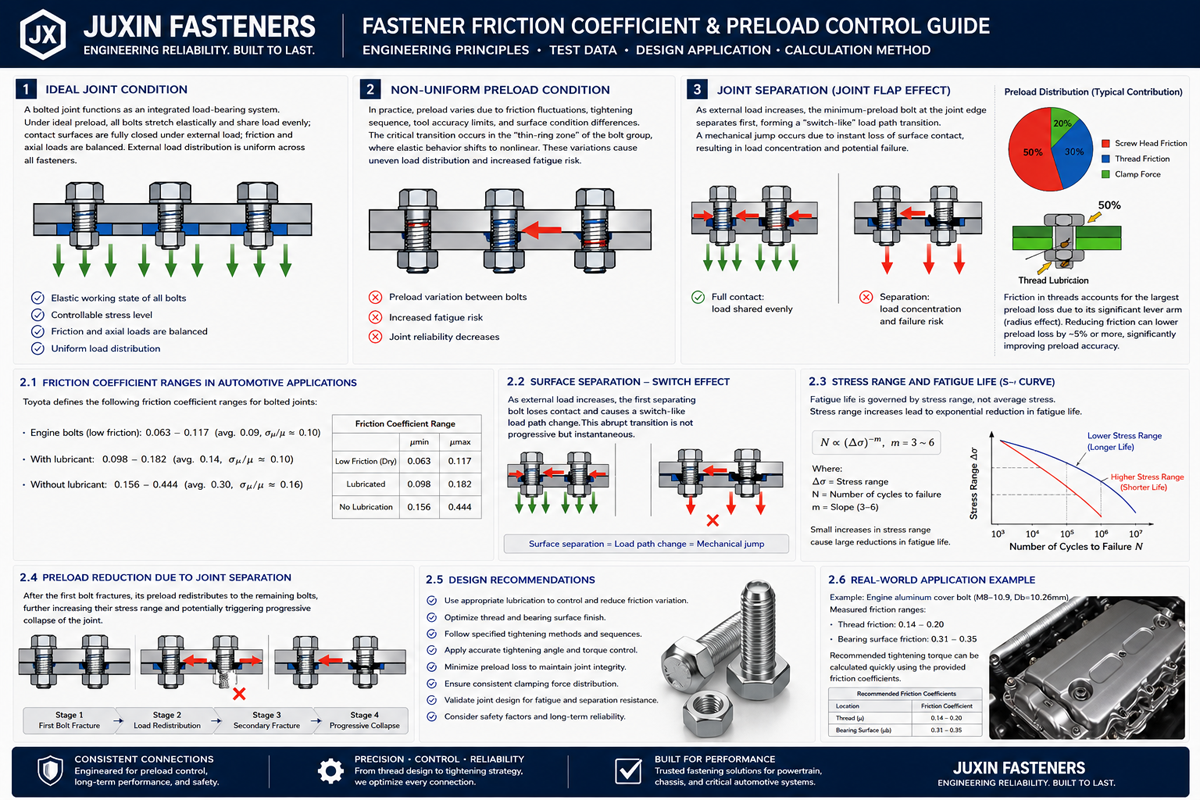
The friction coefficient of a bolted joint is one of the most sensitive parameters in torque-to-preload conversion.
In a typical industrial fastener tightening system:
~50% of the torque is consumed by thread friction
~40% is consumed by bearing surface friction
~10% is converted into actual bolt preload
This is the well-known “50–40–10 torque distribution principle” used in fastener engineering.
Even small variations in the friction coefficient can significantly change the preload:
Slight friction change → large preload deviation
Same tightening torque → drastically different bolt tension
This is why automotive fasteners and high-reliability bolted joints strictly control lubrication conditions.
2. Engineering Reality: When Friction Coefficient Is NOT Defined
In many industries—such as general machinery, construction equipment, and non-OEM supply chains—there is often:
No explicit friction coefficient specification in drawings
No lubrication requirement defined
Surface treatment defined only (e.g., zinc plating, black oxide, phosphate coating)
As a result, fastener suppliers typically deliver bolts without controlled lubrication, leading to significant variability in friction.
This creates a major engineering problem:
Torque values become unreliable without knowing actual friction conditions.
3. Engineering Reference: Japanese OEM Approach to Fastener Torque Design
To solve this problem, automotive engineering—especially Japanese OEM systems—provides a highly practical statistical approach.
For example, in ISC-B11-004J engineering practice, friction coefficient ranges are statistically defined:
Average friction coefficient μ ≈ 0.32
Variation ratio (σμ/μ) ≈ 0.135
Resulting range: approximately 0.19 – 0.45
Using a ±3σ statistical model, engineers define safe design boundaries.
3.1 Toyota-style fastener friction classification
Engineering data used in automotive bolted joint design shows:
Low-friction engine fasteners (lubricated systems)
μ ≈ 0.09
Range: 0.063 – 0.117
σμ/μ ≈ 0.10
Lubricated coated bolts
μ ≈ 0.14
Range: 0.098 – 0.182
σμ/μ ≈ 0.10
Unlubricated fasteners
μ ≈ 0.30
Range: 0.156 – 0.444
σμ/μ ≈ 0.16
Key engineering conclusion
For fasteners without defined friction requirements, a conservative design assumption is:
σμ/μ ≈ 0.16 (uncontrolled surface condition)
This becomes the basis for torque design when no specification is provided.
4. Engineering Method: How to Determine Torque Without Friction Specification
When the friction coefficient is not defined in drawings, a structured engineering procedure should be used.
Step 1: Sample Testing of Fasteners
Select at least 30 samples of industrial bolts and nuts
Use actual assembly condition:
Same nut type
Same washer/bearing surface
Same surface treatment condition
Step 2: Friction Coefficient Measurement
Measure using a calibrated fastener friction coefficient test system in accordance with ISO/DIN testing practice.
Thread friction coefficient
Bearing surface friction coefficient
Step 3: Statistical Analysis
Calculate:
Mean friction coefficient (μ)
Standard deviation (σμ)
Then define range using:
μmin = μ − 3σμ
μmax = μ + 3σμ
This represents real manufacturing variation in fastener surface behavior.
Step 4: Determine Maximum Required Torque
Use μmax to calculate the worst-case tightening condition:
Highest friction → highest torque required
Ensures bolt can still achieve target preload
Step 5: Define Torque Window
Based on design tolerance (e.g. ±10% or ±15%):
Nominal torque
Minimum torque
Maximum torque
This ensures stable preload in high-strength bolted joints.
Step 6: Verify Preload Range
Using μmin and μmax:
Calculate preload range
Verify against structural load requirements
Ensure fatigue safety of ISO/DIN fasteners
5. Engineering Case Study: Zinc Coated Fasteners
A practical test example using zinc–aluminum coated bolts shows:
Measured ranges:
Thread friction coefficient: 0.089 – 0.200
Bearing surface friction coefficient: 0.113 – 0.135
This demonstrates that controlled surface systems can achieve relatively stable friction behavior in industrial fastener applications.
Another case: Zinc-plated bolts with coated washers
Measured results:
Thread friction coefficient: 0.144 – 0.197
Bearing surface friction coefficient: 0.306 – 0.353
Key observation:
Uncontrolled surface combinations lead to a higher average friction coefficient and wider dispersion.
This directly affects torque-to-preload accuracy in structural bolted joints.
6. Torque Calculation Example (M8 High-Strength Fastener)
For an M8-10.9 high-strength bolt system (ISO 898-1):
Friction diameter: 10.26 mm
Measured thread friction: 0.14 – 0.20
Bearing friction: 0.31 – 0.35
Using engineering torque calculation models for industrial threaded fasteners, the result is:
Maximum tightening torque: 48.19 Nm
Recommended tightening specification:
42 Nm ± 6 Nm
Preload result:
Minimum preload: 10.95 kN
Maximum preload: 26.52 kN
This preload range is then evaluated against the structural load requirements of the joint.
7. Engineering Insight: Why Friction Control Matters in Fastener Design
The core issue is not torque itself, but:
Torque is only an indirect method of controlling bolt preload.
Without defined friction coefficients:
Preload scatter increases significantly
Fatigue risk in bolts increases
Multi-bolt joints become unevenly loaded
Structural reliability decreases
This is especially critical in:
Automotive fasteners
Wind turbine bolts
Pressure vessel flange bolts
Rail transit structural joints
8. Engineering Strategy for Real-World Applications
In industrial practice, there are two main approaches:
8.1 Controlled friction design (preferred in OEM systems)
Defined lubrication systems
Controlled coatings (zinc flake, phosphate, dry film lubricant)
Tight μ tolerance range
Used in:
Automotive engines
Chassis systems
Safety-critical assemblies
8.2 Statistical torque design (general industry)
When no friction specification exists:
Measure actual fastener batch
Use statistical μ range (±3σ method)
Define torque based on worst-case friction
Used in:
General machinery
Construction equipment
Industrial maintenance applications

9. Engineering Fastener Solutions from JUXIN FASTENERS
At JUXIN FASTENERS, we provide engineered fastening systems designed for controlled preload performance, including:
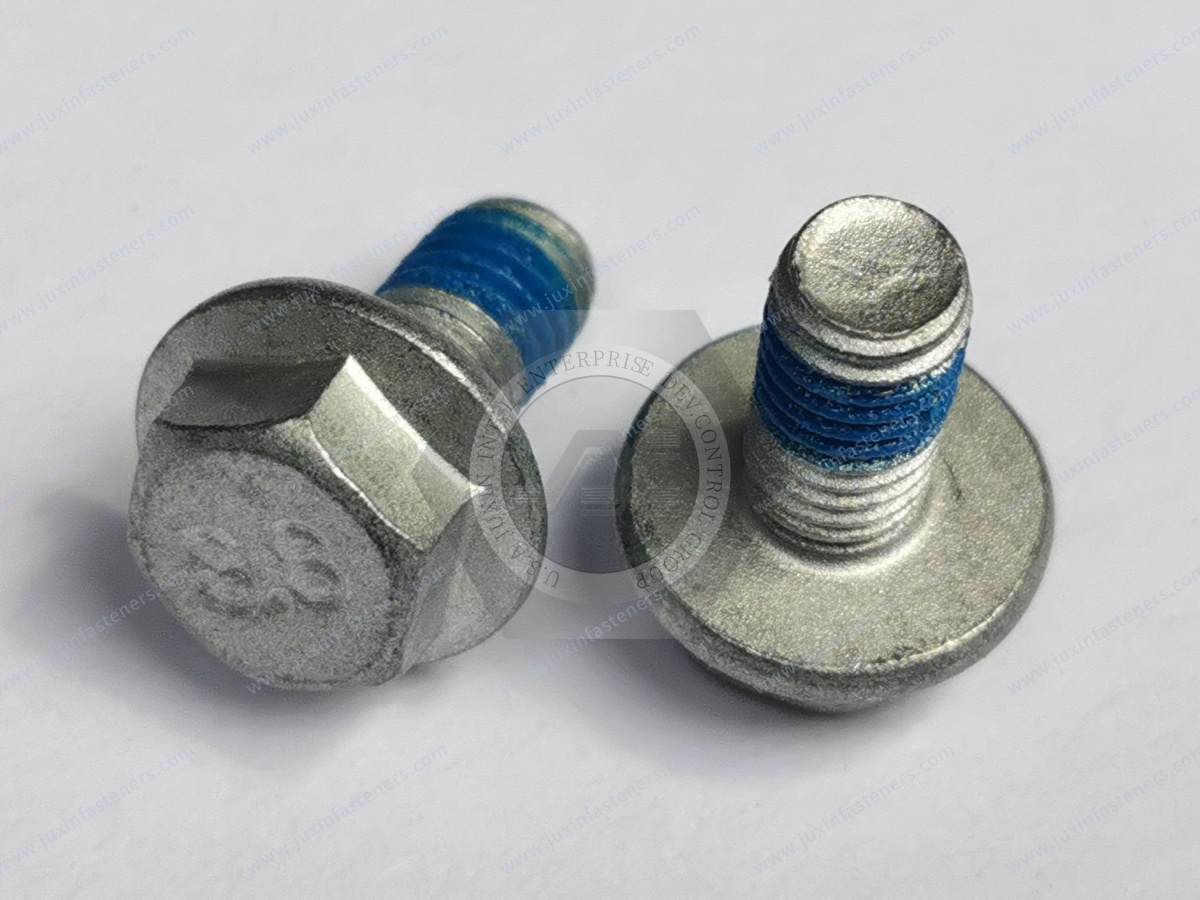
High-strength ISO/DIN fasteners with controlled surface friction systems
Pre-lubricated industrial bolts for stable torque-to-preload conversion
Automotive-grade fasteners for precision tightening applications
Custom-engineered fastener solutions for OEM assembly lines
Surface treatment optimization for friction coefficient control
Our engineering philosophy:
Torque alone is not the solution — controlled friction and predictable preload behavior define real fastening reliability.
Conclusion
When the friction coefficient is not specified in fastener design, torque cannot be determined arbitrarily.
A reliable engineering approach must include:
Statistical measurement of friction variation
ISO/DIN-based bolt system evaluation
Worst-case torque design using μmax
Preload verification under real assembly conditions
Only by controlling or statistically defining friction behavior can industrial fasteners and bolted joints achieve predictable preload and long-term fatigue reliability.

Product Packaging
Packaging Standard
At Juxin Fasteners, we apply standardized export packaging to ensure product protection, traceability, and compliance with international logistics requirements.
1. Standard Export Packaging
Unless otherwise specified, all products will be packed according to our factory standard export packaging, which includes:
Moisture-resistant inner protection
Poly bag or small box packing as required
Reinforced export cartons
Clear labeling with part number, specification, batch number, and quantity
Palletizing for sea or air shipment when necessary
Our standard packaging is designed to ensure safe transportation, efficient warehousing, and long-distance international shipping.
2. Customized Packaging Options
We also provide customized packaging solutions according to customer requirements, including but not limited to:
Private labeling
Customized barcodes
Specific carton dimensions
Retail packaging
Special pallet configuration
Customer-specific marking and identification
So that you know, customized packaging may involve additional costs and extended lead time depending on the complexity of the requirements.
3. Compliance & Quality Assurance
All packaging processes are controlled under our ISO 9001 quality management system to ensure consistency, traceability, and product integrity throughout the supply chain.
Product Pictures
Contact Us
Tel.:
+86 020 8621 0320
+86 020 3121 6067
E-mail:
Technical Support:
Navigation
SEND INQUIREY