Call Us
+86 136 6007 9809
Call Us
+86 136 6007 9809

Why Higher-Strength Bolts Can Show Lower Fatigue Life: An Engineering Solution for Structural Fasteners
In mechanical design, engineers often rely on tensile strength (Rm) and yield strength (Rp0.2) to evaluate whether a fastener is “safe” or “reliable.” This approach works well for static loading conditions, but it becomes misleading when applied to cyclic loading and fatigue-critical bolted joints.
Product Specification
Why Higher-Strength Bolts Can Show Lower Fatigue Life: An Engineering Solution for Structural Fasteners
In mechanical design, engineers often rely on tensile strength (Rm) and yield strength (Rp0.2) to evaluate whether a fastener is “safe” or “reliable.” This approach works well for static loading conditions, but it becomes misleading when applied to cyclic loading and fatigue-critical bolted joints.
Extensive research, including studies from leading European technical institutes, has shown a counterintuitive phenomenon:
Bolts with higher static strength can sometimes exhibit lower fatigue life than lower-strength equivalents.
This finding challenges traditional assumptions about high-strength fasteners, including ISO 898-1 property class 10.9 bolts and DIN 933/DIN 931 structural bolting systems, especially in automotive, wind energy, and heavy equipment applications.
1. Strength vs. Fatigue Life: A Non-Linear Relationship
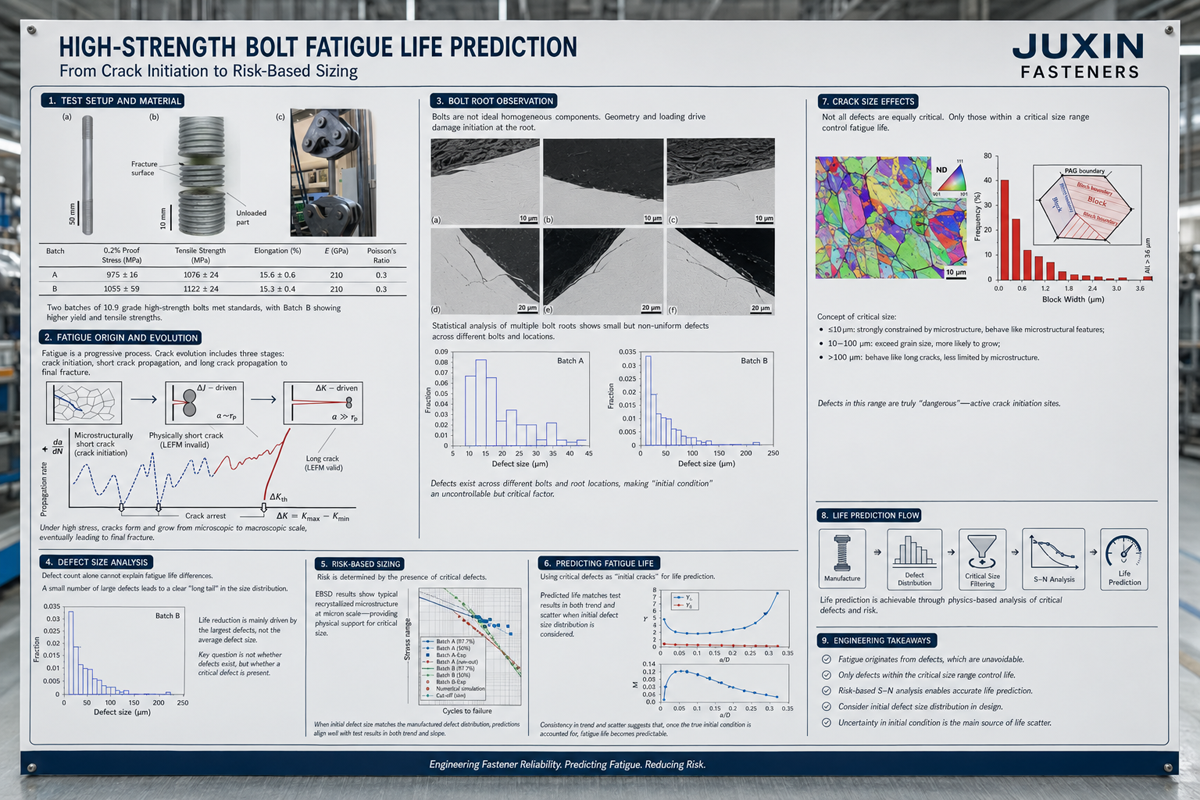
In one comparative study, two batches of nominally identical property class 10.9 high-strength bolts were tested:
Both batches met all tensile strength requirements under static testing
One batch showed a higher yield and ultimate tensile strength
However, in fatigue testing, the higher-strength batch failed earlier
This directly demonstrates a critical engineering principle:
Static strength does not directly correlate with fatigue resistance.
Fatigue performance is governed by damage evolution under cyclic loading, not ultimate load capacity.
2. Fatigue Failure Mechanism in Bolted Joints
Fatigue failure is not instantaneous. It develops through three stages:
Crack initiation
Short crack propagation
Long crack growth leading to final fracture
In most high-cycle fatigue (HCF) applications, the majority of service life is consumed during the crack initiation phase.
For industrial bolted connections, such as:
Wind turbine flange bolts
Automotive suspension fasteners
Engine structural bolts
Heavy machinery jointing systems
The fatigue performance is controlled almost entirely by the evolution of early-stage micro-damage, not by ultimate tensile capacity.
3. The Critical Weak Zone: Thread Root Stress Concentration
A bolted joint is not a uniform stress body.
The most critical fatigue-sensitive region is:
The first engaged thread root inside the nut or tapped hole
Research using microscopic surface analysis shows that:
Micro-discontinuities exist at the thread root immediately after manufacturing
These features are not fatigue damage—they are inherent manufacturing conditions
They appear consistently across multiple bolts and production batches
This means every threaded fastener system (ISO metric threads, DIN 13 profiles, MJ threads) contains an unavoidable “initial condition” that governs fatigue behavior.
4. The Real Root Cause: Defect Size Distribution, Not Strength Level
A key finding from fatigue failure analysis is:
Fatigue life is not controlled by average defect size, but by the largest defect present
Two bolt batches may have similar defect density, but:
One batch has tightly clustered small defects
Another batch contains a few significantly larger defects (a “long-tail distribution”)
This long-tail behavior is critical because:
The largest defect acts as the dominant fatigue crack initiation site.
This explains why higher-strength bolts can fail earlier:
Increased strength reduces plastic relaxation capability
Local stress concentration effects become more severe
Large defects become more “active” crack initiators
5. Critical Defect Size and Material Structure Interaction
Using EBSD (Electron Backscatter Diffraction) analysis, high-strength steels such as:
10.9 and 12.9 property class fasteners
Quenched and tempered martensitic steels under ISO 898-1
show a microstructure composed of tempered martensite with micron-scale structural units.
This allows a physically meaningful classification of defect severity:
Defect Size Regimes
< 10 μm
Comparable to microstructural units
→ Crack growth strongly constrained by material structure
10–100 μm
Exceeds microstructural scale
→ Crack propagation becomes stable and more dangerous
> 100 μm
Behaves like a long crack
→ Minimal microstructural resistance, rapid propagation
This defines a true “critical defect size threshold” in fatigue design of high-strength structural fasteners.
6. Fatigue Life Prediction Using Manufacturing Defects as Initial Cracks
Advanced fatigue modeling treats manufacturing defects as:
Equivalent initial cracks
By integrating real defect sizes into fracture mechanics models:
Stress intensity factor evolution can be calculated
Crack growth behavior becomes predictable
S–N curve trends can be accurately reproduced
Validation results show:
When the initial crack size matches the actual manufacturing defect distribution, the predicted fatigue life closely matches experimental results.
This proves a key concept:
Fatigue life is not random—it is defect-driven and modelable.
7. Engineering Implications for High-Strength Fasteners
The study leads to a fundamental redesign of fastener selection logic:
Traditional approach:
Higher tensile strength = higher reliability
Fatigue-driven approach:
Defect size + stress concentration + preload control = fatigue life
For ISO/DIN high-strength fasteners, this means:
Strength class alone is not sufficient for fatigue-critical design
Manufacturing quality and surface integrity dominate service life
Thread root condition is more important than ultimate strength
8. Engineering Solutions: How to Improve Fatigue Life of High-Strength Bolts
To address the paradox of “higher strength, lower fatigue life,” modern engineering practice focuses on:
8.1 Surface and thread quality control
Precision thread rolling (ISO 898-1 compliant processes)
Reduced surface roughness at the thread root
Elimination of machining-induced micro-notches
8.2 Residual stress engineering
Shot peening to introduce compressive surface stress
Controlled heat treatment (tempered martensite optimization)
8.3 Preload optimization
Maintaining stable bolt preload (typically 70–80% of yield strength)
Avoiding over-tightening that amplifies the crack driving force
8.4 Defect control in manufacturing
Statistical monitoring of defect distribution
Tight control of inclusion size and surface discontinuities
Process capability control (Cp/Cpk for fatigue-critical batches)
9. Conclusion: Strength Is Not Safety in Fatigue Design
The key engineering insight is clear:
Higher strength does not automatically mean higher fatigue life.
In structural bolted joints, fatigue performance is governed by:
Manufacturing-induced micro-defects
Thread root stress concentration
Crack initiation behavior
Material microstructure interaction
For designers and procurement engineers working with:
ISO 898-1 high-strength bolts
DIN 931 / DIN 933 structural fasteners
Automotive and wind energy bolting systems
The focus must shift from “maximum strength” to:
controlled defect size, optimized preload, and fatigue-oriented design methodology
Ultimately, fatigue failure is not a material failure alone—it is the result of how microscopic imperfections evolve under real service loading conditions.
Understanding this transforms bolted joint design from a strength-based selection process into a reliability-engineered fastening system design discipline.
Product Packaging
Packaging Standard
At Juxin Fasteners, we apply standardized export packaging to ensure product protection, traceability, and compliance with international logistics requirements.
1. Standard Export Packaging
Unless otherwise specified, all products will be packed according to our factory standard export packaging, which includes:
Moisture-resistant inner protection
Poly bag or small box packing as required
Reinforced export cartons
Clear labeling with part number, specification, batch number, and quantity
Palletizing for sea or air shipment when necessary
Our standard packaging is designed to ensure safe transportation, efficient warehousing, and long-distance international shipping.
2. Customized Packaging Options
We also provide customized packaging solutions according to customer requirements, including but not limited to:
Private labeling
Customized barcodes
Specific carton dimensions
Retail packaging
Special pallet configuration
Customer-specific marking and identification
So that you know, customized packaging may involve additional costs and extended lead time depending on the complexity of the requirements.
3. Compliance & Quality Assurance
All packaging processes are controlled under our ISO 9001 quality management system to ensure consistency, traceability, and product integrity throughout the supply chain.
Product Pictures
Contact Us
Tel.:
+86 020 8621 0320
+86 020 3121 6067
E-mail:
Technical Support:
Navigation
SEND INQUIREY