Call Us
+86 136 6007 9809
Call Us
+86 136 6007 9809

Wind Turbine Bolt Fracture Solutions: Material Defect or Installation Error?
In modern wind energy systems, bolted joints are not merely mechanical connectors—they are critical load-bearing safety components that directly affect turbine uptime and structural integrity.
A typical 2MW wind turbine blade pitch system contains 64 × M36 high-strength bolts (ISO 898-1 Class 10.9 equivalent) connecting the blade to the pitch bearing. After nearly 9 years of operation, a single unexpected bolt fracture was detected during inspection.
Fracture occurred at the thread
Product Specification
Wind Turbine Bolt Fracture Solutions: Material Defect or Installation Error?
In modern wind energy systems, bolted joints are not merely mechanical connectors—they are critical load-bearing safety components that directly affect turbine uptime and structural integrity.
A typical 2MW wind turbine blade pitch system contains 64 × M36 high-strength bolts (ISO 898-1 Class 10.9 equivalent) connecting the blade to the pitch bearing. After nearly 9 years of operation, a single unexpected bolt fracture was detected during inspection.
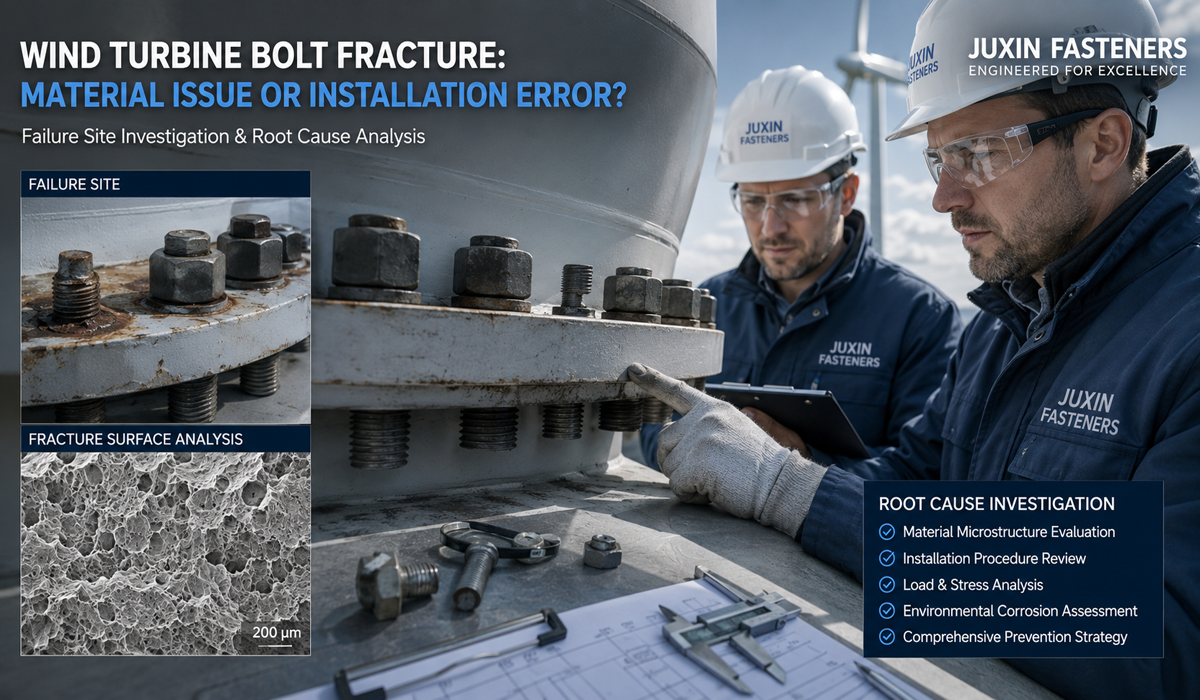
Fracture occurred at the thread root with a classic fatigue beach-mark pattern, raising a fundamental engineering question:
Is wind turbine bolt failure caused by material defects or installation mistakes?
The reality is more complex—most failures result from multi-factor interactions across material, manufacturing, installation, and service conditions.
1. Field Failure Analysis: What the Broken Bolt Reveals
A recent industry inspection case (M36×518 wind turbine blade bolt, 10.9 grade, alloy steel 42CrMo equivalent under ISO 898-1 / ISO 898-2 framework) revealed the following findings:
Chemical Composition
Complies with ISO 683 / ISO alloy steel standards
Material chemistry was acceptable
Mechanical Properties
Local tensile strength below the minimum requirements of ISO 898-1 Class 10.9
Indicates degradation of structural performance
Metallographic Structure
Presence of Widmanstätten (Widmanstätten) microstructure
Normal structure should be tempered sorbite (fine tempered martensite)
Hardness Distribution
Surface hardness: 362.8–474.3 HV
ISO 898-1 recommended limit: ≤ 390 HV
Thread root hardness significantly exceeded specification (up to 474 HV)
2. Why a “Qualified Bolt” Still Failed in Service
On paper, the bolt appears acceptable. In reality, its internal structure tells a different story.
2.1 The Hidden Danger of Widmanstätten Structure
Widmanstätten microstructure causes:
Non-uniform banded hardness distribution
Localized weak zones
Reduced fatigue resistance under cyclic load
In wind turbines, blades undergo:
Continuous pitch adjustment
Cyclic aerodynamic load variation
Millions of stress cycles over service life
This leads to:
Stress concentration at thread roots + microstructural weak zones = fatigue crack initiation
2.2 Excessive Hardness = Reduced Toughness
The measured hardness above 470 HV indicates:
High brittleness
Reduced crack propagation resistance
Accelerated fatigue failure under vibration
In wind turbine bolted joint systems, this is especially dangerous because:
Load direction changes continuously
Stress reversals occur daily
Crack growth is progressive and hidden
3. Installation Factors: The Hidden Contributor to Failure
Failure analysis also revealed evidence of:
Slippage marks on nut surfaces
Indications of insufficient preload (pre-tension loss)
3.1 Why Preload Matters in Wind Turbines
For large-scale wind turbine fastening systems (ISO/DIN high-strength bolting joints):
Too low preload → micro-movement (fretting fatigue)
Too high preload → local overstress at thread root
Both conditions accelerate fatigue failure.
3.2 Dynamic Load Environment Amplifies Risk
Wind turbine blade bolts operate under:
Variable wind speed loading
Continuous oscillation
Offshore corrosion exposure (in many cases)
Long-term vibration fatigue
This creates a combined fatigue, corrosion, and preload-relaxation environment, extremely sensitive to installation quality.
4. Manufacturing Root Causes: Where the Problem Really Starts
The most critical findings point back to manufacturing processes:
4.1 Heat Treatment Deviation
Improper quenching/tempering control
Overheating during austenitization
Formation of Widmanstätten structure
4.2 Surface Hardness Over-Control
Excessively hardened surface layer
Reduced impact toughness at the thread root
High crack initiation probability
4.3 Residual Stress Imbalance
Non-uniform stress distribution after processing
Weak zones at the thread root and transition fillet
5. Engineering Solutions for Wind Turbine Bolt Reliability
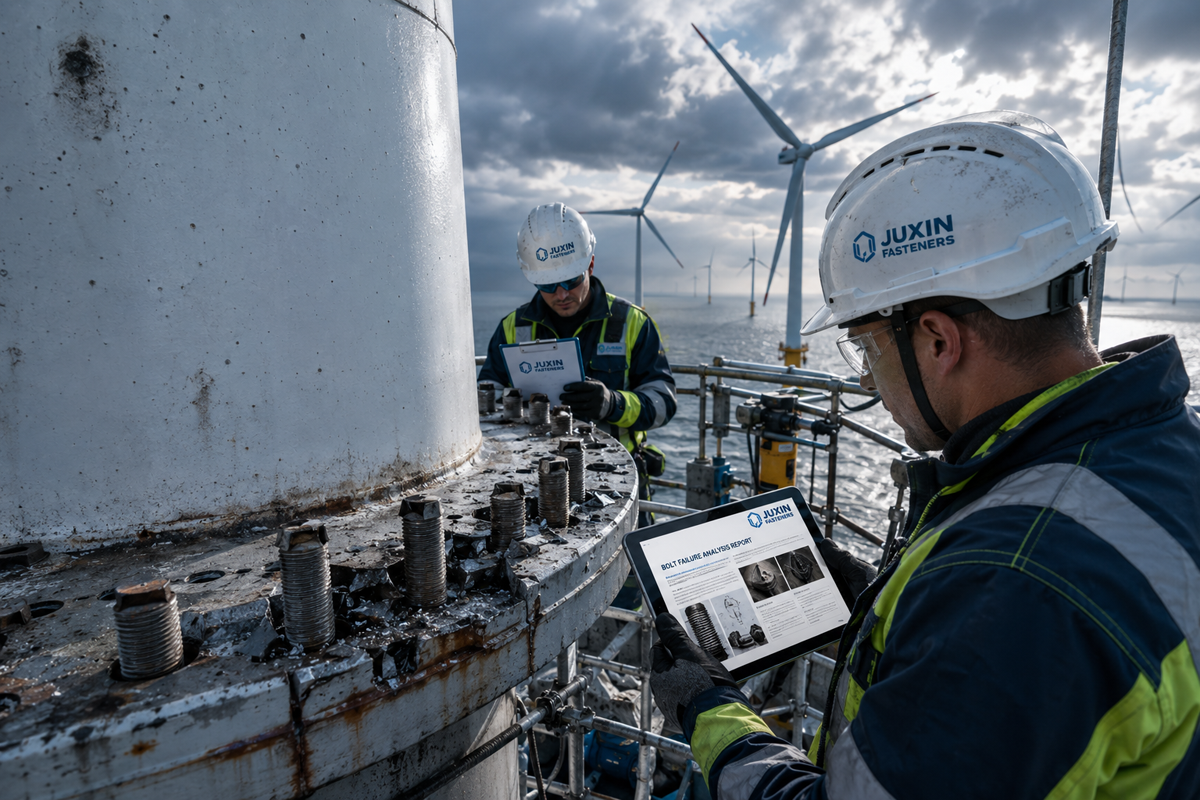
To prevent failures in wind turbine structural fastening systems (ISO 898-1 / DIN EN ISO standards), a full lifecycle control strategy is required.
5.1 Material and Metallurgy Control
Recommended materials:
42CrMo4 / 42CrMoA equivalent steels
Clean steel with controlled impurity levels
Strict control of P, S content
Key requirement:
The heat treatment process shall produce a tempered sorbite microstructure and shall not result in the formation of a Widmanstätten structure.
5.2 Heat Treatment Process Control
Critical parameters:
Precise quenching temperature control
Controlled cooling rate uniformity
Optimized tempering to balance strength and toughness
Mandatory checks:
Hardness distribution mapping
Metallographic inspection (ISO metallography evaluation methods)
5.3 Thread Fatigue Optimization
Engineering improvements:
Rolled threads instead of cut threads (ISO thread rolling standard practice)
Thread root radius optimization
Shot peening to introduce compressive residual stress
5.4 Installation Control System
For wind turbine field assembly:
Use the torque-angle tightening method (TAC method)
Digital torque monitoring and traceability systems
Preload verification for critical joints
Avoid manual “experience-based tightening.”
5.5 In-Service Inspection Strategy
For turbines with >5 years service life:
Non-destructive testing (NDT) sampling
Bolt preload re-evaluation
Vibration monitoring for pitch system bolts
Predictive maintenance data logging
6. Key Engineering Insight: Wind Turbine Bolt Failure Is Always Multi-Factor
Field data consistently shows:
A single defect rarely causes a wind turbine bolt fracture.
It is usually the result of:
Heat treatment deviation (primary root cause)
Fatigue loading (service condition)
Improper preload (installation factor)
Environmental stress (corrosion + vibration)
Conclusion: Reading the “Early Warning Signs” of Bolt Failure
Wind turbine bolt failure is not random—it is a progressive degradation process governed by metallurgy, mechanics, and installation quality.
For engineers working with ISO-grade high-strength bolting systems in wind energy applications, the key takeaway is:
Every fractured bolt has a story. The challenge is whether we can read it before failure occurs.
By implementing strict controls across material selection, heat treatment, ISO/DIN-compliant installation, and lifecycle monitoring, wind turbine operators can significantly improve structural reliability and reduce unplanned downtime.
Product Packaging
Packaging Standard
At Juxin Fasteners, we apply standardized export packaging to ensure product protection, traceability, and compliance with international logistics requirements.
1. Standard Export Packaging
Unless otherwise specified, all products will be packed according to our factory standard export packaging, which includes:
Moisture-resistant inner protection
Poly bag or small box packing as required
Reinforced export cartons
Clear labeling with part number, specification, batch number, and quantity
Palletizing for sea or air shipment when necessary
Our standard packaging is designed to ensure safe transportation, efficient warehousing, and long-distance international shipping.
2. Customized Packaging Options
We also provide customized packaging solutions according to customer requirements, including but not limited to:
Private labeling
Customized barcodes
Specific carton dimensions
Retail packaging
Special pallet configuration
Customer-specific marking and identification
So that you know, customized packaging may involve additional costs and extended lead time depending on the complexity of the requirements.
3. Compliance & Quality Assurance
All packaging processes are controlled under our ISO 9001 quality management system to ensure consistency, traceability, and product integrity throughout the supply chain.
Product Pictures
Contact Us
Tel.:
+86 020 8621 0320
+86 020 3121 6067
E-mail:
Technical Support:
Navigation
SEND INQUIREY