Call Us
+86 136 6007 9809
Call Us
+86 136 6007 9809

Metric fastening systems are widely used in sheet-metal fabrication, industrial machinery, automotive equipment, electrical cabinets, HVAC systems, robotics and other global OEM assemblies.
Where a removable fastening point is required near an accessible sheet-metal edge,
metric clip-on nuts can provide an efficient mechanically installed solution without requiring a loose nut to be manually positioned behind the panel.
Product Specification
Metric fastening systems are widely used in sheet-metal fabrication, industrial machinery, automotive equipment, electrical cabinets, HVAC systems, robotics and other global OEM assemblies.
Where a removable fastening point is required near an accessible sheet-metal edge,
metric clip-on nuts can provide an efficient mechanically installed solution without requiring a loose nut to be manually positioned behind the panel.
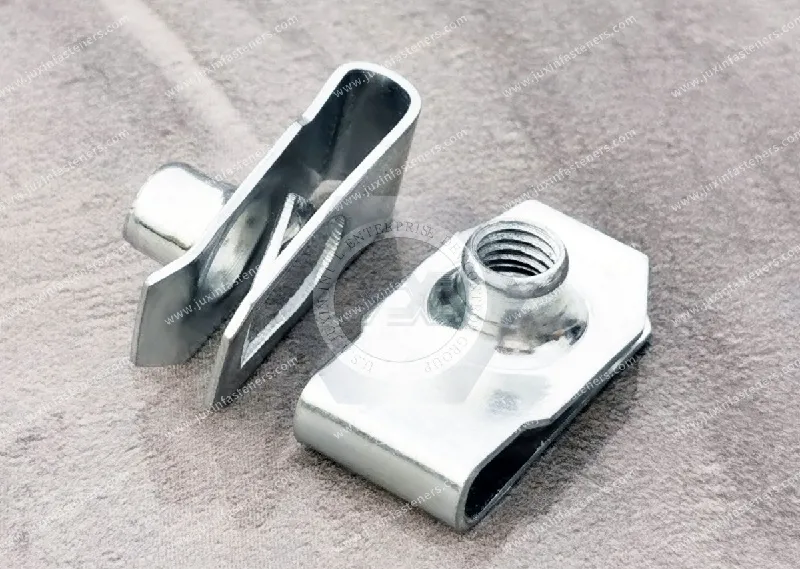
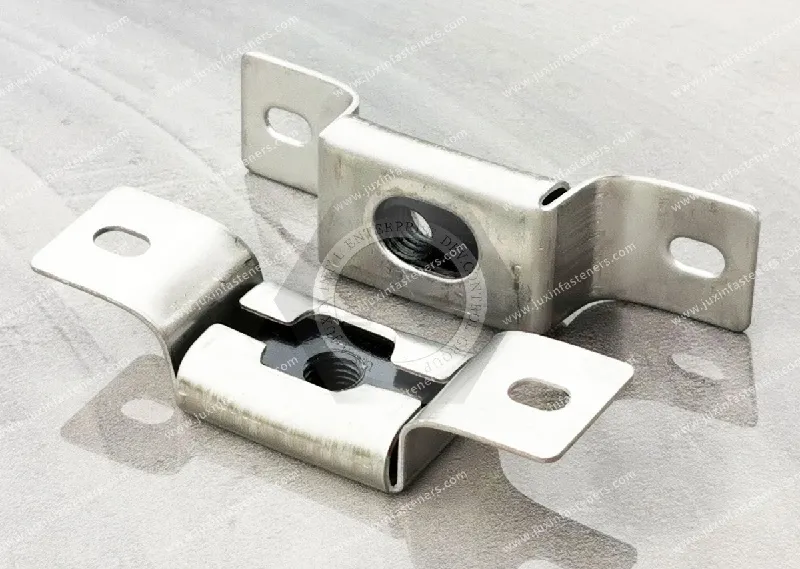
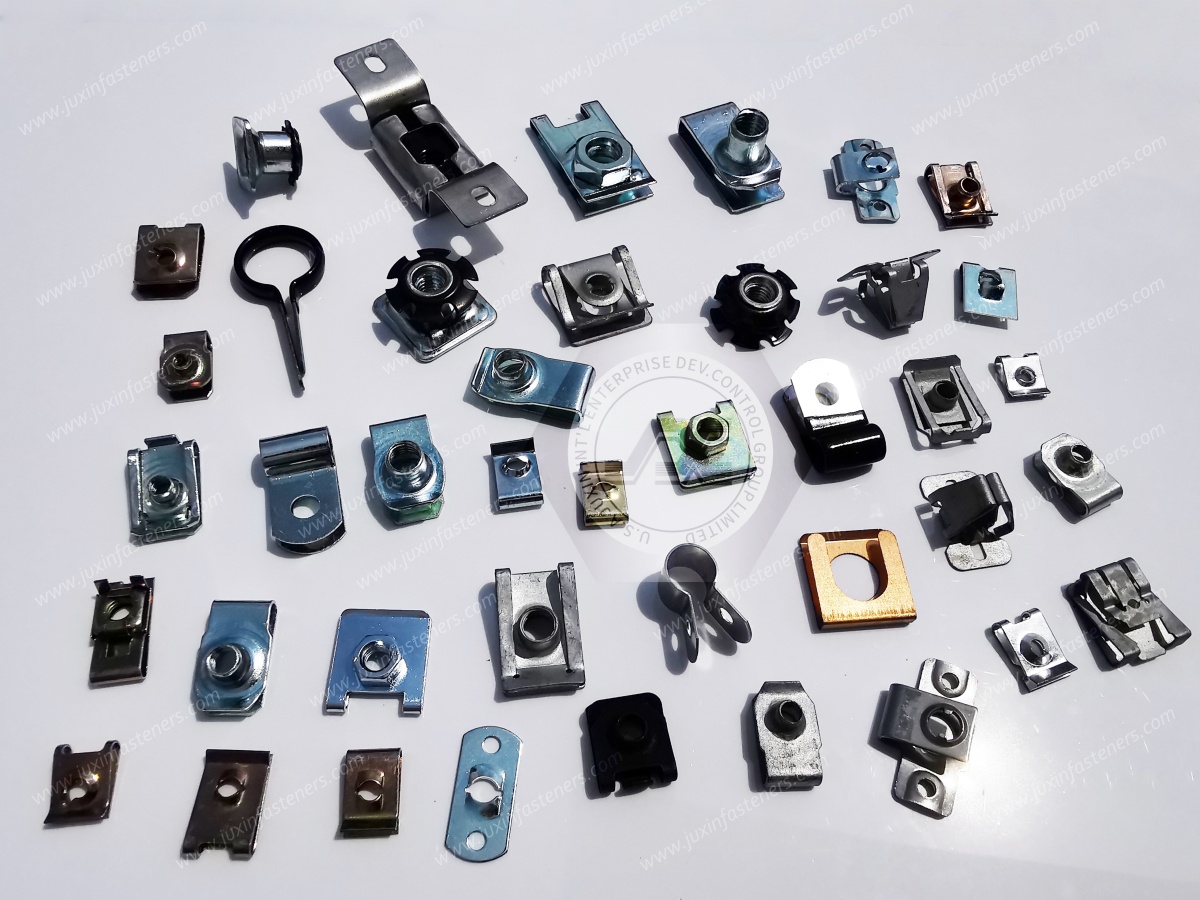
Depending on the product geometry, this category can include:
metric U-nuts;
metric J-nuts;
metric spring nuts;
barrel-style clip nuts;
clip-on nuts for tapping screws;
flanged-edge clip nuts;
other drawing-based edge-mounted fasteners.
However, specifying a metric clip-on nut requires much more information than an M-series thread designation.
A requirement such as:
“Need M6 clip nut”
may still leave several critical engineering variables undefined.
A more complete selection path is:
Thread Diameter → Thread Pitch → Thread Architecture → Mating Screw → Panel Thickness → Hole Setback → Throat Depth → Clip Geometry → Installation Envelope → Material → Finish
For OEM sourcing, JUXIN FASTENERS recommends evaluating the complete fastening interface rather than selecting a clip-on nut from thread size alone.
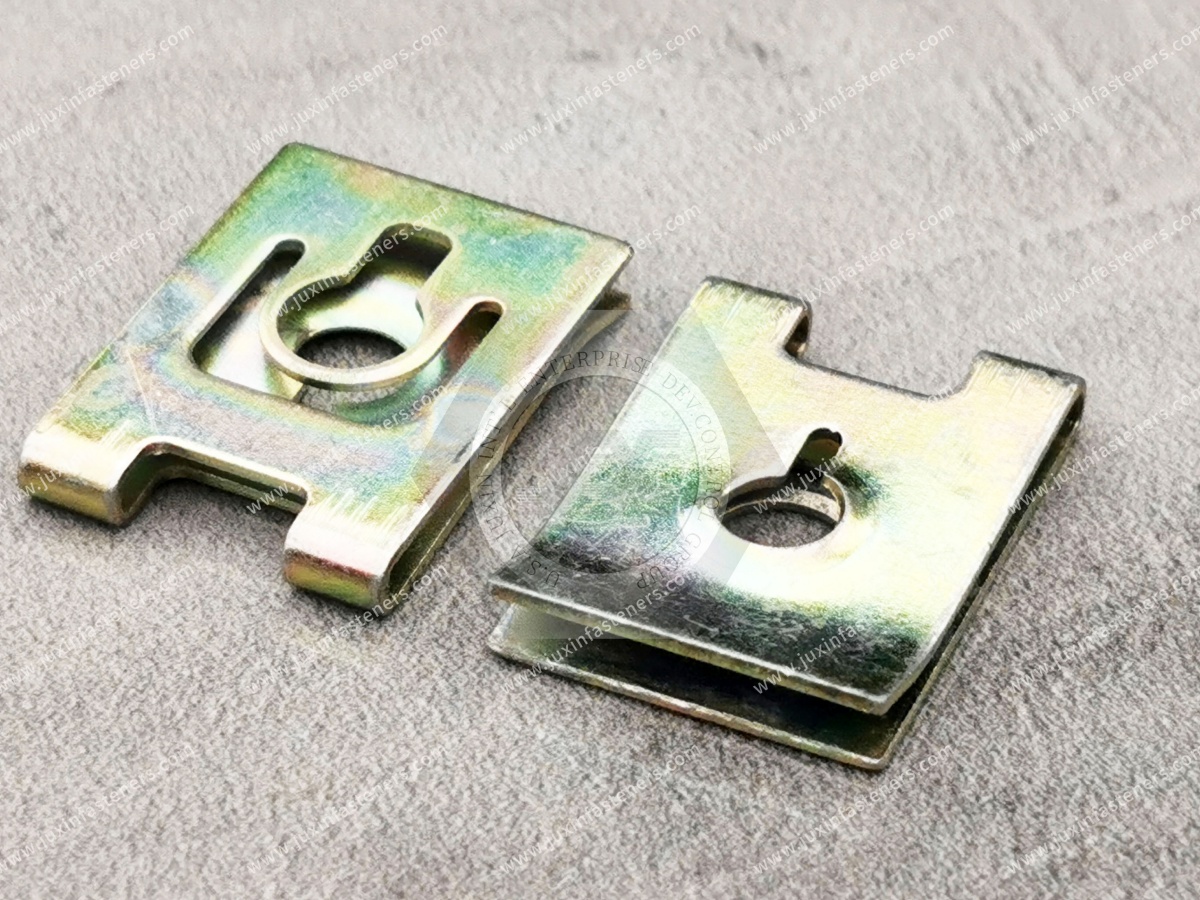
A metric clip-on nut is an edge-mounted fastener designed to work with a metric screw or metric screw interface.
The fastener is typically installed from an accessible panel edge and positions the required thread or screw-engaging feature relative to a mounting hole.
Depending on design, the fastening feature may use:
a formed thread;
a separate captive threaded element;
a barrel-style threaded feature;
a screw-engaging spring feature;
another product-specific architecture.
Therefore, not every metric clip-on nut should be described as a stamped spring-steel cage containing the same type of internal thread.
The actual product geometry matters.
Metric machine screw threads are commonly specified through the ISO metric screw-thread system.
Relevant ISO standards can provide the framework for dimensions, pitch selection and tolerances where their scope applies.
Examples include the ISO 261 and ISO 262 systems for general-purpose metric screw-thread diameter/pitch combinations and the ISO 965 series for tolerances.
These standards concern the thread system.
They should not be interpreted as universal dimensional product standards for every clip-on nut geometry.
A proprietary or drawing-based metric U-nut may use an ISO metric thread while the clip body itself remains controlled by the manufacturer's or customer's drawing.
A metric thread designation identifies the nominal thread diameter and, where stated, the pitch.
For example, a designation can be expressed in the general form:
M diameter × pitch
The thread requirement may also include a tolerance designation where relevant to the particular component.
For clip-on nut sourcing, engineers should therefore identify:
nominal thread diameter;
pitch;
tolerance requirement where applicable;
mating screw specification.
Do not assume that the nominal M-size alone completely defines the interface.
Metric clip-on nuts are available commercially in multiple M-series sizes, but JUXIN FASTENERS should not claim that every clip geometry is automatically available across a fixed list of thread sizes.
Availability can depend on:
U-nut vs J-nut geometry;
barrel-style design;
panel thickness;
throat depth;
material;
surface finish;
existing tooling;
project quantity.
Therefore, an OEM RFQ should specify the required M-size and geometry rather than assuming that every combination exists as a standard product.
Engineers may encounter both coarse and fine metric pitches.
The correct pitch should normally follow the mating screw and the engineering requirements of the assembly.
Coarse and fine threads differ geometrically, and changing pitch can affect factors such as:
thread engagement;
thread dimensions;
assembly sensitivity;
mating component compatibility.
Fine threads should not automatically be specified because an application experiences vibration.
Likewise, coarse threads should not automatically be described as universally more resistant to cross-threading.
Vibration behavior and assembly robustness depend on the complete joint.
This is an important engineering distinction.
Thread pitch is only one variable in a bolted joint.
Resistance to loosening under vibration can depend on:
preload;
joint stiffness;
friction;
mating surfaces;
clamp length;
external loading;
screw geometry;
locking method where required.
Therefore:
Fine Pitch ≠ Vibration-Proof Joint
and
Metric Clip Nut ≠ Self-Locking Nut
unless the actual product has a separately defined locking function.
An M-series diameter does not define pitch in every possible case.
For procurement, this creates a common substitution risk.
Two fasteners may both be described commercially as “M6,” for example, while the required pitch or thread architecture differs.
The sourcing specification should therefore identify the actual pitch where necessary.
The safest rule is:
Match the clip-on nut to the actual mating screw specification—not merely the nominal diameter.
For conventional machine-threaded configurations, thread tolerances may be specified according to the applicable ISO metric thread system.
However, clip-on nuts can use different threaded architectures.
The applicable thread tolerance requirement should therefore be confirmed from:
product drawing;
customer specification;
mating screw;
actual thread construction.
Do not automatically assign a generic nut tolerance class to every clip-on fastener without confirming that it applies to that product.
Thread engagement is another area where generic rules can be misleading.
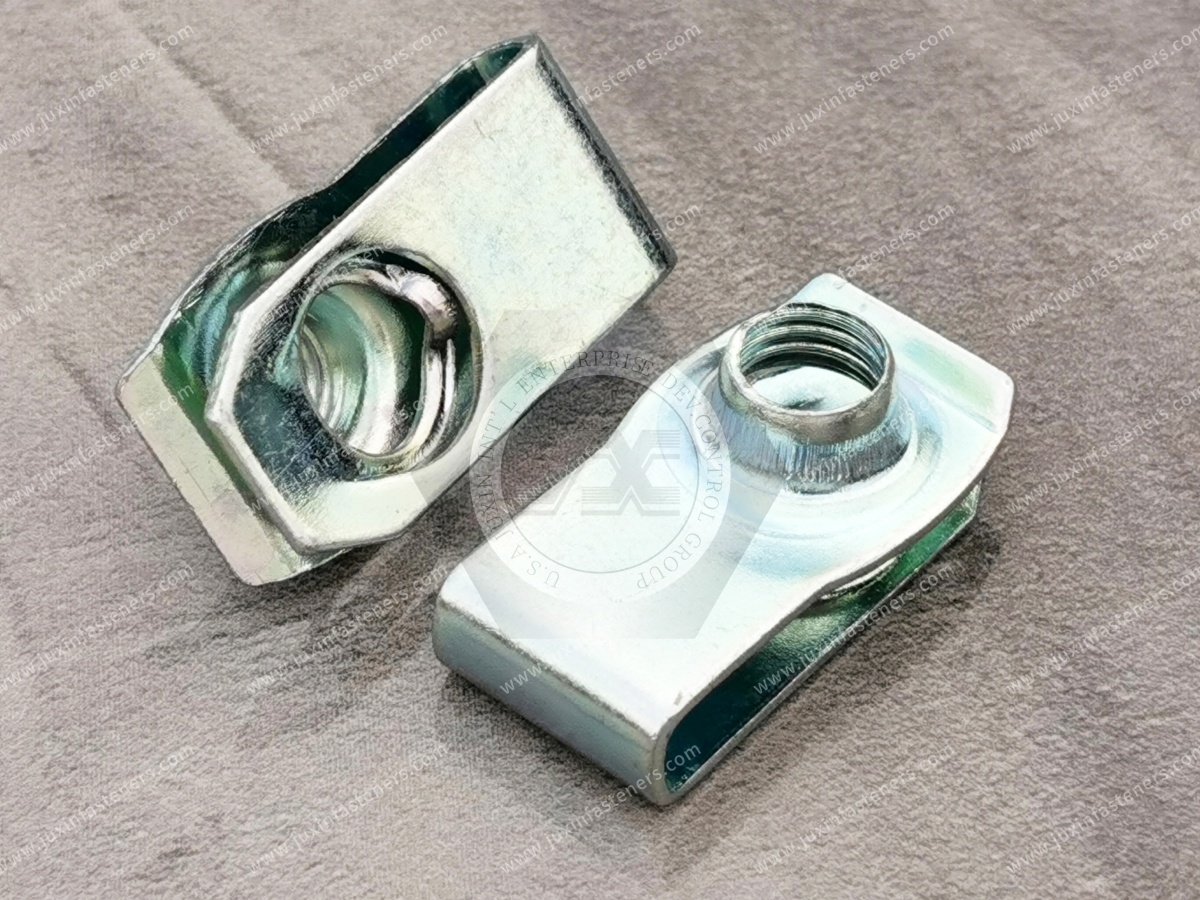
A barrel-style clip nut can have a different threaded geometry from a stamped spring nut.
An enclosed captive hex configuration can differ again.
A clip designed for a tapping screw operates through another fastening principle.
Therefore, there is no single universal thread-engagement rule that should be applied to all metric clip-on nuts.
The engineer should evaluate the actual fastener and mating screw.
Gemini's original draft suggested that the mating screw must pass completely through the spring thread profile.
That should not be universalized.
The correct screw length and engagement depend on the fastener geometry and joint design.
Some assemblies may allow screw protrusion beyond the threaded feature.
Others may have restricted backside clearance.
Enclosed designs can create additional internal-envelope constraints.
The correct question is:
Does the selected screw provide the required engagement and clamp the intended joint without unwanted bottoming or interference?
Thread size and pitch can be correct while the screw length is still wrong.
The engineer should consider:
joint stack thickness;
required thread engagement;
washer thickness where used;
clip/nut geometry;
backside clearance;
adjacent components;
enclosed fastener geometry where applicable.
This is especially important in compact electrical cabinets, automation equipment and electronic enclosures.
A clip-on nut must physically fit the panel on which it is installed.
Panel thickness affects how much the clip must open during installation and how the fastener sits after installation.
A product designed for one panel condition should not automatically be used on a significantly different thickness.
Possible problems from incorrect panel matching can include:
difficult installation;
incomplete seating;
permanent clip deformation;
reduced pre-assembly retention;
hole misalignment;
coating damage.
Gemini's draft used a generic example such as 0.5 mm to 3.5 mm.
That should not be turned into a universal specification.
Different clip-on nut designs can have different panel-thickness capabilities.
The correct range must come from:
the specific product drawing;
confirmed JUXIN FASTENERS product data;
prototype validation;
customer-approved specification.
This prevents generic website numbers from becoming unintended engineering promises.
The engineer should consider more than nominal sheet thickness.
The actual interface can include variation from:
sheet manufacturing tolerance;
paint;
powder coating;
plating;
overlapping panels;
folded layers;
hems;
local forming.
Therefore, the production question is not simply:
What is the nominal sheet gauge?
It is:
What minimum and maximum finished panel condition will the clip encounter?
For metric OEM sourcing, specifying the actual panel thickness in millimeters is more useful than relying only on a generic sheet-gauge description.
Gauge terminology can vary by material and market.
An RFQ should preferably include:
nominal thickness in millimeters;
minimum thickness where relevant;
maximum thickness where relevant;
coating condition;
number of layers where applicable.
This reduces ambiguity for international sourcing.
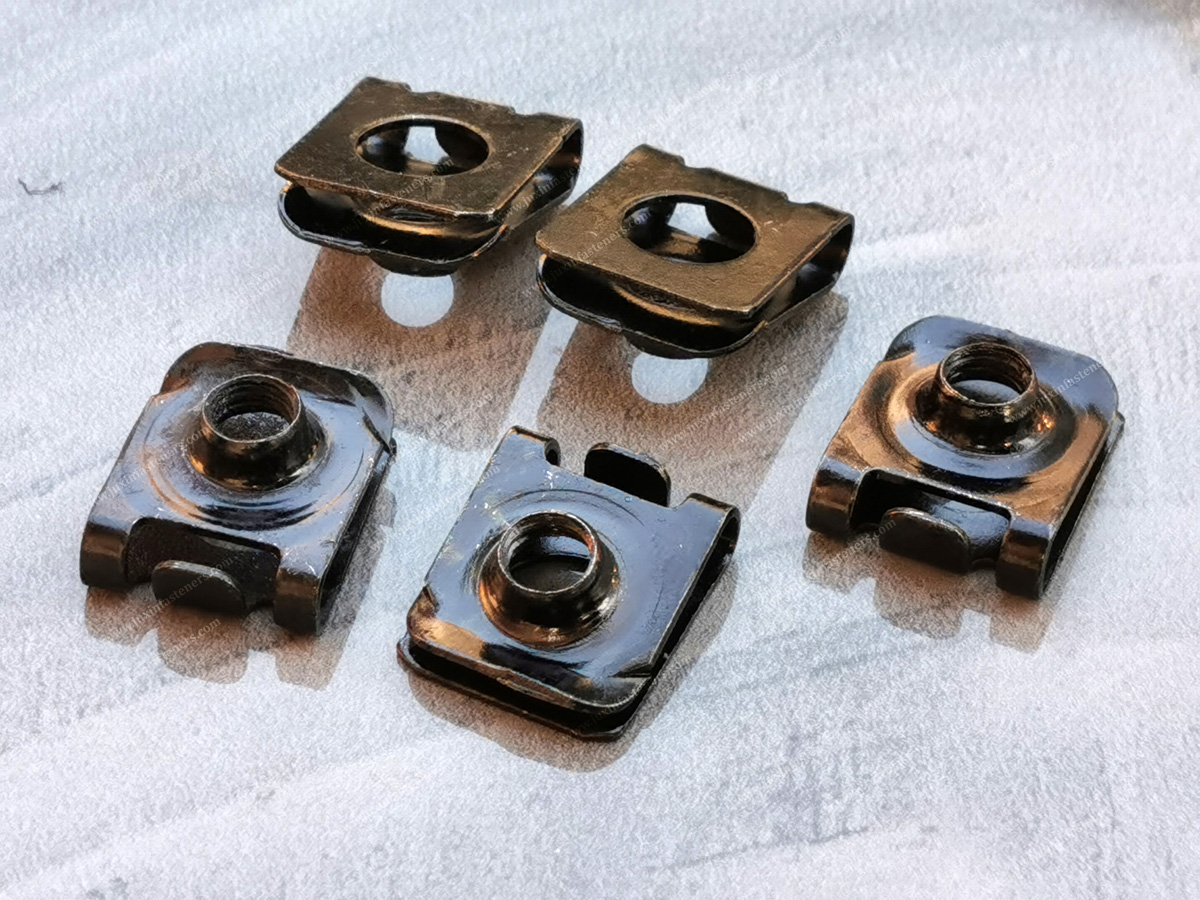
A metric clip-on nut installed from a panel edge must reach the intended mounting-hole position.
The relationship between the panel edge and hole center is therefore critical.
This dimension is commonly treated as the hole setback or edge-to-hole-center relationship.
If the hole position does not match the selected clip geometry, possible problems include:
thread misalignment;
difficult screw starting;
clip displacement;
incomplete seating;
assembly rework.
An M6 thread cannot compensate for the wrong hole setback.
The clip's reach or throat depth determines how far the fastening feature is positioned from the accessible edge.
For selection purposes, engineers should evaluate:
Panel Edge → Clip Entry → Throat/Reach → Thread Center → Panel Hole
A supplier alternative with the same thread but a different reach may not align with the existing panel.
This is one of the most common reasons why apparently similar clip nuts are not interchangeable.
Clip-on nuts occupy three-dimensional space around the panel.
The engineer should consider:
overall length;
width;
height;
lower-leg envelope;
upper-leg envelope;
threaded-feature height;
screw protrusion.
This becomes particularly important where nearby components include:
circuit boards;
cables;
ducting;
brackets;
insulation;
sensors;
other fasteners.
Metric thread size does not determine whether a U-nut or J-nut geometry is appropriate.
The geometry should be selected according to:
panel edge;
hole setback;
throat depth;
installation direction;
surrounding clearance;
fastener architecture.
For a detailed geometry comparison, see the JUXIN FASTENERS guide U-Nuts vs J-Nuts: Geometric Selection for Edge-Mounted Sheet Metal at /solutions/u-nuts-vs-j-nuts-geometry.
Barrel-style clip nuts use a different threaded architecture from some stamped spring-nut designs.
Depending on the product, this can affect:
thread engagement;
envelope;
hole alignment;
screw clearance;
panel interface.
For further engineering guidance, see Strong-Grip Clip-On Barrel Nuts: U-Nuts, Multi-Thread Engagement & Panel Fastening Solutions at /solutions/strong-grip-clip-on-barrel-nuts-u-nuts.
Not every metric clip-on fastener uses a conventional machine-threaded nut.
Some clip-on nuts are designed around tapping-screw interfaces.
These should not be substituted automatically for machine-threaded U-nuts or J-nuts.
The mating screw must be part of the product specification.
For additional guidance, see Strong-Grip Clip-On Nuts for Tapping Screws: U-Nuts & Panel Fastening Solutions at /solutions/strong-grip-clip-on-nuts-tapping-screws.
Folded and flanged sheet metal creates another level of dimensional complexity.
A flange can introduce:
bend radius;
restricted clip entry;
multi-layer thickness;
return geometry;
reduced clearance.
A clip selected for a flat sheet edge may not fit a formed flange.
For detailed flange-selection guidance, see Clip-On Nuts for Flanged Edges: Fastening Folded Sheet-Metal Panels at /solutions/clip-on-nuts-for-flanged-edges.
This distinction remains important for metric clip-on nuts.
Clip retention concerns how the fastener remains positioned on the panel before and during screw installation.
Joint strength concerns the completed screw-fastener-panel assembly.
Joint performance can depend on:
screw specification;
thread engagement;
panel material;
panel thickness;
clip geometry;
tightening process;
clamp load;
tensile loading;
shear loading;
vibration;
corrosion.
The metric thread designation does not define final joint strength.
This is one of the most important procurement lessons in this guide.
Consider two clip-on nuts that both use the same nominal metric thread.
They may still differ in:
pitch;
clip shape;
panel range;
throat depth;
hole setback;
overall envelope;
material;
finish;
thread architecture;
installation direction.
Therefore:
Same M-Size ≠ Same Clip-On Nut
and
Same M-Size ≠ Automatic Interchangeability
This matters when procurement searches for an alternate supplier.
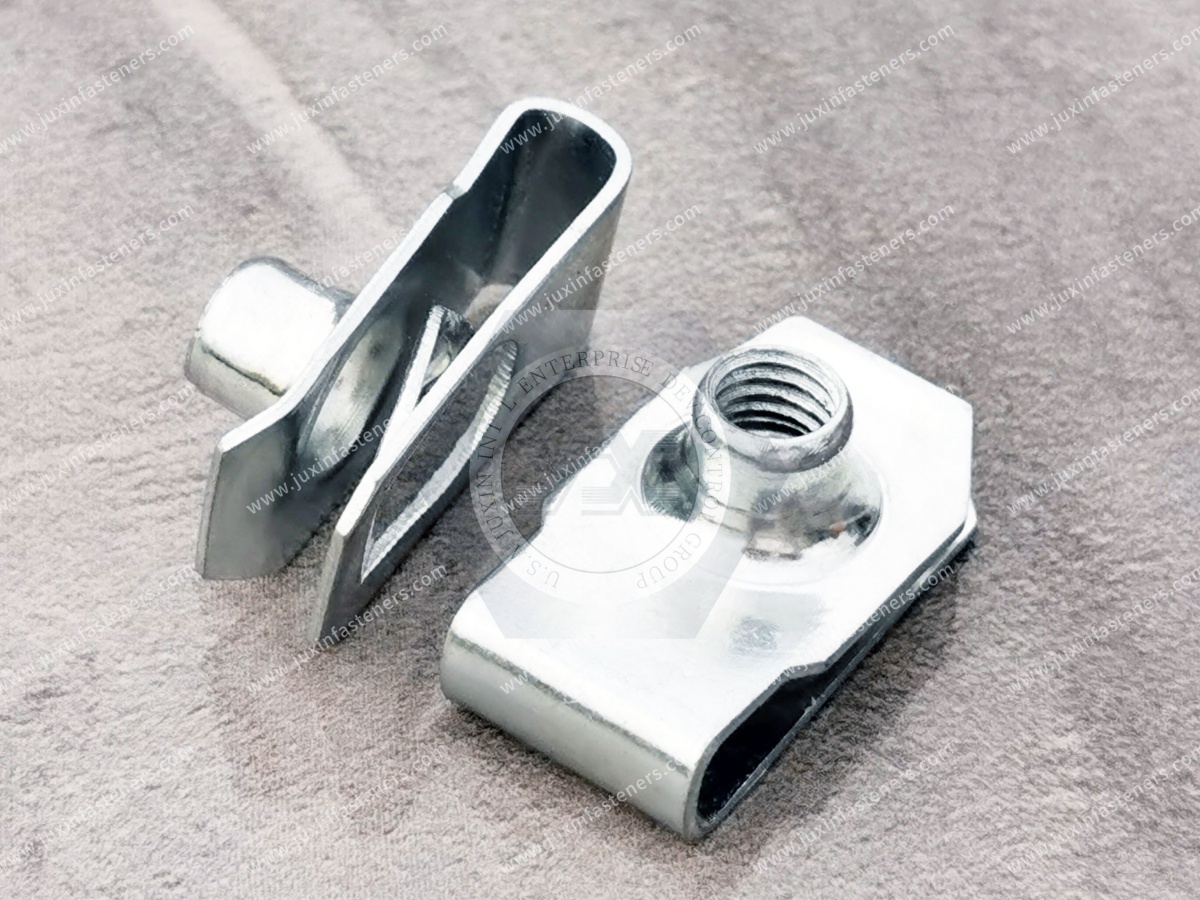
Two metric spring nuts may look almost identical in a photograph.
A small difference in throat depth or clip opening can make one fit and the other fail to align.
Supplier-development teams should therefore avoid approving alternatives based only on:
photograph;
thread size;
overall appearance;
generic catalog description.
The drawing and panel interface should control approval.
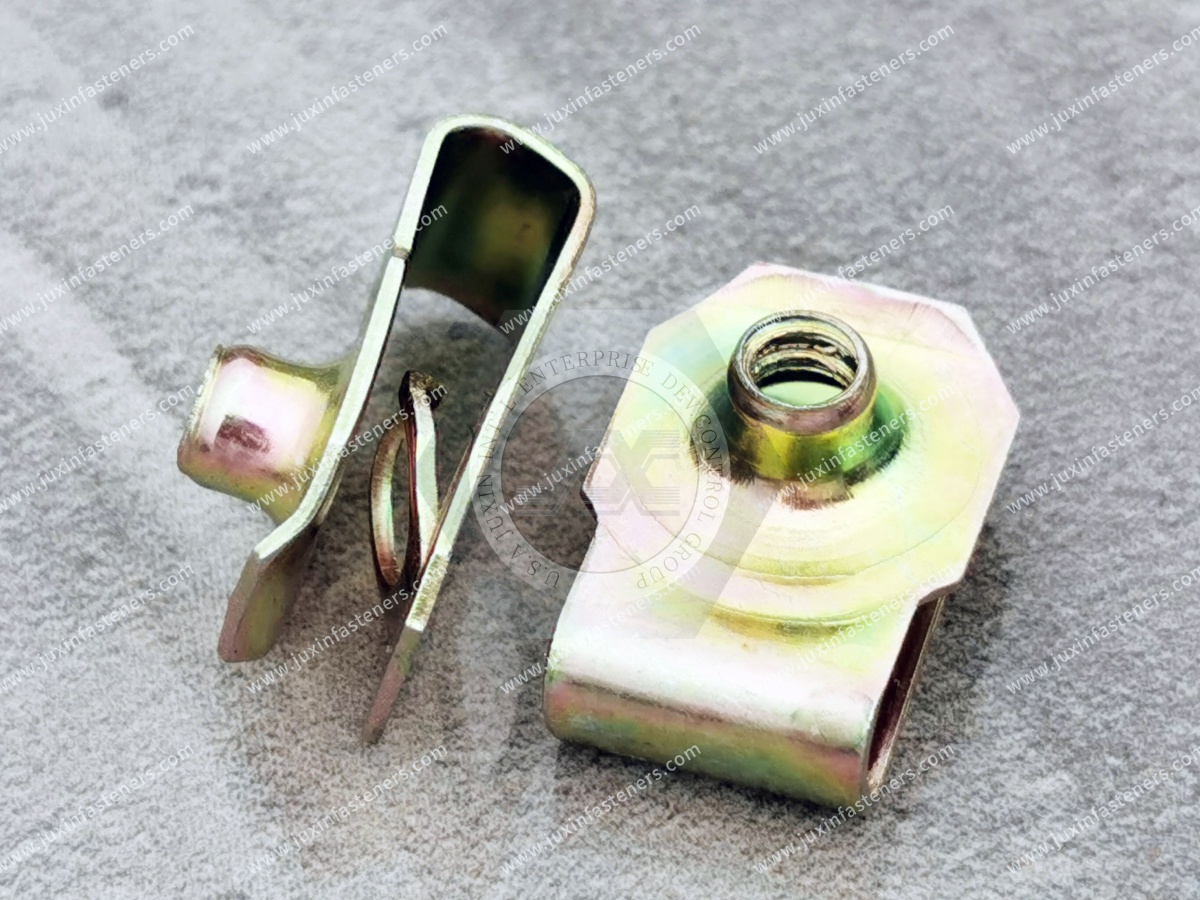
Metric clip-on nuts can be produced from different materials depending on product design and project requirements.
Potential material families can include:
carbon steel;
spring steel;
stainless steel.
Material selection should consider:
clip geometry;
forming;
panel fit;
corrosion environment;
customer specification.
Material names alone should not be used to infer retention, fatigue, vibration or structural performance.
Carbon and spring steel options may be suitable for many industrial sheet-metal applications when paired with an appropriate surface treatment.
For detailed material and coating guidance, see Carbon Steel Clip-On Nuts: Material Grades, Coatings & OEM Selection at /solutions/carbon-steel-clip-on-nuts-material-coating-guide.
Stainless steel can be considered where the application requires stainless material characteristics.
JUXIN FASTENERS product information includes relevant stainless clip-on nut options, including SUS304 and SUS316 in applicable product families.
However, availability should be confirmed for the required metric thread and clip geometry.
The stainless grade should be selected according to the actual environmental requirement rather than simply choosing the higher alloy designation.
Where carbon steel is used, potential project-specific finishes may include:
zinc-based coatings;
phosphate-based finishes;
other specified treatments.
For applicable JUXIN FASTENERS projects, trivalent chromium zinc plating can be specified where required.
The RFQ should define relevant requirements such as:
coating system;
passivation;
coating thickness where required;
corrosion test;
acceptance criteria;
RoHS/REACH requirements where applicable.
Coating adds dimensional buildup.
In tight-tolerance clip-on nut designs, this can influence:
clip opening;
contact surfaces;
internal threads;
narrow clearances.
The panel itself may also be painted or powder coated.
Therefore, final fit should be considered as:
Finished Fastener + Finished Panel
rather than bare component dimensions alone.
Higher-strength or higher-hardness steel spring components may require hydrogen embrittlement risk evaluation when certain electrochemical processing routes are used.
However, post-plating baking should not be treated as a mandatory universal process for every metric clip-on nut.
Risk depends on factors including:
material;
hardness;
processing;
surface preparation;
plating;
residual stress;
component geometry.
Where hydrogen embrittlement control is required, the applicable customer or process specification should define the requirement.
Metric clip-on nuts can be used in suitable:
fabricated enclosures;
chassis;
covers;
brackets;
access panels;
folded sheet-metal structures.
For fabricators, the key advantage is not merely the metric thread.
It is the ability to coordinate the fastening point with the actual sheet-metal geometry.
The fastener should ideally be considered before the panel drawing is frozen.
Electrical equipment frequently uses metric hardware.
Potential clip-on nut applications include:
cabinet frames;
internal brackets;
access covers;
control enclosures;
service panels.
Engineers should consider:
panel thickness;
coating;
hole setback;
internal clearance;
screw length;
service access.
A metric clip-on nut should not automatically be treated as a grounding or bonding fastener.
Metric clip-on nuts can be considered for suitable automotive sheet-metal assemblies such as:
selected brackets;
service covers;
interior mounting structures;
auxiliary equipment panels.
Automotive use does not automatically establish:
vibration resistance;
fatigue qualification;
crash performance;
structural suitability.
These are separate joint-level requirements.
EV systems contain many sheet-metal structures outside primary battery sealing and structural joints.
Potential suitable clip-on nut locations may include:
electronics covers;
auxiliary brackets;
service panels;
control housings.
A metric clip-on nut should not automatically be described as:
an IP67/IP68 fastener;
a battery sealing component;
a busbar fastener;
a grounding fastener;
a structural battery fastener.
Those functions require separate engineering.
Metric clip-on nuts can support removable fastening in:
machinery covers;
control housings;
access panels;
brackets;
non-structural guards.
For safety-related guards or highly loaded joints, the complete fastening system should be validated according to the application.
Compact automation equipment often relies heavily on metric hardware.
Potential clip-on nut applications include:
controller housings;
sensor enclosures;
equipment covers;
service panels;
internal brackets.
Here, dimensional envelope and screw length can be particularly important because nearby electronics and cables may limit backside clearance.
Metric spring nuts can be considered for suitable:
equipment housings;
air-handling unit covers;
control boxes;
service panels.
Selection should consider corrosion environment, panel geometry and service access.
The clip nut itself does not provide sealing, waterproofing or vibration isolation.
A useful engineering selection matrix looks beyond M-size.
| Specification Variable | Engineering Question |
|---|---|
| Metric thread diameter | What mating screw diameter is required? |
| Thread pitch | What pitch does the mating screw use? |
| Thread architecture | Formed thread, barrel, captive nut or tapping-screw interface? |
| Panel thickness | What finished minimum/maximum panel condition must fit? |
| Hole setback | How far is the hole center from the accessible edge? |
| Throat depth | Can the fastener reach the hole correctly? |
| Clip geometry | U-nut, J-nut, flange clip or another design? |
| Screw length | Is engagement adequate without unwanted interference? |
| Material | Carbon/spring steel or stainless requirement? |
| Finish | What corrosion/environmental specification applies? |
| Installation | From which direction is the clip installed? |
| Envelope | Will the clip or screw interfere with nearby components? |
This is a more useful OEM selection tool than a simple M4/M5/M6 catalog list.
A reliable engineering process can follow this sequence:
Mating Screw → Metric Thread → Pitch → Panel Thickness → Hole Setback → Throat Depth → Clip Geometry → Material → Finish → Prototype Fit → Joint Validation → Production Drawing
The sequence prevents procurement from solving a geometry problem with a thread-size-only search.
When replacing an existing metric clip-on nut, compare:
customer part number;
drawing revision;
metric thread;
pitch;
thread architecture;
panel thickness compatibility;
hole setback;
throat depth;
overall dimensions;
material;
coating;
installation direction;
screw length;
inspection requirements.
Do not approve an alternative solely because both suppliers label the product with the same M-size.
When submitting an RFQ to JUXIN FASTENERS at info@juxinfasteners.com, provide as much of the following information as available:
2D engineering drawing;
3D CAD model where relevant;
existing sample or reference photo;
current supplier/reference part number;
clip-on nut type;
U-nut, J-nut, barrel or other geometry;
metric thread designation;
nominal thread diameter;
thread pitch;
thread tolerance requirement where applicable;
mating screw specification;
mating screw length;
washer or joint-stack information where relevant;
panel material;
nominal panel thickness;
minimum and maximum panel thickness where applicable;
panel coating condition;
hole diameter;
hole setback;
throat or reach dimension;
flange or edge geometry;
surrounding clearance;
installation direction;
carbon steel, spring steel or stainless requirement;
specific material grade where required;
surface treatment;
trivalent chromium zinc requirement where applicable;
coating thickness where specified;
RoHS/REACH requirement where applicable;
corrosion test method where required;
corrosion-test duration where specified;
acceptance criteria;
prototype/sample quantity;
production quantity;
annual demand;
packaging requirements;
labeling requirements;
inspection requirements;
customer-specific specifications.
The commercial sourcing path for a metric clip-on nut should evolve from:
“I need an M6 clip nut.”
to:
“I need this M6 thread and pitch, for this panel thickness, at this hole setback, with this clip geometry, material, coating and installation envelope.”
A controlled OEM sourcing path is therefore:
Metric Search → Mating Screw → Thread & Pitch → Panel Condition → Hole Setback → Clip Reach → Geometry → Material
→ Surface Treatment → Prototype Fit → Joint Validation → Approved Drawing → Production RFQ → Repeat Supply
This turns a generic metric fastener search into an engineering-controlled sourcing process.
For drawing-based metric clip-on nuts, metric U-nuts, metric J-nuts, metric spring nuts, barrel clip nuts and other OEM sheet-metal fasteners, contact JUXIN FASTENERS at info@juxinfasteners.com.
Providing the mating screw, metric thread and pitch, panel thickness, hole setback, fastener geometry and annual demand allows
JUXIN FASTENERS to evaluate the requirement far more accurately than specifying an M-series size alone.
Product Packaging
Packaging Standard
At Juxin Fasteners, we apply standardized export packaging to ensure product protection, traceability, and compliance with international logistics requirements.
1. Standard Export Packaging
Unless otherwise specified, all products will be packed according to our factory standard export packaging, which includes:
Moisture-resistant inner protection
Poly bag or small box packing as required
Reinforced export cartons
Clear labeling with part number, specification, batch number, and quantity
Palletizing for sea or air shipment when necessary
Our standard packaging is designed to ensure safe transportation, efficient warehousing, and long-distance international shipping.
2. Customized Packaging Options
We also provide customized packaging solutions according to customer requirements, including but not limited to:
Private labeling
Customized barcodes
Specific carton dimensions
Retail packaging
Special pallet configuration
Customer-specific marking and identification
So that you know, customized packaging may involve additional costs and extended lead time depending on the complexity of the requirements.
3. Compliance & Quality Assurance
All packaging processes are controlled under our ISO 9001 quality management system to ensure consistency, traceability, and product integrity throughout the supply chain.
Product Pictures
Contact Us
Tel.:
+86 020 8621 0320
+86 020 3121 6067
E-mail:
Technical Support:
Navigation
SEND INQUIREY