Call Us
+86 136 6007 9809
Call Us
+86 136 6007 9809

Automotive Hex Flange Weld Nut Solution for Thin Sheet Metal Structures in Automotive Manufacturing
Introduction: Why Automotive Hex Flange Weld Nuts Are Essential for Modern Vehicle Assemblies
Lightweight vehicle platforms, electric-vehicle battery systems, and thin-wall sheet-metal structures have significantly increased demand for reliable welded fastening solutions. Conventional nut-and-bolt assemblies often become difficult to install when reverse-side access is limited or permanent threaded connections are required.
The Automotive Hex Flange Weld Nut is specifically developed to solve these challenges.
Product Specification
Automotive Hex Flange Weld Nut Solution for Thin Sheet Metal Structures in Automotive Manufacturing
Introduction: Why Automotive Hex Flange Weld Nuts Are Essential for Modern Vehicle Assemblies
Lightweight vehicle platforms, electric-vehicle battery systems, and thin-wall sheet-metal structures have significantly increased demand for reliable welded fastening solutions. Conventional nut-and-bolt assemblies often become difficult to install when reverse-side access is limited or permanent threaded connections are required.
The Automotive Hex Flange Weld Nut is specifically developed to solve these challenges.
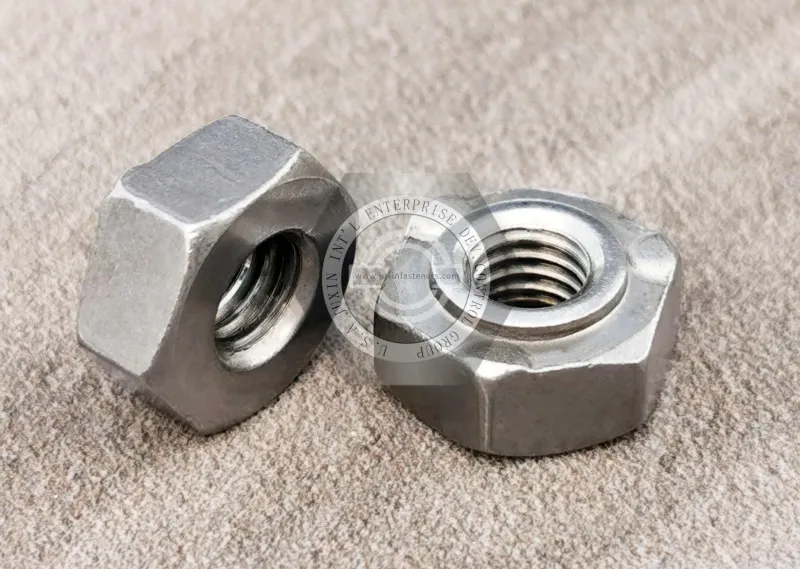
Designed for resistance projection welding on thin automotive sheet metal, an Automotive Hex Flange Weld Nut creates a permanent threaded attachment point while maintaining structural integrity, vibration resistance, and compatibility with automated production lines.
Today, Automotive Hex Flange Weld Nuts are widely used in:
Automotive chassis brackets
Body cross members
Seat rail systems
EV battery pack supports
Suspension reinforcement components
Structural sheet metal assemblies
Their combination of welding capability, flange load distribution, and anti-loosening performance makes them a preferred fastening solution for OEM automotive production.
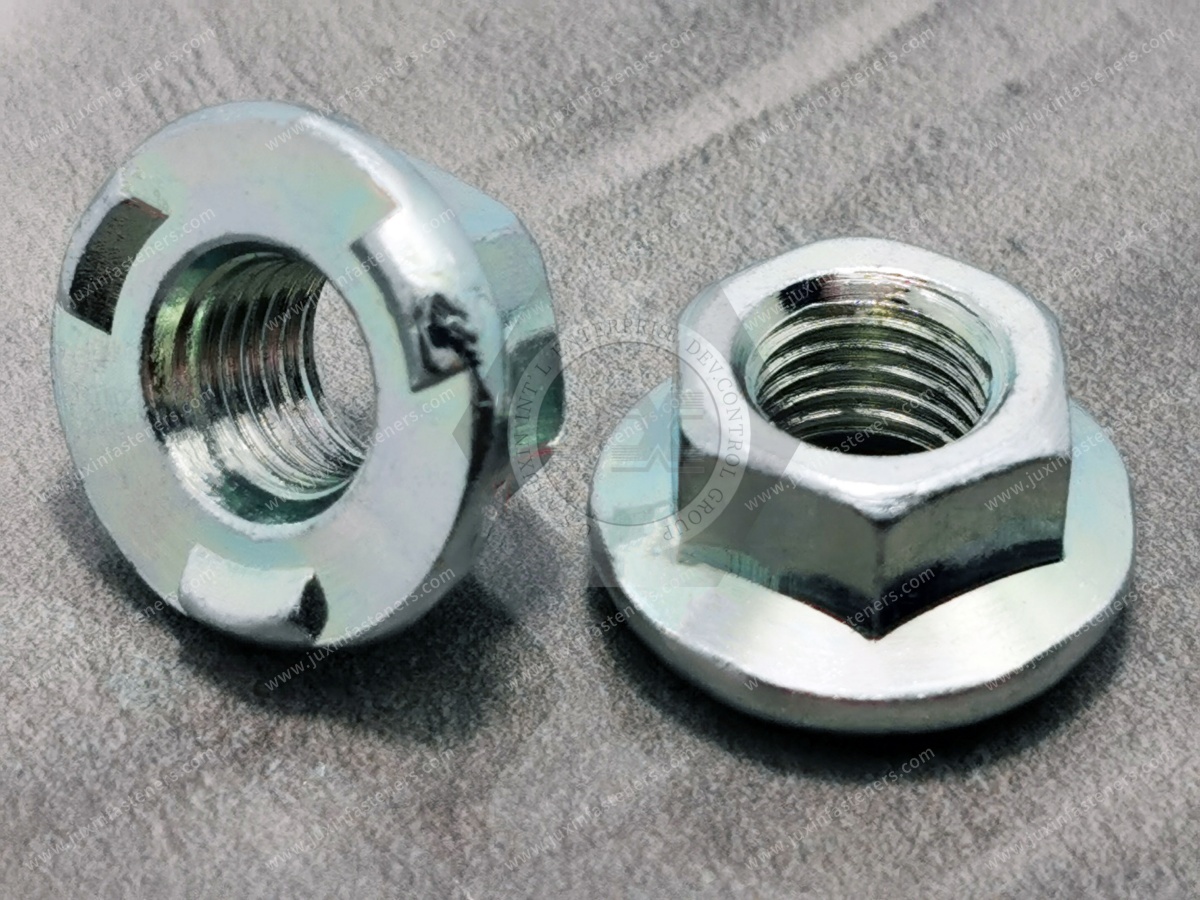
Structural Design of Automotive Hex Flange Weld Nuts
An Automotive Hex Flange Weld Nut typically consists of:
Hexagonal body profile
Integrated flange surface
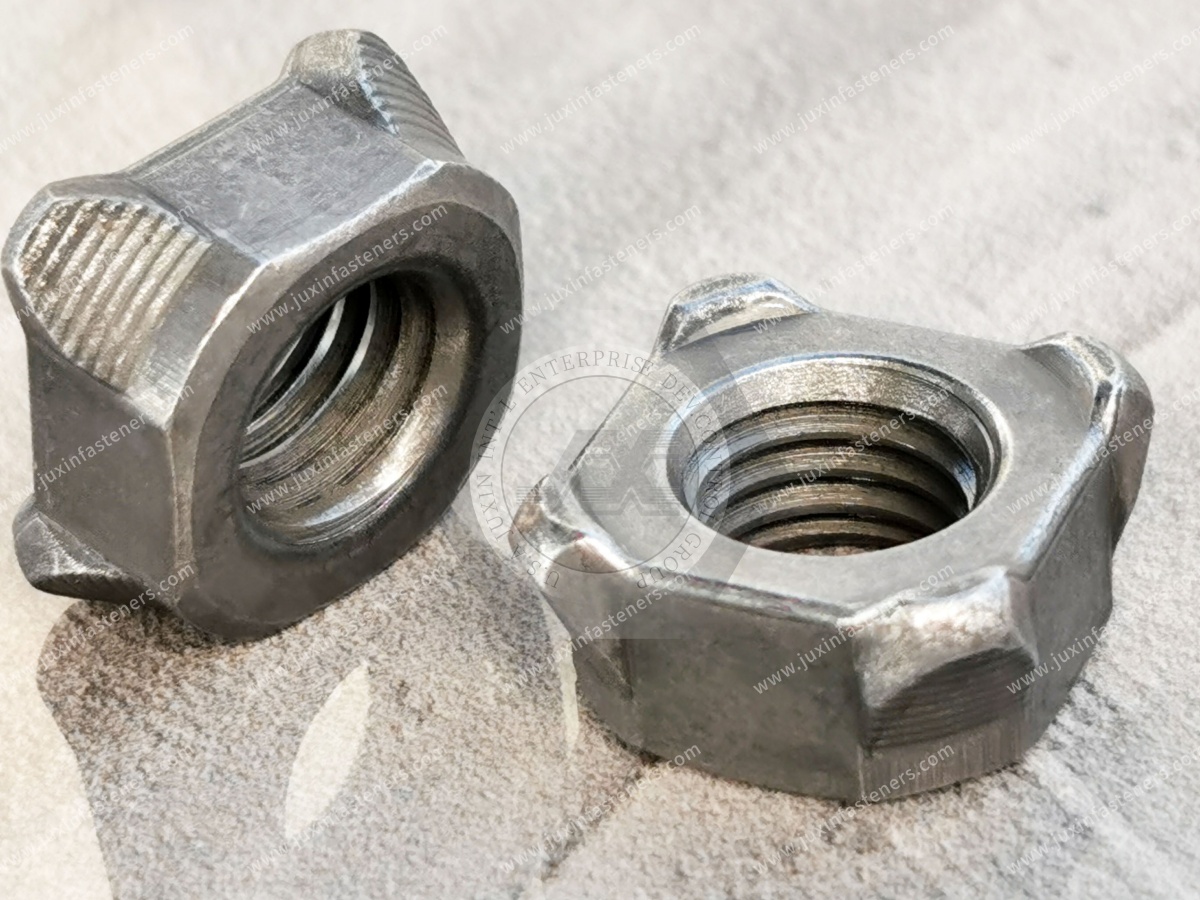
Projection welding base
Internal metric threads
Corrosion-resistant surface treatment
Most designs use three welding projections to concentrate welding energy during resistance projection welding.
The flange section plays a critical engineering role by increasing the bearing area and reducing localized stress around the mounting hole.
Compared with standard weld nuts, an Automotive Hex Flange Weld Nut helps prevent:
Sheet metal deformation
Edge crushing
Clamp force concentration
Installation instability
This design is particularly important for automotive sheet metal with thicknesses ranging from 0.8 mm to 2.0 mm.
Common thread specifications include:
M5 Automotive Hex Flange Weld Nut
M6 Automotive Hex Flange Weld Nut
M8 Automotive Hex Flange Weld Nut
M10 Automotive Hex Flange Weld Nut
M12 Automotive Hex Flange Weld Nut
Selection is normally based on bracket thickness, load requirements, and assembly conditions.
Material Selection for Automotive Hex Flange Weld Nut Production
Material performance directly influences welding quality and long-term durability.
Most Automotive Hex Flange Weld Nuts are manufactured using:
SWRCH10K Carbon Steel
Recommended for:
General body structures
Interior brackets
Seat assemblies
Advantages:
Stable weldability
Good forming performance
Cost-effective production
SWRCH15K Carbon Steel
Recommended for:
Higher load applications
Chassis mounting systems
Structural brackets
Benefits include:
Improved mechanical strength
Better fatigue resistance
Enhanced fastening reliability
To improve corrosion performance, surface treatments commonly include:
Zinc Plated Automotive Hex Flange Weld Nut
Zinc-Nickel Automotive Hex Flange Weld Nut
Dacromet Automotive Hex Flange Weld Nut
For electric-vehicle applications and high-salt-spray environments, Dacromet-coated Automotive Hex Flange Weld Nuts are often preferred.
Resistance Projection Welding Process for Automotive Hex Flange Weld Nuts
The installation of an Automotive Hex Flange Weld Nut usually relies on resistance projection welding.
During welding:
Current concentrates at the projection points.
Heat generation occurs only at localized contact areas.
This process creates strong metallurgical bonding while preventing burn-through of thin sheet materials.
Typical sheet thickness:
0.8 mm – 2.0 mm automotive steel panels
Before welding, the sheet surface should be prepared by removing:
Oil contamination
Oxide layers
Scale deposits
Surface impurities
Proper preparation improves welding consistency and reduces defects.
After welding, inspection should verify:
Weld Nugget Diameter
Recommended standard:
Weld nugget diameter ≥ 3 × sheet thickness
This ensures adequate weld strength for the Automotive Hex Flange Weld Nut assembly.
Thread Integrity
Inspection targets:
Weld spatter intrusion
Thread blockage
Internal thread damage
Distortion after welding
GO / NO-GO gauges are recommended for production verification.
Automotive Applications of Hex Flange Weld Nuts
Automotive Chassis Brackets
Vehicle chassis systems continuously experience:
Dynamic loading
Road vibration
Impact transfer forces
An Automotive Hex Flange Weld Nut for chassis brackets provides:
Permanent threaded attachment
Stable positioning
Improved load distribution
Resistance to vibration loosening
Common sizes:
M8 Automotive Hex Flange Weld Nut
M10 Automotive Hex Flange Weld Nut
Seat Rail Assemblies
Seat structures require:
Accurate positioning
Long-term fatigue resistance
High production consistency
Using an Automotive Hex Flange Weld Nut for seat rails simplifies automated installation and improves assembly efficiency.
Flange support also reduces local deformation around seat bracket holes.
EV Battery Pack Mounting Systems
Electric vehicle battery compartments often require:
Corrosion resistance
Salt spray protection
Permanent threaded locations
Thin sheet compatibility
A Dacromet Automotive Hex Flange Weld Nut for battery pack mounting provides reliable fastening while maintaining long-term durability.
Recommended finishes include:
Dacromet coating
Zinc-Nickel coating
Composite corrosion coatings
These solutions improve resistance against:
Salt spray exposure
Humidity attack
Post-weld oxidation
Surface degradation
Anti-Loosening Performance of Automotive Hex Flange Weld Nuts
Automotive environments generate continuous vibration through:
Road impact
Engine operation
Thermal expansion cycles
Chassis movement
For severe vibration applications, engineers may select:
Serrated Automotive Hex Flange Weld Nuts
The serrated flange face increases friction and improves resistance against rotational loosening.
Typical applications include:
Suspension brackets
Battery supports
Crossbeam assemblies
Structural mounting points
However, engineers should note:
An Automotive Hex Flange Weld Nut functions as a permanently welded threaded insert.
It is not intended to replace serviceable bolted joints.
Applications requiring frequent removal should instead use:
Standard flange nuts
Bolt assemblies
Serviceable threaded systems
Design Verification for Automotive Hex Flange Weld Nut Applications
To ensure long-term reliability, validation should begin during product development.
CAE Simulation Analysis
Recommended evaluations:
Weld joint strength simulation
Load transfer analysis
Sheet deformation prediction
Stress concentration study
CAE validation helps optimize:
Nut position
Flange dimensions
Sheet thickness compatibility
Welding parameters
Vibration Testing
Prototype validation should include vibration testing according to:
ISO 16750-3 automotive environmental conditions
Testing verifies:
Weld stability
Fatigue resistance
Anti-loosening performance
Thread retention reliability
This is particularly important for:
EV battery structures
Chassis systems
Seat safety components
High vibration assemblies
Alternative Fastening Solutions
Although an Automotive Hex Flange Weld Nut is highly effective for permanent installations, it is not suitable for every design.
Alternative solutions should be considered when:
Welding cannot be performed
Pre-coated materials are used
Thick-gauge sheet metal is present
Repeated maintenance is required
In these situations, engineers often select:
Flange bolt and nut assemblies
Mechanical fastening systems
Serviceable threaded joints
Because Automotive Hex Flange Weld Nuts are designed for welded attachment, they should not be specified for locations that require repeated disassembly.
Conclusion
The Automotive Hex Flange Weld Nut has become an essential fastening component in modern automotive manufacturing.
Its combination of:
Projection welding compatibility
Thin sheet metal integration
Flange load distribution
Vibration resistance
Corrosion protection
Permanent threaded positioning
makes it ideal for:
Automotive chassis brackets
Seat rail systems
Body cross members
EV battery mounting structures
Structural sheet metal assemblies
For OEM buyers, automotive engineers, and procurement teams searching for Automotive Hex Flange Weld Nut suppliers, manufacturers, or solutions for EV battery systems, this fastening technology remains one of the most reliable options for welded automotive structures.
Product Packaging
Packaging Standard
At Juxin Fasteners, we apply standardized export packaging to ensure product protection, traceability, and compliance with international logistics requirements.
1. Standard Export Packaging
Unless otherwise specified, all products will be packed according to our factory standard export packaging, which includes:
Moisture-resistant inner protection
Poly bag or small box packing as required
Reinforced export cartons
Clear labeling with part number, specification, batch number, and quantity
Palletizing for sea or air shipment when necessary
Our standard packaging is designed to ensure safe transportation, efficient warehousing, and long-distance international shipping.
2. Customized Packaging Options
We also provide customized packaging solutions according to customer requirements, including but not limited to:
Private labeling
Customized barcodes
Specific carton dimensions
Retail packaging
Special pallet configuration
Customer-specific marking and identification
So that you know, customized packaging may involve additional costs and extended lead time depending on the complexity of the requirements.
3. Compliance & Quality Assurance
All packaging processes are controlled under our ISO 9001 quality management system to ensure consistency, traceability, and product integrity throughout the supply chain.
Product Pictures
Contact Us
Tel.:
+86 020 8621 0320
+86 020 3121 6067
E-mail:
Technical Support:
Navigation
SEND INQUIREY