
Call Us
+86 136 6007 9809
Call Us
+86 136 6007 9809

Aug. 16, 2026
Welded Studs for Shipbuilding and Marine Engineering
Shipbuilding and marine engineering involve complex steel and aluminum structures, extensive piping and electrical systems, and demanding operating environments.
Ship hulls, decks, bulkheads, equipment compartments, machinery spaces, and offshore support assemblies require reliable fastening points that can be manufactured efficiently and maintained throughout the vessel's service life.
Welded studs, also known as weld studs or threaded welding studs, can provide permanent attachment points on compatible metallic substrates.
Depending on the selected stud and welding process, they may reduce the need for through-bolting, simplify installation in restricted-access areas, and support repeatable shipyard fabrication.
Typical applications include pipe support brackets, cable management systems, insulation attachments, equipment mounting panels, secondary metal fittings, and selected fabricated marine components.
However, marine welded studs must be selected with particular care. Ship structures can be exposed to saltwater, humidity, vibration, thermal cycling, fatigue, and significant structural loads.
Welding onto a hull plate, watertight bulkhead, or primary structural member may also be subject to specific design, fabrication, and classification requirements.
For marine engineers and naval architects, the primary considerations are structural compatibility, weld integrity, corrosion resistance, and long-term durability.
Manufacturing engineers and shipyard production managers must also evaluate installation access, welding procedures, confined-space safety, quality consistency, and fabrication sequencing.
Procurement and supplier development teams require clear technical specifications, approved materials, documentation, realistic lead times, and reliable supply planning.
JUXIN FASTENERS supplies industrial weld studs, capacitor discharge weld studs, projection weld studs, and related fastening products for suitable fabricated metal and OEM applications.
Marine projects can be reviewed against customer drawings, material requirements, welding processes, and applicable vessel specifications to determine whether a suitable product configuration is available.
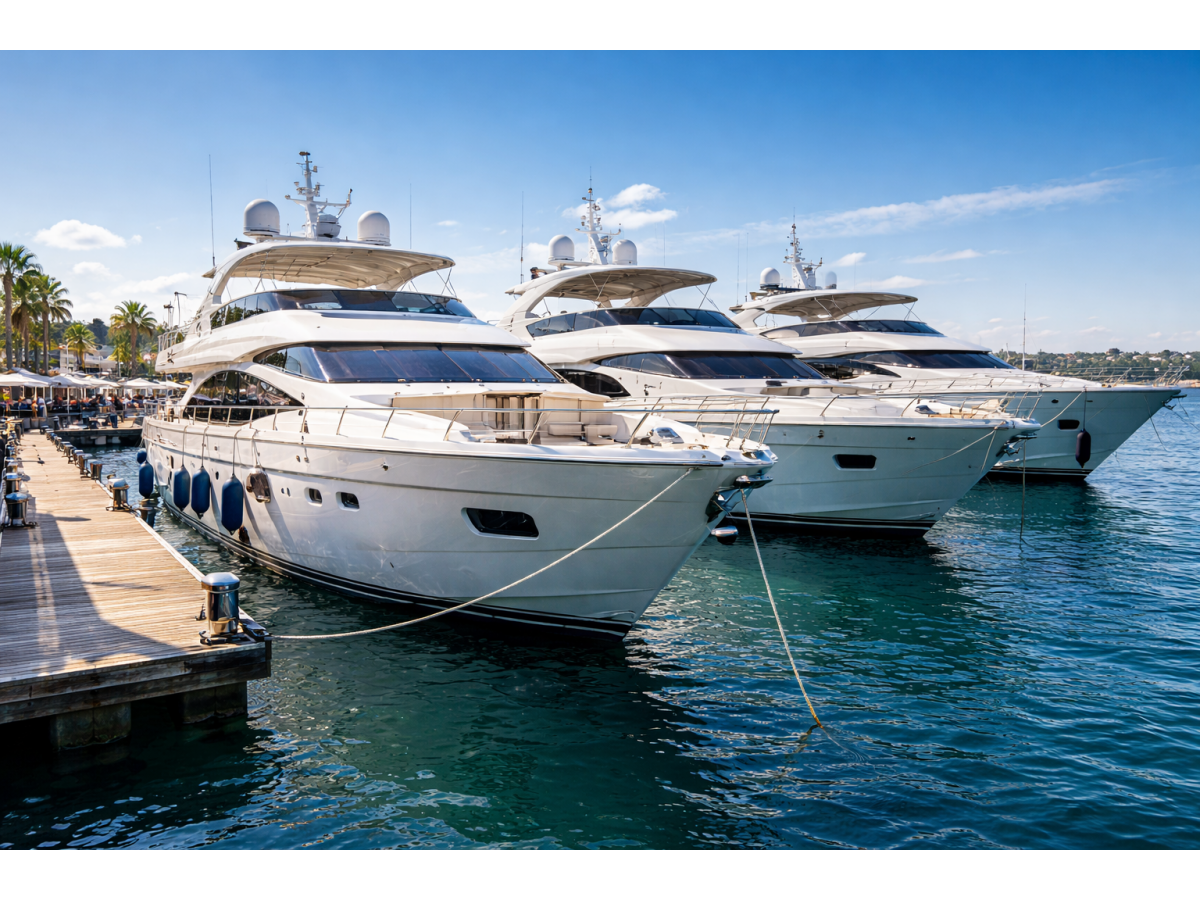
How Welded Studs Are Used in Shipbuilding
A welded stud is a fastener permanently joined to a compatible metal substrate through an appropriate welding process.
The installed stud may provide an external thread for a mating nut, an attachment point for insulation or clips, or another engineered connection feature.
For shipbuilding applications, the main advantage is the ability to integrate attachment points into fabricated metal structures before or during equipment installation.
Depending on the design, welded studs may support:
Pipe and tubing support brackets.
Electrical cable trays and cable clamps.
Equipment mounting plates.
Insulation and lining retention.
Ventilation and HVAC components.
Machinery space accessories.
Secondary structural fittings.
Interior panels and removable covers.
Selected offshore equipment attachments.
The suitability of each application depends on the stud, weld, base material, loading, and approved vessel design.
A threaded weld stud used to hold a lightweight cable clip is not equivalent to a structural welded connection supporting heavy machinery or pressure-containing equipment.
Welded Studs for Hull Plating and Internal Ship Structures
Ship hull plating forms part of the vessel's structural envelope and may contribute to strength, watertight integrity, and fatigue resistance.
Welded attachments to hull structures therefore require careful engineering review.
In suitable approved locations, studs may be considered for internal brackets, insulation systems, cable supports, and other secondary components.
However, welding directly onto hull plating should never be treated as a routine operation without considering the vessel's structural requirements.
Hull Plate Thickness and Structural Function
Hull plates vary in thickness, material grade, and structural significance.
A stud welding process suitable for a relatively thin interior panel may not be appropriate for a heavy hull plate, and vice versa.
The welding procedure must be compatible with the actual substrate material and thickness.
For primary structural members, the naval architect or responsible marine engineer should determine whether the proposed attachment is permissible.
Important considerations include local stresses, fatigue-sensitive details, corrosion protection, and the effect of welding on the base material.
Watertight and Weathertight Integrity
A key advantage of certain surface-mounted welded studs is that they do not require a through-hole in the substrate.
This may be useful where unnecessary penetrations are undesirable.
However, a welded stud does not automatically create or preserve a certified watertight or weathertight boundary.
The attachment location, welding process, base-metal condition, and completed structure must satisfy the vessel's approved requirements.
Where the plate forms part of a watertight boundary, the proposed stud installation should be reviewed before fabrication.
Fatigue and Local Stress Concentrations
Ship hulls and supporting structures experience changing loads from waves, cargo, machinery vibration, and vessel operation.
Additional welded attachments can create local geometric discontinuities that may influence fatigue performance.
This is particularly important near existing welds, structural transitions, highly stressed regions, or fatigue-sensitive details.
The connection should be designed and located to avoid unnecessary stress concentration.
Where fatigue performance is significant, the complete welded detail must be evaluated rather than relying solely on the nominal strength of the stud.
Welded Studs for Deck Structures and Marine Equipment
Ship decks may contain machinery, pipework, cable systems, ventilation equipment, access fittings, and numerous secondary assemblies.
Welded studs can provide attachment points for suitable brackets and fabricated components when permitted by the deck design.
Potential applications include:
Cable support brackets.
Equipment covers.
Interior deck fittings.
Pipe support accessories.
Ventilation components.
Machinery space attachments.
Non-primary mounting panels.
Deck Loading and Equipment Movement
Marine equipment may experience vibration, shock, thermal expansion, and vessel movement.
The welded stud and mating hardware must be evaluated for the expected loading.
For heavier equipment, the connection may require a reinforced bracket, dedicated foundation, or another engineered fastening arrangement.
A general-purpose weld stud should not be used as a substitute for a properly designed machinery foundation or structural anchor.
Corrosion Exposure on Open Decks
Open-deck components may be exposed to seawater spray, rain, ultraviolet radiation, and marine atmospheric conditions.
Corrosion protection should be selected according to the actual exposure.
Material selection should consider both the stud and the connected assembly, including mating nuts, brackets, coatings, and the substrate.
For exposed threaded studs, the possibility of thread corrosion and future maintenance should also be considered.
Welded Studs for Bulkheads and Internal Compartments
Bulkheads divide a vessel into compartments and may serve structural, watertight, fire-resisting, or other functional purposes.
These functions affect whether and how welded studs may be installed.
Potential applications include:
Cable tray supports.
Pipe brackets.
Electrical mounting panels.
Equipment support accessories.
Interior lining attachments.
Insulation retention.
Ventilation and service components.
Watertight and Fire-Rated Bulkheads
Bulkheads with watertight or fire-resisting functions require particular attention.
Welding can affect coatings, insulation, local material properties, and the approved construction arrangement.
The use of a welded stud must not compromise the bulkhead's required performance.
Where an attachment is proposed on a fire-rated division, the fastening method and any affected insulation or lining system should be reviewed against the applicable approved arrangement.
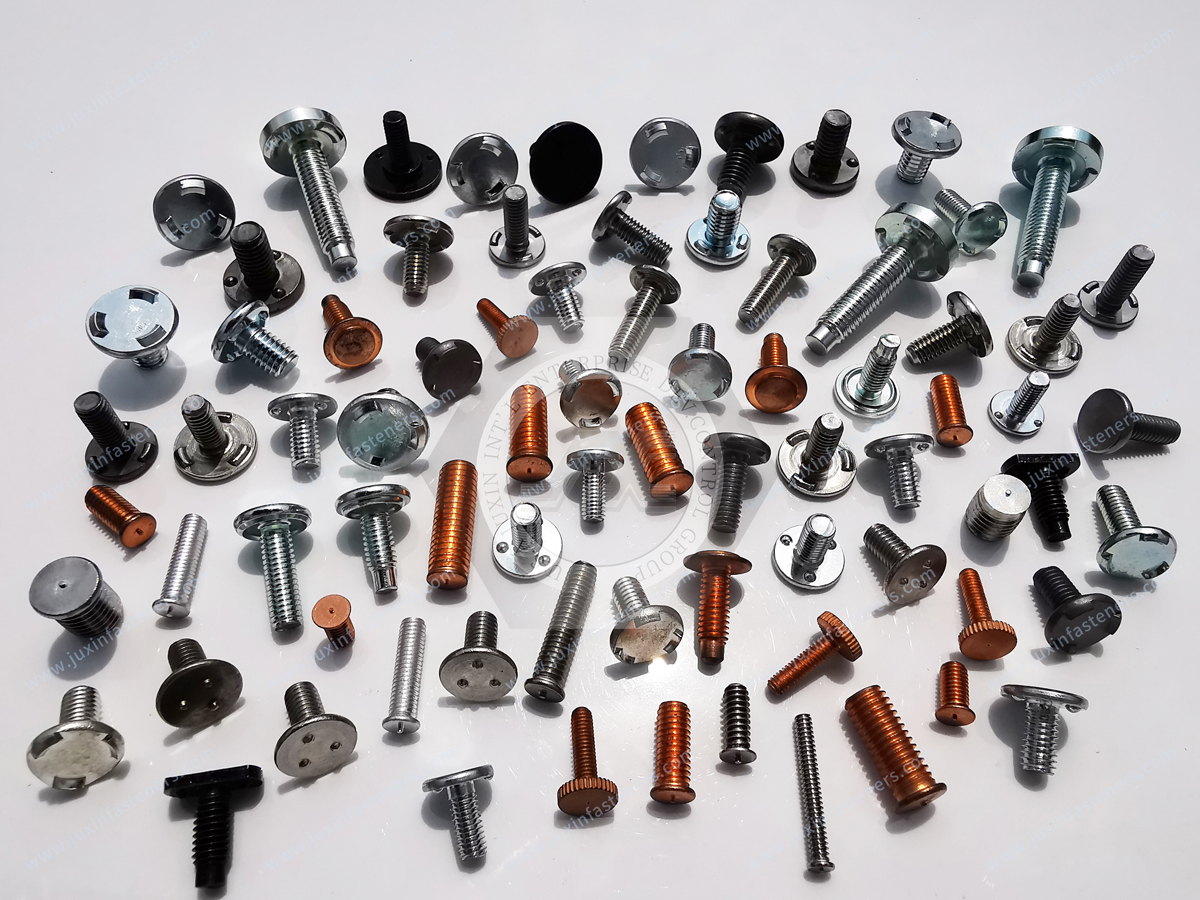
Restricted Access and Installation Planning
Ship interiors frequently contain narrow passages, equipment congestion, curved surfaces, and limited working space.
Stud welding may be advantageous when the installation side is accessible but the opposite side is difficult to reach.
Nevertheless, the welding gun, cables, grounding arrangement, ventilation, and operator working position still require sufficient access.
Installation feasibility should be reviewed during the vessel design or fabrication planning stage rather than after surrounding equipment has been installed.
Marine Pipe Support and Bracket Installation
Ships contain extensive piping systems for cooling water, fuel, ballast, hydraulics, fire protection, ventilation, and other services.
These systems require support arrangements that accommodate weight, movement, vibration, thermal expansion, and maintenance.
Welded studs may provide fastening points for suitable pipe support brackets and secondary mounting components.
Pipe Support Loads and Movement
A pipe support does more than hold the weight of a pipe.
Depending on the system, it may experience forces caused by:
Pipe and fluid weight.
Thermal expansion.
Machinery vibration.
Vessel movement.
Pressure-related forces.
Maintenance loads.
Dynamic operating conditions.
The support design should establish the required load path before selecting the stud.
A welded stud may be appropriate for a lightweight bracket but unsuitable for a heavily loaded or dynamically restrained pipe support without additional engineering.
Pipe Clamp and Bracket Compatibility
The stud thread, projection length, nut engagement, and bracket geometry must be compatible.
Designers should verify that the connection provides sufficient clearance for installation and maintenance.
Where vibration is significant, the mating nut may require a suitable locking method.
A permanent welded stud does not automatically prevent loosening of the threaded assembly.
Corrosion Between Pipe Supports and Ship Structures
Pipe support brackets may be manufactured from materials different from the surrounding ship structure.
Where dissimilar metals are exposed to conductive moisture, galvanic corrosion should be considered.
The complete support assembly may require appropriate material selection, coatings, isolation, or other approved corrosion-control measures.
Welded Studs for Marine Cable Trays and Electrical Systems
Modern ships use extensive electrical distribution, automation, navigation, communication, and monitoring systems.
Cable trays, clamps, and support brackets must maintain suitable routing and mechanical protection.
Welded studs can provide mounting points for selected cable management components.
Applications may include:
Cable tray brackets.
Cable clamp mounting points.
Electrical enclosure accessories.
Equipment support panels.
Cable routing supports.
Secondary mounting hardware.
Cable Routing and Installation Clearance
Cable systems must be routed to avoid damage from sharp edges, excessive bending, heat sources, moving machinery, and other hazards.
Stud location should be coordinated with cable tray geometry and maintenance access.
The installed stud should not create an exposed sharp feature that could damage nearby cables.
Electrical Bonding and Grounding
Some marine electrical installations require protective bonding or grounding.
A welded stud does not automatically provide a validated electrical connection.
Electrical continuity depends on the welded interface, stud material, surface coating, contact pressure, mating hardware, and environmental condition.
Where the stud is part of an electrical bonding arrangement, the complete connection must satisfy the vessel's electrical requirements.
Marine Stud Welding on Curved and Complex Structures
Ship structures contain flat, curved, vertical, overhead, and restricted-access surfaces.
These geometries can complicate stud positioning and welding consistency.
Stud Alignment on Curved Surfaces
A stud installed on a curved plate may not align with the intended mating bracket unless the geometry is reviewed.
The design should consider local surface curvature, welding gun positioning, and the required stud orientation.
A welding process developed for a flat test plate should not automatically be assumed suitable for a curved production component.
Vertical and Overhead Welding Positions
Stud welding may be performed in different orientations where the process and equipment permit.
However, welding position can influence molten metal behavior, access, operator control, and weld quality.
The procedure must be suitable for the intended position.
A process approved for flat-position welding should not automatically be applied to overhead or vertical installation.
Confined-Space Welding Safety
Shipbuilding and repair work may involve enclosed tanks, compartments, machinery spaces, and other confined areas.
Stud welding in such environments requires appropriate controls for ventilation, electrical safety, fire hazards, fumes, and emergency access.
Hot work must follow the applicable shipyard and vessel safety procedures.
Where tanks or compartments may contain flammable residues or hazardous atmospheres, additional controls and authorization are essential.
Production efficiency must never take precedence over safe welding conditions.
Selecting the Correct Marine Stud Welding Process
Marine fabrication includes both heavy structural steel and relatively thin metal panels.
The welding process must be selected according to the fastener type, substrate, loading, and approved application.
Drawn-Arc Stud Welding
Drawn-arc stud welding uses an electrical arc to create localized melting between the stud and base metal before the stud is plunged into the weld pool.
It may be appropriate for certain larger stud configurations and heavier steel applications.
However, its suitability for a marine structural connection depends on the approved welding procedure, material combination, and project requirements.
The process should not be assumed suitable for every shipbuilding application.
Capacitor Discharge Stud Welding
Capacitor discharge (CD) stud welding uses stored electrical energy released during a short welding cycle.
It can be useful for compatible relatively thin metal panels and secondary attachments where localized heat input is desirable.
Potential applications include interior metal panels, enclosures, lightweight brackets, and other suitable fabricated components.
The process is not automatically appropriate for primary hull structure or heavily loaded equipment foundations.
JUXIN FASTENERS offers Flanged CD Weld Studs in Inch and Metric Configurations for compatible applications.
Resistance Projection Welding
Resistance projection welding uses engineered projections and controlled electrical current and force to create the welded joint.
Projection weld studs may be suitable for factory-fabricated brackets, metal panels, and equipment components.
The process requires appropriate electrode access and compatible component geometry.
It is generally evaluated as part of a controlled fabrication operation rather than assumed suitable for direct installation on an assembled ship structure.
JUXIN FASTENERS supplies Carbon Steel Weld Studs with Three Projections Under the Head.
The specific stud and welding process must be matched to the actual component.
Marine Welding Process Comparison
| Process | Potential Application | Main Selection Consideration |
|---|---|---|
| Drawn-arc stud welding | Suitable steel structures and larger welded attachments | Base steel, weld procedure, stud size and structural requirements |
| Capacitor discharge welding | Compatible thin panels and secondary components | Sheet thickness, localized heat input and joint performance |
| Resistance projection welding | Factory-fabricated brackets and sheet metal assemblies | Projection geometry, electrode access and welding parameters |
These processes are not directly interchangeable.
The selected welding method must be validated for the actual stud and substrate combination.
Marine Weld Stud Materials and Corrosion Resistance
Marine environments can accelerate corrosion through saltwater exposure, humidity, temperature changes, and contact between dissimilar metals.
Material selection should therefore consider both mechanical performance and environmental compatibility.
Carbon Steel Weld Studs
Carbon steel weld studs may be suitable for compatible steel structures and fabricated components.
They generally require an appropriate corrosion-protection strategy when exposed to marine conditions.
The coating system should be compatible with the welding sequence and final service environment.
Stainless Steel Weld Studs
Stainless steel may be considered where improved corrosion resistance is required.
However, stainless steel grades vary in corrosion behavior and weldability.
Marine environments containing chlorides can create pitting or crevice corrosion risks for certain stainless steel grades.
Stainless steel should not be described as universally corrosion-proof in seawater.
The selected grade must be appropriate for the actual exposure and welding conditions.
For suitable products, JUXIN FASTENERS offers Stainless Steel Flanged CD Weld Studs.
Aluminum Weld Studs
Aluminum weld studs may be considered for compatible aluminum structures and fabricated components.
The specific alloy, welding process, material thickness, and service environment must be reviewed.
Direct joining of dissimilar metals requires particular care.
An aluminum stud should not be assumed suitable for direct welding to carbon steel using a conventional stud welding process.
Galvanic Corrosion and Dissimilar Metals
When dissimilar metals are electrically connected in the presence of a conductive electrolyte, galvanic corrosion may occur.
Marine environments can increase this risk.
The corrosion behavior depends on the material combination, exposed area ratio, coatings, and service conditions.
The complete assembly should be evaluated, including the stud, mating nut, bracket, substrate, and any isolation materials.
Surface Coatings and Weld Preparation
Welding can damage protective coatings near the attachment point.
The fabrication process should coordinate surface preparation, stud welding, inspection, and coating restoration.
Welding through paint, galvanizing, or other coatings should only be performed when permitted by the approved process.
A corrosion-resistant stud alone does not guarantee that the surrounding welded assembly will remain protected.
Metric and Inch Thread Selection for Marine Weld Studs
Marine equipment may be manufactured using ISO metric or Unified inch-series threads.
Threaded weld studs must match the specified mating hardware.
Relevant standards include ISO 261 and ISO 965 for metric threads and ASME B1.1 for Unified threads.
Metric, UNC, UNF, BSW, and BSF thread systems are not directly interchangeable.
For example, M8 × 1.25 and 5/16-18 UNC are different thread specifications despite their similar nominal diameters.
If an alternative thread system is requested, the change should be reviewed as an engineering modification.
Thread selection should also consider maintenance requirements and the availability of compatible replacement hardware during the vessel's service life.
Mechanical Performance and Marine Joint Reliability
The installed connection must resist the actual loading conditions.
For marine applications, these may include static loads, vibration, shock, cyclic movement, thermal expansion, and corrosion-related deterioration.
Tensile and Shear Loading
A threaded weld stud may experience axial tension, transverse shear, or a combination of forces.
The complete connection must be evaluated, including the stud, weld, substrate, mating nut, and attached component.
The strength of the stud material alone does not establish the load capacity of the installed connection.
Bending and Eccentric Loading
A bracket mounted away from the substrate surface can create bending moments at the stud and weld.
This is especially important where equipment or pipe supports impose offset loads.
Designers should consider the distance between the applied load and the supporting surface.
Vibration and Threaded Joint Loosening
Ship machinery, pumps, engines, and other equipment can generate vibration.
Although the stud is permanently welded to the substrate, the mating nut may still loosen.
Where necessary, the joint should incorporate a suitable locking method approved for the application.
Fatigue and Service Life
Repeated vessel movement and machinery operation may create cyclic loading.
Fatigue performance depends on the welded detail, stress range, material, and loading conditions.
A static pull test does not establish long-term fatigue performance.
For fatigue-sensitive applications, the responsible engineer should define the required analysis or validation.
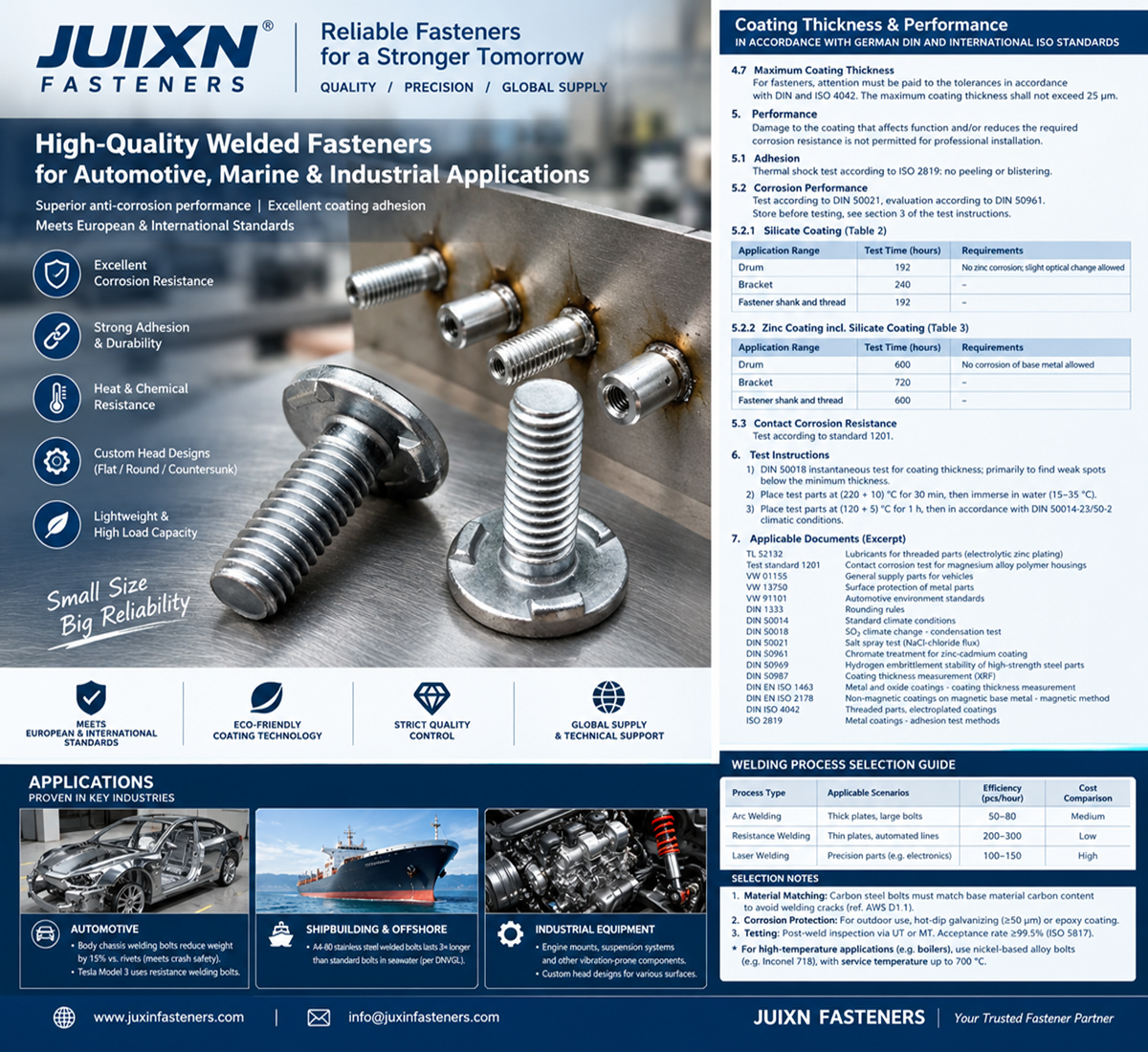
Marine Stud Welding Quality Control
Quality control must be appropriate for the stud type, welding process, and application.
The inspection requirements for a lightweight interior attachment may differ substantially from those for a structurally significant welded connection.
Incoming Product Inspection
Before installation, the shipyard or component manufacturer should verify that the supplied studs match the approved specification.
Checks may include:
Stud type and dimensions.
Thread size and pitch.
Material identification.
Welding-end geometry.
Surface condition.
Required documentation.
Lot identification.
Welding Procedure and Qualification
The welding procedure should be compatible with the base material, stud design, and installation conditions.
For relevant arc stud welding applications, EN ISO 14555 may provide applicable technical requirements where specified.
Other welding standards, shipyard specifications, and classification requirements may also apply.
The correct requirements depend on the vessel and project.
Visual and Dimensional Inspection
Visual inspection may identify incorrect stud positioning, damaged threads, weld irregularities, and local substrate damage.
Dimensional inspection can verify stud height, alignment, and location.
Visual inspection alone does not prove that the weld meets its required mechanical performance.
Mechanical Testing
Depending on the application and approved procedure, testing may include pull tests, bend tests, torque tests, or destructive examination.
These methods are not interchangeable for every stud type.
The appropriate test and acceptance criteria must be defined by the project requirements.
Corrosion and Coating Inspection
Where protective coatings are required, inspection may include coating coverage, damage, and restoration around the welded area.
For exposed marine attachments, corrosion protection is part of the overall connection reliability.
Classification Society and Project Requirements
Marine construction may be subject to the rules of a relevant classification society, such as DNV, ABS, Lloyd's Register, or Bureau Veritas, depending on the vessel and project.
These organizations have different rules and approval processes.
A welded stud product should not be described as classification-approved unless the relevant approval has actually been obtained for the applicable product and scope.
The shipyard or vessel owner should identify any required classification, inspection, material, or welding documentation during the RFQ stage.
Shipyard Production Efficiency and Installation Planning
Shipyards often manage large numbers of attachment points across multiple fabrication stages.
Stud welding can support efficient production when it is integrated into a controlled manufacturing plan.
Pre-Outfitting and Block Construction
Modern shipbuilding may involve prefabricated blocks and pre-outfitted modules.
Installing suitable attachment points before final block assembly can improve access and reduce later work in congested compartments.
However, early installation also creates risks of handling damage or interference with subsequent fabrication.
The installation sequence should be coordinated with structural welding, coating, piping, electrical work, and equipment installation.
Reducing Rework in Confined Compartments
A fastening point that is easy to install on an open fabrication panel may become difficult to access after equipment and piping are installed.
Early coordination can reduce rework and avoid unnecessary hot work inside completed compartments.
This is especially valuable for cable supports, insulation attachments, and secondary brackets.
Automation and Repeatability
Factory-fabricated components may be suitable for automated or semi-automated stud welding.
Automation feasibility depends on part geometry, stud feeding, equipment access, and production volume.
The benefit should be evaluated through total station cycle time, weld consistency, inspection requirements, and equipment maintenance.
Total Installed Cost
The purchasing price of a stud is only one component of the overall cost.
Shipyard production costs may also include:
Surface preparation.
Welding equipment and consumables.
Installation labor.
Access equipment.
Inspection and testing.
Coating restoration.
Rework.
Packaging and handling.
Production scheduling.
A fastening method that reduces loose hardware handling may still require additional welding or inspection operations.
The correct choice should be based on the complete manufacturing process.
Common Marine Welded Stud Failures and Prevention
Incomplete Weld Formation
Poor surface preparation, incorrect welding parameters, or unsuitable materials may cause inadequate weld formation.
Prevention: Validate the process using the actual stud and substrate combination.
Stud Misalignment
Curved surfaces, restricted access, or poor positioning can result in incorrect stud orientation.
Prevention: Review geometry and use suitable installation fixtures or positioning controls.
Local Base-Metal Damage
An unsuitable welding process may cause excessive heating, distortion, or other local damage.
Prevention: Match the welding method to the material and thickness.
Corrosion at the Welded Interface
Coating damage and marine exposure may create corrosion risks.
Prevention: Coordinate welding and corrosion protection and inspect the completed assembly.
Threaded Joint Loosening
Vibration can loosen the mating nut even when the stud weld remains intact.
Prevention: Use a validated locking method where required.
Fatigue Cracking
Repeated loading may damage the welded detail.
Prevention: Evaluate fatigue-sensitive locations and the actual load spectrum.
Unapproved Hull or Bulkhead Attachments
Adding welded studs to a critical structure without engineering review may affect structural or watertight performance.
Prevention: Obtain the required design and shipyard approval before installation.
Incorrect Welding Process Substitution
A CD weld stud or projection weld stud may be incorrectly proposed as a replacement for a different welded fastener.
Prevention: Verify the product geometry, welding process, and required performance before substitution.
Marine Welded Stud Procurement and OEM Supplier Development
Marine purchasing teams must evaluate technical suitability, quality documentation, delivery reliability, and long-term maintenance requirements.
For shipbuilding projects, purchasing decisions may involve naval architects, fabrication engineers, equipment suppliers, shipyard production teams, and classification representatives.
Technical Drawing Review
A complete marine weld stud RFQ should identify:
Stud type and intended application.
Product drawing and dimensions.
Thread specification.
Stud material and mechanical requirements.
Base material and thickness.
Welding process.
Surface preparation and coating.
Required mechanical performance.
Environmental exposure.
Inspection and documentation requirements.
This information helps avoid quotations for products that are dimensionally similar but technically unsuitable.
Alternative Fastener Qualification
A proposed alternative should be evaluated against the approved drawing and project requirements.
Potential differences include stud material, welding-end geometry, thread tolerance, corrosion resistance, and welding process compatibility.
For structurally significant or classification-controlled applications, substitution may require formal engineering approval.
MOQ, Lead Time and Phased Delivery
Shipbuilding projects often require phased procurement aligned with fabrication and outfitting schedules.
Purchasing teams should provide estimated quantities, required delivery dates, and any project-specific packaging or traceability requirements.
MOQ and lead time depend on the exact product configuration and supply arrangement.
These conditions should be confirmed during quotation.
Quality Documentation and Traceability
Depending on the customer and project, required documentation may include material records, dimensional inspection reports, test results, or lot traceability.
The specific documentation should be agreed before order placement.
General supplier product descriptions should not be treated as proof of vessel-specific approval.
Engineering and Procurement Checklist for Marine Weld Studs
| Evaluation Area | Required Information |
|---|---|
| Application | Pipe support, cable tray, bulkhead fitting, panel or equipment bracket |
| Structural significance | Secondary attachment or structurally significant connection |
| Stud geometry | Diameter, length, thread and welding-end design |
| Material | Stud grade and substrate compatibility |
| Base metal | Steel or aluminum grade, thickness and condition |
| Welding | Process, position, access and approved procedure |
| Environment | Saltwater, humidity, vibration and temperature |
| Corrosion protection | Coating, material compatibility and restoration |
| Quality | Inspection, testing and acceptance criteria |
| Approval | Shipyard, owner or classification requirements |
| Procurement | Quantity, MOQ, delivery schedule and documentation |
This checklist supports clearer communication between engineering, production, and purchasing teams.
Marine Weld Stud Supply and OEM Engineering Support – JUXIN FASTENERS
JUXIN FASTENERS supplies industrial weld studs and related fastening products for OEM manufacturers and fabricated metal assemblies.
Our relevant product portfolio includes:
Threaded projection weld studs.
Flanged capacitor discharge weld studs.
Stainless steel CD weld stud configurations.
Carbon steel weld stud options.
Suitable aluminum CD weld stud options.
Metric and Unified inch thread specifications.
Customer-defined dimensions and geometries.
Drawing-based OEM fastener evaluation.
Related product and engineering information:
Flanged CD Weld Studs – Inch and Metric
Stainless Steel Flanged CD Weld Studs
Carbon Steel Weld Studs with Three Projections
Projection Weld Studs: Engineering, DFM and OEM Sourcing
For marine projects, JUXIN FASTENERS can review customer drawings, material specifications, welding requirements, and purchasing quantities to evaluate suitable product options.
Marine structural suitability, classification approval, special testing, and project-specific documentation must be confirmed separately where required.
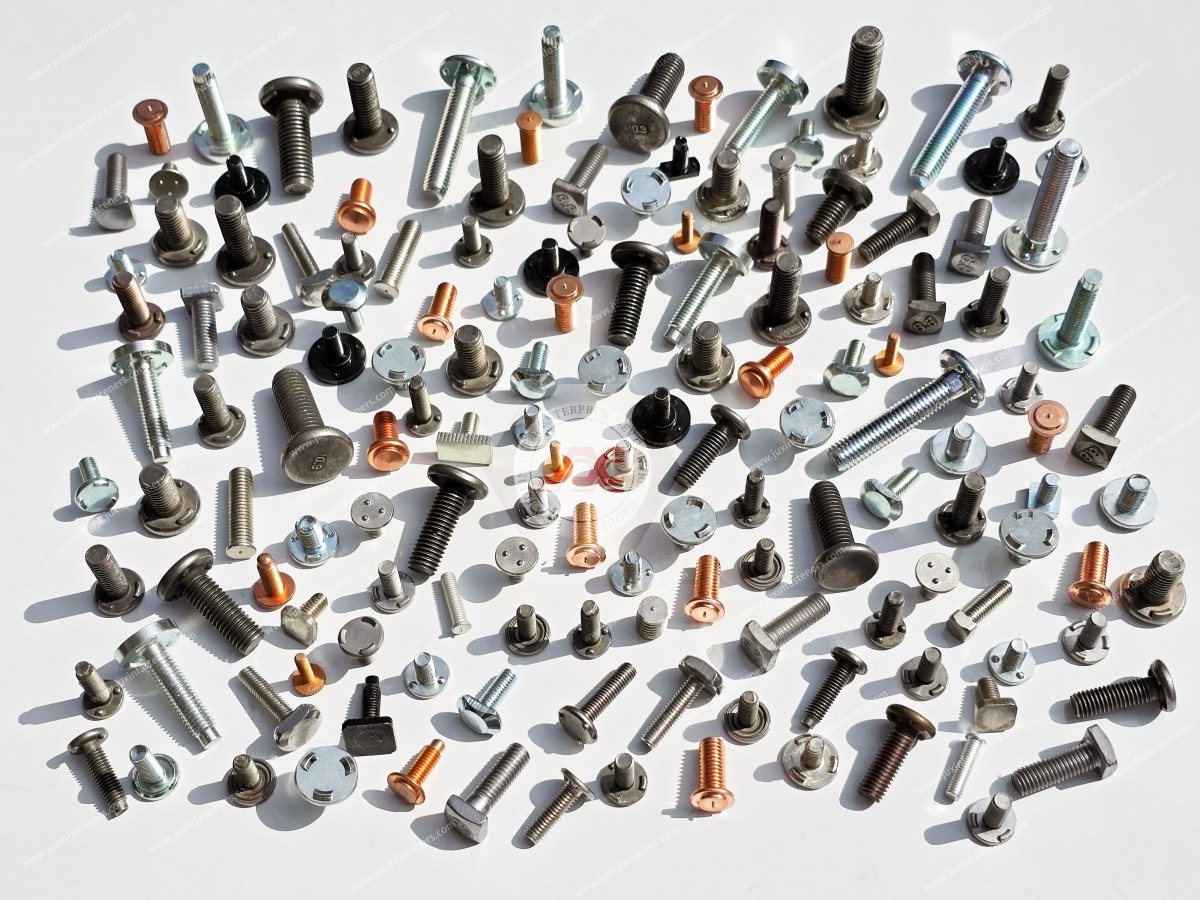
Request a Marine Weld Stud Technical Review or OEM RFQ
Are you sourcing weld studs for shipbuilding, marine equipment, pipe supports, cable management, bulkhead fittings, or fabricated vessel components?
JUXIN FASTENERS welcomes inquiries from shipyards, marine equipment manufacturers, naval engineering teams, fabrication companies, purchasing departments, and international supplier development professionals.
For an accurate technical review and quotation, please provide:
Available 2D drawings or 3D CAD models.
Required stud type and dimensions.
Thread specification.
Stud material and mechanical requirements.
Base metal grade and thickness.
Welding process and installation position.
Intended application and structural significance.
Environmental and corrosion-protection requirements.
Required inspection, testing, or classification documentation.
Estimated order quantity and delivery schedule.
If you are evaluating an alternative to an existing marine weld stud, please include the original approved drawing or specification.
Our objective is to help customers identify technically appropriate welded fastening products that support reliable marine assembly, efficient fabrication, and consistent OEM procurement.
JUXIN FASTENERS
Website: https://www.juxinfasteners.com
Email: info@juxinfasteners.com
Send your technical drawings and RFQ to discuss your shipbuilding, marine engineering, or industrial welded stud requirements.
Contact Us
Tel.:
+86 020 8621 0320
+86 020 3121 6067
E-mail:
Technical Support:
Navigation
SEND INQUIREY



