
Call Us
+86 136 6007 9809
Call Us
+86 136 6007 9809

Apr. 21, 2026
Flanged CD Weld Studs for Food Processing and Commercial Kitchen Equipment: Engineering, Welding and OEM Sourcing Guide
Food processing machinery and commercial kitchen equipment manufacturers face demanding requirements for mechanical reliability,
corrosion resistance, cleanability, surface appearance and efficient production.
Stainless steel equipment housings, preparation machinery, commercial ovens, refrigeration systems,
beverage equipment and food processing lines often require permanent threaded mounting points for brackets, panels, controls and mechanical accessories.
Conventional fastening methods may require drilling, tapping or through-bolting. These operations can introduce additional manufacturing steps,
visible fastener heads, inaccessible assembly locations or openings through the parent sheet.
Flanged CD Weld Studs (Inch / Metric) provide an alternative for suitable metallic workpieces. Using capacitor discharge stud welding,
these fasteners create permanent externally threaded mounting points on the accessible side of a metal surface.
The flange provides a defined weld-base geometry and may increase the effective joining area compared with a comparable non-flanged configuration.
For suitable thin-sheet applications, capacitor discharge welding can also help limit heat input and reduce the risk of distortion or reverse-side marking.
However, these advantages depend on the actual stud design, material combination, welding equipment and production procedure.
In food machinery, an additional distinction is essential: a mechanically reliable welded attachment is not automatically a hygienically acceptable fastening detail.
JUXIN FASTENERS supplies flanged capacitor discharge weld studs and related industrial fastening components for suitable standard and drawing-based OEM applications.
This guide explains how engineers, production teams and procurement professionals can evaluate flanged CD weld studs for food processing equipment,
commercial kitchen assemblies and stainless steel sheet metal manufacturing.
What Are Flanged Capacitor Discharge Weld Studs?
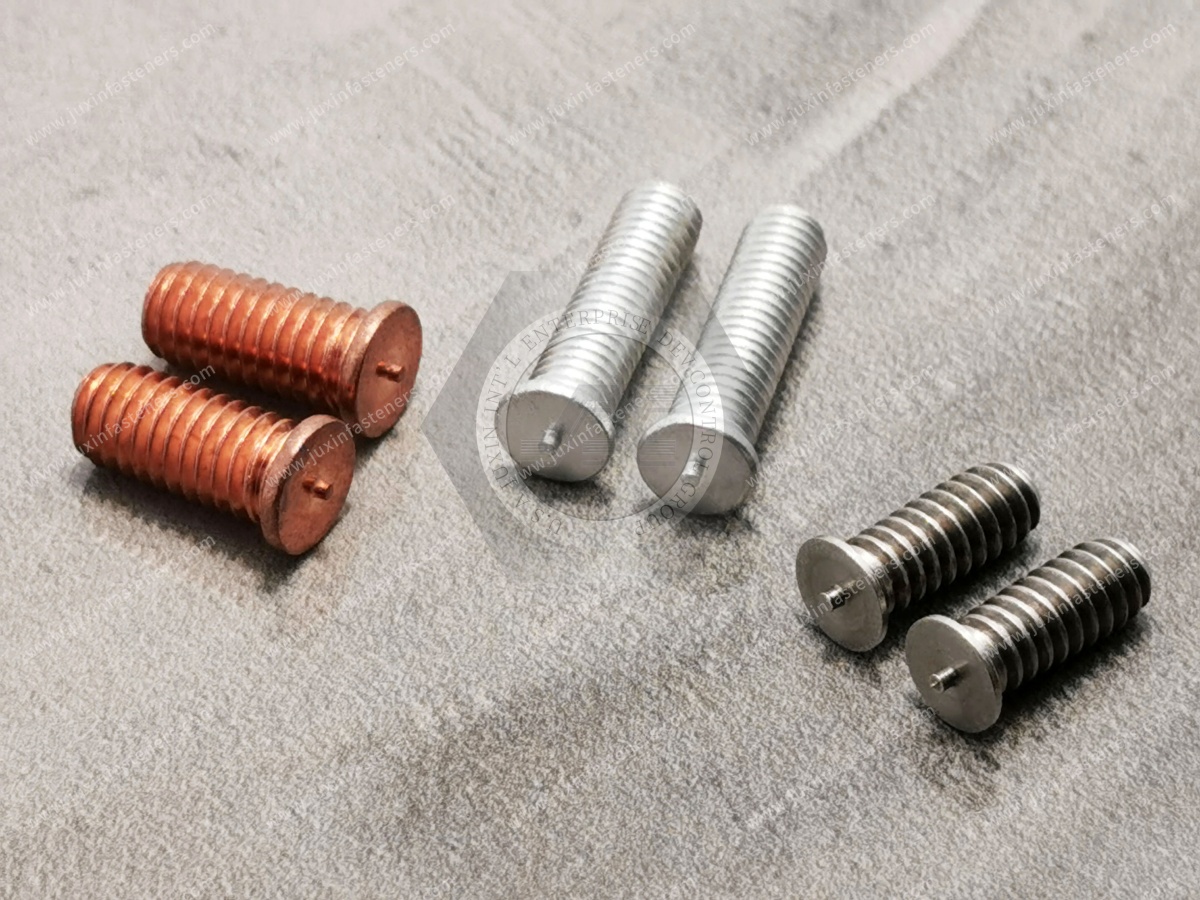
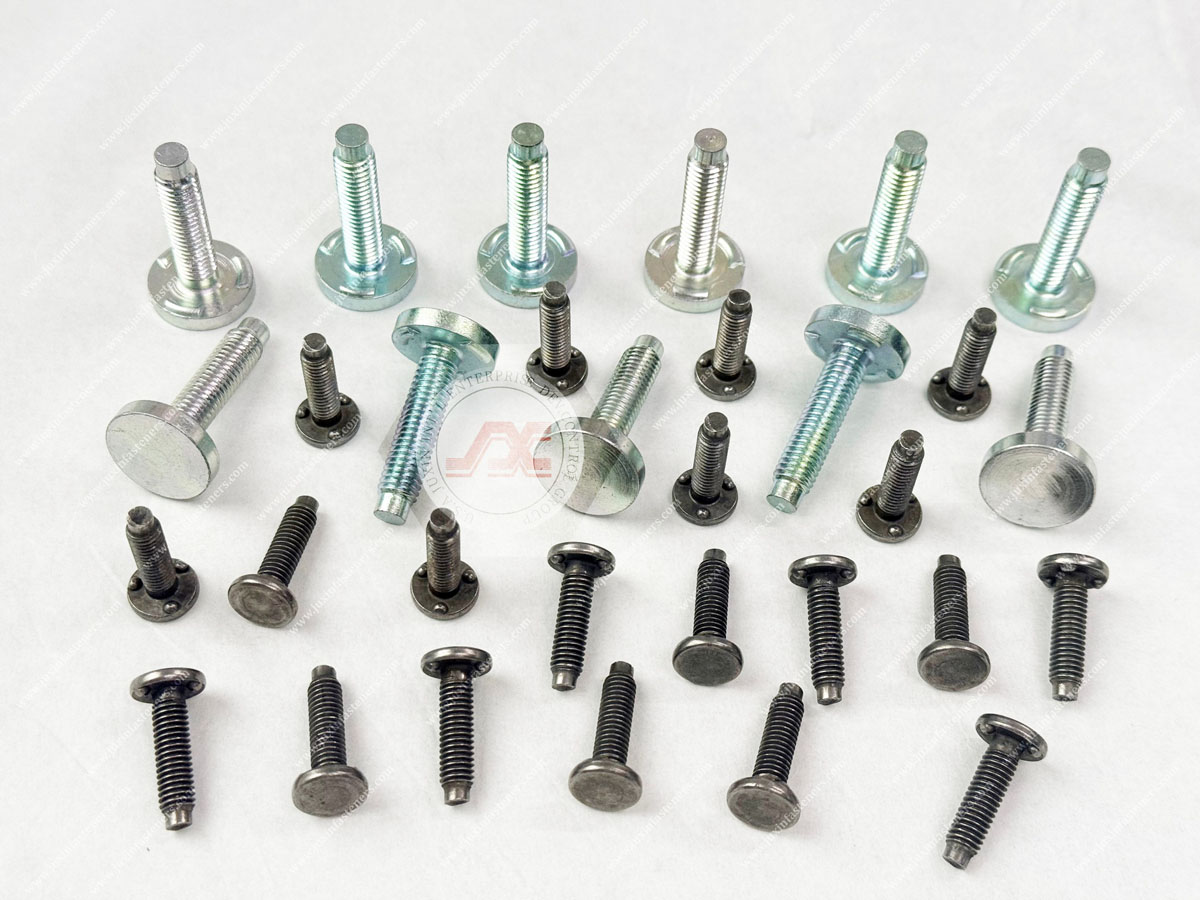
A flanged capacitor discharge weld stud is a fastener designed for attachment to a suitable metallic workpiece using the capacitor discharge stud welding process.
A typical externally threaded configuration incorporates a threaded shank, a wider flange at the welding end and an ignition tip designed for the specified welding process.
The flange provides a defined weld-base region, while the threaded shank remains accessible for subsequent mechanical assembly.
The product may also be described as a flanged CD stud, threaded capacitor discharge stud, tip-ignition weld stud or flanged weld screw.
The precise terminology should match the product drawing and joining process.
Main Structural Features
External Threaded Shank
Provides the male-threaded interface for compatible nuts, brackets and mechanical components.
Flanged Weld Base
Creates a defined joining region and may provide a larger effective weld area than a comparable non-flanged stud.
Ignition Tip
Supports initiation of the tip-ignition capacitor discharge welding process.
Stud Length
Determines available thread engagement and clearance for the mating assembly.
Material and Surface Condition
Influence mechanical properties, corrosion resistance and welding behavior.
The actual flange diameter, flange thickness, ignition-tip geometry, thread tolerance and stud length must be established by the applicable engineering drawing.
Why the Flange Matters in CD Stud Welding
The flange is more than an external geometric feature.
It influences the joining area, mating-component clearance and the way mechanical loads are transferred through the welded attachment.
A larger flange may increase the effective weld area relative to a comparable non-flanged design.
This can be beneficial where the application requires a permanent threaded mounting point and sufficient space is available around the weld base.
However, flange diameter alone does not determine joint strength.
The finished connection also depends on weld formation, substrate thickness, material properties and applied loading.
Flange Diameter and Mechanical Performance
The flange creates a wider interface between the stud and parent metal.
This may help distribute loads across the welded attachment.
Nevertheless, the strength of the connection must be verified for the actual assembly.
Flange Thickness and Nut Clearance
A projecting flange can prevent a nut or mating bracket from moving directly against the parent sheet.
Where close nut rundown is required, the flange may create an interference condition.
A non-flanged CD stud or another fastening method may be more appropriate.
Flange Geometry and Automated Feeding
Certain commercial CD stud configurations use flange geometry to support feeding, orientation and positioning.
However, not every flanged stud is automatically compatible with every feeding system.
Automatic feeding must be evaluated using the actual stud dimensions and equipment.
Standard Flanged Versus Reduced-Flange Configurations
Some product families distinguish conventional flanged studs from reduced-flange or automatic-feed configurations.
These should not be treated as dimensionally interchangeable.
Differences in flange geometry can affect welding performance, installation tooling and assembly clearance.
How Capacitor Discharge Stud Welding Works
Capacitor discharge stud welding uses electrical energy stored in capacitors to produce a short-duration welding event.
In a suitable tip-ignition process, the ignition tip initiates the joining sequence.
The welding system controls the electrical discharge and movement of the stud to develop the welded connection.
The process may use contact or gap operation, depending on the equipment.
General Welding Sequence
The stud is positioned at the specified location on the parent metal.
The welding equipment establishes the required initial contact or gap arrangement.
The stored electrical energy is discharged through the welding circuit.
The ignition tip participates in initiating the welding event.
The welding gun controls stud movement as the joining surfaces develop the welded connection.
The completed joint is inspected against the applicable acceptance criteria.
The actual sequence depends on the equipment and approved welding procedure.
Why CD Welding Is Considered for Thin Sheet Metal
The short-duration welding process can limit the thermal effects associated with certain longer-duration welding methods.
For suitable applications, this may help reduce distortion and reverse-side marking.
However, a short welding cycle does not guarantee an undistorted or mark-free surface.
The actual outcome depends on material, thickness, stud geometry, welding energy and workpiece support.
Contact and Gap CD Welding
Contact and gap capacitor discharge welding are related but distinct operating methods.
They differ in the initial stud position and movement during the welding cycle.
The appropriate method depends on the welding system and stud design.
A welding schedule should not be transferred from one method to another without validation.
CD Welding Versus Resistance Projection Welding
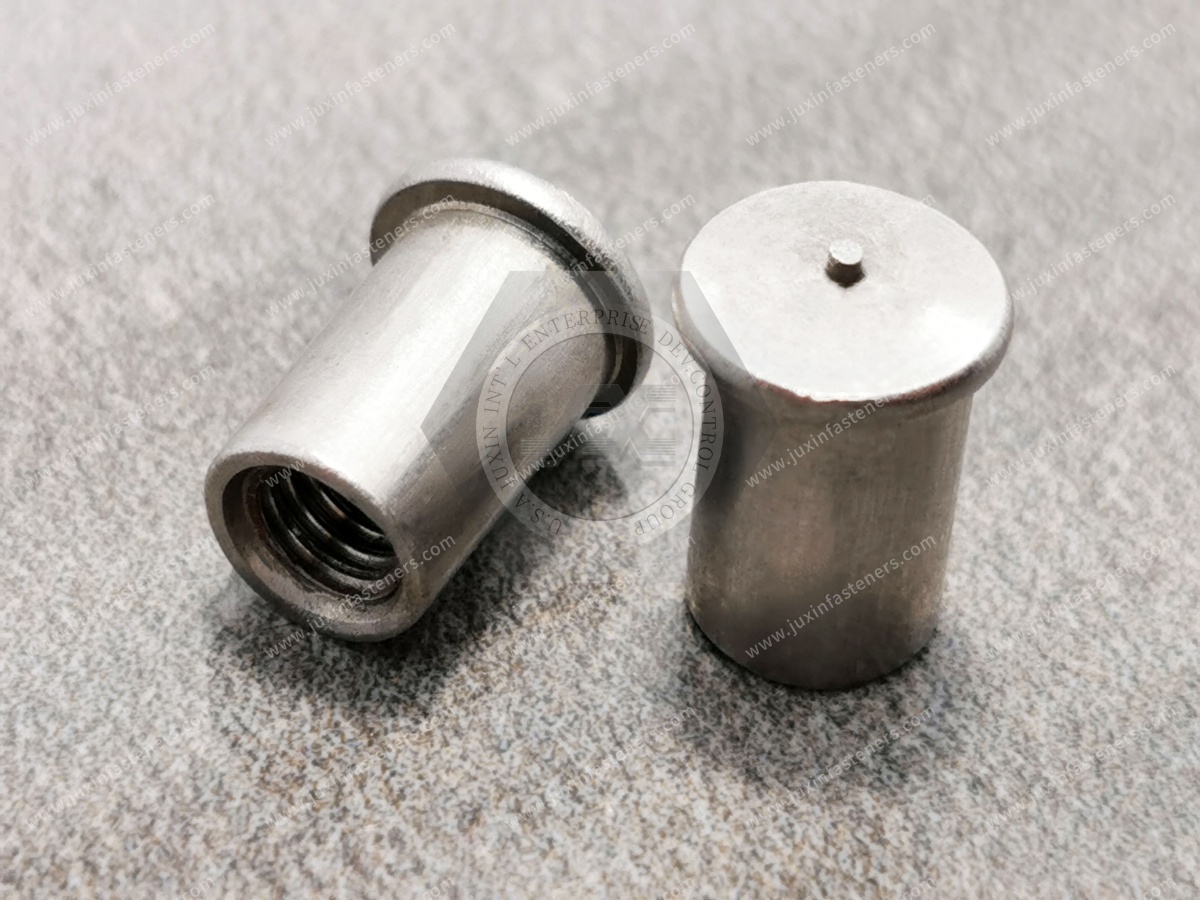
Capacitor discharge stud welding and resistance projection welding use different joining arrangements.
Tip-ignition CD welding uses a stud weld end designed for the capacitor discharge process.
Resistance projection welding uses formed contact projections and electrode force to localize resistance heating.
The fasteners and equipment should not be treated as interchangeable.
Selecting Stainless Steel CD Weld Studs for Food Equipment
Stainless steel is widely used in food processing and commercial kitchen equipment because it can provide corrosion resistance
and cleanable surfaces when appropriately specified and finished.
However, stainless steel is not a single material with uniform properties.
The selected grade must be appropriate for the environment, cleaning process, mechanical requirements and welding procedure.
304 Stainless Steel
304 stainless steel is commonly used in food equipment and industrial enclosures.
It may be suitable for many general-purpose applications where the environment and cleaning chemicals are compatible.
The actual material specification and welded joint requirements must be confirmed.
316 Stainless Steel
316 stainless steel may be considered where improved resistance to certain corrosive environments is required.
Applications involving chloride-containing cleaning agents or demanding washdown conditions require careful material evaluation.
316 stainless steel is not immune to chloride corrosion, pitting or crevice corrosion.
Its suitability depends on the actual chemical exposure, temperature and cleaning conditions.
Carbon Steel CD Weld Studs
Suitable low-carbon steel studs may be appropriate for non-food-contact equipment structures and protected industrial assemblies.
Copper-flashed carbon steel is used in certain commercial CD stud product families.
However, carbon steel should not automatically be substituted for stainless steel in wet or chemically aggressive environments.
The final material choice should consider the entire assembly and its corrosion protection requirements.
Aluminum CD Weld Studs
JUXIN FASTENERS also lists aluminum flanged CD weld studs within its product range.
Aluminum studs may be suitable for selected compatible aluminum assemblies.
They should not be assumed interchangeable with stainless steel studs or suitable for direct welding to every metallic substrate.
The actual alloy combination and welding procedure require evaluation.
Brass and Other Materials
Alternative materials may be available for specific CD stud configurations.
Their mechanical properties, corrosion behavior and weldability must be reviewed for the intended application.
Availability of a material in a product family does not guarantee every thread size and stud length can be supplied in that material.
Hygienic Design: Where CD Weld Studs Should and Should Not Be Used
Hygienic equipment design requires careful control of surfaces, joints, drainage, accessibility and contamination risks.
A permanent welded attachment may help avoid a conventional through-hole at the mounting location.
However, this does not automatically make the joint hygienic.
Food-Contact Surfaces
Direct food-contact areas generally require more demanding assessment of cleanability, surface finish, joint geometry and contamination risks.
An exposed threaded stud, flange transition or inaccessible weld region may create cleaning difficulties.
A standard flanged CD weld stud should not automatically be selected for direct food-contact locations.
The equipment designer must determine whether the complete attachment can satisfy the relevant hygienic design requirements.
Non-Food-Contact Equipment Areas
Flanged CD studs may be more practical for suitable non-food-contact mounting locations, such as:
External equipment panels
Electrical control housings
Mechanical accessory brackets
Protected internal support plates
Selected removable-cover attachments
Even outside direct food-contact zones, cleaning exposure, condensation and maintenance accessibility may remain important.
No Through-Hole Does Not Mean No Hygienic Risk
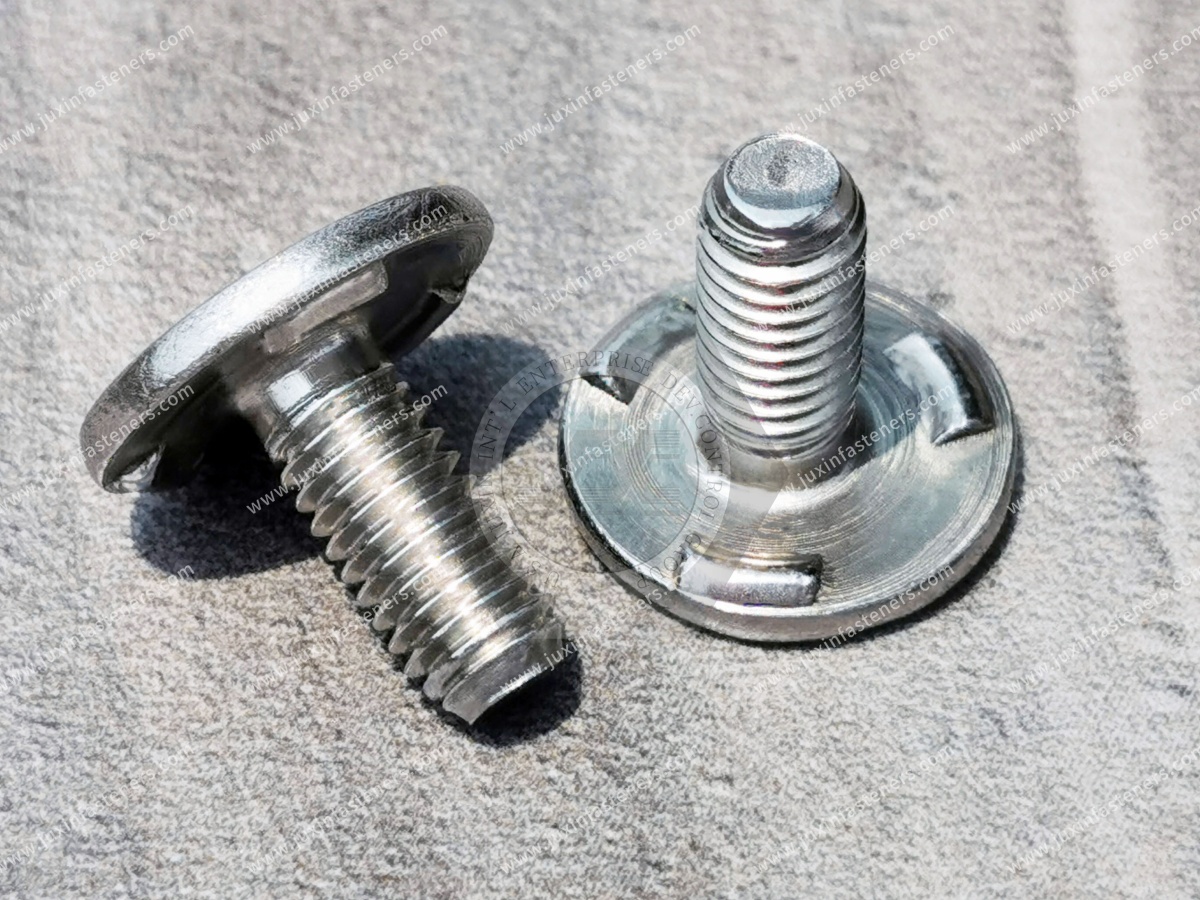
Avoiding a clearance hole may reduce one potential route for contamination or moisture ingress.
However, the flange perimeter, weld geometry, adjacent surfaces and mating hardware can still create difficult-to-clean regions.
The entire joint should be assessed.
No Automatic Hermetic Seal
A conventional CD welded stud should not be assumed to create a hermetic or sanitary seal.
Where pressure integrity, liquid containment or hygienic sealing is required, the joint must be specifically designed and validated for that purpose.
Hygienic Design Reference
ISO 14159 provides hygiene-related design requirements for machinery.
Its relevance depends on the equipment and the associated hygiene risks.
Using a stainless steel CD weld stud does not by itself establish compliance with ISO 14159 or other food equipment requirements.
Commercial Kitchen Equipment Applications
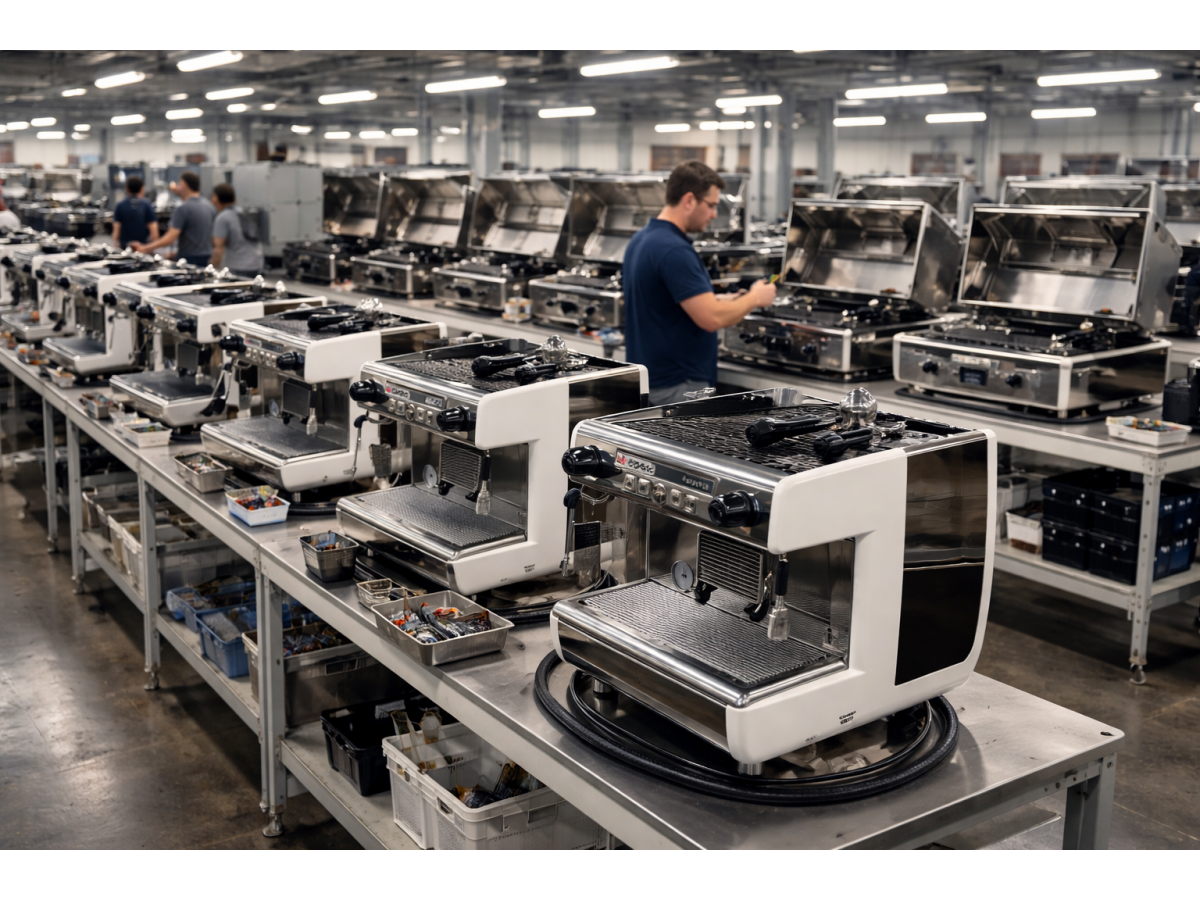
Commercial kitchen equipment frequently combines stainless steel panels, internal mechanical supports, control systems and removable accessories.
Flanged CD weld studs may provide suitable threaded attachment points where the welding process and mechanical requirements are compatible.
Commercial Ovens
Potential applications include selected external panel brackets, control enclosure supports and mechanical accessories.
The designer should evaluate operating temperature, thermal cycling, insulation clearances and maintenance requirements.
Refrigeration Equipment
Commercial refrigeration cabinets may contain stainless steel or coated sheet metal panels.
CD studs may be considered for suitable mechanical attachments outside critical sealing or insulation interfaces.
The design should account for condensation, corrosion and thermal cycling.
Dishwashing Equipment
Commercial dishwashing equipment may experience repeated moisture exposure, elevated temperatures and aggressive cleaning chemicals.
Material selection and corrosion resistance are particularly important.
A standard stainless steel grade should not be assumed suitable for every cleaning environment.
Food Preparation Equipment
Mixers, preparation machinery and related equipment may require threaded mounting points for guards, panels and auxiliary brackets.
The location of the stud relative to the product zone and cleaning process must be reviewed.
Food Processing Machinery and Production Lines
Industrial food processing equipment may incorporate stainless steel guards, conveyor assemblies, equipment frames and control enclosures.
Flanged CD studs may be considered for selected sheet metal attachments.
Protective Guards and Covers
Permanent studs may provide mounting points for removable guards or covers.
The joint should be designed for the required mechanical loading and maintenance frequency.
Sensor and Instrumentation Brackets
Studs may support selected instrumentation brackets where the mechanical load and installation conditions are suitable.
For process vessels, pressure boundaries or product-contact zones, additional requirements may apply.
Cable Management and Electrical Enclosures
Food processing machinery frequently includes electrical control boxes and cable support structures.
CD studs may provide mounting points on suitable metal panels.
Electrical bonding and grounding requirements must be verified separately from weld strength.
Conveyor Accessories
Selected lightweight support brackets and auxiliary components may be candidates for welded threaded attachments.
Dynamic loading, vibration and cleaning exposure must be considered.
When CD Weld Studs Are Not the Preferred Solution
Flanged CD studs are not universally appropriate.
Alternative fastening or joining methods may be preferable when:
The stud would create an inaccessible hygiene risk.
The joint must be pressure-tight or hermetically sealed.
The parent metal is incompatible with the proposed welding process.
The assembly requires a female thread rather than a male stud.
The flange interferes with the mating component.
The required load exceeds the validated joint capacity.
Welding cannot be performed safely within the manufacturing sequence.
A removable or replaceable attachment is required.
The correct fastening method should follow the actual engineering requirements.
Thin Stainless Steel Welding and Surface Appearance
Commercial kitchen equipment often includes visible stainless steel panels.
For these applications, reverse-side appearance can be as important as mechanical strength.
Potential Welding Effects
Reverse-side discoloration
Local surface marking
Distortion
Burn-through
Weld expulsion
Incomplete weld formation
Stud misalignment
Why No Universal Minimum Sheet Thickness Can Be Guaranteed
The minimum suitable sheet thickness depends on the stud diameter, flange geometry,
material, welding energy, workpiece support and mechanical requirements.
A fixed thickness value should not be applied to every CD stud configuration.
Why a Mark-Free Surface Cannot Be Guaranteed
Capacitor discharge welding can help limit thermal effects under suitable conditions.
However, the opposite surface may still show discoloration or deformation.
Where the exterior finish is critical, representative samples should be evaluated before mass production.
Surface Finish and Cosmetic Acceptance
A cosmetically acceptable surface does not prove adequate weld strength.
Likewise, a mechanically acceptable weld may not meet the required appearance standard.
Mechanical and cosmetic acceptance criteria should be defined separately.
Welding Parameters and Process Development
CD welding parameters must be established for the actual stud and substrate combination.
The process should not be controlled using a universal welding-time or current formula based only on stud diameter.
Important Process Variables
Capacitor charging voltage
Equipment capacitance
Stored electrical energy
Discharge circuit characteristics
Stud diameter
Flange geometry
Ignition-tip dimensions
Stud material
Parent-metal material and thickness
Surface condition
Welding gun setup
Contact or gap operation
Stud movement
Workpiece grounding
Required joint performance
Stored Electrical Energy
The electrical energy stored in a capacitor bank is described by:
E = ½ CV²
Here, E represents stored energy, C represents capacitance and V represents charging voltage.
This relationship does not directly establish the energy delivered to the weld interface or guarantee weld quality.
The actual welding procedure must be validated.
Surface Preparation
The intended weld location should be prepared according to the approved process.
Oil, contamination, heavy oxide layers and incompatible coatings may interfere with weld formation.
The cleaning method must be compatible with the material and production requirements.
Workpiece Positioning
The stud should be positioned according to the assembly drawing.
Incorrect alignment may affect weld formation and the dimensional accuracy of the finished attachment.
Equipment Maintenance
Welding gun components, chucks, positioning devices and electrical connections should be inspected according to the equipment manufacturer's requirements.
Maintenance should support consistent equipment operation rather than substitute for weld validation.
Weld Strength and Mechanical Design
The finished joint must meet the intended mechanical requirements.
The nominal strength of the stud material does not automatically establish the strength of the welded attachment.
Relevant Loading Conditions
Axial tension
Transverse shear
Bending
Assembly tightening torque
Vibration
Repeated maintenance loading
Thermal cycling
Potential Failure Modes
Weld interface failure
Parent-sheet tearing
Local panel deformation
Stud fracture
Thread damage
Fatigue-related failure
Why Flange Size Is Not a Strength Guarantee
A larger flange may provide a greater effective joining area.
However, the actual joint capacity depends on the weld, substrate and loading conditions.
The engineering team should verify the required mechanical performance.
Assembly Torque
The tightening torque applied to the mating nut must be compatible with the stud, thread engagement and welded joint.
Excessive tightening torque may damage the thread or welded attachment.
The applicable torque requirements should be established by the assembly design.
Thermal Cycling
Food processing and kitchen equipment may experience repeated heating and cooling.
Differences in material expansion, joint loading and operating temperature may influence long-term performance.
The complete assembly should be evaluated where thermal cycling is significant.
Corrosion Resistance and Cleaning-Chemical Exposure
Corrosion resistance depends on the material, surface condition and service environment.
Chloride Exposure
Chloride-containing cleaning chemicals may increase the risk of localized corrosion in certain stainless steel grades.
The material should be selected according to the actual cleaning procedure.
Crevice Corrosion
Inaccessible gaps around mating components or flange transitions may retain moisture or cleaning chemicals.
These locations should be evaluated during hygienic and corrosion design.
Mixed Materials
Using dissimilar metals may introduce galvanic corrosion risks in suitable conductive environments.
The complete material combination should be assessed.
Post-Weld Surface Condition
Welding may affect the local surface condition.
Where necessary, appropriate cleaning, finishing or passivation procedures should be established by the equipment manufacturer.
No universal post-weld treatment should be assumed suitable for every material or application.
Metric and Unified Inch Thread Specifications
Flanged CD weld studs may be specified with metric or Unified inch-series external threads.
Metric Thread Examples
Common industry designations include M3, M4, M5, M6 and M8.
The applicable diameter, pitch and tolerance must be confirmed for the actual product.
Unified Inch Thread Examples
Common industry designations include #4-40 UNC, #6-32 UNC, #8-32 UNC, #10-24 UNC, #10-32 UNF and 1/4-20 UNC.
These are industry examples, not confirmation that every size is available in every material or length.
Relevant Thread Standards
ISO 261 covers general-purpose metric thread series.
ISO 965 addresses metric thread tolerances.
ASME B1.1 covers Unified inch screw threads.
Metric and Inch Threads Are Not Interchangeable
Metric, UNC and UNF threads are distinct systems.
BSW and BSF are also separate thread systems.
Similar nominal diameters do not establish interchangeability.
For example, M6 × 1.0 and 1/4-20 UNC are different thread specifications.
The thread must match the actual mating component drawing.
International Stud Welding Standards
ISO 13918:2017 addresses dimensions, materials and mechanical properties of specified studs and ceramic ferrules for arc stud welding.
The standard includes several stud configurations relevant to different stud welding techniques.
The applicable stud type must be checked against the actual product geometry and standard edition.
ISO 14555:2025 addresses arc stud welding of metallic materials, including welding procedures, qualification and testing requirements within its scope.
The applicability of these standards must be established for the specific stud and joining process.
A general reference to ISO 13918 or ISO 14555 does not mean that every flanged CD weld stud is certified or compliant.
Product Standards Versus Equipment Hygiene Requirements
Stud welding standards and hygienic equipment design requirements address different issues.
A stud may meet its dimensional requirements while the equipment assembly fails to satisfy its hygienic design requirements.
Both aspects must be evaluated where applicable.
Flanged CD Weld Studs Versus Alternative Fasteners
Flanged CD Weld Stud
Provides a permanent externally threaded attachment using a compatible capacitor discharge welding process.
May be suitable where the flange fits the assembly and the welded joint meets the mechanical requirements.
Non-Flanged CD Weld Stud
May be preferred where a conventional flange interferes with a nut or mating bracket.
The reduced weld-base geometry requires appropriate joint evaluation.
CD Weld Standoff
May be suitable where a defined spacing function or internal thread is required.
The actual configuration must be selected according to the assembly.
Self-Clinching Stud
Uses mechanical installation in a prepared hole.
May be appropriate where the sheet thickness and hardness are compatible and welding is undesirable.
Self-Clinching Standoff
Provides a defined spacing function for suitable sheet metal assemblies.
Blind Rivet Nut
Provides an internal thread through mechanical deformation.
May be useful where one-sided installation access is required.
Weld Nut
Provides a female-threaded attachment using a compatible welding method.
Arc Weld Stud
May be appropriate for applications requiring a different stud welding process and joint design.
No fastening method is universally superior.
The correct choice depends on the assembly's mechanical, manufacturing, environmental and hygienic requirements.
Common CD Welding Problems and Troubleshooting
Weak Weld Attachment
Possible causes include unsuitable welding energy, poor surface condition, material incompatibility or incorrect equipment setup.
The welding procedure and finished joint should be evaluated.
Excessive Weld Expulsion
Excessive expulsion may be associated with inappropriate process settings, surface contamination or equipment behavior.
The actual cause should be identified before parameters are changed.
Reverse-Side Marking
Visible marking may result from localized heating, thin sheet material or unsuitable welding conditions.
Mechanical strength and appearance should be assessed separately.
Stud Tilt
Stud misalignment may result from positioning errors, tooling problems or inconsistent stud movement.
The installation equipment and fixture arrangement should be checked.
Thread Damage
Thread damage may occur during handling, welding or subsequent assembly.
The inspection plan should address critical thread characteristics.
Variable Weld Quality
Production variation may be associated with changes in material, coating, ignition-tip geometry, equipment condition or surface preparation.
A systematic investigation should compare these variables.
Quality Control and Weld Validation
Reliable production requires control of both the supplied fastener and the finished welding process.
Fastener Dimensional Inspection
Critical dimensions may include thread diameter, pitch, length, flange diameter, flange thickness, ignition-tip geometry and straightness.
Material Verification
The specified material should be appropriate for the intended welding process and operating environment.
Documentation requirements should be agreed with the customer.
Weld Testing
Potential evaluation methods include visual inspection, dimensional inspection, bend testing,
torque-related testing, pull-off testing and other mechanical testing where appropriate.
The acceptance criteria must be defined by the application.
Corrosion Testing
Where required, corrosion testing should reflect the specified material, finish and service conditions.
A general corrosion test result does not guarantee performance in every cleaning environment.
Inspection Scope
Sampling inspection or additional verification may be appropriate depending on the customer's requirements.
The inspection plan should be agreed rather than assumed.
Automated Feeding and High-Volume Production
Flanged CD studs may be used in suitable repetitive manufacturing operations.
Certain flange geometries can support automated feeding and positioning.
However, the actual fastener must be compatible with the selected equipment.
Fastener Characteristics Affecting Automation
Stud length
Thread diameter
Flange diameter
Flange thickness
Ignition-tip condition
Straightness
Surface condition
Dimensional variation
Packaging and part orientation
Production Manager Considerations
For production teams, important requirements include installation repeatability, equipment compatibility,
cycle time, maintenance, scrap, inspection and delivery consistency.
Process Monitoring
Depending on the welding equipment, production records may include welding settings, cycle completion and equipment alarms.
These records support process monitoring but do not automatically prove finished weld strength.
Pilot Production Validation
Before volume production, representative samples should be used to verify:
Stud positioning
Weld formation
Mechanical performance
Reverse-side appearance
Tooling compatibility
Assembly fit
Production repeatability
The validation plan should reflect the actual manufacturing requirements.
Total Installed Cost and Production Efficiency
The fastener purchase price is only one part of total installed cost.
Other factors may include welding equipment, tooling, installation time, inspection, rework, maintenance and production interruptions.
Why the Lowest Unit Price May Not Be the Best Choice
A lower-priced fastener may increase manufacturing cost if it introduces dimensional variation, feeding problems or additional inspection requirements.
Conversely, a higher-priced fastener does not automatically provide better welding performance.
The correct decision should be based on verified manufacturing results.
Flanged Versus Non-Flanged Cost Evaluation
A conventional flanged CD stud may be suitable where the flange does not interfere with the assembly.
A non-flanged configuration may be justified where additional clearance is necessary.
The selection should consider both the product price and the finished assembly requirements.
OEM Supplier Development and Procurement Requirements
For purchasing teams, supplier selection requires more than comparing thread size and unit price.
The RFQ should identify the characteristics that affect welding compatibility, mechanical performance and repeat production.
Engineering Information
Product drawing and revision
Stud type
Thread system
Thread diameter and pitch
Thread tolerance class
Stud length
Flange diameter and thickness
Ignition-tip geometry
Material grade
Surface finish
Dimensional tolerances
Application Information
Parent-metal material
Sheet thickness
Welding equipment
Contact or gap welding method
Mechanical loading
Assembly torque
Surface appearance requirements
Cleaning and corrosion exposure
Hygienic design requirements
Inspection and testing requirements
Commercial Information
Prototype quantity
Sample requirements
Minimum order quantity expectations
Estimated annual demand
Packaging
Delivery schedule
Required documentation
Engineering change-control requirements
Drawing-Based Customization
Some OEM projects require nonstandard lengths, flange dimensions, materials or other features.
Technical feasibility and commercial terms depend on the actual drawing and manufacturing requirements.
Engineering Change Control
Changes to ignition-tip geometry, flange dimensions, material or surface condition may affect welding behavior.
For repeat production, changes affecting critical characteristics should be reviewed through the customer's applicable engineering and supplier quality procedures.
JUXIN FASTENERS — Flanged CD Weld Studs and OEM Fastening Solutions
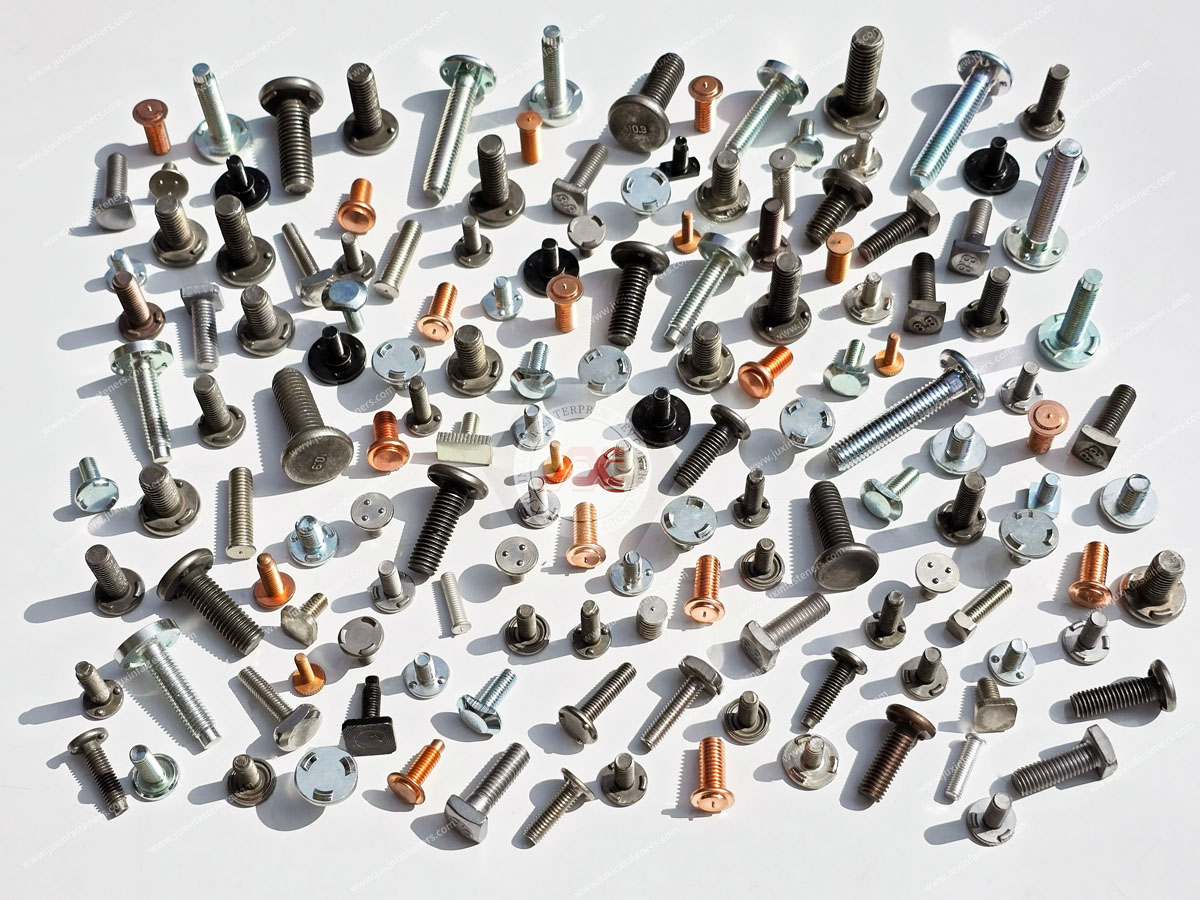
JUXIN FASTENERS supplies industrial weld studs and related fastening components for international OEM manufacturing and drawing-based applications.
Relevant product families include:
Flanged CD Weld Studs
Stainless Steel Flanged CD Weld Studs
Carbon Steel CD Weld Studs
Aluminum Flanged CD Weld Studs
Metric CD Weld Studs
Unified Inch CD Weld Studs
Non-Flanged CD Weld Studs
CD Weld Standoffs
Projection Weld Studs
Weld Nuts
Self-Clinching Fasteners
Drawing-Based Custom Fasteners
Specific dimensions, materials, surface finishes, inspection arrangements, availability and delivery terms require project-level confirmation.
Related JUXIN FASTENERS Products and Engineering Resources
Flanged CD Weld Studs — Inch / Metric
Stainless Steel Flanged CD Weld Studs
Aluminum Flanged CD Weld Studs
Frequently Asked Questions
What is a flanged CD weld stud?
A flanged CD weld stud is a fastener designed for capacitor discharge stud welding with a defined flange at the welding end.
Why does the stud have a flange?
The flange provides a defined weld-base region and may increase the effective joining area compared with a comparable non-flanged design.
Are flanged CD studs suitable for food processing equipment?
They may be suitable for selected equipment locations when the material, welded joint and complete assembly meet the applicable engineering and hygienic requirements.
Can flanged CD studs be used on direct food-contact surfaces?
They should not automatically be selected for direct food-contact areas.
The complete joint geometry, cleanability and hygienic design requirements must be evaluated.
Does CD welding guarantee no reverse-side marking?
No. CD welding may help limit thermal effects, but surface appearance depends on the actual application.
Are 304 and 316 stainless steel interchangeable?
Not automatically. Their corrosion behavior and suitability depend on the environment and cleaning conditions.
Can CD studs be welded to thin stainless steel?
Potentially, but suitability depends on the stud geometry, sheet thickness, material and welding procedure.
Can flanged CD studs be used on aluminum?
Suitable aluminum CD stud configurations may be used with compatible materials and welding procedures.
Dissimilar-metal combinations require specific evaluation.
Are metric and UNC threads interchangeable?
No. Metric, UNC and UNF threads are different systems.
Can flanged CD studs be automatically fed?
Certain configurations may be suitable for automated feeding, but compatibility depends on the actual stud and equipment.
Does a flanged CD stud provide a hygienic seal?
No. A conventional flanged CD stud should not be assumed to create a hermetic or sanitary seal.
Does a stud meeting ISO 13918 automatically make the equipment hygienic?
No. Product conformity and hygienic equipment design are separate requirements.
Can JUXIN FASTENERS review custom OEM drawings?
Drawing-based requirements may be submitted for technical and commercial evaluation, including dimensions,
material, flange geometry, thread specification, inspection requirements and purchasing volume.
OEM RFQ — Flanged CD Weld Studs for Food and Kitchen Equipment Manufacturing
JUXIN FASTENERS welcomes inquiries from food processing machinery manufacturers, commercial kitchen equipment OEMs,
stainless steel fabricators, industrial enclosure manufacturers, design engineers, manufacturing engineers, production managers and international procurement teams.
For technical evaluation and quotation, please provide the following information where applicable.
Engineering Drawings and Product Specifications
2D engineering drawing with revision
3D CAD model where available
Metric or Unified inch thread specification
Thread diameter, pitch and tolerance class
Stud length
Flange diameter and thickness
Ignition-tip geometry
Material grade
Surface finish
Critical dimensional tolerances
Application and Welding Requirements
Parent-sheet material and thickness
Capacitor discharge welding equipment
Contact or gap welding process
Mechanical loading requirements
Assembly tightening torque
Reverse-side appearance requirements
Cleaning-chemical exposure
Corrosion requirements
Hygienic design requirements, where applicable
Inspection and testing requirements
Commercial and Production Requirements
Prototype or sample quantity
Estimated annual purchasing volume
Minimum order quantity expectations
Packaging specification
Required delivery schedule
Supplier documentation requirements
Complete engineering information helps reduce clarification cycles and supports accurate product evaluation and quotation.
Company: Juxin Fasteners
Website: https://www.juxinfasteners.com/
Email: info@juxinfasteners.com
For flanged capacitor discharge weld studs, stainless steel CD weld screws, inch and metric threaded studs and drawing-based
OEM fastening components for food processing and commercial kitchen equipment, contact JUXIN FASTENERS with your drawings and project requirements.
Our team can review the supplied specifications and discuss suitable product options, manufacturing feasibility,
inspection requirements and commercial arrangements for your OEM project.
Contact Us
Tel.:
+86 020 8621 0320
+86 020 3121 6067
E-mail:
Technical Support:
Navigation
SEND INQUIREY



