
Call Us
+86 136 6007 9809
Call Us
+86 136 6007 9809

Apr. 22, 2026
Threaded Inserts for Telecom Equipment: Network Enclosures, Optical Systems and OEM Assembly
Communication equipment manufacturing requires fastening solutions that support reliable assembly, dimensional stability, serviceability and long-term operation.
Telecom infrastructure, 5G radio equipment, network switches, routers, optical communication systems,
industrial networking devices and data center equipment use a combination of engineered plastics, sheet-metal components, machined metal parts and electronic modules.
These assemblies have different fastening requirements.
A plastic network enclosure may require reusable metal threads for covers and internal brackets.
An outdoor communication unit may need corrosion-resistant fastening components. A precision optical module may require controlled alignment.
A sheet-metal telecom cabinet may be better served by self-clinching fasteners, cage nuts or blind rivet nuts.
Thread Insert Nuts for Communication Equipment, also known as Threaded Inserts for Plastics or Insert Nuts for Plastic Housings,
provide a metallic internal thread within a suitably designed polymer component.
They can improve the durability of threaded interfaces and support repeatable assembly when the insert, surrounding plastic and mating components are correctly specified.
However, a threaded insert does not automatically prevent screw loosening, plastic creep, corrosion or mechanical failure.
For telecom OEMs and contract manufacturers, reliable fastening begins with the complete joint design, installation process and application-specific qualification.
Juxin Fasteners supplies industrial threaded inserts and custom fastening components for plastic and metal assemblies.
This guide explains how engineers, manufacturing teams and procurement specialists can evaluate threaded insert designs for communication equipment and prepare technical specifications for OEM sourcing.
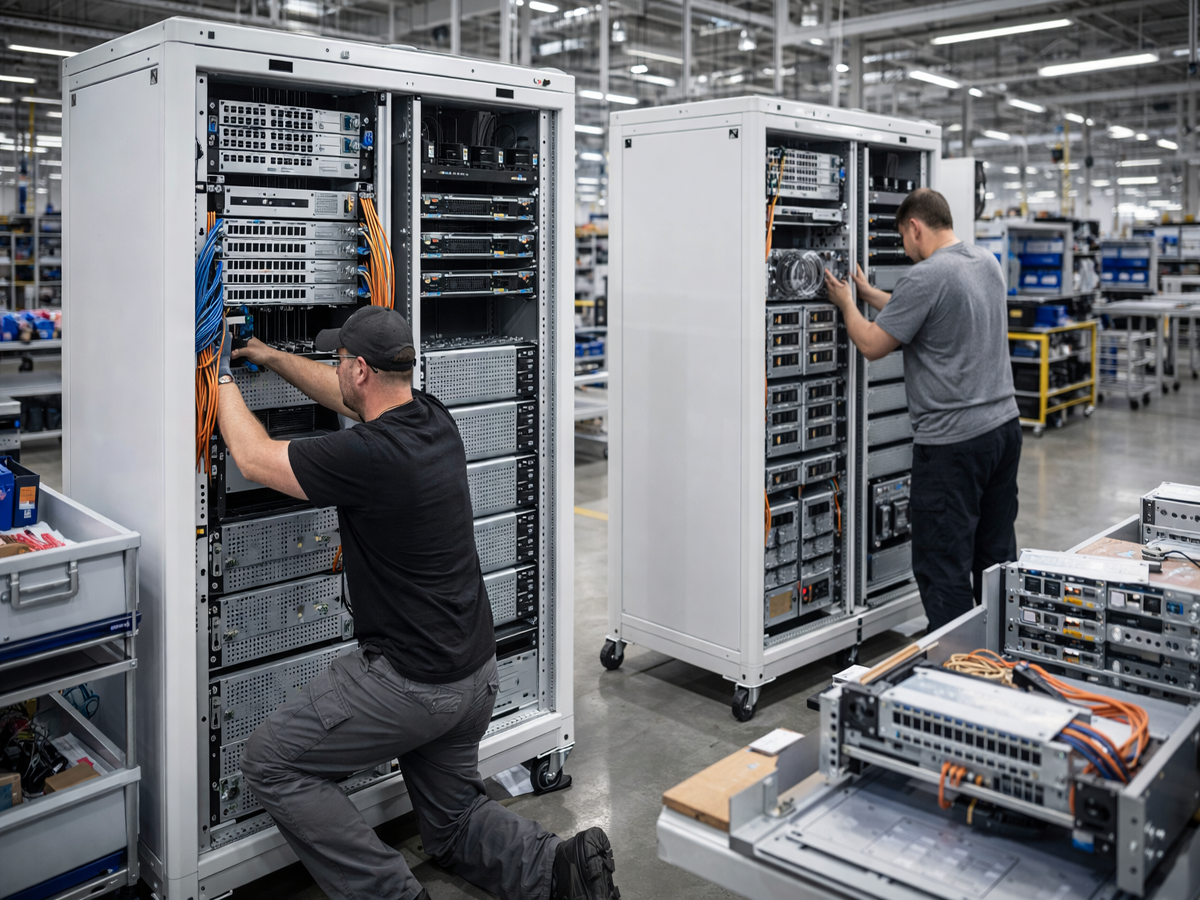
Why Threaded Inserts Are Used in Communication Equipment
Telecommunication and networking products often combine lightweight polymer components with metallic brackets, printed circuit boards, connectors and serviceable electronic modules.
Threaded inserts can provide reusable internal threads in appropriate plastic structures.
Typical Engineering Requirements
Durable threaded connections
Repeatable screw assembly
Serviceable equipment housings
Defined internal thread geometry
Resistance to insert rotation
Resistance to axial pull-out
Compatible installation processes
Reliable performance under specified environmental conditions
Important Engineering Distinction
The metal insert provides the threaded interface.
The plastic boss transfers loads between the insert and the surrounding structure.
The mating screw and bracket determine how those loads enter the joint.
The complete assembly—not the insert alone—determines fastening reliability.
Telecom Applications: Where Threaded Inserts Are Appropriate
Network Switch and Router Housings
Network switches, routers, gateways and communication controllers may contain injection-molded plastic housings or plastic internal structures.
Potential threaded insert applications include:
Removable housing covers
Internal support brackets
Serviceable electronic modules
Selected connector support structures
Auxiliary mounting components
Engineering Priorities
Compact boss design
Repeated assembly
Thread engagement
Installation depth
Housing deformation
Thermal exposure
Assembly cost
5G and Wireless Communication Equipment
Wireless communication equipment may use plastic radomes, electronic housings and hybrid metal-plastic assemblies.
Selected plastic components may benefit from metallic threaded inserts.
Potential Applications
Electronic control enclosures
Plastic auxiliary covers
Internal equipment brackets
Serviceable modules
Selected radome attachment features
Important RF Consideration
Metallic inserts are conductive components.
Their location near antennas or other RF-sensitive structures may affect electromagnetic performance.
A brass or stainless steel insert should not be described as improving signal transmission merely because it is metallic or conductive.
RF-sensitive fastening locations require validation by the equipment manufacturer.
Outdoor Telecom Equipment
Outdoor communication systems can experience:
Humidity
Rainwater exposure
Temperature cycling
UV exposure
Salt-laden atmospheres
Airborne contaminants
Mechanical vibration
Threaded inserts may be used in suitable polymer enclosures and auxiliary components.
However, the environmental durability of the complete assembly depends on the polymer, insert material, screw, surface treatment, seals and enclosure design.
Fiber Optic and Optical Communication Equipment
Optical communication equipment may contain precision housings, connector supports, electronic modules and serviceable covers.
Potential applications include:
Optical module support housings
Internal electronic enclosures
Fiber distribution equipment
Connector mounting brackets
Serviceable auxiliary components
Critical Distinction
A precision internal thread does not automatically establish optical alignment accuracy.
Optical positioning should be controlled by suitable datums, locating features, structural components and the equipment's tolerance stack-up.
The threaded fastener may provide clamping, but it should not be assumed to perform every locating function.
Data Center and Network Infrastructure
Data centers use diverse fastening systems.
Threaded inserts for plastics may be appropriate for:
Plastic equipment covers
Electronic module housings
Cable-management accessories
Selected cooling-system auxiliary enclosures
Network appliance components
However, server racks and metal cabinets frequently require different fasteners.
For sheet-metal structures, alternatives may include:
Self-clinching nuts
Self-clinching studs
Self-clinching standoffs
Cage nuts
Clip-on nuts
Blind rivet nuts
Weld nuts or weld studs
These products serve different installation and structural requirements.
A plastic threaded insert should not be presented as a universal replacement for sheet-metal fastening hardware.
Types of Threaded Inserts for Telecom Plastic Assemblies
Heat-Set Threaded Inserts
Heat-set inserts are installed into suitable thermoplastics using controlled thermal energy.
A heated tool transfers heat into the metallic insert.
The surrounding polymer softens and flows into the insert's knurls, grooves and undercuts.
After cooling, the plastic provides mechanical retention.
Potential Advantages
Reusable metallic threads
Compatibility with selected thermoplastics
Controlled post-mold installation
Potential for automated assembly
Engineering Considerations
Polymer grade
Insert geometry
Hole diameter
Boss dimensions
Tool temperature
Installation speed
Applied force
Final seating depth
Cooling conditions
Typical Applications
Router plastic housings
Communication controller enclosures
Network device covers
Selected electronic module supports
Ultrasonic Threaded Inserts
Ultrasonic insertion uses high-frequency vibration to generate localized heat at the insert-plastic interface.
The polymer softens and flows into the external retention geometry.
Potential Advantages
Short cycle times in suitable applications
Compatibility with automated installation
Localized insertion
Reusable metal threads
Engineering Considerations
Vibration amplitude
Installation force
Process duration
Tool alignment
Polymer response
Insert design
Installation depth
Important Limitation
Ultrasonic insertion is not universally suitable for every thermoplastic or precision component.
Process conditions must be validated to avoid damage, inadequate retention or unwanted deformation.
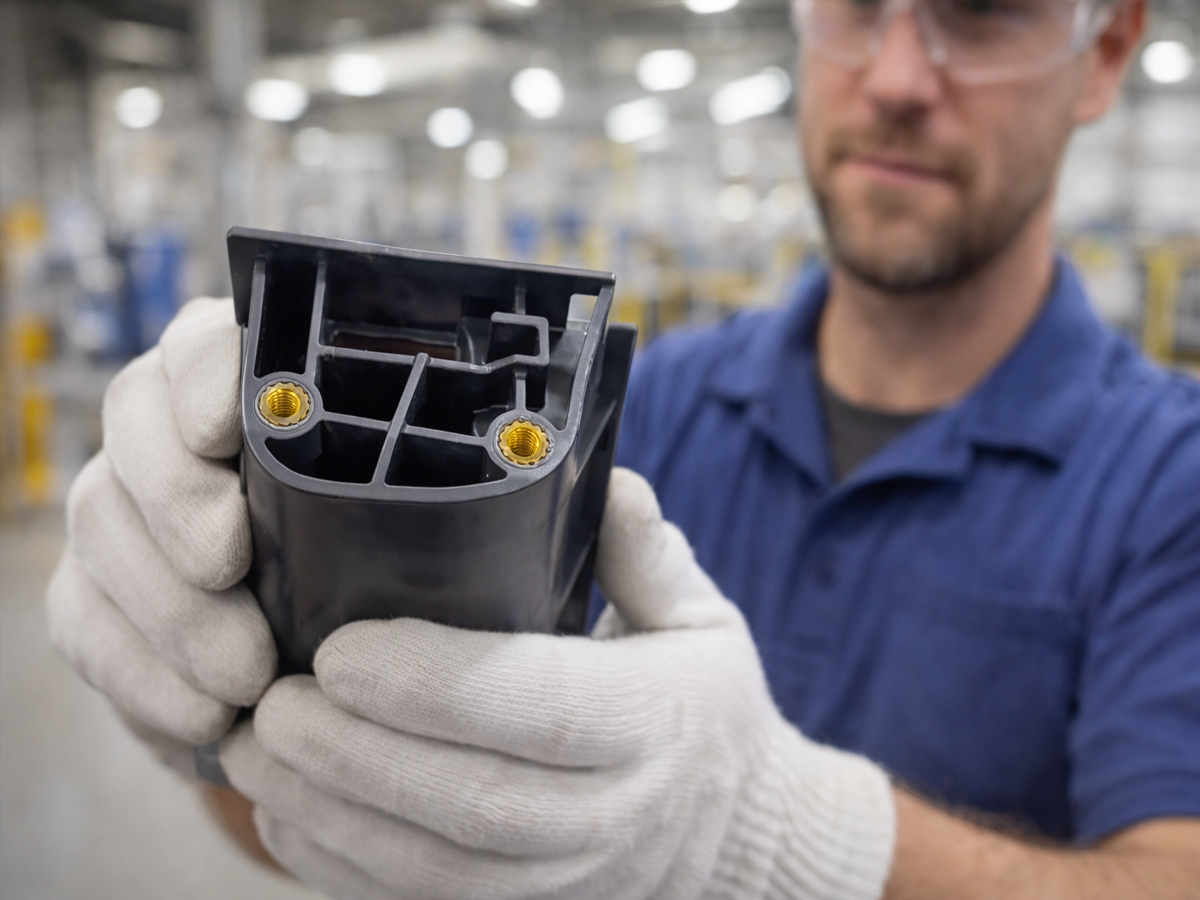
Molded-In Threaded Inserts
Molded-in inserts are positioned inside the mold before plastic injection.
The polymer flows around the insert and retains it after solidification.
Potential Advantages
Integration with molding
Elimination of a separate insertion stage
Compatibility with selected complex geometries
Potentially strong mechanical engagement
Engineering Considerations
Insert positioning
Mold loading
Core-pin geometry
Thread protection
Plastic flow
Mold cycle time
Tooling maintenance
Scrap risk
Important Limitation
Molded-in installation should not automatically be described as the strongest or lowest-cost option.
Its suitability depends on the actual component and manufacturing process.
Press-In Threaded Inserts
Press-in inserts are installed mechanically into prepared plastic holes without intentionally melting the polymer.
They may use barbs, fins, knurls or other retention features.
Potential Advantages
No thermal insertion step
Relatively simple equipment
Compatibility with selected automated presses
Engineering Considerations
Hole diameter
Interference
Boss wall thickness
Polymer stiffness
Insertion force
Alignment
Retention performance
Excessive interference can create local stress and crack the plastic.
Self-Tapping Threaded Inserts
Self-tapping inserts are installed by rotation into a prepared hole.
Their external thread engages the surrounding plastic.
They may be suitable for selected thermoplastics or thermosets, depending on the design.
Engineering Considerations
Installation torque
Hole dimensions
External thread geometry
Material stiffness
Boss strength
Chip generation or material displacement
Installation Method Selection
| Application condition | Potential insert type | Primary validation concern |
|---|---|---|
| Post-mold insertion into suitable thermoplastic | Heat-set | Plastic flow and retention |
| Vibration-assisted insertion | Ultrasonic | Material compatibility and process control |
| Insert integrated during molding | Molded-in | Positioning and molding quality |
| Mechanical installation without heat | Press-in | Interference and boss cracking |
| Rotational installation | Self-tapping | Installation torque and plastic engagement |
| Automated high-volume production | Process-compatible design | Feeding, cycle time and accepted output |
The correct method should be selected through engineering evaluation rather than a universal ranking.
Material Selection for Communication Equipment Threaded Inserts
Brass Threaded Inserts
Brass is widely used for precision threaded inserts in plastic components.
Potential Advantages
Good machinability
Defined internal threads
Thermal conductivity for heat insertion
Availability of different retention geometries
Corrosion resistance in many environments
Potential Applications
Network equipment housings
Router enclosures
Communication controllers
Selected electronic module supports
Material Considerations
The specific brass alloy should be defined by the drawing or purchasing specification.
Where lead restrictions or other material requirements apply, the alloy composition and supporting documentation must be confirmed.
Stainless Steel Threaded Inserts
Stainless steel may be appropriate for selected outdoor or corrosive environments.
304 Stainless Steel
May be suitable for many indoor and moderate outdoor conditions, subject to the actual environment.
316 or 316L Stainless Steel
May offer improved resistance in certain chloride-containing environments compared with common 304 grades.
Important Limitation
Neither 304 nor 316 stainless steel is universally corrosion-proof.
Crevice conditions, contamination, galvanic interaction and environmental exposure can still cause problems.
Carbon Steel Threaded Inserts
Carbon steel may be considered where cost and mechanical requirements justify its use.
Engineering Considerations
Material grade
Surface treatment
Corrosion protection
Thread strength
Installation geometry
Environmental exposure
Aluminum Threaded Inserts
Aluminum may be considered where low weight or specific material requirements are important.
Its thread performance, corrosion behavior and mating fastener compatibility require evaluation.
Material Selection Principle
The most expensive insert material is not necessarily the best.
Selection should be based on the complete fastening system and its service environment.
Outdoor Corrosion and Environmental Durability
Telecom equipment can remain outdoors for extended periods.
An insert's corrosion resistance must be evaluated together with the mating screw, surrounding structure and enclosure design.
Galvanic Corrosion
When dissimilar metals are electrically connected in the presence of an electrolyte, galvanic corrosion may occur.
The risk depends on the materials, exposed area relationship, electrical continuity and environment.
Crevice Corrosion
Moisture trapped around metallic interfaces may create localized corrosion conditions.
Plastic Aging
The polymer surrounding the insert may change under temperature, UV exposure, moisture or chemical contact.
Thermal Expansion
Metal and plastic generally have different thermal expansion behavior.
Temperature cycling can affect stress distribution, retention and joint preload.
Salt Spray Testing
ASTM B117 provides a method for operating salt spray apparatus.
It does not, by itself, establish a universal outdoor service-life prediction.
Test duration, acceptance criteria and correlation with service conditions must be defined by the customer.
Engineering Recommendation
For outdoor telecom equipment, evaluate the complete assembled joint under the intended environmental conditions.
Knurling, Grooves and Retention Geometry
The external geometry of a threaded insert determines how it engages the plastic.
Common features include:
Straight knurls
Helical knurls
Diamond knurls
Annular grooves
Undercuts
Barbs
Flanges
Torque-Out Resistance
Torque-out resistance describes the insert's resistance to rotation within the plastic.
Pull-Out Resistance
Pull-out resistance describes the insert's resistance to axial extraction.
Why These Are Different
An insert may resist rotation effectively while having lower axial retention.
Another geometry may provide strong pull-out resistance but different rotational behavior.
Important Engineering Distinction
External knurls do not automatically prevent the mating screw from loosening under vibration.
Insert retention and screw locking are separate design functions.
Plastic Boss Design for Telecom Enclosures
The surrounding plastic boss is critical to insert performance.
Hole Diameter
An oversized hole may reduce retention.
An undersized hole may generate excessive installation stress.
The required diameter depends on the insert geometry, polymer and installation method.
Hole Depth
The hole must accommodate the insert and required clearance.
The mating screw should not bottom out and apply unintended axial force to the insert.
Boss Outside Diameter
The boss must provide sufficient surrounding material to support installation and service loads.
Boss Height
The boss must accommodate the insert length and required seating position.
Ribs and Reinforcement
Ribs may improve stiffness and load distribution when properly designed.
Edge Distance
An insert placed too close to a housing edge may create local cracking risk.
Molded Knit Lines
Weak knit lines near loaded bosses can reduce mechanical performance.
Glass-Filled Plastics
Glass-fiber reinforcement affects stiffness, shrinkage and local stress behavior.
Hole and installation recommendations for unfilled polymers should not automatically be applied to glass-filled grades.
No Universal Hole Tolerance
A single ±0.05 mm hole tolerance cannot be prescribed for every telecom insert.
The correct dimensions must come from the approved insert design and validated plastic assembly.
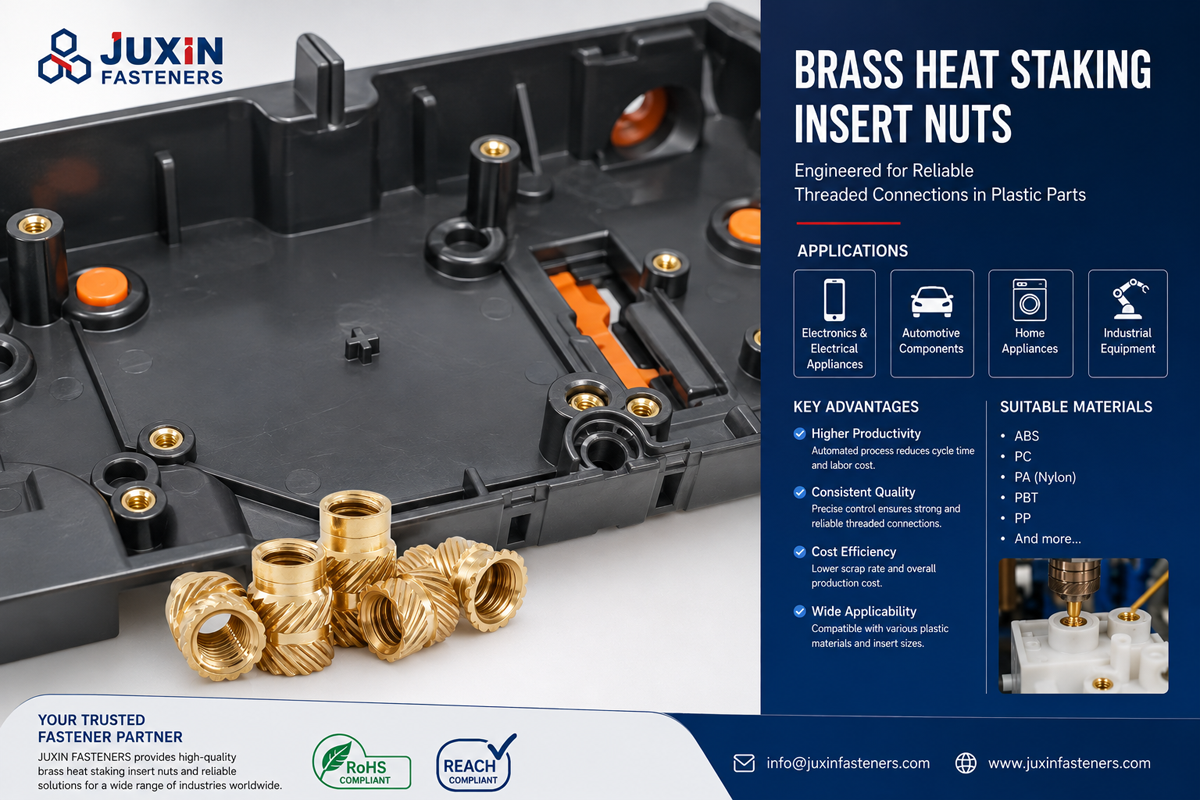
Screw Jack-Out: A Frequently Overlooked Failure Mode
Jack-out occurs when the mating screw and joint geometry create an unintended force that displaces the insert from its plastic host.
Potential Causes
Screw bottoming in a blind hole
Incorrect screw length
Incorrect insert seating
Excessive clearance around the mating component
Poorly designed load transfer
Engineering Controls
Verify screw length
Define thread engagement
Confirm hole depth
Control insert seating
Evaluate the mating-part clearance hole
Provide an appropriate bearing surface
Validate the complete joint
Why Jack-Out Matters in Telecom Equipment
Network and telecom equipment may contain multiple screw lengths and different internal brackets.
A screw-length error can damage an otherwise correctly installed insert.
Plastic Creep and Clamp-Load Retention
A metal threaded insert provides a durable internal thread.
However, the surrounding plastic may deform under sustained compressive loading.
This can reduce the clamp load in the assembled joint.
Compression Limiters
Where appropriate, a separate compression limiter can help manage compressive loading through the plastic component.
The threaded insert provides the screw thread.
The compression limiter helps establish a suitable compressive load path.
These functions should not be confused.
Vibration, Shock and Mechanical Reliability
Communication equipment may experience vibration during transportation, installation or operation.
Outdoor units can also experience mechanical loading from wind or attached structures.
Insert Retention
The insert must resist rotation and axial extraction.
Screw Retention
The mating screw must maintain the required joint condition.
Plastic Structural Integrity
The surrounding boss must transfer loads without unacceptable damage.
Engineering Recommendation
Evaluate the complete joint under the actual loading conditions rather than relying on an unverified claim of vibration resistance.
Optical Equipment: Precision Fastening Versus Precision Location
Optical communication equipment may require tight positional control.
However, a threaded fastener is primarily a clamping or retention component unless the design explicitly assigns it another function.
Recommended Design Approach
Use appropriate locating features, datums and controlled tolerances for critical alignment.
Use the threaded insert and mating screw to provide the required fastening function.
This separation helps avoid relying on screw clearance or thread position as the sole optical alignment mechanism.
Automated Installation for Telecom OEM Manufacturing
High-volume communication equipment production may use automated threaded insert installation.
Potential equipment functions include:
Automatic insert feeding
Orientation control
Robotic positioning
Thermal insertion
Ultrasonic insertion
Servo-controlled pressing
Force monitoring
Position monitoring
Installation-depth verification
Process data recording
Manufacturing Engineer Priorities
Process capability
Tool alignment
Resin variation
Equipment maintenance
Installation repeatability
Defect detection
Production Manager Priorities
Cycle time
Accepted output
Scrap
Rework
Changeover time
Equipment uptime
Labor requirements
Cost per accepted assembly
Why Automated Tightening Is Different from Insert Installation
The insert is first secured within the plastic component.
The mating screw is then tightened into the insert.
These may be separate manufacturing operations.
Installation force, thermal insertion conditions, screw torque and tightening angle should not be treated as interchangeable process parameters.
Digital Traceability
Where required, production systems may record:
Insert batch
Installation equipment identification
Installation parameters
Inspection results
Screw tightening data
Assembly batch
The scope of traceability should be defined by the OEM's quality requirements and actual production system.
No Universal Equipment Performance Claim
Servo accuracy, cycle time, process capability, data-storage capacity and equipment reliability depend on the selected machinery and production conditions.
Such values should only be quoted when supported by actual equipment specifications and validation records.
Quality Control for Telecom Threaded Inserts
A suitable quality plan should address the insert, plastic host and completed joint.
Incoming Insert Inspection
Depending on the approved drawing:
Internal thread size
Thread pitch
Thread tolerance
Outside diameter
Overall length
Knurl geometry
Material grade
Surface treatment
Burrs and visible defects
Plastic Component Inspection
Hole diameter
Hole depth
Boss dimensions
Hole position
Molded defects
Material identification
Installation Process Verification
Insert orientation
Tool alignment
Installation force or temperature
Final seating depth
Equipment condition
Process consistency
Mechanical Testing
As required by the application:
Pull-out testing
Torque-out testing
Assembly torque evaluation
Vibration testing
Thermal cycling
Environmental exposure testing
Acceptance Criteria
Test methods, sample quantities and acceptance limits should be agreed upon for the specific project.
A universal statement of zero failures or a fixed PPM level is not a substitute for an approved quality plan.
Common Failure Modes in Telecom Threaded Insert Assemblies
| Failure mode | Possible cause | Recommended investigation |
|---|---|---|
| Insert rotates | Insufficient external engagement | Review knurl, hole and installation |
| Insert pulls out | Inadequate retention or excessive axial load | Review boss, geometry and load |
| Plastic cracks | Excessive interference or weak boss | Review polymer and structural design |
| Screw strips | Wrong thread or excessive torque | Verify mating screw and thread |
| Insert lifts | Jack-out or screw bottoming | Check screw length and joint geometry |
| Clamp load decreases | Plastic creep or joint relaxation | Review load path and compression |
| Corrosion develops | Unsuitable material or environment | Review material pair and exposure |
| Optical alignment shifts | Structural movement or tolerance stack-up | Review datums, bracket and locating design |
| Assembly variation increases | Tooling or process inconsistency | Review installation parameters |
International Thread Standards
Threaded inserts for plastics are normally defined through product drawings, internal thread standards and application-specific requirements.
ISO 261
General-purpose ISO metric screw thread series.
ISO 965 Series
ISO metric screw thread tolerances.
ASME B1.1
Unified inch screw threads, including UNC and UNF.
Example Metric Threads
M2 × 0.4
M2.5 × 0.45
M3 × 0.5
M4 × 0.7
M5 × 0.8
M6 × 1.0
M8 × 1.25
Example Unified Inch Threads
2-56 UNC
4-40 UNC
6-32 UNC
8-32 UNC
10-24 UNC
10-32 UNF
1/4-20 UNC
These are examples of thread designations, not confirmation that every insert design is available in every size.
Metric, UNC, UNF, BSW and BSF threads are different systems and must not be treated as directly interchangeable.
Environmental and Industry Specifications
Communication equipment may be subject to application-specific requirements for environmental performance, enclosure protection, vibration and mechanical reliability.
The finished equipment manufacturer should define the applicable requirements.
A threaded insert should not be described as independently certified to a complete telecom equipment standard unless that specific claim is supported.
Custom Threaded Inserts for Telecom OEMs
Standard inserts may not fit every communication equipment design.
Juxin Fasteners accepts drawing-based inquiries for customized threaded inserts and related industrial fastening components.
Possible Custom Features
Internal thread size and pitch
Special outside diameter
Custom overall length
Knurl configuration
Retention grooves
Flanges
Blind or through-thread design
Lead-in geometry
Material grade
Surface treatment
Critical tolerances
Automatic feeding requirements
Why Custom Geometry May Be Required
A compact network enclosure may have limited boss space.
A glass-filled polymer may require a different retention profile.
An outdoor application may need a specific material or finish.
An automated assembly line may require a symmetrical insert that simplifies orientation.
An OEM may need a replacement component matching an existing approved drawing.
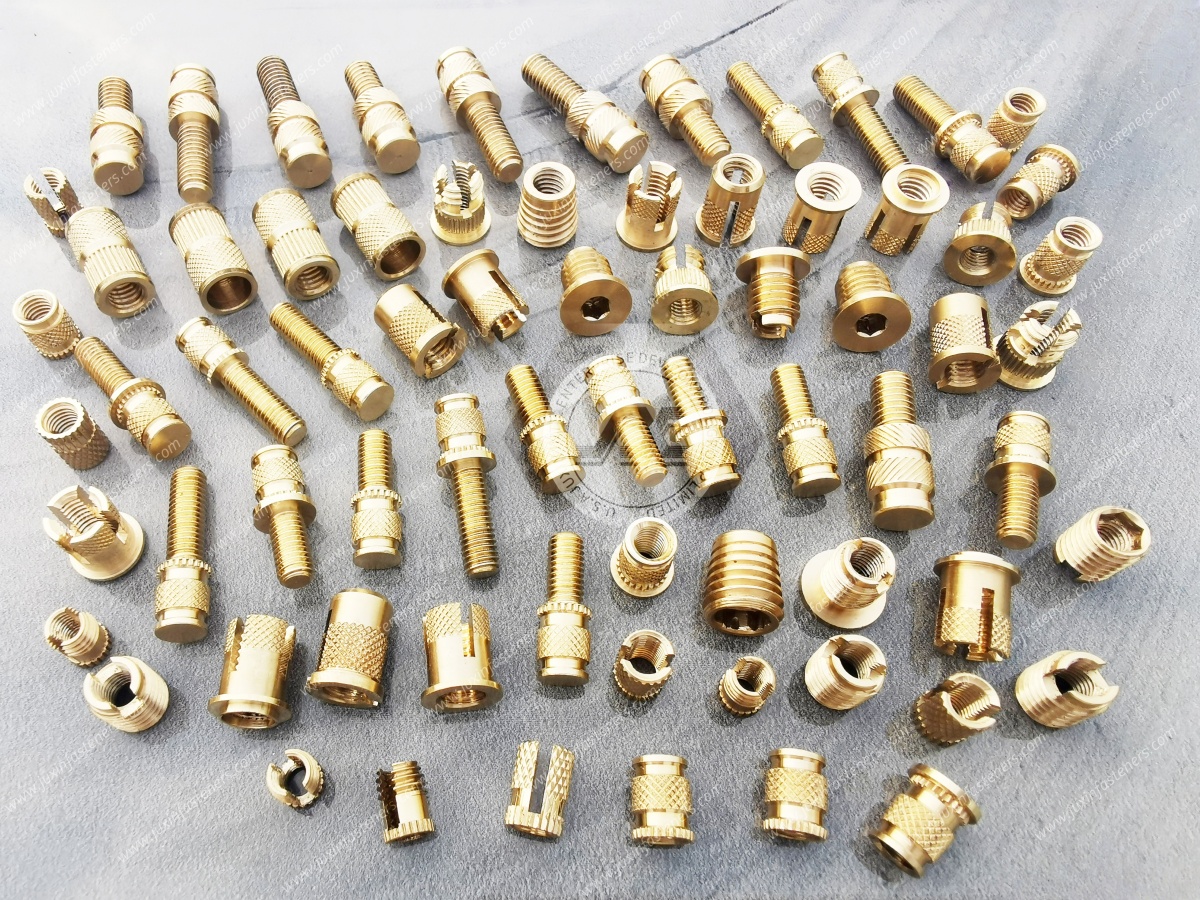
Supplier Development and Second-Source Qualification
Procurement teams should evaluate more than internal thread size and unit price.
Two M4 inserts can have the same internal thread but different external geometry and installation requirements.
Technical Qualification
Approved drawing
Thread specification
Material grade
External retention geometry
Installation method
Critical dimensions
Mechanical performance
Quality Qualification
Inspection methods
Material documentation
Traceability requirements
Agreed testing
Change-control requirements
Packaging requirements
Commercial Qualification
Prototype and sample quantities
Minimum order quantity
Volume pricing
Production lead time
Annual demand
Delivery schedule
Supply continuity
Second-Source Engineering Principle
A substitute insert must be evaluated in the actual plastic component and production process.
Matching the internal thread does not establish full interchangeability.
Total Installed Cost for Telecom Equipment
The insert's unit price is only one part of the manufacturing cost.
Other cost factors may include:
Plastic molding
Insert installation
Feeding equipment
Cycle time
Scrap
Rework
Inspection
Tooling maintenance
Supplier qualification
Packaging
Logistics
The lowest-cost insert is not necessarily the lowest-cost fastening solution.
Juxin Fasteners: Related Fastening Solutions
Juxin Fasteners supplies threaded inserts for plastics and other industrial fastening components used in metal and plastic assemblies.
For telecom and network equipment, relevant product families may include:
Brass threaded inserts for plastics
Stainless steel threaded inserts
Carbon steel threaded inserts
Aluminum threaded inserts
Heat-set threaded inserts
Ultrasonic threaded inserts
Molded-in threaded inserts
Press-in threaded inserts
Self-tapping threaded inserts
Custom threaded bushings
Self-clinching nuts and standoffs
Cage nuts
Clip-on nuts
Blind rivet nuts
The correct product depends on whether the host component is plastic, sheet metal or another material.
For drawing-based custom insert requirements, see:
Custom Threaded Inserts for Plastic Components
For the wider industrial fastener range, visit:
Juxin Fasteners Official Website
Frequently Asked Questions
What threaded inserts are used in telecom equipment?
Heat-set, ultrasonic, molded-in, press-in and self-tapping inserts may be considered for suitable plastic components.
Are brass threaded inserts suitable for outdoor telecom equipment?
They may be suitable for selected applications, but material compatibility, corrosion exposure and the complete joint design must be evaluated.
Is 316 stainless steel always required for outdoor telecom equipment?
No. Material selection depends on the actual environmental exposure, customer requirements and joint design.
Can threaded inserts prevent vibration loosening?
Not automatically. Insert retention and mating screw loosening are separate engineering concerns.
Are threaded inserts suitable for fiber optic equipment?
They may be used for selected housings and brackets, but optical alignment requires appropriate locating features and structural validation.
Can threaded inserts be used in 5G antenna housings?
They may be suitable for selected structures, but metallic components near RF-sensitive areas require electromagnetic evaluation.
What is the best insert for glass-filled nylon?
There is no universal best insert. The specific resin, filler content, boss design and installation process must be evaluated.
What causes threaded inserts to pull out of plastic?
Possible causes include inadequate retention geometry, incorrect hole dimensions, weak plastic bosses or excessive axial loading.
What is the difference between a threaded insert and a compression limiter?
A threaded insert provides the internal metal thread. A compression limiter helps manage compressive loading in selected plastic joints.
Can plastic threaded inserts replace cage nuts in server racks?
Not as a direct substitution. Cage nuts are designed for particular sheet-metal rack interfaces, while plastic threaded inserts are intended for compatible polymer structures.
Can Juxin Fasteners supply custom telecom threaded inserts?
Juxin Fasteners accepts drawing-based OEM inquiries for custom threaded inserts and related industrial fastening components.
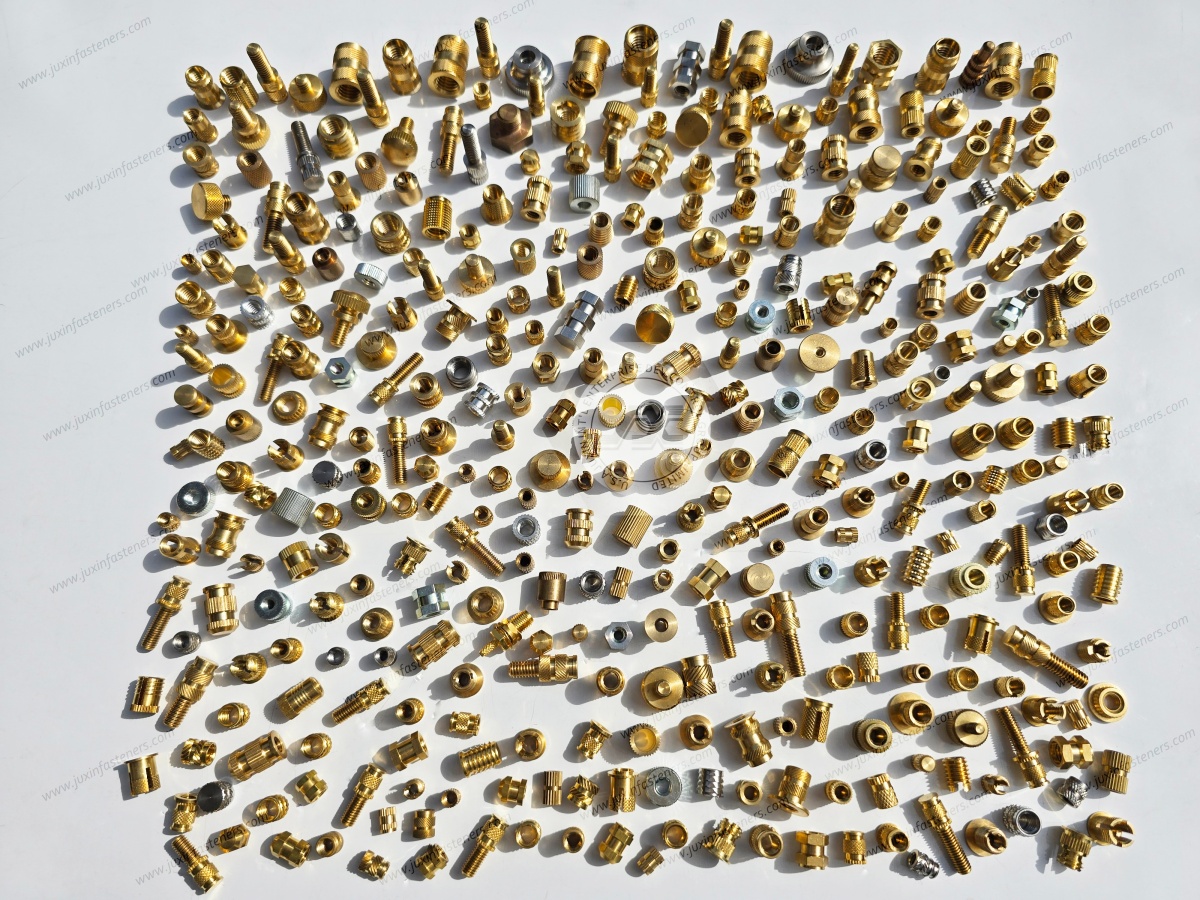
OEM RFQ — Threaded Inserts for Communication Equipment
Juxin Fasteners welcomes inquiries from telecom OEMs, network equipment manufacturers, optical communication companies,
data center equipment suppliers, electronics contract manufacturers, structural engineers, design engineers, manufacturing engineers,
production managers, procurement specialists and supplier development teams.
For technical review and quotation, please provide the following information where applicable.
Insert Specifications
2D engineering drawing
3D CAD model
Internal thread size and pitch
Outside diameter
Overall length
Knurl or retention geometry
Head or flange design
Material grade
Surface treatment
Critical tolerances
Host Component Information
Plastic resin grade
Filler content
Hole diameter and depth
Boss outside diameter
Boss height
Wall thickness
Mating bracket geometry
Sheet-metal thickness if a different fastener type is required
Installation Requirements
Heat-set, ultrasonic, molded-in, press-in or self-tapping method
Installation equipment
Final seating depth
Automatic feeding requirements
Production cycle considerations
Mechanical and Environmental Requirements
Pull-out resistance
Torque-out resistance
Screw tightening torque
Static and dynamic loading
Vibration exposure
Temperature range
Humidity
Outdoor corrosion conditions
Environmental testing
RF or optical constraints where applicable
Quality Requirements
Dimensional inspection
Material documentation
Traceability
Test requirements
Packaging
Change-control requirements
Commercial Requirements
Prototype quantity
Sample quantity
Initial order quantity
Estimated annual demand
MOQ expectations
Delivery schedule
Volume pricing requirements
Looking for Custom Threaded Inserts for Telecom Equipment?
Juxin Fasteners supplies industrial threaded inserts and custom fastening components for suitable plastic and metal assemblies.
Whether your project involves network equipment housings, optical communication modules, outdoor telecom enclosures or data center auxiliary equipment,
our team can review your engineering drawings and purchasing requirements.
Company: Juxin Fasteners
Website: https://www.juxinfasteners.com/
Email: info@juxinfasteners.com
Send your drawings, material specifications, installation requirements and estimated purchasing quantities to request technical evaluation, samples or an OEM quotation.
Reliable communication equipment fastening depends on selecting the correct insert, plastic structure, installation process, environmental protection and complete joint design.
Contact Us
Tel.:
+86 020 8621 0320
+86 020 3121 6067
E-mail:
Technical Support:
Navigation
SEND INQUIREY



