
Call Us
+86 136 6007 9809
Call Us
+86 136 6007 9809

Sep. 24, 2023
A bonded sealing washer, also called a combination sealing washer, metal-rubber sealing washer or bonded seal,
combines a rigid metal support ring with a vulcanized elastomer sealing element. When correctly matched to the port,
fastener or plug, the metal ring carries the installation load while the elastomer creates a static seal against fluid or gas leakage.
Bonded sealing washers are commonly used beneath bolt heads, screw plugs, hydraulic fittings and threaded port connections where the assembly requires both load support and sealing.
They can eliminate the need to machine a separate O-ring groove, but their performance still depends on correct geometry, material compatibility, surface condition and controlled installation.
JUXIN FASTENERS supplies standard and drawing-specific bonded sealing washers for industrial OEMs,
hydraulic equipment manufacturers, automotive suppliers, energy-system manufacturers and machinery producers.
Selection support can include metric or inch dimensions, metal and elastomer combinations, application review, dimensional inspection and production-volume sourcing.
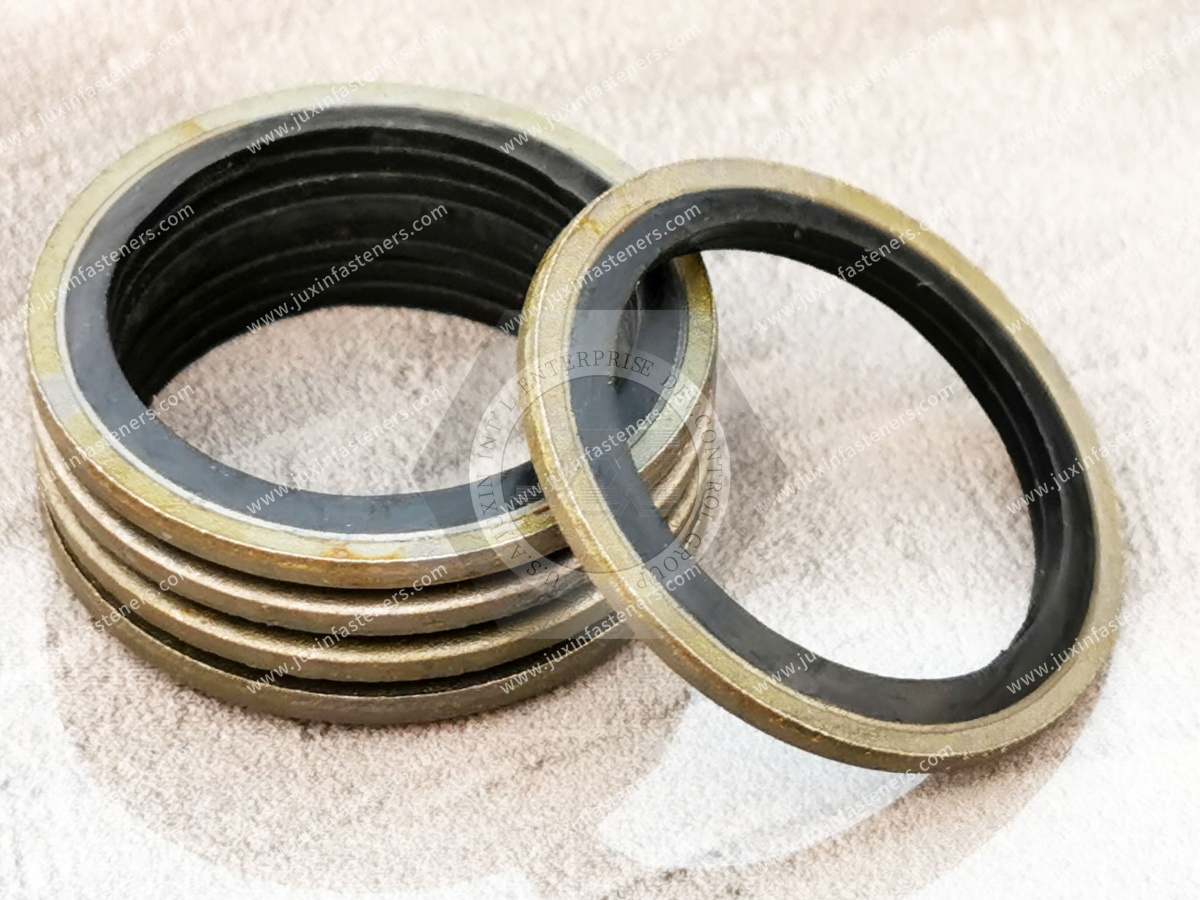
A bonded sealing washer consists of two functional elements:
A metal outer ring that supports the tightening load and limits excessive deformation
An elastomer inner ring that compresses between the mating surfaces to create the seal
The elastomer is chemically or mechanically bonded to the metal ring during manufacturing. In a correctly designed assembly,
the metal ring prevents the seal from being crushed beyond its intended compression range while the elastomer fills small surface irregularities around the threaded connection.
This makes the component fundamentally different from an ordinary flat washer.
A standard flat washer distributes load but does not normally provide a controlled fluid seal. A bonded washer performs both functions within one compact component.
Bonded sealing washers are primarily intended for static sealing. They should not automatically be selected for reciprocating, rotating or continuously sliding interfaces.
Typical applications include:
Hydraulic port plugs
Hydraulic pipe fittings
Valve bodies and manifolds
Pump and motor housings
Gearbox drain and fill plugs
Lubrication systems
Fuel-system connections
Pneumatic equipment
Industrial compressors
Agricultural and construction machinery
Automotive powertrain assemblies
EV thermal-management equipment
Battery manufacturing machinery
Energy-storage production equipment
Industrial cooling systems
Process equipment
General threaded fluid connections
The washer is most effective when the sealing surface provides sufficient flat contact area and the assembly can apply repeatable axial compression.
A threaded connection should not be classified as suitable merely because the bonded washer fits over the thread.
Engineers must also confirm the port face, spotface diameter, under-head geometry, chamfer, edge condition and available sealing land.
As the bolt, plug or fitting is tightened, axial force compresses the elastomer against the mating surfaces. The elastomer deforms and fills small gaps that could otherwise form a leakage path.
The surrounding metal ring performs three important functions:
It transfers and distributes the tightening load.
It limits uncontrolled outward expansion of the elastomer.
It protects the elastomer from direct over-compression when the joint geometry and torque are properly controlled.
The resulting seal depends on maintaining sufficient elastomer contact pressure throughout the operating cycle.
Temperature changes, pressure pulsation, fluid absorption, vibration and long-term compression set can all reduce the available sealing force.
For this reason, a bonded sealing washer should be treated as part of the complete joint system—not as an isolated commodity washer.
Two common design families are used in industrial assemblies.
A conventional bonded washer has an elastomer element bonded around the inner diameter of the metal ring.
Correct positioning during assembly is important because excessive eccentricity can produce uneven compression or place part of the elastomer too close to the thread or port edge.
This design is widely used for plugs, fittings and general static connections where the assembler can control washer location.
A self-centering design includes an elastomer profile that helps retain and center the washer on the fastener or fitting before final tightening.
This design may offer several assembly advantages:
Easier positioning during manual assembly
Reduced risk of washer displacement
More consistent alignment with the sealing face
Improved handling in high-volume assembly
Lower risk of the seal being trapped against a thread runout
The preferred design depends on the fitting geometry, installation direction, assembly automation and cost target.
The metal ring must support the installation load and resist the operating environment. Common options include carbon steel and stainless steel.
Carbon steel provides a cost-effective solution for many hydraulic and industrial applications. Depending on corrosion requirements, the metal ring may require an appropriate protective finish.
The finish must be evaluated for:
Corrosion resistance
Environmental compliance
Coating thickness
Dimensional influence
Contact with the elastomer
Compatibility with the mating component
Risk of galvanic interaction
Surface treatment should not be selected solely by appearance. The required corrosion performance, exposure category and customer specification should be included in the RFQ.
A2 stainless steel is suitable for many general industrial, moisture-exposed and moderately corrosive environments. It can be considered when greater corrosion resistance than coated carbon steel is required.
The exact stainless grade must be stated on the drawing or purchase specification rather than described only as “stainless steel.”
A4 stainless steel may be selected for more demanding environments involving chlorides, outdoor exposure or aggressive cleaning conditions.
However, stainless steel does not make the complete bonded washer universally chemical-resistant. The elastomer, bonding system and mating materials must also remain compatible with the actual environment.
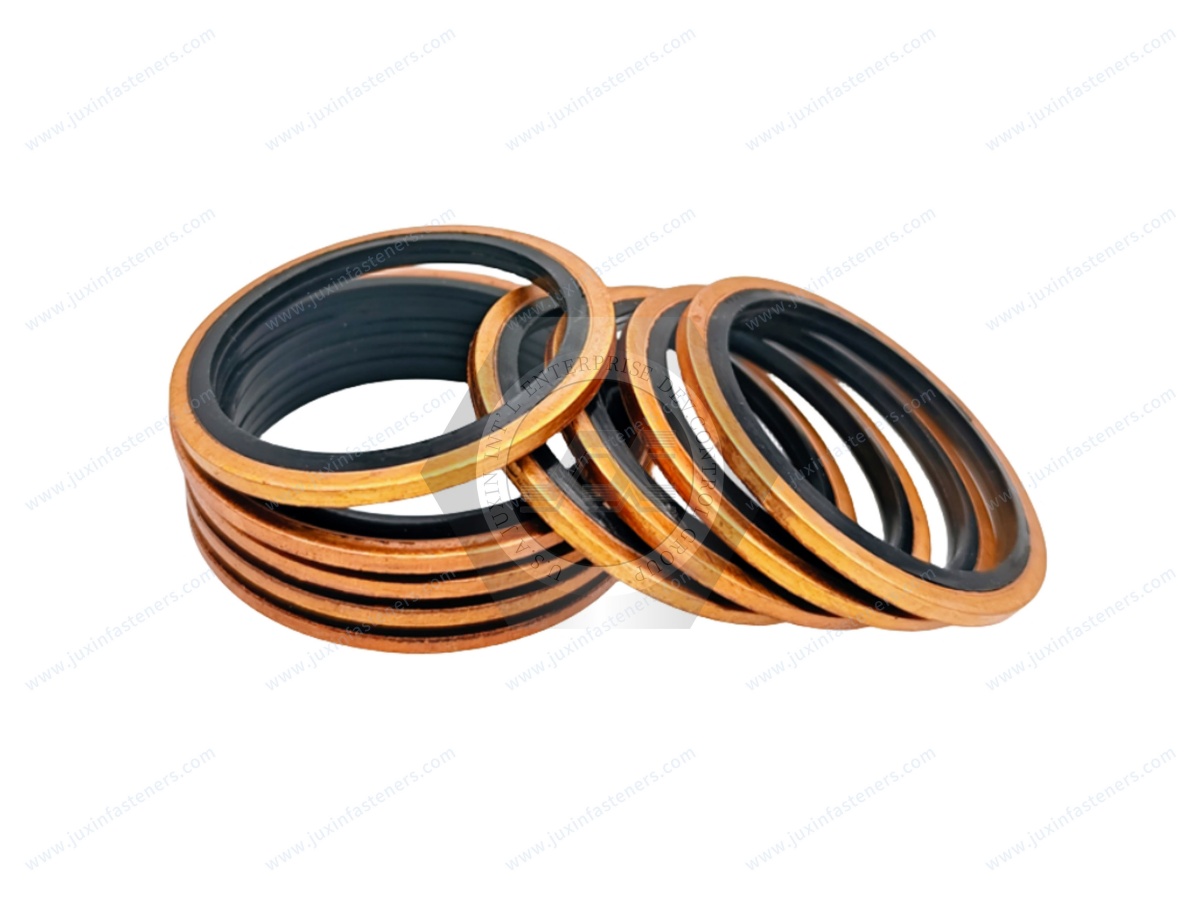
Elastomer selection is one of the most important engineering decisions. The material must be matched to the fluid, temperature range, pressure cycle and required service life.
Nitrile butadiene rubber is widely used for contact with many petroleum-based hydraulic oils, mineral oils and lubricants.
NBR is commonly selected because it offers:
Good resistance to many mineral oils
Good mechanical properties
Practical compression behavior
Broad industrial availability
Cost-effective performance
NBR should not be treated as universally compatible with every fuel, synthetic fluid, solvent, coolant or high-temperature environment. The precise compound grade and fluid formulation must be reviewed.
Fluoroelastomer is often selected for higher-temperature applications or exposure to fuels, oils and certain aggressive media.
FKM may provide:
Higher heat resistance than general-purpose NBR
Strong resistance to many oils and fuels
Good resistance to ozone and weathering
Reduced permeability in selected applications
FKM is not automatically the best choice for every fluid. Its suitability can vary with steam, hot water, amines, low-temperature conditions and specific chemical mixtures.
“Viton” is a registered material brand name and should not be used as a universal substitute for every FKM compound. An RFQ should state FKM or provide the required material specification and performance callout.
EPDM may be considered for water, steam, glycol-based fluids, weathering and selected brake-fluid applications.
It is generally not the preferred choice for petroleum-based mineral oils. Substituting EPDM for NBR without checking the working fluid can cause swelling, softening or premature seal failure.
Hydrogenated nitrile rubber may be specified when the application requires improved heat, oxidation or mechanical performance compared with conventional NBR while retaining compatibility with many oil-based fluids.
Its use should still be based on a defined compound and validated operating conditions.
A bonded sealing washer does not have one universal temperature rating.
Published temperature ranges normally refer to a particular elastomer compound under defined test or service conditions. Actual performance can change because of:
Continuous versus short-duration exposure
Fluid type and concentration
Pressure level
Thermal cycling
Oxygen or ozone exposure
Elastomer hardness
Compression level
Required service life
Metal-to-elastomer bond performance
Low-temperature flexibility
Customer-specific validation requirements
A generic statement such as “FKM operates up to 220°C” is insufficient for component approval.
The engineer should define the minimum and maximum continuous operating temperatures, short-term peak temperature, fluid exposure and expected service duration.
Bonded sealing washers are used in high-pressure hydraulic systems, but pressure capability is not determined by the washer name alone.
The validated pressure limit depends on:
Washer inside and outside diameters
Elastomer profile
Metal ring thickness and strength
Radial extrusion clearance
Port-face geometry
Contact width
Installation torque
Mating-surface hardness
Pressure direction
Fluid temperature
Static or pulsating pressure
Assembly tolerances
Proof and burst test requirements
A statement such as “suitable up to 40 MPa” should therefore be treated as an application-specific result, not as a universal rating for all bonded sealing washers.
For safety-critical or high-pressure equipment, the assembled connection should be validated under the actual pressure, temperature, torque and fluid conditions.
There is no single international standard that defines every bonded sealing washer design, material and application.
Depending on the project, engineering and procurement teams may reference:
ASTM D2000 for classification and specification of vulcanized rubber material properties
ISO 3601 for O-rings and O-ring housing systems when comparing an alternative groove-based seal
ISO 1179 requirements where applicable to certain threaded ports and stud ends
SAE J1926 requirements for applicable straight-thread O-ring port systems
DIN 7603 for metallic sealing rings used in a different sealing concept
DIN 3869 for elastomeric profile sealing rings used with specified fluid-power connections
Customer drawings and OEM material specifications
Application-specific pressure, leakage and durability test requirements
These standards are not interchangeable.
A washer manufactured to fit a nominal thread does not automatically comply with a port standard.
The engineer must confirm whether the joint was designed for a bonded washer, O-ring boss, profile ring, copper sealing washer or another sealing system.
| Sealing method | Typical design characteristic | Main selection consideration |
|---|---|---|
| Bonded sealing washer | Metal ring with bonded elastomer | Compact static sealing without a separate machined groove |
| O-ring face or boss seal | Elastomer installed in a controlled groove or port geometry | Requires compatible groove, squeeze and extrusion control |
| Copper sealing washer | Deformable metallic washer | Useful where elastomers are unsuitable or higher temperature is involved |
| Aluminum sealing washer | Soft metallic sealing element | Lightweight metal seal for compatible faces and loads |
| Elastomeric profile ring | Molded profile designed for a defined connection | Must match the specified fitting and port system |
| Thread sealant | Liquid, paste or tape applied to threads | Process control, chemical compatibility and contamination must be considered |
Bonded sealing washers are attractive because of their simple assembly, but they should not replace another sealing system without reviewing the joint geometry.
For applications requiring an all-metal seal, see JUXIN FASTENERS’ copper sealing washer solutions.
For electrically insulating or low-load applications, nylon sealing washers may offer a different functional solution.
The sealing face should be flat, clean and free from defects that cross the sealing path.
Potential leakage causes include:
Radial scratches
Burrs around the port
Sharp edges
Deep machining marks
Paint or coating buildup
Corrosion
Embedded contamination
Insufficient sealing width
Local waviness
Misalignment between the fitting and port
A single universal roughness value should not be applied to every assembly. Surface roughness must be considered together with elastomer hardness, seal compression, pressure and leakage requirements.
Where leakage performance is critical, the drawing should define the relevant surface-finish parameter, permissible defects, flatness or spotface requirements and inspection method.
Correct installation is essential to achieving repeatable sealing performance.
Check the washer inside diameter, outside diameter, thickness and elastomer profile against the fitting and sealing face.
The washer must not rest on a radius, incomplete thread, burr or chamfer that prevents full contact.
Remove chips, dust, oil residue, corrosion products and other contamination that could create a leakage path or damage the elastomer.
Cleaning agents must be compatible with the elastomer and bonding system.
Some bonded seals are symmetrical, while others have a profile or self-centering feature that requires a defined orientation. Follow the product drawing and assembly instruction.
Use a validated torque or installation method for the complete connection. Excessive torque can damage the elastomer, distort the metal ring, deform the port face or create extrusion.
Insufficient torque can leave inadequate sealing contact pressure.
A bonded washer can retain a permanent compression set after service. It may also have hidden bond damage, cuts or chemical degradation.
Unless reuse has been specifically validated, replacement during maintenance is the safer engineering practice.
Depending on application criticality, inspection may include:
Visual positioning check
Torque verification
Pressure-hold testing
Leakage testing
Vacuum-decay testing
Helium or tracer-gas testing
Thermal-cycle testing
Pressure-pulse testing
Post-test disassembly inspection
The test method and acceptance limit should be defined by the equipment manufacturer.
Possible causes include incorrect washer size, eccentric installation, inadequate torque, damaged sealing faces, contamination or insufficient sealing land.
Extrusion can occur when pressure forces the elastomer into an excessive gap.
Contributing factors include unsuitable geometry, high temperature, excessive clearance, incorrect hardness or pressure beyond the validated range.
Thermal aging, ozone exposure, incompatible chemicals or an unsuitable compound can cause cracking and loss of sealing elasticity.
Chemical incompatibility can change the elastomer volume, hardness and mechanical strength. A seal may initially appear functional but deteriorate during extended exposure.
Long-term compression, elevated temperature and elastomer aging can reduce the seal’s ability to recover. The resulting loss of contact pressure may allow leakage during cooling, pressure changes or vibration.
Corrosion can reduce ring strength, disrupt the sealing face and contaminate the fluid system. Material and coating selection must reflect the actual environment.
Bond separation may result from manufacturing defects, chemical attack, excessive heat, poor storage or severe installation deformation.
Before approving a bonded sealing washer, confirm:
What fluid or gas will contact the seal?
What are the continuous and peak temperatures?
What are the working, proof and transient pressures?
Is the pressure static, cyclic or pulsating?
What thread and port system is used?
What is the available sealing-face diameter?
Is a conventional or self-centering design preferred?
What elastomer compound and hardness are required?
What metal grade and finish are required?
What tightening torque will be applied?
What surface finish and flatness are available?
Is the washer exposed to outdoor weather, salt, cleaning chemicals or ozone?
What leakage test and acceptance limit apply?
Is the connection safety-critical?
What service interval and design life are expected?
Answering these questions produces a more reliable specification than selecting a washer only by nominal bolt or thread size.
Bonded sealing washers are used beneath plugs and fittings in hydraulic manifolds, pumps, valves, cylinders, power units and fluid-control equipment.
Hydraulic applications should specify the oil type, pressure cycle, peak temperature, cleanliness requirement and leakage acceptance criterion.
Potential vehicle applications include lubrication connections, transmission systems, powertrain housings, hydraulic equipment, cooling circuits and selected fuel-compatible connections.
For automotive OEM and Tier-1 programs, elastomer traceability, PPAP-related documentation, dimensional capability and application testing may be required.
JUXIN FASTENERS also supports broader automotive fastening solutions for conventional vehicles, EV platforms and commercial vehicles.
Excavators, loaders, agricultural machines and material-handling equipment operate under vibration, contamination, temperature variation and hydraulic pressure cycling.
The sealing washer must be evaluated as part of the complete connection.
JUXIN FASTENERS provides components for off-highway vehicles and construction equipment, including application-specific fasteners and hydraulic-system hardware.
Bonded sealing washers can be used in machine tools, presses, production equipment, automation systems, lubrication units and hydraulic power systems.
For multi-SKU equipment programs, washer dimensions, elastomer compounds and packaging identification should be standardized wherever technically appropriate to reduce sourcing complexity and assembly errors.
Energy-storage production systems, power-electronics equipment, industrial cooling units and liquid-management systems may use sealed threaded ports.
Material selection must reflect the actual coolant, inhibitors, additives, temperature and electrical environment. NBR should not be assumed compatible with every water-glycol or specialty cooling formulation.
Bonded sealing washers may be specified for threaded inspection ports, drain plugs, fill plugs and auxiliary connections.
Where aggressive chemicals, steam, food-contact media or oxygen service is involved, the project requires application-specific material review and documentation.
Industrial buyers should purchase bonded sealing washers against a controlled specification rather than a simplified description such as “M12 rubber washer.”
A complete purchasing specification may include:
Customer part number
Drawing revision
Inside diameter
Outside diameter
Total thickness
Metal ring thickness
Elastomer profile dimensions
Metric or inch interface
Metal grade
Surface treatment
Elastomer family
Elastomer hardness
ASTM D2000 or customer material callout
Bond integrity requirement
Dimensional tolerances
Visual acceptance criteria
Corrosion requirement
Fluid compatibility requirement
Temperature range
Pressure-test conditions
Leakage acceptance limit
RoHS or REACH requirements
Inspection report requirements
Material certificate requirements
Traceability and lot-control requirements
Packaging and labeling
Annual volume and delivery schedule
For automotive and other controlled production programs, the RFQ should also identify PPAP, IMDS, control plan, capability study, change-control or special documentation requirements where applicable.
JUXIN FASTENERS supports metric and inch bonded sealing washer requirements for industrial OEM production.
Supply options may include:
Standard bonded sealing washers
Self-centering bonded seals
NBR bonded sealing washers
FKM bonded sealing washers
Alternative elastomers subject to application review
Carbon steel support rings
Stainless steel support rings
Custom inside and outside diameters
Drawing-specific metal thicknesses
Special elastomer profiles
Customer-defined inspection requirements
Production packaging and lot identification
Multi-SKU fastener and washer sourcing
Where a standard washer does not match the port geometry or operating environment, a drawing-specific solution can be evaluated according to material, tooling, testing and production-volume requirements.
JUXIN FASTENERS also supports custom automotive fasteners and precision components for OEM and Tier-1 supply programs.
To receive a technically meaningful quotation, send as much of the following information as possible:
2D drawing or sample
Nominal thread or fitting designation
Port or mating-component drawing
Washer inside diameter, outside diameter and thickness
Conventional or self-centering design
Metal material and finish
Elastomer material and hardness
Working fluid or gas
Continuous and peak temperature
Working, proof and peak pressure
Assembly torque
Leakage requirement
Applicable international or customer standard
Compliance and documentation requirements
Prototype quantity
Annual production volume
Packaging and delivery requirements
If the elastomer has not yet been selected, provide the actual fluid, temperature, pressure and expected service conditions rather than requesting only “oil-resistant rubber.”
“Bonded seal” and “Dowty-type seal” are commonly used as related market terms.
However, trademarked or supplier-specific terminology should not replace a controlled dimensional and material specification. Buyers should source according to the drawing, interface and required performance.
Sometimes, but not automatically. An O-ring connection and a bonded-washer connection use different sealing geometry.
The port face, groove, compression control and extrusion clearance must be reviewed before changing the seal type.
Reuse is generally not recommended unless the complete application has been validated for reuse. Compression set, bond damage and surface cuts may not be obvious during maintenance.
No. FKM often offers improved high-temperature and chemical performance, while NBR provides cost-effective resistance to many mineral oils.
The correct choice depends on the fluid, temperature, pressure, low-temperature requirement and service life.
Not safely without material validation. These media can require different elastomers. The actual fluid formulation and operating conditions must be reviewed.
There is no universal value. Pressure capability depends on washer geometry, metal and elastomer materials, extrusion gap, port design, installation torque, temperature and test conditions.
They are often selected because a separate O-ring groove is not required. However, the assembly still needs a suitable flat sealing face with adequate contact width and controlled surface condition.
Yes. JUXIN FASTENERS can evaluate standard and drawing-specific bonded sealing washer requirements based on dimensions, materials, application conditions, documentation and production volume.
The correct bonded sealing washer is defined by the complete application—not only by the nominal thread size.
Send your drawing, sample, port information, metal requirement, elastomer specification, operating fluid, temperature range, pressure conditions, annual quantity and quality-documentation requirements to:
JUXIN FASTENERS supports engineering and procurement teams sourcing bonded sealing washers, sealing components, industrial washers and custom fastener solutions for OEM production.
 MORE NEWS
Sep. 27, 2026
Sep. 27, 2026
Sep. 27, 2026
Contact Us
Tel.:
+86 020 8621 0320
+86 020 3121 6067
E-mail:
Technical Support:
Navigation
SEND INQUIREY