
Call Us
+86 136 6007 9809
Call Us
+86 136 6007 9809

Sep. 25, 2023
Wedge-lock washers are paired mechanical locking washers designed to resist rotational loosening in bolted joints exposed to transverse vibration, cyclic loading and repeated movement.
They are also called wedge-locking washers, double-stack locking washers, twin locking washers, serrated wedge washers or double-layer anti-loosening washers.
The term “DIN 25201 washer” is frequently used in the market, particularly for railway applications,
but DIN 25201-4 is a design guideline for securing bolted joints in railway vehicles rather than a universal dimensional product standard for every wedge-lock washer.
Unlike conventional split spring washers, which rely primarily on spring action and friction, wedge-lock washers use a pair of serrated outer surfaces and opposing internal cams.
When the contact surfaces are suitable and the joint is correctly tightened, any loosening rotation forces the washer pair to climb across the cams.
This increases the axial distance beneath the bolt head or nut and opposes further rotation.
JUXIN FASTENERS supplies metric and inch wedge-lock washer pairs for industrial OEMs, equipment manufacturers, railway suppliers, energy-system manufacturers and maintenance organizations.
Available solutions can include carbon or alloy steel, stainless steel, standard-width and enlarged-outer-diameter designs, corrosion-resistant finishes and customer-specific inspection requirements.
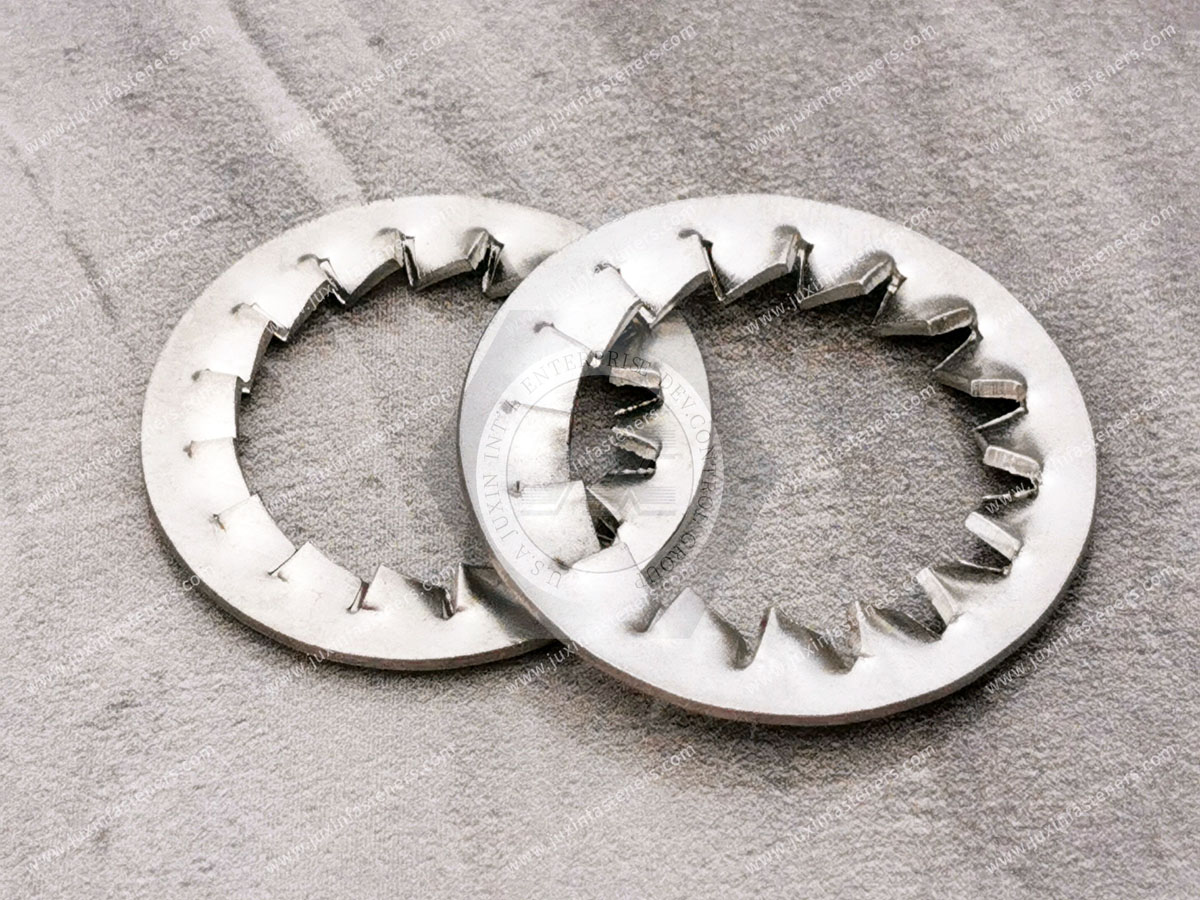
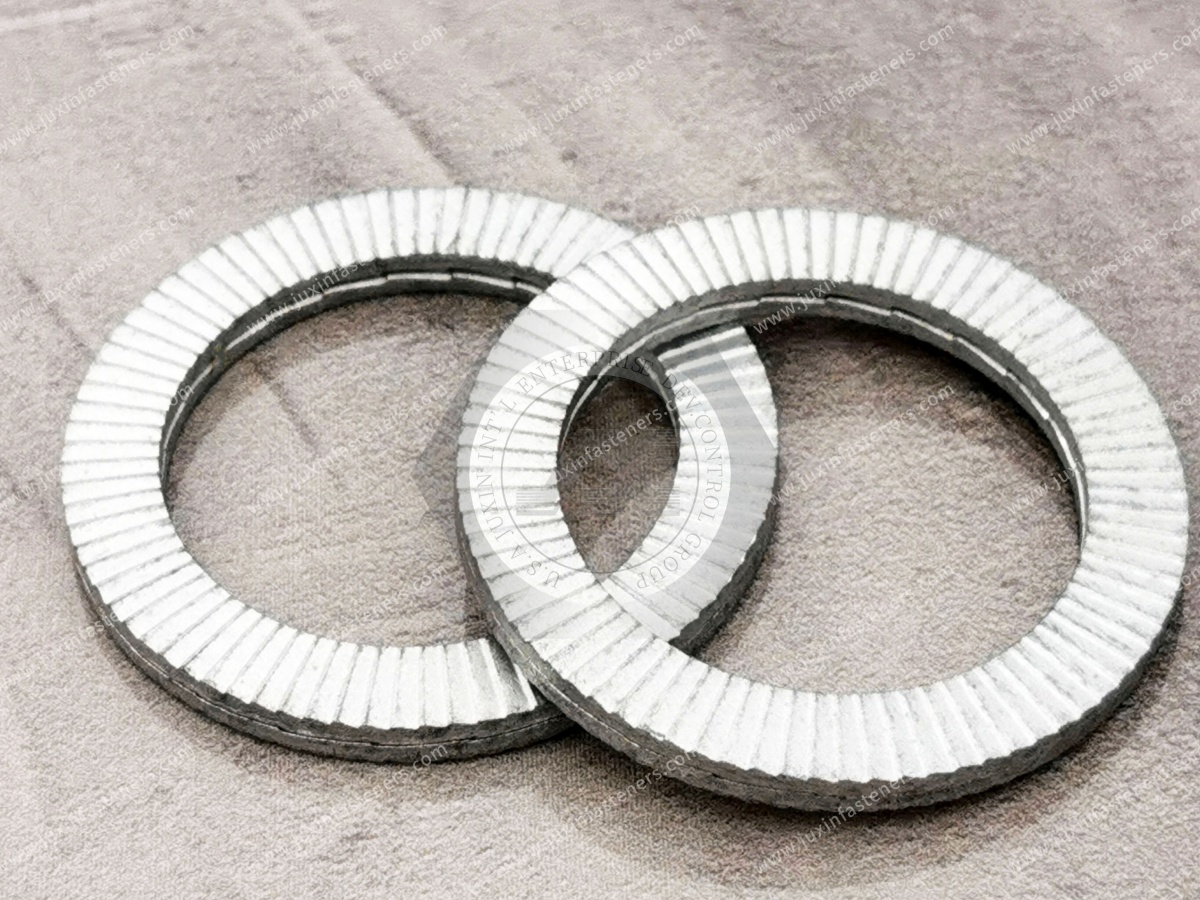
A wedge-lock washer assembly consists of two washers installed as a matched pair.
Each washer has two different functional surfaces:
Radial serrations on the outside
Wedge-shaped cams on the inside
The two cam surfaces face each other. The serrated surfaces face outward toward the underside of the bolt head or nut and the clamped component.
Many washer pairs are supplied preassembled with a light adhesive or another retaining method.
This keeps the cams correctly opposed and reduces the possibility of installing a single washer or reversing one half of the pair.
The retaining adhesive is normally an assembly aid. It is not the mechanism that prevents loosening.
A bolted joint remains stable when sufficient preload keeps the clamped components in firm contact.
Under transverse movement, an inadequately secured threaded connection can lose preload and begin to rotate loose.
Wedge-lock washers create a geometric barrier to that rotation.
The important relationship is between:
The cam angle of the washer pair
The helix angle of the bolt thread
The cam angle is designed to be greater than the thread helix angle. This should not be confused with the included flank angle of a metric or inch thread.
When loosening rotation begins:
The outer serrations are intended to grip the bolt head or nut and the joint surface.
Relative movement is redirected to the internal cam interface.
The opposing cams begin to climb over each other.
Cam movement increases the axial height of the washer pair.
The resulting rise opposes the rotational movement that would loosen the threaded connection.
This creates a mechanical wedge-locking action rather than relying only on friction between the threads.
The system still requires correct bolt preload, suitable mating surfaces and adequate washer engagement.
It should not be described as providing “100% anti-loosening performance” under every operating condition.
The most severe self-loosening mechanism is often repeated transverse movement across the joint interface.
A bolted joint may loosen when:
External shear load exceeds the frictional resistance of the clamped joint
The joint slips laterally
The clamped parts embed or settle
The bolt is not tightened to sufficient preload
The joint is too flexible
Contact surfaces deform
Thermal expansion changes the clamping load
Paint or soft coatings relax
The threaded assembly experiences shock or cyclic loading
The selected locking method is unsuitable for the movement direction
A locking washer can help resist rotational loosening, but it cannot correct every underlying joint-design problem.
If the joint separates, the bolt is overloaded, the grip length is insufficient or the bearing surface collapses, the complete connection must be redesigned rather than relying solely on a locking washer.
DIN 25201-4 addresses methods for securing bolted joints in railway vehicles and their components. It is relevant when evaluating locking methods for rail applications,
but it should not be represented as a universal product specification for all paired wedge-lock washers.
For a railway RFQ, “DIN 25201 washer” is therefore incomplete.
The purchaser should define:
Washer dimensions
Bolt or stud size
Washer material
Hardness requirement
Surface treatment
Corrosion requirement
Joint classification
Required locking verification
Inspection and traceability
Railway-specific customer requirements
Drawing or approved product specification
Where DIN 25201-4 compliance is contractually required, the applicable edition, joint category and verification responsibilities should be identified in the project documentation.
ISO 16130 defines a dynamic test method for investigating the self-loosening behavior of bolted connections under transverse displacement.
This type of test is often associated with the Junker test principle. A test assembly is subjected to repeated transverse movement while bolt preload is monitored over time.
The test can help compare:
An unsecured reference joint
Different locking washer designs
Prevailing-torque nuts
Thread-locking adhesives
Serrated fasteners
Alternative anti-loosening systems
A transverse-vibration test is highly useful, but its results must be interpreted correctly.
Test performance can change with:
Bolt diameter and property class
Initial preload
Tightening method
Thread and bearing-surface lubrication
Joint stiffness
Clamp length
Washer hardness
Transverse displacement
Excitation frequency
Number of cycles
Hole clearance
Test-fixture design
Contact-surface material
Reuse condition
Passing one laboratory test does not prove that every size, coating and installation configuration will perform identically in service.
The project should define the test configuration and acceptance criteria that represent the actual joint.
Split spring washers and wedge-lock washers work through different mechanisms.
| Selection factor | Wedge-lock washer pair | Split spring washer |
|---|---|---|
| Primary principle | Geometric cam or wedge locking | Spring action and additional friction |
| Components | Two matched washers | One split washer |
| Response to loosening rotation | Cams oppose rotational movement | Relies mainly on friction and residual spring force |
| High transverse vibration | Often selected for demanding joints after validation | May provide limited protection in severe transverse movement |
| Contact-surface requirement | Serrations must engage suitable surfaces | Requires suitable bearing surface |
| Installation height | Greater than a flat washer | Generally lower |
| Surface marking | Serrations can mark the contact surfaces | Ends can mark or embed into surfaces |
| Reuse | Conditional on inspection and approval | Application-dependent |
| Cost | Higher unit cost | Lower unit cost |
| Typical use | Critical or high-vibration industrial joints | General-purpose, lower-demand joints |
For a deeper comparison, see Do Spring Washers Prevent Bolts from Loosening?.
Wedge-lock washers may be appropriate when:
The joint is exposed to transverse vibration
Maintenance access is required
The connection must be removable
Adhesive curing time is undesirable
Repeated thermal cycles occur
A visible mechanical locking component is preferred
The bolt head and nut provide adequate bearing area
The mating surfaces are strong enough for serration engagement
Laboratory or application testing confirms performance
The joint specification permits surface indentation
They may be less suitable when:
The mating surface is soft or fragile
The assembly uses thin sheet without sufficient bearing support
The surface must remain cosmetically undamaged
The joint includes thick paint, soft coating or compressible material
The washer outside diameter exceeds the available spotface
Electrical bonding surfaces must remain controlled
The bolt head or nut has insufficient bearing area
The assembly rotates against the washer during normal operation
The joint requires a locking method with visual positive retention
The applicable OEM specification prohibits serrated contact surfaces
The outer serrations must engage the surfaces beneath the bolt head or nut and against the clamped component.
The critical comparison is therefore not simply whether the washer is harder than the bolt.
Engineers must evaluate:
Washer serration hardness
Bolt-head or nut bearing-surface hardness
Clamped-component surface hardness
Coating hardness and thickness
Risk of surface indentation
Risk of the serrations sliding instead of gripping
Risk of crushing or damaging soft materials
If the contact surface is harder than the washer serrations, the serrations may not develop reliable engagement. If the surface is too soft, the washer may embed excessively, reduce preload or damage the component.
The washer and joint surfaces must be evaluated as a system.
Wedge-lock washer pairs are commonly available in standard-width and enlarged-outer-diameter configurations.
Standard-width washers are intended for conventional bolt heads and nuts where the available bearing surface and edge distance are adequate.
They are commonly used with:
Hex head bolts
Socket head cap screws
Hex nuts
Flange-compatible assemblies
General machinery joints
Enlarged designs distribute the bearing load over a wider area and may be selected for:
Slotted holes
Oversized holes
Flange connections
Painted structural components
Softer mating materials
Joints requiring greater bearing coverage
A larger outside diameter does not automatically make the joint more secure. The washer must still fit the bolt head, nut, spotface and surrounding geometry.
For slotted or oversized holes, engineers should also confirm whether an additional hardened washer, flange component or application-specific large-OD wedge-lock design is required.
Hardened steel wedge-lock washers are widely used with high-strength carbon or alloy steel bolts.
Potential material routes may include spring or alloy steels selected to achieve the required:
Core hardness
Serration strength
Fatigue resistance
Dimensional stability
Heat-treatment response
Coating compatibility
An RFQ should specify the required mechanical properties or approved material standard instead of relying only on a commercial steel name.
A4 stainless steel wedge-lock washers may be selected for outdoor, marine, chemical-processing and chloride-exposed environments.
However, stainless steel selection must consider:
Washer hardness
Mating fastener grade
Galling risk
Required preload
Operating temperature
Chemical environment
Strength and deformation behavior
Customer material approval
A stainless steel washer is not automatically equivalent to a hardened alloy-steel washer in load capacity or serration performance.
Applications involving elevated temperature, aggressive chemicals or specialized bolting materials may require a project-specific washer material.
Material selection should consider whether the washer retains the hardness and mechanical properties required for the wedge-locking mechanism at the operating temperature.
Common protection systems for hardened steel wedge-lock washers may include:
Zinc-flake coatings
Mechanical zinc coatings
Electroplated zinc systems
Phosphate-based finishes
Application-specific organic or inorganic topcoats
The coating must be evaluated for more than salt-spray duration.
Important requirements include:
Coating thickness
Corrosion resistance
Coefficient of friction
Dimensional influence
Serration definition
Resistance to handling damage
Compatibility with the bolt coating
Electrical conductivity
Environmental compliance
Hydrogen-embrittlement risk
Customer-approved coating specification
Zinc-flake systems are frequently selected for high-strength fasteners because appropriate non-electrolytic application processes can reduce hydrogen-charging risk compared with conventional electrolytic plating.
This does not mean every zinc-flake coating has identical properties.
The RFQ should define:
Approved coating system
Required coating thickness
Corrosion-test standard
Test duration
Friction range
Topcoat or sealer
RoHS and REACH requirements
Lot-testing requirements
Neutral salt-spray testing may be specified according to ISO 9227 or another customer-approved method. A laboratory salt-spray result should not be translated directly into years of outdoor service life.
Hardened steel components can be sensitive to hydrogen embrittlement when exposed to certain cleaning, pickling or electrolytic coating processes.
Where relevant, the coating and process-control requirements should reference ISO 4042, customer specifications or another applicable international requirement.
Material hardness, coating route, pretreatment and post-treatment must be reviewed together.
The wedge-locking action is mechanical, but it is incorrect to state that the complete connection is unaffected by lubrication.
Lubrication can substantially change:
Thread friction
Under-head or under-nut friction
Torque required to reach a target preload
Risk of bolt overloading
Preload scatter
Surface interaction during tightening
Disassembly torque
Using the same torque value for a dry and lubricated bolt can produce very different preload.
The tightening specification must therefore identify the assumed friction condition, lubricant, coating and installation method.
Where high preload accuracy is required, torque-angle control, tension measurement, ultrasonic verification or another controlled tightening method may be more appropriate than torque alone.
Install the two washers as a matched pair with the cam surfaces facing each other. Do not install only one half of the pair.
The serrated faces must contact:
The underside of the bolt head or nut
The surface of the clamped component
The washer must pass over the bolt shank without interfering with the thread runout, under-head radius or incomplete thread.
The bolt head or nut must contact the washer correctly. The washer must also have sufficient support from the joint surface.
If possible, tighten the nut or bolt on the side selected by the joint design while controlling rotation at the opposite end. Installation procedures should prevent unintended movement or damage to the washer pair.
Apply the torque, torque-angle or tension-control procedure established for the actual:
Bolt size
Property class
Thread condition
Coating
Lubricant
Washer system
Joint stiffness
A conventional flat washer placed between the wedge-lock washer and the contact surface may prevent the serrations from engaging the intended joint material.
Additional washers should be used only when the joint has been specifically designed and validated for that arrangement.
Wedge-lock washers should not be described as universally reusable.
Reuse may be possible when permitted by the washer manufacturer, equipment owner and joint specification, but the pair should first be inspected for:
Flattened or damaged serrations
Worn cam surfaces
Permanent deformation
Cracks
Corrosion
Coating loss
Contamination
Separation or incorrect pairing
Damage to the mating surfaces
Changes in the bolt or nut condition
Safety-critical railway, lifting, pressure-containing, rotating or structural assemblies may prohibit reuse even when the washer appears undamaged.
The reuse policy should be established before maintenance begins.
If the cam faces do not oppose each other, the wedge-locking mechanism cannot operate as designed.
A single washer does not create the paired cam action.
Very hard surfaces, thick coatings, soft polymers, fragile composites or unsuitable finishes may prevent reliable serration engagement.
Insufficient preload can allow joint slip. Excessive preload can overload the bolt, deform the joint or damage the washer interface.
A standard outside diameter may provide inadequate support over a slot, oversized hole or large clearance hole.
Interference with the bolt’s under-head radius can prevent flat seating and create an unintended stress concentration.
Paint, powder coating or another compressible layer may embed or creep, reducing preload after assembly.
Using a washer with insufficient hardness, incompatible corrosion behavior or inadequate temperature resistance can compromise the locking system.
A washer that performed well in one test cannot automatically be assumed to provide identical preload retention with a different bolt, coating, preload, clamp length or joint material.
Rail vehicles and railway equipment experience repeated vibration, braking loads, thermal changes and long maintenance intervals.
Potential applications include:
Underframe equipment
Bogie-related auxiliary assemblies
Traction and electrical equipment
Equipment cabinets
HVAC modules
Cable-support systems
Interior equipment
Serviceable mechanical connections
Selection must follow the vehicle manufacturer’s joint classification, approved locking method and validation requirements.
Learn more about JUXIN FASTENERS’ railway and rail transit fastening solutions.
Wind turbines subject bolted assemblies to vibration, cyclic loading, outdoor corrosion and difficult maintenance conditions.
Wedge-lock washer applications may include:
Nacelle equipment
Access systems
Service platforms
Auxiliary machinery
Electrical cabinets
Cooling equipment
Non-foundation structural accessories
Primary tower, blade and other highly loaded structural connections require project-specific bolting engineering and should not be converted to a wedge-lock washer assembly without formal approval.
See JUXIN FASTENERS’ power and energy fastening solutions.
Excavators, mining equipment, agricultural machinery and material-handling systems experience vibration, shock, contamination and high cyclic loads.
Wedge-lock washers may support serviceable joints in:
Hydraulic equipment
Engine accessories
Pumps and motors
Guards and covers
Brackets
Operator-cab systems
Electrical enclosures
Auxiliary equipment
Potential applications include:
Machine tools
Robotic systems
Production lines
Compressors
Pumps
Conveyors
Vibrating equipment
Servo and motor mounting
Industrial cooling systems
The complete joint should be reviewed for slip, preload loss, surface hardness and maintenance access.
Wedge-lock washers may be evaluated for selected vehicle and production-equipment connections exposed to vibration.
They should not be automatically introduced into safety-critical chassis, steering, braking, restraint or battery-structure joints without OEM approval and application-specific validation.
Turbine auxiliaries, generators, switchgear, transformers, power converters and cooling equipment may contain vibration-exposed mechanical connections.
Where electrical continuity or grounding is involved, serration engagement, coating conductivity, contact resistance and corrosion behavior must also be evaluated.
ISO 16130 originated as an aerospace-series dynamic test standard, but this does not mean a commercial wedge-lock washer is automatically approved for aerospace use.
Aerospace applications require the exact approved material, process, part number, testing, quality system and customer authorization.
JUXIN FASTENERS should only quote such applications against complete customer drawings and qualification requirements.
A professional wedge-lock washer specification may include:
Nominal bolt size
Washer inside diameter
Washer outside diameter
Pair thickness
Individual washer thickness
Cam geometry
Serration geometry
Material specification
Heat-treatment requirement
Hardness range
Surface treatment
Coating thickness
Coefficient-of-friction requirement
Corrosion-test method
Hydrogen-embrittlement controls
Dimensional inspection plan
Visual-defect criteria
Pair-retention requirement
ISO 16130 or customer-specific test
Traceability
Material certificates
Inspection records
Packaging and labeling
Critical dimensions and performance criteria should be placed on the drawing or purchasing specification instead of relying only on the description “DIN 25201 washer.”
To receive an accurate quotation, provide:
Bolt size and thread system
Bolt and nut standard
Bolt property class or material
Washer inside and outside diameter
Standard or enlarged outside diameter
Carbon/alloy steel, stainless steel or special material
Required hardness
Surface coating and corrosion target
Dry, coated or lubricated assembly condition
Target tightening torque or preload
Mating-surface material and hardness
Hole type and diameter
Joint drawing or installation sketch
Operating temperature
Vibration and dynamic-load conditions
Applicable DIN, ISO, EN, ASTM, SAE or customer specification
Required vibration-test method
Inspection and documentation requirements
Prototype quantity
Annual production volume
Packaging and delivery schedule
For a broader joint review, see JUXIN FASTENERS’ high-strength fastener assembly and installation solutions.
“DIN 25201 washer” is a common commercial search term, but DIN 25201-4 is a railway bolted-joint securing guideline rather
than a universal washer dimensional standard. Buyers should specify the exact washer dimensions, material, hardness, coating and verification requirements.
Their primary locking mechanism is geometric cam action. However, friction remains important during tightening and affects the relationship between installation torque and bolt preload.
No. Lubrication may not eliminate the cam mechanism, but it changes thread and bearing friction and can substantially change the preload produced by a given torque.
Yes, when the washer material, hardness, strength, galling risk, environment and tightening procedure are suitable for the complete joint.
Possibly, but paint thickness, hardness, adhesion and relaxation must be evaluated. Serrations may penetrate or damage the coating, and soft layers can cause preload loss.
Not automatically. A separate flat washer can change which surfaces are locked and may introduce another slip interface. The arrangement requires engineering review and validation.
Only when reuse is permitted and the washers, fasteners and contact surfaces pass the required inspection. Critical applications may require new washer pairs for every installation.
No locking product provides an unconditional guarantee for every joint. Performance depends on preload, washer engagement, joint design, transverse movement, materials, installation and service conditions.
An enlarged-outer-diameter version or another engineered arrangement may be required. The washer must bridge the slot safely and maintain full support.
No. It provides a controlled method for comparing locking behavior. Actual service performance still depends on how closely the tested joint represents the production assembly.
JUXIN FASTENERS supports industrial buyers requiring more than a generic washer size.
Available sourcing and engineering support can include:
Metric and inch wedge-lock washer pairs
Standard and enlarged outside diameters
Hardened carbon or alloy steel
Stainless steel configurations
Zinc-flake and application-specific coatings
Customer-drawing production
Dimensional and hardness inspection
Corrosion and coating requirements
Packaging and lot identification
Multi-SKU fastener consolidation
Prototype and production-volume evaluation
JUXIN FASTENERS can also help customers compare wedge-lock washers with other thread-locking fastener solutions according to the joint design and maintenance requirements.
A reliable wedge-lock washer specification must define more than the nominal bolt size.
Send your drawing, bolt specification, washer dimensions, mating-surface details, material, hardness, coating, tightening condition, vibration requirement, annual quantity and required quality documentation to:
JUXIN FASTENERS supports OEMs, Tier-1 and Tier-2 suppliers, equipment manufacturers and industrial sourcing teams requiring wedge-lock washers, locking fasteners and application-specific anti-loosening solutions.
 MORE NEWS
Sep. 27, 2026
Sep. 27, 2026
Sep. 27, 2026
Contact Us
Tel.:
+86 020 8621 0320
+86 020 3121 6067
E-mail:
Technical Support:
Navigation
SEND INQUIREY